You can support the Fort Scott Farmer’s Market or Uniontown’s Union Station by completing the survey and collecting a $10 voucher paid by the Healthy Bourbon County Action Team with BCBS Pathways to Healthy Kansas grant funds.
The Healthy Bourbon County Action Team has obtained pledges from CHC/SEK and Ascension Via Christi to work together in completing a community health environment needs assessment that also includes identifying gaps in healthy eating, physical activity, and/or commercial tobacco control.
This process includes engaging community members to respond to the community health needs survey. Survey results will be used to inform our decisions, action plans, and financial resources. Our goal is to obtain one survey per household from 60% of Bourbon County.
Paper surveys will be available upon request. iPad Kiosks will be set up at Unionstation, CHC/SEK, Via Christi, Farmer’s Market, and HBCAT locations in the near future.
Kansas Positioned to Lead the Nation’s Renewable Energy Transition, New Report Reveals
Kansas tops national charts in renewable energy share and demonstrates
vast economic benefits of wind and solar power.
Topeka, KS – In 2020, the renewable energy industry had a banner year, and Kansas is a leader with its success in wind and solar energy developments. The newly released Clean Power Annual from the American Clean Power Association (ACP) notes Kansas as a national leader in renewable energy, with 43.4 percent of Kansas’ electricity coming from renewable sources, ranking second in the nation. The report highlights Kansas’ ability to increase jobs and investment while maximizing energy efficiency across the state.
Renewable energy is powering Kansas in more ways than one; wind and solar power are economic drivers. Clean power developments have brought $12.7 billion in cumulative capital investment and support 3,096 jobs in Kansas. In 2020 alone, renewable energy projects paid out $32.3 million in land lease payments to ranchers and farmers across the state, providing a much-needed source of reliable income throughout the pandemic. ACP’s report noted that Kansas generates 7,058 MW of electricity from renewable sources – the equivalent of powering at least 2.8 million homes, which accounts for more homes than Kansas has in the state. Renewables serve as a cash crop for the state, allowing exportation and reinforcement of the regional transmission organization.
Across industries, more companies are looking to power their operations with renewable energy, and Kansas stands to benefit. Thanks to an abundance of wind and sunshine, Kansas renewable energy operations are attracting development from major companies like Home Depot, Target, and Amazon, bringing even more jobs to the state.
“As a state of the great plains, Kansas is uniquely positioned for growth in wind and solar energy,” said David Toland, Kansas Secretary of Commerce. “Our stellar record of renewable energy development has put our state on the map, attracting businesses that demand renewables as a part of their portfolio to the great state of Kansas.”
A recent report from the U.S. Bureau of Labor Statistics says that wind technicians rank as the first fastest-growing career for the decade while solar installers ranked third. For Kansas residents, the growth of the state’s renewable energy industry means job growth and increased revenue.
“Kansas has seen tremendous growth in renewable energy,” said Gary Yager, President and CEO of Vision Bank in Topeka. “I am excited to see further renewable energy development for the economic and environmental future of the state.”
The report notes that 19.3 million metric tons of carbon emissions were saved through renewable energy production in Kansas last year. Wind and solar power have some of the lowest environmental impacts compared to other energy sources. The clean power industry is powering the local economy while preserving the state’s natural resources, all while bringing cleaner air to communities.
Clean energy in the U.S. topped 170,378 MW and now has enough wind and solar energy capacity to power the equivalent of 50 million homes – more than a third of the nation’s houses. In 2020, annual land-lease payments from clean power projects totaled $800 million, providing an additional income stream to America’s ranchers and farmers. State and local tax revenue from clean power projects across the nation reached $1.7 billion last year, and more than 415,000 Americans worked in the clean power industry in 2020.
A bipartisan infrastructure plan making its way through Congress would spur on these benefits even more. This plan would include $73 billion in funding for clean energy transmission and updated power infrastructure. Kansas is set to lead the county toward reliable, affordable, renewable energy.
To speak with a Boost Kansas representative or to set up an interview, please contact Maura Kennedy at [email protected] or 856-220-8172. The full report can be viewed by clicking here – if this link does not work for you, please respond to this email to be sent a copy of the report. Be sure to follow along on social media using the hashtag #CleanPowerAnnual.
###
About Boost Kansas
Boost Kansas, an initiative of the American Clean Power Association, is a statewide coalition of civic and business leaders supporting innovative policies that expand renewable energy investment in the state. With commonsense federal and state policies, Kansas can continue to be a national leader in harnessing the power of renewable energy development. Learn more at BoostKansas.com.
About the American Clean Power Association
The American Clean Power Association (ACP) is the voice of companies from across the clean power sector that are providing cost-effective solutions to the climate crisis while creating jobs, spurring massive investment in the American economy and driving high tech innovation across the United States. ACP works to transform the U.S. power grid to a low-cost, reliable and renewable power system. By uniting the power of wind, solar, transmission and storage companies, along with manufacturers and construction companies, developers and owners/operators, utilities, financial firms and corporate purchasers, we are championing policies that enable the continued and aggressive growth in renewable energy in the United States. Visit ACP’s website to learn more about the enormous economic benefits renewable energy brings to America and be sure to follow us on Facebook,Twitter, and LinkedIn.
Minimum-custody Inmate Eljay Reinhardt Who Walk Away from Wichita Work Release Facility Apprehended
TOPEKA, Kansas. – Minimum-custody resident Eljay Allen Reinhardt #124800 has been apprehended.
Reinhardt was taken into custody Saturday evening, July 31, 2021, by officials from the Kansas Department of Corrections, Enforcement, Apprehensions & Investigations (EAI) Unit, the Wichita Police Department, and the Kansas Highway Patrol.
Reinhardt had been placed on escape status after he walked away from Wichita Work Release Facility (WWRF) at approximately 11:45 p.m. Friday, July 30, 2021 after he did not report for work.
At this time no other details are being released as the investigation is ongoing.
The Wichita Work Release Facility, a satellite unit of the Winfield Correctional Facility, is an all-male, minimum-custody state facility with a population of 79.
I live in the country and I’ll be the first to admit that my yard is not perfect. The Better Homes and Gardens team will not be doing an article on my place! Nonetheless, I mow the three-acre property and it looks good from a distance. But for about three weeks in the spring you can see those puffy dandelions. I always thought these weeds were worthless, but after some research, I changed my attitude toward them. I discovered that dandelions serve a purpose in nature because they’re valuable to birds, bees, and little wild animals.
If you ever feel like a bump on a log, worthless, insecure, or unimportant, you need to understand that Jesus says you have great value. “What is the price of two sparrows — one copper coin? But not a single sparrow can fall to the ground without your Father knowing it. And the very hairs on your head are all numbered. So don’t be afraid; you are more valuable to God than a whole flock of sparrows” (Matthew 10:29-31 NLT). Believers are not to place their confidence in education, wealth, social privilege, or good looks. God alone, not things, should be our true source of confidence. “We rely on what Christ Jesus has done for us. We put no confidence in human effort (Philippians 3:3 NLT). It’s comforting to know that there’s nothing we can do to make God love us any more or any less.
You can’t be worthless because Jesus believed you were worth dying for. You’re important enough for God to want to be your partner…like two peas in a pod. God wouldn’t trade you for a farm in Texas! If you need to change your old negative attitude toward yourself, then do it. Choose to believe what God says about you and reject the lies Satan whispers to your soul. “But if one loves God truly [with affectionate reverence, prompt obedience, and grateful recognition of His blessing], he is known by God [recognized as worthy of His intimacy and love, and he is owned by Him]” (1 Corinthians 8:3 AMP). To be known by God is to be accepted as His redeemed child and to have fellowship with Him.
The devil wants you to feel insecure and doubt God’s love so you’ll be afraid to reach out for His help. But your heavenly Father wants you to come boldly to Him: “Let us have confidence then, and approach God’s throne, where there is grace. There we will receive mercy and find grace to help us just when we need it” (Hebrews 4:16 GNT). When believers stand on the promises of God, we will have confidence that He will do what He says.
If you’re continually down on yourself, do some research in God’s Word and discover you’re not just a bump on a log. God thinks you’re very special and He‘s adamant about His love for you. “Can a mother forget her nursing child? Can she feel no love for the child she has borne? But even if that were possible, I would not forget you! See, I have written your name on the palms of My hands“ (Isaiah 49:15,16 NLT). “Whoever is a believer in Christ is a new creation. The old way of living has disappeared. A new way of living has come into existence“ (2 Corinthians 5:17 GW).
The Key: Live and think like the valuable person you are in Christ, not the bump on a log you thought you were.
Minimum-custody Inmate Eljay Reinhardt Walked Away from Wichita Work Release Facility
TOPEKA, Kansas. – Minimum-custody inmate Eljay Reinhardt #124800 has been placed on escape status after he walked away from Wichita Work Release Facility (WWRF) at approximately 11:45 p.m. Friday.
Reinhart, a 40-year-old Male, was reported missing when the offender did not report for work. Reinhart was last seen wearing blue jeans, a red shirt and a tan cap.
Reinhart is currently serving a 28-month sentence for a 2020 Sedgwick County conviction for drug possession.
Reinhardt is 5 feet 11 inches tall, 225 pounds with brown eyes and brown hair.
Anyone with information on Reinhardt can call the Wichita Work Release Facility at (316) 265-5211, the Kansas Bureau of Investigation at (800) 572-7463 or local law enforcement at 911.
The walk-away is currently being investigated. New information will be released as it becomes available.
The Wichita Work Release Facility, a satellite unit of the Winfield Correctional Facility, is an all-male, minimum-custody state facility with a population of 79.
PLEASE NOTE THE MEETING WILL BE HELD ON THURSDAY, AUGUST 5TH. MEETING WILL BE HELD IN THE COMMISSION ROOM.
Call to Order
Flag Salute
Approval of Minutes from previous meeting
Eric Bailey – Road and Bridge Report
David Neville – Renodry Dehydration Systems (Foundation Dehydration)
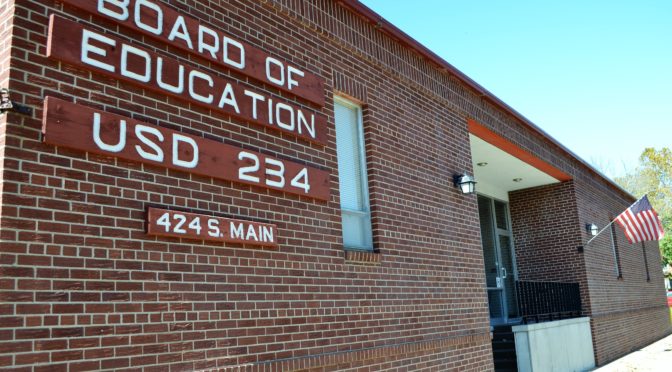
USD 234 – Ted Hessong – Inviting Commissioners to an Event on August 16th
Lynne Oharah – KCAMP
Tiana McElroy – Executive Session – KSA 75-4319(b)(1) To discuss personnel matters of individual nonelected personnel to protect their privacy
Salary Resolutions
Deputy Jeff Keller – Exit Interview
Elected Officials Comment
County Counselor Comment
Susan Bancroft, Finance Director Comment
Public Comment
Michael Braim – Lynn Oharah’s Outburst at Anne Dare at a Previous Meeting
Michael Braim – Cutting Funding for BEDCO
Commission Comment
Justifications for Executive Session:
KSA 75-4319(b)(1) To discuss personnel matters of individual nonelected personnel to protect their privacy
KSA 75-4319(b)(2) For consultation with an attorney for the public body or agency which would be deemed privileged in the attorney-client relationship
KSA 75-4319(b)(3) To discuss matters relating to employer-employee negotiations whether or not in consultation with the representative(s) of the body or agency
KSA 75-4319(b)(4) To discuss data relating to financial affairs or trade secrets of corporations, partnerships, trust, and individual proprietorships
KSA 75-4319(b)(6) For the preliminary discussion of the acquisition of real property
KSA 75-4319(b)(12) To discuss matters relating to security measures, if the discussion of such matters at an open
Barbara Stockebrand. K-State Extension Agent. Submitted photo.
The Compulsive Keeper
Putting things away after the fair reminded me of how stuff just seems to multiply and collect. Statements such as, “We might need that someday,” repeatedly come to mind.
Yes, we were sorting through things from a specific event. Yet it reminded me how we tend to “over keep” things, especially in our own personal living spaces. Things accumulate with little effort. Without some self-control, our homes can be reduced to pathways or overstuffed drawers and closets. Then it becomes an overwhelming task when we really get the urge to purge.
How do we know if our ‘collections’ have gotten out-of-control? A collector is proud to show off their collections and will keep them neat and organized. However, if a large group of unrelated items is stashed away out-of-sight, we might be leaning toward the cluttered category. If it is in plain sight and in a state of disarray, we could be on the verge of hoarding.
Hoarding can affect anyone, regardless of age, gender, or economic status. It often starts in adolescence and gets progressively worse with age. It’s usually a personal and private behavior making it difficult for others to know the seriousness of the situation.
Individuals are more likely to hoard if they have a family member who keeps everything. Often these individuals are withdrawn from society because they are isolated or lonely. They may struggle with obsessiveness and worry about making the right decision whether to keep something or not. The process of trying to decide whether to keep or dispose creates distress, so they may avoid making any decision at all. Thus, everything is kept.
Other characteristics that can indicate a tendency to hoarding include:
–Difficulty or anxiety with letting go of possessions, regardless of their value.
–Unable to find important papers or money in the clutter.
–Buying things because they are seen as a bargain with a desire to stock up.
–Not inviting family and friends to their home due to shame or embarrassment.
–Refusing to let people into their homes to do needed repairs.
Compulsive keepers often have a poor sense of time. They may be late or absent frequently in the workplace. Missing important deadlines and a reduction of productivity are other signs that often create havoc for businesses.
How can we support a family member or friend who has stuff they can’t seem to deal with? Even though we might want to help clear out some clutter, we need to ask first and develop trust with the compulsive keeper. They need to be ready to make some lifestyle changes.
Be sympathetic, listen, and try to understand the emotion and meaning behind all of the things they have chosen to keep. If safety is an issue, work together to create ways to make doorways and hallways safe and clear. Celebrate the successful small steps.
We all have different standards as to what is clutter and what is not. If you were to step into my office right now, you would likely question my clutter status. Yes, it’s time for me to do some serious housecleaning!
More information on clutter control is available through K-State Research and Extension Southwind offices, and by contacting Barbara at 620-625-8620 or by email to [email protected].
K-State Research and Extension is an equal opportunity provider and employer.
Gregg Motley. President of the Bourbon County Economic Development Council. Submitted photo.
Good News!
I am not on social media, but I understand the buzz is not good; not just in Bourbon County, but across the country. It is so easy to go negative. I was the banker for many newspapers in the Kansas City metro area, and it was interesting that the lowest paid reporters on staff were the critics: movies, restaurants, the arts, etc. It is just way too easy. Even I have made a few negative remarks in my columns.
Want some positive news? Bourbon County is number one in per person income in the eight counties in SEK. Here are the numbers:
2009201820092018
Allen $33,302 $40,218 Crawford $30,834 $37,921
Anderson $31,955 $38,539 Labette $32,530 $42,127
Bourbon $32,661 $42,697 Linn $29,438 $37,267
Cherokee $28,170 $39,645 Neosho $28,926 $39,485
What this means is that the total income earned by Bourbon County residents divided by every man, woman and child exceeds that of all of our neighbors. Good news!
This is important for economic development in that it takes cash flow to make households, businesses, and government go, and we have it. What else is required for economic development? Capital to invest. Here are dollars on deposit with county bank branches, and the per person calculation, in 2019:
Millions in Millions in
DepositsPer PersonDepositsPer Person
Allen $292 $23,600 Crawford $669 $17,200
Anderson $200 $25,500 Labette $484 $24,700
Bourbon $254 $17,500 Linn $178 $18,300
Cherokee $271 $13,600 Neosho $394 $24,600
What this means is that there is $17,500 on deposit in a county bank branch for every man, woman, and child in BB. We are closer to the bottom on the list. Either we have deposited a lot of money with local investment advisors/out of area banks, or we are bad savers. Money in savings is what people use to start new businesses.
Another statistic that plays into the future of economic activity in our county is the “pull factor” which measures the number of dollars spent in BB when compared to the earnings of its citizens; we are at 70%. Using the per person income chart above, what this means is that the average BB person spends about $30,000 in BB (It is actually lower than that, as the statistic does not measure dollars spent here by non-residents). This is a low number; for example, Allen County has pull factor of 103%, meaning more money is spent in Allen County than the total earnings of its residents. Alas, poor Cherokee County is just at 38% and declining; Joplin, Pittsburg, and Miami are just too close with better shopping options.
What can we do? Buy local. Save. Invest in BB. Deposit your money in local bank branches or with local investment advisors. Donate your money to local charities. Invest in a local business. Decide to pay as much of your sales tax as possible in BB. We have the earnings; let’s use it!