Bourbon County Commission Room
1st Floor, County Courthouse
210 S. National Avenue
Fort Scott, KS 66701
Tuesdays starting at 9:00
Date: February 22, 2022
1st District-Lynne Oharah Minutes: Approved: _______________
2nd District-Jim Harris Corrected: _______________________
3rd District-Clifton Beth Adjourned at: _______________
County Clerk-Ashley Shelton
MEETING HELD IN THE COMMISSION ROOM
Call to Order
• Flag Salute
• Approval of Minutes from previous meeting
• Eric Bailey – Road and Bridge Report
• Cereal Malt Beverage Permit Approval
• Removal of Special Assessment Process
• County Counselor Comment
• Susan Bancroft, Finance Director Comment
o Inclement Weather
o Control Room Request
o Finance Report Update
• Public Comment
• Elected Officials Comment
• Commission Comment
What’s Happening in Fort Scott!
|
|

|
|
|
|
|
|
|
|
|
|
|
|

|
|
|
|
|
|

|
|
|
|
|
|

|
|
|
|
|
|

|
|
|
|
|
|

|
|
|
|
|
|

|
|
|
|
|
|




 |
|
|
|
|
|
Legislative Update Coffee Tomorrow at the Empress Event Center
|
|
|
|
|
|

|


|
The Bourbon County Sheriff’s Office Daily Reports Feb.18
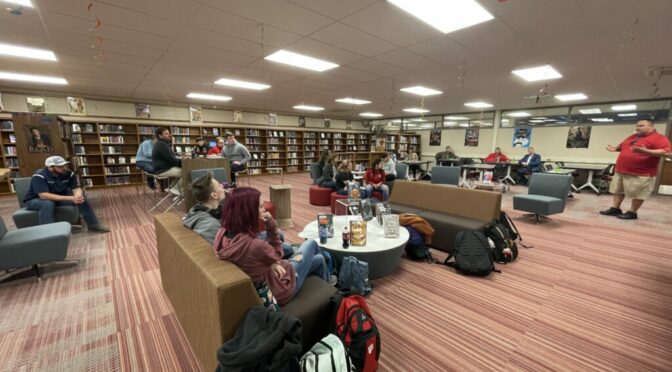
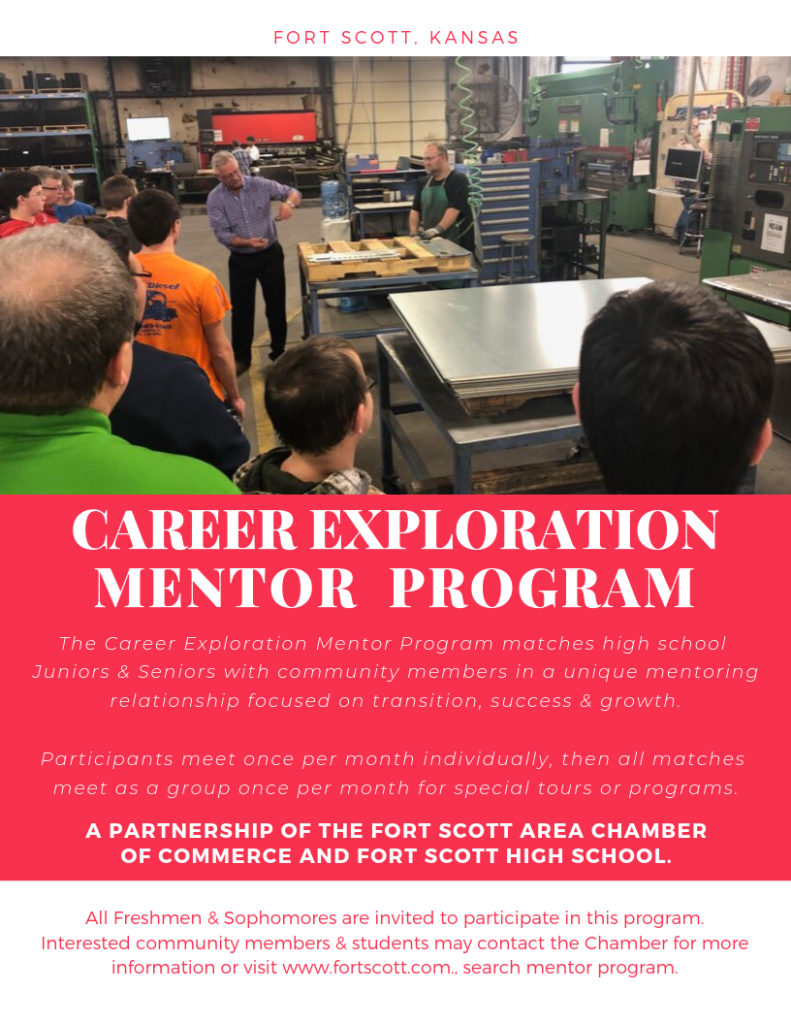
High School Career Exploration Program Needs More Mentors
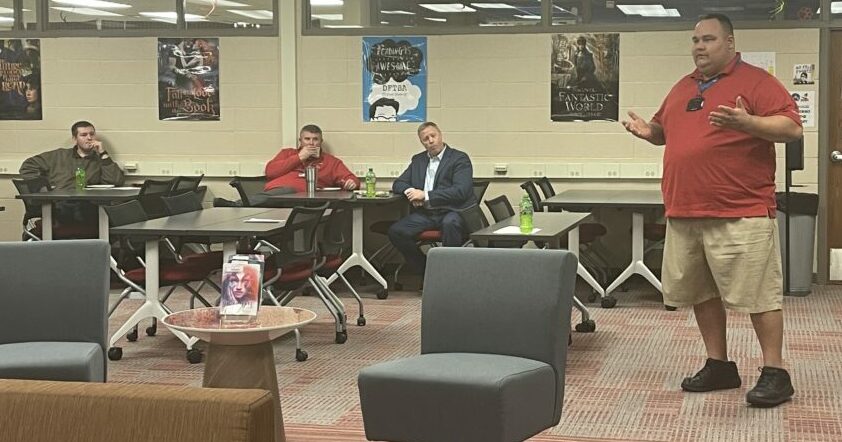
The Fort Scott High School Career Exploration Mentoring Program needs a few more volunteers.
The program is a partnership of the Fort Scott Chamber of Commerce, the City of Fort Scott and the school district, USD234, according to the Chamber website.
Fort Scott Chamber of Commerce President and CEO Lindsay Madison told the weekly Chamber Coffee attendees on Thursday that two more female mentors are needed for the students.
“The Chamber’s motivation for organizing the program is related to Workforce Development,” Madison told fortscott.biz. “Our goal is to help the students be on a path to success, but also develop a funnel of employees for our manufacturers and other businesses by exposing students to local career opportunities available.”
“Students may be ready to start working directly after high school or college, or may move away for several years and return to Bourbon County in the future,” she said. “By being part of the mentor program they will be more aware that Fort Scott truly is a great place to live, work and raise a family.”
“Working at a local manufacturer does not exclusively involve assembly line work as students may perceive, there are many great positions to be held in accounting, sales, engineering, welding and other areas that we try to expose them to,” she said.
“Some students are more interested in health care, law enforcement or other fields and mentors will work to set up job shadows or question/answer sessions with people in those careers” Madison said. “Each student’s needs are differently related to their educational goals or career exploration and while we bring the mentors and students together monthly as a group, the mentors work individually with the students they are paired with to build connections and make a positive impact towards their success.”
Currently, there are 14 students enrolled in the program, Madison said.
Once per month a group activity, speaker or tour is organized by the Chamber.
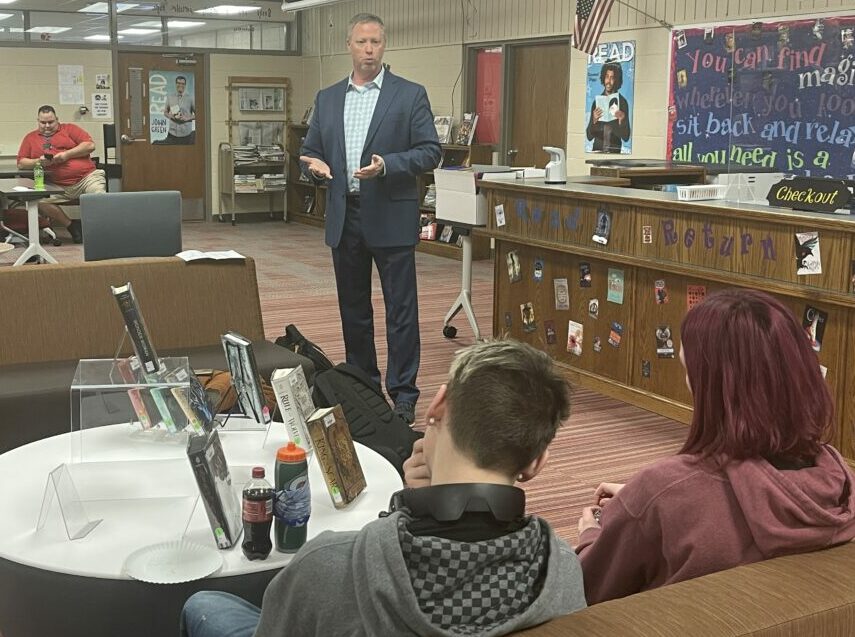
At least one other time per month the student meets with their mentor one-on-one to talk about personal goals, pertinent topics or other issues that the student might have.
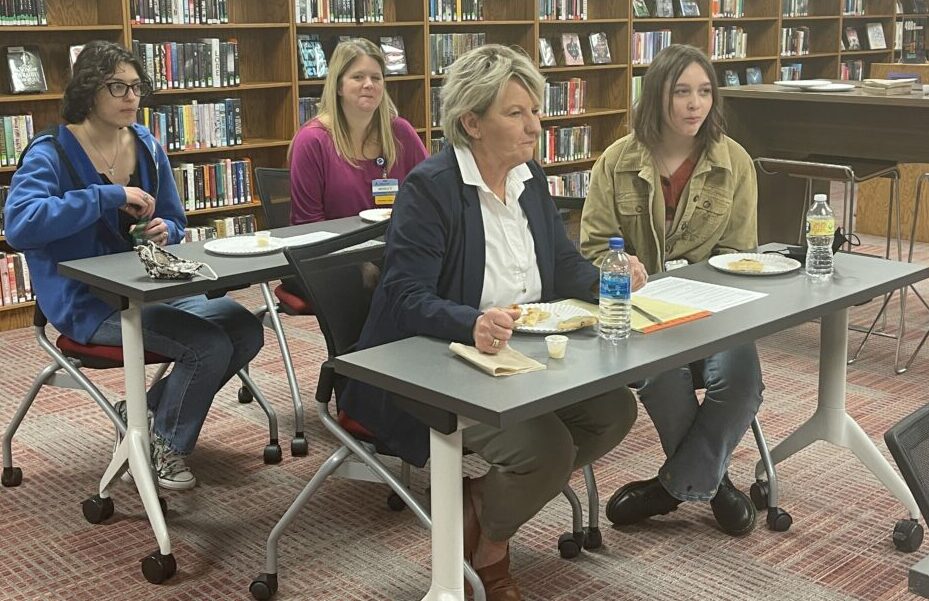
The program is funded in part by the Fort Scott Area Community Foundation, she said.
Bill Michaud, the owner of Sleep Inn Hotel and Chamber member, helps with the program, working with the mentors. Lewis Dunkeson, Communities in Schools Site Coordinator, helps recruit high school students and keeps them informed of meetings, Madison said.
It is an extra-curricular activity, and the high school staff are “very supportive” by allowing extra time at lunch for the meetings, Madison said.
Community members interested in being mentors, and students interested in the program, may contact the Chamber of Commerce at 620-223-3566 or email [email protected].
If you are interested in being a mentor to a high school student please complete the following, which is found on the Chamber website:
Background check authorization.
Email: [email protected]; or fax 620-223-3574.
Here are several of the education modules used by mentors for discussion topic ideas for one-on-one visits with the students: basic vehicle maintenance, cooking, driver’s license information, household financing, jobs, and personal health.
The modules listed above were developed by the 2017-18 LEAD Bourbon County class, a leadership program organized by the Chamber.
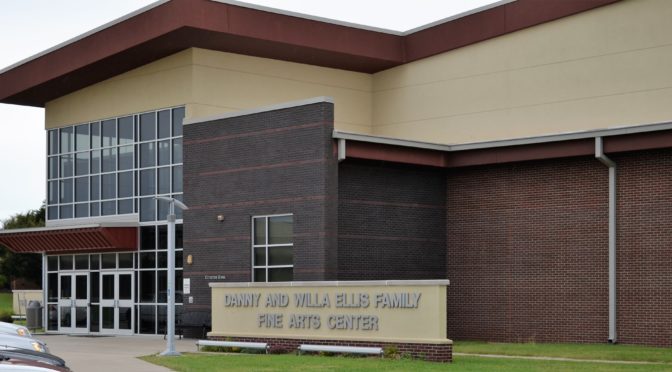
Creative Artists Bring Your Work To Showcase


View Poetic Documentary on Economic Insecurity on Sunday


Obituary of Rose Rivet
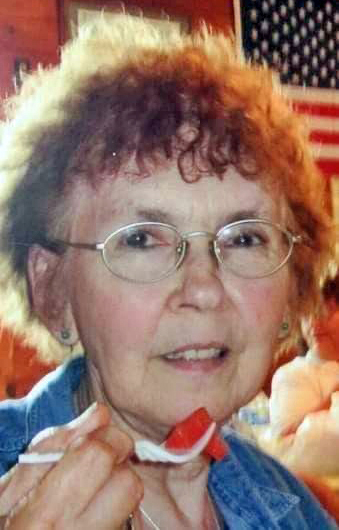
Rose Marie “Billie” Rivet née Corbin, age 88, died Thursday February 3, 2022, peacefully at her home in Fort Scott, KS. She was a former resident of Troy & Averill Park, New York.
Billie was born July 29, 1933, in Berlin, New York, daughter of Maurice H. and Maria S. (Church) Corbin.
Billie was an eccentric creature of beauty who loved garage sales, crafting, and collecting things for the people she cared for. She was an avid photographer; her favorite subjects were family and friends; once the photos were developed, she would proudly display them for all to see. Billie had a love for animals, especially her cats.
She was known by her grandchildren for her tea parties, which we now know was an excuse to clean out the fridge. She was best known for her love of turquoise (the color and the stone). Quotes made famous by Billie included ‘in one ear and out the other’ and ‘tough titty said the kitty.’
As a member of the Sand Lake and Stephentown Seniors she and her sister Katherine took many adventures together including traveling on a cruise ship to explore Alaska and Hawaii.
She is survived by two sons, Rodney Baisley (Teresa Weidman, former spouse) and Ronald (Sarah) Baisley, 8 grandchildren, 23 great grandchildren and 3 1/2 great great grandchildren. She was preceded in death by her husband of 30 plus years, Thomas J. Rivet, her daughter Ruth A. (Baisley) Seror, her sister Katherine S. & (Lewis) Hoffman, her parents Maurice H. and Maria S. (Church) Corbin, and Robert G. Baisley (former spouse; father of their children Rodney, Ruth and Ronald).
Per her request no services will be held. A celebration of life has been scheduled for Saturday February 26, 2022, for family and friends to gather, share memories, tears and laughter.
Her remains will be cremated and sent to rest in Memory Gardens (Albany, New York) with her loved ones.
The family requests those who wish to express sympathy consider donating to their local animal shelter to honor Billie’s love for animals.
Local arrangements are under the direction of the Cheney Witt Chapel, 201 S. Main, Fort Scott, KS. Words of remembrance may be submitted to the online guestbook at cheneywitt.com.
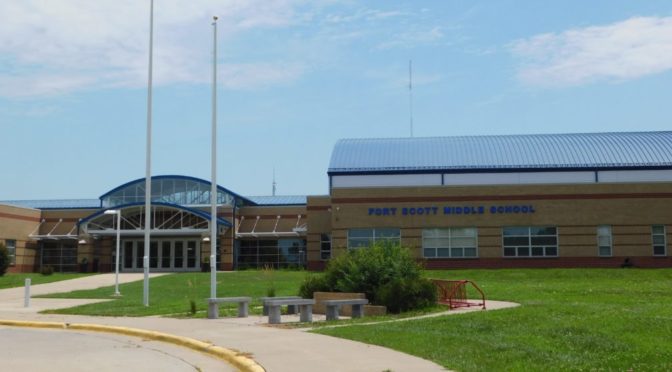
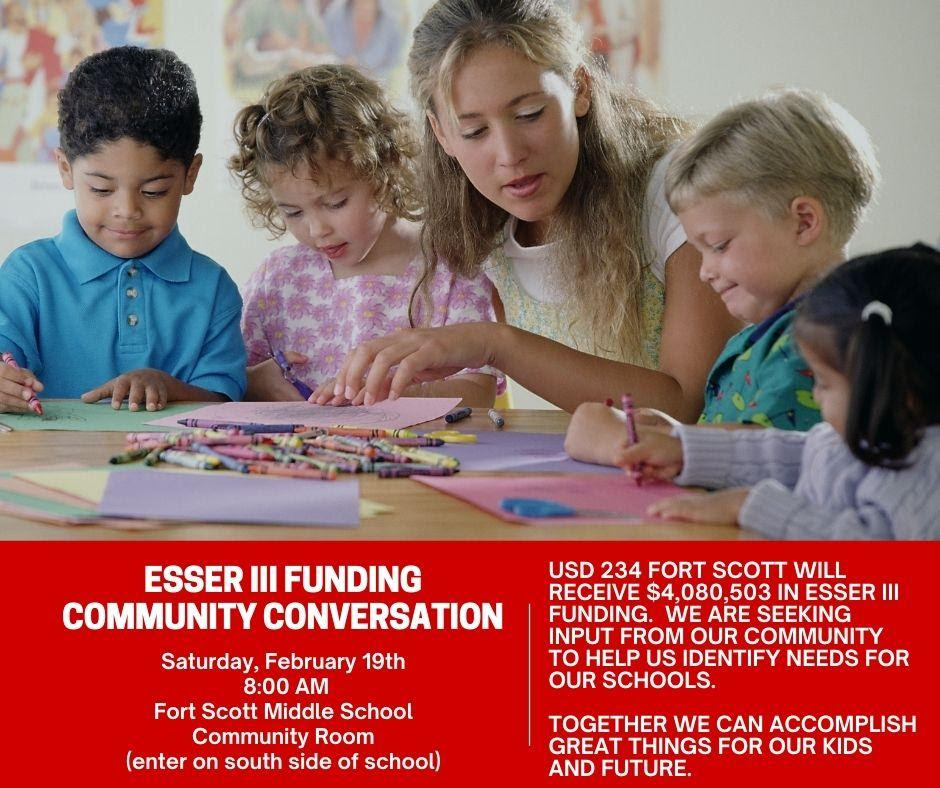
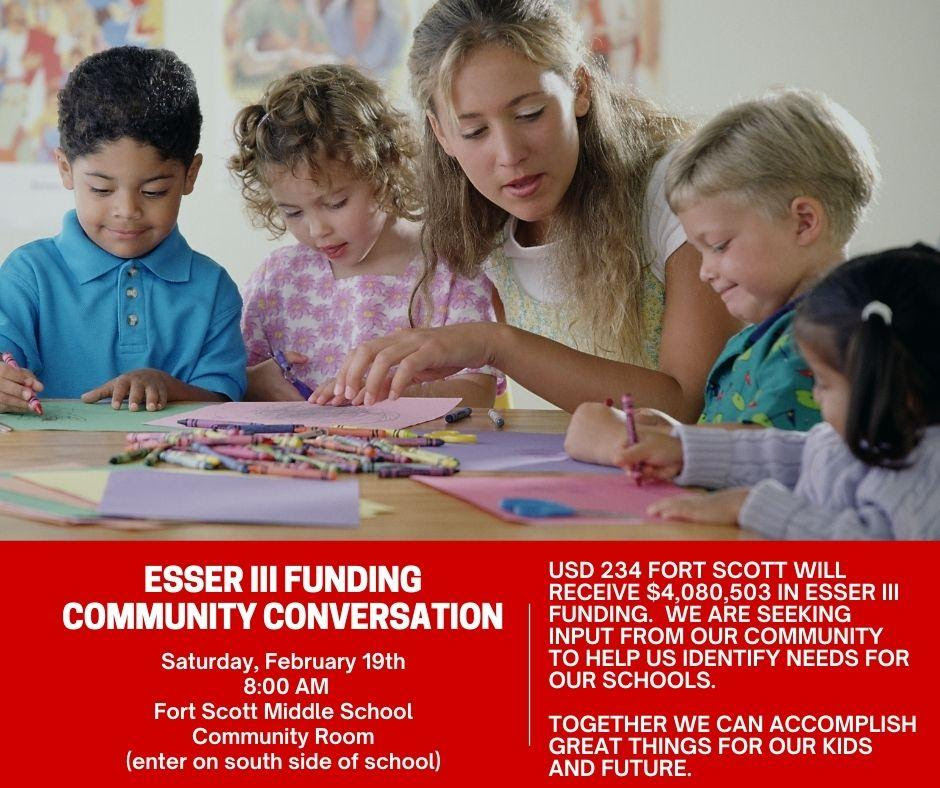
Third USD234 School Funding Community Conversation Tomorrow
|
|

|
|
|
|
|
|
|
|

|
|
|
|

|
|
|
|
|
The Fort Scott Police Department Daily Reports Feb. 17
McKinney to Serve as KS State Executive Director for USDA’s Farm Service Agency
Biden Administration Appoints Dennis McKinney to Serve as State
Executive Director for USDA’s Farm Service Agency in Kansas
WASHINGTON, Feb. 17, 2022— The Biden Administration recently appointed Dennis McKinney as
the new State Executive Director (SED) for the USDA Kansas Farm Service Agency (FSA). McKinney
joined the Kansas FSA team on Feb. 14, 2022.
“Individuals selected to serve as FSA State Executive Directors are incredible public servants who have
a proven track record when it comes to their commitment to advance their states and communities,” said
Agriculture Secretary Tom Vilsack. “Each will serve on the frontlines, carrying out USDA’s mission at
the state level and ensuring the voice of each and every USDA customer is heard. We are fortunate to
have each of these talented individuals at this critical time for farmers and producers and rural
communities across America.”
McKinney is a Kansas farmer and cattle producer whose family farm operates in southern Kiowa and
northern Comanche counties. He served as a Kiowa County Commissioner from 1989 to 1992 before
being appointed to the Kansas House of Representatives, where he served until 2009. In 2009,
McKinney was appointed as the 38th State Treasurer of Kansas. A resident of Greensburg, he has also
served as a member of the board of the Kiowa County Memorial Hospital and the Kansas Historical
Foundation.
As SED, McKinney will be responsible for overseeing the delivery of FSA programs to agricultural
producers in Kansas. These commodity, conservation, credit, and disaster assistance programs ensure a
safe, affordable, abundant, and nutritious food, fiber, and fuel supply for consumers.
“The State Executive Director is a pivotal leadership position for the Agency and for the agricultural
producers we serve,” said Marcus Graham, FSA Deputy Administrator for Field Operations. “These
leaders, appointed by the Biden-Harris Administration, bring a wealth of knowledge and expertise to
their respective states. We are happy to have them on board and wish them much success.”
Farm Service Agency serves farmers, ranchers, foresters, and agricultural partners through the effective,
efficient, and equitable delivery of federal agricultural programs. The Agency offers producers a strong
safety net through the administration of farm commodity and disaster programs. Additionally, through
conservation programs, FSA continues to preserve and protect natural resources and provides credit to
agricultural producers who are unable to receive private, commercial credit, including targeted loan
funds for beginning, underserved, women and military veterans involved in production agriculture.
USDA touches the lives of all Americans each day in so many positive ways. In the Biden-Harris
Administration, USDA is transforming America’s food system with a greater focus on more resilient
local and regional food production, fairer markets for all producers, ensuring access to safe, healthy and
nutritious food in all communities, building new markets and streams of income for farmers and
producers using climate smart food and forestry practices, making historic investments in infrastructure
and clean energy capabilities in rural America, and committing to equity across the Department by
removing systemic barriers and building a workforce more representative of America. To learn more,
visit usda.gov.
Fishing: Live-Imaging Sonar Study
KDWP Fisheries Staff Test Latest Technology in Ground-breaking Study
EMPORIA – Many advances in technology arise out of a desire to improve output and efficiency, and the fishing industry is no exception. One such advancement that has many anglers “picking sides” is the introduction, and proliferation, of live-imaging sonar (LIS) – sonar that allows anglers to view fish and structure, below and around their vessel, in real time and often with great clarity. While some believe LIS adds immense value to the overall fishing experience, others believe it poses an ethical dilemma, blurring the lines of “fair chase.” So, when is an advancement too advanced? That’s the data KDWP Fisheries staff sought but couldn’t find; so, they developed it themselves in a first-of-its-kind study.
“As a conservation-based organization, we always want to look to science and ask ourselves, ‘What is the data telling us?’” said KDWP Fisheries biologist, Ben Neely. “But this technology is just new enough, that these data really didn’t exist. That’s when we decided we needed to explore this further and develop the study. It’s taken off like wildfire in the conservation community ever since.”
KDWP Fisheries staff opted to conduct a controlled and replicated experiment to assess the influence of LIS on catch of winter crappie – Kansas’ second-most sought-after sportfish. Specifically, the project was designed to examine LIS impacts on “casual weekend anglers” fishing unfamiliar water on a weekend trip.
In early December 2021, a total of 32 individuals from KDWP’s Fisheries and Wildlife divisions, and Kansas State University took part in a two-week experiment at Cedar Bluff Reservoir. Anglers were randomly partnered up and instructed to fish for seven hours on either the north or south sides of the lake, and either with or without the aid of LIS. The next day, each team switched sides and use of equipment; This resulted in a total of 16 controlled “samples.” The results were unexpected.
- Participating anglers who did not use LIS averaged 6.3 crappie per day, while anglers who used LIS caught 7.3 crappie per day.
- When other species of fish were counted in the study, teams not using LIS averaged 12.9 fish per day, compared to 14.4 per fish per day when LIS was used.
- And, anglers also caught slightly larger crappie on average (10.8 inches) when using LIS, compared to the fish (10.5 inches) caught by anglers not using LIS.
Ultimately, the data collected demonstrated that while LIS may improve angler catch and size of crappie by casual weekend anglers, overall differences were statistically minimal. And maybe more importantly, the data suggests an overall low risk of long-term damage to crappie populations as a result of LIS. However, anglers with more experience and expertise using LIS to target crappie were not considered in this study. Future studies are being discussed that can leverage the abilities of more LIS-experienced anglers to further inform future management of crappie in Kansas.
“Balancing sociological needs with biological needs is at the heart of nearly everything we do at KDWP,” said KDWP Secretary Brad Loveless. “This study is a fine example of how our staff continue to operate off of the best-available data to make science-based decisions that benefit not only the resource, but our users. I’m confident this study will be just one of many that the conservation industry looks to, as our talented staff in Kansas continue to pave the way in fisheries research and management.”
To learn more about this study, watch an audio/video presentation by Neely here, https://youtu.be/XEiP0_PMjjg.
For more on fishing in Kansas, visit ksoutdoors.com/Fishing.