Emergency Rental Assistance remains available

More than $125 million in rental, utility assistance awarded
TOPEKA, Kan.— Kansas Emergency Rental Assistance (KERA) funding remains available to support Kansans at risk of eviction. KERA provides rent, utility, and internet assistance to households that have experienced a financial hardship during the pandemic.
“More than a third of Kansans rent their homes, and many have struggled to cover rent and utility bills since the pandemic began,” said Ryan Vincent, Executive Director of Kansas Housing Resources Corporation (KHRC), which administers the KERA program. “The financial repercussions are far from over for our most vulnerable families. This crucial assistance is still available to keep Kansans safely housed throughout our economic recovery.”
The KERA program has disbursed more than $125 million in rental, utility, and internet assistance to 17,633 eligible tenant households in Kansas. These funds have prevented 45,674 Kansans from experiencing evictions and utility disconnections and helped make 6,656 landlords whole.
One frontline worker described how KERA assistance kept her in stable housing during the pandemic. While on short-term work leave, she was unable to return to her health care job after twice contracting the virus. “I am beyond grateful for the rental and utility assistance provided by KERA while I recovered so I could get back to work,” she said.
The KERA program supports Kansas tenants and landlords experiencing financial hardship. Recent updates have made the program more inclusive, allowing the state to serve even more Kansans:
  • Households that have experienced financial hardship at any time duringthe pandemic may now qualify for assistance.
  • Eligible households may receive up to 18 months of assistance, an increase from the previous 15-month maximum.
  • Eligible households may receive a lump sum of $900 in past-due or future internet assistance, an increase from the previous $750 limit.
Previous applicants who have not hit the 18-month maximum are eligible to recertify for additional months of assistance.
A Topeka property manager witnessed how KERA funding has helped both the complex and her tenants thrive in hard times. “Since emergency rental assistance has been available, we have provided KERA documents and Shawnee County income guidelines to any tenant that receives an eviction notice,” she said. “I tell tenants, ‘It’s always worth a shot to apply.’”
Tenants and landlords can apply jointly online via the KERA application portal. Tenants must answer pre-screening questions to determine their eligibility before accessing the application. KERA applicants must meet income guidelines and must provide:
  • Proof of identification;
  • A signed lease or equivalent documentation;
  • Documentation or self-attestation of housing instability;
  • Documentation or self-attestation of financial hardship; and
  • Proof or self-attestation of household income.
Once an application has been submitted, households can track their application status and respond to communications by logging into their KERA dashboard. If applicants have additional questions, they can contact KERA customer service by emailing [email protected] or calling 785-217-2001, Option 1 for English; or Option 2 for Spanish.
KHRC launched the KERA program in March 2021 with funding provided by the Coronavirus Supplemental Relief Act of 2021. Continuing funding is provided through the American Rescue Plan Act. The measures have provided a combined $23.4 billion in emergency rental assistance to rental households nationwide, with nearly two-thirds of those funds serving extremely low-income households.
For more information and to apply, visit kshousingcorp.org/emergency-rental-assistance.
###
Kansas Housing Resources Corporation (KHRC)is a self-supporting, nonprofit, public corporation committed to helping Kansans access the safe, affordable housing they need and the dignity they deserve. KHRC serves as the state’s housing finance agency, administering essential housing and community programs to serve Kansans.
For more information on Kansas rental statistics, visit the National Low Income Housing Coalition’s report, Out of Reach 2021.

Legislative Update Wk 10 Session 2022 by Kansas Senator Caryn Tyson

Caryn Tyson

March 18, 2022


Wrapping up committee work was our main goal last week. While that means the end of regular meetings for most committees, it does not mean that the work is finished. The final days of session will be floor debate, and no or minimal committee work.


Election Security is critical.  During debate last week on the Senate floor, a compelling argument was given by a Senator, former county commissioner, that he would not certify an election because the vote count could not be reconciled.  The other two commissioners did certify the election, so the issue was dropped at that time.  (There should have been a complete investigation.)  Senate Bill (SB) 389 and SB 390 should help prevent that situation from occurring again.  SB 389 would require a distinctive watermark for paper ballots and a sample hand-count audit of paper ballots that are counted with electronic tabulating equipment.  The bill would also prohibit use of poll books that do not require a hand-written voter signature.  The bill passed 27 to 11.  SB 390 would require each person working with ballots to sign an affidavit in the tracking of ballots handled.  It passed 27 to 10.  I voted Yes on both measures.


Out-of-control spending continues in this year’s budget, SB 444.  As with most budget bills, there was some good and some bad.  Paying down debt and long overdue pay increases are some of the good.  Increased spending on programs that are not being held accountable or proven effective is some of the bad.  The budget also “puts away” $600 million in a rainy-day fund and has a $360 million ending balance.  That $600 million could be used to remove sales tax on food, not socked away for government to spend at a later date.  The bill passed the Senate 23 to 14.  I voted No in defense of the taxpayer and slowing government growth.


Senate redistricting map passed on a vote of 28 to 8.  I did not support the map.  It would take the city of Ottawa and Bourbon County out of the 12th Senate district and include Coffee, Woodson, and Wilson Counties.  The 12th district could have easily increased population in Miami County and kept all of Franklin in the 12th district.


We also worked on the following:

  • Energy Independence is the strong message the Kansas Senate sent to the President of the United States. STOP importing oil and gas from Russia and RESTORE energy independence in the United States.  SCR 1623 passed unanimously.
  • Non-driver identification cards could be renewed online if SB 529 becomes law.  It passed the Senate unanimously.
     
  • Gold Star families could be recognized and honored on the State Capitol grounds.  Gold Star families are families who have lost family member in the line of military service.  House Bill 2540 passed the Senate unanimously.

It is an honor and a privilege to serve as your 12th District State Senator.


Caryn


USD 235 Kindergarten Roundup Coming April 4

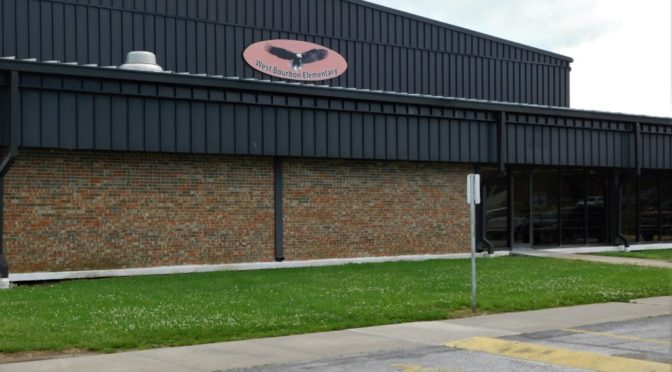
West Bourbon Elementary School – Uniontown

Kindergarten Roundup Coming in April


A screening clinic for 2022-2023 kindergarten students has been scheduled for Monday, April 4 at West Bourbon Elementary. To be eligible for kindergarten, your child must be 5 years old on or before August 31, 2022.

Students who will be new to WBE will sign up for a 30 minute slot to be assessed on April 4. Please bring in your child’s birth certificate and immunization record. The agenda for the child will include kindergarten skills assessment, vision, hearing, speech, and checking health records.

Kindergarten children are required to have a physical exam within 12 months of beginning school and have all current immunizations. You may contact Girard Medical’s Uniontown Clinic to set up a physical time on the 4th if you wish; they can be reached at 620-756-4111. Students that have incomplete records will not be allowed to start school until their records are complete.

Due to the screenings, there will be no Kindergarten class on April 4th.

For the best testing environment for your child, we ask that you not bring brothers or sisters.

Please phone the school to set up a time to bring your child for the assessment and screening.  The phone number is 620-756-4335.


Free Trees Offered to FS Residents From Kiwanis

The Fort Scott Kiwanis Club on a workday at Gunn Park in August. 2020, one of many community projects/events of the club. Submitted photo.

A local organization is helping to add more of a tree canopy to the community.

The Fort Scott Kiwanis Club is offering free trees to residents of the city.

“This is made possible through a grant from the Fort Scott Area Community Foundation,” Phil Gorman, treasurer of Kiwanis, said.  “Sixty trees will be purchased and planted by the club in cooperation with Fort Scott Community College, Fort Scott High School, and the City of Fort Scott.”

“FSCC,  and the high school, we are going to use some of their organizations for labor to help us get the trees in the ground,” Gorman said.

“The city helped us with the grant and they will help dig the holes and also help with logistics of where the trees will be planted,” he said.

Two large-growing tree varieties are being offered,  Swamp White Oak and Shumard Oak.

To be considered for trees contact the City of Fort Scott at 620.223-0550, by April 4. Trees will be planted sometime in April.

For safety, the group won’t plant trees in the way of high lines or on street corners, Gorman said.

The Kiwanis tree planting program has been done for many years, Gorman said.

“Some street trees all around the city were planted by Kiwanis years ago,” he said. “I’d say in the thousands.”

The group is rejuvenating the program and hopes to make it an annual event.

The Fort Scott Kiwanis logo. Submitted.

About Kiwanis

Kiwanis is a global organization of volunteers dedicated to improving the world, one child and one community, at a time.

They meet each Tuesday at noon at the Presbyterian Church, 308 S. Crawford.

“There are currently 35 members,” Gorman said. “We are always open to new members.”

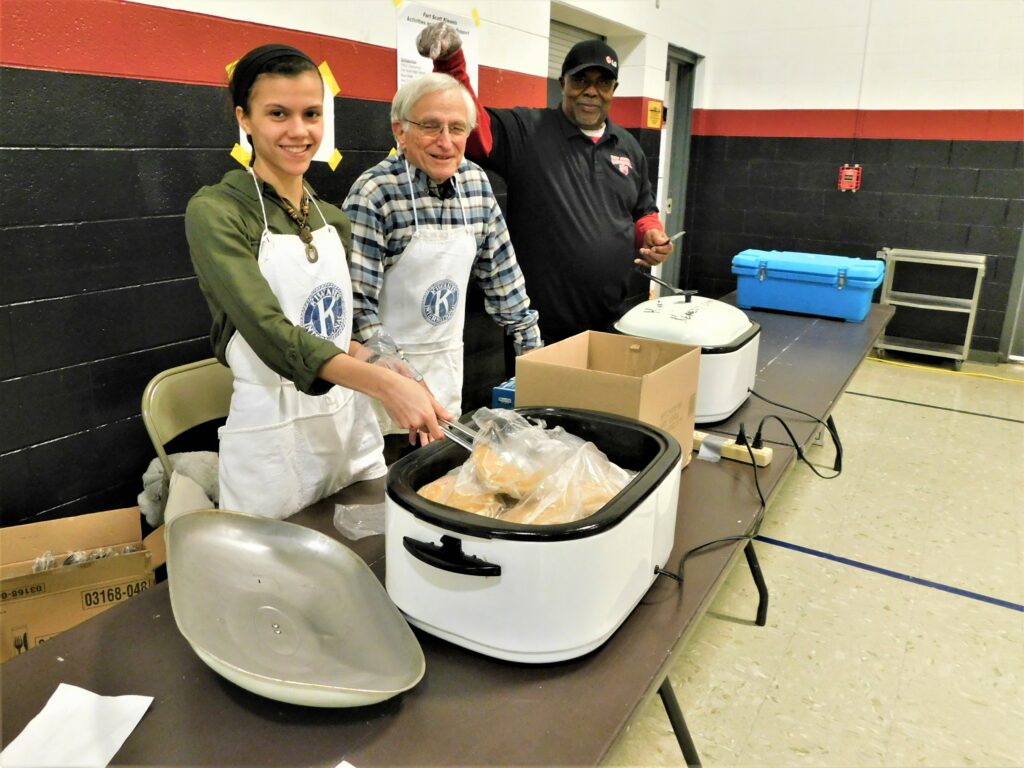
Addisyn Fowler, Fort Scott High School Key Club member, left, along with Fort Scott Kiwanis Club members Bob Eckles and Clyde Stepps serve pancakes at the annual Pancake Feed in February 2020.
Angelyka and her dad, Daniel Simonds, pick up Easter eggs in the preschool section of the Kiwanis Easter Egg hunt in this 2018 photo.
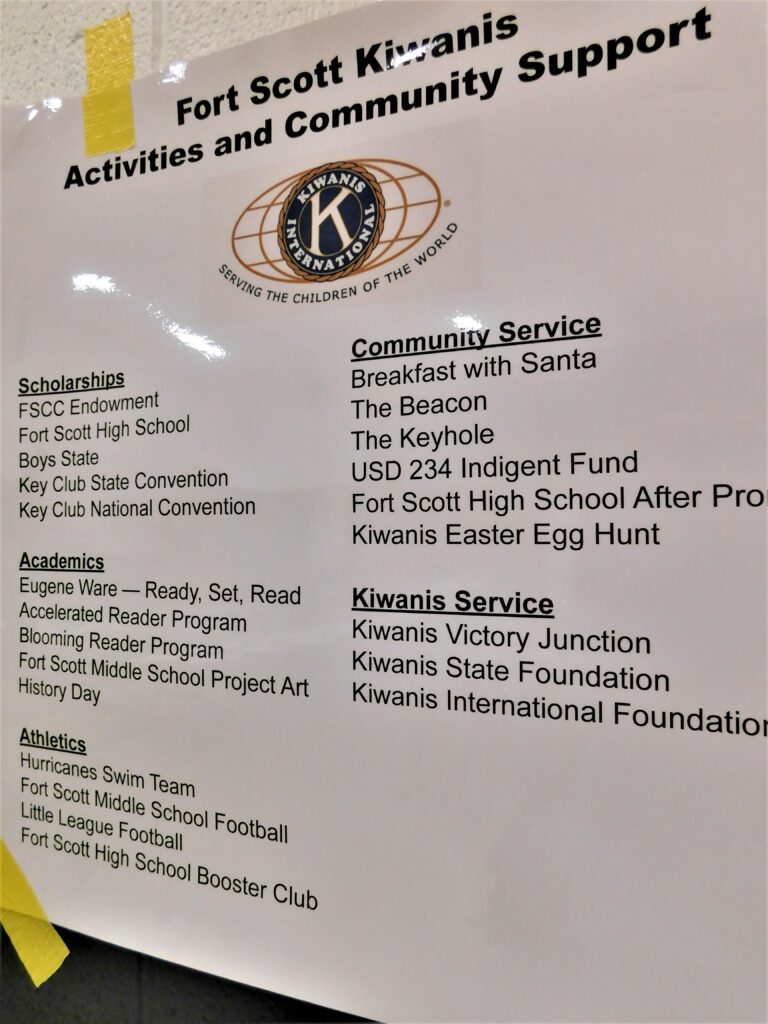
Some of the projects of the Fort Scott Kiwanis Club were showcased on a poster of the gym at Buck Run Community Center during the annual pancake feed in 2020.

Obituary of Hallie Cannon

Hallie B. Cannon, age 89, a resident of Ft. Scott, Kansas, passed away Sunday, March 20, 2022, at the Medicalodge in Ft. Scott. She was born December 30, 1932, in Iola, Kansas, the daughter of Charles E. Haberbosch and Ruby H. Wedell Haberbosch.

Hallie graduated from the Marmaton Valley High School in Moran, Kansas. She later moved to Ft. Scott where she worked as a trainer for the Western Insurance Company and later for Lincoln National Insurance Company.

Hallie was a faithful member of the Mary Queen of Angels Catholic Church and the St. Anne’s Altar Society. She had also served as church secretary for several years.

In earlier years, Hallie enjoyed participating in theater. She had performed in several productions with both the Iola Community Theater and the Ft. Scott Community College Theater.

She also liked to travel.

Hallie is survived by her son, Tom Cannon (Kristi) of Broken Arrow, Oklahoma and her grandson, Becket Cannon. She was preceded in death by three brothers, Lyle and Carol Haberbosch and another who died in infancy as well as a sister, Audrey Ellmer.

Father Yancey Burgess will conduct Mass of Christian Burial at 10:30 A.M. Thursday, March 24th at the Mary Queen of Angels Catholic Church.

The rosary will be recited at 10:00 A.M. prior to the funeral Mass at the church. Following services, there will be cremation and a private burial will take place at the St. Mary’s Cemetery in Ft. Scott, Kansas. Memorials are suggested to Paws & Claws Animal Shelter and may be left in care of the Cheney Witt Chapel, 201 S. Main, P.O. Box 347, Ft. Scott, KS 66701. Words of remembrance may be submitted to the online guestbook at cheneywitt.com.

Bo Co Commission Will Meet at Uniontown City Hall on March 22

Uniontown City Hall.

PLEASE NOTE: THE MEETING WILL BE HELD AT CITY HALL IN UNIONTOWN @ 6PM.

County Commission Room
1st Floor, County Courthouse
210 S. National Avenue
Fort Scott, KS 66701

Date: March 22, 2022

1st District-Lynne Oharah Minutes: Approved: _______________
2nd District-Jim Harris Corrected: _______________________
3rd District-Clifton Beth Adjourned at: _______________
County Clerk-Ashley Shelton

AMENDED!!!!!
MEETING HELD IN CITY HALL AT UNIONTOWN AT 6:00PM.
Call to Order
• Flag Salute
• Approval of Minutes from previous meeting
• Eric Bailey – Road and Bridge Report
• Resolution for Liquor Sales in the County
• County Counselor Comment
• Susan Bancroft, Finance Director Comment
o End of Year Report
• Public Comment
• Elected Officials Comment
• Commission Comment
Justifications for Executive Session: KSA 75-4319(b)(1) To discuss personnel matters of individual nonelected personnel to protect their privacy KSA 75-4319(b)(2) For consultation with an attorney for the public body or agency which would be deemed privileged in the attorney-client relationship KSA 75-4319(b)(3) To discuss matters relating to employer-employee negotiations whether or not in consultation with the representative(s) of the body or agency KSA 75-4319(b)(4) To discuss data relating to financial affairs or trade secrets of corporations, partnerships, trust, and individual proprietorships KSA 75-4319(b)(6) For the preliminary discussion of the acquisition of real property KSA 75-4319(b)(12) To discuss matters relating to security measures, if the discussion of such matters at an open meeting would jeopardize such security measures.

Aging With Attitude Regional Expo returns to Fort Scott

Barbara Stockebrand. K-State Extension Agent. Submitted photo.

By  Barbara Stockebrand

Southwind Extension District –Yates Center

Family and Consumer Sciences


Every stage in life offers challenges, and making the most of one’s later years requires different tools and perspectives than other stages.

To connect older Kansans and promote physical, mental and financial health, K-State Research and Extension and several community agencies and businesses are offering the annual Aging with Attitude Regional Expo on April 29 in Fort Scott.

This year’s expo will take place from 9 a.m. to 3:30 p.m. at the Community Christian Church, 1919 Horton St. Among the topics on the agenda are:

  • At Home and Independent
  • Medicare Advantage Plans – What Are They Really?
  • Stretching Your Food Budget
  • Medication Safety
  • Immunizations – Checking the Facts
  • Estate Planning 101
  • Healthy or Challenged? Physical Therapy and In-Home Safety
  • Aging and Mental Health

Professor at the Kansas Technology Center of Pittsburg State, Dr. Mark Johnson, will deliver the keynote address, “Honing Your Memory Skills.” Dr. Johnson, also known as the Memory Guy, will share proven memory techniques that will help participants develop skills to remember dates, names, and other information.

Registration is $15 per person until April 18 and includes lunch, refreshments, activities, access to the keynote address, educational speakers and resource fair, and eligibility for door prizes. Registrations after April 18 are $25 per person, and lunch is not guaranteed.

For those who cannot attend in-person, a registration fee of $5 will gain access to recordings of the sessions a few weeks following the in-person event. Registrations may be made online at www.agingexpo.ksu.edu

Blood and Guts by Carolyn Tucker

Keys to the Kingdom


My Dad, Morris J. Hayward, served in Germany on the front lines in the 90th Infantry Division, Company B, under General George S. Patton’s Third Army. General Patton is the most famous and celebrated U.S. general of that era. He was an outstanding motivator and one of the best tacticians of the time. He was the most colorful general, known by the troops as “Blood and Guts” Patton. My Dad further defined that nickname by explaining, “Yeah, his guts and our blood.” With a mighty combination of blood and guts, the U. S. and our allies defeated the Nazis and won the victory in the European Theater.

It usually takes a combination of things working together like a well-oiled machine to achieve successful results. “For God sent Christ Jesus to take the punishment for our sins and to end all God’s anger against us. He used Christ’s blood and our faith as the means of saving us from His wrath” (Romans 3:25 TLB). Jesus died on the cross so that all might live victoriously and be saved from hell. But it takes faith to believe in Jesus, and the guts to stick with it, in order to achieve the abundant life here and eternal life in heaven.

When General Patton devised his incomparable battle plans, what would have happened if he hadn’t been able to find any soldiers with enough guts to carry it out? It takes guts for believers to take a stand for Christ — it always has. It takes guts to not go with the flow (any old dead fish can float downstream). It takes guts to love the ugly-hearted and extend forgiveness. It takes guts to live according to God’s Word when the world wants to live like the devil.

Even in the face of terrible odds, believers can choose to go with God and have victorious outcomes. I’m not talking about just going to heaven when we die, I’m referring to having victory right here, right now. “No, despite all these things, overwhelming victory is ours through Christ, who loved us” (Romans 8:37 NLT). The Son of God loved everyone so much that He was willing to shed His blood in order to save us from ourselves (a life of selfish misery). There’s more power in the blood of Jesus than a Sherman tank. There’s more power in Jesus’ blood to free a person’s soul than a B-24 Liberator.

We’d all be dead in the water if it weren’t for the blood of Jesus. “In fact, according to the law of Moses, nearly everything was purified with blood. For without the shedding of blood, there is no forgiveness” (Hebrews 9:22 NLT). Jesus has done His part once and for all and it’s up to everybody else to do their part. He provided the blood.

We are marching through a world that’s not our true home. “Dear friends, I warn you as ‘temporary residents and foreigners’ to keep away from worldly desires that wage war against your very souls. Be careful to live properly among your unbelieving neighbors…(1 Peter 2:11,12 NLT). Believers aren’t in a physical war like Patton’s Third Army, but we are in a spiritual war. We must be determined to hold our position and never give up or give in to the enemy of our souls. And that, brother and sister, takes guts.

The Key: With His blood and our guts, believers can be more than conquerors.

Poverty by Gregg Motley

Gregg Motley. President of the Regional Economic Development, Inc. Submitted photo.

Poverty

Economic development is not about the rich getting richer. It should be about lifting all sectors of our economy by giving everyone a chance to succeed. That includes supporting education, health care and charities that target short-term help to those in immediate need. As individuals, we should also look charitably on our neighbors in need and help as we can in safe and productive ways according to the resources we have been afforded. An economy cannot be considered successful that leaves a segment of the population behind.

There is good news on the poverty front. According to a 2019 article entitled “Global Extreme Poverty” by Max Roser and Esteban Ortiz-Ospina, 1.9 billion people worldwide lived in extreme poverty in 1990; by 2020, estimates are that the number was 479 million, a 74.8% drop over the last 30 years. Estimates are that the number will stabilize and be about the same in 2030.

Looking back further, the article observes that 94% of the world lived in extreme poverty in 1820; now, that number is 9.6%. The big winner has been Asia. The losers? Sub-Sahara Africa and the Middle East; both regions have lost ground to poverty. All other regions have improved their poverty percentage. There is no question that the wave of freedom initiated in the 18th century, including the American and French Revolutions, have had a positive, long-term economic impact on the world. For the first time in modern history, a high percentage of the world had the power of self-determination.

What about Bourbon County, Kansas? In 1990, the rate was 19.7%, well above the State number of 11.5% and higher than all surrounding counties. By 2010, the number had lowered to 15.9%, which was still above the State average of 13.2%, but below neighboring counties. Since then, the number has gone up and down significantly, cresting at 20.9% in 2012, and mitigating to 15.6% by 2019; that number leaves us below the surrounding counties to the South, but remains above the State percentage at 11.3% and Linn County at 12.0%.

What can we do about poverty in Bourbon County from an economic development perspective? First, we need to define the size and nature of the demographic. Who are they and where do they live? Only then can we make sure that all new development and investments in Bourbon County have elements that help the impoverished, not further isolate or marginalize them.

Additionally, we need to support charitable and governmental programs and outreaches to those below the poverty line, including health care and education, both public and private. Community development must consider all segments, geographies and entities within out county and encourage positive investments in the totality.

As we begin the process of a third party analysis of Bourbon County, we will be mindful of the whole county. We need everyone to come along with us if our community is to be the best that we can be.

Highly Pathogenic Avian Influenza Continues to Spread in Kansas

MANHATTAN, Kansas — The Kansas Department of Agriculture has now identified two new counties which have confirmed cases of highly pathogenic avian influenza (HPAI) as the disease outbreak continues in Kansas and nationwide. Samples from birds exhibiting HPAI symptoms in a non-commercial backyard mixed-species flock (poultry) in Dickinson County and also in a non-commercial backyard mixed-species flock (non-poultry) in rural Sedgwick County were confirmed today by the National Veterinary Services Laboratories in Ames, Iowa.

KDA is working closely with USDA–APHIS on a joint incident response in both of the new locations. KDA officials quarantined the affected premises, and birds on both properties will be depopulated to prevent the spread of the disease.

Anyone involved with poultry production from the small backyard chicken owner to the large commercial producer should review their biosecurity activities to assure the health of their birds. Find guidance on biosecurity on the KDA Division of Animal Health webpage at agriculture.ks.gov/AvianInfluenza. Going forward, any additional confirmed cases will be shared directly with local communities and announced on the KDA Avian Influenza webpage, rather than through a statewide news release.

Highly pathogenic avian influenza (HPAI) is a highly contagious viral disease that can infect chickens, turkeys and other birds and can cause severe illness and/or sudden death in infected birds. Attentively monitor your birds for symptoms of HPAI which include: coughing, sneezing, nasal discharge, and other signs of respiratory distress; lack of energy and appetite; decreased water consumption; decreased egg production and/or soft-shelled, misshapen eggs; incoordination; and diarrhea. Avian influenza can also cause sudden death in birds even if they aren’t showing other symptoms.

If these symptoms are observed in your birds, immediately contact your veterinarian. If you don’t have a regular veterinarian, contact KDA’s Division of Animal Health office toll-free at 833-765-2006.

According to the U.S. Centers for Disease Control and Prevention, the recent HPAI detections do not present an immediate public health concern. No human cases of these avian influenza viruses have been detected in the United States. Birds and eggs from the infected flock will not enter the food system.  As a reminder, the proper handling and cooking of all poultry and eggs to an internal temperature of 165 ˚F is recommended as a general food safety precaution.

As part of existing avian influenza response plans, federal and state partners are working jointly on additional surveillance and testing in areas around the affected flocks. The United States has the strongest AI surveillance program in the world, and USDA is working with its partners to actively look for the disease in commercial poultry operations, live bird markets and in migratory wild bird populations.

For more information about HPAI, including current status of the confirmed cases in other states as well as more information about biosecurity for your flock, go to KDA’s avian influenza webpage at agriculture.ks.gov/AvianInfluenza or call KDA at 833-765-2006.

Bourbon County Local News