|
|

|
|
|

|
|
|
|
|
||||||||||||||
|
|
|
|
|
|
|
|
|
|
|
||||||||||||||
|

Conventional wisdom accepts that Star Wars and the Super Bowl attract an audience of millions.
What’s less well known is that a recent survey indicates almost 50 million people attend one of more than 37,000 school theatre performances annually in the United States.
The Theatre in Our Schools (TIOS) Month in March, is an opportunity to inform them, and millions more, that the pleasure they get from seeing a show on stage is just one of many benefits that school theatre brings to all involved—from overcoming fears of public speaking to the development of collaboration and teamwork.
TIOS is timely in that its March celebration occurs the same month as Music in Our Schools and Youth Art Month.
TIOS provides an opportunity for all of us here in Fort Scott—students, parents, school boards and elected officials—the entire community—to become familiar with the benefits of school theatre
participation.
Thespian troupe #7365 is planning a number of events to celebrate this month. On March 2, they travel to Topeka to meet with legislators about the importance of supporting theatre education.
March 6, troupe president Kinsley Davis presents to the USD 234 Board of Education about the way theatre education is impacting our own school district. On Thursdays in March, Thespians will wear
theatre–related t–shirts to school. March 24 is the annual FSHS Talent Show and Miss(ter) FSHS Pageant at 7 p.m. in the FSHS Auditorium. Admission is $5 at the door. Thespians travel to the Music Hall in Kansas City to see the Broadway Touring production of Hamilton on March 28.
You can follow FSHS Thespians through the following social media links: Facebook – Fort Scott High School Thespians, Instagram – FSHSThespians, Snapchat – FSHSThespians, Tiktok – fshsthespian,
Twitter – FSHS_Thespians. Share your school theatre thoughts with us using #TheatreInOurSchools.
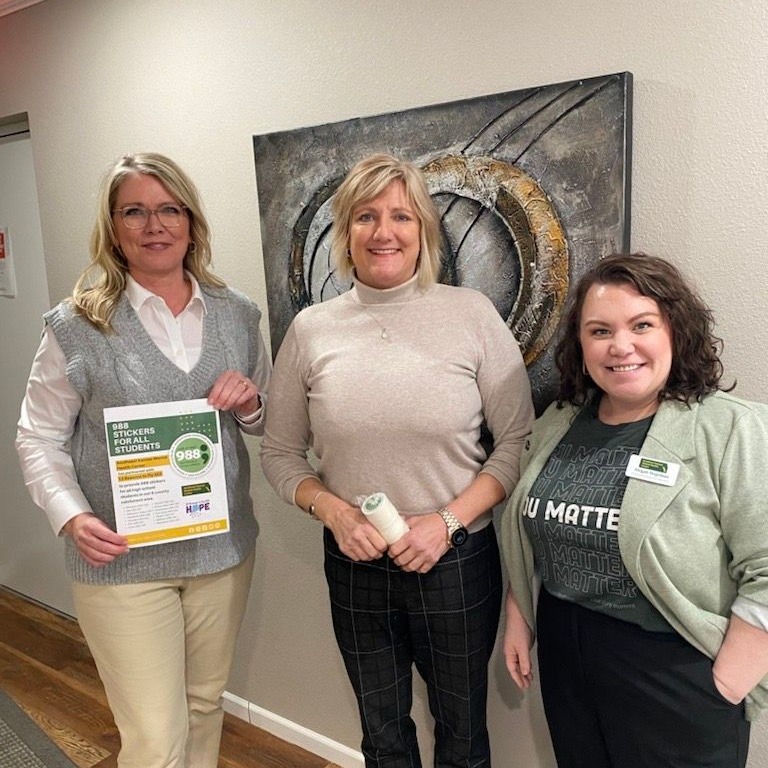
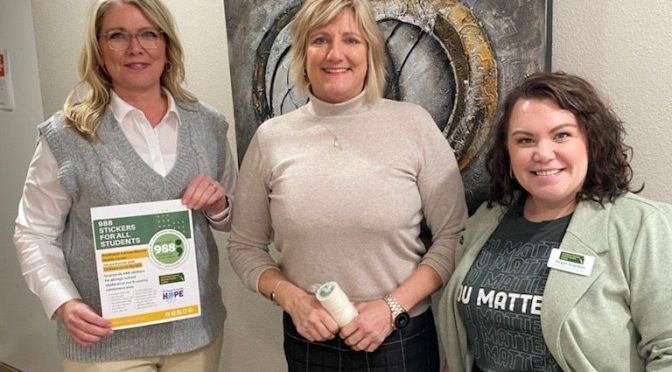
Southeast Kansas Mental Health Center is working to reach out to area students with nearly 3,200 reminders that help is available when they are experiencing a mental health challenge or crisis.
Partnering with Sharla Miller, with 13 Reasons to Fly SEK, SEKMHC created stickers themed to share information about 988, the national suicide and crisis hotline. They will be distributing nearly 3,200 of them to students in 13 high schools in their six-county catchment area.
“Even if we help just one student – that’s one life that might be saved,” commented Miller. “We need to get better at letting kids know it’s ok to not be ok. We need to encourage those conversations.”
Miller, a strong mental health advocate in the community, started the SEK chapter of 13 Reasons to Fly after her son died by suicide nearly four years ago.
Suicide is the second leading cause of death for people ages 10-24 in Kansas. Kids are reporting feelings of depression and anxiety at higher rates than ever before. Teachers are observing alarming mental health challenges experienced by their students daily. It’s undeniable that children need help.
“We hope to see lots of stickers on laptops, water bottles, and other student belongings soon!” explained Megan Hageman, SEKMHC prevention and promotion specialist. “Getting this information to the youth in the area can make a huge difference. Showing kids that they have support, no matter what, is essential!”
988 (similar to 911) is the national hotline designated to provide support for individuals who are experiencing a mental health or suicide crisis. Callers may call confidentially and speak with mental health professionals who can help them through their crises and provide referrals for additional mental health resources.
13 Reasons to Fly, a non-profit organization, works to reduce the stigma surrounding mental illness while still spreading hope to those who are struggling. The foundation advocates for continual mental health care reform so that recovery can be equitable and accessible to all people. The SEK chapter, serving Allen County and surrounding communities, incorporates education, shared stories, and perspectives of teens to dismantle the stigma of mental health.
The mission of the Southeast Kansas Mental Health Center is to provide, advocate and coordinate quality mental health care, services, and programs for people in its service area. Our vision is to improve the quality of life in southeast Kansas. We offer services and programs in the following counties: Allen, Anderson, Bourbon, Linn, Neosho, and Woodson. Our core services include outpatient psychiatry, therapy, consultation, chemical abuse counseling, case management, educational and skill-building groups, specialty training, physical healthcare coordination, and 24/7 crisis intervention services.
###
|
| Stay Connected with Kansas Office of the Governor: |
    |
TOPEKA – Governor Laura Kelly today announced that total tax-only collections for February were $549.8 million. That is $36.8 million, or 7.2%, more than the monthly estimate. Those collections were also $47.3 million, or 9.4%, more than in February 2022.
“Revenues have exceeded estimates for 30 out of the last 31 months – a clear sign that our efforts to make Kansas a place where businesses and families want to call home is paying off,” Governor Laura Kelly said. “These revenues will continue to grow our historic budget surplus, making it possible for our legislature to pass responsible tax cuts that help every Kansan, like my ‘Axing Your Taxes’ plan.”
Consistently strong revenues were one of the reasons S&P Global improved Kansas’ credit outlook, which the firm announced yesterday. In its report, S&P cited Governor Kelly’s recommended budgets for fiscal years 2023 and 2024 as indicators of continued fiscal responsibility that could lead to a credit rating upgrade and warned against irresponsible tax plans that could lead to a credit rating downgrade.
Individual income tax collections were $211.3 million in February. That is $6.3 million, or 3.1%, above the estimate and $27.9 million, or 15.2%, more than February 2022.
“The positive trend in tax receipts continues with all of the major tax types, individual income tax, corporate income tax, retailer’s sales tax, and compensating use tax, performing well,” Secretary of Revenue Mark Burghart said.
Corporate income tax collections were $15.3 million, which is $324,000, or 2.2%, more than the February 2023 estimate. Those collections are $8.1 million, or 34.5%, less than in February 2022. It should be noted that February 2022 corporate income tax receipts were greater than February 2023 because of the higher-than-expected collection of nonrecurring corporate audit assessments that occurred that month.
Retail sales tax collections were $203.8 million, which is $13.8 million, or 7.3%, more than the estimate. Those collections are also $8.5 million, or 4.4%, greater than February 2022. Compensating use tax collections were $64.2 million, which is $849,000, or 1.3%, less than the estimate. Those collections were $4.7 million, or 8.0%, more than in February 2022.
Click here to view the February 2023 revenue numbers.
###
The weather is warming up, which is a sign that it is almost time for Walk Kansas! Walk Kansas is an eight-week healthy lifestyle challenge that will inspire you to lead a healthier life by being more active and making better nutrition choices. You are part of a six-member team which selects a goal and supports one another in reaching it. If you don’t have a team, you can be assigned to one or you can fly solo! The cost to participate is $10 per adult. Registration is open now at WalkKansas.org, and the program will take place from March 26th through May 20th. The benefits of participating in Walk Kansas include:
There will also be a kickoff event hosted in both Chanute and Pittsburg this year in collaboration with the Wildcat Extension District. At this event, participants will be able to run or walk a 5K, 3K, or 1K. The cost to participate in the kickoff event is $25 per adult, which includes a t-shirt and your Walk Kansas registration fee. If you are interested in attending the kickoff event, please register for it first at https://bit.ly/wildwindwalkrun. Register by March 15th to ensure you will receive a shirt in your size.
For more information, contact Clara Wicoff with the Southwind Extension District at (620) 365-2242 or [email protected].
# # #
Kansas State University Agricultural Experiment Station and Cooperative Extension Service
K – State Research and Extension is an equal opportunity provider and employer.

It will be in the FSHS Cafeteria and dine-in attendees should enter through the main entrance on the west side of the school.
For drive-thru: enter from the west side of the school off Main St. and go between the high school and football field.
The menu:
Butcher Block Pulled Pork
Glen’s Taters
FFA Homestyle Beans
Homemade desserts by FS FFA
Tea and water
100% of the donations will be given to the
Parks Family, according to Casper.
For more info:
Contact:
Sydney Cullison at 620-224-7290 or Katie Casper
620-224-6585.
TOPEKA – The Kansas Department for Aging and Disability Services today announced $66 million has been made available through the Strengthening People and Revitalizing Kansas (SPARK) Executive Committee and State Finance Council to close service gaps in the continuum of care by addressing statewide shortages of health and behavioral health services and the state’s increasing demand for a well-trained healthcare workforce.
The funds, approved by the State Finance Council in December, are available to service providers, educational institutions, local units of government, and non-profit organizations to specifically address three program areas: expansion of health care facilities; expanding the reach of current service providers; and workforce training expansion.
“The $66 million in SPARK funding allocated to KDADS can make a significant difference in expanding access to services by funding new facilities, program expansions, and workforce training,” KDADS Deputy Secretary of Hospitals and Facilities Scott Brunner said. “KDADS is excited to put these funds to use in communities across Kansas to meet the needs of people with mental illness, disabilities, and long-term care needs.”
Applicants must specify which of the following three program areas their proposal addresses:
Program 1: Expansion of health care facilities. KDADS seeks applications from service providers, local units of government, established partnerships of providers, or non-profit organizations to expand health care facilities. The facility expansion must result in more services being delivered within a defined geographic area or clearly increase service capacity through more licensed bed space, expanded treatment facilities, or additional credentialed providers. Expanded health care facilities must deliver more services in one or more of the following areas:
Program 2: Expand reach of current service providers. KDADS seeks applications from Medicaid enrolled service providers to deliver Medicaid services through innovative delivery models using technology to expand the reach of current service providers or to reach additional Medicaid eligible beneficiaries. Grantees must describe how their proposed intervention expands access to services for underserved individuals or communities.
Program 3: Workforce Training Expansion. KDADS seeks applications from providers, local units of government, educational institutions, or non-profit organizations to expand workforce training. Workforce training expansion must result in an increase in students being trained to serve in the medical field. Grantees must document the number of trainees and how they will impact the future health care workforce.
KDADS’s application process is open now, with submissions closing March 17 at 5:00 p.m. and awards announced March 29.
Applicants and any questions regarding the funding opportunity should be submitted to [email protected]. More information about this funding opportunity and the complete Request for Application can be found on the KDADS website: https://kdads.ks.gov/funding-
What Do Honesty, Integrity, and Trust Mean in Leadership?
Think of an ethical leader you know who exemplifies integrity, honesty, and trust. What specific behaviors cause you to experience this leader as upright, honest and trustworthy? Here are some examples of what I’ve heard.
Do What it Takes
While most everyone is adamant that ethical leadership ought to demonstrate integrity, honesty and trust, they do not define or understand those terms consistently. The differences in perception make it critical for you to find out more specifically what your managers, colleagues, direct reports, and other key stakeholders are looking for when it comes to leader integrity, honesty, and trust. It may not be enough for you to simply tell the truth when challenged or to turn in accurate expense reports. To be known for your integrity, honesty, and trust, you may need to demonstrate more personal courage; you may need to create an environment that is more open and transparent; or, you may need to build a stronger sense of teamwork and cooperation.
The critical next step is to ask around. When it comes to ethics like honesty, integrity, and trust, what do the people in Fort Scott expect from authentic leaders?
In 1971, I moved back to Fort Scott to enter contracting business with my brother. We started doing small jobs. Later, in that year. an urban renewal project was proposed, and we thought we could handle it. We picked up plans and over several days and nights, we came up with an estimate for it and we decided to bid it. There were now two bidders. On the morning of the bid opening, the other bidder called me and asked me to meet with him at a local restaurant. I agreed to the meeting. When we met his first question was “how much would it cost me for you to forget to sign your bid” and he went on to assure me he would sub the work out to us, with him being the prime contractor. I turned down his offer and turned in our signed bid, which turned out to be the low bid and we were awarded the contract.
Since being elected commissioner, I have learned of many instances of seemingly unethical and dishonest behavior of the “staff” of the city.
All the above pales in comparison to the current issue with our involvement with ADM. When I became a commissioner, there was never any mention of our involvement with treating raw sewage and furnishing treated wastewater to the ADM plant, and the budgets did not mention a source of income for the sewage plant called ADM. It was late 2021 when a contract was expiring, that the issue was brought before the commission. That contract was to extend the current one, which I presume was signed in 2018. At the regular commission meeting on 12/7/21, the commission was told by the utilities director only that we had a “wonderful situation’ with our contract with ADM and that we now had a spreadsheet that automatically calculated the billing for processing the raw sewage. (I might mention it was our engineering firm. Earls, who developed the spreadsheet to calculate the billing based upon the test results). However, it was September in 2022 before we began testing for BOD (which was the main billing factor for determining the pounds of solids over the prescribed limits of 1,500 ppm).
That misguided contract has, and still is, threatening our federal and state permit that allows the dumping of our treated wastewater into the Marmaton River. Staff was ignorant in the testing requirements of the permit, as well as for the treatment of the raw sewage being dumped directly into our lagoons. For instance, testing requirements for our federal permit specified testing for BOD be done and reported twice monthly, yet our contract with ADM specifies the testing be done “up to twice monthly or at least quarterly”. It was well into the year 2022 (September) before the first test was done for BOD, and it was propagated by our then city manager who was shocked by the lack of testing being done. Said city manager then was promptly fired by the commission.
Sludge removal requirements were ignored, and sludge was allowed to build up in our lagoons. By July of 2022, sludge was measured at 77 inches with a design capacity of 24 inches. The microbes that were part of the sludge control system had been killed off by the excessive amounts of sludge being pumped directly into the lagoons with BOD of 10 times the allowable limits. The smell of sewage began drifting over our city as a result, and by the end of the year, we signed a 1.1 million dollar emergency contract with a sludge removal contractor to remove the excessive sludge. That sludge removal is still ongoing. Our “wonderful situation” with ADM has been a major embarrassment, as well as a costly one and the utilities director has been terminated.
What has this incompetence cost the city taxpayers? A breakdown of billings done since the spreadsheet and BOD testing has shown that average billing has gone from 55K per month to 514K, a difference of 459K per month. From January 2019 to September of 2022 is approximately 45 months. That amounts to a shortage of billing of approximately 20 million dollars. It was pointed out that the number of loads had increased two-fold in 2022, so even if that is so, one half of 20 million would be 10 million. And we will never know, due to inadequate testing, but 10 million would have replaced all the 20-year-old parts of our disposal plant and could have eliminated the remaining sanitary sewer overflows that occur with each rain event. Now it up to the citizens to pay the overhaul cost with exorbitant water and sewer charges and additional tax money.
We can trace the ADM fiasco to the then city manager and his inability to hire competent, trained staff to run this important function and protect the safety and wellbeing of the citizens.
How do we overcome the past? We start with the city manager and commissioners who would declare a new policy in FS. That policy would push to the forefront a declaration of honesty, trust and integrity be made a part of everyone working for the city, with training furnished. We would become more transparent, with more citizen’s involvement with real life town hall meetings and discuss the “new” push for serving the citizens with real projects, such as the Cooper Street project, the Special Street Improvement (Cape Seal) project that will improve the drivability of 80 more blocks of our streets this year, building on the 40 blocks we did last year, the upcoming Horton Street project and the rebuilding of Wall Street coming up next year. We must utilize our public works director (Earls Engineering and Inspection) to set up comprehensive plans for water and sewer improvements and street improvements as recommended by the 2018 comprehensive plan. We must furnish the citizens with quality and timely projects that can be seen, with ribbon-cutting ceremonies and progress reports. As recommended in the above-mentioned comprehensive plan, we must become proactive in the pursuit of excellence for the citizens who furnish the funds to keep this city going and to improve the quality of life in fort Scott. We want “real-life” reports on projects at each commission meeting….are we on schedule, are we within budget, what to expect from our crews over the next two weeks? Reports from each department head should become available at each meeting, or at least monthly. We must improve the meetings with topics the public wants to hear, not about what homeowners are doing or not doing with condemned properties. The sound quality of the meetings leaves a lot to be desired, especially to those of us with impaired hearing. I would recommend a new quality sound system with a notice before every meeting of the requirement to speak clearly into the mike. I make mention that most of the issues mentioned were under previous administrations. Current administrators have promised more accountability and transparency; we will see!
Former City Commissioner,
Harold (Pete) Allen
February, 28, 2023