Click below:
Bourbon County Commission Agenda March 26
Agenda
Bourbon County Commission Room
1st Floor, County Courthouse
210 S. National Avenue
Fort Scott, KS 66701
Tuesdays starting at 9:00
Date: March 26th, 2019
1st District-Lynne Oharah Minutes: Approved: _______________
2nd District-Jeff Fischer Corrected: _______________
3rd District-Nick Ruhl Adjourned at: _______________
County Clerk-Kendell Mason
9:00-9:45-Jim Harris
Executive Session-Non-elected personnel-15 min.
KDOT-Highway 69 Project update
12:00-1:30-Commissioners gone to lunch
2:00-2:30-Executive Session-Attorney Client Privilege
Gov. Kelly Vetoes Senate Bill 22
Governor Laura Kelly refuses to endorse another tax experiment, vetoes Senate Bill 22
The following message is from Governor Laura Kelly regarding the veto of Senate Bill 22:
Just two short years ago, the State of Kansas found itself on the brink of financial disaster. Even after depleting state savings and enduring multiple rounds of devastating budget cuts, unsustainable tax policy continued to perpetuate fiscal crisis. We saw schools close and class sizes grow. We saw an overwhelmed child welfare system let children fall through the cracks. And despite promises of immediate prosperity, Kansas routinely ranked among the nation’s worst in multiple economic indicators.
As the budget hole continued to grow, the legislature passed two sales tax increases, swept more than $2 billion from the state highway fund, delayed numerous payments to the state pension system, accumulated historic levels of debt, and raided every critical investment from early childhood education to public safety. But in the end, none of these short-term band aids could stem the bleeding caused by reckless tax policy. In November of 2016, Kansans called for change.
The very next year, the state hit “reset” in a historic act of bipartisanship with the passage of comprehensive tax reform. Our credit score improved within a week. The number of Kansans participating in the labor force increased for the first time since 2014. And we’ve finally begun to heal from the unprecedented devastation found in state agencies and state programs.
However, we have only just started the rebuilding process. Our recovery is tenuous; our budget is fragile. The State of Kansas cannot afford to make a U-turn.
Unfortunately, Senate Bill 22 would absolutely dismantle all the progress we’ve made. It would throw our state once again into a self-inflicted budget crisis, diminishing all the investments we’ve worked so hard to rebuild and restore. It would put our future at risk once again in order to give significant tax breaks to entities who need them the least, while continuing to leave working families behind.
Additionally, as noted by the Senate President during the floor debate, Senate Bill 22 will put Kansas out of compliance with the Streamlined Sales and Use Tax Agreement. This would potentially cost Kansas up to $18 million in lost revenue — on top of the bill’s already unaffordable $200 million price tag in the next fiscal year.
I look forward to working with the Kansas Legislature in the future to achieve our common goal of a reduced food sales tax. However, as I explained repeatedly — both as a candidate for governor and after I took office – we cannot responsibly enact a food sales tax cut until our state’s fiscal health stabilizes. This is not the time.
I share Kansas lawmakers’ desire to keep the state tax burden as low as possible and that will continue to be my priority. In January, I presented a structurally balanced budget to the Kansas Legislature that funded our schools and roads, reduced state debt, left Kansas with the largest ending balance in 20 years, and did so all without a tax increase.
The people of Kansas elected me to rebuild our state. They elected me to bring fiscally conservative and responsible principles back to our government. We must be patient, thoughtful, and prudent as we evaluate tax policy. And, when we move forward with commonsense tax relief, we must ensure that it benefits the Kansans who need it the most.
Therefore, under Article 2, Section 14(a) of the Constitution, I hereby veto Senate Bill 22.
Bryan’s Termite and Pest Control
|
|

|
|

|
|
|
FSCC Spring Concert April 10

Seeding Cool-Season Grasses in the Spring is Difficult

District Extension Agent, Horticulture
Southwind Extension District
111 S. Butler
Erie, KS 66733
Office: 620-244-3826
Cell: 620-496-8786
It makes me happy to say that spring has arrived, on the calendar at least! After a seemingly endless winter, I think everyone is excited to know that spring is near. The frogs have been singing at my house and this is one of my favorite signs of spring! The other, I like to catch a whiff of smoke on the air from the burning that takes place in the spring. I know not everyone is a fan of this, but it is a necessary and useful tool that agricultural producers use.
It won’t be long and the lawn mowers will be pulled out of the garage preparing for the season ahead. As you survey your lawn in the next few weeks, you may be thinking to yourself that it looks a bit ragged. You might even consider buying some seed and throwing it out in the lawn in hopes of thickening it up. Before you do that, I would like to give a little advice….wait!
It is not recommended to seed cool-season grasses such as tall fescue and Kentucky bluegrass in the spring. I know this seems strange because it would seem that spring would be the best time for seeding because the entire growing season is available for the grass to grow and establish. But there are a number of reasons why you should wait until fall to seed.
- Summer is the hardest time of year for cool-season grasses – not the winter. Summertime is difficult because our cool-season grasses do not have the heat or moisture stress tolerance that our warm-season grasses such as buffalo, zoysia and Bermuda have. Therefore, they tend to become weakened in the summer which makes them more susceptible to disease and other stresses – especially heat. Young, newly planted seedlings struggle even more to survive the summer.
- Soils are warmer in the fall. Warm soils mean less time required for germination and growth, so the grass becomes established more quickly.
- In the spring, our major weed problems are annual grasses such as crabgrass. Since spring seeded turf is slow to mature, there are often thin areas that are easily invaded by these grassy weeds. If this happens, weeds are better adapted to our summer conditions than our cool-season grasses and so the weeds take over! Plus, the chemicals that can be used on young turf is limited.
- Weeds are less of a problem in the fall. The major weed problems in the fall tend to be chickweed, henbit or dandelions. Turf seeded in early September is usually thick enough by the time these weeds germinate that often there is not much weed invasion
Spring seeding of cool-season grasses can be done, but it is more difficult to pull off than fall seeding. So my advice is to just tough it out this spring and summer if your yard is less than desirable. Come late July and August, get a game plan together for fall seeding. If your lawn needs a complete renovation, late summer is the time to do a complete kill-out of grass and work to get a good seed bed prepared.
If you have questions about lawn fertility, weed control or seeding, please don’t hesitate to contact me. A reminder, I am in Fort Scott every Thursday. Feel free to stop by the office and visit.
Krista Harding is a K-State Research and Extension Agricultural agent assigned to Southwind District. She may be reached at 620-244-3826 or [email protected].
K-State Research and Extension is an equal opportunity provider and employer.
Seventy-five Jobs Are Available in Fort Scott
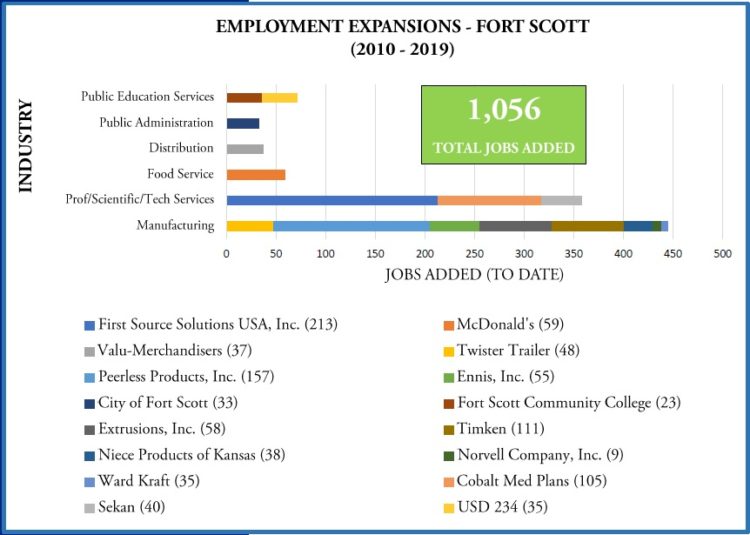
Rachel Pruitt, Fort Scott’s Economic Development Director says the city has seen job growth in the last decade.
She provided the above graph to demonstrate that growth.
“The graph represents the job growth Fort Scott has seen since 2010,” she said. “The data is collected by the City and Chamber by contacting each of the employers. The City anticipates the growth to continue given there are over 75 current openings within the community.”
” The City and Chamber do the research by calling the employers,” according to Pruitt.
The Fort Scott Area Chamber of Commerce is working to help fill job openings by sponsoring the 2019 Spring Job Fair on Tuesday, April 2 from 10 a.m to 2 p.m. at the Ellis Fine Arts Center on the campus of Fort Scott Community College, 2108 S. Horton Street.
“Employers of any size seeking employees are encouraged to reserve a booth,” according to a press release from the Chamber. “The job fair will give business owners the opportunity to recruit both students and community members for seasonal, part-time and full-time positions. This event is also an opportunity for employers to network with each other and to promote their company to the public.”
An employer booth at the job fair is $50 for Chamber members or $90 for non-Chamber members.
Lunch, if desired, is $10 per person.
To register, or for more information, contact the Fort Scott Area Chamber of Commerce at 620-223-3566 or visit fortscott.com.
Job fair informaiton submitted by Monica Walden, Administrative Assistant of the Fort Scott Area Chamber of Commerce which is located at 231 E. Wall Street, Fort Scott, KS 66701.
Senator Hilderbrand’s Weekly Communication March 22
|
|
|
|
|
|
|
|
|
|
|
The Bourbon County Sheriff’s Office Daily Reports March 25
The Fort Scott Police Department Daily Reports March 22-24

Legislative Update By State Senator Caryn Tyson
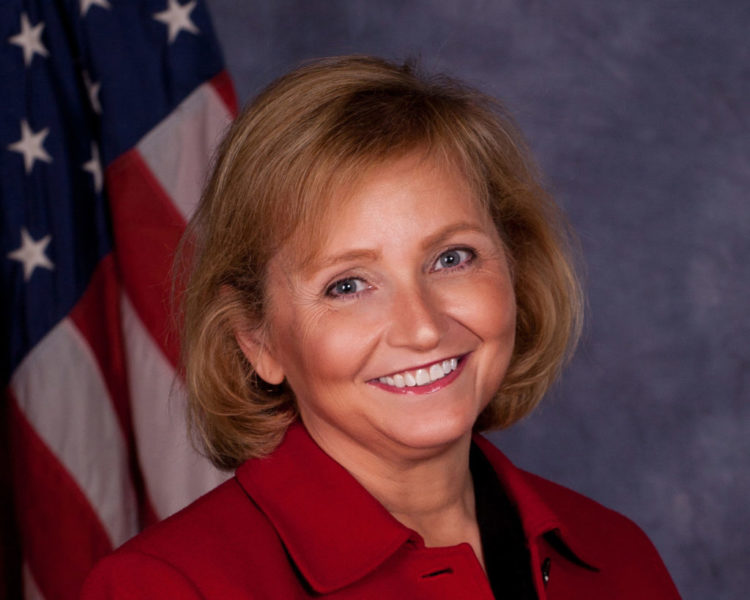
Legislative Update By State Senator Caryn Tyson
March 22, 2019
There is a spending problem in government, especially Kansas State government. The Senate passed a budget according to the Chair of Ways and Means that, “is more than the Governor asked for.” Senate Bill (SB) 75 appropriates $17.2 billion all funds and $7.1 billion of State General Funds (SGF). Since 2013, State expenditures have increased over $3 billion – a 19% increase in less than 7 years for all funds. The SGF increased $1 billion in that same time-frame – a 14% increase. This is not sustainable! SB 75 had a few good things, but not enough to justify the out-of-control spending. The vote was 21 Yes to 18 No. I voted No.
The Senate Tax Committee, which I chair, passed SB 91, an attempt to lighten the tax burden for senior citizens, disabled veterans, and Kansas taxpayers. SB 91 would freeze property taxes on a home via a tax credit for people over 65 who make less than $30,000 a year, and for disabled veterans. The bill would also increase the standard deduction for an individual to $3,500, up from $3,000. Married filing jointly would increase to $8,500. After the massive spending increases passed in the budget, cutting taxes is an attempt to reel in government growth.
Rural Opportunity Zone (ROZ): SB 125 would extend the ROZ five more years to 2026. The program is a state income tax credit for people moving into an approved rural county from out of state. The bill passed Yes 29 to No 11. SB 135 would increase the number of counties in the ROZ program by eight: Atchison, Cowley, Crawford, Dickinson, Ford, Franklin, Miami, and Pottawatomie. There are 73 counties in the program. If the bill becomes law, the entire Senate District 12 would be included in the ROZ. SB 135 passed Yes 30 to No 8. I voted Yes on both bills.
Kansas Closed Case Task Force would be established with SB 102. It creates a task force to create and implement a plan for uniform protocols for law enforcement to follow. The process does need to be identified. However, what makes legislators the experts in establishing the protocols and procedures relating to data hits in the Combined DNA Index System (CODIS). SB 102 would have two legislators co-chairing the task force. It’s just another layer of bureaucracy. The vote was 39 to 1. I voted No.
The Kansas National Guard Educational Assistance Program would be updated by House Bill (HB) 2123, removing a requirement that eligible members of the Kansas National Guard have at least one year remaining on their enlistment contract to qualify for education assistance. HB 2123 would allow Air National Guard members to participate as they can only re-enlist 90 days prior to their end of service. The bill passed the Senate unanimously.
Kansas sales tax statutes name some exemptions for specific groups, like a Rotary club in Wichita, while all other Rotary clubs in Kansas do not enjoy the same sales tax exemption. In an attempt to create a fair tax code, SB 178 sets parameters for non-profit community care organizations so that if an organization qualifies they get the sales tax exemption and do not have to go through the legislature to get their name added to the statutes. During debate on the Senate floor, an amendment was added that would require one sales tax exemption of equal or higher dollar amount to be removed when one is added. Sales tax exemptions total over $3 billion. The bill passed unanimously.
It is an honor and a privilege to serve as your 12th District State Senator.
Caryn
Downtown Meet and Greet April 2