Fiscal responsibility critical to rebuilding Kansas

Fiscal responsibility critical to rebuilding Kansas

The following column is by Governor Laura Kelly:

Just two short years ago, the State of Kansas found itself on the brink of financial disaster. Even after depleting state savings and enduring multiple rounds of devastating budget cuts, unsustainable tax policy continued to perpetuate fiscal crisis. We saw schools close and class sizes grow. We saw an overwhelmed child welfare system let children fall through the cracks. And despite promises of immediate prosperity, Kansas routinely ranked among the nation’s worst in multiple economic indicators.

As the budget hole continued to grow, the legislature passed two sales tax increases, swept more than $2 billion from the state highway fund, delayed numerous payments to the state pension system, accumulated historic levels of debt, and raided every critical investment from early childhood education to public safety. But in the end, none of these short-term band aids could stem the bleeding caused by the reckless Brownback tax experiment. In November of 2016, Kansans called for change.

The very next year, the state hit “reset” in a historic act of bipartisanship with the passage of comprehensive tax reform. Our credit score improved within a week. The number of Kansans participating in the labor force increased for the first time since 2014.

We have only just started the rebuilding process. Our recovery is uncertain; our budget is fragile. The State of Kansas cannot afford to make a U-turn now.

Senate Bill 22 – another reckless tax plan – would absolutely dismantle all the progress we’ve made. It would throw our state once again into a self-inflicted budget crisis, diminishing all the investments we’ve worked so hard to rebuild and restore. It would put our future at risk once again in order to give significant tax breaks to entities who need them the least, while continuing to leave working families behind.

I share Kansas lawmakers’ desire to keep the state tax burden as low as possible and that will continue to be a priority. In January, I presented a structurally balanced budget that funded our schools and roads, reduced state debt, left Kansas with the largest ending balance in 20 years and did so all without a tax increase.

I was a math major. This is about basic math. My budget proposal left a healthy, fiscally responsible ending balance. If I had signed Senate Bill 22, the budget that just passed the Senate would fall to more than $600 million in the hole within two years.

That is unacceptable. That is irresponsible.

We must be patient, thoughtful, and prudent as we evaluate tax policy. And, when we move forward with sustainable, commonsense tax relief, we must ensure that it benefits the Kansans who need it the most. We will focus on reducing the sales tax on food and providing real tax relief to working families.

The people of Kansas elected me to rebuild our state. They elected me to bring fiscally conservative and responsible principles back to our government. And I refuse to endorse another round of fiscally reckless policies – similar to the Brownback tax experiment – that left our state in shambles and our families struggling.

I commit to you – the people of Kansas – that I will stabilize our state’s budget, invest in our shared priorities, and continue the recovery we have all fought so hard to begin. By following through on this commitment, our state has every reason to expect a bright and successful future.
Water Technology Farms Report Now Available


Data from the 2018 growing season on the KWO website


Technology and management tools keep evolving to help crop producers make every drop of water count on their fields. Water Technology Farms were developed four years ago as part of the Long-Term Vision for the Future of Water Supply in Kansas. They began as three-year pilot public-private partnerships to demonstrate the latest in crop irrigation technology and water conservation research on the field scale.


“I’m pleased to see the growing interest in Water Technology Farms across the state,” said Kansas Water Office Acting Director Earl Lewis. “We continue to see outcomes from these farms showing that water use reductions, coupled with irrigation technology adoption and water management improvements are leading to positive effects on the aquifer as well as the producer’s bottom line.”


Water Technology Farms have proven valuable in helping to expand the conversation and education of producers as well as decision makers on equipment and technology utilized in agricultural water conservation efforts.


“As one of the first three Tech Farms we have learned so much as far as water conservation production and how what we do affects the Ogallala Aquifer,” Dwane Roth, Garden City Company/Dwane Roth Farm near Holcomb, KS. “A fifth generation Kansan recently said to me that western Kansas is different compared to other parts of the world – our water problems are solvable! I now ask with what we know, do we become resilient? And in doing so have vibrant local communities or do we become just another page in the history books? I say we become resilient.”


The 2018 Growing Season Report shares information about each of the 10 farms including the crop or crops grown, technology utilized to manage water application, as well as harvest data and sponsors of each location.


“My goal as a first year Water Technology Farm was to increase the bushels per inch of irrigation we produced,” said Matt Long of Long Water Technology Farm near Marienthal, KS. “We really pushed our crop using different application technologies, soil moisture probes and a weather station to utilize our irrigation water efficiently which resulted in growing 34 bushels per inch of irrigation. As we start this spring with adequate profile moisture and more knowledge about the application technologies and soil probes, I am excited to see how much more progress we can achieve.”


It is anticipated up to five new farms will be added to the network in 2019, bringing the total number of Water Technology Farms up to 15 for the 2019 growing season.  Field days and other informational events in conjunction with the Water Technology Farm Program will take place later this summer. For more information and the complete 2018 Growing Season Report, visit www.kwo.ks.gov


The Water Technology Farms would not be possible without key public-private partnerships. More than 80 companies and organizations support this effort and sponsors for each farm are on the Water Tech Farm pages on the KWO website.


For more information visit: www.kwo.ks.gov or contact Armando Zarco, Water Resource Planner at (620) 276-2901.

After 50 Years Teaching: Shinn Retires

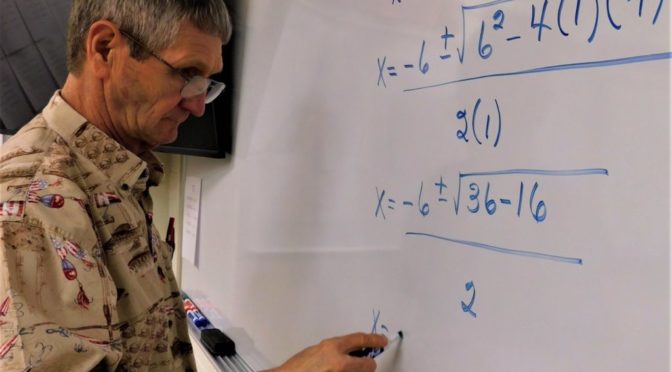
Alan Shinn has been a math teacher for 50 years at Uniontown High School, getting to his math room by 6 or 7 a.m. daily to prepare for class and be available for students with math questions.

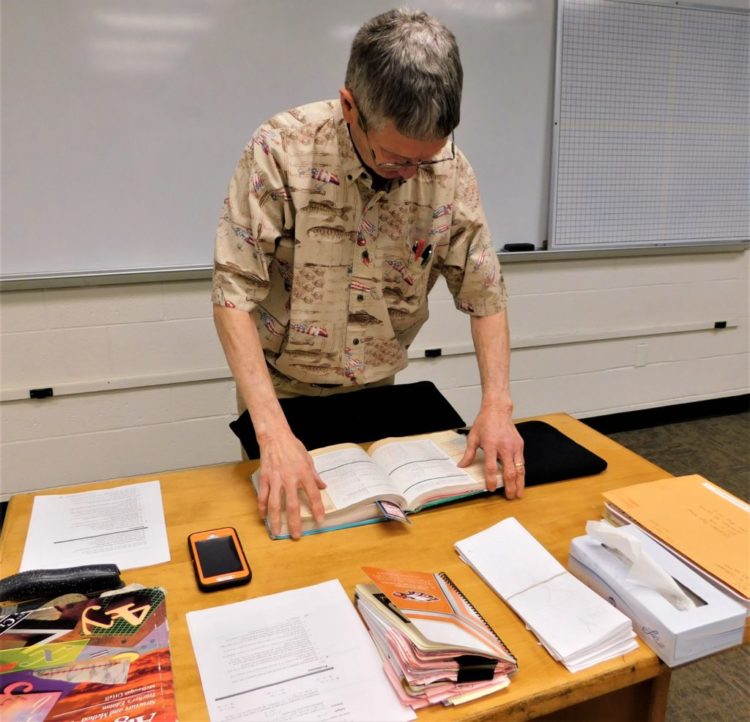
UHS Math Teacher Alan Shinn looks over a lesson for class.

As of May 17, he is retiring.

His long tenure began with an interest in math as a youth.

As a freshman at Iola High School, Shinn was challenged by his algebra teacher, Mr. Jewell.

“He would answer every question with a question,” Shinn said. “I know that frustrated fellow students. But it made me attempt to do the problem.  I decided my freshman year I wanted to be a math teacher.”

Shinn attended Allen County Community College, then Kansas State Teachers College at Emporia, getting a degree in mathematics.

He was the first person in his family to attend college.

Shinn started his first year of teaching math at Uniontown High School in 1969, with a $19,000 contract.

He found out about the UHS math vacancy from his uncle Don Nichols, who was the math teacher at the school for seven years.

His first year of teaching was a learning curve.

“The first year, my wife and I would go to Kansas City (to visit Don Nichols) a half-dozen times to get advice and answer questions I had about teaching,” Shinn said.

“I owe a lot to those two gentlemen: my freshman teacher and my uncle,” he said.

There was another motivation.

“My Dad worked at the cement plant,” Shinn said. “I got to work there for two summers. It was hot and dirty and I didn’t want to do that for the rest of my life.”

During his first year of teaching at UHS, Shinn was offered a scholarship from the National Science Foundation (NSF) through Pittsburg State University to get his masters degree in math.

At that time in history, science and mathematics were being strongly encouraged in the U. S. education system due to the space technology challenge from the Russians.

“They (NFS) paid for the master’s degree,” Shinn said.

“I think they need to do that again,” he said. “There is a shortage of math teachers.”

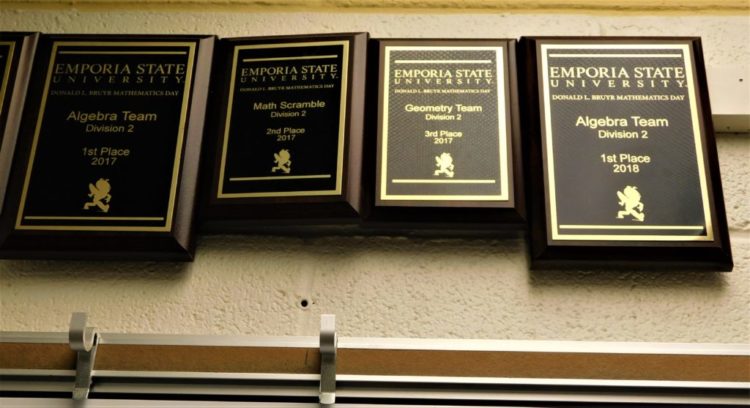
In his 50 years of teaching at UHS Shinn has coached math students into more than one hundred first-place victories in competitions with from three to 30 schools. Additionally, he has coached students to 46 second-place school awards and 24 third-place overall school achievements.

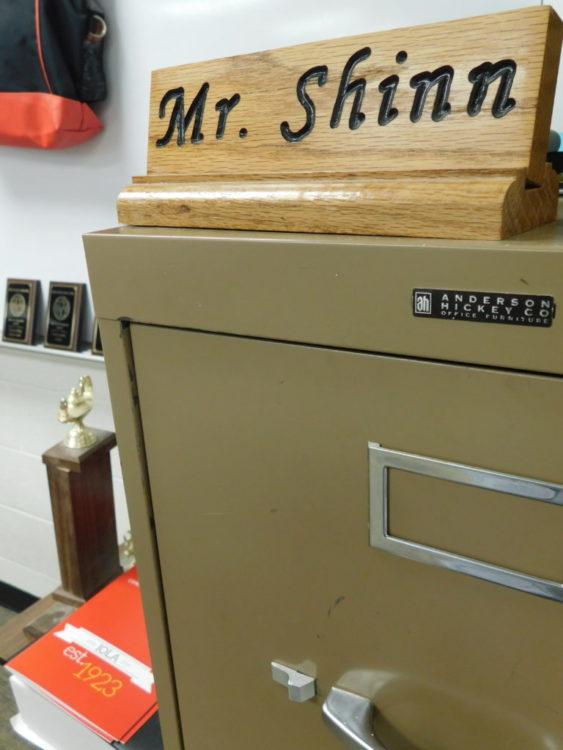
Some of Shinn’s math students’ awards line the wall in his room at UHS.

“I have had more than 20 students who are now math teachers,” Shinn said.  “Two more are going to college right now to become math teachers.”

Additionally, a current UHS senior and sophomore have a desire to become math teachers, he said.

“I have always been known for giving lots of homework,” Shinn said. “I don’t think you can learn math and do one-half dozen problems per night.”

The best part of teaching for Shinn is doing the best he can to get his students to “be able to go to college (math) and get through it.”

“I hope that I have made a difference,” he said.

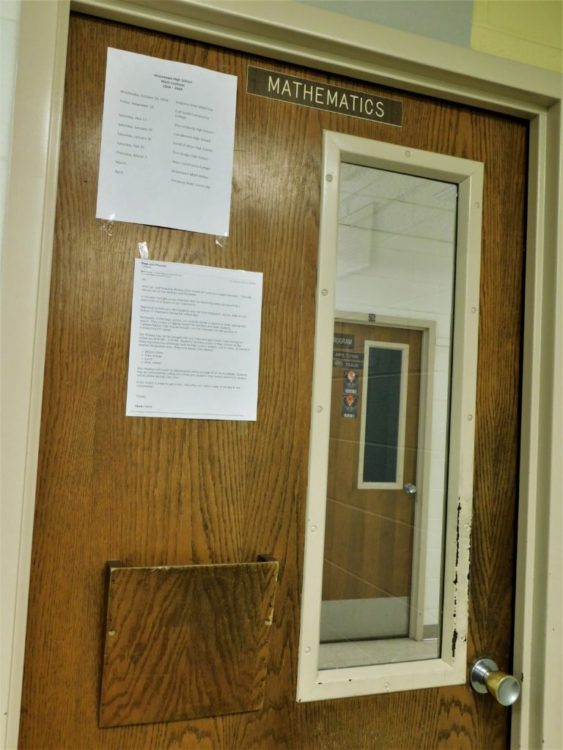
The door to Mr. Shinn’s UHS  math room.


Make a difference – adopt a highway


Make a difference in your community and help the environment at the same time – join the Adopt-A-Highway program in Kansas.


The goal of the program is to clean along the roadways throughout the state to increase safety for motorists and pedestrians as well as improve the beauty of Kansas. This helps to raise awareness on the negative effects of pollution and the positive aspects of a clean community.


Any non-profit group that does not discriminate upon the basis of race, religion or gender can join and there is no cost to the group. Members must be at least 11 years old and have adequate adult supervision. Groups have clean-ups three times a year and are recognized for their efforts with signs marking their sections of highway.


Adopt-A-Highway groups are gearing up for the annual Clean Up Kansas Campaign which takes place during the month of April. This event, as well as the program, is sponsored by the Kansas Department of Transportation. All Adopt-A-Highway groups are encouraged but not required to participate in the statewide event.


Groups clean their sections of roadway three times a year at their convenience. Most choose to schedule a clean-up time in the spring, summer and fall.


For more information, contact the KDOT office in your area (listed below). Ask for the Adopt-A-Highway coordinator in the KDOT office located closest to you.


Northeast Kansas

Topeka, (785) 296-2291

Kansas City Area –

Bonner Springs, (913) 942-3040

Olathe, (913) 764-0987

North Central Kansas

Salina, (785) 823-3754

Northwest Kansas

Norton, (785) 877-3315

Southeast Kansas

Chanute, (620) 902-6400

South Central Kansas

Hutchinson, (620) 663-3361

Southwest Kansas

Garden City, (620) 765-7074


Bourbon County Commission Agenda March 26

Agenda

Bourbon County Commission Room

1st Floor, County Courthouse

210 S. National Avenue

Fort Scott, KS 66701

Tuesdays starting at 9:00

Date: March 26th, 2019

1st District-Lynne Oharah Minutes: Approved: _______________

2nd District-Jeff Fischer Corrected: _______________

3rd District-Nick Ruhl Adjourned at: _______________

County Clerk-Kendell Mason

9:00-9:45-Jim Harris

Executive Session-Non-elected personnel-15 min.

KDOT-Highway 69 Project update

12:00-1:30-Commissioners gone to lunch

2:00-2:30-Executive Session-Attorney Client Privilege

Gov. Kelly Vetoes Senate Bill 22

Governor Laura Kelly refuses to endorse another tax experiment, vetoes Senate Bill 22


The following message is from Governor Laura Kelly regarding the veto of Senate Bill 22:


Just two short years ago, the State of Kansas found itself on the brink of financial disaster. Even after depleting state savings and enduring multiple rounds of devastating budget cuts, unsustainable tax policy continued to perpetuate fiscal crisis. We saw schools close and class sizes grow. We saw an overwhelmed child welfare system let children fall through the cracks. And despite promises of immediate prosperity, Kansas routinely ranked among the nation’s worst in multiple economic indicators.

As the budget hole continued to grow, the legislature passed two sales tax increases, swept more than $2 billion from the state highway fund, delayed numerous payments to the state pension system, accumulated historic levels of debt, and raided every critical investment from early childhood education to public safety. But in the end, none of these short-term band aids could stem the bleeding caused by reckless tax policy. In November of 2016, Kansans called for change.

The very next year, the state hit “reset” in a historic act of bipartisanship with the passage of comprehensive tax reform. Our credit score improved within a week. The number of Kansans participating in the labor force increased for the first time since 2014. And we’ve finally begun to heal from the unprecedented devastation found in state agencies and state programs.

However, we have only just started the rebuilding process. Our recovery is tenuous; our budget is fragile. The State of Kansas cannot afford to make a U-turn.

Unfortunately, Senate Bill 22 would absolutely dismantle all the progress we’ve made. It would throw our state once again into a self-inflicted budget crisis, diminishing all the investments we’ve worked so hard to rebuild and restore. It would put our future at risk once again in order to give significant tax breaks to entities who need them the least, while continuing to leave working families behind.

Additionally, as noted by the Senate President during the floor debate, Senate Bill 22 will put Kansas out of compliance with the Streamlined Sales and Use Tax Agreement. This would potentially cost Kansas up to $18 million in lost revenue — on top of the bill’s already unaffordable $200 million price tag in the next fiscal year.

I look forward to working with the Kansas Legislature in the future to achieve our common goal of a reduced food sales tax. However, as I explained repeatedly — both as a candidate for governor and after I took office – we cannot responsibly enact a food sales tax cut until our state’s fiscal health stabilizes. This is not the time.

I share Kansas lawmakers’ desire to keep the state tax burden as low as possible and that will continue to be my priority. In January, I presented a structurally balanced budget to the Kansas Legislature that funded our schools and roads, reduced state debt, left Kansas with the largest ending balance in 20 years, and did so all without a tax increase.

The people of Kansas elected me to rebuild our state. They elected me to bring fiscally conservative and responsible principles back to our government. We must be patient, thoughtful, and prudent as we evaluate tax policy. And, when we move forward with commonsense tax relief, we must ensure that it benefits the Kansans who need it the most.

Therefore, under Article 2, Section 14(a) of the Constitution, I hereby veto Senate Bill 22.

Bryan’s Termite and Pest Control

Get on top of pest control before it gets you!
Bryan’s Termite and
Pest Control
is offering treatment for ants, spiders, mice, bed bugs and termite inspections
Bryan’s Termite and Pest Control is offering treatment for ants, spiders, mice, bed bugs and termite inspections.
Residential and Commercial
Insured, licensed, and guaranteed.
One-time service and ongoing prevention & treatment available.
Free estimates (with the exception that real estate termite inspections are $50).
Call Bryan K. Rushing
“The Bug Man”
at 620-224-9566
Prompt, reliable, honest service

Seeding Cool-Season Grasses in the Spring is Difficult

Krista Harding
District Extension Agent, Horticulture
Southwind Extension District
111 S. Butler
Erie, KS 66733
Office: 620-244-3826
Cell: 620-496-8786


It makes me happy to say that spring has arrived, on the calendar at least! After a seemingly endless winter, I think everyone is excited to know that spring is near. The frogs have been singing at my house and this is one of my favorite signs of spring! The other, I like to catch a whiff of smoke on the air from the burning that takes place in the spring. I know not everyone is a fan of this, but it is a necessary and useful tool that agricultural producers use.

It won’t be long and the lawn mowers will be pulled out of the garage preparing for the season ahead. As you survey your lawn in the next few weeks, you may be thinking to yourself that it looks a bit ragged. You might even consider buying some seed and throwing it out in the lawn in hopes of thickening it up. Before you do that, I would like to give a little advice….wait!

It is not recommended to seed cool-season grasses such as tall fescue and Kentucky bluegrass in the spring. I know this seems strange because it would seem that spring would be the best time for seeding because the entire growing season is available for the grass to grow and establish. But there are a number of reasons why you should wait until fall to seed.

  • Summer is the hardest time of year for cool-season grasses – not the winter. Summertime is difficult because our cool-season grasses do not have the heat or moisture stress tolerance that our warm-season grasses such as buffalo, zoysia and Bermuda have. Therefore, they tend to become weakened in the summer which makes them more susceptible to disease and other stresses – especially heat. Young, newly planted seedlings struggle even more to survive the summer.
  • Soils are warmer in the fall. Warm soils mean less time required for germination and growth, so the grass becomes established more quickly.
  • In the spring, our major weed problems are annual grasses such as crabgrass. Since spring seeded turf is slow to mature, there are often thin areas that are easily invaded by these grassy weeds. If this happens, weeds are better adapted to our summer conditions than our cool-season grasses and so the weeds take over! Plus, the chemicals that can be used on young turf is limited.
  • Weeds are less of a problem in the fall. The major weed problems in the fall tend to be chickweed, henbit or dandelions. Turf seeded in early September is usually thick enough by the time these weeds germinate that often there is not much weed invasion

Spring seeding of cool-season grasses can be done, but it is more difficult to pull off than fall seeding. So my advice is to just tough it out this spring and summer if your yard is less than desirable. Come late July and August, get a game plan together for fall seeding. If your lawn needs a complete renovation, late summer is the time to do a complete kill-out of grass and work to get a good seed bed prepared.

If you have questions about lawn fertility, weed control or seeding, please don’t hesitate to contact me. A reminder, I am in Fort Scott every Thursday. Feel free to stop by the office and visit.

Krista Harding is a K-State Research and Extension Agricultural agent assigned to Southwind District.  She may be reached at 620-244-3826 or [email protected].

K-State Research and Extension is an equal opportunity provider and employer.

Bourbon County Local News