Teaching Young Children During the Pandemic: A Teachers Viewpoint

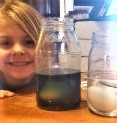
Lauren Walker, a student in Mrs. Gauthier’s kindergarten class, works on an experiment at home. Submitted photos.


Uniontown’s school district began a continuous learning plan to allow students to learn from home during the nationwide closure of schools, due to the COVID 19 pandemic.

Last week, a parent’s story of how the learning plan was working was published on FortScott.Biz.

This feature is from a teacher’s view.

Rose Gauthier teaches kindergarten at West Bourbon Elementary School.
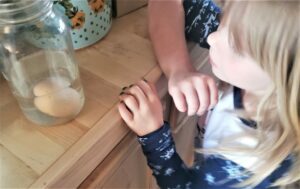
A.J. Vincent looks at her science experiment, following a lesson from WBE Kindergarten Teacher Rose Gauthier. Submitted photos.

Following is an interview by email from Gauthier.

When did the USD235 Continuous Learning Plan begin?

“We began Thursday, April 2nd with a practice run with the parents and students to work out kinks. We started our remote learning officially on Monday, April 6th. We will finish on Tuesday, May 19th.”

How much daily planning do you have for the classes?

“A lot. A teacher’s job has never been a 9:00 to 5:00 job, but even more so with this new way of teaching. It is hard to put a certain time frame on all the work the teachers, administration, and staff have put into it. From getting devices into student’s hands, the tech department working out tech issues for teachers and parents, and teachers creating different ways to teach their students with this new way of learning.”

Did you get together as a group of teachers and decide what the most important things to teach are?

“Yes. The school began with many “Zoom” meetings that included administration and teachers, with guidance from KSDE, to determine the best way to reach the kids.”

(Zoom provides users with a cloud (internet) platform for video and audio conferencing, collaboration, chat, and webinars across mobile devices, desktops, telephones, and room systems, according to the Zoom website).

“I create a meeting on Zoom and send the parents an invite.,” she said. “The students click on a link and have a password to log in.”

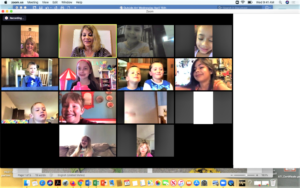
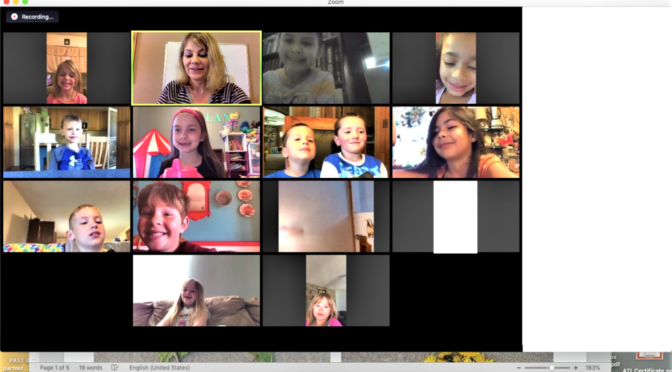
Rose Gauthier’s kindergarten class can view each other during lesson time. Submitted photo. Gauthier is shown on the top row, second from left.

“Our focus, as for many schools, is primarily the social and emotional spirit of the kids. This is a difficult and confusing time for them and many of the kids do not understand what is going on, especially at the primary levels. Letting them know that we are here for them, we miss and love them. Academically we are focusing on maintaining what the kids have already learned and limited new material to the essential outcomes that were agreed upon as a team”

Do you teach from home or do you go to school?

Both, the less I need from my classroom the more I teach from home. I go in once or twice a week.”

Have you seen any good come out of this difficult situation of not having the students in a classroom?

“Out of every bad situation, something good always comes out of it. Nothing will replace the social and emotional aspects of being together in the learning environment. The hugs, the high fives, being right beside them to guide them in their learning.”

“This situation has given us the appreciation of each other, the parents an opportunity to be a bigger part of the learning experience, and for all of us to step back and remember what is really important in life. And mostly, we get reminded of what a great community we have. We couldn’t do this without the support of great parents.”

What are some of the challenges?

“The biggest challenge is not seeing the kids every day. Adjusting to remote learning and tech issues are some other challenges, which gets easier as we go along. Also, reaching those kids without internet access is a challenge.”

How do you grade the kindergartners in this new plan?

“In Kindergarten we don’t give a traditional letter grade. We use checklists to provide feedback to parents about where the students are academically. During this time, we will still focus on those checklist skills while understanding that we will need to be prepared to provide the needed remediation to students at the beginning of the 2020-21 school year.”


“The district has worked together to provide a similar learning experience for all students, but obviously this looks slightly different based on the grade, content, teaching style, etc.”
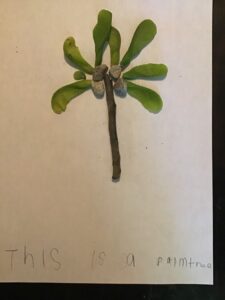

Outdoor art by Kinnis Shepard, from Rose Gauthier’s kindergarten class. Submitted photos.

Gardens Can Provide Some Food Security

Krista Harding
District Extension Agent, Horticulture
Southwind Extension District
111 S. Butler
Erie, KS 66733
Office: 620-244-3826
Cell: 620-496-8786


Just like many of you, I’m having difficulty wrapping my mind around how quickly our lives have changed in a very short period of time. Seeing the panic and chaos that’s happening around us can be concerning. Now more than ever, it might be the time for folks to think about becoming more self-sufficient and grow some of their own food.

I have been in contact with a couple of our local suppliers and have seen social media posts that they are stocked with garden seed and supplies. Like many other local retailers, I know they are willing to work with you if you do not feel comfortable going inside the business. Just give them a call and arrange for outside pick-up.

If you are reading this and thinking to yourself that you have never grown anything in your life and just don’t think it’s possible, let me assure you that it is possible. Even for the most novice! You might be thinking that you don’t have space for a garden, or maybe you don’t have a tiller or other equipment. Don’t let that stop you because almost all vegetables can be grown in containers.

The containers don’t have to be anything fancy. Literally, anything that can hold soil and have drain holes drilled in the bottom can be used. Containers that are 16 to 24 inches in diameter work well. Containers less that 12 inches are probably too small – except for lettuces. The most important component of growing vegetables in a container is getting the right potting media. Potting mixes are ideal (instead of soil from your yard). The components are lightweight and hold water and oxygen much better. Make certain that you don’t forget to drill some drainage holes into the bottom of the container.

Fertilizer should be added at planting time and mixed into the soil. If you want to go the organic route, mix blood meal or bone meal into the soil before planting. If you use a synthetic fertilizer, add a slow-release type when preparing the container.

Another benefit to growing vegetables in containers – you don’t have to fight the weather quite as much. Right now, traditional garden soils are way too wet to even think about planting. But with the container system, you can keep them dry inside a garage until you are ready to plant.

Early spring is the ideal time to plant cool season vegetables such as lettuce, spinach, radish, onions, carrots and potatoes. All can be easily grown in containers, even potatoes!

Gardening is a great stress reliever. It also allows for good social distancing. If you have kids at home, gardening is the perfect activity to get them outside to enjoy some fresh air and sunshine, all while learning at the same time!

Here’s where I come in. I have lots of resource material to help you. In addition, I’m always available by phone, e-mail or social media to answer your questions. Don’t be afraid to ask! In Extension, we say there are no “dumb” questions! I am here to help you in any way that I can. The Extension mission continues. We are committed to being innovative to connect you with research-based resources and education. We appreciate your patience as we all navigate the challenges associated with this time. 

Krista Harding is a K-State Research and Extension Agricultural agent assigned to Southwind District.  She may be reached at [email protected] or 620-244-3826.

K-State Research and Extension is an equal opportunity provider and employer.

Governor addresses workers compensation for frontline responders     


TOPEKA – In an effort to help Kansans who put their health and lives on the line during the COVID-19 pandemic, Governor Laura Kelly is directing the Kansas Department of Labor (KDOL) to evaluate all of its processes and procedures for handling workers compensation claims filed by law enforcement, firefighters, emergency medical service providers and health care workers that are reasonably related to the pandemic.


KDOL will draft and submit a temporary regulation and develop or prepare potential legislation designed to create workers compensation coverage for our first responders and healthcare workers who contract COVID-19 while assisting in the State’s response to the pandemic. The regulation and proposed legislation will create a presumption that first responders and healthcare workers who contract COVID-19 contracted the disease arising out of, and in the course of their employment. The legislation will be reviewed or developed in time for consideration by the Kansas Legislature at the next possible opportunity, special or regular session, whichever occurs first.


Should any law enforcement, firefighters, emergency medical service providers or health care workers who contract COVID-19 while assisting in the State’s response to the pandemic be found not covered by workers compensation, the Governor’s office will request that the Legislature establish a special fund to satisfy claims incurred during the emergency.


“It is imperative that we stand behind emergency responders, healthcare workers and the many other steadfast Kansans who serve the public each and every day, at risk to their own personal health and safety,” the Governor said.


“KDOL stands ready to assist in this expansion of workers compensation coverage for our healthcare workers and emergency responders,” Secretary Delía García said. “We are working on the regulation and reviewing Kansas’ current work comp statutes now.”


Confirmed COVID-19 case at Topeka Correctional Facility


TOPEKA, Kan. – Kansas Department of Corrections (KDOC) Secretary Jeff Zmuda announced today that one staff member at Topeka Correctional Facility (TCF) tested positive for COVID-19 on Monday, April 20. This is the third KDOC facility with a confirmed case, with the first cases reported at the Lansing Correction Facility and Wichita Work Release Facility.


The staff member at TCF is a male over the age of 20. In order to protect the identity of the person, no other information will be released.


The KDOC has been in consultation with officials from the Kansas Department of Health and Environment (KDHE) on next steps to address these circumstances. As a result of that consultation with KDHE, the following steps were implemented:


  • KDHE conducted contact tracing to determine who among our staff and residents have been in close contact with this individual
  • The Shawnee County Health Department conducted contact tracing to identify anyone outside of TCF who may have been in close contact with this individual and will notify those persons
  • KDOC will remain diligent in monitoring other staff and residents for symptoms


“Our corrections staff are committed to their work of preparing our residents for a successful return to their communities,” Zmuda said. “Our staff take that responsibility very seriously and we will continue to work with KDHE to ensure that we are conducting ourselves in a way that ensures the health and safety of everyone.”


The Topeka Correctional Facility is Kansas’ only all-female prison with a capacity of 948. The facility houses minimum, medium, special management and maximum custody residents.


For current information on COVID-19 in Kansas, and to sign up for updates, go to the KDHE COVID-19 Resource Center at kdhe.ks.gov/coronavirus.
 

###


FSCC Will Livestream Tonights Meeting

To access a livestream of tonight’s regular monthly Fort Scott Community College Board of Trustees meeting, follow the youtube link currently posted at the top of the Board of Trustees page on FSCC’s website found here http://fortscott.edu/trustees.

The youtube link will provide a live feed of the meeting.

Once the meeting is adjourned tonight, Zoom will process the cloud-based storage and provide a link that will provide a replay version of the meeting.  The replay link will be posted to the same place on FSCC’s website by noon tomorrow.

Provided by Juley McDaniel, Clerk of the board.


Fort Scott Commission Agenda April 21

AGENDA

FORT SCOTT CITY COMMISSION

FORT SCOTT CITY HALL

COMMISSION ROOM

123 SOUTH MAIN

APRIL 21, 2020

6:00 P.M.

I. ROLL CALL:

K. ALLEN P. ALLEN NICHOLS WATTS MITCHELL

II. FLAG SALUTE

III. INVOCATION:

IV. PROCLAMATIONS/RECOGNITIONS: National Public Safety Telecommunicators Week – April 12-18, 2020

V. CONSENT AGENDA:

  1. Approval of minutes of the regular meeting of April 7th, 2020.

  1. Approval of Appropriation Ordinance 1261-A totaling $495,579.32.

  1. Resolution No. 10-2020 – Notice of Hearing with Reference to Alleged Unsafe and Dangerous Structure located at 10 N. National Street – Public Hearing Date – June 2nd, 2020 – 6:15 p.m.

  1. Request to Pay #8 – Crossland Heavy Contractors – $297,929.28 – River Intake Project

  1. Change Request Proposal #11 – Crossland Heavy Contractors – $37,859.00 – River Intake Project – Pump #3 Rebuild

  1. Approval of 3RK – Certificate of Pay Request #4 – MIH Housing Grant – $11,557.87.

  1. March financials

VI. APPEARANCE/COMMENTS/PUBLIC HEARING:

  1. APPEARANCE: None

B. CITIZEN COMMENTS (Concerning Items Not on Agenda – 5 minute limit per citizen) Comments will not be taken during this meeting. If you have a topic to discuss not listed on the agenda, please contact a City Commissioner or send a written request to [email protected].

C. PUBLIC HEARINGS/COMMENTS: 6:00 p.m. De-annexation of property located at 1121 207th Street – Approval of Ordinance No. 3560

VII. CONSIDERATION:

  1. Consideration to Hire a City Engineer

  1. Consideration of Request to send out Request for Qualifications for City Engineer

  1. Consideration of Approval of Salary Ordinance Number 3561

  1. Consideration to repeal Ordinance No. 3556 and approve Ordinance No. 3562 establishing a Street Advisory Board

  1. Consideration of appointments to Street Advisory Board (Six (6) City residents – One (1) County resident within 3 mile limit)

  1. Consideration to reject bids – Machine Shed – Airport

  1. Consideration to apply for 2020 CARES Act for Airport runway improvements funding

  1. Consideration of approval of charter ordinance to fill a vacancy on the City Commission

VIII. COMMENTS:

  1. Director Updates:
  1. Commission:
  1. City Manager:

EXECUTIVE SESSION:

I MOVE THAT THE CITY COMMISSION RECESS INTO EXECUTIVE

SESSION FOR ________________________________ IN ORDER TO

(see below justification)

DISCUSS ______________________________________. THE

EXECUTIVE SESSION WILL BE ___________ MINUTES AND THE OPEN

MEETING TO RESUME AT ________________.

Justifications for Executive Sessions:

  • Personnel matters of non-elected personnel

  • Consultation with an attorney for the body or agency which would be deemed privileged in the attorney-client relationship

  • Matters relating to employer-employee negotiations whether or not in consultation with the representative or representatives of the body or agency

  • Confidential data relating to financial affairs or trade secrets of corporations, partnerships, trusts and individual proprietorships

  • Preliminary discussions relating to the acquisition of real property

IX. MOTION FOR ADJOURNMENT: ROLL CALL

Close calls in highway work zones occur all too often

Amelia Earhart Bridge is lit in orange during a past National Work Zone Awareness Week safety campaign. Submitted photo.


Highway construction projects are continuing across the state with modified work practices. And as always, work zone safety is a top priority for the Kansas Department of Transportation, Kansas Turnpike Authority and partner organizations. Unfortunately, there are oftentimes close calls in work zones.


KDOT Equipment Operator Specialist Kent Portenier, from the Phillipsburg office, realized a vehicle traveling through a work zone did not see him.


“I took off towards the ditch just as the driver hit the corner of the stopped pickup,” Portenier said. “The driver also swerved into the ditch and fortunately missed hitting me as I was running to safety.”


KTA Structures Worker Caleb Provo, from the Wichita office, was in a dump truck during a striping operation when he saw a semi traveling in the wrong lane.


“There was no way the driver could stop in time, and he tried to – unsuccessfully – squeeze between me and the barrier wall to avoid a collision,” Provo said. “Ultimately, the semi driver ended up crashing into the back end of my attenuator.”


Portenier, Provo and others are sharing their stories this week as part of a blog series to help illustrate the importance of work zone safety. Read all the blogs here –www.kansastransportation.blogspot.com.


“Close calls are all too common for highway workers, law enforcement and emergency responders who are serving the public,” said KDOT State Transportation Engineer Burt Morey. “It’s imperative that all drivers make paying attention and focusing on the road their main priorities every time they get in a vehicle.”


National Work Zone Awareness Week, which is April 20-24, raises awareness of the dangers highway workers and motorists face in work zones. Last year in Kansas, 1,420 work zone crashes occurred in which 437 people were injured and seven people were killed. A few locations around the state will be lit in orange to highway work zone safety, such as the Amelia Earhart Memorial bridge in Atchison.


For more information about work zone safety in Kansas, go to KDOT’s website, www.ksdot.org, and click on the work zone safety slide.

Kansas COVID 19 Update April 20

Bourbon County has six cases.

Corrected:

“The reason the number of cases went from 7 to 6 is because one of the positive cases was living in Bourbon County, but was actually a resident of Woodson County, KS. So, now Woodson County has 5, where they had 4 cases,” according to Rebecca Johnson, administrator of Southeast Kansas Multi-County Health Department.


https://www.coronavirus.kdheks.gov/DocumentCenter/View/912/4-20-20-update-numbers

The Census Is Important For Future Funding And More

“The census affects many aspects of funding, legislative apportionment, and our official population count for the next 10 years ~ it’s important to get as many people to respond as possible,” Lindsay Madison, Fort Scott Chamber of Commerce Executive Director said.   “Your help is appreciated!”
Lindsay Madison is the Fort Scott Chamber of Commerce Executive Director.

Why participate in completing the census?

According to the census website: https://www.census.gov/programs-surveys/decennial-census/2020-census/about/why.html

Here are the reasons:

Federal funds, grants and support to states, counties and communities are based on population totals and breakdowns by sex, age, race and other factors. Your community benefits the most when the census counts everyone. When you respond to the census, you help your community gets its fair share of the more than $675 billion per year in federal funds spent on schools, hospitals, roads, public works and other vital programs.

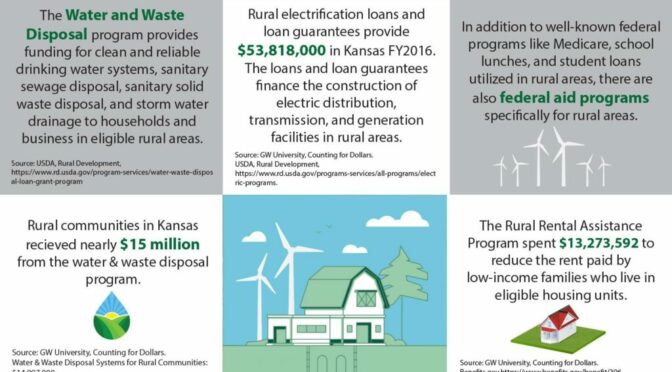
A post from the Kansas Dept. of Commerce explains some more detail of why it is important for rural areas to send back the census forms:

Taken from the Kansas Dept. of Commerce Facebook page.

The current census response rates compared to the state and national average and Bourbon County were pulled together by  Madison.

The response rates:

National- 48.6%
State- 53.3%
Bourbon County- 45%
City of Fort Scott- 46.8%

“Becki Roberts is our local ‘on the ground’ contact for the census leading the local census takers, etc.,” Madison said.

Online, phone and mailed self-responses will continue throughout the data collection process, according to information provided by Madison.

In light of the COVID-19 outbreak, the U.S. Census Bureau is adjusting 2020 Census operations in order to:

  • Protect the health and safety of the American public and Census Bureau employees.
  • Implement the guidance from Federal, State, and local authorities regarding COVID-19.
  • Ensure a complete and accurate count of all communities.

Under the adjusted 2020 Census operational plan, field activities would resume after June 1, 2020, as Area Census Offices begin returning to full staff capacity.

Extended Time To Collect Data

Due to health and safety concerns related to the coronavirus pandemic, this will be the first-ever decennial census that has been delayed, according to  Steve Hale, Sr. Partnership Specialist (Kansas) with the U.S. Census Bureau / 2020 Census, in the information provided by Madison.


For more info: 2020census.gov

 The U.S. Commerce Department officially is seeking statutory relief from Congress for 120 additional calendar days to deliver final apportionment counts, according to the info provided by Madison.
Under this plan, which must receive congressional approval, field data collection and self-response will be extended from the original July 31 date until October 31, 2020. Apportionment counts would then be delivered to the President on April 30, 2021, and the redistricting data to be delivered to the states by July 31, 2021.
Here’s a quick link to those Operational changes:
Delivery of 2020 Census Paper Questionnaires
Also of note is those households that have not yet responded online or by phone to the initial 2020 Census mailings are now receiving a paper questionnaire.
While more than half of Kansas households have already responded online, some may prefer the paper-and-mail option.
Phone Response Wait Times
Persons using the phone to respond to the Census are experiencing increased call wait times. This is primarily due to social distancing measures. There’s a link in the Infogram
explaining a call-back option and the Census Bureau making more employees available to respond to requests.
Response Map
The public is encouraged to go to the 2020 Census response rate map to see how its community is responding by county or city or census tract. The map is updated daily.

Bourbon County Local News