|
|

|
|
|

|
|
|

|
|

|
|
|

|
|
|

|
|||||||||||||||
|
|
|
|
|
|
|
|
|
|
|
|
|
|
|
|
|
|
|||||||||||||||
|
The Fort Scott Community College Board of Trustees will hold a board workshop on Friday, August 22 at 12:00 pm in Cleaver-Burris-Boileau Agriculture Building to prepare for the regular board meeting to be held on August 25.
They may adjourn to executive session if needed.
No action will be taken at this workshop.
The cost of employee benefits in 2024 for Bourbon County has come up frequently in recent discussions about the county budget. Generally, the number has been given at around $4,000,000 for about 100 employees.
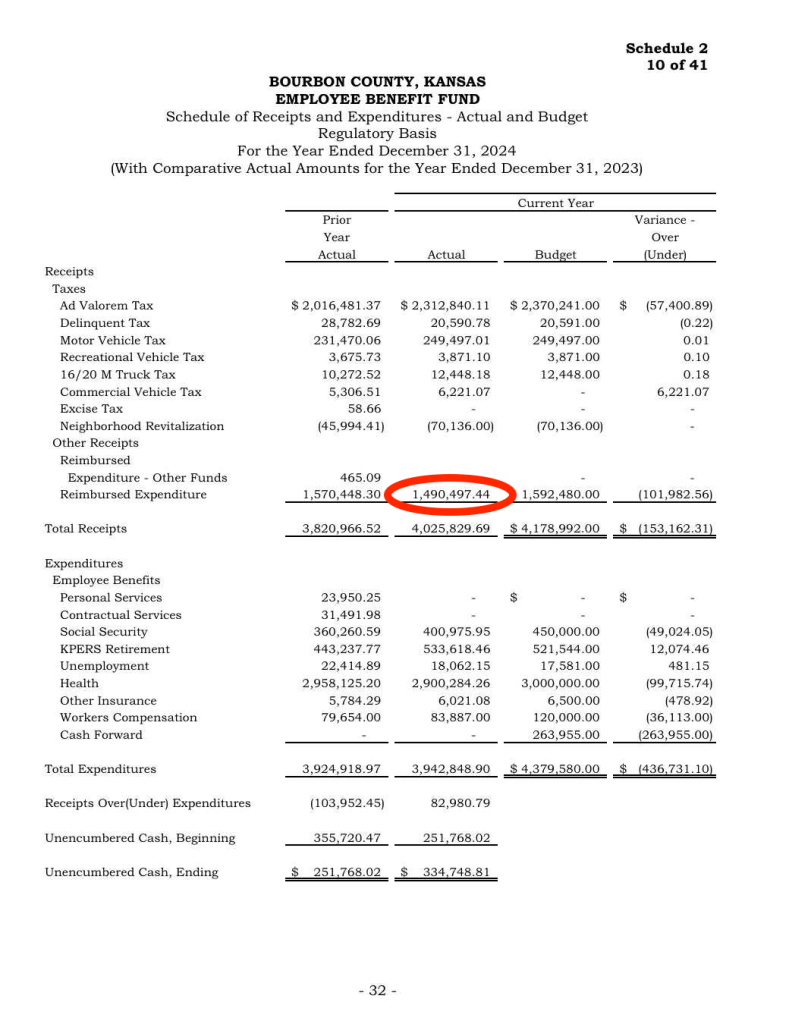
In paperwork from the county, the actual amount budgeted for 2024 was $4,379,580, but the amount actually spent in 2024 was $3,942,848.
While those numbers are correct in the sense that they represent the amount that shows up on the accounting document, the roughly $4 million amount includes money that is deducted from the employee’s paycheck for various benefits. For example, if an employee’s family is being covered by county health insurance, the employee is responsible for a portion of those premiums, but the amount the employee reimburses still shows up as outflow under the Health line item.
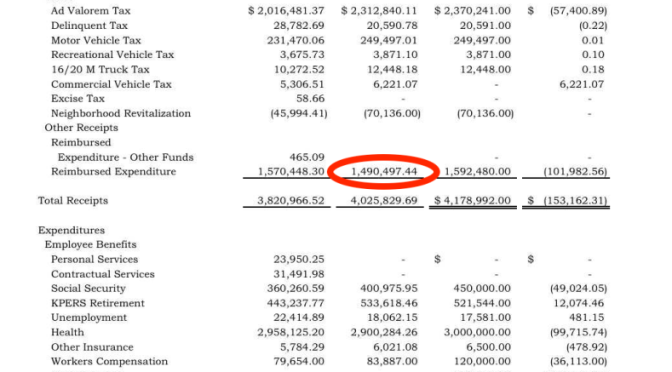
In 2024, $1,490,497.44 was deposited into the employee benefits account as “Reimbursed Expenditure” from employee salary deductions, which covered employee contributions for benefits. These deductions include various types of insurance that the employee can choose to pay for, as well as money funding health savings accounts or flexible spending arrangements.
So to get a better idea of how much of the money being payed out in employee benefits is actually being paid by the county and not the employees, the amount that is being paid by employee payroll deductions needs to be subtracted from the amount flowing out of that account. The total employee benefit expenditures minus the amount reimbursed via payroll deductions come to $2,452,351.46.
With approximately 100 employees, this would bring the average spent per person on county employee benefits closer to the $24,000 range, rather than the $40,000 range, as it might appear at first glance.

“Classes begin Tuesday evening at Community Christian Church Use the southeast side door. Classes will run from 6:00 p.m. to 8:00 p.m. for 13 weeks beginning August 26th,” said a spokesman, Jon Bailes. “Everyone is welcome and there is no charge except for a workbook.”
“This is a Biblically based program that has been operating with great success at helping people who have lost a loved one.”
Community Christian Church is hosting, but is not responsible.

|
Update: It appears that the dates published in the notice that was mailed to residents and the USD 234 public hearings will be on 9/11/2024 at 5:30 at 424 S Main. The USD 234 Recreation (Buck Run) will be at 9/3/2025 at 12 PM at Buck Run Community Center.
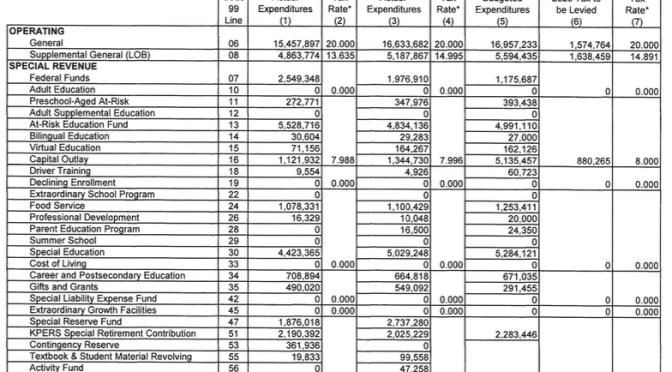
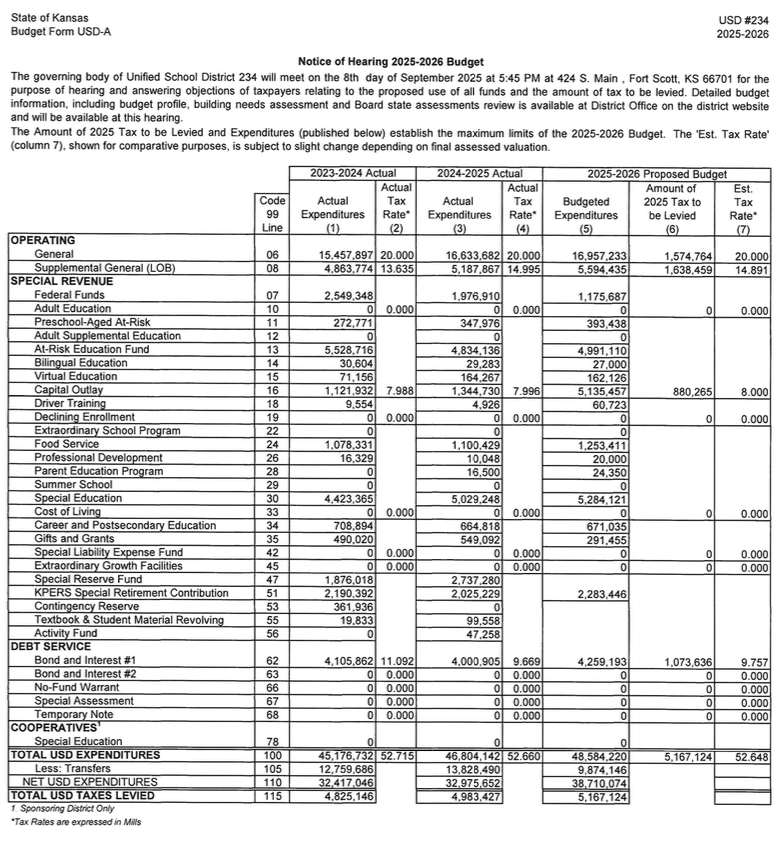
According to Terry Mayfield, Assistant Superintendent at USD234, the public hearing regarding the district’s proposal to exceed the revenue-neutral rate will be held on September 8th, 2025, at 5:30 & 5:45 p.m. at 424 S. Main, Fort Scott, KS 66701. The county’s Notice of Proposed Property Tax Increase and Public Hearing mailing, which was previously mailed to county residents, had listed the hearing dates as September 3rd and September 11th.
According to the notice, “Detailed budget information, including budget profile, building needs assessment and Board state assessments review is available at the District Office on the district website and will be available at this hearing.”
See the attached PDF for the proposed budget amounts:
USD 234 Hearing Notices 2025-2026
|
|
|
|
|
|
|
|
|
|
|
|
|
|
|
|
|
|||||||||
|
| A meeting to form and formalize a stamp club will take place at the Fort Scott Library , 201 S. National, on Sept. 13 from 10 a.m. to 12:30 p.m.
The challenge this month is to locate and or display your favorite foreign stamp. The meeting allows discussion of the bylaws and membership in the club. Free, previously used, postage stamps will be available for all persons wishing to start or continue a collection. There is no charge for attendance and a special membership drive will waive the first year dues. Dues cover only the operating costs of the club.
Fort Scott Public Library Lower Floor Conference Room 201 S National Ave., Fort Scott, KS 66701 RSVP to [email protected]
|
Thursday, October 2nd: 3:00 p.m. – 4:00 p.m. — Guided Trolley Tour of Gordon Parks’ Fort Scott & The Learning Tree Film Scene Locations
Meet at the entrance of the Fort Scott Community College Ellis Fine Arts Center, 2801 S. Horton.
Saturday, October 4th: 3:45 p.m. – 4:45 p.m. — Guided Trolley Tour of Gordon Parks’ Fort Scott & The Learning Tree Film Scene Locations. Meet at the entrance of the FSCC Ellis Fine Arts Center
Kirk Sharp, Executive Director
Gordon Parks Museum
Fort Scott Community College
2108 S. Horton
Fort Scott, Kansas 66701-3141
620-223-2700, ext 5850
Email: [email protected]
In 1977, USD234’s budget was discussed in the Tribune. The story lists the district’s budget as $2,332,642 and the number of students as 2112 for the year, which gives a cost per student of $1,104.47.
This historical cost per student is now part of the data that school districts submit to the state, but the district no longer has (or can’t easily obtain) records before 2002.
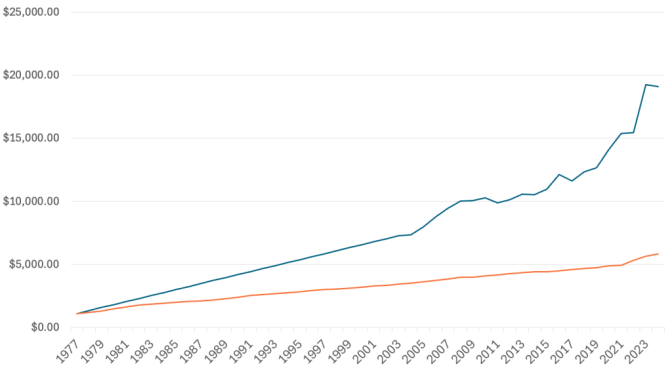
The most recent cost per student at USD234 was $19,110 in 2024. This was down just slightly from the $19,235 cost per student in 2023. While $19,110 is $18,006 more than what each student cost in 1977, inflation accounts for a portion of that increase.
In 1977, the average annual wage in the United States was $9,779.44, and a new car could be purchased for $3,000 to $6,000. To obtain a fair comparison, one needs to graph the growth of spending against the amount of the 1977 cost per student, adjusted for inflation, each year. While no data was available from 1978 to 2001, those amounts have been represented as an even increase between the 1977 amount and the amount in 2001. The actual cost per student between those years may not be individually accurate, but the growth rate will be correct. Inflation numbers come from BLS.gov.
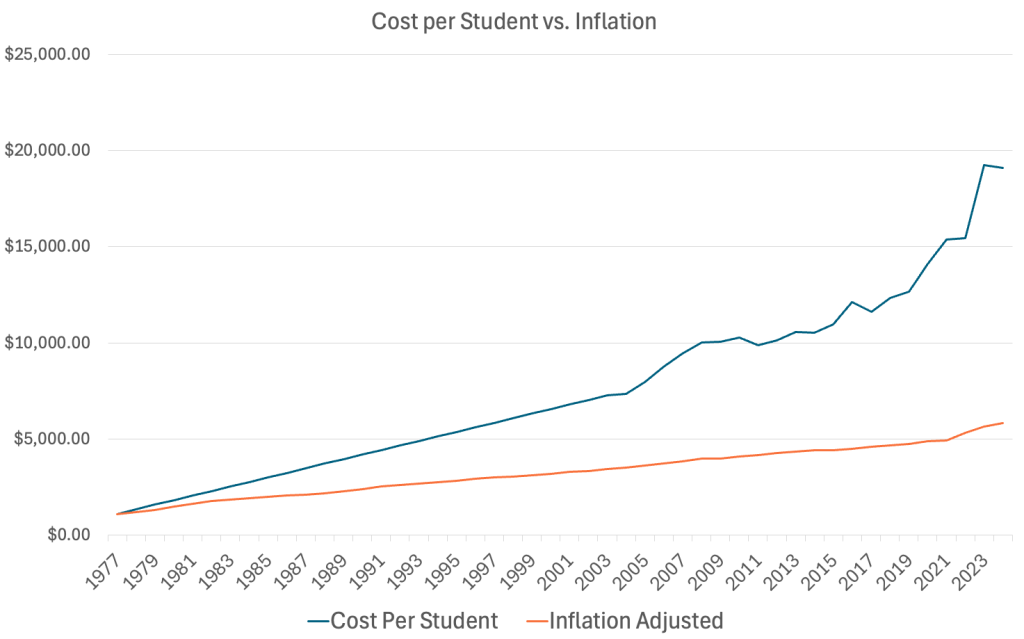
There may be some minor discrepancies due to school years not aligning with the Jan to Dec, inflation numbers used in the calculation, but those issues will average out over longer periods of time.
According to the data, if USD234 spent the same amount as they did in 1977, while increasing it as needed to keep up with inflation, the expected cost per student would $5,882 in 2024. Instead, the cost per student is $19,110, representing an increase of $13,288, or 228% more than what can be explained by inflation. For context, if the average wage of $9,779.44 had grown by the same amount, the average wage would now be $169,207. (In 2023, the average wage in the US was $66,621)
Obviously, inflation isn’t the only thing that drives up the cost of education, but it is a critical component and essential to factor in when comparing the current costs to historical.
Below is a chart of the data. Italicized numbers were not available from the school district and are extrapolated from the overall growth rate.
| USD234 Historical Cost Per Student | Inflation Adjusted from 1977 baseline | |
| 1977 | $1,104.47 | $1,104.47 |
| 1978 | $1,341.37 | $1,179.99 |
| 1979 | $1,578.27 | $1,289.49 |
| 1980 | $1,815.17 | $1,468.85 |
| 1981 | $2,052.07 | $1,642.55 |
| 1982 | $2,288.98 | $1,780.37 |
| 1983 | $2,525.88 | $1,846.45 |
| 1984 | $2,762.78 | $1,923.85 |
| 1985 | $2,999.68 | $1,991.82 |
| 1986 | $3,236.58 | $2,069.23 |
| 1987 | $3,473.48 | $2,099.43 |
| 1988 | $3,710.38 | $2,184.40 |
| 1989 | $3,947.28 | $2,286.35 |
| 1990 | $4,184.19 | $2,405.29 |
| 1991 | $4,421.09 | $2,541.22 |
| 1992 | $4,657.99 | $2,607.30 |
| 1993 | $4,894.89 | $2,692.26 |
| 1994 | $5,131.79 | $2,760.23 |
| 1995 | $5,368.69 | $2,837.63 |
| 1996 | $5,605.59 | $2,915.05 |
| 1997 | $5,842.49 | $3,003.78 |
| 1998 | $6,079.40 | $3,050.98 |
| 1999 | $6,316.30 | $3,101.95 |
| 2000 | $6,553.20 | $3,186.92 |
| 2001 | $6,790.10 | $3,305.86 |
| 2002 | $7,027.00 | $3,343.62 |
| 2003 | $7,288.00 | $3,430.46 |
| 2004 | $7,356.00 | $3,496.55 |
| 2005 | $7,950.00 | $3,600.38 |
| 2006 | $8,751.00 | $3,743.87 |
| 2007 | $9,444.00 | $3,821.58 |
| 2008 | $10,014.00 | $3,985.16 |
| 2009 | $10,042.00 | $3,986.35 |
| 2010 | $10,275.00 | $4,091.01 |
| 2011 | $9,863.00 | $4,146.21 |
| 2012 | $10,142.00 | $4,279.39 |
| 2013 | $10,548.00 | $4,347.64 |
| 2014 | $10,529.00 | $4,416.29 |
| 2015 | $10,962.00 | $4,412.35 |
| 2016 | $12,111.00 | $4,472.94 |
| 2017 | $11,608.00 | $4,584.76 |
| 2018 | $12,353.00 | $4,679.69 |
| 2019 | $12,652.00 | $4,752.28 |
| 2020 | $14,094.00 | $4,870.45 |
| 2021 | $15,383.00 | $4,938.62 |
| 2022 | $15,453.00 | $5,308.02 |
| 2023 | $19,235.00 | $5,648.28 |
| 2024 | $19,110.00 | $5,822.86 |