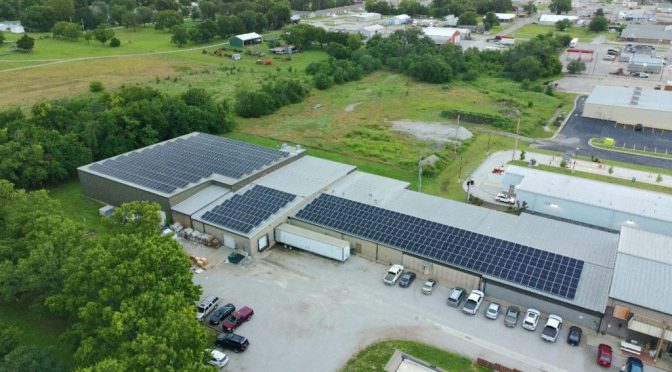
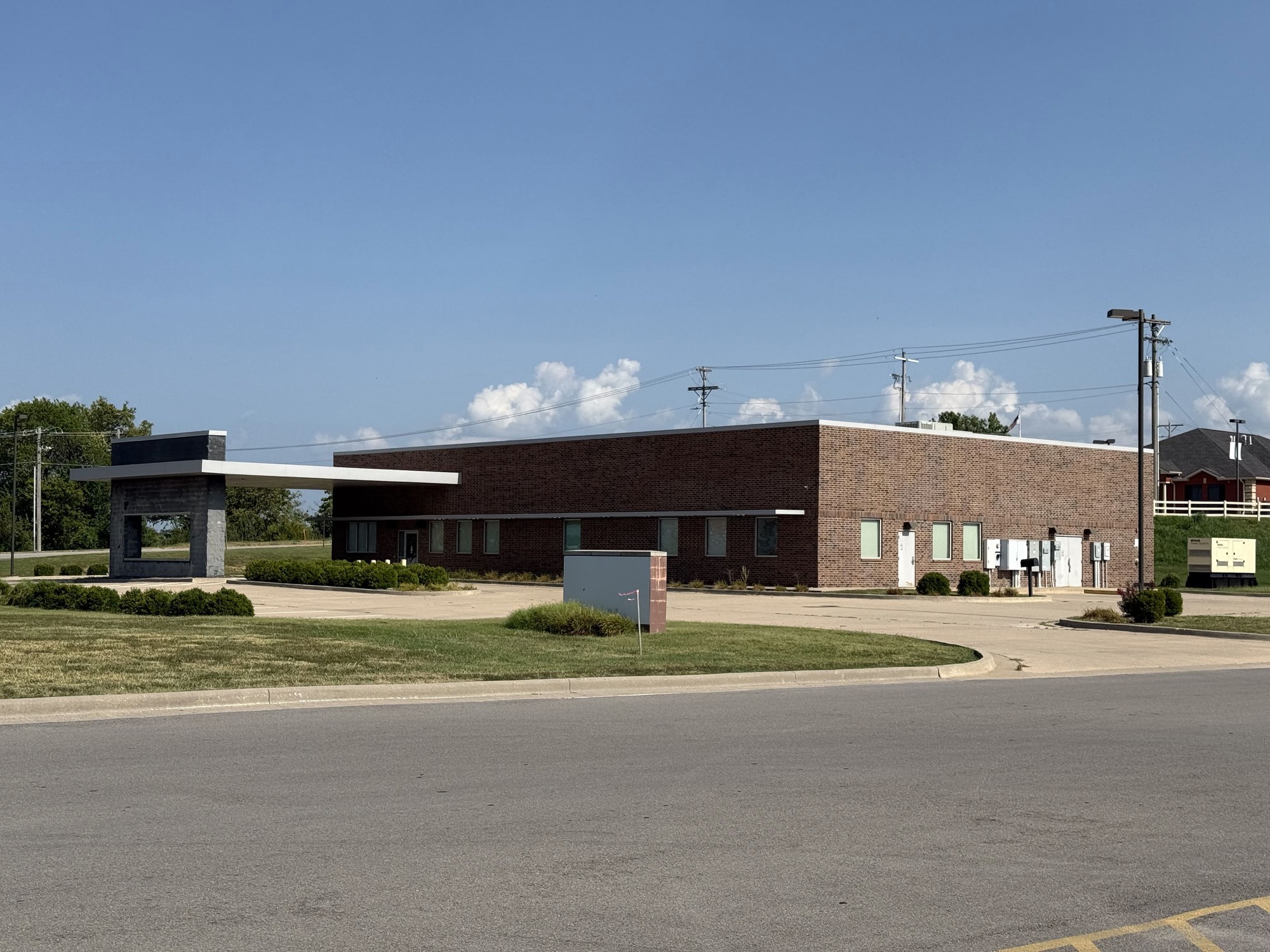
Submitted photo of SEK Printing, Fort Scott’s newest solar energy system.
A new solar energy system was completed at Sekan Printing Company, 2210 S. Main on August 5.
“We just finished commissioning the largest solar-battery system in Southeast Kansas — right here in Fort Scott at Sekan Printing,” said Daniel Zywietz, with SEK Solar.
Daniel Zywietz.
“300 kW of solar plus 240 kWh of battery storage, cutting their demand charges.” said Zywietz.
The process
“Last October, Justin’s cousin put us in touch. Justin had a very high demand charge from Evergy and wanted to know if anything could be done about it. We spent a month or two looking into it and found the real problem was his demand peaks — short, heavy stretches where his power use spikes. A battery handles peaks well, but it can’t carry a long peak on its own. So the answer was solar and battery together.”
The presses at SeKan run from 5:30 in the morning to 3:30 in the afternoon, five days a week, according to a press release from SEK Solar. The heaviest draw does not come from the presses themselves. It comes from drying. Full-color work means laying ink down in layers and curing each layer before the next one goes on, and that pulls hard and steadily for half an hour at a time, with bigger draws on top of it. A good share of it happens early, before the sun is high. The solar makes the power. The battery holds it and puts it out across those long, heavy stretches. Together they match the way the plant actually runs.
That matters on a commercial power bill. Businesses on Evergy’s medium and large general service rates pay for the electricity they use, and they also pay on the heaviest half-hour they hit in the month. That peak charge can be most of the bill. A system with solar and storage together can bring both down.
The project took bout nine to ten months start to finish, he said. “We put the battery in first, at the end of last year, since it tackled the demand charges right away. The solar took longer: Evergy approvals, a cold first quarter, and a lot of integration. It’s a complex system, with battery inverters, batteries, solar, and a separate meter monitoring the whole thing.”
About ten people helped with the project.
“The mechanical crew installing solar on the roof, the electricians on the ground, and the controls and programming folks. Not all at once, but roughly ten involved overall, ” he said.
There were federal tax credits for the project.
” For commercial and industrial systems, the federal tax credit is still in place — 30% of the system cost — and businesses can also depreciate the system on an accelerated schedule, which adds up to a significant additional write-off. Some projects can qualify for extra credit on top through domestic-content and energy-community bonuses.
“One timing note worth knowing: a commercial system started now needs to be up and running by the end of 2027 to capture the credit, so this is the window.
“On the residential side, the federal tax credit ended December 31, 2025, so there’s no longer a federal credit for homeowners — home systems now stand on their own economics and the value of battery backup.”
Other Fort Scott businesses that have gone solar with SEK Solar:
– 110 South Main / Cohn’s Cafe (Kathy and Tracy Dancer)
– Great Expectations, (Matthew Wells)
– Hole in the Wall Liquor (Roy Hoehner)
– Sekan Printi
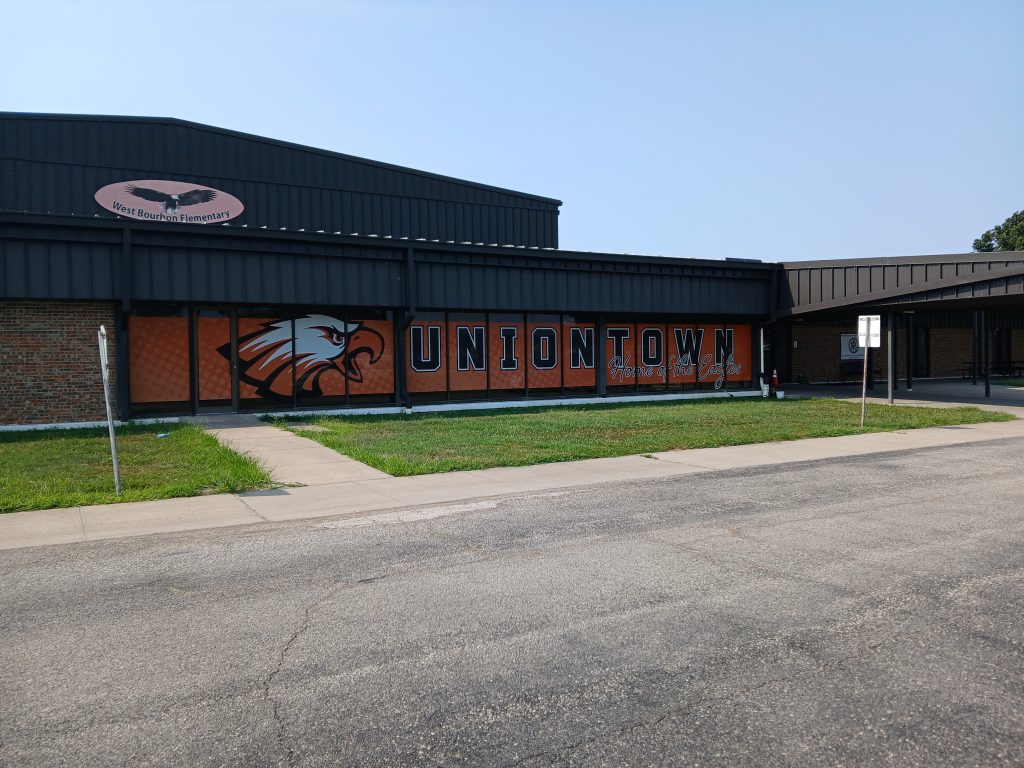
The West Bourbon Elementary School is located on Fifth Street in Uniontown. The junior high and high school, and board office are located north, across the street.
Uniontown School District, U.S.D. 235 students start school on Wednesday, August 19.
Open house for the district is August 18 from 4-6 p.m.
Enrollment is currently online, but anyone needing assistance can come to the board office for the appropriate paperwork, according to Superintendent Vance Eden.
“We are excited for a great 2026-27 school year,” Eden said.
There are six new teachers this year:
Kristy Beene, is the new preschool teacher.
Ransom Pflieger is the new West Bourbon Elementary School Music Teacher, and Bralynn Sutterby is the new first grade teacher.
Tori Hathaway is the new Uniontown High School Special Education Teacher, Mike Main is the new high school math teacher and
Ryan Jarboe is the new high school social studies teacher.
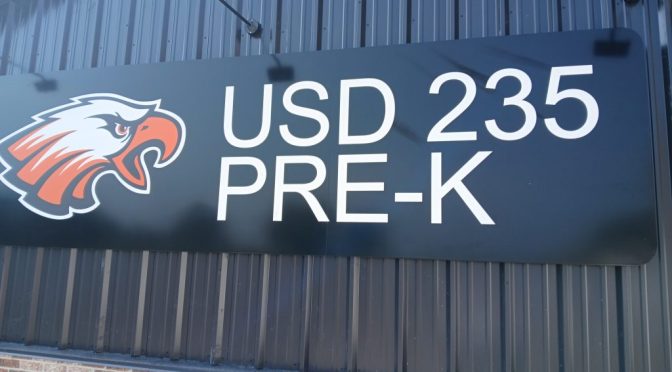
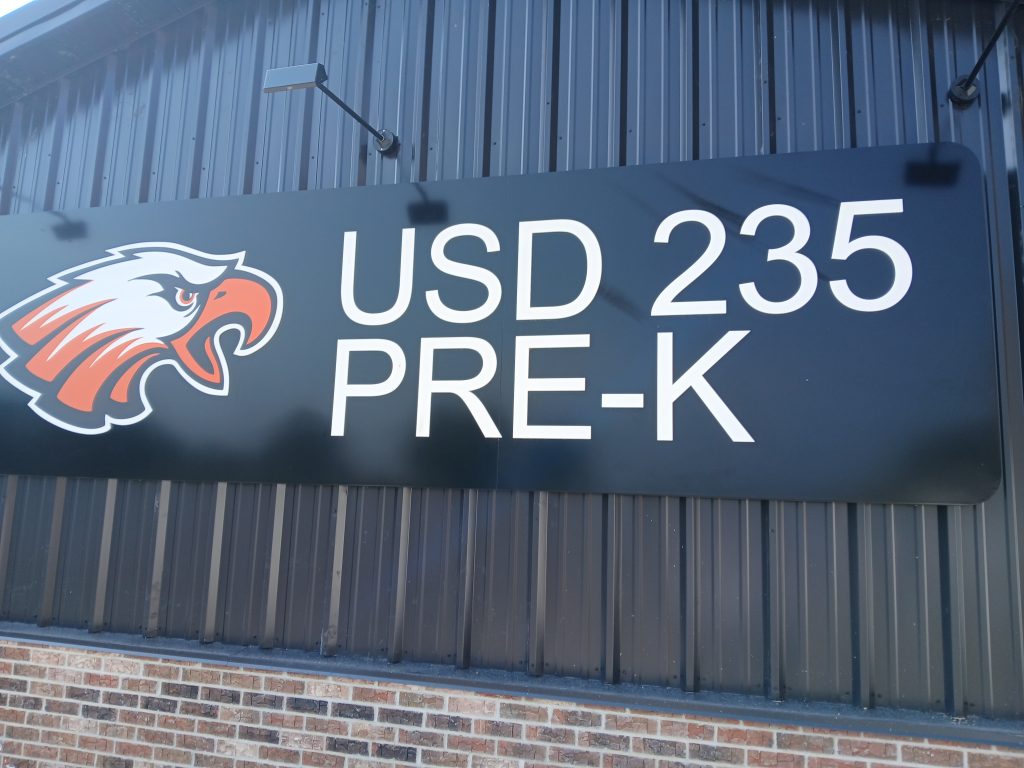
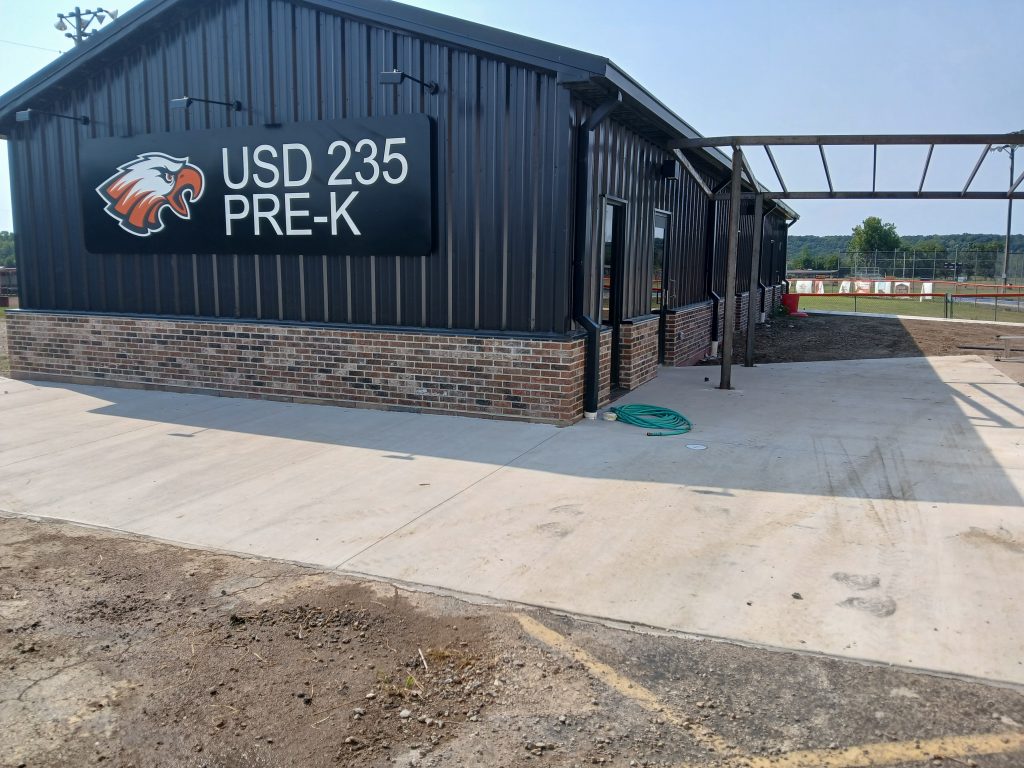
The new pre-kindergarten building is located on the southeast side of the main elementary school building.
There is a new building and repurposing of an old building at West Bourbon Elementary School.
The new building will provide a learning space for the 35 currently enrolled pre-kindergarteners starting this school year, according to a school employee, Regina Cagle.
The new pre-k as seen from the east parking lot of the school.
There was a need to replace the modular building that formerly housed the pre-kindergarten learning space in the district, according to Superintendent Eden.
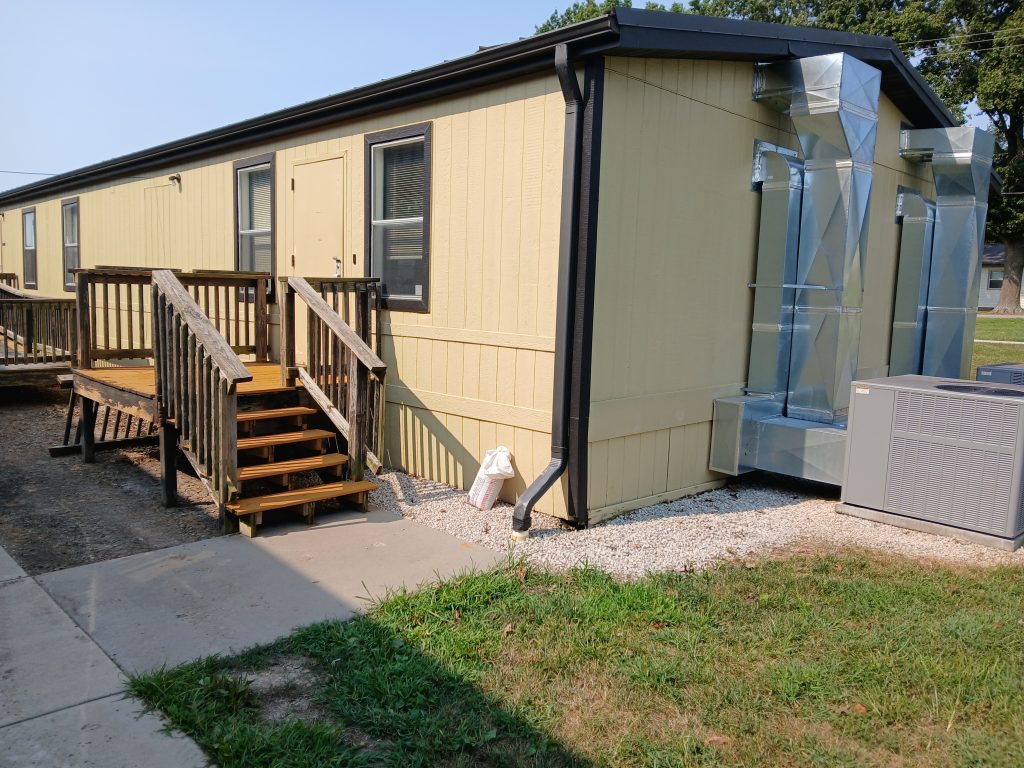
The old modular building on the west side of the school, the one on the north, will be the new custodial storage building.
“It was near the end of its life for use as a classroom,” Eden said. “A new building ensures that the district has a safe and quality learning environment for years to come.”
“Two old modulars were sitting where the new PK has been built. Those modulars were offered free to the public. One was claimed, and the other was demolished after no one expressed interest in it.”
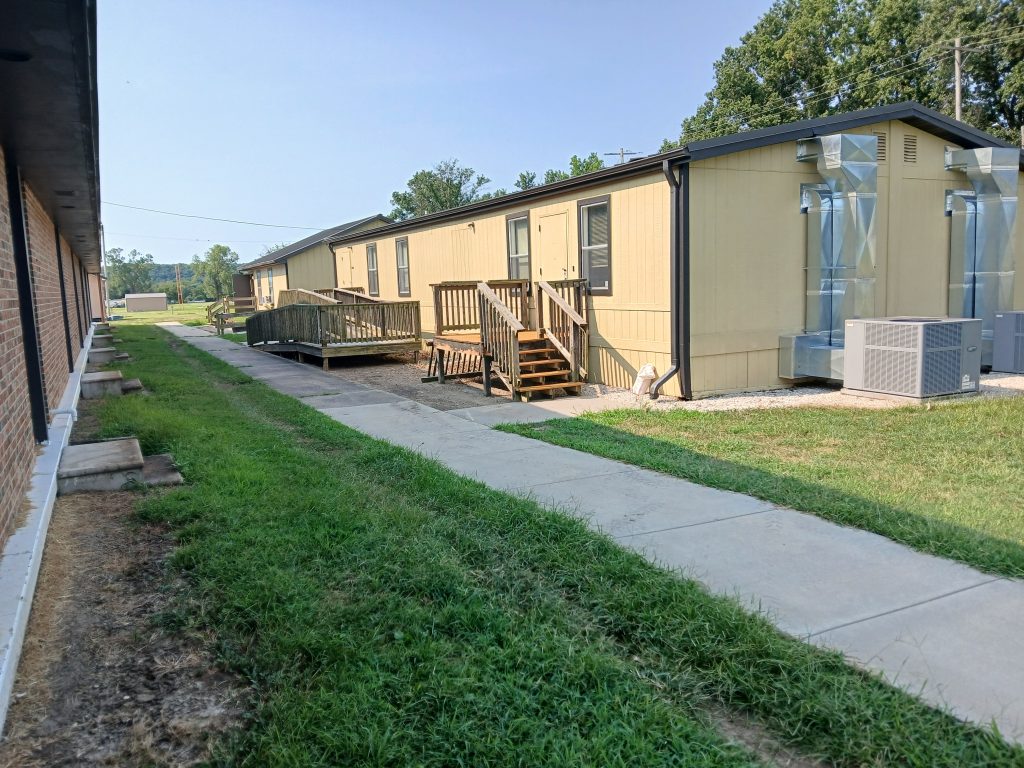
The old pre-k school room is on the north, the former custodial storage building is on the south. Both are located on the west side of the elementary school campus.
There are two other modular buildings, pictured above, where the PK classrooms were previously. The location at the elementary school is on the west side of the campus.
“Our intention is to use the old PK as custodial storage… and get rid of the old modular that has been used as custodial storage.”
The following is the USD 235 Calendar for the new year:
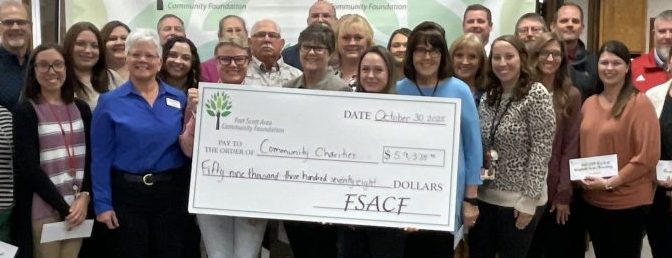
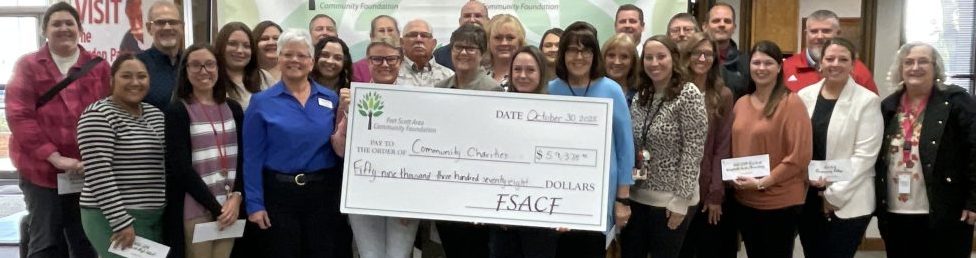
These are the representatives of organizations that received grant awards in 2025—submitted photo.
The annual local grant application cycle benefiting the Bourbon County community has begun.
The Fort Scott Area Community Foundation (FSACF) began on August 1, and those who wish to apply must submit applications by August 31.
“Eligible organizations are 501c3 charitable organizations, nonprofit educational institutions, government entities, and nonprofit religious organizations that serve Fort Scott and Bourbon County,” said the marketing chairman Becky Tourtillott.
“We consider projects based on how they improve the quality of life for Bourbon County residents, with particular interest in projects that are collaborative, and sustainable for the future.
“Over the past few years, we have awarded anywhere between $40,000 and $75,000 in grants depending on the performance of our investment funds and the projects submitted, as some of our grant funding is earmarked for specific types of projects.”
Applications are submitted online through the FSACF website, //FSACF.com/Grant-App, where grant guidelines, application materials, and resources for grant writers are available, according to a press release.
Applications received during August will be reviewed throughout September, with grant awards announced mid-October.
“Community foundation grants have helped strengthen Bourbon County by supporting projects that address local needs and create lasting benefits for our residents,” said Gregg Motley, FSACF Grants Committee Chairman. “Over the years, we’ve seen these investments help organizations expand services, improve facilities, and bring people together around common goals. We encourage applicants to think beyond immediate needs and consider how their projects can create sustainable, long-term impact for our communities.”
Organizations interested in applying are encouraged to visit the FSACF website early in the application period to review eligibility requirements and available grant-writing resources.
For more information about the grant program, application guidelines, or eligibility requirements, visit the Fort Scott Area Community Foundation website or contact the foundation directly.
About Fort Scott Area Community Foundation
The Fort Scott Area Community Foundation is a nonprofit organization dedicated to improving the quality of life in Fort Scott and Bourbon County by connecting donors with community needs. Through charitable funds established by individuals, families, businesses, and organizations, FSACF provides grants and resources that support local nonprofits and community initiatives. Since 2007, the foundation has awarded more than $500,000 in competitive grants to benefit the communities it serves.
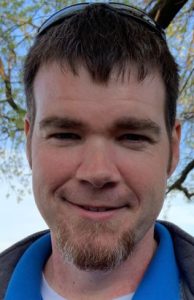
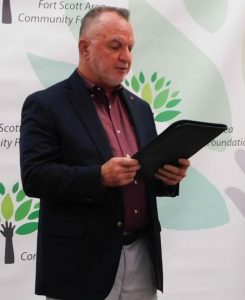
Jess Ervin is the newly elected chairman of the FSACF. This is a fortscott.biz 2019 photo.Gregg Motley tells about the Fort Scott Area Community Foundation before the awarding of the grants in this 2021 photo.
“Jess Ervin is our newly-elected Chairman of the Board, so he would be our main official contact for the foundation, and then Gregg Motley would be the official contact for the granting process, as he chairs our grant committee,” Tourtillott said.
The current board of directors include Ervin, Motley, Brad Matkin, Ronda Hassig, Diana Endicott, Jordan Witt, Gary Cullor, Matthew Hunt, Dean Striler, Kenny Felt, Marla Heckman, and Bailey Lyons.
Three votes separate Mike Hueston and Lyle K. (Pete) Owenby in the Republican primary for Bourbon County Commissioner District 1, according to the unofficial results the Bourbon County Clerk’s office posted after Tuesday’s primary election. Countywide, 2,908 ballots were cast.
The race is too close to call, and none of these numbers are final. Provisional ballots are not included in the unofficial totals; the county Board of Canvassers decides which of them count and makes the results official at the canvass, which the Bourbon County Monitor reports is scheduled for Aug. 17. The Monitor also reported that County Clerk Susan Walker said the number of outstanding provisional ballots would be released Wednesday. Under a recent change in Kansas law, mailed advance ballots had to be in by 7 p.m. on Election Day to count. FortScott.biz published a step-by-step walkthrough of how the county counts, reconciles and canvasses ballots in June.
County Commissioner: unofficial totals
District 1, Republican
Candidate
Votes
Vote %
Mike Hueston
163
42.67%
Lyle K. (Pete) Owenby
160
41.88%
Lisa Dillon
59
15.45%
The nominee will appear on the November general election ballot with Clinton L. Walker of Mapleton, unopposed in the Democratic primary.
District 1, Democratic
Candidate
Votes
Vote %
Clinton L. Walker
88
100.00%
District 3, Republican
Candidate
Votes
Vote %
Joe Allen
307
65.60%
Josh Jones
161
34.40%
The results report lists Jones as Joshua Jones; he filed as Josh Jones. No Democrat filed for District 3; the Democratic primary line recorded six write-in votes.
District 4, Republican
Candidate
Votes
Vote %
Gregg Motley
427
100.00%
No Democrat filed for District 4; the Democratic line recorded 12 write-in votes.
Township clerk: unofficial totals
All township clerk candidates ran as Republicans; no Democrat filed for any township clerk office. Marion Township was the only contested race. In the county’s other townships no candidate filed, and those races recorded only scattered write-in votes.
Five Republican precinct committee races drew more than one candidate.
Race
Candidate
Votes
7th Ward Committeeman
Robert S. Love
79
7th Ward Committeeman
Michael Hoyt
73
Drywood Committeewoman
Vickie Shead
67
Drywood Committeewoman
Laura Krom
18
Marmaton D2 Committeeman
Jeffrey L. Reed
68
Marmaton D2 Committeeman
Micheal Bryant
23
Osage Committeeman
Marvin Creager
47
Osage Committeeman
Joshua Kee
22
Timberhill Committeeman
Timothy H. Emerson Sr.
20
Timberhill Committeeman
Brandon Whisenhunt
18
What happens next
The Board of Canvassers will review provisional ballots before certifying the official results. In a race as close as the District 1 Republican primary, those ballots could matter. FortScott.biz will report the official totals after the canvass.
The full unofficial report, “Statement of Votes Cast by Geography,” is posted on the Bourbon County website. It also includes Bourbon County’s votes in the federal, state and statewide-ballot-question primaries; those contests are decided by voters beyond Bourbon County, and the county’s numbers alone do not determine their outcomes.
Bourbon County Appraiser Matt Quick has resigned, with his last working day set for August 18. In a letter emailed to all five county commissioners Monday evening, Quick said he and his wife “have been presented with an exciting opportunity to embark on a new life adventure,” and called leaving the office “bittersweet.”
The letter, sent shortly after 5 p.m. on Monday, August 3, was addressed to the commission and copied to the County Clerk’s office, Treasurer Jennifer Hawkins, and the Register of Deeds.
The office he leaves. The county appraiser values all taxable real and personal property in Bourbon County each year, houses, farmland, commercial buildings, vehicles, and business equipment. Those valuations are the base on which the county, cities, school districts, and other taxing entities levy property taxes. Under Kansas law (K.S.A. 19-430), the appraiser is appointed by resolution of the county commission for a four-year term, and an appointee must have at least three years of mass appraisal experience and hold a state credential, either the Registered Mass Appraiser (RMA) designation Quick mentions in his letter, or a certified general real property appraiser’s license.
Quick’s letter counts eight years of service to the community. Commission records show he has led the office since July 2021, when commissioners named him interim county appraiser by Resolution 22-21; a Kansas Department of Revenue compliance reviewer praised his work before the commission that December, and his reappointment to a new four-year term came before the commission in the summer of 2025.
His departure is one of two from the office this month: Quick writes that his personal property manager is also leaving, with a last day of August 14. He notes that no state reports or analysis are due until October, which he says gives the commission time to find a replacement who can do their own analysis for the 2027 tax year, and that Matthew Booker, the county’s district representative with the state Property Valuation Division, will guide commissioners through candidates.
His letter follows in full.
Dear Commissioners,
After much thought and consideration, I am formally submitting my resignation as County Appraiser for Bourbon County, with my last working day being August 18, 2026.
Serving this community for the past eight years has been both an honor and a privilege. I am deeply grateful for the trust placed in me, the collaboration with dedicated colleagues, and the opportunity to contribute to the county’s growth and success.
My wife and I have been presented with an exciting opportunity to embark on a new life adventure, and while I am eager for what lies ahead, leaving this role and the people I’ve worked alongside is bittersweet.
I will be informing Matthew Booker who is our District Rep with Property Valuation Division with the state to let them know. They will be your guides for candidates to replace me as they must be an RMA with the state to qualify. My office will be self-sustainable for the next few months. There are no reports or analysis for the state that needs to be done until October. This will allow you to find a replacement and they will be able to do their own analysis for the 2027 tax year. My Personal Property manager is also leaving and last day will be on the 14th so they can find the right person for them in that position as well. My field appraisers Mike and Herb have been faithful hard-working employees that brave the elements and the people of Bourbon County and will continue to do their jobs at the highest level after I am gone. Janet my office manager has been with the county since 2008. She is a wealth of knowledge about running all aspects of the department and is a loyal and trustworthy employee. She will keep things running smoothly in my absence. I hope that the employees in my office will be treated with respect and dignity that long term dedicated assets that they deserve.
Thank you for the support, guidance, and friendship I have experienced during my tenure. Bourbon County will always hold a special place in my heart.
With sincere appreciation,
Matt Quick
The appraiser’s office is in the county courthouse at 210 S. National Ave. FortScott.biz will follow the commission’s search for a successor as it develops.
When the State dismissed its misdemeanor case against Bourbon County Commissioner Mika Milburn-Kee in late June, Senior Judge Merlin G. Wheeler’s order set Monday at 1 p.m. in Fort Scott for a first appearance and preliminary examination in the case the Kansas Attorney General’s office told the court it would refile. Five weeks later, no new case has been filed, and the Monday hearing, with no case to attach it to, never made it onto the court’s schedule.
Asked whether the hearing was going forward, the Bourbon County District Court clerk’s office replied by email Monday: “There is no hearing today. The case was dismissed.” Court staff confirmed by phone that nothing has been refiled and “there was nothing scheduled for today.”
At a June 26 pretrial conference, Senior Judge Merlin G. Wheeler denied the State’s eve-of-trial motion to add a felony Intimidation of Voters count to the two misdemeanors Milburn-Kee had faced since March. The State then dismissed the case without prejudice, telling the court it intended to refile all three charges together under a new case number. The judge’s written order, filed June 27, set the Aug. 3 date for the anticipated new case.
That case has not appeared. In Kansas district court records pulled Monday morning, a party search — run both for Bourbon County and statewide — shows no new case against Milburn-Kee. Nothing has been docketed in the dismissed case since the June 27 order. The Attorney General’s office, where Assistant Attorney General Olivia R. Higdon is prosecuting the case, has not publicly explained the delay. When FortScott.biz called the office July 27, a staff member said the only thing the office could share was that the matter was under “prosecutorial review.”
Whether and when the State will refile are open questions. One constraint is the calendar: Wheeler ordered that dismissing and refiling does not restart the speedy-trial clock, which he dated to April 15. Under Kansas’s speedy-trial law, K.S.A. 22-3402, a defendant who is out on bond must be brought to trial within 180 days of arraignment, not counting delays the defense causes — by that measure, roughly mid-October.
All of the charges stem from an Oct. 25, 2025 incident at the county commission room while it was being used as an early-voting polling place. The dismissed case charged interference with the conduct of public business, a Class A misdemeanor, and disorderly election conduct, a Class B misdemeanor that on conviction would mean forfeiture of office under K.S.A. 25-2432. The proposed third count, Intimidation of Voters, is a severity level 7 nonperson felony.
A charge is an accusation, not a finding of guilt, and Milburn-Kee, who has pleaded not guilty, is presumed innocent unless and until a jury decides otherwise. FortScott.biz will report when a new case is filed or a new hearing is set.
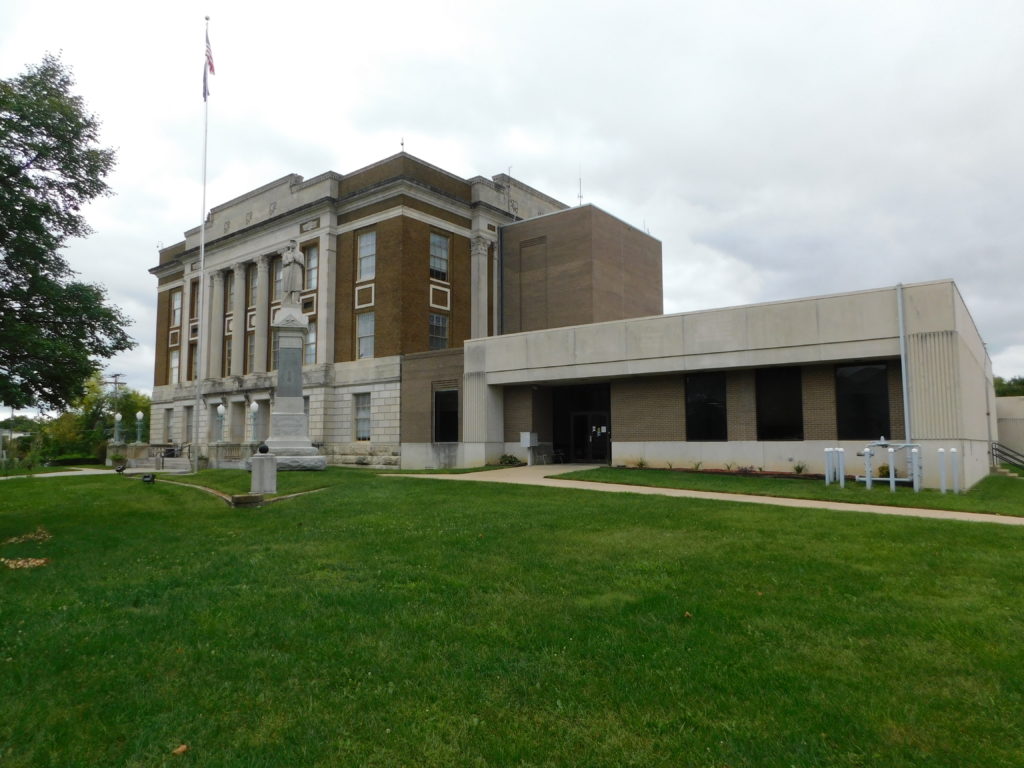
The Bourbon County Courthouse, 210 S. National Avenue.
2026 Bourbon County Primary Election: Candidates and Ballot Question
The Bourbon County Clerk’s office released the official list of candidates and ballot question for the August 4, 2026 Primary Election.
Below is a complete breakdown of every race and the constitutional amendment question that Bourbon County voters will see on their ballots.
Democratic Primary Candidates
United States Senator
Damon Anderson – Shawnee
Christy Davis – Cottonwood Falls
Adam Hamilton – Stilwell
Jason Hart – Wichita
Kevin Latz – Mission Hills
Erik Murray – Kansas City
Sandy Spidel Neumann – Overland Park
Anne Parelkar – Overland Park
Patrick C. Schmidt – Topeka
Michael “Mike” Soetaert – Wellington
Noah Taylor – Kechi
U.S. House of Representatives – District 2
Don Coover – Galesburg
Kansas Governor / Lt. Governor
Ethan Corson / Renee Duxler – Salina
Cindy Holscher / KC Ohaebosim – Wichita
Curt Skoog / Jennifer Bacani McKenney – Fredonia
Kansas Secretary of State
Jennifer Day – Overland Park
Samuel Lane – Shawnee
Kansas Attorney General
Chris Mann – Lawrence
Kansas State Treasurer
Juan C. Luengo – Olathe
Commissioner of Insurance
Dinah Sykes – Lenexa
State Board of Education – District 9
Heather Guernsey – Chanute
Bourbon County Commissioner – District 1
Clinton L. Walker – Mapleton
Bourbon County Commissioner – District 3
No candidate filed
Bourbon County Commissioner – District 4
No candidate filed
Township Clerk (Democratic)
No candidates filed in Drywood, Franklin, Freedom, Marion, Millcreek, Marmaton, Osage, Pawnee, Scott, Timberhill, or Walnut townships.
Democratic Precinct Committeeman/Committeewoman
Precinct
Position
Candidate
7th Ward
Committeewoman
Tracy J. Schafer – Fort Scott
Marmaton D2
Committeewoman
Thelma J. Quirin – Redfield
Millcreek
Committeewoman
Jane L. Gaines – Fort Scott
Scott D4
Committeewoman
Carol K. Lydic – Fort Scott
Timberhill
Committeeman
Clinton Lee Walker – Mapleton
Timberhill
Committeewoman
Rachel Walker – Mapleton
All other Democratic precinct positions: No candidate filed
Republican Primary Candidates
United States Senator
Roger Marshall – St. John
Pond Naramore – Lawrence
U.S. House of Representatives – District 2
Derek Schmidt – Independence
Chad E. Young – Lawrence
Kansas Governor / Lt. Governor
Ty Masterson / Jeffrey Klemp – Lansing
Charlotte O’Hara / Michelle Dombrosky – Olathe
Nick Reinecker / Katy Reinecker – Inman
Stacy L. Rogers / Michael W. Smith – Lansing
Philip Sarnecki / Joy Eakins – Wichita
Vicki Schmidt / Joe Newland – Neodesha
Scott Schwab / Ken Rahjes – Agra
Kansas Secretary of State
Pat Proctor – Leavenworth
Kansas Attorney General
Kris Kobach – Lecompton
Kansas State Treasurer
Steven Johnson – Assaria
Commissioner of Insurance
Daniel Hawkins – Wichita
Kansas House of Representatives – District 4
Rick James – La Cygne
State Board of Education – District 9
Destry Brown – Fort Scott
Kristian Gerken – Paola
Renee Slinkard – Parker
Bourbon County Commissioner – District 1
Lyle K. (Pete) Owenby – Redfield
Mike Hueston – Mapleton
Lisa Dillon – Fort Scott
Bourbon County Commissioner – District 3
Joe Allen – Fort Scott
Josh Jones – Fort Scott
Bourbon County Commissioner – District 4
Gregg Motley – Fort Scott
Township Clerk (Republican)
Drywood: Laura Krom
Franklin: No candidate filed
Freedom: No candidate filed
Marion: Brent M. Smith; Michael Ramsey
Millcreek: No candidate filed
Marmaton: No candidate filed
Osage: No candidate filed
Pawnee: No candidate filed
Scott: Donald Banwart
Timberhill: Jennifer Epting Williams
Walnut: No candidate filed
Republican Precinct Committeeman/Committeewoman
Precinct
Position
Candidate(s)
1st Ward
Committeeman
Kevin W. Davidson
1st Ward
Committeewoman
Cheryl L. Adamson
2nd Ward
Committeeman
Robert J. Uhler
2nd Ward
Committeewoman
Laurie R. Uhler
3rd Ward
Committeeman
Brian Rhoades
3rd Ward
Committeewoman
Brandy L. Rhoades
4th Ward
Committeeman
Matthew Wells
4th Ward
Committeewoman
Katie Wells
5th Ward
Committeeman
No candidate filed
5th Ward
Committeewoman
Jana R. Walker
6th Ward
Committeeman
Douglas E. Niemeir
6th Ward
Committeewoman
No candidate filed
7th Ward
Committeeman
Michael Hoyt; Robert S. Love
7th Ward
Committeewoman
Patricia S. Love
Drywood
Committeeman
Larry Shead
Drywood
Committeewoman
Vickie Shead; Laura Krom
Franklin
Committeeman
Tony Bradbury
Franklin
Committeewoman
Kaitlyn Bradbury
Freedom D1
Committeeman
No candidate filed
Freedom D1
Committeewoman
Janice Seested
Freedom D5
Committeeman
Lawrence Paddock
Freedom D5
Committeewoman
Karen A. Paddock
Marion
Committeeman
No candidate filed
Marion
Committeewoman
Nancy Holt
Marmaton D2
Committeeman
Jeffrey L. Reed; Micheal Bryant
Marmaton D2
Committeewoman
Angela Soetaert
Marmaton D4
Committeeman
No candidate filed
Marmaton D4
Committeewoman
No candidate filed
Millcreek
Committeeman
Boa Casper
Millcreek
Committeewoman
Katie K. Casper
Osage
Committeeman
Joshua Kee; Marvin Creager
Osage
Committeewoman
Mika Milburn-Kee
Pawnee
Committeeman
Kevin Wagner
Pawnee
Committeewoman
Rachel Wagner
Scott D1
Committeeman
Jim Sackett
Scott D1
Committeewoman
Gayle Sackett
Scott D2
Committeeman
Bryan Holt
Scott D2
Committeewoman
Tara Holt
Scott D3
Committeeman
Luke Demko
Scott D3
Committeewoman
No candidate filed
Scott D4
Committeeman
Roy D. Dare
Scott D4
Committeewoman
Anne Dare
Scott D5
Committeeman
Bill Lalman
Scott D5
Committeewoman
Glenda Lalman
Timberhill
Committeeman
Timothy H. Emerson Sr.; Brandon Whisenhunt
Timberhill
Committeewoman
Rebecca Whisenhunt
Walnut
Committeeman
Jason Sutterby
Walnut
Committeewoman
Rebecca Sutterby
Constitutional Amendment Question
In addition to candidate races, voters will be asked to decide on a proposed constitutional amendment regarding how Kansas Supreme Court justices are selected.
Explanatory Statement
This amendment gives voters the right to elect the justices of the Kansas Supreme Court. The justices shall serve terms of six years, with elections of justice positions 1, 2 and 3 to occur in 2028, positions 4 and 5 to occur in 2030, and positions 6 and 7 to occur in 2032, and every six years thereafter. The rules applicable for such elections and the designation of position numbers shall be provided by law. Any vacancy on the court for an unexpired term shall be filled at an election as provided by law.
A vote FOR this proposition would give Kansas citizens the right to elect Kansas Supreme Court justices as provided by law. Justices will hold office for terms of six years. The Kansas Supreme Court nominating commission, whose membership consists of a majority of lawyers, would be abolished.
A vote AGAINST this proposition would continue the current system in which the Kansas Supreme Court nominating commission, whose membership consists of a majority of lawyers, provides the governor a list of three individuals to choose from for vacancies on the Kansas Supreme Court. Justices hold office for a term of six years and retain their offices if they win a retention election in which they do not face an opponent.
Proposed Amendment Text (§ 5 – Selection of Justices of the Supreme Court)
The citizens of Kansas who are qualified electors shall elect the justices of the supreme court. The rules applicable for such elections and the designation of position numbers shall be provided by law. Justice positions 1, 2 and 3 shall be elected at the general election in November of 2028, justice positions 4 and 5 in November of 2030 and justice positions 6 and 7 in November of 2032, and every six years thereafter, respectively. Any vacancy occurring on the supreme court for an unexpired term shall be filled by election as provided by law.
The full text of the amendment, including proposed changes to §§ 8 and 15 of the Kansas Constitution, is available in the attached ballot PDF.
Late in the spring of 2014, a Bourbon County man was working outdoors on his property. He picked up several tick bites and found one tick on his shoulder swollen with blood.
Within a few days he felt sick to his stomach and weak, with diarrhea. A fever came the next day. On the third day he saw his primary care doctor, who prescribed doxycycline, the standard antibiotic for a suspected tick-borne illness.
The next morning his wife found him barely conscious. An ambulance took him to a local hospital, where doctors started intravenous fluids and intravenous doxycycline and kept testing him. Rocky Mountain spotted fever, Lyme disease, ehrlichiosis: they were all negative. He kept getting worse, and on the eighth day they moved him again, this time to the University of Kansas Medical Center in Kansas City (Mitchell et al., Case Reports in Infectious Diseases, 2026), for what the 2015 report calls further evaluation and management. Two days after that he was in intensive care.
Nobody ignored his symptoms. As he failed to improve, his doctors escalated at every step: from a clinic to a local hospital to a tertiary care center in five days. They ruled out the treatable causes before transferring him.
Every test for the tick-borne illnesses anyone knew about came back negative. Two days before he died, doctors sent a sample of his blood to a Centers for Disease Control and Prevention lab in Fort Collins, Colorado.
Eleven days after his first symptom, he died of septic shock. His blood pressure had fallen past what three separate drugs could hold up, and his organs were shutting down (Kosoy et al., Emerging Infectious Diseases, 2015). Scientists at that CDC lab went on to find a virus never before seen in a sick person in this country.
They named it for the county the man came from. Bourbon virus.
Why the antibiotic did not work
Here is the part worth remembering. Doxycycline is an antibiotic, and antibiotics kill bacteria. They do nothing at all to a virus.
Kansas has numerous bacterial tick diseases, including Rocky Mountain spotted fever, ehrlichiosis, and tularemia. Doxycycline is the standard first-line treatment for a suspected bacterial tick illness. Bourbon virus is not bacterial, and that one difference explains most of what makes this disease dangerous.
When the CDC announced the discovery in February 2015, it said this was the first virus of its kind ever shown to make a person sick in the United States.
It comes from the lone star tick
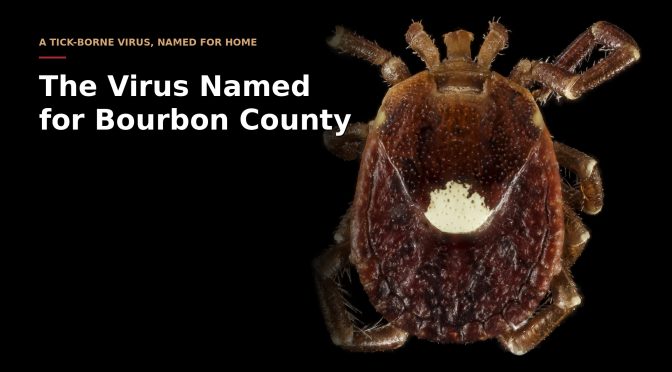
Bourbon virus is believed to spread through the bite of an infected tick, and every known case has followed one. The only species ever confirmed to carry it is the lone star tick, identifiable by the small white dot on the female’s back. A 2023 review of the research notes that in the five cases known at that point, the species of the tick that bit each patient was never identified.
This is not a rare or exotic tick. In a 2024 advisory, the Kansas Department of Health and Environment called the lone star tick the most common tick in Kansas, living across at least the eastern two-thirds of the state and biting people aggressively.
Scientists have also found the virus in ticks collected in the wild. A CDC team tested more than 39,000 ticks collected in northwestern Missouri in 2013 and found live Bourbon virus in three batches, all of them lone star ticks (Savage et al., 2017).
The second death, also in Bourbon County
In the spring of 2024, a 63-year-old man with well-controlled diabetes was preparing hunting ground in the woods of Bourbon County. He pulled two small ticks off himself that day and found a third on his lower back two days later. None of them were swollen with blood.
A week later he nearly fainted while standing, and went to an urgent care clinic with a headache, sore muscles, no appetite, and swollen legs. His blood pressure was 67 over 54.
He reached intensive care already in multi-organ failure. Within four hours he was on maximum doses of four separate drugs to hold his blood pressure up. His kidneys gave out and he went on continuous dialysis, then onto a machine that takes over the work of the heart and lungs. They gave him doxycycline early, in case this was bacterial. It was not. CDC testing came back positive for Bourbon virus.
Late in his stay he developed a fungal pneumonia, which his doctors linked to the steroids used to fight the shock. He died on his 21st day in the hospital. The report lists that infection alongside the virus as what killed him.
His case was written up by KU Medical Center doctors and published in January 2026 (Mitchell et al., Case Reports in Infectious Diseases). The same report notes that the 2014 patient died at that hospital too. In a June 2024 advisory, state health officials wrote: “This year alone, KDHE has investigated several tickborne disease cases with severe health outcomes, including hospitalizations due to Rocky Mountain Spotted Fever and Tularemia, and a fatal case of Bourbon virus.”
A search of the FortScott.Biz archive found no local news coverage of this death at the time.
Two men have died of this virus after picking up ticks in Bourbon County. Their deaths were ten years apart, both at the University of Kansas Medical Center in Kansas City.
The virus is in ticks here
After his diagnosis, the state health department surveyed the man’s land.
They collected 1,253 ticks, and every single one was a lone star tick. Tested in batches, one batch came back positive for Bourbon virus, and eleven came back positive for Heartland virus, an unrelated tick-borne virus spread by the same tick, which causes a similar illness and also has no cure.
That is a finding from 2024, not a footnote from 2014. The virus remains uncommon, though. Earlier CDC surveys near Bourbon County estimated roughly 0.25 to 0.32 infections per 1,000 adult ticks, and a 2016 survey found none at all.
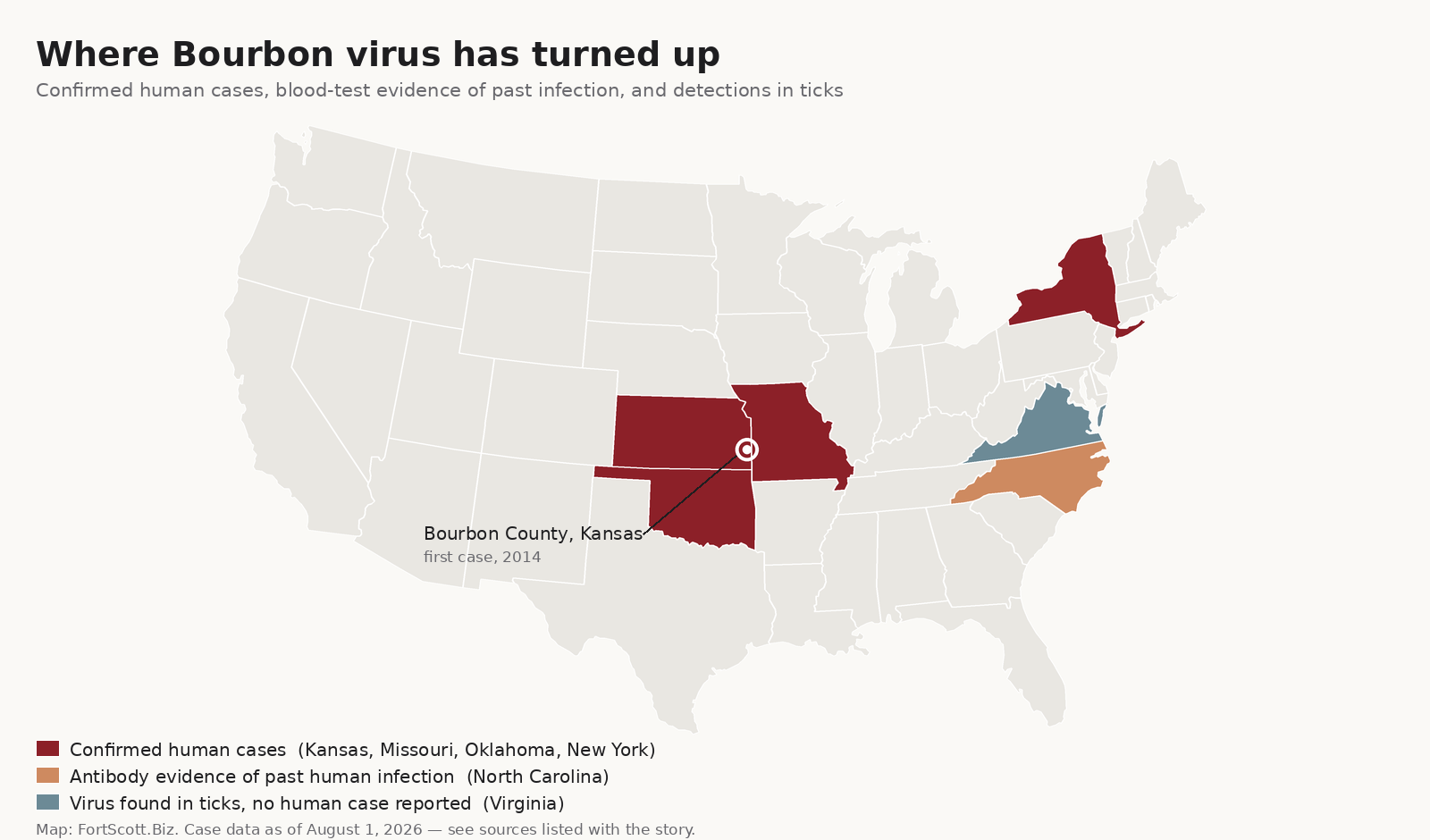
Where Bourbon virus has turned up. Map: FortScott.Biz. Case data as of August 1, 2026.
How rare is it, really
Six human cases have been reported in the medical literature since 2014, in four states: Kansas, Oklahoma, Missouri, and New York. That count comes from the January 2026 case report. The CDC’s own page, updated in June 2026, gives no running total at all.
One of the Missouri cases was a state park official whose death was linked to Bourbon virus in a March 2018 report by The Missourian, a Franklin County newspaper. That case is documented in news coverage rather than in the medical journals, and the 2023 scientific review of the virus cites the newspaper account rather than a case report.
The researchers who study it say the real number is higher. There is no commercial test for Bourbon virus, so a doctor who suspects it has to send samples through the state and then to the CDC. The Stony Brook team notes that many clinicians are unfamiliar with the virus, which raises the chance of a missed diagnosis.
When researchers went looking in stored blood samples in North Carolina, they found four people out of 518 carrying antibodies showing they had been infected at some point (Zychowski et al., 2024). That state has never had a confirmed case.
That does not mean those people got seriously ill, and some infections are probably mild. It does mean the virus reaches more people than the case count shows.
Long Island doctors reported the same kind of finding this summer. They rechecked blood from 107 patients who had a fever after a tick bite between 2019 and 2024, and two carried Bourbon virus antibodies (Bateman et al., American Journal of Tropical Medicine and Hygiene, 2026). One of them was New York’s first confirmed case, identified in April, a patient who had been hospitalized and assumed to have Lyme disease (Stony Brook Medicine, July 2026). Fox Weather reported that the patient recovered.
What to do about it
There is no vaccine and no drug that treats Bourbon virus. Hospitals can give fluids and treat the pain and fever, but they cannot kill the virus.
Since there is no treatment, not getting bitten is the only defense. The advice is the same as for every other tick illness. Treat clothes and boots with permethrin. Use a repellent with DEET, picaridin, oil of lemon eucalyptus, or IR3535. Tuck your pants into your socks. Shower soon after you come in. Then do a real tick check: waistband, armpits, around the ears, belly button, behind the knees, and in your hair. Check the dog too. Pull an attached tick straight out with fine-tipped tweezers, gripping close to the skin.
If you are being treated for a tick bite and not improving, tell your healthcare provider. That failure to improve is the specific clue Kansas health officials tell doctors to watch for.
Kansas health officials tell doctors to consider testing for Bourbon and Heartland viruses when a patient has a fever, a possible tick bite in the last three weeks, certain abnormal blood counts, and an illness that is not responding to doxycycline. Both Bourbon County men were given it. So was the New York patient, who was first thought to have Lyme disease.
The state also says to watch for symptoms for 30 days after a tick bite, and to tell your doctor about the bite. Kansas doctors who want testing help can call the state Epi Hotline at 877-427-7317, option 5.
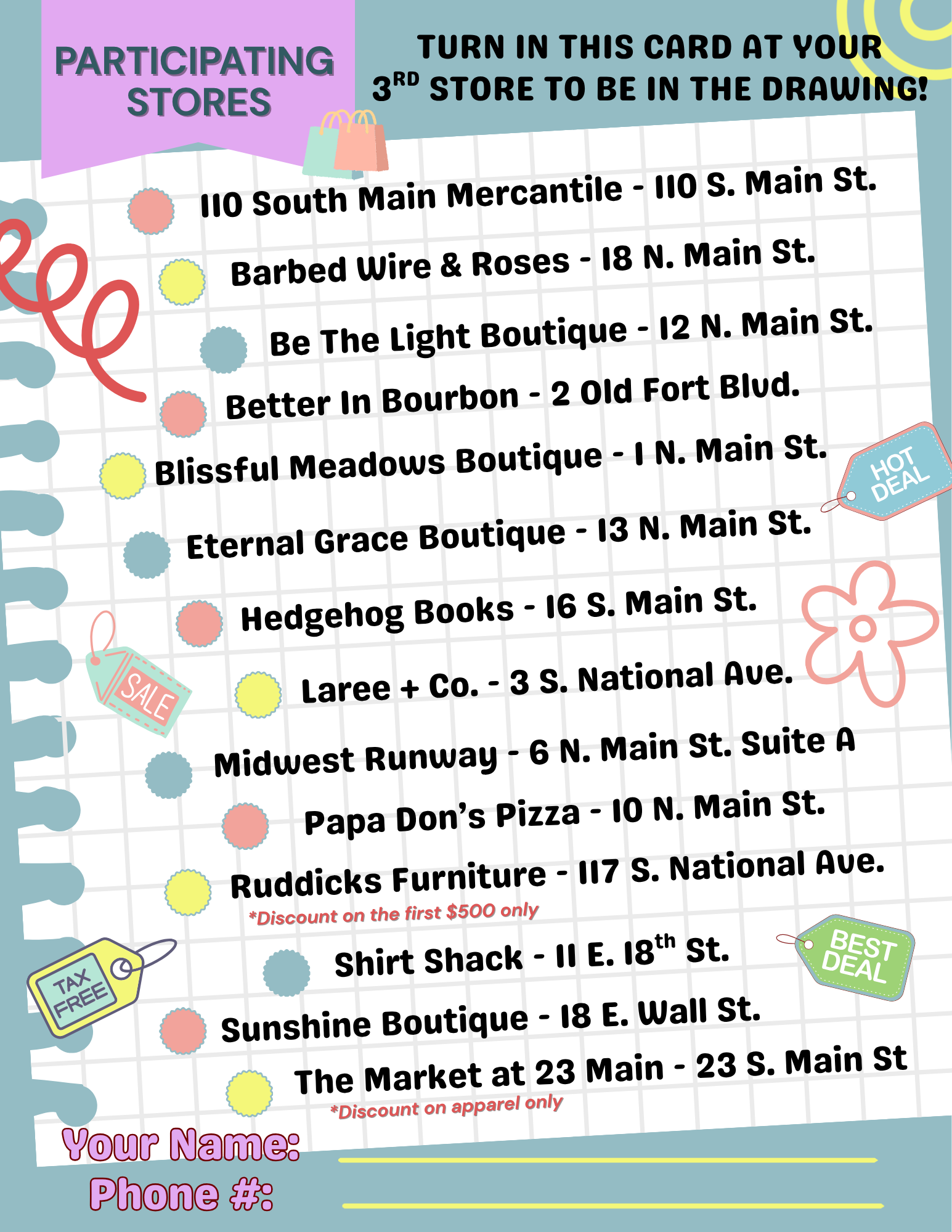
The Fort Scott Area Chamber of Commerce has 14 businesses involved in this year’s Shop Fort Scott Sales- Tax Holiday event this weekend, August 7-8.
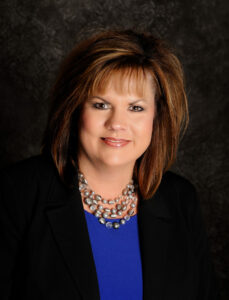
Lindsay Madison is the executive director of the Fort Scott Area Chamber of Commerce. Submitted photo.
Lindsay Madison, Fort Scott Area Chamber of Commerce Executive Director, said the annual event began in 2011, when a few stores approached the Chamber with the idea.
The neighboring states of Missouri and Oklahoma have tax holidays before the fall season each year. Kansas has none.
So, to keep the community and their dollars in Fort Scott, some local businesses are providing the opportunity to save money, while supporting local businesses with an almost 10 percent reduction in their total receipts.
Some retailers will participate in the Shop Fort Scott Sales Tax Holiday Weekend by offering shoppers a 9.65% discount while continuing to collect and remit all applicable sales tax.
Participating merchants include 110 South Main Mercantile, Barbed Wire & Roses, Be The Light Boutique, Better In Bourbon, Blissful Meadows Boutique, Eternal Grace Boutique, Hedgehog Books, Laree + Co., Midwest Runway, Papa Don’s Pizza, Ruddick’s Furniture, Shirt Shack, Sunshine Boutique, and The Market at 23 Main.
Special considerations include that the discount at Ruddick’s Furniture applies to the first $500 of a purchase, while the discount at The Market at 23 Main applies to apparel only, according to a Chamber press release.
Shoppers may also enter to win $50 in Chamber Bucks.
To qualify for the Chamber Bucks, shoppers must spend at least $5 at three participating businesses and have their event rack card marked at each location. Completed cards should be turned in at the third participating business visited to be entered into the drawing.
Participating businesses offer a wide variety of merchandise, including apparel, home décor, new and repurposed furniture, school supplies, pizza, and much more.
With most participating businesses located in Fort Scott’s Downtown Historic District, shoppers can enjoy a convenient weekend of shopping while supporting local businesses throughout the community, according to the press release.
For more information, contact the Chamber at (620) 223-3566 or visit fortscott.com.
Leslie Godden from her email signature
“We are always looking for new ideas and ways to change things up so the event stays fresh and people continue to get excited about shopping locally,” said Leslie Godden, Chamber Communications and Events Planner.
Fort Scott’s budget consultant told commissioners at last week’s work session that the city’s golf course does not cover its own costs, and questioned whether the way the city runs it now is sustainable.
“The revenues that we’re generating is not going to cover the expenses,” Baker Tilly financial advisor Ben Hart told commissioners on July 27, suggesting Woodland Hills might belong back inside the general fund. (watch)
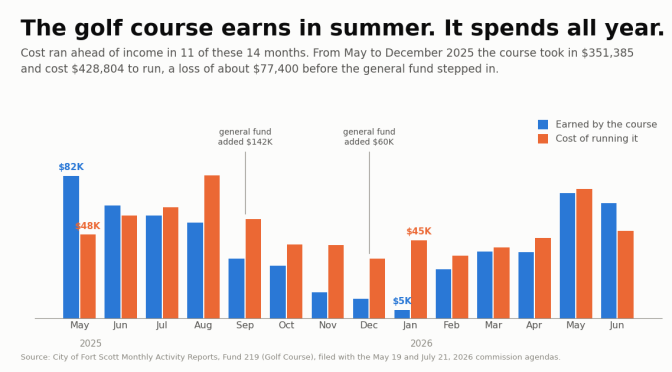
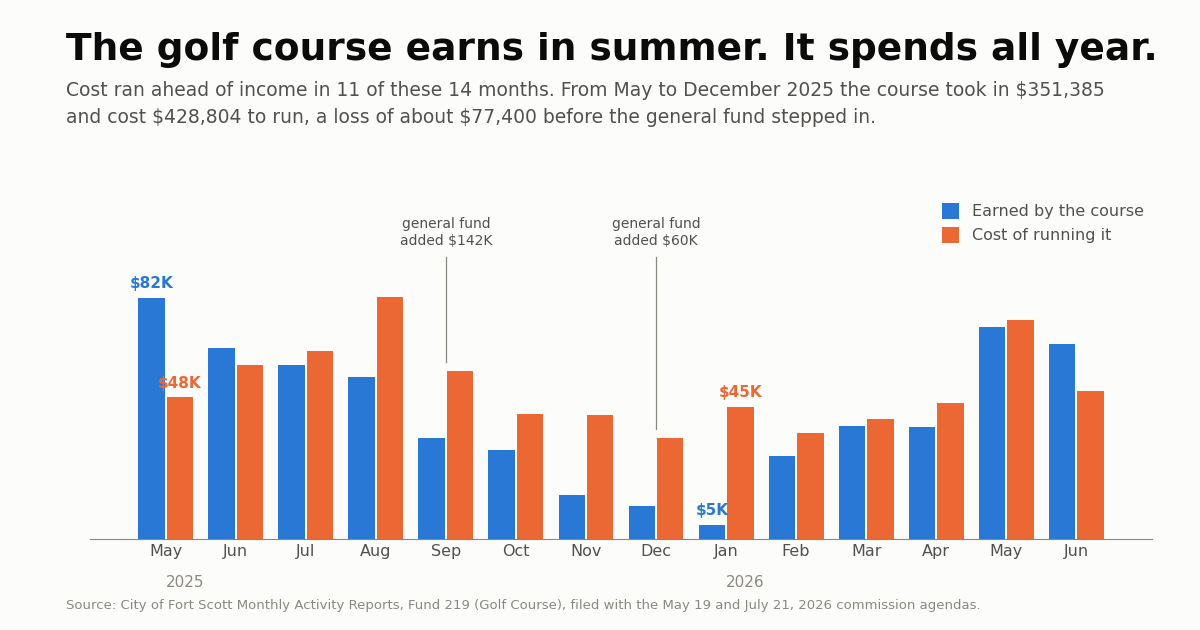
The city’s own monthly reports put numbers to it. Twice last year the general fund transferred money into the golf fund to cover its losses: $142,135.64 in September 2025 and $59,630.23 in December, $201,765.87 together. Strip those transfers out and Woodland Hills ran roughly $77,400 in the red over the eight months from May through December 2025. Through June 2026, the latest month the city has reported, the fund is down about another $44,100, with no transfer so far this year. June was its best month in a year, a $16,299 surplus.
In April, Hart told commissioners the general fund ran a deficit of roughly $987,000 in 2025, driven largely by about $476,000 in transfers out to the golf course, economic development, and parks and recreation. Of those three, the golf course took the most. Over the same eight months the city’s reports show $201,766 going to golf, $147,179 to economic development and $35,566 to recreation.
The gap between the bars is the loss. Cost ran ahead of income in 11 of these 14 months. Source: City of Fort Scott Monthly Activity Reports, Fund 219, filed with the May 19 and July 21, 2026 agendas.
How Fort Scott ended up owning a golf course
The city didn’t set out to be in the golf business.
When Dave Martin became city manager in 2010, people started telling him the city should buy the course before it fell apart. Others told him to stay well clear of it. The owners could no longer keep it up, and nobody else stepped forward.
Martin’s answer was to put it to the town: if residents thought the city should own it, residents should help pay for it. They did. The community raised about $350,000 toward buying and fixing up the course.
“This is what a community can do when they set their sights to work together to make something nice and better in Fort Scott,” Martin said in 2016.
The years that followed brought steady investment. The city hired PGA professional Shannon O’Neil as clubhouse manager and a superintendent, Jon Kindlesparger, to rebuild grounds Martin admitted were “in disrepair.” A new clubhouse opened in February 2016. A $65,000 cart barn went up in 2018, again paid for largely by donations. In 2019 the city’s community development director, Robert Uhler, told a chamber coffee that a bestthingsks.com list had put Woodland Hills among the top ten public golf courses in Kansas.
The course became more than a place to golf. Fort Scott High School, Uniontown High School and Fort Scott Community College teams all played there, and in FSCC’s first year with a golf program two players qualified for nationals. By 2018 the course carried 127 memberships, hosted 25 tournaments a year and logged 9,100 rounds. In 2024 the clubhouse was renamed “The Clubhouse” by public vote, got new carts and furniture, and the city floated a Fort Scott-themed miniature golf course to pull families in.
So does it make money?
Two of the city’s own officials say they had heard for years that it did. That assumption is exactly what the city set out to test, by pulling the course out of the general fund and into a fund of its own, so its revenue and costs could be seen on their own.
Mayor Kathryn Salsbury told the July 27 work session she wants it kept that way. She said she had always heard the “golf course is the only place where we make money. And then we pulled out and found out that’s not true. So I’d kind of like to keep watching it.” (watch)
City Manager Brad Matkin backed her up, saying the old claim never had evidence behind it: “when I first started, it was like we made money. And that was a statement. You didn’t have any, there’s no proof to that.” (watch) Breaking it out, he said, was the only way to find out: “because other than that, you’re just saying things.”
Commissioner Julie Buchta raised a complication worth remembering: when the course did appear to turn a profit, it may have been because maintenance was being deferred. “Didn’t we show a profit, but it’s because basically they were cutting all the fertilizer and everything out?” (watch) A golf course that stops buying fertilizer looks cheaper for a season and worse for years, which is roughly the condition the city bought it in.
The shape of the problem
The chart above shows why this is hard to fix. Woodland Hills earns real money, about $351,000 from May to December 2025, but it earns almost all of it in five months: May alone brought in $82,000 and January brought in $4,748. The cost of running the course does not follow that curve. It ran between $34,000 and $82,000 every single month, summer and winter alike, and over those same eight months the city’s own reports put the cost of running the course at $428,804 against $351,385 of income. The fund’s expense lines run from salaries, health insurance and KPERS through electricity, equipment and irrigation maintenance to fertilizer, chemicals, sand and gravel. The 2026 budget had to add money for fertilizer and chemicals as prices rose.
The city has kept putting money in, and has looked for more out. In February commissioners raised what tournaments pay. Groups booking an event are charged per player, and the city caps what any single event pays for the day: the per-player fee went from $30 to $35, and the cap on one day’s tournament from $4,500 to $7,000. Those terms sit on the city’s golf event application rather than the published green-fee rates, so most golfers never see them; the change falls on the large charity and fundraiser tournaments the course hosts; as of 2018 it held about 25 a year. On July 21 they took $31,000 out of general fund reserves for a used 2021 Ventrac mower, after the 2012 machine failed and its parts were discontinued.
And the 2027 budget now in front of the commission sets aside nothing to cover golf course losses — only the annual golf cart lease. “There’s nothing budgeted here to transfer over for any kind of losses in the golf course,” Hart said. (watch)
Which leaves an unanswered question on the table as budget hearings approach: if the course again spends more than it takes in during 2027, where does that money come from? Hart said he and a Baker Tilly colleague would start producing a running profit-and-loss statement for the course so commissioners can follow it line by line.
The next budget work session is August 18. The public hearing and adoption are set for September 15.
Reporting from the city’s published recordings of its July 21 and July 27, 2026 commission meetings, the 2027 budget presentation filed with the July 27 agenda, the city’s Monthly Activity Reports for Fund 219 filed with the May 19 and July 21, 2026 agendas, and fortscott.biz coverage from 2016 to 2024.
Fort Scott’s city commission spent about 35 minutes on Monday, July 27, on a proposed 2027 budget that closes a projected shortfall: on paper, it balances. How it balances is what commissioners kept circling back to.
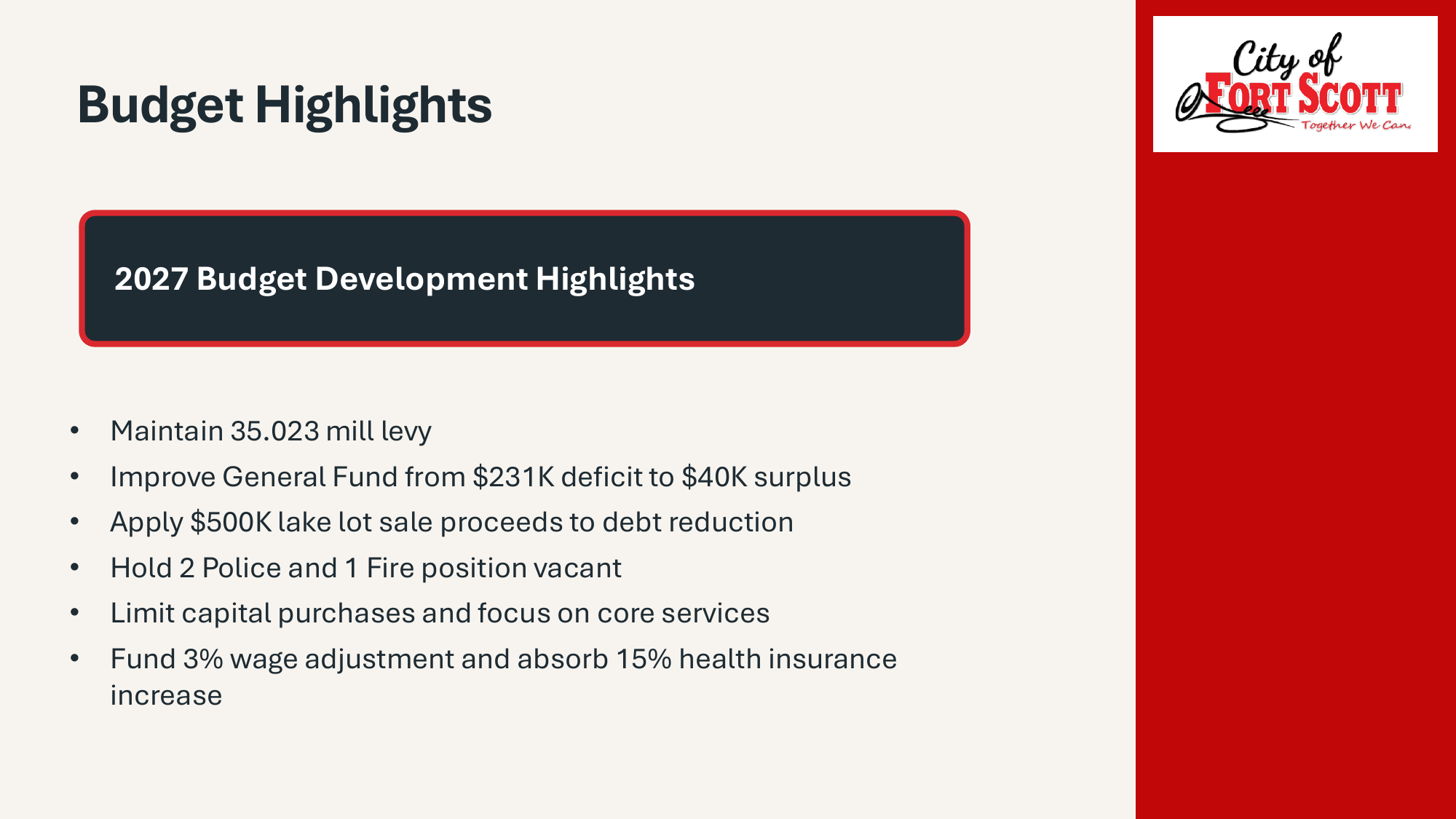
According to the budget presentation filed with the meeting agenda, the plan holds the general fund levy flat at 35.023 mills — the largest piece of a city property tax rate that totalled 43.382 mills in the 2026 budget and moves the general fund from a projected $231,000 deficit to a $40,000 surplus. It gets there partly through belt-tightening — holding two police positions and one fire position vacant, and limiting capital purchases — and partly by applying $500,000 it hopes to raise from selling lake lots to debt — which the city scores as $134,733 of recurring relief a year, not as $500,000 of operating money. It also funds a 3% wage increase and absorbs a 15% jump in health insurance.
The plan in the city’s own words. Source: City of Fort Scott 2027 budget presentation, filed with the July 27 agenda.
That $500,000 is money the city only gets once, and Baker Tilly financial advisor Ben Hart, who presented the budget, was direct about why he wants it spent on debt rather than daily operations.
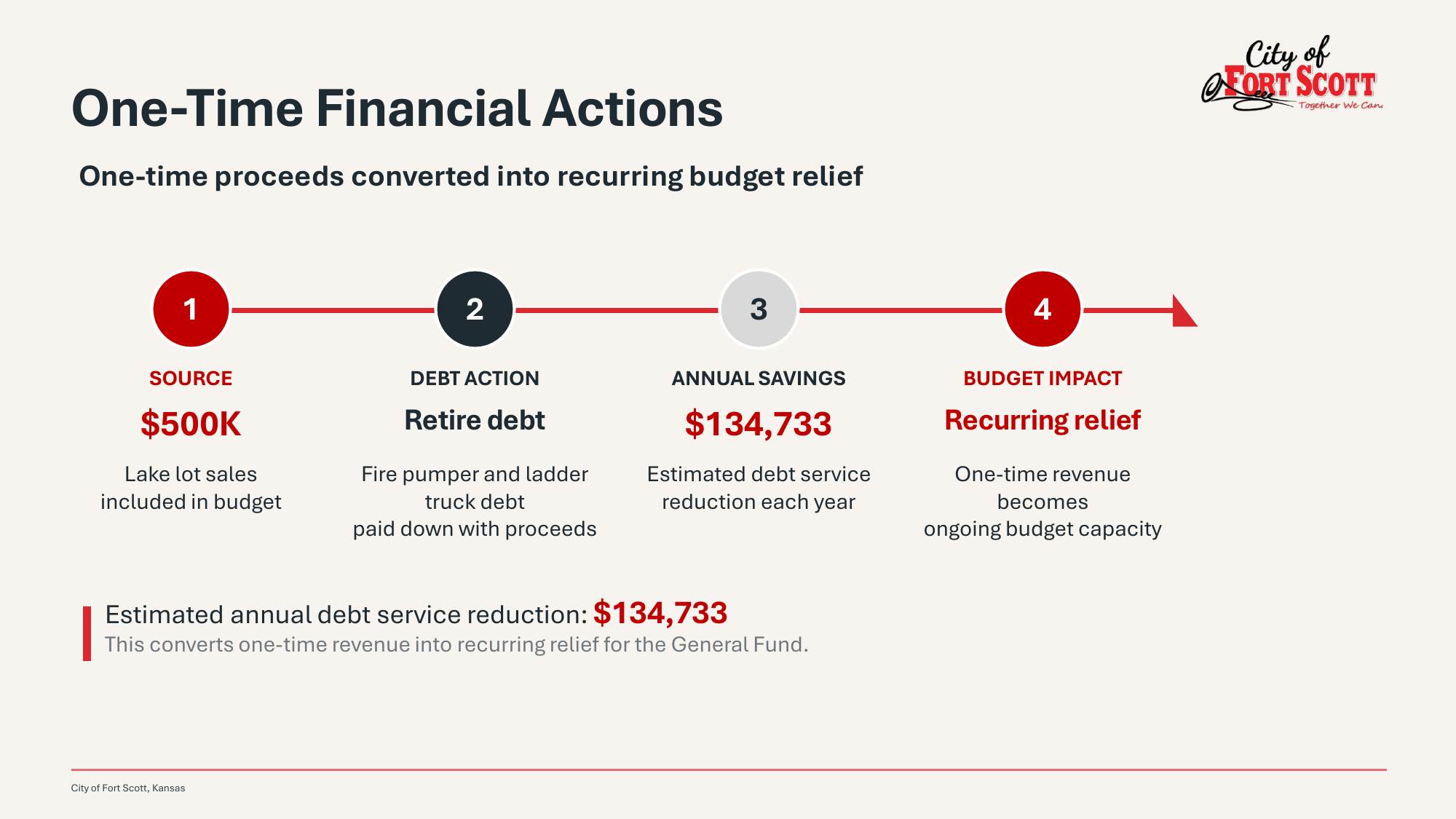
The thinking behind the lake lots, he told commissioners, is that the money has to go to retiring debt — it cannot pay for day-to-day operations. “It’s also a one-time revenue source. And that’s it. You only get it once. You match that up with a one-time expense that would benefit the general fund, what that does is eliminate $134,000 in debt service payments out of the general fund.” (watch)
City Manager Brad Matkin said the lots are already surveyed: “The lake lots that he’s talking about are the five that have already been staked out. … It’s on the east side at the very end, be the north end.” (watch)
The city’s own diagram of the plan: a one-time $500,000 land sale retires fire truck debt, which the city says cuts debt service by $134,733 every year. Source: City of Fort Scott 2027 budget presentation.
What if the lots don’t sell
Mayor Kathryn Salsbury asked the obvious question: “What if we don’t sell any lots like that?” (watch)
Hart said the city would fall back on money coming from Bourbon County for dispatch services — using part of that payment to cover the shortfall. Earlier he had said that would have to “take place for the next three or four years” (watch) (watch), for as long as the debt is outstanding.
That county payment isn’t in the budget at all. “Keep in mind, what we try to do is keep the dispatch payment from the county out of the general fund entirely,” Hart said. “Right now it’s not accounted for anywhere in the 27 budget.” (watch)
It also isn’t spare change. Hart described it as “reserved for future, well, really economic development,” pointing to the rodeo initiative the commission had announced as the sort of thing that might offset falling sales tax. (watch) So if the lake lots don’t sell, the trade-off isn’t free: money the city has been holding for possible future economic-development priorities would go to old debt instead.
Commissioner Julie Buchta pushed on whether early payoff actually saves anything. “What are we paying in interest? I mean, if we pay off those debts, are we trying to remember what our interest rate is?” she asked. (watch) Hart said the two trucks involved — a fire pumper and a ladder truck, according to the presentation — are near the end of their payment schedules, so the interest avoided would be roughly $75,000 in total over the remaining term. That is a separate figure from the recurring saving: the city puts the annual debt service reduction at $134,733 a year.
The other flashpoint was the municipal golf course, which the city pulled into its own fund to see whether it makes money. It doesn’t, and the 2027 budget sets aside nothing to cover its losses — only the annual golf cart lease (watch). We will look at the golf course, and how Fort Scott came to own it, in a separate story.
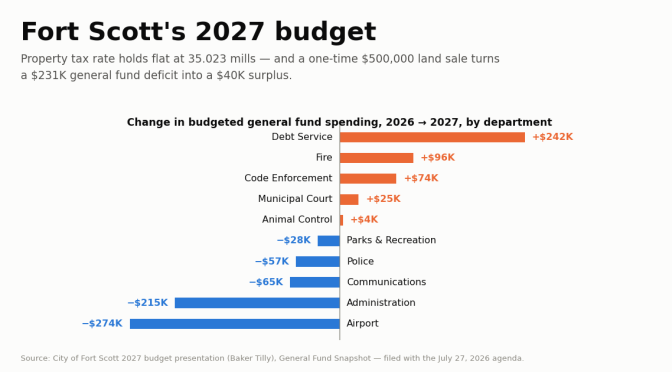
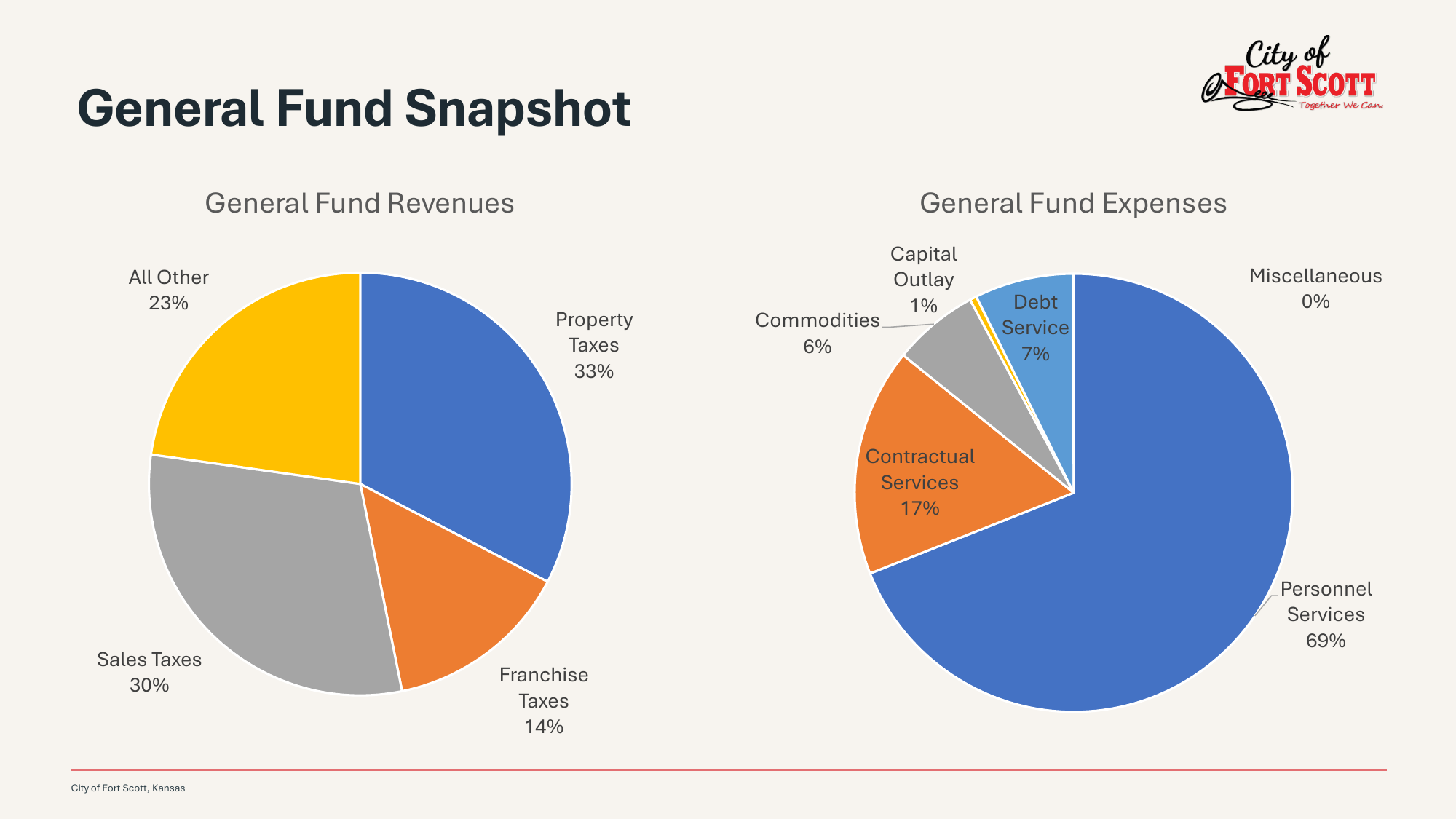
Where general fund money comes from, and where it goes. Source: City of Fort Scott 2027 budget presentation.
Where the money comes from
Per the presentation, about 33% of general fund revenue is property tax and about 30% is sales tax, with franchise taxes at 14%. Personnel is roughly 69% of general fund spending — Fort Scott is, as Hart described it, a “service driven industry.” The plan assumes sales tax falls about $118,930 and franchise taxes about $134,944, including roughly $75,000 less in electric franchise tax.
The general fund should end the year with about $1.2 million in reserve — around 17.7% of spending, or about 65 days of operating money. “That’s if all revenue stopped and ceased to exist,” Hart said, “you’d have 65 days operating reserve to continue to maintain services.” (watch)
What’s next
Commissioners asked for a 2026 year-end forecast, a list of contractual services above about $10,000, and a clearer comparison of paying cash versus borrowing. Hart reminded them the choices are theirs. “This is the city administrator’s budget. You come up with what priorities look like. Our job is to set them up for you and give you the data necessary to make that decision.” (watch)
The budget calendar filed with the agenda sets the next work session for August 18, with the public hearing and adoption on September 15.
Based on the city’s published recording of the July 27, 2026 budget work session and the budget presentation filed with that meeting’s agenda.
Late in 2025 the Fort Scott City Commission approved a property tax break of up to ten years for the vacant dialysis clinic at 2526 S. Main, to help a Joplin kidney specialist reopen it. Fort Scott has had no dialysis center since 2019. Patients drive to Pittsburg or Chanute, three times a week.
This week, FortScott.biz checked with those involved. City officials say their part is finished. The commission awarded the abatement, the bond paperwork is complete, and nothing more is pending at City Hall. The reopening is now in the hands of the physician who will run the clinic.
The building itself is quiet for now. A July 25 visit found no signage or activity yet, and county records show the property’s 2025 tax bill of $65,343.80 was paid in full. That fits the timeline in the city’s documents, which say the exemption cannot appear before the 2026 tax statement.
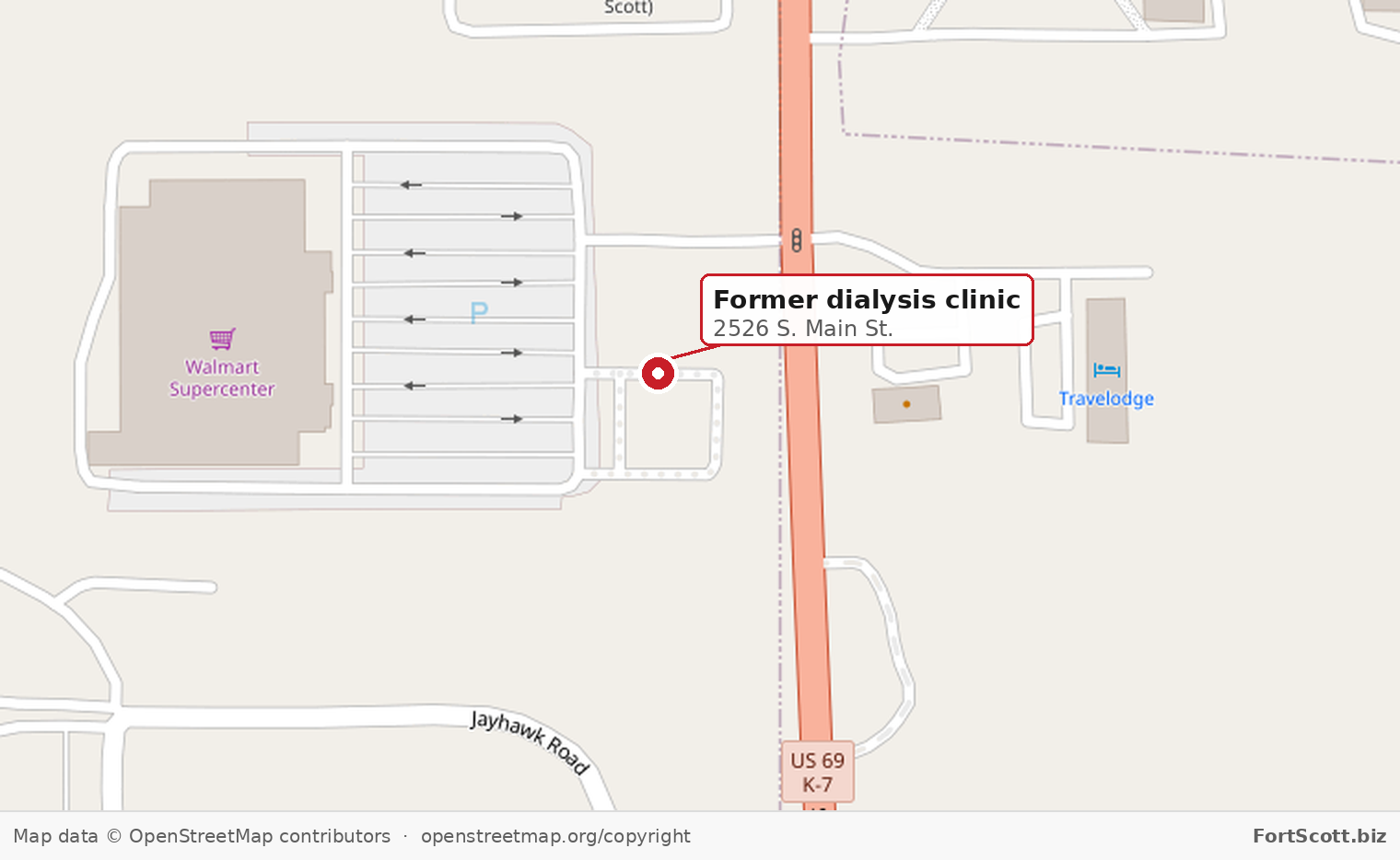
Where the building is
Most people know it as the low brick building in front of Walmart.
Bourbon County’s tax record for the parcel (tax ID 002-FS10762B, in the Wal-Mart Plaza Pointe subdivision) answers the abatement question directly.
The building did change hands. The county lists Moka Rentals LLC as the current owner and taxpayer of record. That is the company named in the city’s bond documents as the tenant. Before Moka, the record shows Phoenix Fort Scott LLC, and before that Wal-Mart Stores and Wellington Ft Scott Ltd.
The 2025 taxes were paid in full, with no exemption. For tax year 2025 the county appraised the property at $1,400,000 ($193,790 in land, $1,206,210 in building) for an assessed value of $350,001. At a mill levy of 186.696 that produced a bill of $65,343.80, paid on December 18, 2025.
Tax year
Owner of record
Assessed value
Total tax
2025
Moka Rentals LLC
$350,001
$65,343.80
2024
Phoenix Fort Scott LLC
$377,331
$72,397.38
2023
Phoenix Fort Scott LLC
$422,346
$80,914.32
2022
Phoenix Fort Scott LLC
$413,983
$79,080.28
2021
Phoenix Fort Scott LLC
$395,233
$78,653.34
2020
Phoenix Fort Scott LLC
$389,186
$77,981.20
2019
Phoenix Fort Scott LLC
$396,485
$80,160.54
So when does the abatement take effect? By the terms of the city’s own documents, the earliest it can apply is tax year 2026. Both the resolution and the ordinance say the exemption runs for ten years “commencing in the calendar year following the calendar year in which the Bonds are issued.” The draft bond documents date the bonds December 23, 2025. If they were issued on schedule, the first year the exemption could show up on a tax bill is 2026. Kansas tax statements for 2026 don’t go out until November.
That makes this November’s statement for 2526 S. Main the first place the exemption can appear in the public record.
The county’s appraisal record still lists the structure under its old name, “Fresenius Medical Care Dialysis,” a 7,992-square-foot medical office building put up in 2014.
The deal ran through taxable industrial revenue bonds. Despite the name, the city borrows nothing and owes nothing; it acts as a pass-through so a private project can reach two state-level tax breaks, a property-tax exemption and a sales-tax exemption on construction.
On November 18, 2025, after a public hearing, the commission voted 5-0 to move forward with Resolution 40-2025, declaring it advisable to issue about $800,000 in bonds to acquire, renovate, furnish and equip the building and lease it to Moka Rentals LLC (resolution; minutes).
Dr. Nadine Aboul-Magd, a kidney specialist with Joplin Nephrology Consultants who the minutes say served Fort Scott from 2015 to 2019, told the commission the abatement was essential to the project. The minutes record her saying the reopened clinic would employ at least seven people initially and would add two kidney physicians (minutes).
Steve Robb of Municipal Consulting LLC, who prepared the cost-benefit study Kansas requires before a city grants this kind of exemption, told commissioners the deal would return $9.67 for every dollar the city gave up, well above the 1.3 he called the cutoff for a worthwhile deal, mostly because a dialysis clinic uses a great deal of city water (minutes).
On December 16, 2025, the commission took up Ordinance No. 3792, which authorizes the bonds (ordinance). “There were no changes from what was discussed,” Mayor Tim Van Hoecke said as he introduced it (video, 2:07:39). A staff member called it “just procedural.” The commission voted and the mayor moved on. The city has not posted approved minutes for that meeting, so the exact tally is not on the public record.
Two details in the paperwork are worth knowing:
The break covers the bond-funded share of the property. The exemption applies only to the part of the property paid for with bond money, and it must be applied for. The one levy it cannot touch is the school district’s capital outlay levy, under the statute the resolution cites, K.S.A. 72-53,113 (resolution, § 4). For USD 234 that levy is 7.998 mills (about 4.3% of the 186.696 total on this parcel). Everything else can be abated, including Bourbon County’s share. This parcel sits in tax unit 002, which is made up of the state, Bourbon County, Fort Scott Community College, the city of Fort Scott, USD 234 and the Southwind Extension District (2025 Bourbon County levy sheet). The minutes record the city’s consultant telling commissioners that most taxing entities come out ahead, with minimal impact on the extension district and the community college (minutes).
The break is tied to actually running a dialysis center. The lease says that “[s]ubject to the Project being continually operated as a dialysis center,” the city will make the filings needed to keep the exemption alive for the full ten years (project lease, § 7.4).
What the city, the county and the doctor’s office said this week
On July 29, Mary Wyatt, Fort Scott’s Planning, Housing and Business Development Director, told FortScott.biz the city’s part of the deal is done. The commission voted to award the ten-year abatement, and the paperwork between the city’s bond counsel and the owner has been completed. “It’s all in the hands of the owner at this point,” she said. “The ball is just in their court to get their operations up and running.”
Wyatt said she had not heard from the owner recently. In their last conversation, she said, the owner told her that opening a dialysis clinic is a legally involved process, lining up physicians in particular, and that she wants to go about it carefully, given the building’s history of closing.
Bourbon County Appraiser Matt Quick confirmed that no exemption yet appears in county records. Once the remaining paperwork is complete, he said, the property goes into exempt status for ten years. Quick described the city as the lead on the bond arrangement.
Wyatt said the approval that mattered came from the city commission, because the city is the entity abating the taxes locally. The state’s remaining role, as she described it, is a document that “has to be acknowledged at the state level.”
Quick also sent FortScott.biz pages from the state Division of Property Valuation’s guide to these exemptions, which fills in the steps between the city’s vote and a smaller tax bill. After the bonds are issued, the applicant files an exemption application, called the IRBX form, with the county appraiser, who forwards it with comments to the Board of Tax Appeals. The exemption is deemed approved unless the board schedules a hearing within 30 days of receiving all the information. The break is not automatic once granted. The owner must file a claim with the county appraiser by March 1 each year of the ten; miss the filing, and the property goes back on the tax roll. Those filings square with what the city describes. Under the lease, keeping the exemption in place is tied to the building operating as a dialysis center.
At Joplin Nephrology Consultants, practice manager Heather said there are “no updates as of right now” on the Fort Scott clinic, which she described as Dr. Nadine’s project, and confirmed the reopening is still in the plans.
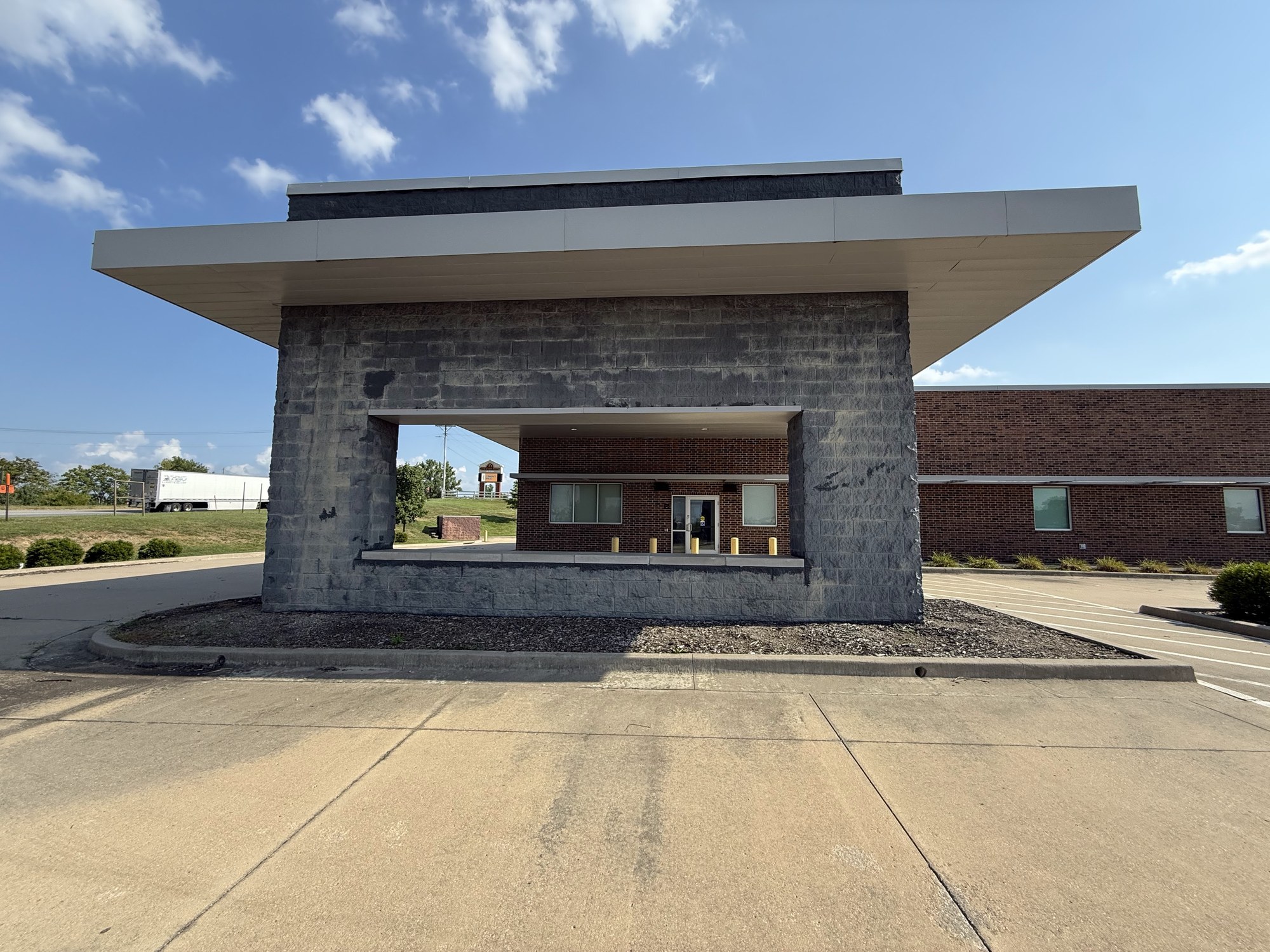
What the building looks like now
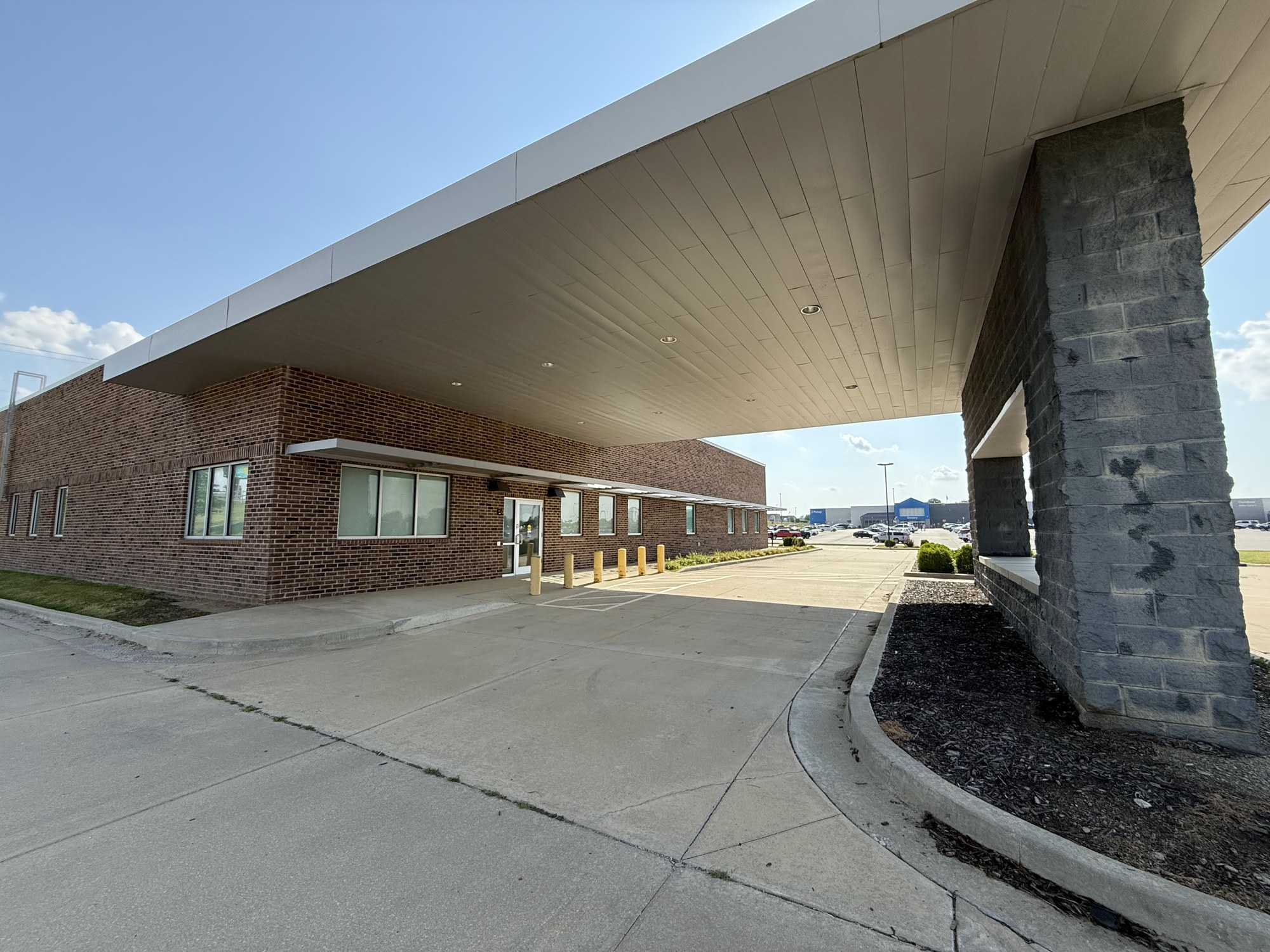
2526 S. Main on the afternoon of July 25, 2026. FortScott.biz photo.The covered patient drop-off at the entrance. There is no signage on the building. FortScott.biz photo, July 25, 2026.
The lot was empty on the afternoon of July 25. There is no signage on the building or at the street, the blinds are drawn, and the covered patient drop-off, the giveaway that the place was built as a clinic, sits unused.
Fort Scott has been losing health care since 2018. Mercy announced that October that it would close the hospital it had run in town since 1886 (FortScott.biz, Oct. 3, 2018). The dialysis center closed the following September. Fresenius did not publicly give a reason for the closure. “I have talked to Fresenius,” then-City Manager Dave Martin said at the time. “They haven’t made money to the point of, they can’t stay open” (FortScott.biz, Aug. 30, 2019). Ascension Via Christi closed the emergency department in December 2023 (FortScott.biz, Dec. 18, 2023). Freeman has been working toward a hospital and emergency department here (FortScott.biz, Jan. 8, 2025).
The building has been empty since Fresenius Medical Care closed it on Sept. 30, 2019. As late as May 2023, its owner at the time said it was still looking for a tenant (FortScott.biz, May 2, 2023).
If the project comes together, that vacancy — and the three-times-a-week drives to Pittsburg or Chanute — would end.