I have several mature trees on my place and, after a windstorm in the night, I will usually see broken tree branches and dead sticks littering the yard. Sometimes the branches do not break clean, so they’re just hanging on by the skin of their teeth. These damaged branches will initially look alright, but after a few days the leaves begin to die and turn brown and crispy. What an ugly mess! These once-healthy branches didn’t have the strength to hang on to the tree, so now they’re nonproductive and worthless and must be hauled off to the burn pile. These branches are simply good for nothing.
God told Moses “I AM”, and Jesus told His disciples “I am…” John the Beloved recorded Christ’s words: “I am the true vine, and my Father is the vinedresser. Every branch in Me that does not bear fruit He takes away, and every branch that does not bear fruit He prunes, that it may bear more fruit. Already you are clean because of the word that I have spoken to you. Abide in Me and I in you. As the branch cannot bear fruit by itself, unless it abides in the vine, neither can you, unless you abide in Me. I am the vine; you are the branches (John 15:1-4 ESV). The Bible is the believer’s owner’s manual for our life that sometimes goes in one ear and out the other – or is flat-out neglected. Jesus teaches how we are to live so we need to heed His words in order to live right.
The biblical definition for abide is: to remain, continually dwell, or walk daily in a close, enduring, personal relationship with Christ Jesus. Disciples of Jesus are to abide in Christ, develop a healthy, fruitful life, represent Him well, and bring glory to His Name.
I have two godly women in my life and both have one small tattoo. One tat simply reads “Abide” and the other is “Faith” – both of these gals are serious about constantly abiding in Christ and following His Word. All believers must somehow remind ourselves about staying connected to the Vine in order to bear lots of fruit. We’re to live abundantly in life-union with Jesus. He said, “I am the way, the truth, and the life. No one can come to the Father except through Me” (John 14:6 NLT). No one can truly live the way God intended for us until we surrender to Jesus and choose to abide in Him. Make the critical decision to stick with Jesus so you’ll bear fruit. Otherwise, you’re on your own and the definition of that is FAIL.
Whoever abides in Me and I in him, he it is that bears much fruit, for apart from Me you can do nothing” (John 15:5 ESV). This is a sobering scripture. We must live every day of our lives in Christ – attached at the hip, heart, and mind. Without His empowerment and wisdom we can do nothing spiritually for the Kingdom of God. Man, I don’t want to stand before God with an empty fruit basket — how embarrassing and needless!
“If anyone does not abide in Me, he is thrown away like a branch and withers; and the branches are gathered, thrown into the fire, and burned” (John 15:6 ESV). I don’t want to be fruitless for the devil, I want to be judged fruitful for the Lord when I cross the Jordan River at the end of my journey.
The Key: If you don’t want to be broken and worthless, abide, abide, abide in Christ Jesus.
Dave and I thought we had thought this “moving thing” through. We would pack most of our belongings into storage for a few weeks, but some items we would need until we could move into the house we were renovating. The plan was to live in the basement of the house we bought until the upstairs was ready to be inhabited, so great thought went into what we would need temporarily. We made mistakes. Clearly, “great thought” was not enough.
For example, we kept back the portable vacuum cleaner…but not its battery charger. Same with the leaf blower. They both lost their power within the first week we were here. We failed to keep the coffee pot and toaster and so breakfasted on frozen Jimmy Dean sandwiches. (The house came with a microwave.)
And yes, I know, these are not big problems. There is, however, one area in which thinking things through can have eternal implications. This is fresh in my mind because I focused my Bible reading this morning on Matthew 7 where Jesus speaks to his disciples about who will make it to Heaven and who won’t. One of the most convicting, disturbing, thought-provoking passages of scripture is found in Jesus’ words: “Not everyone who says to me, ‘Lord, Lord,’ shall enter the kingdom of heaven, but he who does the will of my Father in heaven. Many will say to me on that day, ‘Lord, Lord, have we not prophesied in your name, cast out demons in your name, and done many wonders in your name?” And then I will declare to them, ‘I never knew you, depart from Me, you who practice lawlessness.”
Think about it. God will judge what’s going on inside us. If that doesn’t shake you up, you’re pretty unshakeable.
I don’t know about you, but I can’t brag about prophesying or casting out demons or doing “wonders” in Jesus’ name. I haven’t led hundreds to the Lord. I haven’t even prayed faithfully or read my Bible every day. I’ve spent weeks trying to memorize Psalm 91 (a prayer for my family members) and still stumble at verse nine.
The fact that I go to church, write this article, speak to Christian audiences, am in a Bible study and don’t cuss will not be enough. My thought life needs to be melded to God’s heart. I need to know His will and do His will…and that requires thoughts that lead me to love the unlovely and not judge, to mourn over my sins and be a peacemaker, to do nothing for others’ approval and not let the sun go down on my anger. Thoughts that cause me to do good works will be the evidence of a relationship with Christ, not the basis for it. No matter what my circumstances are, I need to trust that God is in charge and I’m not. In secret, I need to honor Him, yield to Him, obey Him, and “think these things through.”
Giving God his rightful due is a critical “thought” that demands I do just that.
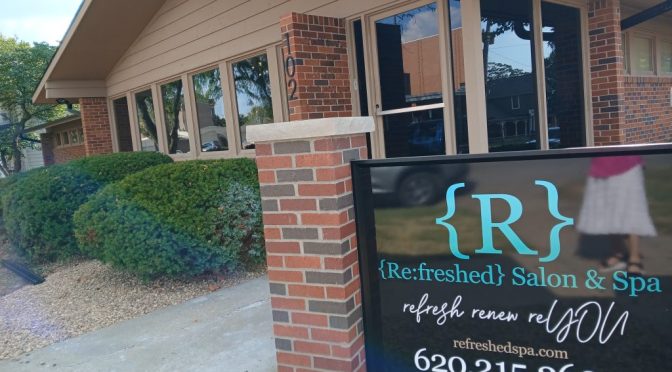
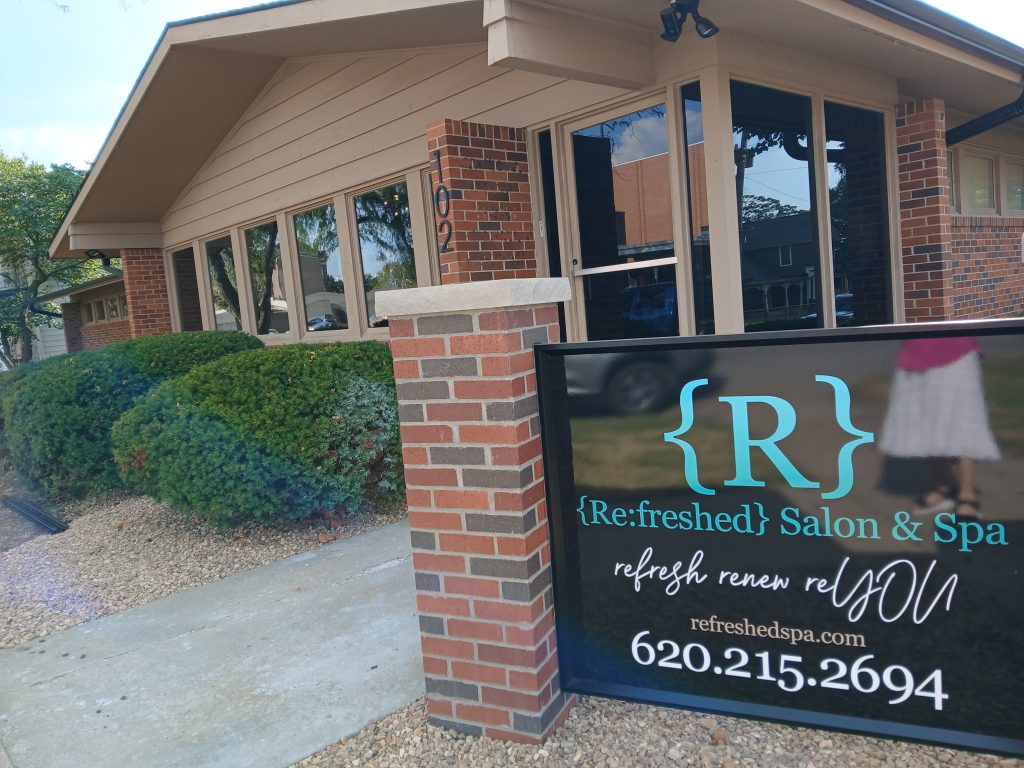
{Re Freshed} Salon and Spa has a new, expanded building at 102 S. Judson.
Business owner and aesthetician Delane Godden has moved to a new location, 102 S.Judson, and is open for business as of September 1.
“We have grown significantly and needed a bigger space,” Godden said. The building has 3,500 square feet of space.
The building, at 102 S. Judson, was at one time Fort Scott Family Physicians, then Reynold Law Firm, she said.
In addition to the five technicians already at {Re:freshed} Salon & Spa , she has added another aesthetician to her team, Meghan Owenby, who will specialize in headspa services and facials as well.
Godden started her aesthetician business in the Lyons Mansions, then moved to the Five Corners Strip Mall, just off of Highway 69 in 2016.
Delane Godden with eight month old son, Jagger.
Julie Daly has been a provider of massage therapy and nail/pedicure technician services at the salon/spa for nine years. She can be reached at 620.215.3436
Kayla Greenway has provided manicures/pedicures, eyelash services and spray tans for eight years at the spa, contact her at 620.363.0195
Bailey Hall has been a hairstylist for six years there; contact: 620.215.0107
Owenby recently started as a second aesthetician; contact: 620-215-6987
Dr. Saeid from Kansas City has been providing injectable cosmetic services on weekends at the spa for about one year, and has 20 years of experience in aesthetics. Contact “In Town Aesthetics by MD” at 913-602-6265
Cali Emerson is a hairstylist specializing in hair extensions and is also a receptionist, and has been with Re: freshed Spa for a few months.
Heather Jackson has been a receptionist for two years.
The spa is open Monday and Friday from 10 a.m. to 5 p.m., and Tuesday, Wednesday, and Thursday from 10 a.m. to 6 p.m.
Saturday hours are undetermined at this time.
Godden has created a brand of skin care products that is comprised of plant-based ingredients including perfumes and hand sanitizers, and facial products.
“We also have a line of laundry detergent, multi-purpose cleaning spray, hand soaps and room and linen sprays, as well as Bathhouse Trading Co. products and several skincare and body care line options as well,” she said.
One of a kind greeting cards are for sale by Laura Garzone and Cindi Lipe.
Other retail items include hair clips/scrunchies, belt bags, and insulated tumblers etc. Services provided
The Bourbon County Commission meets Monday, and one of the first items is a set of minutes it already sent back — the Aug. 17 minutes, tabled on Aug. 24 after Commissioner Mika Milburn-Kee said they needed “extensive revision.”
That is not unusual. The commission has sent minutes back over the past ten months, and not always for the same reason. Members have never agreed among themselves on what the minutes are supposed to be.
The county has used AI software to help produce its minutes since at least the fall of 2025. The current program, HeyGov, was demonstrated to the commission in January 2026 by then-Clerk Susan Walker. It offered three levels of detail, she said then — “a simple level, a medium level and a detailed level.”
Acting County Clerk Michael Hoyt described the current process: after a meeting is uploaded to the county’s YouTube channel, the video is downloaded as a file and run through a program called HeyGov, which transcribes the meeting and matches what was said to each item on the agenda. Hoyt then proofs the draft against his own notes.
“All I have to do is go through and proof to my notes — you know, who made the motion,” he said. “Even sitting there as close as I am, you sometimes don’t hear who seconded, or if two second at once, who wants to take credit for it.”
The draft then goes into the agenda packet for the next meeting. The commission either approves it, or gives corrections and approves it later. Once signed, it is the official record.
Hoyt said he checks requested corrections against the video before making them, because “I’m the keeper of the records. Even though it’s their meeting and it’s their minutes, they still can’t make things up after the fact.”
The alternative is doing it by hand. Walker said a full-length meeting took her office about eight hours, “because you have to sit up there and listen to everything and then try and figure out who the speaker is.”
The commissioners’ requests have not pointed the same direction.
At the Oct. 20, 2025 meeting, with the commission ten sets of minutes behind, then-Chairman David Beerbower read out his view of what belongs in them, and argued against detail.
“They are official, they are permanent, they are legal record,” Beerbower said. “They are distinct from a full transcript, though. Details that should be in there is motions and resolutions, voting outcomes, summary of discussions — but it is not a direct quote.”
A week after Beerbower’s speech, Chairman Samuel Tran asked for more — and what happened to that request is instructive.
The minutes he objected to covered an Oct. 22 special meeting on the county’s decision to move payroll out of the clerk’s office. Walker had read a prepared statement, and the minutes record its sharpest line: “The decision to remove payroll responsibilities from the clerk’s office was portrayed as a cost savings, improved processes. I must say plainly that it was not an operational improvement, it was a political move.”
The minutes give Walker five bullet points, ending with that accusation. They give the commissioners five, all procedural — reach out to the vendor, get everyone to the next meeting, discuss the timeline, review the noise ordinance, “Commissioner Beerbower will contact legal counsel.” Nothing the commissioners said in reply appears.
Tran did not dispute Walker’s cost figures or her account of how the decision was made; his objection was to the speech being delivered in public. The closest thing to an answer on the substance came from Beerbower: “And that’s a decision that we made at the time. And I’m going to stick with that.”
At the Oct. 27 meeting, Tran asked for those replies to be added, but the version the commission went ahead and signed on Dec. 1, 2025 appears to have been unchanged.
By June 2026 the software was producing longer minutes, and Tran objected to how they read. At the June 15 meeting, citing the May 11 minutes, he singled out phrases like “attempted to,” “push back gently” and “echo this point forcefully.”
“Minutes should be very bland. It should not have narratives in it,” Tran said. “I think we need to go back to just reporting what people say and leave it alone and not paint certain commissioners in a bad light.” He said the concern was not about any one commissioner.
The June exchange showed some differing opinions about what the commissioners think they can ask for.
Walker responded to Tran by explaining that the software produces long, medium and short versions, and that she had already changed which one she used.
“Before, I was being ridiculed for not doing enough, and so I went to the long version,” Walker said. “And now I’m being told the long version is [wrong], so now I need to go back to the medium version or the short version?”
Tran declined to say which he wanted.
“I’m not telling you anything, Madam Clerk. I’m not telling you anything. You’re an elected official. You do your job the way you see fit,” he said. “I’m just saying the final product does not meet my expectation of what minutes should be.”
On July 6, Beerbower put the question on the agenda to settle it: pick one of the three versions and move on.
He argued for the shortest, because “it provides just what is necessary by law to have.” Minutes “shouldn’t be about what you say,” he said, “it should be about what was done in the meeting.” Motley agreed: “My vote would be the short version.” Joe Allen said he had no preference, noting school boards “keep a shorter minute.”
Milburn-Kee’s answer was again about accuracy rather than length. “I’m happy with whichever one you want, Mr. Beerbower. I will read and correct whatever I need to do,” she said. “If they don’t send them to me with mistakes, I won’t have to make any corrections.”
County Counselor Bob Johnson gave the legal standard. “You shouldn’t have editorialized minutes,” he said. “It should be a concise description and summary of what was done. And I think that’s the law.” He added that the county’s minutes run “generally three times longer” than those of other boards he works with.
Tran said length had never been his concern. “That’s all I’m asking for, whether we vote on the long, the medium, or the short version,” he said. “To me, it’s always been one adjective in there changes the narrative.”
Then Tran made the motion: “So I move that we approve the short minute version of our minutes.” Motley seconded. The minutes of that meeting record that it carried unanimously.
Six weeks later, Tran asked for something the short version does not produce. At the Aug. 17 meeting, reviewing minutes that condensed Walker’s resignation statement, Tran said the full text should be in the record.
“I think it would be a disservice to the county if we did not include the whole verbiage of that resignation statement,” he said. Asked by Beerbower whether the letter would already be in county records anyway, Tran said the minutes are what people actually go to: “Very few people go back through and look at the actual documents.”
The commission agreed. Walker’s full three-page statement was attached to the Aug. 10 minutes, which were approved Aug. 24.
Running alongside the disagreement over length is a separate one about accuracy, and that request has been the same throughout.
Walker told the commission in June why speakers get mixed up: “It doesn’t pick up your voices because you don’t announce when you’re talking, and so therefore sometimes it might get Beerbower and Allen mixed up.” She added, “Oftentimes it says Mrs. Milburn is a man.”
Milburn-Kee has raised the same point at least three times. In October 2025 she asked that “great attention be paid before they’re sent to us in the first place.” A week later: “It’s important for me not to have extra things that are untrue in there, mainly.” On Aug. 24 she said it again: “Please, please make sure the right speaker is notated in there before sending it out as the minutes. I think I’m the only one bringing back edits for that.”
The commission takes up the Aug. 17 minutes again Monday, with corrections, and will review the Aug. 24 minutes.
Hoyt is doing the work alone. He said he is the only person in the clerk’s office, “replacing three people and doing it all.” He is seeking appointment as county clerk at the Bourbon County Republican convention on Sept. 1.
After buying new tires and reading the information on the job ticket/invoice, I noticed a statement in caps at the bottom: “HAVE YOUR LUG NUTS RETORQUED AFTER THE FIRST 50 MILES.” The last time I purchased a new set of tires, I didn’t see those instructions. This was news to me so I made a mental note to come back and have them retorqued. About a week later, I walked into the shop and asked to have the lug nuts retorqued. Both service technicians went into shock and nearly fainted and fell to the floor! The one guy said, “I’ve worked here for years and never had anyone ask for this service.” I responded, “Well, you guys didn’t mention this to me, but I read it on the paperwork, so here I am.”
I was ignorant because I hadn’t previously read the warning. There was no one to blame but me, myself, and I. Having the lug nuts retorqued after installing new tires is critical. It ensures that your wheels remain securely fastened to the hub assembly. During the first few miles of driving, the wheel and hub components settle, and repeated heating/cooling from braking and road friction can cause slight loosening of the lug nuts. Plus, uneven torque can cause misalignment, leading to uneven tire wear, steering issues, and handling problems. The bottom line: Proper torque prevents future problems. It’s not the technicians’ job to warn the customer. It’s the customer’s responsibility to read the fine print and then return the vehicle to be serviced.
Apostle Paul warns young Timothy of the dangers lurking in life. “You should know this, Timothy, that in the last days there will be very difficult times. For people will love only themselves and their money. They will be boastful and proud, scoffing at God, disobedient to their parents, and ungrateful. They will consider nothing sacred. They will be unloving and unforgiving; they will slander others and have no self-control. They will be cruel and hate what is good. They will betray their friends, be reckless, be puffed up with pride, and love pleasure rather than God. They will act religious, but they will reject the power that could make them godly” (2 Timothy 3:1-5 NLT).
God’s Word is a valuable treasure box, full of instruction, admonition, warning, blessing, wisdom, etc. Apostle Paul informed Timothy of the importance of reading and obeying the valuable information in the Manual of Life.“All Scripture is inspired by God and is useful to teach us what is true and to make us realize what is wrong in our lives. It corrects us when we are wrong and teaches us to do what is right. God uses it to prepare and equip His people to do every good work” (2 Timothy 3:16-17 NLT). For under $20, you can purchase a nice Bible and give it away. If the individual reads it and believes it, his/her life will be changed forever.
Jonathan Edwards (1703-1758), brilliant American theologian and preacher cautioned, “Be assiduous in reading the Holy Scriptures. This is the fountain whence all knowledge in divinity must be derived. Therefore, let not this treasure lie by you neglected.” Have you ever been in a situation where the wheels fell off in your life? It’s never too late to begin faithfully reading the Bible and practicing what it says. God’s Word is a safeguard against driving down the road of life with dangerous philosophies that aren’t biblical.
The Key: Believers, keep the lug nuts of your heart properly torqued with God’s Word.
The City of Fort Scott told residents Friday afternoon that it will not remove the people living in tents at 2nd Street Park unless they break the law.
In a statement posted to the city’s Facebook page and signed by City Manager Brad Matkin, the city acknowledged “several individuals staying in tents at the park” and said it is aware of “concerns and reports regarding fires in the area.” It asked residents to report illegal activity to law enforcement at 620-223-1700 and emergencies to 911. Short of that, its position is explicit: “we will not remove homeless individuals from staying at 2nd street unless their actions deem necessary.”
The city has already advised people not to camp in the downtown area, Gunn Park or Riverfront Park, the statement said. It also said the city is “working toward creating” a local alliance of organizations, churches, service providers, law enforcement, businesses and residents to look for longer-term answers. Matkin asked anyone willing to take part to email him at bmatkin@fscity.org.
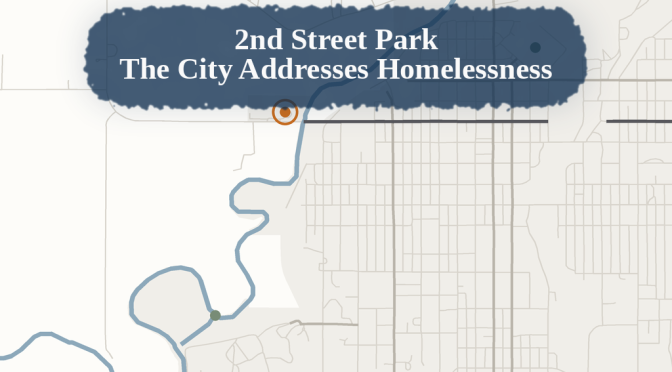
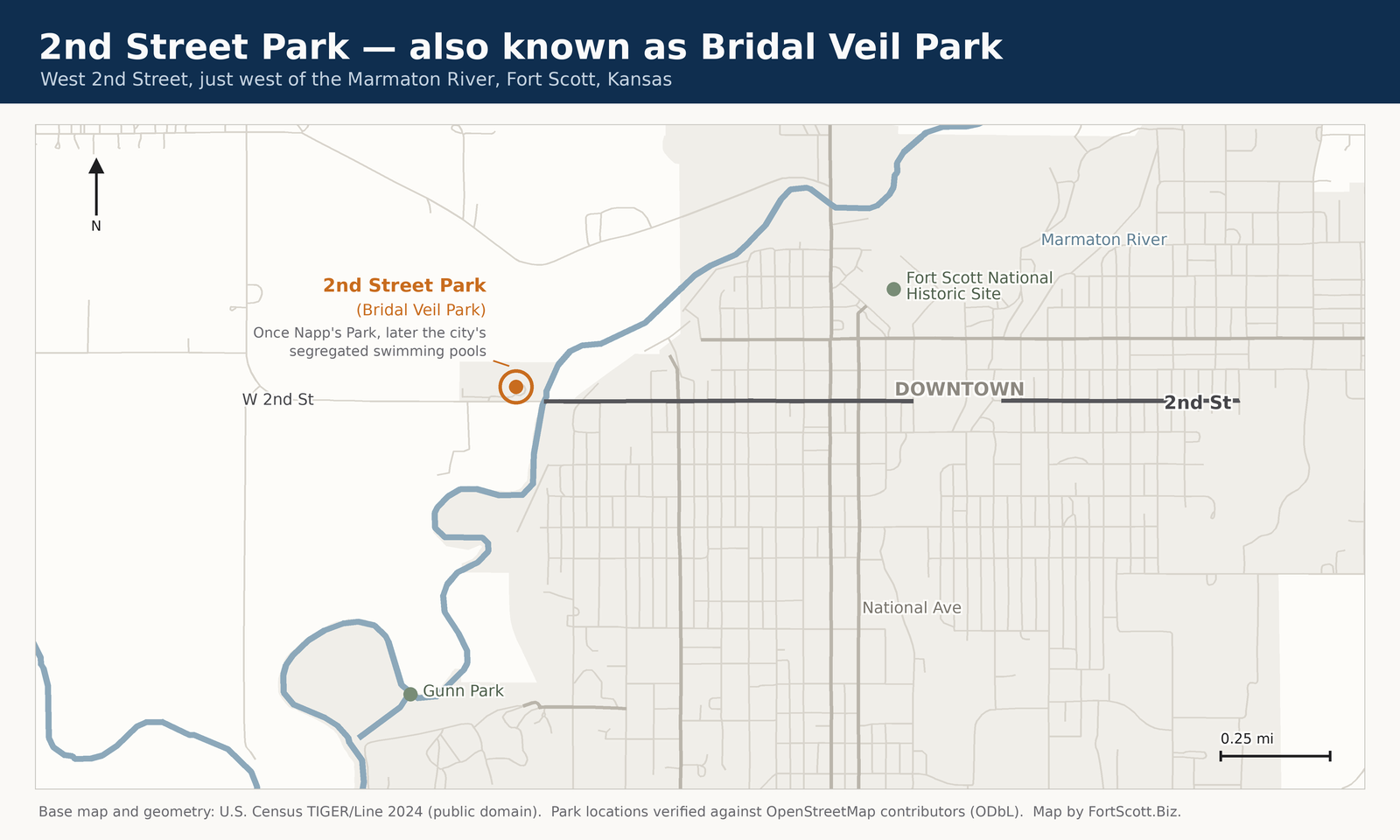
Where 2nd Street Park is
2nd Street Park sits on West 2nd Street, just west of the Marmaton River. Base map from U.S. Census TIGER/Line 2024.
The park is also known as Bridal Veil Park. The two names refer to the same property, and the city commission has used them interchangeably for at least a decade — its March 2016 minutes say “2nd Street (Bridal Veil) Park,” and its October 2017 minutes say “Bridal Veil Park/2nd Street Park.”
Napp’s Park, the spring and the pools
It began as Napp’s Park in the 1880s. “It had a large artesian water well in the southeast corner of the park,” local historian Fred Campbell told FortScott.biz in 2017. “As the water shot up about 20-30 feet from the spring, it looked like a bridal veil.”
The park later held two community swimming pools, one for girls and one for boys. In 1936 the Works Progress Administration built a new pool at the Main Street site. “At that point, the (Bridal Veil Park) swimming pools were turned over to the African-American community,” historian Don Miller said. “Segregation was the law until 1954.” After desegregation the pools were filled in.
A flood swept the brick shelter house away in 1986. “After that, it was used for a hang-out place,” Miller said. “There was a lot of illegal activities going on.” What remains is three WPA-built concrete picnic tables, a pavilion, a rock wall, tree stumps and a dirt road.
The city spent years weighing a sale
On March 22, 2016, commissioners voted 4-1 to let the city manager investigate whether selling “2nd Street (Bridal Veil) Park” was feasible. City Manager Dave Martin said at the time that he knew “there is a lot of history with this park and emotions tied to it.”
He reported back on Oct. 17, 2017. The park cost the city $5,000 to $10,000 a year in gravel and cleanup, he said, it floods, it was “not well used,” and there was “quite a bit of police activity there.” He was unsure the WPA picnic tables, pavilion and rock wall could be moved without damaging them. The sale, he told commissioners, would not be about the budget but about whether the city has more parks than it needs.
Martin also said he wanted to keep an easement across the property for a long-hoped-for trail connection between Gunn Park and Riverfront Park. By July 2018 the city manager was still telling commissioners the city was “moving forward with the possible sale.” No completed sale appears in the city’s records, and the city’s statement Friday still treats the park as its own.
In between, in December 2015, four Fort Scott High School students — Gabrielle Allen, Olivia Houston, Austin Bolinger and Morgan Stoughton, working under teacher Amber Toth — presented the City Council a renovation proposal for the park: a playground, a quarter-mile walking trail, 14 trees, picnic tables, benches and new lighting, priced at $74,841. It is still online, and it argued the park was worth keeping because it “is the only park around that part of town,” in a low-income neighborhood where children could walk to it.
In December 2021, a volunteer group called Warming Hearts — Tonya Cliffman, Anne Dare and Sarah Maike — planned two insulated 4-by-6-foot sleeping pods at about $1,000 apiece, and the commission approved placing them on private land north of Community Christian Church on the condition they came out by March 31. It is not clear whether the pods were ever put into use.
This July, FortScott.biz reported on Frankie’s Mission, started by Vickie Crowe of Fort Scott in memory of her son, who was homeless when he died. It hands out food, hygiene items and clothing — but holds its dinners in Pittsburg, Crowe said, because she could not find a place in Fort Scott for one.
Two city decisions this summer
On June 2, Matkin asked commissioners to close a gap in the Gunn Park camping rules. A 14-day permit could be cycled indefinitely by leaving for a day or moving to another site, he said, so someone had “the opportunity to stay at Gunn Park” without limit. The camping areas get “pretty busy down there” in the summer months, he told commissioners. The resulting ordinance requires campers to stay out for 30 days once a permit expires. (Watch that discussion.)
On July 13, commissioners held a special meeting on a Continuum of Care grant of nearly $1.6 million that would have converted the former convent at 810 S. Burke St. into transitional housing, a project called BridgePoint Community. Matkin read a prepared statement opposing it — not transitional housing itself, he said, but the city owning and operating it. Grant money would cover buying and renovating the building, but “those funds are temporary,” he said, and afterward the cost of running, staffing and maintaining it “could ultimately fall on the city and its taxpayers.” (Watch the statement.)
Commissioners voted to decline the grant. Commissioner Tracy Dancer said the proposal “felt rushed” and that he did not have enough information. Mayor Kathryn Salsbury said she lacked information about the building’s title and questioned its condition, and Commissioner Tim Van Hoecke said that as a first step it “would have been more like a gigantic leap.” Commissioners also raised the building’s location near an elementary school and Gunn Park. Salsbury said it was not “the right time, the right place, the right building, the right program, but we need to keep working and we need to keep helping.”
During public comment, Jenni Simhiser of the Path of EASE Association, which runs a recovery house for women and children, said she had no room left. “I’m getting ready to couch a girl. I am overly full and I have a waiting list,” she said.
Afterward, Commissioner Matthew Wells said the first step of his seven-step plan was to form a local coalition of the city, churches, nonprofits, schools and health providers, meeting monthly “at a minimum.” “If we don’t have a plan, then it only gets worse,” he said, and offered to organize it himself if no one at the city would. (Watch those comments.)
The city’s statement, in full
A Message to the Citizens of Fort Scott Regarding 2nd Street Park
Citizens of Fort Scott,
The City of Fort Scott is aware of the current situation at 2nd Street Park, including several individuals staying in tents at the park. We are also aware of concerns and reports regarding fires in the area.
Any active fire or situation that presents an immediate threat to public safety should be reported to local authorities immediately.
We understand the frustration and concern this situation may cause for residents, businesses, and those who use our public spaces. At the same time, this is not as simple as asking individuals to leave one location where there is no appropriate place to direct them.
Moving someone from one park to another does not solve the underlying problem; it simply moves the problem somewhere else. We also do not want to direct individuals into locations where they may create additional problems or place themselves or others in unsafe situations.
The City has advised individuals against “Camping” in the downtown area, Gunn Park, and Riverfront Park. These are among our most heavily traveled and utilized public areas, and allowing long-term “camping” in these locations creates concerns for residents, visitors, businesses, recreational users, and the individuals themselves. Our goal is to protect our public spaces while approaching this difficult issue responsibly.
It is also important to remember that the individuals involved are human beings and have legal rights. Homelessness is an extremely complicated issue, and there is no single solution. Communities throughout the country continue to struggle with this same challenge. Enforcement alone will not solve homelessness, just as compassion without accountability will not solve the concerns being experienced in our community. We must find a responsible balance between helping people in need and maintaining safe, clean, and accessible public spaces for everyone.
The City of Fort Scott is working toward creating a local alliance of community organizations, churches, service providers, law enforcement, businesses, concerned citizens, and others who are willing to work together to identify realistic solutions.
Our goal is not simply to relocate individuals from one location to another. We want to determine what resources are available and what can realistically be done to help individuals move toward stable housing, employment, treatment, family assistance, or other services appropriate to their circumstances. We recognize that this will not be an easy or immediate process.
If you witness illegal activity at 2nd Street Park or any other location, please contact local law enforcement at 620-223-1700. Law enforcement will respond and address the situation appropriately. For emergencies or situations involving an immediate threat to life or property, please call 911. *Please note, we will not remove homeless individuals from staying at 2nd street* unless their actions deem necessary.
If no illegal activity is occurring, we ask for patience as the City and the proposed Alliance Group work to find a responsible path forward. We understand that citizens expect their parks and public spaces to be safe, clean, and available for everyone, and we share that expectation. At the same time, we want to address this issue in a way that is lawful, humane, and focused on finding solutions rather than simply moving the problem from one part of Fort Scott to another.
We need our community’s help. If you would like to participate in this alliance, represent an organization that may be able to provide assistance, or have constructive ideas for addressing homelessness in Fort Scott, please send your ideas and comments to bmatkin@fscity.org.
This is a community issue that will require a community response. We may not have all the answers today, but we are committed to working together to find practical solutions while protecting both the dignity of individuals and the quality of life in Fort Scott.
There is also a positive side to this challenge: Fort Scott has always been a community that steps up when help is needed. We have caring citizens, churches, organizations, businesses, law enforcement officers, and community leaders who want to make Fort Scott a better place. I believe that if we bring those people together, listen to one another, and focus on solutions rather than blame, we can make progress.
We may not solve homelessness overnight, and we may not be able to help every individual immediately, but that does not mean we should stop trying. Sometimes success begins with helping one person find housing, helping another find a job, reconnecting someone with family, or connecting someone with the services they need. Every success matters.
Fort Scott is a community that cares about its people and takes pride in its neighborhoods, parks, businesses, and public spaces. I am confident that we can show compassion while still maintaining accountability and protecting our community.
Working together, I believe we can make a difference—not just by moving a problem somewhere else, but by helping create a path toward a better future for the individuals involved and for Fort Scott as a whole.
Thank you for your patience, your understanding, and most importantly, your willingness to be part of the solution.
Brad Matkin
City Manager
City of Fort Scott
The statement was posted to the City of Fort Scott’s Facebook page at 3:06 p.m. Friday, Aug. 28, 2026. The asterisks in the paragraph about not removing individuals are in the city’s original post.
What would Christianity look like if everyone served like you and me? A pastor recently asked that question, and it stopped me in my tracks. If I were the face of my religion, would I take it a lot more seriously? How many hours a day would be given to evangelizing, to sharing the gospel with people with whom I come in contact, to sacrificially loving the unlovely? What if discipleship depended on you and me as we are right now? Would our smorgasbord witness make a difference? You know, a little of this, a lot of that…but only when we aren’t inconvenienced. Serving when it doesn’t cost a lot of time, talent or money. Sharing a little bit of gospel…enough not to be embarrassed or lose friendships. Being angry or judgmental or complaining instead of faithful. Forgetting that we have nothing except what God has given us and can do nothing except what He enables us to do.
My friends and I recently were introduced to the plight of “Selah,” a hard-working, determined, single mother of four who has found herself in trouble. A failed marriage to an abusive man has caused this immigrant to provide for her children single handedly by getting her masters’ degree while at the same time cleaning houses and working part-time at the college. Selah has been without transportation and was borrowing a friend’s vehicle until she could finish school and get a full-time job. But then the car’s loaner needed her vehicle back.
That’s when Selah’s boss told my girlfriends and me about her situation. Could we help? A used car had been located. We made contributions, but I knew our small group could not put together the numbers needed to buy Selah a car. I was wrong. Some must have been much more generous than others, me included. Within a day, the money was raised to purchase this desperate woman the transportation she needed.
Jesus teaches that serving others is the same as serving him. “Whatever you did for the least of these brothers and sisters, you did for me.” (Matthew 25:40) I have to believe that if Jesus appeared to me today and asked for my car, I would not think twice about handing him my keys, so why didn’t I do that for this woman in need? I have a bike. I have two legs. How sincere is my faith when my first thought was to make sure I had my transportation needs met instead of helping her?
Somehow, taking cookies to an ailing neighbor or running errands for a friend or giving clothes to the needy or even tithing is easy compared to being inconvenienced, but inconvenience is more in line with what Jesus wants. In Romans 16, Paul cites several people who sacrificed for the ministry. At the top of the list—for good reason—are Priscilla and Aquila, a couple who were kicked out of their home and had to take their tent-making business elsewhere. On that journey they met Paul and risked their lives for him – and probably for the gospel as well. Being inconvenienced was not an excuse for them to quit working; it was simply God leading them to rely on Him.
We can never forget that Jesus died for you and me. Compared to that, giving up my car should have been no big deal. I need to remember that in the future, but something tells me that I probably won’t.
Four weeks after narrowly enrolling the old county landfill in the state’s walk-in hunting program, Bourbon County commissioners unwound the deal Monday. The sale of the land is dependent on environmental paperwork the county has owed on the property for years.
“I’m making a motion to withdraw our contract with the walk-in hunting on the old” landfill, Commissioner Joe Allen said. “The reason why is the city has opted out on their portion, and this was a package deal, and so we need to opt out on our side.” (video, Aug. 24, 65:54)
The board then voted to list the roughly 24-acre parcel — southwest of Oak Grove Cemetery at 225th Street and Native Road — for sale, but only after groundwater testing and only with a restrictive covenant filed against the deed. Commissioner Mika Milburn-Kee supplied the conditions in her second: “pending water testing and restrictive covenant.” (video, 68:22)
Chairman Gregg Motley explained: “The big one is groundwater, because if that groundwater travels, we can’t expunge ourselves from liability.” (video, 67:12)
Four weeks, four meetings
The walk-in hunting idea arrived on July 27, when Justin Harbit, a wildlife biologist with the Kansas Department of Wildlife and Parks, pitched enrolling the parcel in the Walk-In Hunting Access program: about $10 an acre per year — roughly $260 for the tract, by Chairman Samuel Tran’s math — with the state posting, patrolling and publishing the ground in its hunting atlas, and covering liability — Harbit pointed commissioners to a state recreational-use statute. (video, July 27, 30:09) Commissioner David Beerbower moved to enroll the same night, and it passed 3–2 — Beerbower, Motley and Allen in favor — over objections from Milburn-Kee and Samuel Tran that the public had not been given notice. County Clerk Susan Walker flagged another issue in the same discussion: the county has “an obligation” on file from the landfill’s closure, and the ground cannot be used for anything that disturbs the soil for 30 years, a restriction that runs to 2039. (video, 46:53)
On Aug. 3, as the contract came back for signature, Tran read aloud an email reply the clerk had obtained from the Kansas Department of Health and Environment. Walk-in hunting itself was fine, KDHE wrote. It is considered an “acceptable post-closure use” that would not disturb the landfill’s cover soil. But on the restrictive covenant required on closed landfills under state regulation, “our files do not represent that [a] restrictive covenant has been filed, and Bourbon County has been notified several times that this is required.” KDHE gave the county until Sept. 30 to file one, noted the covenant “runs with the land so any further buyer is aware that a closed landfill is on the property,” and pointed out that under state law a buyer inherits the site’s post-closure care. Commissioners agreed to hold the matter until the county attorney returned mid-month to review the deed issues. (video, Aug. 3, 123:05) Beerbower, who had made the enrollment motion a week earlier, said he was still weighing other ideas for the property, “I’m not done researching some options for that land,” though when Motley asked whether he opposed signing the hunting agreement, he said no, “it wouldn’t impact that anyway.” (video, 120:54)
On Aug. 10, the neighbors arrived. Oak Grove Cemetery’s caretaker, Phillip Pavey, asked how the plan came about (video, Aug. 10, 26:50), and Milburn-Kee read a letter from Richard and Alyssa Cronemeyer, whose land adjoins the parcel: 24 years of trespassing hunters, cut fences, game cameras and deer stands on their trees, calls from out-of-state hunters wanting access and a reminder that roughly a decade ago a county commissioner had personally posted the ground against hunting. (video, 28:52) The same night, Milburn-Kee pressed the other unfinished obligation: “I ask that we fulfill our duty to the legalities of testing the water on that old site, which have not been fulfilled as to this point.” (video, 32:23) The board authorized her to draft a proposal directing Public Works to conduct the testing with KDHE and file the deed restrictions. (video, 55:22)
By Aug. 24, with the city out, the county withdrew. Beerbower reported one more wrinkle from his research: under the closure restrictions the land cannot be dug or built on — but “somebody that wants to use it for private hunting land” could buy it. (video, 67:21) Milburn-Kee offered the other possibility: “Or an adjoining neighbor that wants nobody to touch it.” (video, 67:46) Either way, one use that would survive a sale is the same one the county just declined to lease to the state. And the delinquent paperwork was on the commissioners’ minds as they voted: “we are delinquent,” Beerbower acknowledged. “We have until September or something.” (video, 68:06)
The city’s half of the deal
The county’s 24 acres were never the whole plan. Harbit told commissioners the City of Fort Scott owns “20 some” adjoining acres — 22, he said at a later meeting, that KDOT owns roughly 45 acres to the south, and that the goal was “one big contiguous block” of public hunting ground — but he would not enroll the city’s piece without the county’s, “just because of access and the size.” (video, July 27)
The city is no stranger to the program. It has held a walk-in hunting agreement with the state around Lake Fort Scott for years. City staff cited the agreement, which runs through 2027, as far back as October 2021, when staff raised it as the commission weighed — and tabled — an unsolicited $350,000 offer on 80 lake acres. The city’s 2018 comprehensive plan describes “many acres of walk-in hunting” around both Fort Scott Lake and Rock Creek Lake, and Harbit noted the city also has “a big chunk across the river at the wastewater treatment plant” — the reason the county tract was proposed as archery-and-shotgun only, to match the rules already posted next door.
Harbit and KDWP’s Don George were on the city commission’s Aug. 18 agenda for walk-in hunting contracts and a wildlife-parks grant. By Monday, Allen reported the city had opted out, but what the city decided, and when, is not yet in the public record: no recording of the Aug. 18 city meeting has appeared on the city’s YouTube channel, and approved minutes are not yet available.
The program the county walked away from
Kansas’s Walk-In Hunting Access program, started in 1995, leases more than a million acres statewide from landowners, mostly private, and opens them to public hunting on foot, no vehicles or camping, from fall through spring. Enrolled tracts are posted with the program’s signs, patrolled by the department, and published in the annual hunting atlas and a statewide GIS map. Harbit told commissioners the program is thin in eastern Kansas, where access is hardest to come by: “citizens and everybody … they’re just being priced out of hunting and fishing.” In Bourbon County, he said, the program already includes “all the city property and a handful of others.” (video, July 27, 41:56)
Contracts run September through May; long-term deals, historically 15 years for government-owned land, can pay up front in a single check, with a prorated refund owed if the land is sold or withdrawn mid-term. A federal Farm Bill grant, expected to be decided this fall, would have allowed such a long-term contract to be paid up front here. The program also offered habitat cost-sharing to knock down the Johnson grass on the county site.
What has to happen now
Before the parcel can be sold, two obligations from the landfill’s closure have to be met: the groundwater testing and the restrictive covenant KDHE expects filed by Sept. 30. The 30-year no-disturbance restriction runs with the land to 2039 either way, which is why, as Motley observed when the idea first surfaced, “landfills are hard to sell.” (video, July 27, 44:40)
In the action movie “Black Dog,” Patrick Swayze’s character expertly drives a 1994 Peterbilt. This tractor is known for long-haul and heavy-duty capabilities. No matter what the make, these big rigs are impressive as they barrel down our interstates. When I woke up this morning, I began thanking God for specific blessings. With so many people homeless, I thanked God for “our” home. (My late husband has been gone for five years, but it doesn’t sound right to say “my” home.) In my gratitude, it came to me that I have been living in a Jimmybilt home for 45 years. It’s a modest, well-built, efficient structure that has always suited our needs. Our home is a welcoming, heartwarming, and peaceful place where I see Jimmy’s excellent craftsmanship everywhere I cast my eyes.
Our home is beginning to show its age (and so am I). For believers, our destination will be a final Godbilt home. Ever since my parents, husband, and brother checked out of this world, I’ve been especially interested in heaven. I know that in the last moment of closing our fleshly eyes, we’ll open our spiritual eyes and find ourselves at Home. Even though there are descriptive verses in the Bible about heaven, I want to know more!
In my growing-up years, during testimony time at church, I would often hear, “There’s a heaven to gain and a hell to shun.” That’s a true statement that I haven’t heard in over 50 years. Should someone, in the distant future, tear down this Jimmybilt house, they will find that some of the 2x4s have a testimony! While helping to construct the house in 1980-81, I was compelled to write messages on the wood, “Jesus is Lord,” etc.
King David penned these words to the Lord: “Your house glows with Your glory” (Psalm 26:8 MSG). Some of the scriptures in the Book of Psalms were prophetic and this verse could fall into that category as we read further in the last book of the Bible: “The city has no need for the sun, neither of the moon, to shine, for the very glory of God illuminated it, and its lamp is the Lamb” (Revelation 21:23 HNV). Nothing negative that we’ve experienced on earth will be found in heaven. No regrets, no unhappiness, and (I believe) all questions about everything will be answered in some awesome fashion. “He [God] will wipe every tear from their eyes, and there will be no more death or sorrow or crying or pain. All these things are gone forever” (Revelation 21:4 NLT).
Oh my! There are more biblical descriptions of heaven than I have room to mention! Actually, all I really need to understand about heaven is this: “No eye has seen, no ear has heard, and no mind has imagined what God has prepared for those who love Him” (1 Corinthians 2:9 NLT). My focus right now is to seek Him, love Him, obey Him, and serve Him with gladness. What my loved ones are doing in heaven at this moment is none of my business. Right now, my job is to represent Jesus well on earth and take as many to heaven as I can. I don’t want to be so heavenly minded that I’m of no earthly good.
During the stoning of Stephen, he tells what he saw, “But he, being full of the Holy Spirit, gazed into heaven and saw the glory of God, and Jesus standing at the right hand of God, and said, ‘Look! I see the heavens opened and the Son of Man standing at the right hand of God!” (Acts 7:54-56 NKJV).
The Key: Believers know enough about heaven to understand that God built it and we’ll enjoy living there forever.
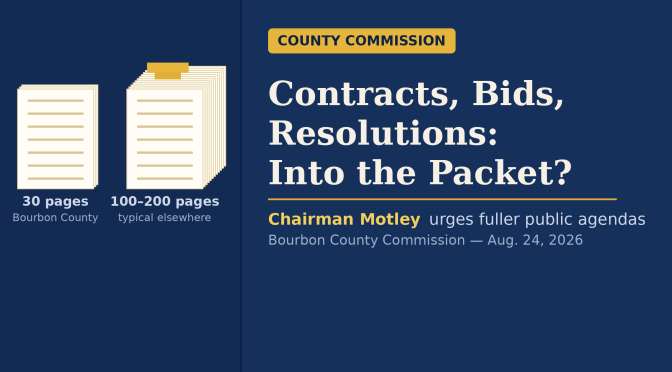
Bourbon County’s agenda packet should carry the documents the commission votes on, Chairman Gregg Motley told fellow commissioners at the end of Monday’s meeting — contracts, bids and resolutions included, so both commissioners and the public can read them before decisions are made.
“Our agenda was, with accounts payable, about 30 pages,” Motley said, describing his review of other local governments’ agendas. “In most cities and counties, their agenda is about 100 to 200 pages, because all these kinds of documents that we have laying around are on the agenda so that the public can see it, along with commissioners, in advance of meetings.” (video, 71:45)
He pointed to the five road-work bids Public Works had handed across the table earlier that evening as the kind of document that “could have been on the agenda and in the packet so that we could see those in advance.”
Motley also connected the thin packet to the county’s open-records workload. Stronghold, the county’s IT contractor, services numerous cities and counties, he said, and “we have more KORA requests than all other cities and counties in their jurisdiction combined. And some of that is that documents like this, people have to KORA instead of just seeing it in the agenda.”
His ask: “I’m going to suggest that we send documents to the clerk so that they can be included on the agenda packet… contracts, resolutions, bids, anything that we can get in the agenda packet. I think it’s going to be helpful to us and the public.” No motion was made; the suggestion drew no objection.
Commissioner David Beerbower answered that the requirement, at least in part, already exists: “The resolution we did on meetings said… you shouldn’t put anything on the agenda that … you’re not prepared to provide the supporting documents” — unless, he added, an item is “pure discussion” with no documents to attach. (video, 73:23)
A rule with a year of history
Beerbower is right that the books already say something. The commission has been circling this exact problem since last fall.
September 8, 2025. Then-chairman Beerbower first proposed meeting-procedure reforms, including that “all items on the agenda … supporting documents should be provided to the clerk prior to the deadline date.” (video, Sept. 8, 7:20)
October 14, 2025. Beerbower brought a drafted “Rules of Procedure” resolution requiring agenda requests “to include supporting documents” be submitted to the county clerk before a deadline. Commissioner Samuel Tran’s question then still hangs over the discussion: “How hard are you going to adhere to this? Because quite frankly, that has not been adhered to since I’ve been” on the board. (video, Oct. 14, 1:50:55) The same night, the board debated what counts as a supporting document, and the clerk noted an agenda-request form exists but “the only one that really ever uses it is the sheriff.”
October 20, 2025. The board adopted the resolution 2–1 (Beerbower and Tran yes, Mika Milburn-Kee no), amending the deadline on the floor to noon Friday before a regular meeting. (video, Oct. 20, 2:57:40) The text, as drafted, is on page 145 of that meeting’s own agenda packet: any county department, elected official or commissioner may submit agenda items, and “such requests, to include supporting documents, must be submitted to the County Clerk’s office” by the deadline, with the chair able to add emergency items. That packet, at 156 pages, drew Tran’s praise the same night: “For 90% of your package, it was spot on… I just want to give you props.” (video, 2:49:16)
Since then. The rule has proven easier to adopt than to live by. In December, Tran went looking for documentation on a benefits item — “if you’re going to bring something to the table, you’ve got to have some supporting documentation” — and Beerbower conceded compliance had been “kind of iffy.” (video, Dec. 15, 4:52) In February, Motley himself named the failure mode — “what’s problematic is when a resolution hits the table that we never read” (video, Feb. 19, 2:28:54) and Commissioner Joe Allen noted the City of Fort Scott had just adopted a stricter version: a resolution nobody has seen in advance is tabled to the next meeting except in emergencies. (video, 2:29:17) Tran shared his view Monday’s proposal: nothing in the county’s rule requires the documents be available to the public. Though it wasn’t clear if he was suggesting a different packet could be sent to the commissioners separate from the public published agenda. (video, 2:30:56)
The dynamic predates the resolution. In May 2025, when a landfill restructuring proposal arrived with no numbers attached, then-commissioner Brandon Whisenhunt declined to second it — according to the minutes, saying that had he known the topic was coming he “would have brought his numbers in,” and asking not to be surprised “like this with discussions.” The motion died. (video, May 5, 2025, 1:47:33)
The existing resolution talks about what reaches the commissioners: documents go to the clerk so the board is prepared while including those documents in the public agenda is generally how that is given to the commissioners and the public, Tran seemed to suggest the information could be provided ahead of time for the commissioners in way that wasn’t public. Motley’s suggestion was to follow the existing resolution and also include all the information in what the public sees, making the published packet posted with the agenda so people have access without requiring a KORA request to view it.
US Army Photo of the Commanding General’s Mounted Color Guard Soldiers from the US Army’s 1st Infantry Division.
Fort Scott, Kan. – Saturday, August 29, 2026, Fort Scott National Historic Site will host the Commanding General’s Mounted Color Guard (CGMCG) from Fort Riley, with activities from 9 a.m. to 2 p.m. Visitors of all ages are invited to witness living history as the Army quarters their horses in the Dragoon Stables, echoing practices from the 1840s and 1850s. Wagon and mule team rides will be available throughout the event.
The CGMCG preserves Fort Riley’s legacy, showcasing the discipline and tradition of America’s mounted forces. Soldiers and horses, outfitted in authentic uniforms and equipment, present polished displays of cavalry horsemanship and military tradition.
Fort Scott and Fort Riley share a historic connection: Fort Scott closed in 1853, the same year Fort Riley was established. Both posts played key roles in protecting travelers along the Oregon and Santa Fe Trails.
Fort Scott National Historic Site, a unit of the National Park Service, is open Friday through Tuesday from 8:30 a.m. to 4:30 p.m. Park grounds are open daily from one-half hour before sunrise to one-half hour after sunset. For more information or to learn how to get involved, call 620-223-0310 or visit www.nps.gov/fosc.
Noah Terry opened a martial arts business on August 1 in the former St. Andrews Episcopal Church at 123 S. National Avenue.
Terry defines Jiu Jitsu as submission grappling.
“Imagine a martial art built on pure human mechanics, where brain beats brawn almost every single time. Brazilian Jiu Jitsu gives you the ultimate equalizer: a proven system of leverage, movement, and control that allows a smaller, calmer person to effortlessly neutralize a larger attacker without ever throwing a single punch.”
“All while inside a community of training partners who push you to get 1% better every single day. Whether you’re looking to get into the best shape of your life or master a real-world chess match on the mats, Jiu Jitsu delivers skills that stick with you for a lifetime.”
“The Watchmen Brazilian Jiu Jitsu is stepping up its community outreach in Fort Scott, introducing dynamic new programs built to give local residents of all ages practical skills and confidence,” Terry said in a press release.
Founded by Terry, the academy was established after he recognized a need in the community for a team- like martial arts experience.
Terry is certified in defensive tactics through the Johnson County Sheriff’s Office and brings a tactical, real-world perspective to the mat, according to the press release.
“What started as a vision quickly took root thanks to a strong core of dedicated men who bought into the mission of building a grounded, supportive, and resilient martial arts family.”
“We built this academy to be a place where people can gain real-life skills, physical strength, and unshakeable confidence,” says Terry. “Whether you’re a parent wanting your child to be bully proof, or a woman looking to learn essential self-defense, or a father who wants to prepare himself to defend his family, our goal is to serve and strengthen Fort Scott.”
“The ‘we’ in my statement is the community of guys that have surrounded me and supported me. They are the building blocks of this business, and I am forever grateful to them,” he said.
This fall, The Watchmen BJJ is highlighting two upcoming opportunities. To join the event, go to the event page on Facebook and select ” Going ” to RSVP:
“All you need is a $10 entry fee! A T-shirt and shorts, and an excitement to learn! “
Submitted graphic.
Women’s Only Intro to Jiu Jitsu Seminar
“Designed specifically for women with zero prior experience, this beginner-friendly workshop focuses on practical self-defense techniques in a safe, supportive environment.”
• Date: Wednesday, August 26th
• Time: 5-6 p.m.
• Focus: Core self-defense fundamentals, building functional strength, and empowering personal safety.
• Registration is on the Watchmen’s event page.
Submitted graphic.
Back to School Youth Special (Ages 5–12)
“Timed with the new school year, this youth program helps kids develop physical health alongside lifelong character habits.”