Nick Graham recently wrote that Bourbon County will never get another Western Insurance company. On first reading, I mentally nodded my head in agreement, but then paused. While on one level, he is right—the probability of a large insurance company wanting to come to Bourbon County and employ 1,000 people is extraordinarily close to zero—the actual history of the Western illustrates his point of the need for business investments and an environment that allows growth.
 The Western didn’t just “come to Fort Scott” and start employing a thousand people. The idea for what became The Western Automobile Indemnity Association was dreamed up in 1910 and it started business the next year. It survived the Great Depression due to careful financial management and grew into a holding company that owned a variety of businesses. By the 1950s a 20-year-old Warren Buffett discovered the company’s stock could be had for $16 a share, while it was producing profits of $20 per share. It became one of his earliest investments and a model for the type of value investing that grew his fortunes.
In 1967 the Western built what amounted to a tiny skyscraper downtown with an investment of over $11 million in today’s dollars because they were outgrowing the space they had in the Scottish Rite Temple building.
In 1981, the Tribune ran a story saying that the city had agreed to annex property south of Fort Scott where the Western planned to put an 80,000-square-foot building. This space would be used to house their computers and other offices. The city approved industrial revenue bonds of up to $22 million (in 2026 dollars). Since industrial bonds would make the building free from property taxes while the bonds were being repaid, the Western said they intended to make “payments in lieu of taxes.”
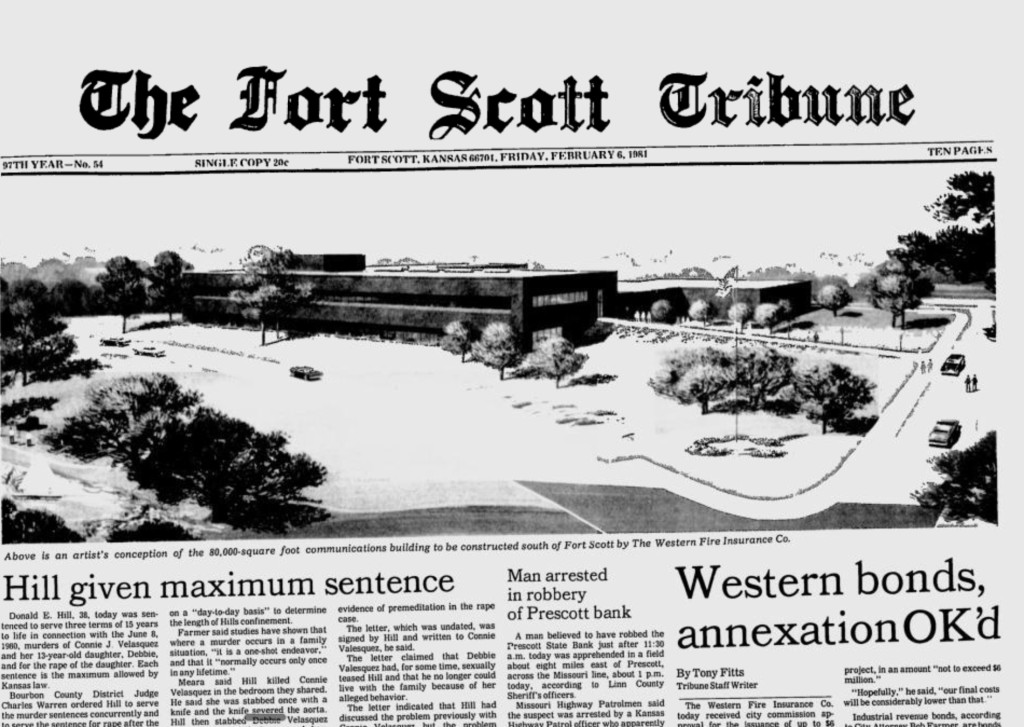
I remember being at the picnic on the grounds of that building after it was built. They had stocked the pond and I caught what, to an 8-year-old, seemed like the biggest catfish in the world. My father worked at the Western as a programmer and would occasionally get called in at night to fix an errant computer job that needed to get a clean run before the morning. I remember going with him, pulling up to the property gate in the dark and dealing with the security process to open the gate, walking from the parking lot to the door where more security verified we were supposed to be there and then entering the massive dark building. We made our way to the computer bunker where the bright lights made it feel like we had just stepped into daytime again. The room had a raised floor that hid miles of cable and pushed the constantly running air-conditioning into the giant computers. The light was a good thing. It made it easy to avoid the gaping holes in the floor where an occasional large tile had been removed to help cool a particular work area for some of the operators. The inefficient (by today’s standards) electronics put out a tremendous amount of heat and required a massive battery installation and huge generators to guarantee they wouldn’t crash if the power went out.
Our family, like many others, depended on the Western’s ability to provide what the market needed. The Western was very good at doing this and the demand for what the Western provided created the demand for my father’s programming skills and created the job that put food on our table just like so many others in the area.
The Western had a huge economic impact on the city and county. It wasn’t just the people who got a paycheck from the Western either. Those paychecks funded many of the other jobs, and the paycheck from those jobs funded others. The company paid taxes that helped fund the government. With the large real-estate holdings it made up a not insignificant portion of the Bourbon County tax base. But 75 years of growth culminated in a $270 million deal selling the company to Lincoln National. Over time it was rebranded as American States, and later sold to Safeco. By the end of the millennium all the jobs were gone. One of the downtown structures was torn down and the other sold for $1 and converted to apartments.
The nature of business in 1910, 1967, and 1981 is very different than it is in 2026. It does seem unlikely that any company is going to give the county the type of investment in office real estate that creates a taxable footprint bringing in the $1 million to $2 million that the Western would have likely been paying in today’s dollars. There aren’t a lot of probable futures where a company heavily invests in an existing downtown office building, runs out of space, puts in an $11 million mini-skyscraper and later follows up with another $22 million expansion on property it asks to be annexed to the city.
The massive inefficient computers used a tremendous amount of electricity in their operation and cooling. The entire setup with the rest of the equipment in the tornado-proof bunker wasn’t technology that was well understood by many of the people in the town who weren’t actively working on the computers. The process of writing code using flow charts and diagrams and then going over to a shared terminal to type in code that ran against the miles of black magnetic tape stored on large spools probably looked like a lot of black magic to people of a time when home computers were just beginning to hit the market. But it all represented a free market where technology was being used to rapidly move forward to solve the problems of the time.
The world is different now, the entire bunker of computing power I visited as a child, could all be replaced with an inexpensive laptop or even your phone. And the work done by all the people in those rows of cubicles has been replaced by a few individuals with more efficient tools today. But at the time, all the infrastructure, all the investment in buildings and human capital was exactly what was required to support the national need for insurance. Meeting that need brought millions of dollars from the nation into Bourbon County.
The world’s needs are different today. There is no massive funnel of money waiting to come to the area if we just build a new building and fill it with 1,000 people trying to mimic the way work was done 50 years ago. So in that sense Nick is right. You couldn’t grow the Western today, but you also couldn’t have grown the Western if they had tried to start the same thing in 1810. It was the right solution for the needs of the time and that particular solution is entirely unfit for the unique needs of any other time.
For this area to thrive from the type of economic growth that came from the Western in the past, we can’t continue to focus on how our county met the needs of the past—needs that don’t exist anymore. We need to be focused on how we can meet the needs that exist today—the needs where there is growing demand going forward.
If we are unable or unwilling to do this, the county will die. Not right away, but it will fade away through hundreds of small losses with no wins of any significance. As businesses close, they won’t be replaced. As the tax base shrinks, everyone will have to pay more and get less. As taxes go up, it will be harder to justify moving to the area and harder for those who are here to justify staying. (And the idea of being unwilling to do this isn’t hypothetical, it is definitely happening.)
But, if we do follow the model of the Western by focusing on what the market needs today, our kids and grandkids will look back on the coming years the same way we look back on the apogee of the Western. With a fondness for the past, but with determination to follow the tradition they saw clearly modeled for them on how to move forward, adapt, and change in meeting the new needs of the nation and world, needs that we probably can’t even imagine today.
Mark Shead
Note: FortScott.biz publishes opinion pieces with a variety of perspectives. If you would like to share your opinion, please send a letter to news@fortscott.biz.