
Category Archives: Opinion

From the Bleachers by Dr. Jack Welch

Culture Always Tells the Truth

Leadership books and boardrooms spend an enormous amount of time talking about strategy: five-year plans, organizational charts, metrics, and benchmarks. Ask anyone who has truly led a family, a college, a business, or a team, and they’ll tell you the same truth: culture defeats strategy every single time. Strategy may write the script, but culture performs the show.

Every organization, whether a Fortune 500 company, a community college, a small-town high school, a football team, or even a household, is “culturized.” They all project an image to the public, a polished face meant to inspire confidence. The real culture isn’t found in the mission statement or the social-media post. It shows up in daily habits, quiet interactions, and in how the people inside that group treat others when no one is watching.

Families are the clearest example. You can dress up for church on Sunday, take a perfect Christmas picture, and speak politely in public. The true culture of a family shows itself in how members support one another during a crisis, how they speak to each other at home, and how they treat guests, or strangers. Love, patience, generosity, and respect can’t be faked for long. The real culture always rises to the surface.

Businesses and teams operate the same way. Leaders can talk about excellence, teamwork, and service all day long, but the organization’s actual behavior will reveal whether those values are real or just words on a wall. Employees know when leadership is authentic, just as players know when a coach’s message is consistent. If the team’s actions contradict the message, the culture cracks, and once culture cracks, strategy collapses with it.

Yet even in strong organizations, there are always a few team members, especially ones in leadership positions, who quietly work against the mission. They stir emotions, whisper how they would have done things differently, and try to present themselves as the “real” supporter of their coworkers. On the surface, they appear helpful, but beneath it, they are promoting themselves at the expense of the team’s unity. These back-door critics rarely rise to the top of their profession, not because they lack talent, but because they fail to understand that leadership requires loyalty, humility, and alignment. When someone spends more time undermining others than supporting the direction of the organization, they reveal why they have never advanced to their desired position. Culture exposes the truth about people just as clearly as it exposes the truth about teams.

For a college, business, family, or team to earn respect, it’s not enough to build a great strategic plan. Respect is built through how people act, how they serve others, and how well they follow through on the values they preach. A strategy may outline where an organization wants to go, but culture determines whether the people inside it actually want to take the journey together.

That’s the leadership challenge: Are you building a culture where the majority is committed to the mission? If you aren’t, even the most polished plan will fail. If you are, if you create a culture of trust, service, and shared purpose, then even an imperfect strategy can succeed.

Thought for the week, “In leadership, strategy may guide the path, but culture decides whether you ever reach the destination.” Wade Phillips, Former Head Coach of the Dallas Cowboys and San Antonio Brahmas.

Dr. Jack Welch serves as President of Fort Scott Community College. With a career spanning professional sports, public education, and rural community development, he brings a servant-leader mindset and a passion for building trust-driven cultures that empower people to thrive in the classroom, on the field, and in life. He is also the author of Foundations of Coaching: The Total Coaching Manual.
Opinion: Proposed Moratorium On All New County Businesses

In October, I wrote a piece about how the commissioners had passed a resolution to ban running a particular computer program. Ostensibly, they were trying to make it illegal to run loud generators, but instead of writing an ordinance about generators or sound, they issued an ordinance that would include three silent computers that can fit in the palm of your hand without saying a single thing about what they claimed they were trying to address.

Despite having full access to paid legal counsel, despite technologically savvy citizens who are happy to provide advice for free, despite knowing that the issue with a loud generator is, well, the loud generator, the commissioners managed to pass an ordinance that was completely divorced from the actual sound problem. It was written to ban what a tech- and business-savvy middle schooler might run in their bedroom, while being useless when it comes to preventing another identical generator-run installation that uses a different algorithm.

If the commissioners, in an effort to prevent loud, noisy generators, accidentally ended up banning things so trivial, we should be very concerned that when they spend your taxpayer money in lobbing their nuclear bomb of zoning at solar and wind installations, it might not only miss what they say is the mark, but do significant collateral damage. That was my concern back in October. What happened since that silly moratorium made me realize that I severely underestimated just how bad that blast radius could be.

There is a planning committee created by the commissioners to make recommendations on zoning. As usual, this committee contains people who were not elected. They also didn’t go through the normal process of having citizens submit letters of interest. Instead, the members were hand-selected by the commissioners. This isn’t necessarily a bad way to select people and it has a distinct advantage for anyone trying to figure out where the commissioners are trying to take the county. This hand selection means that when the committee passes a resolution, it is being made by the people the commissioners felt most represented their goals for the future.

So with that background, residents should be paying very close attention when the planning committee votes on a resolution. We got a very insightful glimpse on page 7 of the agenda packet for the commissioners meeting on 11/17. There was a resolution, passed unanimously by the planning committee, that said:

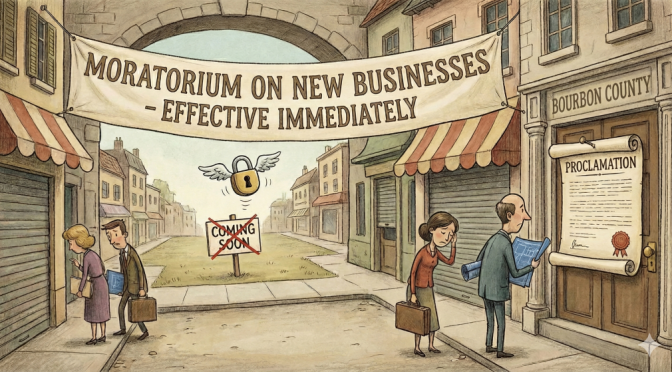
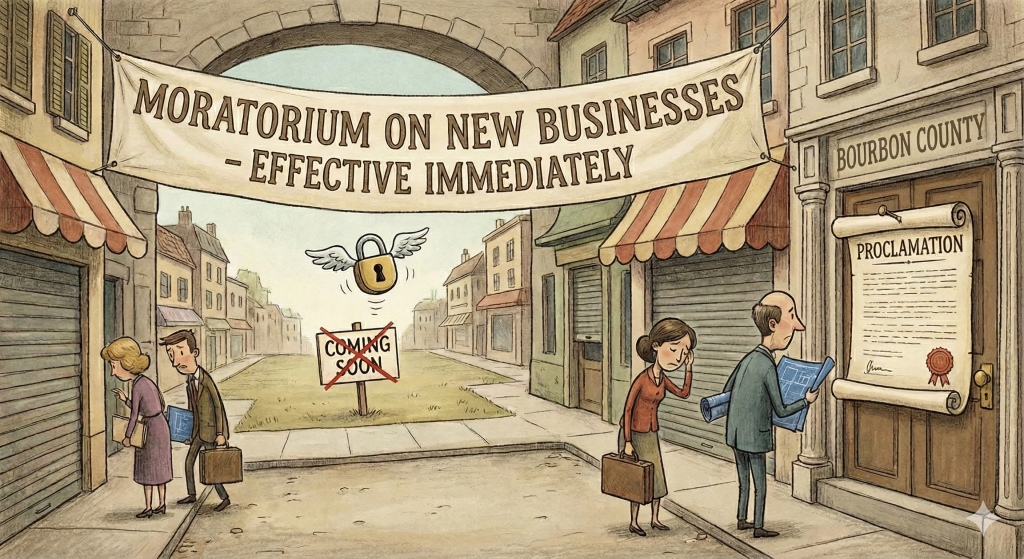
The Planning Committee, passes unanimously. recommends that the Bourbon County Board of Commissioners enact a moratorium, effective immediately, requiring that any new business—specifically, commercial or industrial—that is not agricultural in nature and located in unincorporated areas of the county, be required to obtain a special use permit prior to commencing operations. This moratorium should reference the existing Bourbon County zoning (taxation) map as the basis for determining current land use designations.

The purpose of this moratorium is to protect the county and its residents while the Planning Committee continues the process of developing more detailed and comprehensive zoning regulations.

There were some legal issues with the recommendation, so the commissioners didn’t end up discussing it, but even if they couldn’t put a moratorium on all businesses worded in this way, it doesn’t diminish the desired goal. We can clearly see what the committee (and the commissioners who appointed them) see as a desired future. The planning committee, that hand-selected group the commissioners thought were the best people in the county to accomplish their zoning goals, unanimously resolved to recommend a moratorium on all new non-agricultural businesses in the county. It didn’t pass by a small margin; it wasn’t just discussed. They unanimously passed a resolution to make this recommendation, and that is a very big deal.

Some might say it was just the political back and forth and doesn’t really mean anything, that some of the people voting for it didn’t think it would pass, etc. But consider the actual implications: If you want to start a commercial lawn mowing business and you are outside the city limits, they want you to have to get special permission from the commissioners. If you want to start a business doing small manufacturing of high-end telescopes, the resolution recommends that your business should be illegal until the commissioners give it their blessing. If you want to start exercising your skills as a mechanic, start a printing company, create an LLC to make furniture, or anything else in the rural county areas, every single person on this committee voted that you should be required to come hat in hand to the commissioners and answer all their questions about your business and beg them to make an exception to the moratorium to allow you to pursue your business idea. 

This desired change by the planning committee is a fundamental shift. We currently live in a county where the default position is that you are allowed to start any legal business and move forward with it. You might have a good idea and do well. You might have a bad idea and go bankrupt. Either way, you are free to pursue your capitalistic endeavors without being subject to the whims, biases, and the sometimes general confusion of the commissioners.

For an average member of the community, voting for a resolution to recommend such an action would have come with a huge reputational risk. Would you really want to be on the record as having voted to move from a default of saying yes to business to a default of saying, “you have to get permission from the commissioners first”? Somehow, not a single person on the committee, who I might remind you, were hand-selected by the commissioners, looked at the resolution and said, “I’m not sure I want my name on something that does this to our local economy.” Instead, every single one voted for it.

As I’ve said before, the issue with zoning is not whether there is a hypothetical way to implement it that would do no or only minimal harm. The question is how likely we are to get a future where the damage from zoning isn’t egregiously worse than whatever the commissioners think they are trying to attack by this massive expansion of their powers. This unanimous resolution from the planning committee gives us a peek into the future we are headed toward, a future that further increases the probability that the “cure” of zoning will turn out to be worse than the “disease.”

Mark Shead

Note: FortScott.biz publishes opinion pieces with a variety of perspectives. If you would like to share a perspective or opinion, please send a letter to news@fortscott.biz. 

Watching Over Me by Carolyn Tucker

Keys to the Kingdom

By Carolyn Tucker

Watching Over Me

Two wonderfully-talented ladies made two beautiful songs very popular many years ago. In 1959, Ella Fitzgerald recorded “Someone to Watch over Me” written by brothers George Gershwin and Ira Gershwin. This sublime song was also performed in one of my favorite movies, “Mr. Holland’s Opus.” And Ethel Waters was best known and loved for singing “His Eye is on the Sparrow” composed by Civilla Martin and Charles H. Gabriel in 1905. She began singing as a guest vocalist at the Billy Graham crusades in 1957 and continued for nearly 20 years. I remember intently watching and listening to her ad lib with the biggest smile and soulful expressions. The last line of the song was impressive to me then, and it’s still impressive: “For His eye is on…the spar-row…and I know…He wa-tches…me.“

I recently came across this quote by pastor/evangelist and Revivaltime radio broadcast speaker C. M. Ward in one of my old journals: “None of us can make it through without God’s help. I need an abiding sense of God’s presence. I need a ’cloud’ by day and a ’pillar of fire’ by night. In the gloomiest hour, when the lights of this world have gone out, I need to know that He is there watching over me.”

One of my favorite scriptures is 1 Peter 5:7 AMPC: “Casting the whole of your care [all your anxieties, all your worries, all your concerns, once and for all] on Him, for He cares for you affectionately and cares about you watchfully.” The key words in this verse that are especially comforting to me are “all, affectionately, and watchfully.” God knows all about our circumstances, our emotions, our thoughts, our fears, and our faith.

Jesus’ disciples had spent years following, learning, assisting, and witnessing miracles. The storm on the Sea of Galilee was a test of the disciples’ faith. This situation was an opportunity to practice using their faith. I don’t think Jesus was impressed with their faith because, “He replied, ‘Your faith is so small! Why are you so afraid?’ Then Jesus got up and ordered the winds and the waves to stop. It became completely calm” (Matthew 8:26 NIRV). I don’t think He’s impressed with our faith when we act like we don’t have a heavenly Father to take care of us.

God is aware and cares about the smallest, insignificant things and events. “Not a single sparrow can fall to the ground without your Father knowing it. And the very hairs on your head are all numbered. So don’t be afraid; you are more valuable to God than a whole flock of sparrows” (Matthew 10:29-31 NLT). Believers can find assurance in knowing God is unlimited in taking care of the big or small stuff — it‘s all the same to Him!

“The Lord sees what happens everywhere, He is watching us, whether we do good or evil” (Proverbs 15:3 GNT). This reminds me of the story about a man who was burglarizing a home as the parrot excitedly watched. In fact, the parrot repeatedly kept saying, “Jesus is watching you.“ The man couldn’t have cared less. But after several minutes the burglar noticed a vicious Dobermann standing nearby staring at him and baring his teeth. About that time the parrot screeched, “Sic ’em, Jesus!”

The Key: Believers can rest assured that God is on 24-7 watch duty because He cares.

A Choice I Choose by Patty LaRoche

Patty LaRoche. 2023.
Author: A Little Faith Lift…Finding Joy Beyond Rejection
www.alittlefaithlift.com
AWSA (Advanced Writers & Speakers Assoc.)

A Choice I Choose by Patty LaRoche

Dan’s wife, Sandy, told me that she never has seen her husband “not happy.” I could understand that if they had been married for one or two days, but eighteen years after saying, “I do,” my friend shared this with me.  I asked Dan how he did it.

“Why would I choose not to be happy?” he said.  “There’s always something to be happy about.”

Dave, my husband, and I have been around Dan and Sandy multiple times.  This past week, they flew here to Kansas to hang with us.  No matter what we were doing–touring, playing competitive games or having deep discussions–Dan was delightful.  And always, always happy.

Recently, while my cleaning lady was sharing some difficulties she is having, she said this: “Sometimes, I forget to be happy.”  Clearly, God is telling me something.

After all, happiness is a choice, so why would I ever opt for the alternative?  Maybe because there’s always a reason not to be happy.  Health.  Finances.  Shame.  Guilt.  The grumpy, selfish neighbor.  A friend’s betrayal.  A broken lawn mower.  Lost keys.  Weight gain. Boring retirement.

You get the picture.  Daily, we are given opportunities not to see the blessings amongst the difficulties, yet we fail to seek the good.   Serious stuff.

There is a story about an elderly man who immigrated to the United States from one of the Communist bloc countries of Eastern Europe. After his papers were processed he found his way to a New York cafeteria where he sat down and waited for someone to bring him a menu and take his order. No one came. Eventually a woman with a full tray of food approached, realized the old man’s dilemma, and explained how American cafeterias work.

“Start at the beginning,” she said kindly. “Look at all the choices that are available, decide what you want, and just reach out and take it. When you get to the end, you’ll be told how much you must pay for the things that you’ve chosen.”

After he had settled into his new home, he made this observation: “Life in America is a lot like that New York cafeteria. The options are endless, but you’ll never get what you want if you sit around and wait for someone to deliver it. Anything is possible (a job, education, a home, a car) but you have to be willing to get up and go after it. And in the end, you have to pay the price of your choices.”

I would add that these choices are not only about the material goods we acquire but also the attitudes and beliefs that dominate our thoughts. Psalm 144:15, although brief, tells us how to acquire that happiness: “Happy are the people whose God is the Lord.” Just how do we make that happen?   “Delight yourself in the Lord, and he will give you the desires of your heart.” (Psalm 37:4)

Someone once said, “Being happy doesn’t mean everything’s perfect.  It means you’ve decided to look beyond the imperfections.”  Our choice…and a choice I need to choose.

How about you?

From the Bleachers by Dr. Jack Welch

Honor the Contract or Change the System?

In college athletics, few debates stir up as much passion as whether administrators should honor the full length of a coach’s contract. Every hire is a gamble. Some coaches arrive with little proven success at the level they’re stepping into. Others come with résumés full of championships, rebuilds, and turnarounds. Yet in every case, everyone, the administration made the choice. They believed the coach was the right person for the job, or they never would have signed their name on the contract.

A contract, after all, is not a suggestion. It’s a roadmap. When a coach is hired on a three-, five-, or seven-year deal, that length isn’t arbitrary. It represents the time needed to recruit players, build a system, implement a culture, and create the foundation for long-term success. No coach worth their whistle expects instant magic. They build a plan aligned with the years they were promised, or did they? Maybe the administration expected immediate results. Maybe the administration realizes they made a big mistake.

In today’s impatient sports world, many coaches never get the chance to finish what they started. A season and a half in, maybe two years at most, administrators decide that the win-loss record isn’t good enough, the crowd size isn’t big enough, or the social media noise is too loud. So, the coach is dismissed, sometimes with one, two, or even three years left on the contract. If both sides truly agreed on the plan from the start, shouldn’t the coach be allowed to execute it? Unless the coach is failing according to the agreed upon plan.

Legally, the structure is clear. Coaching contracts often include clauses allowing institutions to terminate the agreement without cause, if they pay the agreed-upon buyout. Contracts also outline “for-cause” conditions, major misconduct, violations, or ethical breaches, which allow a school to sever ties without further obligation. Most dismissals fall under the former, not the latter. Consequently, the college writes the check, honors the buyout, and moves on. Reassignment is another option.

Honoring the dollars isn’t the same as honoring the contract. Paying someone to go away may satisfy the legal requirement, but it doesn’t satisfy the ethical one. It raises a bigger question: If a school hires a coach based on a vision that supposedly takes years to fulfill, why abandon the vision before the time is up? Or did they have an agreement to produce immediate results?

Some argue that administrators must react quickly when things go poorly. Others say you can’t preach commitment, stability, and trust to student-athletes while modeling the opposite at the administrative level.

Colleges have every right to make a change if they believe it’s needed. They also have a responsibility to ensure they’ve done their part: reviewing the plan thoroughly on the front end, providing the promised time and resources, and allowing the coach a real chance to succeed. Otherwise, we don’t just fail the coach, we fail the process.

Thought for the Week, “Commitment loses its meaning the moment convenience replaces conviction.” Jack Welch

Love is Spelled T I M E by Carolyn Tucker

Keys to the Kingdom
By Carolyn Tucker
Love is spelled T I M E

Uncle Dennis once said that kids spell love as “TIME.” In truth, I believe all ages spell it the same way. When I was in high school, my typing teacher would instruct the students to type, “Now is the time for all good men to come to the aid of their country” over and over. This phrase contained words that are super easy to type which facilitated in developing an efficient rhythm without errors.

Now is the time to be thankful for what we’ve got and forget what we “don’t got.” Every so often God will provide an opportunity to jolt us into counting the blessings that matter the most. While on a family vacation this summer, we pulled off the highway so a couple of us could use the facilities at a rest stop. When my six-year-old granddaughter took a step to cross the single-lane driveway in the parking lot, a speeding car came from out of nowhere. Vivienne immediately stood still, but she was visibly shaken. This near-accident happened in the blink of an eye and there was nothing any human could have done to prevent a heartbreaking outcome. We were all thankful for God’s hand of protection on Vivienne.

Our topic of conversation between the five adults on the ten-hour drive from Kentucky were varied. There were times of hilarity, but eventually the conversation turned serious. My daughter-in-law Emily asked me a question and my heartfelt response was, “Everything I need and am most thankful for are the eight people in this vehicle.” The most-treasured blessings God gives us are flesh-and-blood family and friends. When I was recently involved in an auto collision, the emergency responders kindly reminded me,
“Vehicles can be replaced; people cannot.” We can individually “give thanks to the Lord for His unfailing love and His wonderful deeds for me” (Psalm 107:8 NIV).

The prophet Jonah prayed from the great fish’s belly, “But I will offer sacrifices to You with songs of praise, and I will fulfill all my vows. For salvation comes from the Lord alone” (Jonah 2:9 NLT). Like Jonah, I want to use my voice of thanksgiving for all the things God prevented from happening and the things He has caused to happen. Anything that’s good is from God. “Whatever is good and perfect comes down to us from God our Father, who created all the lights in the heavens. He never changes or casts a shifting shadow” (James 1:17 NLT).

It’s important to remember that believers are surrounded by His blessings everywhere. We’re recipients of a neighbor’s helping hand, prayers of a church family, the love and care of family and friends, and the sunshine of a smile. A steady stream of giving thanks to the Lord should be the solid foundation of our daily lives. “Therefore, let us offer through Jesus a continual sacrifice of praise to God, proclaiming our allegiance to His name” (Hebrews 13:15 NLT).

When we count our blessings, we are focusing on the goodness of God. We can joyfully give thanks to the Father for what we have. “May you be filled with joy, always thanking the Father” (Colossians 1:11-12 NLT).

The Key: Now is the time for all thankful people to joyfully praise God for all His blessings.

Wandering and Wondering by Patty LaRoche

Patty LaRoche. 2023.
Author: A Little Faith Lift…Finding Joy Beyond Rejection
www.alittlefaithlift.com
AWSA (Advanced Writers & Speakers Assoc.)

A Day in the Life of an Israelite

Sometimes, I think about how the wandering Israelites did what they did.  God asked them to sacrifice…if they wanted to be blessed. You and I have Leviticus and Numbers and Deuteronomy at our fingertips, and I can’t even graph on paper on what occasions they were to offer up their unblemished bull or sheep or bird.  (Trust me, I tried.)  And without fences or branding, how did they separate their animals from the other kajillion mammals running free?

On another matter, were there mirrors, or did that even matter?  Think about their clothing and possessions. They had one pair of sandals.  One outfit that, according to Deuteronomy 8:4, did not wear out.  Never did they wake up and have to decide what color they were in the mood to wear that morning.  Or look longingly at the rack of clothes that no longer fit…but sometime, might. Their kiddies did not have stuffed animal collections (like my grandkids do) that rival any carnival offering.  There were no books or DVD’s, no newspapers or meteorologists or political rivals. What in the world did they discuss?

The Israelites’ Sabbath rituals centered around tabernacle worship and rest.  No golf courses or Kansas City Chiefs to pull them away from their creator.  No Sunday school classes for the children.  No Sharkys or Lucci’s for lunch. No Walmart “shop-til-you-drop” outings for the family.  Had I been the matriarch of a family back then, I pity any relatives dependent upon me daily kneading loaves of bread unless, of course, it was in remembrance of Passover. (Yeast and I are not friends.)

On a moment’s notice, they were to pack up their tents, animals, families and belongings (as few as they were) and leave for…well, wherever the cloud (by day) or fire (by night) led them.  Not a big deal when they started out from Egypt because within a couple of weeks, they would be at their final destination.  But because of their disobedience, there they were, 40 years later, still comin’ ‘round the mountain with no Promised Land in sight.  Just wandering…and wondering, I imagine.

That being said, when I think of the things that fill my schedule (and my life), I sort of envy those who lived eons ago who had none of the entanglements we have.  Their life was all about teaching their children about God, setting up the portable tabernacle, and waiting on God.

The choices that consume my day like “What shall we have for dinner?” weren’t even part of the Israelites conversations.  Manna and quail and water from a rock.  Manna and quail and water from a rock.  Manna and quail and water from a rock.  Every day.  Every meal.  And they didn’t even have to provide it.  God did.

As I sit here this morning, scrolling through mashed potato recipes on my computer (and, of course, writing this article), I realize that my life is complicated because I make it that way.  God expects from me what He expected from the Israelites: that no matter what I do, I follow Him, care for what He was given me, and teach others about His provision.  And somewhere, in the middle of all of that, I think He wants me to clean out my closet and let those “too small” clothes be a blessing to someone else.

Aim for the Stars, Even If You Miss by Dr. Jack Welch

FROM THE BLEACHERS-736

BY DR. JACK WELCH

Aim for the Stars, Even If You Miss

As I was visiting with my friend David Bailiff last week, we started talking about energy in the workplace, specifically the kind that employees bring to their jobs and the expectations leaders place on them. Do employers truly want people who think creatively and go above and beyond, or do they only want individuals who follow the job description word for word?

David and I agreed: any employer would rather have employees you have to pull down out of the stars than those you have to kick in the tail just to get out of the chair. We’ve all heard the sayings: “Aim for the stars and you might reach the moon,” and the opposite, “Shoot low, Sheriff, I’m riding a Shetland.” Both philosophies exist in the workplace. One pushes people to innovate; the other encourages them to play it safe and avoid taking chances. The mindset employees adopt has everything to do with the culture employers create. Here’s the truth: playing it safe has never produced greatness.

Some employees make very few mistakes but never do anything extraordinary. Others slip up occasionally but bring creativity and fresh ideas. When both can handle the basic expectations of the job, any wise employer chooses the one who takes initiative, even if it means they fail sometimes. Failure is often proof that someone is trying.

At the same time, employers must lead with vision. They must evaluate what’s working, what’s not, and what needs to change. When results lag, doing the same thing over and over leads to stagnation. Progress requires new direction, calculated risks, and the courage to break old patterns.

I once served as a junior college head football coach and will never forget a conversation with one of my sophomore players. He shared his big goals, becoming All-Conference and earning a major college scholarship. At the time, he was a second-team guard. I told him his chances were slim, but encouraged him to work hard for his goals. He did much more than that.

When he returned for fall camp, he whipped every defensive lineman on our team. He earned the starting job, became All-Conference, and signed with a four-year university. What I later learned is that he had been discouraged after our meeting, but his position coach, Tracy Welch, talked to him and said, “Coach told you where you are, not what you can be. If you want those goals, shoot for the stars, and work to accomplish your dream.”

That’s exactly what he did. This is the kind of drive employees need and the kind of belief employers must cultivate. Let’s not limit each other by focusing on obstacles. Excellence requires effort, risk, and vision, from both sides of the relationship.

Thought for the week, “Greatness never comes from comfort. Aim high, take risks, and encourage others to do the same. Even if you miss the mark, the climb will make you stronger.” Joe Welch, Assistant Superintendent of Schools, Kingsville I.S.D.

 Dr. Jack Welch serves as President of Fort Scott Community College. With a career spanning professional sports, public education, and rural community development, he brings a servant-leader mindset and a passion for building trust-driven cultures that empower people to thrive in the classroom, on the field, and in life. He is also the author of Foundations of Coaching: The Total Coaching Manual.

Horses Peck? by Carolyn Tucker

Keys to the Kingdom
By Carolyn Tucker
Horses Peck?

We’re all familiar with the term, “pecking order” which originated from a zoologist’s study of social hierarchies among chickens. He observed how hens established their authority through pecking those of lower status without retaliation. As a youth, I was around chickens just enough to know I didn’t like them (unless they were on my supper plate). I’ve been around horses all my life and they also have a pecking order, which is fascinating to watch. This hierarchy system establishes dominance and relationships. It also helps reduce tension and potential conflicts, allowing horses to understand their roles and maintain social order. Each horse knows its place, which contributes to a more-harmonious environment, and this is
crucial for their well-being.

The dominant horse walks with purpose and expects others to move out of his way. He may pin his ears, swish his tail, or toss his head to make a point. In addition, you can watch a horse interact with another horse and witness mutual grooming or fly swatting. This bonding affirms social ties among them, indicating a good relationship within the pecking order. Amazingly, the horse pecking order in pastures actually helps prevent injuries, resolves conflicts, and promotes harmony in the herd. A structured hierarchy makes the horses feel at peace and enables them to function safely and properly.

Humans need to be as smart as a horse — maybe that’s why it’s called “horse sense.” Horses understand pecking order which means there can only be one boss. Humans need to understand that God is da Boss. My daughter Mariam worked in a preschool in Longview, Texas for two years. She had an adorable mouthy little girl who was really feeling her oats one day. Mariam told Mimi to do something and she defiantly said, “You not da boss o’ me! You not da boss o’ nothin‘!!” I don’t know if Mariam’s degree in early childhood development helped her much in this laughable case.

I suspect a lot of believers need to hand off the reins to God and let Him be the Boss. We are not more capable than God. As long as we’re holding the reins, God cannot reign in our lives. It’s one thing to sing the song, “Our God Reigns” but it’s another to put it into practice. When there’s a big mountain looming in front of us and we’re still holding the reins, we have no choice but to keep going around and around the mountain — getting nowhere fast. Until we give up and give in to the fact we’re not good at bossing our
life, God will let us do it on our own.

Apostle Paul reminds us that Christ Jesus is supreme and, therefore, qualified to be the Boss of everyone and everything. “Christ is the visible image of the invisible God. He existed before anything was created and is supreme over all creation, for through Him God created everything in the heavenly realms and on earth. He made the things we can see and the things we can’t see — such as thrones, kingdoms, rulers, and authorities in the unseen world. Everything was created through Him and for Him. He existed before anything else, and He holds all creation together“ (Colossians 1:15-17 NLT).

The Key: I’m choosing God’s pecking order, which means I ain’t da boss.

What Kind of Friend are You? by Patty LaRoche

Patty LaRoche. 2023.
Author: A Little Faith Lift…Finding Joy Beyond Rejection
www.alittlefaithlift.com
AWSA (Advanced Writers & Speakers Assoc.)

My author friend, Maggie Wallem Rowe, had the privilege of sharing a working lunch with the Rev. Dr. Barry Black, who has served as Chaplain of the United States Senate since 2003.  Dr. Black, who grew up in a poverty-stricken neighborhood in Baltimore, held master’s degrees in divinity, counseling, and management as well as a doctorate in ministry and a doctor of philosophy degree in psychology.  “One smart dude,” my friend says.

Dr. Black was asked to say grace before the group began eating, and Maggie said that she expected a lengthy prayer.  Instead, this is what Dr. Black said: “Dear Father, there are friends who have no food, and those with food who have no friends.  Today, Father, we are most fortunate to have both food and friends.  For this we most humbly thank you.  In Christ’s name, Amen.”                                                                                                                                                  During this Thanksgiving season, I am reminded of how much I take my friends for granted.  Oh, yes, I always am thankful for the elaborate buffet spread before me as my daughter-in-law Jenn opens her home to dozens of relatives and friends, but when was the last time I thanked God for old (and new) friends who forgive my failings and seem grateful for the times (fewer than ever due to my new job) that we can hang together or even talk on the phone?  Those who never make me feel guilty but manage to pick up where we left off every time we reconnect?

Ecclesiastes 4:9-10 weighs the importance of those kinds of friends:  Two are better than one because they have a good return for their labor:  If either of them falls down, one can help the other up.  But pity anyone who falls and has no one to help them up.           

Let’s be honest.  Losing friends is easy.  Making friends takes effort.  Or God does it for us.  In the Bible, we read about the Christian-persecutor, Saul, who was determined to stop the movement of Jesus followers.  In a split second, a blinding bolt of light caused him to fall off his horse, lose his eyesight and meet Jesus.  How desperate he must have been…until, that is, God introduced him to two of the best friends he would ever have.

First, God commanded Ananias to go to Saul to support him through his anguish and to teach him about Jesus Christ.  And then there was Barnabas, Paul’s friend in Jerusalem through which he met the disciples.  Like all good friends, they were present. Especially in hard times.  Good friends drive hundreds of miles or jump on a plane to be with us when we are struggling.  They make the effort…with no guilt or excuses.

Good friends know how to speak the right words at the right time.  Or they just remain silent and let their presence speak for them.   Then Ananias went to the house and entered it. Placing his hands on Saul, he said, “Brother Saul, the Lord – Jesus, who appeared to you on the road as you were coming here – has sent me so that you may see again and be filled with the Holy Spirit.” (Acts 9:17)

Ananias did not berate Saul on what a terrible person he had been.  Instead, he shared the truth with Saul in a very gentle way and baptized him. The first person whom Saul saw after he heard the truth of the Holy Spirit was a God-sent friend.  For several days, Ananias encouraged Saul.  Good friends look for the best in each other.

Acts 9:26 says that the disciples were terrified of meeting Saul.  Enter Barnabas who joined the band of twelve and Saul together to form a partnership that birthed the Christian church.  Barnabas stayed with Saul for a lifetime. They started churches together, they grew missionaries together, and they even stayed together in the midst of disagreement.

During this Thanksgiving season, thank God for the true friends with which He has blessed you.  More importantly, be that friend to someone else.

How Does God Feel? by Carolyn Tucker

Keys to the Kingdom

By Carolyn Tucker

How does God feel?

One morning I had a fleeting thought that I wanted to call Mom. But she’s been gone since May 2015. When you dearly love someone and then they’re no longer around, you miss the sound of their voice and the close relationship you shared. If Mom were still here, she would encourage me, give advice (if asked), kiss and hug me and say, “I love you.“ We had a sweet mother-daughter bond and I knew her like the back of my hand. We always listened closely to each other’s heart. It’s been said that people may not remember what you said but they remember how you made them feel.

Have you ever wondered how you, as a believer, make God feel? I just read an Oswald Chambers quote in one of my old journals and, with tears welling up in my eyes, it caused me to pause and think. He wrote: “We don’t consciously and deliberately disobey God — we simply don’t listen to Him. God has given His commands to us, but we pay no attention to them — not because of willful disobedience, but because we do not truly love and respect Him. Am I constantly humiliating God by ignoring Him, while He lovingly continues to treat me as His child?”

The scriptures reveal that God has feelings/emotions. Here are just a few references: “But Moses again pleaded, ’Lord, please! Send anyone else.’ Then the Lord became angry with Moses” (Exodus 4:13-14 NLT). If we push His buttons long enough, He can get  angry. “For the Lord your God is living among you. He  will take delight in you with gladness” (Zephaniah 3:17 NLT). God experiences great pleasure in His children.  “For God so loved the world that He gave His only begotten Son, that whoever believes in Him should not perish but have everlasting life” (John 3:16 NKJV). God loves extravagantly. Love is who He is. “The Lord hates these seven things: eyes that show pride, tongues that tell lies, hands that kill innocent people, hearts that plan evil things to do, feet that run to do evil, witnesses in court who tell lies, and anyone who causes family members to fight” (Proverbs 6:16-19 ERV). God’s love is to the moon and back, therefore, He hates wickedness and injustice to the max.

I think there’s a possibility that we sometimes treat God worse than we would treat our family or friends. If my best friend knocked on the door and I didn’t let her in, that would hurt her feelings. How often does God knock on our heart’s door and we act like we’re not home? How often do we neglect to read His 66 love letters? Not reading the Bible is the same as refusing to listen to Him. God also speaks to us in other ways but we can’t hear Him because we don’t want to be still. To truly love and respect God we must first know Him, and that requires spending a significant amount of time with Him.

Since God loves believers as His very own children, the last thing we want to do is disrespect and ignore Him. We don’t want to be disloyal simply because we’re hard of hearing. As our heavenly Father, He deserves our utmost love and deepest respect all the days of our lives.

The Key: God feels delight when His children make time to love, honor, obey, and worship Him.

A Candle Loses Nothing When It Lights Another Candle by Patty LaRoche

Patty LaRoche. 2023.
Author: A Little Faith Lift…Finding Joy Beyond Rejection
www.alittlefaithlift.com
AWSA (Advanced Writers & Speakers Assoc.)

Someone once said, “A candle loses nothing if it helps to light another.”   Encouragers know that.  They look for ways to recognize others who are disheartened or just having a “blah day” and find ways to cheer them up. The high school where I teach, the church that I attend, the retreats where I speak, the grocery store where I shop…they all offer endless opportunities to encourage others by telling them how talented or creative or helpful or needed or valued they are.  Endless opportunities.  And I’m sure, dear reader, that even though your opportunities might be different than mine, they exist just the same.  Why don’t we allow our candles to do more?

What keeps us from offering words of encouragement?  Is it jealousy?  Insecurity?  Laziness?  Are we fearful that our “quota” will be used up and we won’t have any left for the “really important” people we need to build up?

Saint Paul was an encourager.  He constantly wrote letters to various churches, praising them for their faithfulness, for the use of their spiritual gifts, and for their sacrifice in “running the race” and not quitting.  Even from his prison cell, he galvanized fellow Christians, inspiring them to continue the work he was prevented from doing.  In his letter to the Thessalonians, he wasted no words: “…encourage one another and build one another up…”

I have been the recipient of encouragement that has changed my life’s direction.  When we lived in Houston and attended a Bible church, Dave and I became friends with the pastor, Jack, and his wife, Lael.  It was she who pushed me to write down some of my crazy stories, realizing there were spiritual applications in all of them.  Even though I felt totally inadequate when it came to writing or speaking, Lael saw potential and encouraged me.

That same friend also dragged me along to a conference for professional speakers.  It was there I was critiqued by Carol Kent who later asked me to “come on board” and join her group of Christian speakers.  Both Lael and Carol motivated me to write and rewrite and rewrite some more, to practice my speaking, and to never give up (and trust me, I wanted to).

Elaine, my Fort Scott friend, listened to my story about my struggles establishing a “platform” so that my name would be recognized and I could get my book published.  It was she who suggested I contact the Tribune to submit articles for its religion section.  It was she who sent me a wonderfully supportive e-mail after my first article was printed.

My lawyer friend Rick expressed concern that I might not be thick-skinned enough for this newspaper-writing task, yet he kindly offered to proof my articles before I wrote something that either got me sued or caused a response that made me cry.

And there’s my faithful husband, Dave, who finds a way to see potential in whatever I undertake and praises my efforts, even when I fail.

Returning to teaching this year has shown me how desperate teens are to feel like they matter.  A recent assignment in which they were to write about an area in which they are hurting followed by a response to themselves, seeing something positive in their area of heartbreak, left me grieving for the things most of them have experienced.  How blessed I was to write on each one a note to offer them hope by telling them that God never makes a mistake and that I see their value!

Encouragers have used their candles to light mine, and I am determined to spread that light to others I meet.  On the “encouragement continuum of life,” where do you fall?  Are you the candle that spreads its energy, or are you the one that selfishly hoards your wick’s potential?  I “encourage” you to start today.  Look for ways to compliment, to build up, and to inspire someone else.  It just might be the best way to ensure your own light never gets extinguished.