The state is sending the disease update in a new form.
There are still three confirmed cases of COVID 19 in Bourbon County.
To view the comprehensive report:
The state is sending the disease update in a new form.
There are still three confirmed cases of COVID 19 in Bourbon County.
To view the comprehensive report:
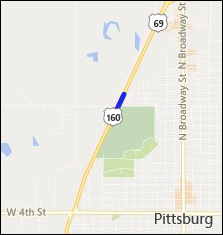
The Kansas Department of Transportation (KDOT) expects to begin a concrete pavement rehabilitation project at the intersection of U.S. 69 and 20th Street in Pittsburg the week of April 6, weather permitting.
U.S. 69 traffic will be maintained through the work zone. 20th Street will be closed to traffic at the intersection, with a posted detour on local streets.
KDOT awarded the $1.3 million construction contract to Koss Construction of Topeka. The project should be completed by late summer, weather permitting.
Drivers are reminded to slow down and proceed with caution through the work zone. Persons with questions may contact Bob Gudgen, (620) 308-7621, or Priscilla Petersen, (620) 902-6433.
Governor Laura Kelly today announced that public access to state office buildings will remain closed until April 19, 2020. This restriction matches the stay-home order that Governor Kelly signed on March 28.
Following the two-week suspension of state government operations on March 23, state government operations and the delivery of services will resume on Monday, April 6. However, Governor Kelly made it clear that to reduce the risk of infection to state employees, all employees who are able will begin working remotely.
“Our public employees perform critical functions that the people of Kansas depend on,” Kelly said. “Their work must continue despite this ongoing crisis.
“This crisis has been unprecedented, but the state will deliver critical state services, even though the delivery of those services may look different than they have in the past.”
Public facing offices, such as the Division of Motor Vehicles or the Office of Vital Statistics, will remain closed to the public until April 19 to limit the number of individuals gathering in small spaces.
State Treasurer Jake LaTurner receives 1000 entries in the first day of $50,000 Surprise a Senior Scholarships Giveaway
Topeka— Over 1000 nominations for the Surprise a Senior scholarship giveaway have flooded in following Wednesday morning’s announcement that Kansas State Treasurer Jake LaTurner will be awarding 20 scholarships of $2500 each to Kansas high school seniors from across the state.
“We are thrilled at the response we are seeing as teachers, parents, grandparents, and friends have been filling our inboxes with nominations to surprise their favorite high school senior with one these scholarships,” said Treasurer LaTurner. “It is heartwarming to know that even though the senior class of 2020 won’t be finishing up the school year the way they had hoped, there is no question that the people of Kansas care about their success after graduation.”
Contest entries will continue to be accepted through midnight April 30, 2020. The student must be nominated by someone who is 18 years or older. A student can receive multiple nominations; however, they will only be entered into the contest one time for the drawing.
Twenty scholarships of $2,500 each will be awarded to high school seniors obtaining their diploma in the 2019-2020 school year. Five scholarships will be given out in each of the four Kansas congressional districts. The winner will be selected via random drawing and the $2500 will be deposited into a new or existing LearningQuest® 529 Education Savings account for the student to use for qualified educational expenses. Entry rules can be found on the Kansas State Treasurer’s website at www.kansasstatetreasurer.com/sas.html. No purchase necessary. Void where prohibited.
All completed entries will be considered and winners will be notified by May 6, 2020.
The April 5, 2020 Commission meeting at 9:00 has been canceled, according to Bourbon County Clerk Kendell Mason.
Agenda
Bourbon County Commission Room
1st Floor, County Courthouse
210 S. National Avenue
Fort Scott, KS 66701
Tuesdays starting at 9:00
Date: April 5, 2020
1st District-Lynne Oharah Minutes: Approved: _______________
2nd District-Jeff Fischer Corrected: _______________
3rd District-Nick Ruhl Adjourned at: _______________
County Clerk-Kendell Mason
Special Meeting
9:00 am – Executive session for personnel matters of individual non-elected personnel – the meeting will take place over the telephone. The meeting can be viewed on the Bourbon County Facebook page.
Topeka, Kan. – The Kansas Department of Commerce today launched a new jobs website, connecting job seekers with Kansas businesses hiring to fill urgent needs during the COVID-19 pandemic.
The COVID-19 jobs site, kansasworks.com/coronavirus, allows employers from essential industries to quickly and easily post critical positions that need to be filled to support activities related to helping individuals and businesses during the COVID-19 crisis. The site, which is available at no cost to employers or job seekers, will be updated continuously as businesses add new jobs to the system.
Job seekers can visit the site to find companies hiring for COVID-19-related positions and quickly access company hiring portals.
“While the COVID-19 crisis has led to many Kansans losing their jobs, it’s also driven demand and opportunity for some functions in critical industries such as food and grocery, shipping and logistics and healthcare,” Secretary of Commerce David Toland said. “The COVID-19 jobs website allows us to quickly connect individuals looking for work with companies that have urgent hiring needs, particularly those related to support needed as a result of the coronavirus pandemic.”
To access the COVID jobs website, visit kansasworks.com/coronavirus.
For current information on COVID-19 in Kansas and to sign up for updates, go to the KDHE COVID-19 Resource Center at kdhe.ks.gov/coronavirus. To access resources available to businesses, please visit kansascommerce.gov/covid-19-response.
For more information: www.kdheks.gov/coronavirus
2019 Novel Coronavirus (COVID-19) in Kansas Test Results
Updated 4/1/20 at 10 a.m.
Total Positive Cases
482
Private Labs
361
Kansas Health and Environmental Lab (KHEL)
121
Deaths (included in above numbers)
KDHE does not release locations of deaths.
10
Out-of-State Resident Positive Cases* (not counted in KS #s)
2
Total Negative Cases for Kansans
Note: Update on 3/29 should have read 4,194 negative
5,411
Positive Case Information
County Number
Atchison
1
Finney
1
Lyon
12
Reno
8
Barton
2
Franklin
7
McPherson
5
Riley
4
Bourbon
3
Gove
1
Mitchell
2
Saline
1
Butler
5
Harvey
2
Montgomery
6
Sedgwick
64
Chautauqua
1
Jackson
1
Morris
2
Shawnee
18
Cherokee
3
Jefferson
1
Neosho
1
Stafford
1
Clay
1
Johnson
143
Osage
3
Stevens
1
Coffey
16
Labette
1
Ottawa
1
Sumner
1
Crawford
5**
Leavenworth
25
Pottawatomie
2
Woodson
3
Doniphan
1
Linn
5
Pratt
1
Wyandotte
93
Douglas
31**
*Ford and Miami Counties reported positive cases in out-of-state residents.
**1 case in Douglas and 2 cases in Crawford are presumptive positive at a reference lab, but were not confirmed through the KDHE lab, so are included in the county numbers, but not in the overall state total or demographics at this time.
Demographics
Gender
Female
242
Male
240
Age Range
Age range on patients is 0 to 95 years of age, with a median age of 55.
Hospitalized
114 hospitalizations to date reported*
* this is a cumulative number, based on 354 cases where information is available.
TOPEKA – The State of Kansas closed March with total tax collections at $523.4 million; 1.6% or $8.6 million below the estimate. That is 0.3% or $1.4 million more than March of Fiscal Year 2019.
Individual income tax collections were $247.3 million; $4.3 million more than the estimate and 7.1% more than last March. Corporate income tax collections were $18.4 million; $8.6 million below estimate and 24.5% below March FY 2019.
Retail sales tax collections were $179.4 million; $3.4 million more than the estimate. That’s an increase of $2.9 million compared to the same month last fiscal year. Compensating use tax collections were $34.7 million; 8.5% or $2.7 million more than the estimate and 8.7% more than last March.
“We expect the uncertain business and employment landscape to negatively affect withholding and estimated income taxes,” Secretary Mark Burghart said.
“As consumer spending patterns change, retail sales tax and compensating use tax collections could experience a major decline in the months to come.”
“While seeing a slight increase in total tax collection revenues compared to last fiscal year, we must continue to be cautious as we evaluate the financial impact of COVID-19,” Governor Laura Kelly said.
“Later this month, we should see a clearer picture moving forward as the Consensus Revenue Estimating group evaluates fall projections.”
The Consensus Revenue Estimating Group, comprised of the Department of Revenue, Division of Budget, Legislative Research Department, and economists from the University of Kansas, Kansas State University, and Wichita State University, will meet on April 20. The group will review the fall estimate and make any revisions it may consider necessary.
The City of Fort Scott is posting this notice for the purpose of considering
applications to be submitted under the CDBG Local Revolving Loan Emergency Response for the effects of COVID 19 on local businesses.
The funds will be used for working capital such as: salaries, wages, inventory, utilities, rent, insurance payments, etc., and must retain LMI (low to moderate income) jobs. The estimated fund amounts available will be over $265,000.
Program and application information may be found at fscity.org. Contact Rachel Pruitt for additional details at rpruitt@fscity.org
State Treasurer Jake LaTurner to Give Away $50,000 in Scholarships to 20 High School Seniors
Topeka—In response to the disappointing loss for Kansas high school seniors of the concluding quarter of their senior year, Kansas State Treasurer Jake LaTurner today announced the Surprise a Senior scholarship contest, which will award scholarships of $2,500 each to 20 lucky high school seniors.
“It’s impossible to look around and find many aspects of life that have not been altered by the disruptions from COVID-19. While we can’t bring back the end of their senior year for our Kansas high schoolers, we wanted to find a way to ease the disappointment a bit and surprise a few of our hard-working seniors with a little extra money to help them get going toward their educational goals after graduation,” said Treasurer LaTurner.
Twenty scholarships of $2,500 each will be awarded to high school seniors obtaining their diploma in the 2019-2020 school year. Five scholarships will be given out in each of the four Kansas congressional districts. The winner will be selected via random drawing and the $2500 will be deposited into a new or existing LearningQuest® 529 Education Savings account for the student to use for qualified educational expenses. Entry rules can be found on the Kansas State Treasurer’s website at www.kansasstatetreasurer.com/sas.html. No purchase necessary. Void where prohibited.
Entries will be accepted online through midnight April 30, 2020. All completed entries will be considered and winners will be notified by May 6, 2020.