TOPEKA – The Kansas Department of Labor (KDOL) has released the August 2025 Kansas Labor Report. The full report and accompanying news release can be accessed here: August 2025 Kansas Labor Report
The September 2025 Kansas Labor Report will be issued on Friday, October 17, 2025.
September 22, 2025
Board of Trustees
Fort Scott Community College
2108 S. Horton
Fort Scott, KS 66701
The Board of Trustees of Fort Scott Community College will meet in regular session on Monday,
September 22, 2025. The meeting will be held in Cleaver-Boileau-Burris Hall at Fort Scott
Community College.
5:30 p.m. Regular monthly Board meeting
THE AGENDA
5:30 ROLL CALL, 3
PLEDGE OF ALLEGIANCE
BOARD PRAYER
MISSION STATEMENT
Fort Scott Community College is an institution of higher learning with a long history of culture and diversity that
provides affordable academic, technical and occupational programs to meet student needs while fostering a
mutually supportive relationship between the college and its communities.
CALL TO ORDER, 4
A. Comments from the Chair, 4
B. Comments from the Public, 4
C. Recognitions and Retirements, 4
PROGRAM REVIEW AND ADMINISTRATIVE UPDATES, 4
CONSENT AGENDA, 6
A. Approval of Agenda, 5
B. Approval of Minutes of previous Regular Board Meeting conducted on August 25, 2025 and Special
Meetings conducted August 7, 2025, August 22, 2025, September 4, 2025, September 8, 2025, and
September 16, 2025, 7
C. Approval Treasurer’s Report, 16
DISCUSSION ITEMS, 19
A. Retirement 403B Plan Policy, 19
ACTION ITEMS, 20
A. Consideration of Financial Aid Policies, 20
B. Consideration of Shuttle Lease, 54
C. Approval of Bank Signer Resolution, 67
D. Approval of Sale of Property – Greyhound Lodge, 69
E. Consideration of Maintenance Building Expansion Bid, 70
CORRESPONDENCE AND TRUSTEE COMMENTS, 73
EXECUTIVE SESSION, 741
Board Meeting
Board Workshop
Board Meeting
Board Workshop
Board Meeting
ADJOURNMENT, 75
UPCOMING CALENDAR DATES:
August 25, 2025 (to facilitate budget process)
September 19, 2025
September 22, 2025 (to facilitate budget process)
October 17, 2025
October 20, 2025
November 14, 2025 Board Workshop
November 17, 2025 Board Meeting
December 12, 2025 Board Workshop
December 15, 2025 Board Meeting
January 23, 2026 Board Workshop
January 26, 2026 (Changed from January 19 due to Dr. Martin Luther King, Jr. Day) Board Meeting
February 13, 2026 Board Workshop
February 16, 2026 Board Meeting
March 13, 2026* adjusted for spring break Board Workshop
March 23, 2026 (Changed from March 16 due to spring break) Board Meeting
April 17, 2026 Board Workshop
April 20, 2026 Board Meeting
May 14, 2026* adjusted for graduation Board Workshop
May 18, 2026 Board Meeting
June 11, 2026* adjusted for summer schedule Board Workshop
June 15, 2026 Board Meeting
Sincerely,
Bryan Holt, Chair
Dr. Jack Welch, President
FSCC’s vision for the future is to support “Students First, Community Always” through a
central focus on teaching and learning; advancing strong, innovative programs and
departments; maximizing and leveraging opportunities; initiating efficient and effective
processes; and developing the region’s workforce.2
ROLL CALL
_____ Ronda Bailey
_____ John Bartelsmeyer
_____ Jim Fewins
_____ Bryan Holt
_____ Chad McKinnis
_____ Doug Ropp3
CALL TO ORDER
A. COMMENTS FROM THE CHAIR
B. COMMENTS FROM THE PUBLIC
C. RECOGNITIONS AND RETIREMENTS
Nursing and CNA
PROGRAM REVIEW AND ADMINISTRATIVE UPDATES
A. GORDON PARKS CENTER4
Miami County Campus & Environmental Water Technology Program
August 2025
• Barrett and Willis loaded and delivered 12 – Fifty-pound cans of Lincoln Excalibur 7018
5/32 rods, with an estimated value of $3,000. Also included miscellaneous stainless steel
rods (valued at minimum $400).
• Barrett and Willis put the “Enroll Now” banner on the lawn to help encourage enrollment
this week (08/07).
• Barrett and Willis received a steel donation from WEBCO. They loaded it on their trailer
and brought it back to the college before the start of classes.
• Meeting with Dr. Guerrero (8/5) to discuss MCC programs and EWT programs.
• Cabinet meeting (8/6).
• Attended a concurrent meeting with Louisburg High School (8/8).
• Fire Marshall visit (8/11).
• Osawatomie, Louisburg and Paola High School starts (8/13), Prairie View High School
starts (8/14). Paola changed their procedures for concurrent enrollment to FSCC and the
students appropriately identify the section code used for each individual student. It
should help with parent awareness.
• Met with EWT students from the local area to help them apply, enroll and find their
books to start class. Also, talked with out-of-town students over the phone and email as
they were having difficulty with Bb, Email and MYFSCC due to J1 issues.
• ZOOM meeting with EWT faculty and Dr. Guerrero (8/19).
• Toured Sutherlands building (08/26) with Lindsay, Dr. Welch, Dr. Guerrero, and Ralph
(08/25).
• Attended HLC ZOOM meeting regarding the higher Learning Commission (8/28).
• Met with 2 students at the Paola Adult Education Center (08/29).
• Revised/Edited a new Application/Enrollment Checklist based on the new MYFSCC
program. Working with Joe and the Jarred on a flyer for the fall EWT workshops.
• Seven students are attending the Criminal Justice courses (9 credit hours).
• Attended Fall Inservice (8/13)
• Held an Adjunct Inservice at the Miami County Campus (8/13).
• Barrett and Willis (WLD instructors) installed the new Entrance Gates at the Miami
County Fairgrounds.
• Nolanda proctored 7 C.N.A. state exams (interstate students)
• Nolanda proctored 13 ACCUPLACER tests
• Joint Conference in Topeka – August 25-28th.
• Cody Isbell and joe Cribbs presented on Basic and Advanced Water Math (8/28) at the
Joint Conference.5
CONSENT AGENDA
A. APPROVAL OF AGENDA
B. APPROVAL OF MINUTES OF PREVIOUS MEETINGS
Attached are the minutes of the Regular Board Meeting conducted on August 25, 2025 and Special
Meetings conducted August 7, 2025, August 22, 2025, September 4, 2025, September 8, 2025, and
September 16, 2025
C. APPROVAL OF TREASURER’S REPORT AND CHECKS
Attached are the Treasurer’s Report, Financial Report, and Checks Written, Cleared, or Voided
D. PERSONNEL ACTIONS
Separations
1) Tracy Dougherty, Nursing Instructor, effective September 18, 2025
Kansas Tourism Wins Second National Award for Sunflower Summer Program
TOPEKA – Lieutenant Governor and Secretary of Commerce David Toland today announced that Kansas Tourism has earned the Gold Award in the State Bridging Communities category for the popular Sunflower Summer program. Announced at the 2025 Educational Seminar for Tourism Organization (ESTO) Conference, ESTO awards recognize state and territory tourism offices for standout initiatives that strengthen communities and inspire travel.
“The Sunflower Summer program has been a shining example of how Kansas is investing in families, education and community connections,” Lieutenant Governor and Secretary of Commerce David Toland said. “By opening the doors to cultural, history and recreational experiences, we’re not only building memories – we’re strengthening our local economies by driving more visitation to the many unique attractions that Kansas has to offer.”
The Bridging Communities category honors campaigns that foster meaningful connections across diverse populations and regions by bringing bold ideas, data-driven creativity and deep community impact.
The award, presented by the U.S. Travel Association, was announced during the annual ESTO Conference held August 17-19 in Phoenix.
“This award underscores our goal to grow the tourism industry by connecting Kansas families with our state’s cultural and educational treasures found in their own backyard,” Kansas Tourism Director Bridgette Jobe said. “Sunflower Summer sparks new journeys, fosters state pride, and fuels the entire tourism economy.”
This recognition builds on previous honors given to the Sunflower Summer program, including Best Local Impact Campaign at the 2025 Etsy Awards, where Kansas Tourism was recognized for its efforts during the eTourism Summit in April.
The 2024 Sunflower Summer program delivered remarkable results, with more than 705,000 Kansas residents visiting the 223 participating attractions.
About the Kansas Department of Commerce:
As the state’s lead economic development agency, the Kansas Department of Commerce strives to empower individuals, businesses and communities to achieve prosperity in Kansas. Commerce accomplishes its mission by developing relationships with corporations, site location consultants and stakeholders in Kansas, the nation and world. Our strong partnerships allow us to help create an environment for existing Kansas businesses to grow and foster an innovative, competitive landscape for new businesses. Through Commerce’s project successes, Kansas was awarded Area Development Magazine’s prestigious Gold Shovel award in 2021, 2022, 2023 and 2024, and was awarded the 2021 and 2022 Governor’s Cup by Site Selection Magazine.
About Kansas Tourism:
The mission of Kansas Tourism is to inspire travel to and throughout Kansas to maximize the positive impacts that tourism has on our state and local communities. Kansas Tourism works hand in hand with other Commerce community programs to elevate and promote Kansas as a tourist destination. Kansas Tourism oversees all tourism marketing and PR for the state, produces travel publications and advertising, manages state Travel Information Centers, manages both the Kansas By-ways program and the Kansas Agritourism program, approves tourist signage applications, produces the KANSAS! Magazine, and provides financial and educational support to the tourism industry in Kansas through grants, education and support.
About ESTO & U.S. Travel Association:
The U.S. Travel Association’s ESTO is the tourism industry’s premiere conference, delivering innovative strategies and trend-driven sessions for destination marketing professionals. The ESTO State Awards, formerly known as the Mercury Awards, celebrates excellence in state-level tourism initiatives.
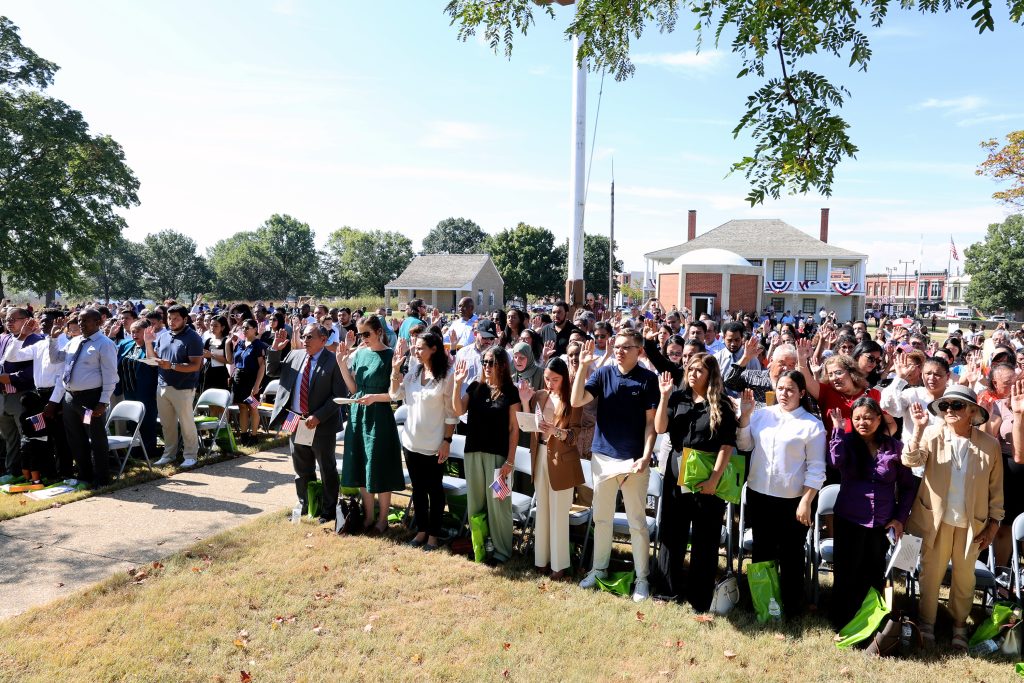
New citizens use the program flyers of the naturalization ceremony for protection from the sun.The future citizens wait for the ceremony to begin, which will officially conclude their journey to become American citizens.
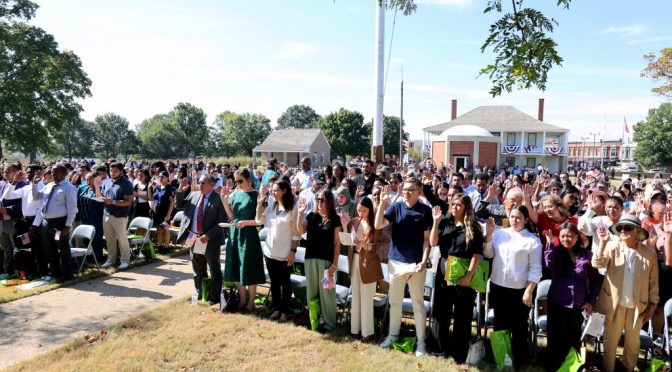
Ninety-six people from 44 countries became new American citizens today at Fort Scott National Historic Site in a U.S. District Court of Kansas Naturalization proceeding.
Jill Jaworski, Superintendent of the Fort Scott National Historic Site, welcomes the citizens, their families, and the community to the ceremony.
The humidity of this beautiful September day made the ceremony a little stifling.
The Fort Scott High School Orchestra prepares for its performance at the ceremony at Fort Scott National Historic Site for new American citizens.
The citizens were welcomed by local, state, and federal officials, listened to the Fort Scott High School Orchestra students play patriotic songs, were introduced by their county of origin, pledged an oath of allegiance to their new country, and took numerous photos of the event.
Representatives of the Kansas Secretary of State were on hand so the new citizens could register to vote, following the ceremony.
New citizens could register to vote at the Fort following the ceremony.A new citizen from the country of Belize stands during the recognition of countries in the ceremony.
Kansas Department of Corrections Announces Implementation of Grants Expanding Behavioral Health Services for Juveniles in Detention
WICHITA, Kansas. – The Kansas Department of Corrections (KDOC) today announced the successful implementation of over $1.4 million in grant funding, which has enabled juvenile detention centers across the state to provide vital mental health and substance use services to young people. The grants, established through the 2023 passage of House Bill 2021, address the significant behavioral health needs of juveniles and connect families to crucial support services sooner.
“This funding is a game-changer for our ability to effectively help Kansas youth in the justice system,” said Megan Milner, KDOC Deputy Secretary. “By identifying and addressing mental health and substance use needs early, we are providing a pathway for young people to receive the support they need to avoid future system involvement. For many detention centers, this is the first time they have had the capacity to offer these essential services”.
This grant program utilizes the state’s Evidence-Based Programs fund to improve services in Kansas’ nine locally operated juvenile detention centers. Assessments conducted since the grants were implemented in 2023 have revealed a critical need: over 80% of youth admitted to a detention center have mental health or substance use disorders. The grants are directly addressing this by funding timely assessments, case management, and behavioral health services.
“These grants provide crucial funding to address the needs that may be influencing a youth’s behavior in the community, thus resulting in them coming to the attention of the justice system. By getting them connected to services as early as possible, we can provide a structure of support for the youth and their family to hopefully change their trajectory in the juvenile justice system”, said Steve Stonehouse, Sedgwick County Director of Corrections.
The KDOC is responsible for the adult and juvenile correctional systems in the state, ensuring a safe and secure environment while providing opportunities for offenders to become productive members of society upon release.
Registration for the 2025 Governor’s Conference on the Future of Water in Kansas is open. The conference will take place on Wednesday, November 12 and Thursday, November 13 at the Hilton Garden Inn in Manhattan.
The conference will feature the latest policy and research developments on water issues in Kansas, including presentations on:
– Surface and Groundwater Issues
– Water Quality
– Education and Outreach
Registration closes on October 24. For more information, including the draft conference agenda and speaker bios, visit the Governor’s Water Conference page at kwo.ks.gov under the News & Events section.
This event is open to the press. Press badges are available for one or both days. When you arrive, visit the late registration desk to get a badge.
###
As the state’s water office, KWO conducts water planning, policy coordination and water marketing as well as facilitates public input throughout the state.
The agency prepares the KANSAS WATER PLAN, a plan for water resources development, management and conservation. KWO in coordination with the KWA also reviews all water laws and makes recommendations to the Governor and Legislature for needed legislation.
Fort Scott National Historic Site to Host Special Naturalization Ceremony on Constitution/Citizenship Day Sept. 17
Fort Scott, Kan. – Media outlets and the general public are invited to Fort Scott National Historic Site on Wednesday, September 17, 2025, for a Special Naturalization Ceremony at the parade ground here.
Check-in for ceremony participants begins at 9 a.m. and the ceremony begins at 10:30 a.m. The Honorable Holly L. Teeter, United States Magistrate Judge for the District of Kansas, is scheduled to preside.
Fort Scott National Historic Site Superintendent Jill Jaworski and Fort Scott Mayor Tim Van Hoecke plan to provide opening remarks. John K. Burchill, Emeriti Professor of Criminal Justice, is scheduled to provide the keynote address. The Fort Scott High School Orchestra is scheduled to perform.
Seating will be provided for ceremony participants. Friends, family, guests, and the public are encouraged to bring lawn chairs or picnic blankets for seating. In case of rain or inclement weather, the ceremony will be moved to Fort Scott’s Memorial Hall.
Media attending the ceremony are requested to RSVP and be in place by 10 a.m. at Fort Scott National Historic Site, 1 Old Fort Blvd., Fort Scott, Kansas, 66701.
Fort Scott National Historic Site’s exhibit areas and visitor center are open Friday through Thursday from 8:30 a.m. – 4:30 p.m. The park grounds are open daily from a half hour before sunrise until a half hour after sunset. Fort Scott National Historic Site is a free park that offers a glimpse into the growth of our nation. A walk through the fort reveals the significant role it played in the opening of the West, as well as the Civil War and the strife in the State of Kansas that preceded it. To find out more or become involved in activities at the Fort, please contact the park at 620-223-0310 or visit our website at www.nps.gov/fosc, on Facebook www.facebook.com/FortScottNPS and Instagram www.instagram.com/fortscottnps
It has been a sad week in America. A young father and husband’s life was taken by an assassin’s bullet while he was engaging in a dialogue with those he disagreed with — exercising the God-given rights enshrined by our Founding Fathers in the Constitution. Charlie Kirk’s voice will live on in the organization he founded and the many young people who have been inspired by his example to participate in the political process.
This week also marked the 24th anniversary of the terrorist attacks of September 11, 2001. In the days ahead, I hope we can recapture some of the spirit of unity that pervaded our country in the days and weeks following 9/11. The rise in political violence in recent years is antithetical to the principles of self-government on which the United States of America was founded.
Let us resolve to honor Charlie’s memory by recommitting to those principles that he held and practiced — having thoughtful conversations with those with different beliefs and resolving our disagreements not with violence, but by informed participation in the democratic process.
Ensuring Peace Through Strength
This week, the House passed the annual legislative package to authorize funding for every aspect of our military for the upcoming year. This year’s bill focuses on overhauling the Department of Defense’s (DoD) acquisition process, allowing our Armed Forces to quickly and effectively adapt to a constantly shifting global battlefield.
As part of that acquisition reform, I was able to secure a provision in the bill that makes it easier for small companies to become suppliers for the Pentagon. My amendment requires the Pentagon to establish a single application process that minimizes paperwork and bureaucracy for small businesses interested in competing for Pentagon contracts.
In addition, the bill contains huge wins for our servicemembers and their families, including a 3.8% pay increase for military personnel, extension of in-home child care programs for military families, and expansion of TRICARE dental insurance to reservists.
The bill passed the House with a bipartisan vote of 231-196. It now must be reconciled with a different version under consideration by the Senate. Watch my speech on the House floor in support of the bill below.
Making Border Security Permanent
There can be no doubt by now that President Trump’s efforts to secure the border have been successful, with illegal crossings now at historic lows. But, only Congress can enact new border laws that will ensure a future administration cannot turn back the clock and force Americans to relive the disastrous policies of the last four years.
To that end, this week the House passed legislation that will stiffen penalties for those who enter the country illegally — and in particular those who have committed a crime, been deported once (or even multiple times) and then illegally reentered the country. I was proud to cosponsor this bill, H.R.3486, the Stop Illegal Entry Act of 2025.
In my floor remarks in support of the bill, I spoke about a tragic 2016 case in Wyandotte County where an illegal immigrant, who had been previously deported and encountered law enforcement multiple times after reentering the country, killed four individuals in Kansas and one in Missouri. The perpetrator was not deterred by the current, weak penalties for illegal reentry, and federal officials in the Obama administration failed to enforce them. We must continue our work to codify strong border security measures to protect our communities.
Working Families Tax Cuts — Cutting Taxes for Seniors
As we continue to highlight the big wins for Kansas in the Working Families Tax Cut bill signed into law earlier this summer, I was pleased that the bill contained a new “bonus deduction” for our senior citizens. I have cosponsored a standalone bill that would fully eliminate income taxes on Social Security benefits — but due to procedural rules in Congress, a full repeal was not possible though the budget reconciliation process. Instead, the provision that was included will allow seniors to deduct up to an additional $6,000 (or $12,000 for married couples), which willfully offset the tax on Social Security benefits for the vast majority of the nearly 140,000 seniors in our Second District.
Thanks to the many Kansans who visited Washington this week, including the Kansas Auto Dealers Association, Kansas Pork Association and Kansas Chamber!
Emergency Declaration Approved
Last night, President Trump approved a Major Disaster Declaration for Kansas, in response to the severe storms, straight-line winds, tornadoes, and flooding that occurred June 3-7, 2025. My fellow members of the Kansas delegation joined last month in a letter to the President supporting the declaration. The disaster declaration will result in $5.7 million in federal funds to help communities recovering from these storms.
The 15 Kansas counties included in the disaster declaration include five counties in the Second District: Chase, Coffey, Lyon, Morris and Osage.
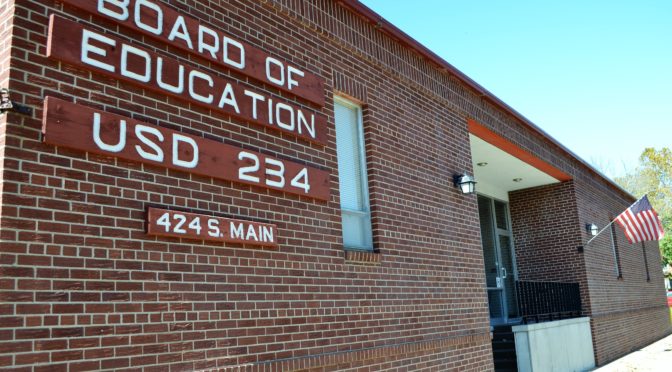
Members of the USD 234 Board of Education met at 5:30 p.m. on Thursday, September 11, 2025, for their regular monthly meeting at 424 S Main.
President David Stewart opened the meeting.
The board approved the official agenda, and the consent agenda as follows:
Board Minutes
Board Minutes
08-11-25
Financials – Cash Flow Report
Check Register
Payroll – August 20, 2025 – $1,556,743.36
Activity Funds Accounts
USD 234 Gifts
Orchestra Extended Trip
HS Powerlifting Fundraising
The Revenue Neutral Hearing was held at 5:30 PM, none were present during public forum.
The Budget Hearing was held at 5:45 PM, one public was present for clarification on Mill Levy.
The Board approved –
Resolution 25-10 – Exceeding the Revenue Neutral Tax Rate
Resolution 24-11 – Make a local option percentage in an amount of 33% for the 25-26 school year.
The Board Approved the 2025-26 Budget with consideration of the Needs Assessment.
Superintendent Destry Brown gave an update on current enrollment as we are approaching the September 20th count day. The district has received the Patterson grant. At the High School the Hydroponic Farm is growing and the students are starting to harvest from their efforts.
Assistant Superintendent Terry Mayfield provided information on the Special Education Audit that has been finalized and the district did a wonderful job completing. The district financial audit will be starting September 22. Also, he updated the Board on each of the departments and the startup of the new school year. He also attended a Bus Safety training held with the district Bus Drivers.
Assistant Superintendent Zach Johnson updated the Board on iReady testing and the growing data that we have received and soon should be able to share with parents. State has said there will be changes to some requirements for graduation starting next year and he will be collaborating with High School Principals as more information becomes available. He is also working with a few in the community with students walking to and from school and how to improve the safety and encouragement for students.
Special Education Director Tonya Barnes provided a shared an update on the CatAid payment and information that she has been working on. We should receive our first payment next month.
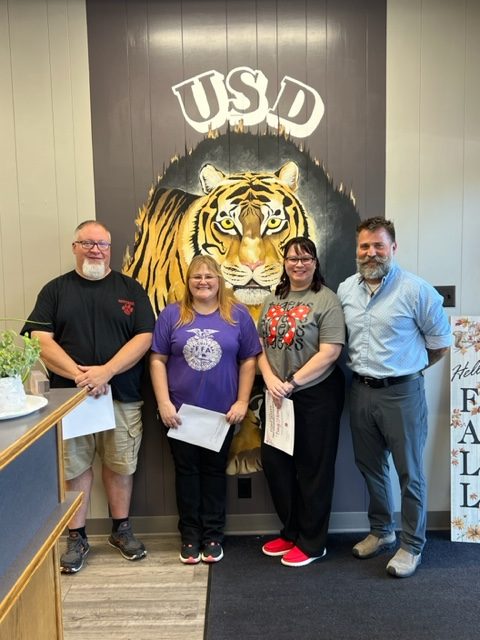
Tracy Homan was recognized by Principal DJ Brown “Tracy Homan from FSMS goes above and beyond for kids. She has been instrumental in developing the student council program and is often seen at after-hours programs and events supporting students.”
Maintenance recognized Dusty Hood – “Dusty covered nearly 50 extra shifts at the end of last school year covering for absent staff. Dusty cleaned up for nearly all volleyball and basketball games/tournaments both after hours and on weekends last year. He is still covering his normal daytime shift at the Middle School this year plus 3 hours per night at the High School and another 1.5 hours per night at the Middle School and anywhere else we need him. He maintains an awesome relationship with his students and staff members. He helps lead the summer crew and he helps train any and all new custodial crew. Dusty is one of our most trusted and respected employees because of his hard work and dedication to the district. His positive attitude and “can do” mentality truly raised the bar in an exemplary manner. I wish we could find more than a piece of paper to distinguish what Dusty means to us staff members behind the scenes. We are forever indebted and grateful.”
Jennifer Durkin, Paraprofessional at Kansas Renewal Institute was recognized for her hard work and always being willing to jump in and help wherever needed. She loves the kids and is present for them every day.
Eugene Ware Principal, Mina Query, recognized Todd Magee, “Todd is a wonderful employee. He serves on Guiding Coalition, PBIS, and Team Tiger. He has such a positive attitude and never minds being silly for the kids. There are plenty of pictures out there from last year’s PBIS assemblies that show just how silly he is willing to be. Just check out his Maui photos on Facebook. He is a creative teacher who works hard to make learning seem like a game. I know a few students who got through their third-grade year because he was their teacher.”
The Board Approved the following items:
Adult Meal Prices for 2025-26
Adult Breakfast – $3.00
Adult Lunch – $5.05
MOU with FSCC for shared use of facilities
Partnership agreement with Head Start
One Year Lease agreement with Head Start
There were none present for public forum.
The Board went into an executive session for personnel matters.
Consideration of Resolution No. 25-2025 A RESOLUTION DIRECTING THE REPAIR OR REMOVAL OF AN ALLEGED UNSAFE AND DANGEROUS STRUCTURE AT 18 S. HOLBROOK – L. Kruger
Consideration of Resolution No. 26-2025 A RESOLUTION DIRECTING THE REPAIR OR REMOVAL OF AN ALLEGED UNSAFE AND DANGEROUS STRUCTURE AT 402 N. SHUTE – L. Kruger
Consideration of Resolution No. 27-2025 A RESOLUTION DIRECTING THE REPAIR OR REMOVAL OF AN ALLEGED UNSAFE AND DANGEROUS STRUCTURE AT 205 N. LINCOLN – L. Kruger
Action Items:
Consideration to Trade 963 Track Loader – T. Coffman
IT Update – S. Mitchell
Discussion of Small Business Grant Incentive – M. Wyatt
Planning, Housing and Business Development Update – M. Wyatt
Consideration of Application – CDBG Housing Rehabilitation Grant – L. Dillon
Consideration of Second Amendment to ER Funding Agreement – Approved by
Bourbon County Commission September 8, 2025
Approval to go out for Codes Mowing Bids – 3-Years – B. Matkin
Consideration of CCLIP Project Programming Request – J. Dickman


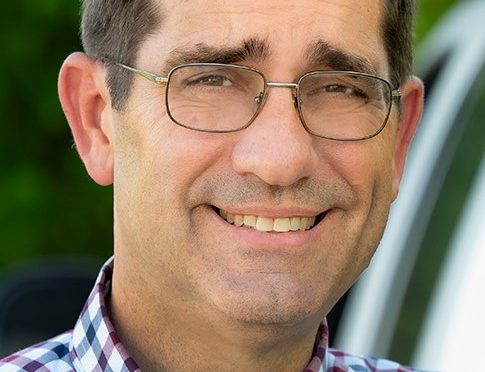


.png "Rep. Schmidt speaks to the Kansas Independent Oil and Gas Association.")
.png "Rep. Schmidt at the Topeka Mars facility")