TOPEKA – Lieutenant Governor and Secretary of Commerce David Toland today announced a new round of funding totaling $250,000 available through the Strategic Economic Expansion and Development (SEED) grant program. Now in its fifth round, the SEED initiative continues to support economic development and quality-of-life improvements in Kansas’ smallest communities.
“Over the last eight years, we’ve worked strategically to bring economic opportunities to all of our Kansas communities — including the rural and smaller parts of our state,” Lieutenant Governor and Secretary of Commerce David Toland said. “SEED funding creates transformational change in communities that might not otherwise have the means to complete necessary economic development projects on their own.”
Administered by the Kansas Department of Commerce, SEED grants are available to communities in 78 eligible counties, with populations of 5,000 or fewer. Grants of up to $25,000 will be awarded in the following categories:
Childcare and Senior Programming – Projects that support or enhance services, such as building improvements, educational materials, supplies and equipment
Community Vibrancy – Projects that re-energize and beautify rural communities through public art, signage and placemaking initiatives
Food Retail – Projects that increase access to food through new, expanded or renovated retail spaces
Libraries – Projects that expand access to information and community resources through reading materials, technology upgrades, furnishings and facility improvements
Eligible applicants include local government, economic development organizations, chambers of commerce and other community-based organizations in towns that have not received a SEED grant in the past year. A 10% local match is required, and all funded projects must be completed within 12 months of receiving grant funds. Grants will be distributed in two installments: half at the time of award and the remainder once the project has reached at least 50% completion.
Awarded grants are having a real impact on real Kansas communities. In 2025, a $25,000 SEED grant paired with $43,450 in local matching funds is helping the City of Larned build a greenhouse at the Larned Community Garden for students, volunteers and seniors to utilize. A “Senior Saturdays” program will have seniors planting vegetables and flowers during the winter, then returning in the spring to take them home. The city also is creating programming with cooking classes and a county-wide equipment share co-op that will give seniors more opportunities for socialization.
“We’re excited about the impact that the equipment share program and the greenhouse will have on our community,” City of Larned City Manager Bradley Eilts said. “Together, they create opportunities that simply wouldn’t be possible in a small rural community. Through programs like Senior Saturdays, we’ll be able to provide meaningful hands-on experiences, social connections and access to resources that enrich the lives of our older adults.”
Funding for the SEED program is made possible through the Technology Enabled Fiduciary Financial Institutions (TEFFI) Development and Expansion Fund, established through bipartisan legislation in 2021 to promote economic development statewide in rural communities.
SEED grant applications will open Monday, August 17, and close at 5 p.m. Monday, October 19. Awardees will be announced in December.
A webinar to learn more about this opportunity will take place at 2 p.m. Tuesday, August 18. Those interested in participating can register here. The webinar also will be recorded and available on demand following the meeting.
For information about program guidelines, the list of eligible counties, or to view previous awardees, visit the SEED Grant webpage.
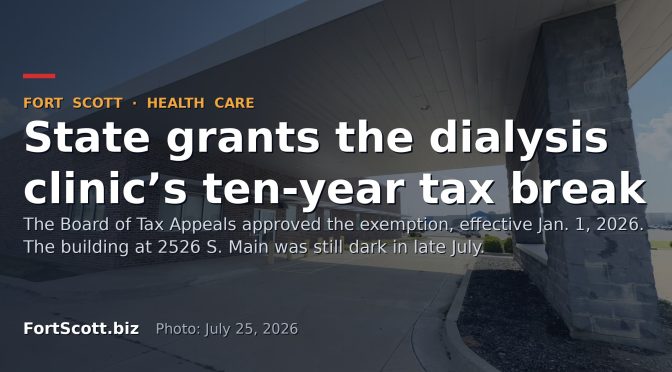
The Kansas Board of Tax Appeals has granted the ten-year property tax exemption for the vacant dialysis clinic at 2526 S. Main.
The board’s order, in Docket No. 2026-3773-IRBX, runs ten calendar years, from January 1, 2026 through December 31, 2035, or for as long as the bonds remain outstanding, whichever is shorter. Bourbon County Appraiser Matt Quick provided the order to FortScott.biz on Aug. 13. The copy he sent is stamped received Aug. 3.
The industrial revenue bonds, in an amount not to exceed $800,000, were issued December 30, 2025. The order records $450,000 of that for improvements and $350,000 for personal property, which is already exempt under a separate statute and was not at issue.
What the break covers
The exemption reaches only the portion of the property paid for with bond money. It does not touch USD 234’s capital outlay levy — 7.998 mills, about 4.3 percent of the 186.696 mills on this parcel. Everything else can be abated, including Bourbon County’s share.
It is not automatic, and the paperwork does not end here. A claim has to be filed with the county appraiser before March 1 every year for ten years, and the exemption ends if taxes on the non-exempt portion go unpaid. The order puts that annual filing on the applicant (the city). The city makes the filings, at Moka Rentals’ request.
The 2025 bill on the parcel was $65,343.80, paid in full on Dec. 18, 2025. The first tax statement the exemption can affect goes out this November.
The building, and who owns it
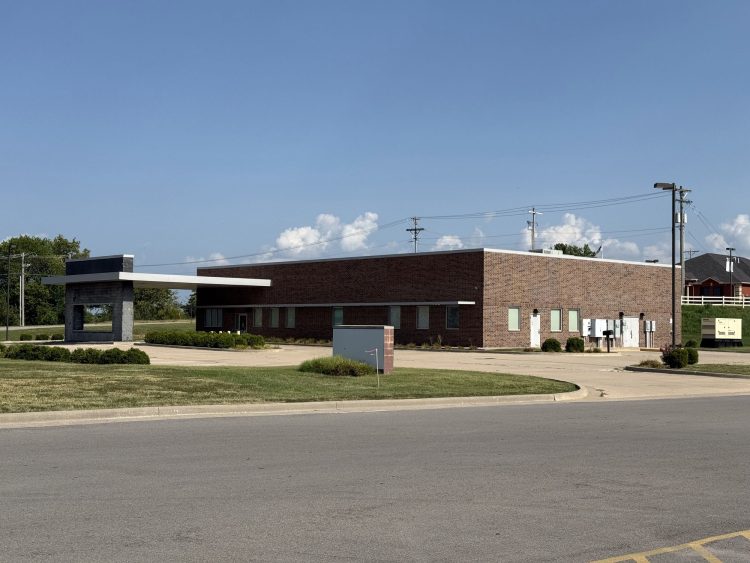
The order describes the property as “leased to Moka Rentals, L.L.C., who uses the subject as a dialysis treatment facility” — the language an exemption order uses for the qualifying use. The building was dark when FortScott.biz visited July 25: no signage, no activity, blinds drawn. It has been empty since Fresenius Medical Care closed it on Sept. 30, 2019.
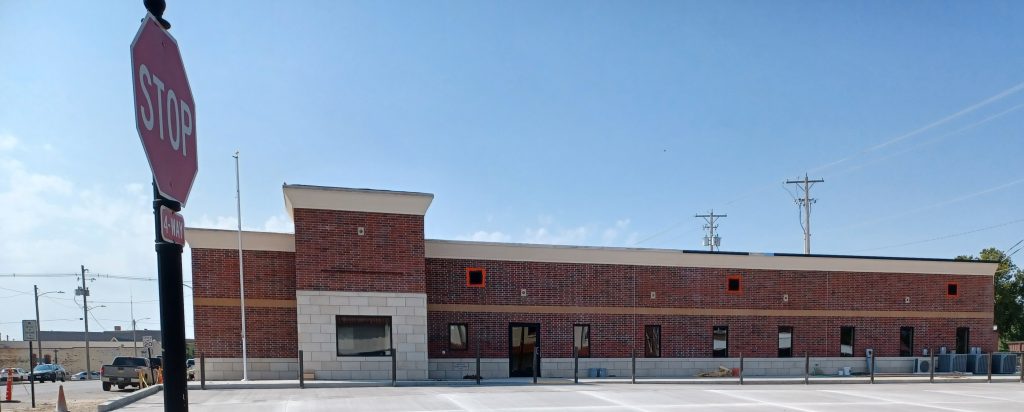
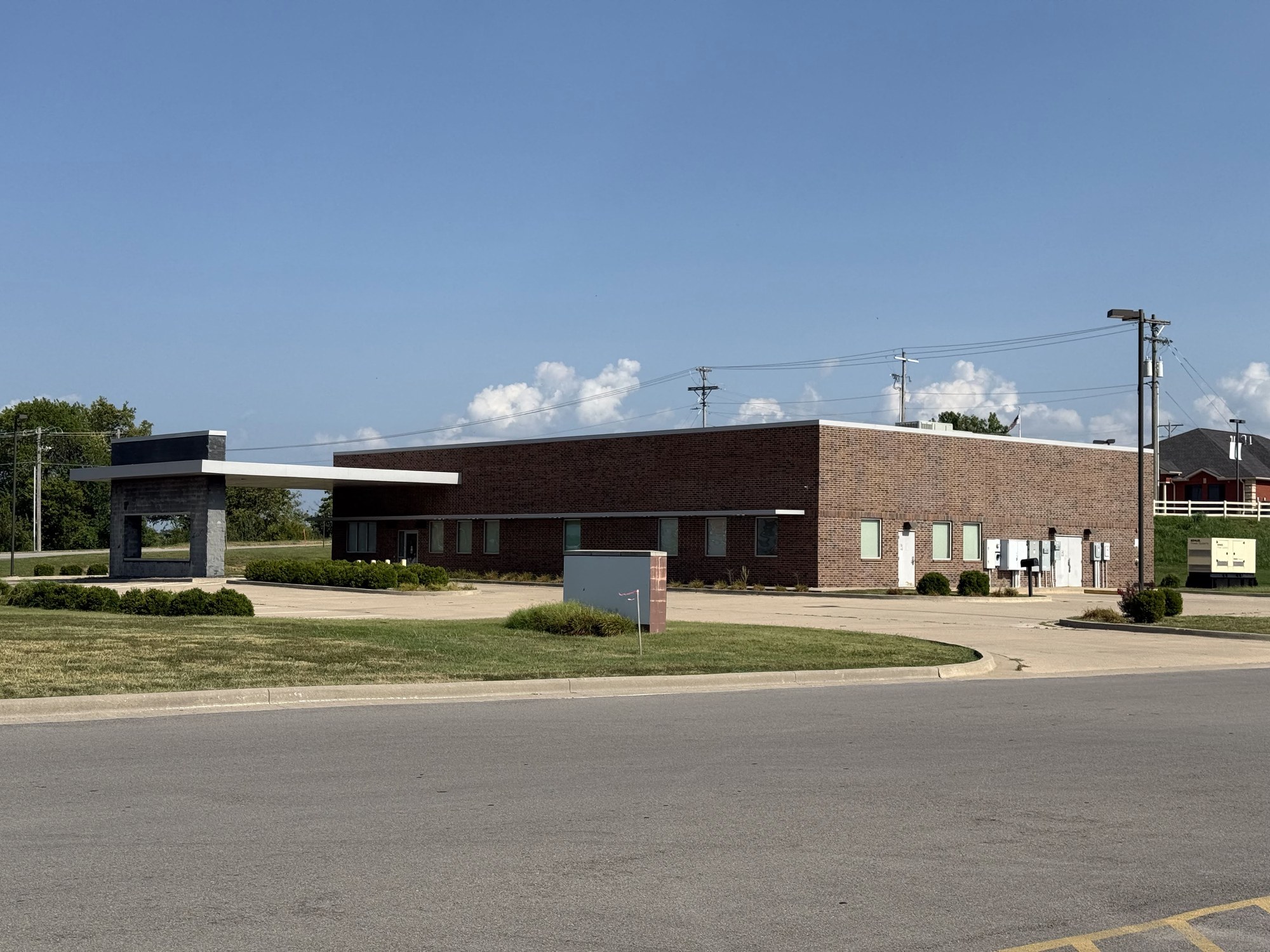
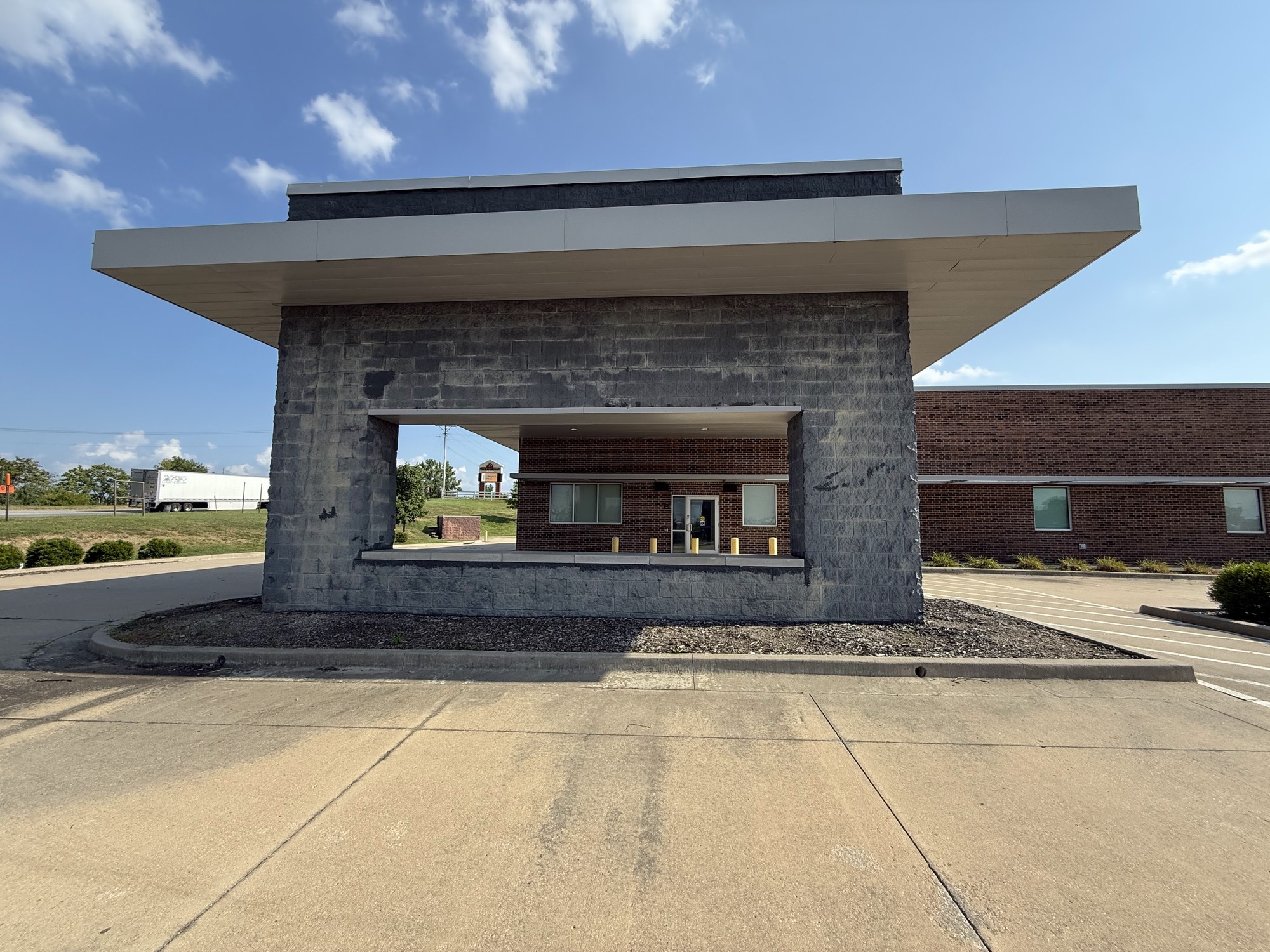
The building at 2526 S. Main on July 25, 2026. FortScott.biz photo.
The deal runs on two leases, which is how the city ends up a party to a tax case over a building it does not own. Moka Rentals, which the county lists as the owner and taxpayer of record, leases an interest in the property to the city; the city then leases the project back to Moka. That is a standard industrial revenue bond arrangement when the company already owns the building. Wichita used the same structure, drafted by the same bond counsel, for a $134 million project at Wesley Medical Center. Under the Fort Scott project lease, the city’s promise to keep filing for the exemption across the full ten years holds only “[s]ubject to the Project being continually operated as a dialysis center.”
There is still no announced opening date. In late July, the practice manager at Joplin Nephrology Consultants said there were “no updates as of right now” on the project.
A Fox television station in the Kansas City area reported recently they had received tips that some people in Kansas are not getting money loaded onto their Electronic Benefit Transfer (EBT) cards.
EBT is the electronic debit card system used to access the official Food Assistance Program in Kansas, which is the state’s name for the federal United States SNAP (Supplemental Nutrition Assistance Program), according to the KDCF website.
Fortscott.biz went to the local Department of Children and Families in Fort Scott to find out more.
The spokesperson at DCF, Fort Scott, said she was unable to give information and sent a request to the Kansas Department of Children and Families media relations spokesperson.
In a nutshell, the answer is yes, there have been delays for some people because of requirements by federal and state laws that need longer processing times for case updates, along with increased workload and staffing shortages.
Erin La Row, MBA, who is the Deputy Director of Media Relations, responded with the following in an email:
“My colleagues in Fort Scott said after seeing the FOX 4 story, you were looking for information about delays clients may be facing with receiving their SNAP Food Assistance,” she said in the email.
The Department of Children and Families building, National Avenue and Wall Street, August 2024
“Some clients are experiencing delays in receiving their benefits due to longer processing times for required case updates, including recertifications, change reports, and interim reports. We understand how important these benefits are to the individuals and families who rely on them, and we recognize the hardship and uncertainty that delays can create.”
She listed several factors contributing to longer processing times.
“Increased seasonal workload and staffing shortages, and the time required to obtain and review required verifications —such as shelter and utility expenses— to ensure benefit accuracy and reduce error rates. Some of these factors are related to new requirements put in place by the U.S. Congress and Kansas Legislature.
“DCF is committed to reducing processing times. The agency has implemented overtime opportunities and continues to prioritize recruitment and training to strengthen the eligibility workforce, reduce wait times, and improve service for Kansans.”
Result of 2025 Laws
The U.S. Congress in 2025 enacted the One Big Beautiful Bill Act, with the effect trickling down now to the local level.
To learn more about this legislative act, click below.
The One Big Beautiful Bill Act of 2025 reduces federal funding for the Supplemental Nutrition Assistance Program (SNAP) by $187 billion through 2034 and establishes stricter eligibility standards nationwide, according to a Public Broadcasting Service story:
With highway construction continuing and the beginning of the school year fast approaching, the Kansas Department of Transportation and the Kansas State Department of Education are reminding drivers of a new law aimed at reducing distracted driving in construction and school zones.
Senate Bill 366 prohibits handheld mobile device use in active construction and school zones across the state. Governor Laura Kelly signed the bill this spring, which then became law on July 1. Devices are still allowed to be used in hands-free mode.
Law enforcement officers are issuing warning citations until June 30, 2027. Beginning July 1, 2027, violations may result in traffic citations with a $60 fine plus court costs.
“Removing the distraction of handheld devices in construction and school zones is an effort to improve safety in locations where vehicles and pedestrians or construction workers can be in close contact with one another,” said Gary Herman, KDOT Behavioral Safety Section Manager. “The safety of people in these zones must be a top priority.”
An active construction zone means workers are present, and signs are posted at the beginning and end of the work zone to alert drivers. Active school zones are defined as areas where reduced speed limits are in effect. Devices are still allowed to be used in hands-free mode.
“People are walking and working in these areas just a few feet from passing vehicles,” said Keith Dreiling, KSDE State Director of the School Transportation Safety Unit. “We urge drivers to use extra caution and remain aware of their surroundings when traveling through school and construction zones.”
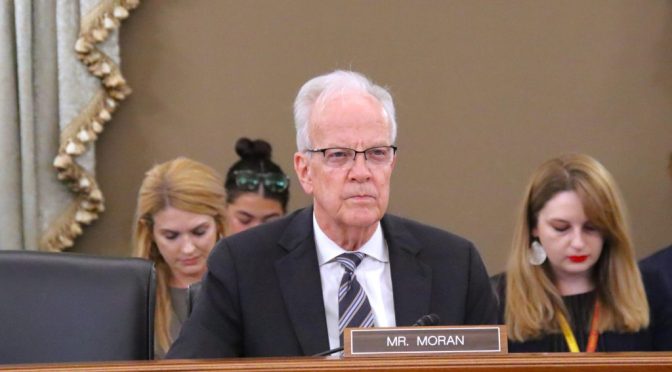
On Friday, Sen. Jerry Moran joined Greg Akagi on WIBW Ag Radio and Chip Flory on AgriTalk to discuss the latest developments on the Farm Bill with the markup scheduled for this Thursday in the Senate Agriculture Committee and the importance of advancing priorities critical to Kansas agriculture. When he meets with Kansas farmers and ranchers, he hears firsthand about the challenges they are facing, including high input costs, ongoing drought conditions and uncertainty in the agriculture economy. Passing this legislation will provide certainty for rural America and Kansas farmers and ranchers.
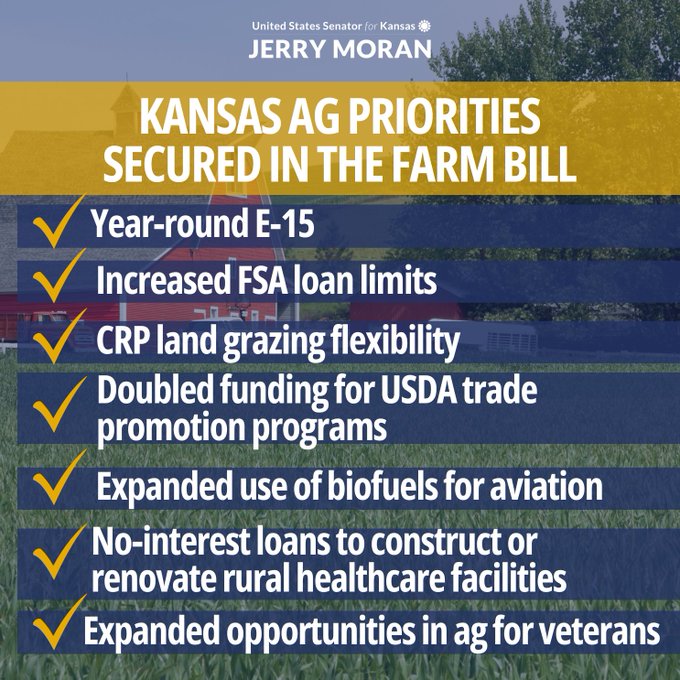
As a member of the Senate Agriculture Committee, Sen. Moran has worked to make certain the Farm Bill includes priorities that strengthen Kansas agriculture, and he is working to include his legislation to permanently transfer the administration of the Food for Peace program from the Department of State to the U.S. Department of Agriculture. This legislation also includes a number of provisions that will benefit producers and rural communities in Kansas, such as:
Year-round E15 sales, which expands markets for Kansas farmers and ethanol producers, supports American energy independence and provides consumers with more affordable options at the pump
The CRP Improvement and Flexibility Act, increasing flexibility for livestock grazing on conservation lands
The Rural Hospital Revitalization Act, which would provide no interest loans for constructing or renovating rural healthcare facilities
The Farm to Fly Act, allowing sustainable aviation fuel to qualify for USDA energy programs
The Colonel Gary LaGrange AgVets Act, which would expand career opportunities in agriculture for veterans
Language to increase FSA loan limits to better reflect lending conditions in farm country
Doubled funding for USDA trade promotion programs, better allowing producers to market their products globally
Introducing Legislation to Strengthen Rural Kansas Hospitals & Providers
This week, Sen. Moran introduced bipartisan legislation with Sen. Tina Smith (D-Minn.) to expand access to federal resources for rural hospitals through the Rural Emergency Hospital (REH) Medicare designation. The legislation, the Rural Emergency Hospital Designation Improvement Act (REH 2.0), would allow more Critical Access Hospitals (CAH) and rural hospitals at risk of closure to sustain health care services in rural communities, and it would make technical improvements to strengthen the designation.
Sen. Moran worked to help establish the REH designation through the Consolidated Appropriations Act of 2021, providing eligible rural hospitals with a pathway to convert and continue serving their communities with limited services rather than closing their doors. He has visited every hospital in Kansas numerous times, and during these visits, providers shared their recommendations for strengthening the designation so it can better support the struggling health care facilities it was originally intended to serve.
The legislation introduced this week is the direct result of what Sen. Moran has heard from rural hospitals and providers in Kansas, and it makes needed improvements to the program to help make certain patients can continue to access critical health care services in their communities for years to come.
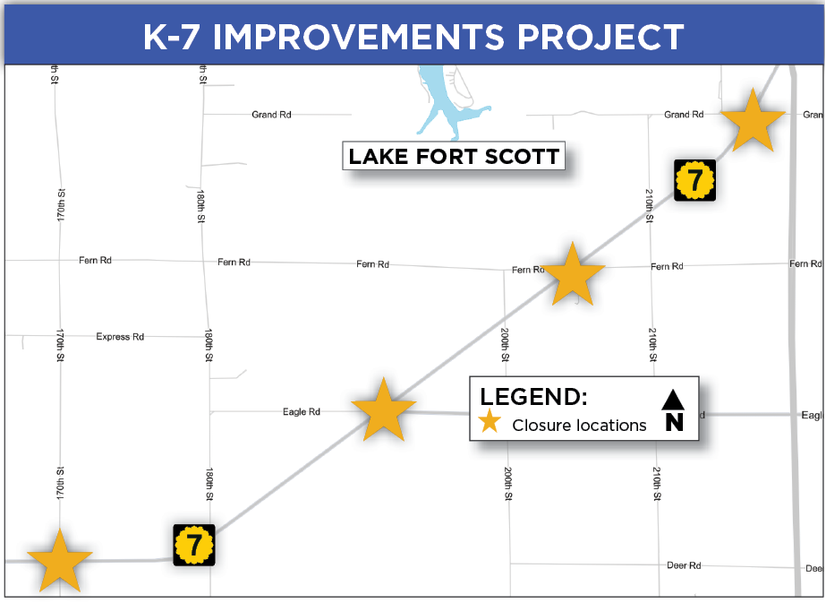
Post Date:08/04/2026 12:00 PMWork on current K-7 improvements between K-39 and U.S. 69 in Bourbon County will require some daytime closures of roads crossing the highway, according to the Kansas Department of Transportation, according to a press release.K-7 remains closed to through traffic because of the project, but these closures will involve the streets and roads that cross K-7. These daytime closures allow the contractor to work on the road base and start pouring asphalt. Please find an alternate route during daytime hours.
Some closures – 160th Street, 180th Street, 200th Street and 210th Street – have already started and will wrap up after daytime work hours today, Tuesday, Aug. 4.
On Wednesday through Friday, Aug. 5 to 7, 170th Street, Eagle Road, Fern Road and Grand Road will be closed during daytime hours for the same work.
These intersections will reopen to traffic overnight and during times that work is not occurring. No two adjacent side roads will be closed simultaneously.
APAC-Kansas Inc., Shears Division, of Hutchinson, is the primary contractor.
KDOT urges motorists to stay alert, follow posted signs and refrain from hand-held mobile device use in all active work zones. For current road conditions, visit kandrive.gov or call 511. For updates on construction projects in southeast Kansas, visit ksdot.gov/projects/southeast-kansas-projects.
TOPEKA – The Kansas Department for Aging and Disability Services (KDADS) Aging Services Commission today issued a Request for Applications (RFA) for the Dementia-Related Behavioral Supports in Rural Nursing Facilities Pilot, a new initiative funded by the federal Rural Health Transformation Program (RHTP).
Up to six Medicaid-certified nursing facilities (one from each of the six Kansas Department of Health and Environment (KDHE) District Office areas) will receive funding to better support Medicaid recipients aged 60 and older with dementia who exhibit complex behaviors. Participating facilities may receive up to $200,000 each to provide specialized training, technical assistance, subject-matter expert consultation, and enhanced person-centered care services. The funding model provides $175 per eligible resident per Medicaid day for up to 90 days, with extensions considered on a case-by-case basis.
“By investing in training and person-centered supports for rural nursing facility staff, we can improve residents’ quality of life while helping facilities build lasting capacity to manage dementia-related behaviors,” KDADS Secretary Laura Howard said. “This pilot directly responds to the needs we have heard from rural providers and aligns with our commitment to transforming rural health care through the RHTP.”
This initiative is part of Kansas’s broader efforts under the RHTP, a major federal initiative designed to strengthen rural health systems, expand access to care, build a sustainable workforce, and improve outcomes for residents in underserved areas. Kansas developed a comprehensive state plan and is now implementing targeted strategies to address specific challenges facing rural communities. One such challenge is supporting older adults with dementia in nursing facilities, where staff often face complex behavioral needs and have limited access to specialized training and consultation.
“This pilot project reflects the kind of innovation and collaboration the RHTP is designed to advance,” KDHE Secretary Janet Stanek said. “KDHE is proud to partner with KDADS and rural nursing facilities in our shared commitment to advancing high-quality, person-centered dementia care for older Kansans.”
Eligible applicants are Medicaid-certified nursing facilities in rural Kansas counties. Facilities in Johnson, Wyandotte, Leavenworth, Miami, Linn, Douglas, Shawnee, Jefferson, Osage, Jackson, Wabaunsee, Riley, Geary, Pottawatomie, Sedgwick, Butler, Harvey, and Sumner counties are ineligible. Nursing Facilities for Mental Health (NFMH) are also ineligible.
This project is supported by the Centers for Medicare & Medicaid Services (CMS) of the U.S. Department of Health and Human Services (HHS) as part of a financial assistance award totaling $221,898,007.82, with 100 percent funded by CMS/HHS. The contents are those of the author(s) and do not necessarily represent the official views of, nor an endorsement by, CMS/HHS, or the U.S. Government.
The following is a news release issued July 31, 2026 by the office of U.S. Sen. Jerry Moran (R-Kan.), originally headlined “Sens. Moran, Smith Introduce Bipartisan Legislation to Strengthen Rural Hospitals.” It is reprinted in full, unedited. View the original release.
REH 2.0 makes changes to bolster & improve the original REH Designation
WASHINGTON – U.S. Senators Jerry Moran (R-Kan.) and Tina Smith (D-Minn.) this week introduced the Rural Emergency Hospital Designation Improvement Act (REH 2.0), bipartisan legislation to expand access to federal resources for rural hospitals through the Rural Emergency Hospital (REH) Medicare designation. This legislation would allow more Critical Access Hospitals (CAH) and rural hospitals at risk of closure to sustain health care services in rural communities, and it would make technical improvements to the designation. The legislation is cosponsored by Sens. Tommy Tuberville (R-Ala.), Katie Britt (R-Ala.), Shelley Moore Capito (R-W.Va.), Cindy Hyde-Smith (R-Miss.) and Roger Marshall, M.D., (R-Kan.).
“I have visited every hospital in Kansas numerous times, and these conversations help guide my efforts to make certain health care providers across our state have the support they need to provide critical services to patients in their communities,” said Sen. Moran. “During these visits, providers shared with me their recommendations for strengthening the Rural Emergency Hospital designation so it can better support the struggling facilities it was originally intended to serve. The legislation I am introducing with Senator Tina Smith is the direct result of what we have heard from rural hospitals and health care providers in our states, and it makes needed improvements to the program to help make certain patients can continue to access critical health care services in their communities for years to come.”
“Rural hospitals are vital for families in small towns and rural communities. These hospitals not only provide care close to home, they’re also economic engines for their region,” said Sen. Smith. “But many rural hospitals face increasingly dire financial strain and workforce shortages, forcing them to cut services or even close down altogether. This important legislation is just one tool in the toolbox to help rural hospitals on the verge of closure keep their doors open. Make no mistake, much more is needed to ensure the health and wellness of rural hospitals and families.
“The Rural Emergency Hospital designation has already created new opportunities to preserve health care access in rural Kansas, but experience has also shown where additional flexibility is needed,” said Chad Austin, President and CEO of the Kansas Hospital Association. “The Rural Emergency Hospital Improvement Act represents the next step in strengthening this model by removing barriers that have prevented certain hospitals from participating and by providing commonsense improvements that will help more rural communities maintain access to essential services. We appreciate Senator Moran’s leadership and longstanding commitment to ensuring hospitals have the tools they need to care for their patients today and well into the future.”
“Healthcare access across rural Kansas is at a critical tipping point, with our state facing one of the highest numbers of at-risk rural hospitals in the nation,” said Tripp Owings, CEO of Ascension Via Christi. “The reality is that the needs of rural communities continue to evolve, and hospitals need the flexibility to adapt how they deliver care so they can preserve access and remain sustainable for the long term. When the Ascension Via Christi Emergency Department in Wellington opened in March 2021 to restore emergency services after the local hospital closed, we missed the initial federal REH cutoff by mere months, leaving our facility without a pathway to qualify. We thank Senator Moran for his continued support for rural hospitals in Kansas and we believe that REH 2.0 would provide important flexibilities to ensure more hospitals across Kansas and the country to adapt, stabilize, and maintain 24/7 emergency care close to home.”
“As the first Rural Emergency Hospital in Kansas, SCK Health has seen firsthand how the REH designation can preserve access to high-quality care in rural communities,” said Margaret Grismer, CEO of SCK Health. “The Rural Emergency Hospital Improvement Act builds on that success by providing the flexibility hospitals need to better serve their patients while strengthening the long-term sustainability of rural healthcare. We applaud Senator Moran’s leadership in advancing practical solutions that help ensure rural Kansans continue to receive the care they deserve, close to home.”
“In the fall of 2015, the hospital located in Independence, Kansas closed. Labette Health located 35 miles east of Independence worked with local leaders, KDHE, the USDA, and Senator Moran to open an off-campus Emergency Room, Observation Unit, and Rural Health Clinic on July 4, 2017, in Independence. This REH 2.0 will provide two paths to sustainability for Independence Healthcare Center as either an REH or as a ‘REH like’ facility,” said Brian Williams, President and CEO of Labette Health.
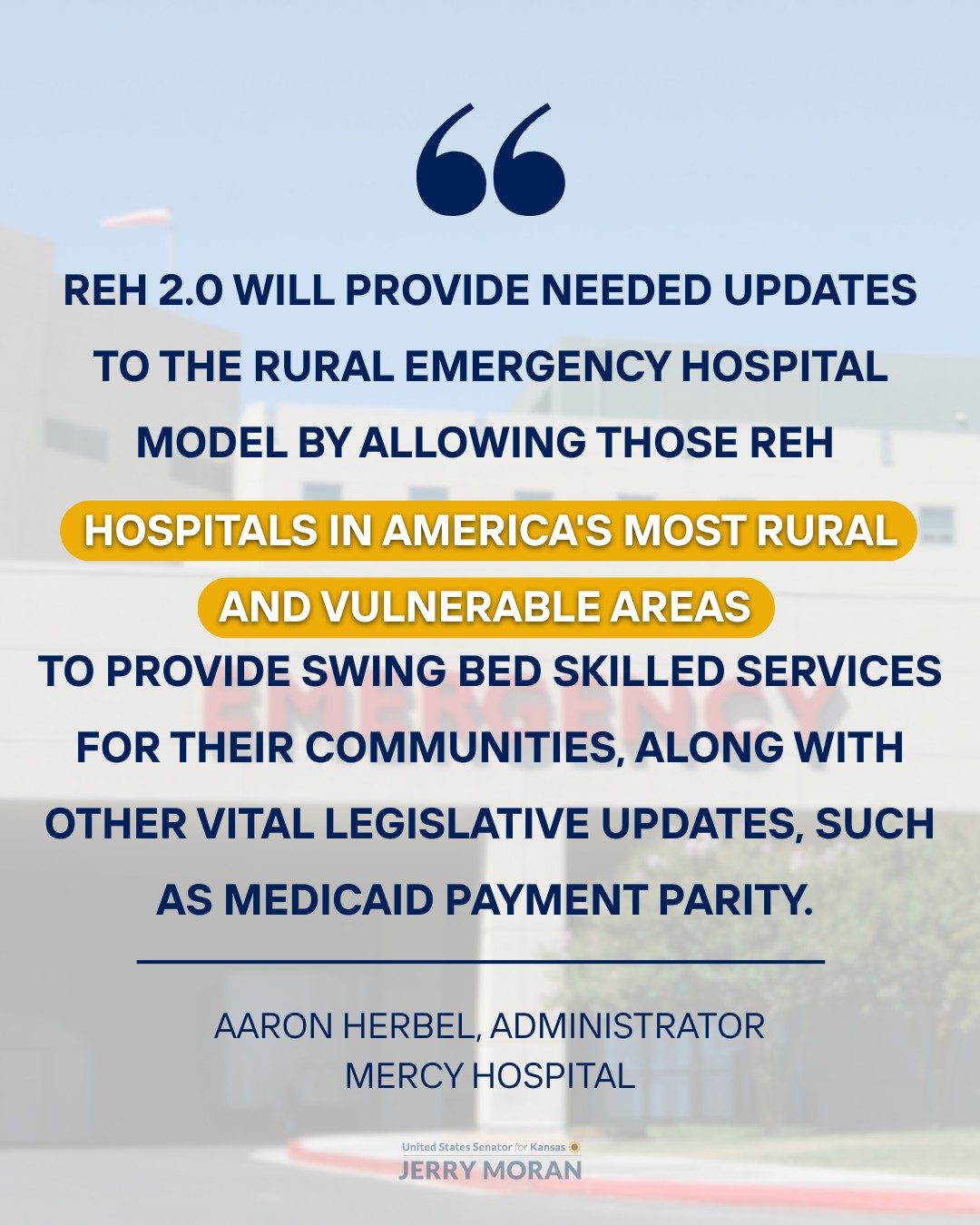
“REH 2.0 will provide needed updates to the Rural Emergency Hospital model by allowing those REH hospitals in America’s most rural and vulnerable areas to provide Swing Bed Skilled services for their communities, along with other vital legislative updates, such as Medicaid payment parity,” said Aaron Herbel, Administrator of Mercy Hospital. “Rural Emergency Hospitals across the U.S., including Mercy Hospital in Moundridge, Kansas, are grateful for the continued support that Senator Moran has showed by authoring this essential legislation.”
The REH Designation Improvement Act is also supported by the National Rural Health Association.
The provisions in the REH Designation Improvement Act are the result of numerous conversations Sen. Moran held with rural health care providers and CEOs of hospitals that are eligible for the REH designation. Originally created with the support of Sen. Moran as part of the Consolidated Appropriations Act of 2021, REH is a Medicare provider designation that offers certain rural hospitals the opportunity to convert and continue operating with limited services rather than closing.
The Rural Emergency Hospital Designation Improvement Act would:
Allow previously closed rural hospitals to re-open and apply for the Rural Emergency Hospital designation if they can demonstrate they met all eligibility requirements between Jan. 1, 2015, and Dec. 27, 2020.
Direct the Secretary of Health and Human Services (HHS) to create a waiver program for facilities operating similarly to an REH in order to convert to an REH.
Allow REH facilities to maintain or create a unit for inpatient psychiatric care, obstetric care and allow for limited inpatient rehabilitation services.
Require the Centers for Medicare & Medicaid Services to provide additional funding for laboratory services.
Clarify that REH facilities are eligible for Small Rural Hospital Improvement grants.
Direct the Secretary of HHS to allow an REH to be eligible as a National Health Service Corp site.
Authorize REH facilities to transfer patients from acute care to a Skilled Nursing Facility without leaving the hospital, in accordance with the Social Security Act.
Allow an REH facility to revert back to a Critical Access Hospital (CAH) to regain necessary provider status, only if the facility was designated a necessary provider prior to converting to REH.
Clarify state Medicaid agencies can pay REH facilities as hospitals.
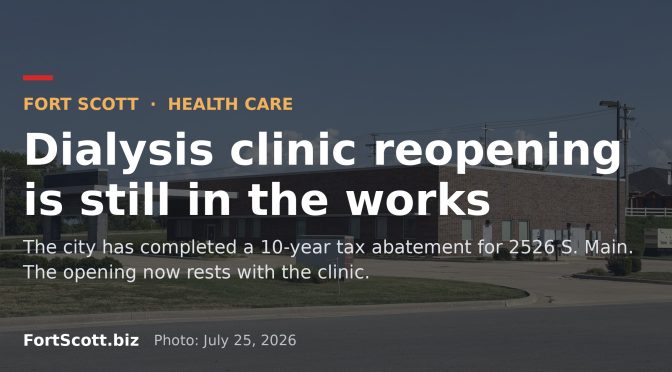
Late in 2025 the Fort Scott City Commission approved a property tax break of up to ten years for the vacant dialysis clinic at 2526 S. Main, to help a Joplin kidney specialist reopen it. Fort Scott has had no dialysis center since 2019. Patients drive to Pittsburg or Chanute, three times a week.
This week, FortScott.biz checked with those involved. City officials say their part is finished. The commission awarded the abatement, the bond paperwork is complete, and nothing more is pending at City Hall. The reopening is now in the hands of the physician who will run the clinic.
The building itself is quiet for now. A July 25 visit found no signage or activity yet, and county records show the property’s 2025 tax bill of $65,343.80 was paid in full. That fits the timeline in the city’s documents, which say the exemption cannot appear before the 2026 tax statement.
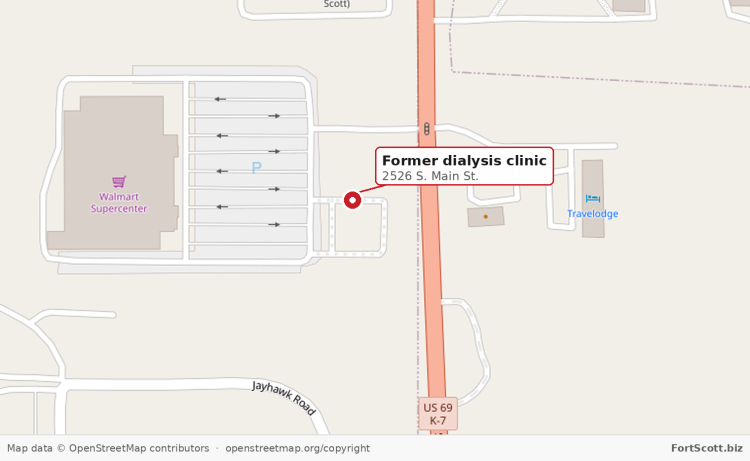
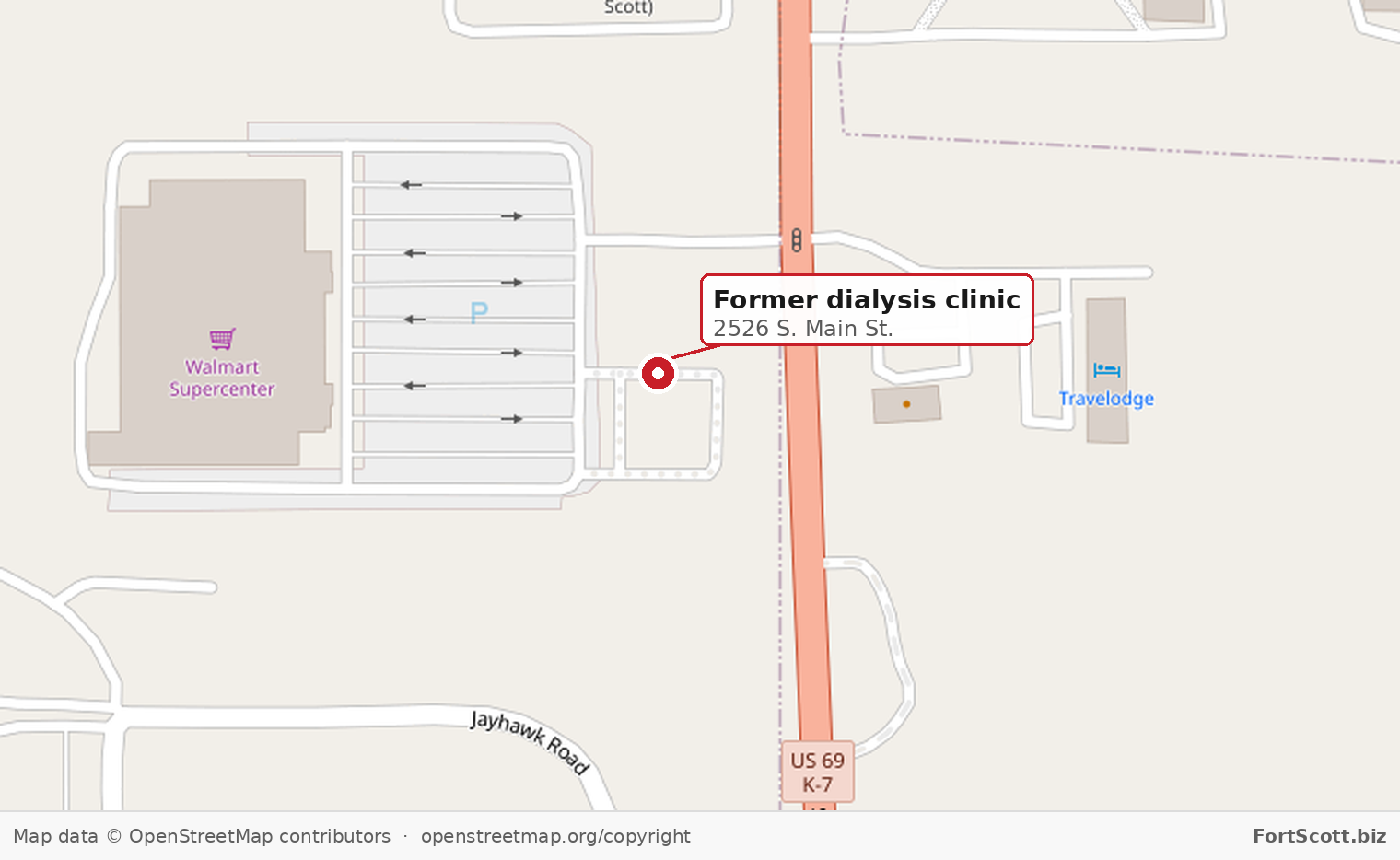
Where the building is
Most people know it as the low brick building in front of Walmart.
Bourbon County’s tax record for the parcel (tax ID 002-FS10762B, in the Wal-Mart Plaza Pointe subdivision) answers the abatement question directly.
The building did change hands. The county lists Moka Rentals LLC as the current owner and taxpayer of record. That is the company named in the city’s bond documents as the tenant. Before Moka, the record shows Phoenix Fort Scott LLC, and before that Wal-Mart Stores and Wellington Ft Scott Ltd.
The 2025 taxes were paid in full, with no exemption. For tax year 2025 the county appraised the property at $1,400,000 ($193,790 in land, $1,206,210 in building) for an assessed value of $350,001. At a mill levy of 186.696 that produced a bill of $65,343.80, paid on December 18, 2025.
Tax year
Owner of record
Assessed value
Total tax
2025
Moka Rentals LLC
$350,001
$65,343.80
2024
Phoenix Fort Scott LLC
$377,331
$72,397.38
2023
Phoenix Fort Scott LLC
$422,346
$80,914.32
2022
Phoenix Fort Scott LLC
$413,983
$79,080.28
2021
Phoenix Fort Scott LLC
$395,233
$78,653.34
2020
Phoenix Fort Scott LLC
$389,186
$77,981.20
2019
Phoenix Fort Scott LLC
$396,485
$80,160.54
So when does the abatement take effect? By the terms of the city’s own documents, the earliest it can apply is tax year 2026. Both the resolution and the ordinance say the exemption runs for ten years “commencing in the calendar year following the calendar year in which the Bonds are issued.” The draft bond documents date the bonds December 23, 2025. If they were issued on schedule, the first year the exemption could show up on a tax bill is 2026. Kansas tax statements for 2026 don’t go out until November.
That makes this November’s statement for 2526 S. Main the first place the exemption can appear in the public record.
The county’s appraisal record still lists the structure under its old name, “Fresenius Medical Care Dialysis,” a 7,992-square-foot medical office building put up in 2014.
The deal ran through taxable industrial revenue bonds. Despite the name, the city borrows nothing and owes nothing; it acts as a pass-through so a private project can reach two state-level tax breaks, a property-tax exemption and a sales-tax exemption on construction.
On November 18, 2025, after a public hearing, the commission voted 5-0 to move forward with Resolution 40-2025, declaring it advisable to issue about $800,000 in bonds to acquire, renovate, furnish and equip the building and lease it to Moka Rentals LLC (resolution; minutes).
Dr. Nadine Aboul-Magd, a kidney specialist with Joplin Nephrology Consultants who the minutes say served Fort Scott from 2015 to 2019, told the commission the abatement was essential to the project. The minutes record her saying the reopened clinic would employ at least seven people initially and would add two kidney physicians (minutes).
Steve Robb of Municipal Consulting LLC, who prepared the cost-benefit study Kansas requires before a city grants this kind of exemption, told commissioners the deal would return $9.67 for every dollar the city gave up, well above the 1.3 he called the cutoff for a worthwhile deal, mostly because a dialysis clinic uses a great deal of city water (minutes).
On December 16, 2025, the commission took up Ordinance No. 3792, which authorizes the bonds (ordinance). “There were no changes from what was discussed,” Mayor Tim Van Hoecke said as he introduced it (video, 2:07:39). A staff member called it “just procedural.” The commission voted and the mayor moved on. The city has not posted approved minutes for that meeting, so the exact tally is not on the public record.
Two details in the paperwork are worth knowing:
The break covers the bond-funded share of the property. The exemption applies only to the part of the property paid for with bond money, and it must be applied for. The one levy it cannot touch is the school district’s capital outlay levy, under the statute the resolution cites, K.S.A. 72-53,113 (resolution, § 4). For USD 234 that levy is 7.998 mills (about 4.3% of the 186.696 total on this parcel). Everything else can be abated, including Bourbon County’s share. This parcel sits in tax unit 002, which is made up of the state, Bourbon County, Fort Scott Community College, the city of Fort Scott, USD 234 and the Southwind Extension District (2025 Bourbon County levy sheet). The minutes record the city’s consultant telling commissioners that most taxing entities come out ahead, with minimal impact on the extension district and the community college (minutes).
The break is tied to actually running a dialysis center. The lease says that “[s]ubject to the Project being continually operated as a dialysis center,” the city will make the filings needed to keep the exemption alive for the full ten years (project lease, § 7.4).
What the city, the county and the doctor’s office said this week
On July 29, Mary Wyatt, Fort Scott’s Planning, Housing and Business Development Director, told FortScott.biz the city’s part of the deal is done. The commission voted to award the ten-year abatement, and the paperwork between the city’s bond counsel and the owner has been completed. “It’s all in the hands of the owner at this point,” she said. “The ball is just in their court to get their operations up and running.”
Wyatt said she had not heard from the owner recently. In their last conversation, she said, the owner told her that opening a dialysis clinic is a legally involved process, lining up physicians in particular, and that she wants to go about it carefully, given the building’s history of closing.
Bourbon County Appraiser Matt Quick confirmed that no exemption yet appears in county records. Once the remaining paperwork is complete, he said, the property goes into exempt status for ten years. Quick described the city as the lead on the bond arrangement.
Wyatt said the approval that mattered came from the city commission, because the city is the entity abating the taxes locally. The state’s remaining role, as she described it, is a document that “has to be acknowledged at the state level.”
Quick also sent FortScott.biz pages from the state Division of Property Valuation’s guide to these exemptions, which fills in the steps between the city’s vote and a smaller tax bill. After the bonds are issued, the applicant files an exemption application, called the IRBX form, with the county appraiser, who forwards it with comments to the Board of Tax Appeals. The exemption is deemed approved unless the board schedules a hearing within 30 days of receiving all the information. The break is not automatic once granted. The owner must file a claim with the county appraiser by March 1 each year of the ten; miss the filing, and the property goes back on the tax roll. Those filings square with what the city describes. Under the lease, keeping the exemption in place is tied to the building operating as a dialysis center.
At Joplin Nephrology Consultants, practice manager Heather said there are “no updates as of right now” on the Fort Scott clinic, which she described as Dr. Nadine’s project, and confirmed the reopening is still in the plans.
What the building looks like now
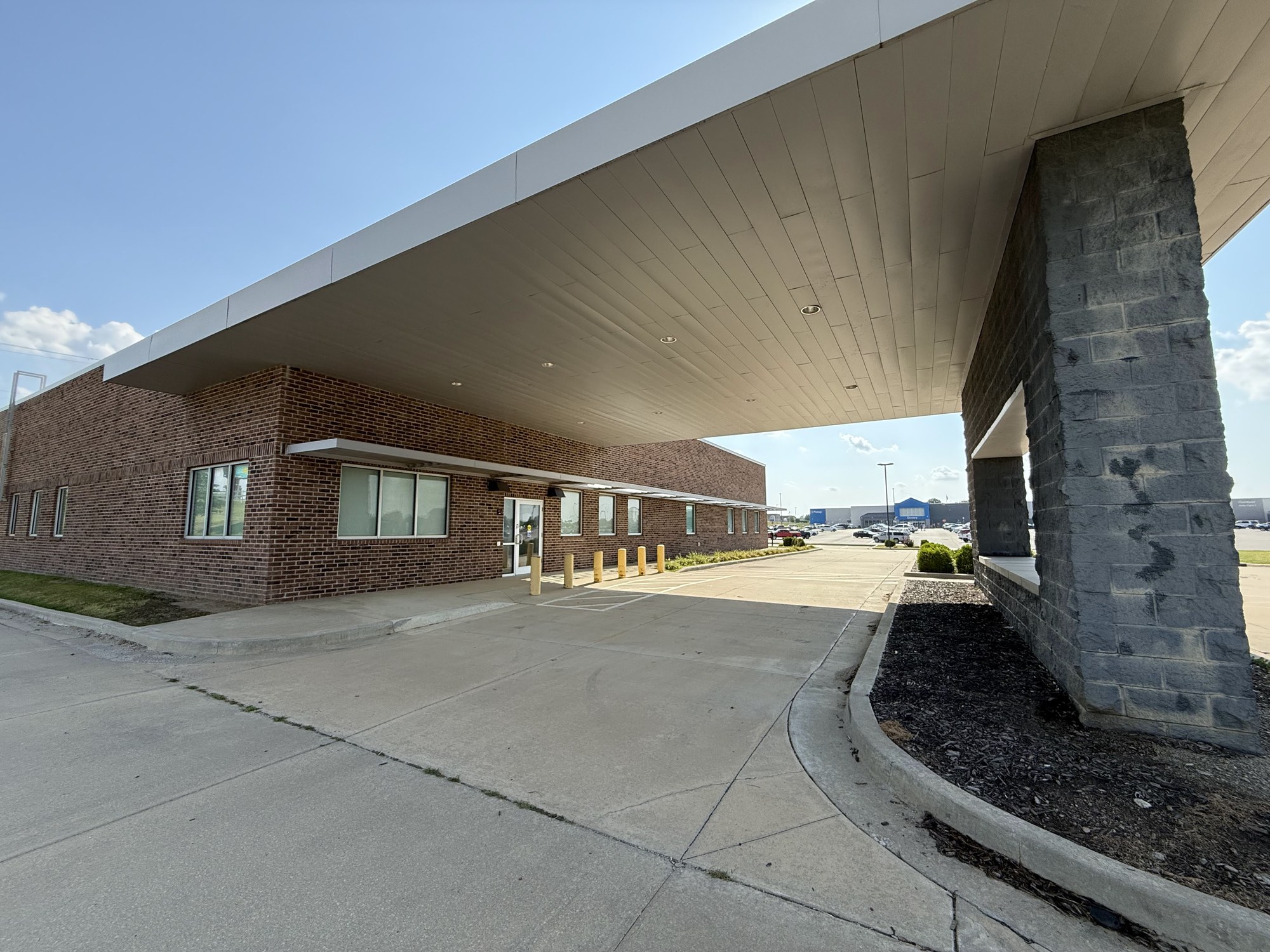
2526 S. Main on the afternoon of July 25, 2026. FortScott.biz photo.The covered patient drop-off at the entrance. There is no signage on the building. FortScott.biz photo, July 25, 2026.
The lot was empty on the afternoon of July 25. There is no signage on the building or at the street, the blinds are drawn, and the covered patient drop-off, the giveaway that the place was built as a clinic, sits unused.
Fort Scott has been losing health care since 2018. Mercy announced that October that it would close the hospital it had run in town since 1886 (FortScott.biz, Oct. 3, 2018). The dialysis center closed the following September. Fresenius did not publicly give a reason for the closure. “I have talked to Fresenius,” then-City Manager Dave Martin said at the time. “They haven’t made money to the point of, they can’t stay open” (FortScott.biz, Aug. 30, 2019). Ascension Via Christi closed the emergency department in December 2023 (FortScott.biz, Dec. 18, 2023). Freeman has been working toward a hospital and emergency department here (FortScott.biz, Jan. 8, 2025).
The building has been empty since Fresenius Medical Care closed it on Sept. 30, 2019. As late as May 2023, its owner at the time said it was still looking for a tenant (FortScott.biz, May 2, 2023).
If the project comes together, that vacancy — and the three-times-a-week drives to Pittsburg or Chanute — would end.
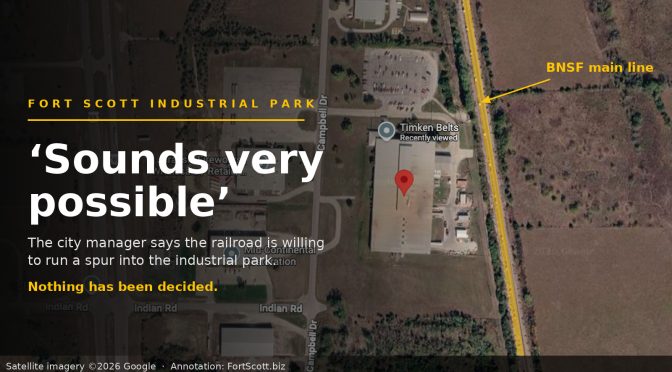
Fort Scott City Manager Brad Matkin told city commissioners on Tuesday, July 21, that he has finally found someone at the railroad willing to talk about running a rail spur into the city’s industrial park — and that the railroad is willing to bring one in.
Nothing has been agreed to, and nobody has voted on anything. But the report was the most concrete public word yet on infrastructure that would shape what kind of employers Fort Scott can try to attract.
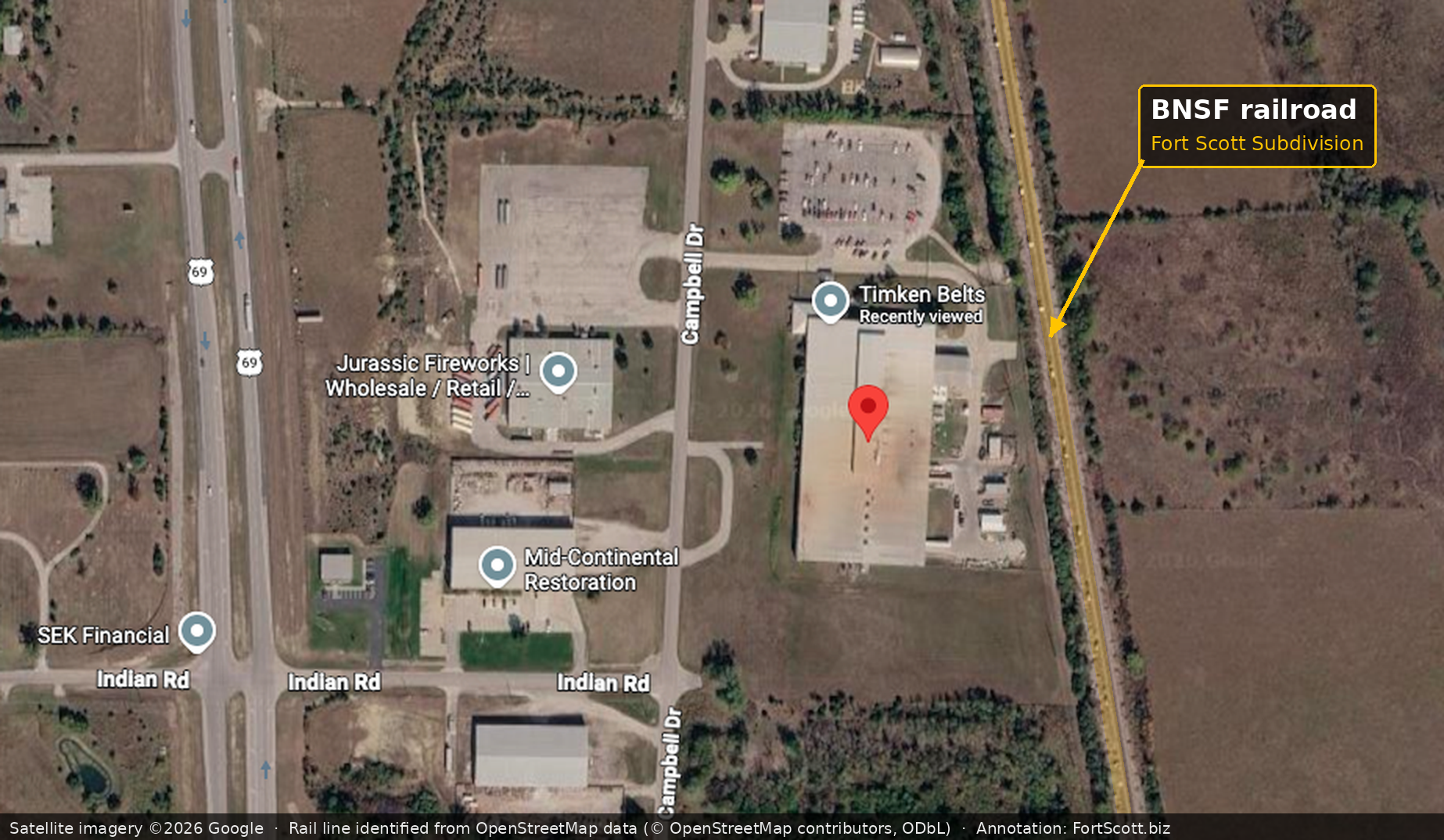
“I finally found somebody from the railroad that wants to talk, and it happens to be an economic development person for the railroad,” Matkin said. After a meeting the previous Friday, he said, “they are willing to bring a spur up right now up to the south of Timken, actually south of Valu.”
“It sounds very possible that we will be getting a railroad spur out to Industrial Park,” he said. “And manufacturing background can tell you how big that is.” He called it “huge for economic development in the future, because not that many industries have spurs going behind them.”
Matkin said they were meeting again that Friday and would “continue meeting until we get this thing ironed out.” He said the railroad “has been listening. They’ve been cooperative. They want the business, of course.”
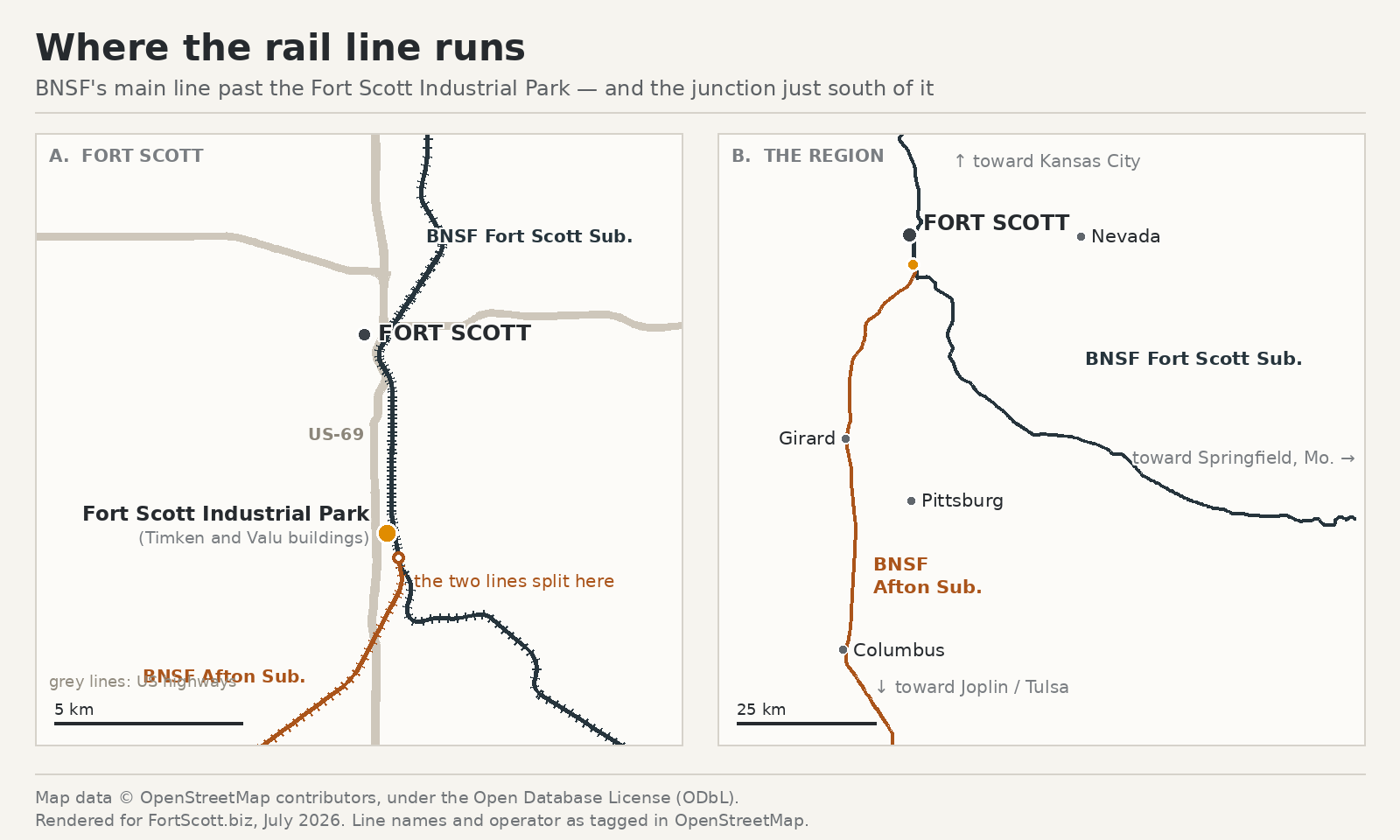
The railroad wants to tie the spur into a Columbus, Kansas, line rather than a Springfield, Missouri, line, Matkin said, adding that he could not explain the reasoning. Public rail maps show two BNSF lines meeting just south of the industrial park — one running southeast toward Springfield, the other southwest through Columbus.
Matkin’s own ask is that the track not stop short. Running it behind the Timken building, he said, would let more than one company use it: that “would give a runway through their parking lot that you could bring from other companies to that spur.”
That is the case for rail access. A spur ties a plant to the main line, and for a manufacturer that ships heavy or bulk freight, having or sharing one is often what decides whether a site gets a serious look. The company buying the Timken building has raised it with him directly, Matkin said: “They’ve been talking to me about the railroad spur. That’s very important to them.”
The Timken building is why the timing matters. Timken announced in November 2023 that it would wind down its belts plant at 4505 Campbell Road and close it in 2025; about 155 people worked there. On the city’s radio show on July 16, Matkin said “the Timken building is sold. The contract is signed and everything,” with the buyer’s name and line of business expected “later in the month or first of August,” pending paperwork and financing. He has not named the buyer.
Next door, Diversey, the cleaning-products company that said in May it would put a blending plant and warehouse in the former Valu Merchandisers building, is already at work on its building, Matkin said, coordinating with the city’s fire department and engineer on code. Both buildings had been sitting empty. “These are big companies that are coming in,” he said.
A second rail item came up the same night on a different project: Commissioner Matthew Wells asked about the study the city is running with Fontana and Spring Hill through the firm Wilson & Company. That one is about crossings rather than spurs. Fort Scott, Spring Hill and Fontana share a $2.15 million BNSF planning grant, of which $800,000 covers the Fort Scott end of the work; the city put up $40,000 to match it. The study is meant to determine whether Fort Scott needs an overpass, Jayhawk Road is the hoped-for location, and which existing crossing BNSF would want closed in exchange. Matkin said it is underway, with the city’s business development director, Mary Wyatt, leading it.
TOPEKA – (July 23, 2026) – Kansas Attorney General Kris W. Kobach today sent letters to the mayors of Lawrence, Roeland Park, and Prairie Village, calling on each city to immediately repeal its local ordinance banning so-called “conversion therapy,” including counseling that involves only speech.
The letters cite the U.S. Supreme Court’s recent ruling in Chiles v. Salazar, which struck down a nearly identical Colorado law as a violation of the First Amendment. The Court held that such bans improperly censor therapists’ speech based on viewpoint and that therapist speech is constitutionally protected.
“The First Amendment applies to everyone – therapists, patients and everyone else. A city violates the Constitution when it attempts to forbid a therapist from providing the counseling that the therapist believes is in the best interest of the patient,” Kobach said. “The government may not declare that some words and ideas are forbidden. And now the Supreme Court of the United States has squarely ruled on the subject.”
In the letter to Lawrence Mayor Brad Finkeldei, Attorney General Kobach wrote: “Lawrence’s ordinance seeks to control speech in a nearly identical way. … In other words, only one viewpoint is allowed to be expressed. Thus, the ordinance engages in viewpoint discrimination in violation of the First Amendment.”
The letters to Roeland Park and Prairie Village contain substantially similar analysis, noting that each city’s ordinance defines “conversion therapy” to include any counseling that fails to affirm a patient’s sexual orientation or gender identity. But it expressly permits counseling that supports identity exploration or gender transition—thereby allowing only one viewpoint to be expressed.
Attorney General Kobach requested that each city inform his office within 60 days whether the ordinance has been repealed. The letters were also copied to the respective city council members.