|
|
|
|
|
|
|
|
|
|
|
|
|
|
|
|
|
|
|
|
|
|
|
|
|
|
|
|
|
|

Kristin Lewis Gorman is the owner and director of Rock Ballet, a Fort Scott dance instruction studio.
Her dance instruction recital is at 7:30 p.m. on June 24 and 25 at the Bicknell Family Center for the Arts, on the campus of Pittsburg State University.

Gorman said the dancers are all getting very excited right about now.
She is as well, but last years recital is giving her confidence that this one too, will be a great performance for the dancers.
“Having one recital under my belt, I’m feeling a tiny bit less frantic at this point,” she said.
“Our dress rehearsal is Wednesday, June 22 and the shows will be Friday and Saturday, June 24 and 25 at 7:30 p.m.” she said.


“I would love to get our online- reserved seating- ticket link out there to everyone in Fort Scott because last year so many people told me after the fact that they hated that they didn’t even know about the show,” she said. “My fault totally, I just ran out of time.”
“It is super easy to purchase tickets using the link, as it is all done online through Tutu Tix,” she said.
Click below to purchase tickets for the event:
https://buy.tututix.com/rockballet

Her email is [email protected] and the website is therockballet.com
Her mission: “Building confident, graceful, dynamic dance-athletes from the ground up”
Click Here To Register For Dance Classes

|
||
|
|
||
|
|

This week’s Friday Night Concert will be presented by local musician Steve Fortenberry. The one-hour concert begins at 7 p.m. at the Heritage Park Pavilion at First and Main streets. Fortenberry plays light classical and Christian songs on guitar. Ralph Carlson will join him on guitar for the last half of the show
“Steve is an accomplished musician with unique guitar stylings, using special effects,” concert-series organizer Ralph Carlson said. “We are happy to welcome Steve back to the pavilion and we‘re looking forward to an enjoyable evening of great guitar music from him. Bring a friend and join us.”
The shows, sponsored by the Fort Scott Area Chamber of Commerce, are free and open to the public. Dave Oas and Jim Butler provide the sound each week. Due to limited seating, attendees are encouraged to bring lawn chairs.
In the event of inclement weather or excessive heat temps, the concert will be moved to the Loading Dock at Common Ground Coffee Co., 12 E. Wall Street.
Minutes are unapproved until the meeting.
CITY OF FORT SCOTT
CITY COMMISSION MEETING
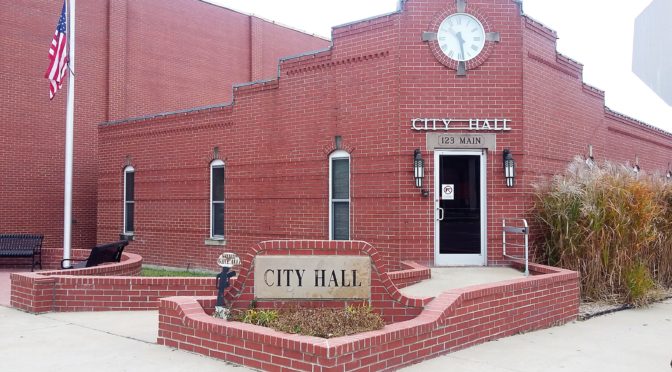
The regular meeting of the Fort Scott City Commission was held June 7th, 2022 at 6:00 p.m. in the City Commission Meeting Room at City Hall, 123 S. Main Street, Fort Scott, Kansas.
ROLL CALL:
Commissioners K. Harrington, T. Van Hoecke, S. Walker, and M. Wells were present with President J. Jones presiding.
INVOCATION: City Commissioner, Matthew Wells, said a prayer asking God for guidance for the City, our Government and City officials.
AUDIENCE IN ATTENDANCE: Travis Shelton, Jason Dickman, Brad Matkin, Jackson Tough, Kevin Allen, Megan Smith, Dallas Smith, Ann Rawlins, David Saker, Claudia Wheeler, Jody Hoener, Clayton Miller, Steve Anthony, Harold Martin, Rob Harrington, Emily Bolt, Tayton Majors, and representing the press Tammy Helm, Editor, Fort Scott Tribune.
PROCLAMATIONS/RECOGNITIONS: State Farm Insurance 100th Anniversary Proclamation – President Jones read a proclamation proclaiming June 7th, 2022 as State Farm Day in the City of Fort Scott. He called upon the residents of the City to observe this day by demonstrating what being a good neighbor is all about through acts of kindness and making people feel welcome.
Josh asked that Rob Harrington be added under Appearance.
Election of President of the City Commission – Josh said that the next item is to elect a President of the Commission.
City Attorney said that you can change your current ordinance. There is an ordinance to replace a Commissioner. The replacing of the President to the Mayor position has not come up since he has been City Attorney. He said they can change the ordinance however they wish.
Back to the previous motion to take nominations for Mayor at this time, roll call was taken with T. Van Hoecke, S. Walker, M. Wells, and K. Harrington voting aye. J. Jones abstained. Motion carried 4-1.
APPROVED TO TAKE NOMINATIONS FOR MAYOR.
APPOINTED KATIE HARRINGTON AS MAYOR.
APPOINTED MATTHEW WELLS AS THE LIASION OF THE LAKE ADVISORY BOARD.
APPOINTED TIM VAN HOECKE AS PRESIDENT OF THE CITY COMMISSION.
CONSENT AGENDA:
APPROVED CONSENT AGENDA WITH THE REMOVAL OF THE PAYMENT TO BOURBON COUNTY R.E.D.I.
Bourbon County R.E.D.I. Payment of $5,416.67:
APPROVED PAYMENT TO BOURBON COUNTY R.E.D.I. IN THE AMOUNT OF $5,416.67.
(Sign up required. Comments on any topic not on the agenda and limited to 5 minutes per person, at Commission discretion)
Ann Rawlins – Ms. Rawlins appeared before the Commission regarding the Old Fort Genealogical Society. She is the librarian. She has an exciting project regarding the Katy Railroad project. They had an exhibit in Texas, and they want to move it to Fort Scott. Documents to be housed are accounting records, maps, annual reports, etc. They need to be available to the public. Their museum will donate these items to a research library. They would like to take over the lower half of Memorial Hall for these items. She asked them to consider their putting Memorial Halls repairs on the front burner.
Steve Anthony – Mr. Anthony asked permission to use the tennis court lights at the Golf Course on July 30th for their Special Olympics tournament.
APPROVED TO ALLOW THE SPECIAL OLYMPICS TOURNAMENT TO USE THE TENNIS COURT LIGHTS AT THE GOLF COURSE FOR THEIR EVENT ON JULY 30TH, 2022.
Clayton Miller said that they want to make sure they are up to City codes on the property for the salvage yard.
City Manager said that we can get an ordinance in place also. It will take a little while to get this developed and started.
APPROVED TO MOVE FORWARD WITH AN IMPOUND YARD FOR THE CITY OF FORT SCOTT FOR CODES VEHICLES.
Dallas Smith – Wedding reception venue request – Dallas and Megan Smith appeared before the Commission to ask for the use of the Airport hangar for a wedding reception and for the City to waive the alcohol consumption on this property for this event on October 29th, 2022. This would be from 12:00 p.m. to 12:00 a.m.
APPROVED TO ALLOW DALLAS SMITH TO USE THE HANGAR AT THE FORT SCOTT MUNICIPAL AIRPORT FOR THE WEDDING RECEPTION ON OCTOBER 29TH, 2022 AND TO WAIVE THE ALCOHOL CONSUMPTION ON THE PROPERTY FOR THAT DATE.
Jody Hoener – Healthy Bourbon County Action Team – Consideration of Memorandum of Understanding – 3rd Street Park upgrades – Downtown Arch placemaking – Jody stated that in their packets is the Memorandum of Understanding. She had the City Attorney review it and he gave a suggestion or two which she included in the MOU. There is $70,000 in grant funds in the 3rd Street project and $70,000 in grant funds for the Downtown Arch project. She also asked for approval for the Pledge.
APPROVED THE MEMORANDUM OF UNDERSTANDING BETWEEN THE HEALTHY BOURBON COUNTY ACTION TEAM AND THE CITY OF FORT SCOTT TO OUTLINE THE IMPLEMENTATION OF THE 3RD STREET PARK PROJECT AND THE DOWNTOWN ARCH PROJECT AND THE PLEDGE.
Jody gave an update on the T-Mobile grant project also to the Commission. They are meeting with Fort Scott National Historic Site personnel on this project.
Lake Advisory Board Representative – Harold Martin, Lake Advisory Board member, informed the Commission that their Board met on June 4th, 2022, and they would like the City to wait two to three years before the sale of any additional Lake property. There were complications with the sale of the first four lots. The Lake Advisory Board would like a Comprehensive Plan established before the sale of any additional lake lots. Their Board voted that all boat licenses be shown on the actual vessels. All boat licenses expire on December 31st of each year. They should be displayed on the right side of the vessel. They asked for a change in this ordinance to reflect this.
Two recommendations were made at their meeting in May which remains unanswered. The Board recommended that legal counsel determine whether Lake Fort Scott falls under the State of Kansas Boating Regulations. Their board has not heard a reply.
City Attorney said that he and the City Manager discussed this. The Lake Patrol Officer always consults the State and complies with what they require.
Mr. Martin said that their other issue is regarding anchors and proper maintenance and protocol for the anchors and for the City to invest in what is needed. This should not be designated to the Lake Patrol Officer but a City employee. He asked for a status on this.
City Manager said that he would look into the cost of that.
Mr. Martin said that they are up now.
Rob Harrington – Rob introduced his new grant writer Emily Diebolt, and the new intern for Bourbon County R.E.D.I, Tayton Majors. They each stood up and gave a little of their background.
Rob said that he prepared a policy and procedures and handed the City Attorney a copy.
He said a year ago he stood before the Commission and addressed a couple of items on behalf of a couple of businesses. He addressed the road by Peerless and El Charro. The road needs to be repaired.
City Attorney is working on this issue to get easements on this road known as 25th Street. He has quit claim deeds from all property owners except for Peerless.
Rob will check with Peerless on this.
Rob also brought up the ditch in front of Niece Products and if the road is City or County property. There is a water issue there. The ditch needs cleaned out.
Shane said that the roads are the County, but the ditch is the City’s.
City Manager will check into this issue.
Public Hearings:
OPENED PUBLIC HEARING AT 7:06 P.M.
6:00 p.m. – Notice of Hearing of de-annexation of the property more commonly known as 2142 Jayhawk Road –
Katie asked if there was any public comment and there was none.
TABLED THE DE-ANNEXATION FOR 2142 JAYHAWK ROAD AT THIS TIME.
CLOSED PUBLIC HEARING AT 7:12 P.M.
New Business:
APPROVED K.D.O.T. GRANT FOR HORTON STREET IN THE AMOUNT OF $949.000.00.
approved Change Order #1 for Nowak Construction Co., Inc. for the Manhole 148 Project in the increased amount of $1,283.50.
Discussion was held on what is charged whether it is per hour or a percentage of time.
APPROVED THE MEMORANDUM OF UNDERSTANDING BETWEEN THE CITY AND BOURBON COUNTY FOR EMS.
Dave Saker said that he had Kevin Russell contact him about getting the rock from these demolitions. He will remove it himself as he has a big hole he is wanting to fill.
City Manager said that he didn’t see any reason why he couldn’t have it. It belongs to the contractor to dispose of.
Dave said that he will have all three structures removed within a five-day period.
APPROVED TO AWARD THE DEMOLITION FOR 731 S. HEYLMAN IN THE AMOUNT OF $1,100.00 TO DAVE’S DEMOLITION; 312 S. HEYLMAN IN THE AMOUNT OF $1,200.00 TO DAVE’S DEMOLITION; AND 1409 S. RANSOM IN THE AMOUNT OF $1,200.00 TO DAVE’S DEMOLITION.
Reports and Comments:
City Manager stated that he and the City Attorney are working on the Bourbon County R.E.D.I. and Tourism Ordinance update.
He stated that they are working on the Land Bank ordinance for mowing and well as preparing an ordinance for a separate fund for the Land Bank.
Josh said that his preference would be to move those funds to a Land Bank account so it can be tracked.
Rob said that there is a Land Bank meeting next week.
No action was taken on this item so it will be on the next agenda.
He stated that he is still looking for Memorial Hall plans.
Jason also updated on three other projects. He also discussed Wall Street. The Commission reminded him that they asked that an impact study be done for the businesses on Wall Street before the project proceeds further.
Chief Shelton said that it was handled in house by H.R.
Tim commended all those involved with Good Ol’ Days – from the Committee to all the City crews. He thanked all those involved with the parade and the vendors and the organizations that were on display. He thanked Jackson Tough and Lindsay Madison also. He thanked the citizens also for supporting this event.
Tim commended the Golf Course on the serving of food at the Golf Course now. This will be a great profit maker.
Matthew asked about the electric hookups in the downtown area and upgrading them.
Matthew asked about the Codes Department and the creation of a Standard Operating Procedure.
City Manager is working on this still.
Matthew asked about Smart Growth America and if the City is still on board with this program and their ideas. He said we need to address this.
Matthew asked about rewriting the boat license for the Lake residents. He also asked about the rewriting of the ordinance for replacement of Commissioners.
City Attorney said that there are only two options: leave it alone or pattern it after a couple of other ordinances.
Matthew asked for an update on the microphone system in the City Commission room so people can hear better.
Shane said that he is having issues getting proposals for it. He has a bid from one company.
Matthew asked if Jason Dickman can look at Niece and the water issue. He said that there are hydrants and signs with issues with tree and brush overgrowth. He said that one is in the City and the other two are in the County.
Jason will look into this issue.
Matthew asked about adding an extra Land Bank member.
Tim said that they are working with Rob Harrington on this issue. Their meeting is next week, and he doesn’t want to speak prematurely on this.
Shane asked if Jason and the City Manager had looked at 2nd and Judson.
Jason said that there are multiple items to be addressed at that location.
Josh stated that Pee Wee Button passed away. He served as a Firefighter for many years.
He thanked all the crews for their assistance in Good Ol’ Days.
Josh said that over $750.00 were sold in boat permits at Lake Fort Scott over Memorial Day weekend.
Josh asked Bob to look at Charter Ordinance No. 21 and if it still exists.
Adjournment:
ADJOURNED MEETING AT 8:12 P.M.
Respectfully submitted,
Lisa Lewis
Deputy City Clerk
NOTICE OF AND AGENDA FOR
MEETING OF
FORT SCOTT CITY COMMISSION
CITY HALL
CITY COMMISSION MEETING ROOM
123 SOUTH MAIN STREET
JUNE 21, 2022
6:00 P.M.
Building Inspection $ 497.00
City Engineer $4,120.00
Ft. Scott System Design $11,500.00
Cooper St Inspection $2,671.75
On Call Project Engineer $ 172.00
Manhole 148 Design $ 71.00
Total $19,031.75
(Sign up required. Comments on any topic not on agenda and limited to five (5) minutes per person, at Commission discretion)
Burke Street – 10th and Burke – July 4th, 2022 – Burke Street Celebration
Rob Harrington – Industrial Park Road Discussion
Lake Advisory Board
Street Crew Update
Bill Downey – Codes Update
(City Manager – Attorney/Client Privilege)
XII. Adjournment:

Yesterday, 6/16/22, the body of a deceased male individual was located in the northern end of Gunn Park, near the Marmaton River. The deceased is now presumed to be 40 year old, Derrick Wayne Johnson of Fort Scott.
Confirmation of identity as well as cause of death will be determined by an impending autopsy, which is scheduled for Sunday, June 19th, 2022.
This investigation is on-going. Official updates will be released as we are able.
Our thoughts and prayers are with the Johnson family.
Sergeant Bill Downey
Public Information Officer
|
|
|
|
|
|
|
|
|
|
|||||||
|
|
|
|
|
|
|
|
|
|
|
|
|
|
|
|
|
|
|
|
|
|
|
|
|
|
|
|
|
|
|
|
|
|
|
|
|
|
|
|
|
|
|
|
|
|
|
|
|
|
|
|
|
|
|
|
|
|
|
|
|
|
|
|
|
|
|
|
|
|
|
|
|
|
|
|
|
|
|
|
|
|
|
|
|
|
|
|
|
|
|
|
|
|
|
|
|
|
|
|
|
She sent this story to fortscott.biz, just completed, on Noble Health that is a contender corporation for reopening a hospital in Fort Scott, at the former Mercy site.
MEXICO, Mo. — When the new corporate owners of two rural hospitals suddenly announced they would stop admitting patients one Friday in March, Kayla Schudel, a nurse, stood resolute in the nearly empty lobby of Audrain Community Hospital: “You’ll be seen; the ER is open.”
The hospital — with 40 beds and five clinics — typically saw 24 to 50 emergency room cases a day, treating patients from the surrounding 1,000-plus acre farms and tiny no-stoplight towns, she said. She wouldn’t abandon them.
A week later Noble Health had the final word: It locked the doors.
Noble, a three-year-old startup that acquired Audrain and nearby Callaway Community Hospital, offered explanations on social media, including “a technology issue” and a need to “restructure their operations” to keep the hospitals financially viable.
The company should have had plentiful resources to keep them afloat: Noble was launched in late 2019 by Nueterra Capital, a venture capital and private equity firm that has raised millions of dollars to back dozens of health care companies, according to Nueterra’s portfolio and federal filings.
What’s more, in addition to Medicare and Medicaid funds, Noble had received nearly $20 million in federal covid relief money in the 18 months before it closed the hospitals — funds whose use is still not fully accounted for.
Private equity investors, with their focus on buying cheap and reaping quick returns, are moving voraciously into the U.S. health care system; investments increased twentyfold from 2000 to 2018, and have only accelerated since. Financially distressed rural hospitals like Audrain are targets, putting vulnerable communities at the mercy of firms whose North Star is profit, rather than patient health. A recent report found that 441, more than 20%, were at risk of closing or losing services.
The saga that followed Noble into these towns may well serve as a warning flare from the rolling wheat and corn fields between Kansas City and St. Louis.
Noble acquired the hospitals after charming local leaders desperate to save beloved local institutions. And federal regulators did nothing to block or thoroughly vet the acquisition, despite red flags.
Noble’s directors had little health care experience. The one who did was Donald R. Peterson, whose previous foray into the space, an infusion company, ended with charges of Medicare fraud. Just months later, he became one of two directors of Noble, along with Nueterra’s chairman, Daniel R. Tasset, according to a state filing.
In an emailed response to questions from KHN, Peterson said the startup was meant to do good: “We created Noble to save a rural hospital that was about to close.” Tasset could not be reached for comment.
Audrain had struggled before Noble came calling, said Dr. Joe Corrado, a longtime surgeon at the hospital: On an average day in 2019, 40% of beds were empty, as more treatments moved to the outpatient setting and some patients drove an hour to larger hospitals for specialty care.
Things grew worse rather than better under the new private equity owners, according to Corrado as well as state and federal documents, gained through months of public records requests, and dozens of interviews with community leaders, health officials, and residents.
Once Noble owned Callaway and Audrain, the hospitals stopped paying their bills, according to lawsuits filed by contract nurses, security guards, and others. Inspection reports from the state workers coordinating with the Centers for Medicare & Medicaid Services were alarming, listing 135 pages of deficiencies that put patients “at risk for their health and safety.”
Corrado saw his hospital being whittled away. Supplies for surgery disappeared, crucial medicines went unstocked, paychecks never came, he said. Just days before Noble suspended operations, he told management: “We don’t have the ability to do the things we need to take care of patients.”
When state health department surveyors arrived at the Callaway hospital in late summer 2021, only three patients remained, all in the geriatric psychiatry unit.
Inspectors reported they witnessed a suicidal 77-year-old stab her own leg with an ink pen, that an 85-year-old missed his medicine over the weekend because a pharmacist was unavailable, and that nurses waited five minutes to provide oxygen after surgery because the machine malfunctioned.
Ambar La Forgia, a Columbia University assistant professor who studies private equity in health care, said the business model, in general, is “all about creating short-term returns for shareholders.” The emphasis on profit, she said, is “not necessarily great for the patient.”
That, La Forgia said, raises hard questions for rural America: “Is a bad hospital better than no hospital?” And how should federal regulators who approve hospital purchases and monitor their performance thread that needle?
Hospitals Hollowed Out of Drugs, Supplies, and Salaries
Audrain was once a 247-bed regional destination for care, with more than 4,300 admissions in 1992, according to a county bond report. Internal medicine doctors, orthopedic surgeons, and pulmonologists competed to admit the most patients.
By 2019 it was a shadow of that former self. Yet patients like Dee Tate, diagnosed with cancer in 2020, relied on it. She got blood tests, scans, port placement, and chemotherapy to put her into remission — all at Audrain.
So she was shocked when her oncologist, Dr. Shahid Waheed, told Tate he couldn’t perform her scheduled infusion this January.
“If I don’t take this treatment, the likeliness of this kind of cancer coming back goes way, way up,” she said.
The medication, Rituxan, was not in short supply nationally. Noble could not stock it because the hospital purchasing department did not have the money for it, according to a former hospital employee who spoke on condition of anonymity. Ultimately, the person said, the staff bought it directly from the supplier.
Tate’s infusion was five weeks late. “It came from Indiana,” she recalled. Tate, along with about 500 other patients, now must travel at least 40 miles for cancer care.
In the operating suite, Corrado said he could never be sure supplies like anesthesia medicines, bandages, and catheters would be available for surgeries, from mastectomies to emergency appendectomies.
Management determined who would be paid on a week-by-week basis, he said: “On one Friday, they would pay the employees, and they couldn’t buy anything else. And another week they would be able to maybe buy supplies.”
Money troubles were not new to the hospitals. Despite federal subsidies, rural hospitals often struggle because their patients tend to be on Medicare or Medicaid or have no insurance, providing less revenue than commercial insurance.
The year before Noble bought Audrain, the hospital reported an $18 million loss for patient services on $44 million in patient revenue. The Callaway hospital had eked out a $170,000 profit from patient care while still owned and operated by Nueterra.
The next year, under Noble’s management, Callaway reported a nearly $6 million loss on patient services, its 2020 Medicare cost report showed. On paper, financial filings show, it had spent 43% more than the year before.
But much of the money was not spent on delivering health care, said Ge Bai, a professor of accounting at Johns Hopkins Carey Business School, who reviewed Callaway’s most recent Medicare cost reports for KHN. She noted that the hospital received millions in covid relief that it reported as miscellaneous income.
The hospital’s spending on laboratory, medical supplies, contract nursing, and care all increased, as is expected in a pandemic, Bai said. But she questioned other line-item cost increases.
For example, spending on the non-salaried employee benefits climbed 273%, to $1.4 million. Callaway’s 18-bed hospital nearly doubled its spending on administration, adding $1.1 million in fees paid to Nueterra subsidiaries NueHealth and Noble in 2020. The hospital also paid Noble a $38,000 lease in 2020, a statement filed with Callaway County showed.
“These dramatic increases raise a red flag,” Bai said. “To whom did the money go?”
Noble executives repeatedly declined requests for comment or interviews to clarify such questions. In late March, Noble spokesperson Nancy Mays said they did not have time to answer questions because they were “talking to potential buyers and figuring out how to best serve employees right now.”
A Sales Pitch Heavy on Charm
Audrain County officials were easy prey for investors. Noble was the only bidder for the failing hospital, said Lou Leonatti, the longtime local attorney, and many in Mexico, a town of 11,000 and the county seat, “believed we were saved.”
Dana Keller, the head of Mexico’s Chamber of Commerce who felt a hospital was essential to keeping business in town, said she set up meetings so Noble’s executives could “talk about their philosophy for rural health care.”
Leaders who called themselves “Progress Mexico” tried to evaluate the startup. “At the time we looked at it, Nueterra had an ownership interest, Don Peterson had an ownership interest, Drew Solomon, and Tom Carter,” Leonatti said.
But there was much they didn’t know or overlooked. None of Noble’s three founding owners had run a hospital or navigated its regulatory demands. Only Peterson — a serial entrepreneur who spent decades investing in workstation and information technology businesses — had worked briefly in health care, and that ended badly.
In 2012, he created IVXpress, now called IVX Health, with infusion centers in 10 states. Peterson left IVX in 2018 after a whistleblower accused him of altering claims, faking drug purchases, and paying a doctor kickbacks. Peterson settled the resulting Medicare fraud charges with the U.S. Health and Human Services’ Office of Inspector General without admitting wrongdoing.
Such OIG settlements are “in essence the federal government saying that we don’t trust you,” said Robert Salcido, an attorney who specializes in health care fraud.
Jeff Morris, Peterson’s attorney, said in a letter to KHN: Peterson’s five-year voluntary “exclusion applies to health care programs only, this precludes him from making any claim to funds allocated by federal health care programs for services — including administrative and management services — ordered, prescribed or furnished by Mr. Peterson.”
Morris said Peterson had been “diligent in complying with his exclusion,” which began Aug. 5, 2019. Peterson agreed to pay $334,800 in restitution. According to the terms, violating the agreement could bring criminal prosecution and as much as $4.5 million in penalties.
Within months of the settlement, Peterson signed Noble’s filing to register in Missouri as a director — as well as its secretary, vice president, and assistant treasurer. In April 2020, he ordered medical supplies for the Callaway hospital, according to a receipt obtained through a public records request.
Pandemic Relief and Unpaid Bills
As in much of rural America, the pandemic was slow to emerge in Callaway and Audrain counties, but covid-19 cases were climbing by fall 2020. The hospitals hired contract nurses for help and when possible transferred patients to larger, urban areas.
Callaway saw a surge in late 2020 and closed its general inpatient care in January 2021. Audrain, the larger hospital, dealt with a surge of daily cases in that span.
Noble pursued all forms of coronavirus-related funding. On its watch, Callaway and Audrain hospitals attested to receiving about $11 million in federal relief, which rolled out after the Coronavirus Aid, Relief, and Economic Security Act was enacted in March 2020. Noble’s hospitals also took in $4.8 million in loans from the federal Paycheck Protection Program that have been forgiven.
Hospital cost reports from 2020 indicate that the millions should have helped: Audrain’s health care staffing costs were $3.5 million, and Callaway’s were $562,000.
Noble also turned to state and local officials. Missouri distributed $1.1 million to Noble from its CARES funding, mostly to Callaway for covid testing.
Callaway County drew from two of its own federal allocations for the hospital. As of February, leaders had approved more than $14,000 for covid testing, funded by the American Rescue Plan Act. In addition, invoices provided through a public records request show that the county used CARES Act funding to pay Noble’s hospital nearly $364,000 for covid testing, operations, and marketing.
Noble sought Audrain County’s help last fall to pay contract nurses after pandemic costs soared. Its commissioners approved a one-year $1.8 million loan using ARPA money. The loan is due in September, at a 2.5% interest rate. If Noble defaults, the rate climbs to 5%.
Even as the hospitals looked flush with federal money, contractors were pulling out, according to lawsuits that allege more than $2 million in unpaid bills.
In one suit filed April 21, Moberly Anesthesia Associates said the Audrain hospital failed to pay nearly $214,000 for services provided.
Among other lawsuits:
Noble Health executives Carter and Solomon declined to comment on the lawsuits.
Nueterra Capital CEO Jeremy Tasset, the son of Daniel Tasset, said in a March email that “we are a minority investor in the real estate and have nothing to do with the operations of the hospitals.”
Callaway County records show Noble owes more than $72,000 in unpaid property taxes and penalties.
Audrain and Callaway counties’ records confirm that Noble kept hospital operations and real estate assets separate — a common move, experts said, from the private equity playbook, when profits are expected from property value rather than medicine.
Said Rosemary Batt, a management professor at Cornell University: “That’s a tipoff that they must be doing something to monetize the real estate to make money.”
Patients ‘At Risk for Their Health and Safety’
Eileen O’Grady, research manager at the nonprofit Private Equity Stakeholder Project, said private equity’s focus on strong, speedy returns makes it a risky business model for health care. “In rural hospitals,” O’Grady said, “there are very few ways” to boost revenue and cut expenses “without having an impact on patient care.”
Indeed, by late summer 2021, federal and state inspectors found alarming deficiencies at the Callaway hospital and gave Noble 23 days to fix them.
Noble took some corrective actions, so inspectors cleared the hospital to admit patients and receive funding. But it was not exactly a clean bill of health.
The September checklist of deficiencies spanned 16 pages, compared with 135 the month before. Some lapses, such as not staffing an overnight ER doctor, were unaddressed.
At the Audrain hospital, inspectors found “ineffective management.” Its electronic medical record system did not keep patient information. Its behavioral health staff did not retain records or footage of an alleged patient assault, and inspectors found long electrical cords next to beds, a risk for strangulation.
Meanwhile, the three men who ran Noble were shopping for more hospitals to buy.
Solomon and Carter pitched Noble’s services to officials in Fort Scott, Kansas, whose hospital had closed in 2018. City and county leaders on July 23, 2021, paid $1 million from their American Rescue Plan Act funds for Noble to study the feasibility of reopening. The money was paid to a new company Peterson founded in June, Access Medical Advisors.
Solomon, president of Noble’s real estate company, told the county in late March of an “incredible” finding from the study — Fort Scott’s hospital building was worth $19.6 million, which “could present the borrowing basis or the bonding basis for a really great viable community project to move forward.”
Solomon’s discovery came as Noble’s hospitals in Missouri remained closed, staffers looked for new jobs, and patients traveled even farther for care.
It came as Noble Health appeared to be unraveling. In late March and April, the Kansas City attorney who registered the company, its hospitals, its real estate entities, and Access Medical Advisors — Philip Krause — informed state officials he had resigned his positions with all of them.
Peterson’s LinkedIn page said he has retired from Noble Health. In March he incorporated a new company, Noble Health Services, based at his home address — a half-million-dollar brick colonial in a leafy Kansas City suburb. Its purpose: “healthcare administrative services.”
As for Noble’s failed hospitals, Texas-based Platinum Team Management executive Cory Countryman said it would buy and reopen them. “We have equity investors,” said his colleague Melissa Upshaw, as well as “traditional financing” and “a portfolio of our own.” Countryman does have recent health care experience: In 2017, as CEO, he abruptly shut down Walnut Hill hospital in Dallas.
KHN (Kaiser Health News) is a national newsroom that produces in-depth journalism about health issues. Together with Policy Analysis and Polling, KHN is one of the three major operating programs at KFF (Kaiser Family Foundation). KFF is an endowed nonprofit organization providing information on health issues to the nation.
Some elements may be removed from this article due to republishing restrictions. If you have questions about available photos or other content, please contact [email protected].
|

|
|
|
|
|
|
|