|
|
|
|

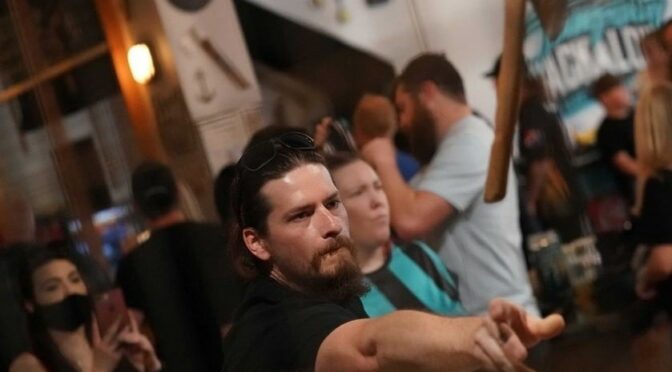
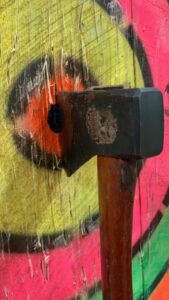
Mac Stoughton has a plan is to open an axe bar/ throw house, at 212 East First Street, behind Doctor Patterson’s office.
“As of now, we are planning to open around the end of June beginning of July,” he said. “We will have available two double lanes and four single lanes and also a knife lane.”
“We will be doing a weekly league that will consist of seven weeks of gameplay and on week eight, a tournament,” Stoughton said. “To see who has what it takes to be number one!”
“The leagues will consist of a standard hatchet, hatchet duals, big axe, and knife throwing,” he said.
“The cost will be $20 per person per hour, 12 and under $15 per hour per person,” he said. “I’ll have a group rate upon request and also private parties available.”
“Walk-in customers will be able to experience the zin of slinging steel and if you have never thrown…. no worries we can teach you,” Stoughton said.
“We have thrown with the best in the world,” he said. ” When you arrive at M’axe you get to pick a lane and we will coach you and get you started on how to throw.”
“We want to make everyone’s experience fun!” Stoughton said. “The sport of ax throwing goes way further than just the competition… this sport instills sportsmanship and is not just for the athletic or talented …. this sport is anyone’s and almost all ages.”
“If you can score high enough to rise to the top, you could have the opportunity to go to the ax-throwing U.S. open or the world finals (competitions). “I have been to 2020 world finals and the 2021 U.S. open, and man what an experience!”
” Axe throwing is new and it can be dangerous,” he said. “It’s part of the beauty of the sport. So… throw better!”
Chamber Grand Opening & Ribbon Cutting Announced for the Fort Scott Barber Shop
The Fort Scott Area Chamber of Commerce invites members and guests to a Grand Opening and Ribbon Cutting to celebrate the opening of Fort Scott Barber Shop in the Downtown Historic District at 118 E. Wall St. The event will take place Tuesday, May 25th at 9 a.m. with remarks starting at 9:15 a.m. followed by the cutting of the ribbon. Coffee, juice, and light refreshments will be served in addition to door prize drawings.
The family-friendly Fort Scott Barber Shop is owned and operated by the Montanez Family who recently relocated to the community from the Kansas City area where they operated Jose’s Barber Shop, winning multiple awards including Best Barber Shop in the Midwest. They are known for their iconic cuts and their motto is “Looking Like a Movie Star”.
Contact the Chamber of Commerce at (620) 223-3566 for more information.
***
|
|
|
|
|
|
|
|
|
|
|
|
|
|
|
|
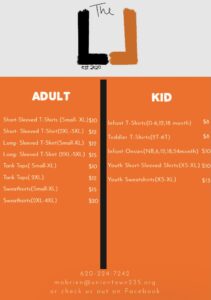
For the 2020-21 school year Uniontown High School participated in Project-Based Learning.
Project-Based Learning (PBL) is a teaching method in which students learn by actively engaging in real-world and personally meaningful projects, according to www.pblworks.org/what-is-pbl
Each UHS participating student chose a project that they presented to a board of teachers. The incentive: students got to opt-out of finals.
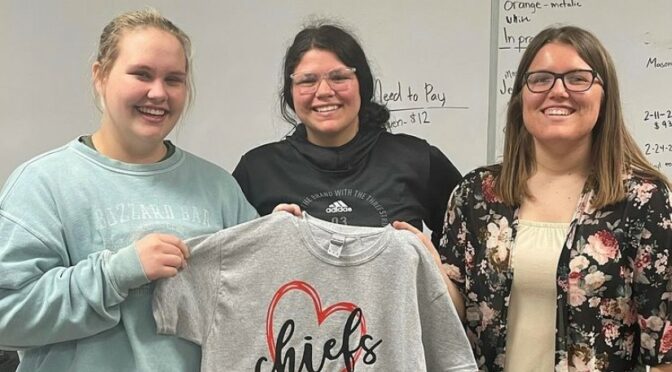
Uniontown High School Students Kristy Beene and Mason O’Brien, both juniors, decided to start a vinyl t-shirt business.
“They are custom-made shirts or a design that the customers choose,” Beene said.
“There was a lot of deciding that came with starting this business,” Beene said. “During the first semester of the 2020-21 school year, (we) decided that the best way to start this business was to fundraise the money in order to get the machines and supplies necessary.”
“We started this business in Mr. Feagins room, at UHS,” Beene said. “We chose him to…help us in the money and business itself.”
“One of the first orders of business was a name,” she said. “There were many names we considered but the one we chose was The U.”
“The first semester we raised the money needed through fundraisers and purchased a silhouette cameo and a heat press,”
Beene said. “By the end of the semester, we were starting to get up and going. At the start of the second semester, we added Skyler Coulter to our team as an extra hand for making shirts.”
Coulter is a sophomore.
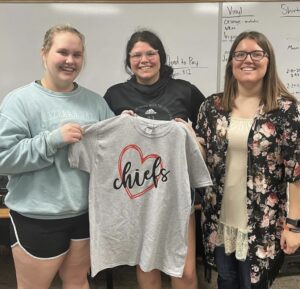
“We have been staying busy with everyone’s support for our small business,” she said. “We have been so happy that we are able to make products that our customers love!”
This student-led business will be set up at Good Ol’Days in Fort Scott making custom shirts and water bottles.
“We hope that this will be a good aspect for our business and help us grow, both with customers and knowledge of the business industry itself,” Beene said. “Next year we hope to expand even more and invest in a screen printing machine.”
|
|
|
|
|
|
|
|
|
|
|
|
|
|
|
|
PUBLIC INVITED TO LEARN MORE ABOUT THE BIG KANSAS ROAD TRIP
The Big Kansas Road Trip (BKRT) will be coming to Bourbon, Cherokee and Crawford Counties May 5-8, 2022. Marci Penner and WenDee Rowe of the Kansas Sampler Foundation will be leading meetings June 7-8 for anyone interested in learning how they might participate.
The BKRT operates as a tri-county open house and businesses, attractions and communities are invited to help the public get to know them “as they are.”
Marci and WenDee will conduct an hour-long meeting in each county to share some pictures to illustrate how the event works, to share some criteria, and to answer questions. Anyone in the three counties can attend any of the three meetings to learn more about the event.
The Bourbon County meeting will take place in Fort Scott on June 7 at 2 p.m. at the Common Ground Coffee Co. in the Loading Dock at 112 E. Wall.
The Cherokee County meeting will take place in Columbus on June 7 at 4:30 p.m. in the State Theater Event Center at 104 W. Pine.
The Crawford County meeting will take place in Pittsburg on June 8 at 9 a.m. in the Frisco Event Center at 210 E. 4th.
Your local contacts are Allyson Turvey and Rachel Pruitt in Bourbon County; Liz Simpson and Jake Letner in Cherokee County; and Devin Gorman and Chris Wilson in Crawford County.
To learn more about the BKRT go to www.bigkansasroadtrip.com.
###

CHAMBER-AFTER HOURS GRAND OPENING & RIBBON CUTTING TO CELEBRATE LYONS REALTY GROUP
Wednesday, June 2, 2021
5:15 to 6:30 p.m.
The Fort Scott Area Chamber of Commerce invites members to a Chamber After-hours Grand Opening & Ribbon Cutting as we celebrate the Lyons Realty Group establishing an office in the Downtown Historic District at 8 E. Wall St. The event will take place Wednesday, June 2nd from 5:15 to 6:30 pm with the remarks and ribbon-cutting starting at 5:45 pm.
The team of Lyons Realty Group is excited to share their new offices and learn more about how they can help reach the real estate goals of sellers and buyers.
Mark your calendars for an evening of networking, prize giveaways, food, drink and much more. There will be a $2 admission for the Chamber half-and-half drawing.
Contact the Fort Scott Area Chamber of Commerce for more information at 620-223-3566 or information@fortscott.com.

Nedra Barr started her insurance career at age 16 in Fort Scott, and this week announces that she is bringing her new business home.
“I started my insurance career in Fort Scott while in high school,” Barr said. “After a great career in the insurance industry, I started developing software that served this market. I’ve designed various software products serving this industry. It’s very exciting to develop the Spyder (her new company) product. It will help producers and home offices modernize, digitize, standardize and simplify their business.”
She is the Cheif Executive Officer of Spyder, Inc., and Sharon Ross, Charlotte, SC, is the Chief Operating Officer, with Bob Peacock, Denver, CO the Chief Technology Officer of the business.


“All three of us are software executives in the insuretech/fintech industry,” Barr said. “I am an award-winning software executive. I have won a Top 50 Tech Visionary award in 2019, a Top 50 Tech Leaders award in 2021, and last week named one of the most impactful women in technology,” she said.
See the feature of her award here: https://www.analyticsinsight.net/The-10-Most-Impactful-Women-in-Technology-2021-Volume-5/#page=1
“Once our offices are ready, I will be spending lots of time in Fort Scott as well Sharon and Bob,” Barr said.
The office is located at 102 W 2ndSt, Fort Scott, with hours of 8 a.m.-5 p.m. Contact Barr at 620-531-0368.
“The first two Spyder products will be released in June,” she said. “The first two products will be cybersecurity device certifications and a document storage solution that is purpose-built for the insurance industry. Additional products will be coming in the fall timeframe as well.”
Barr has led teams and guided technology firms for many companies, including SunGard Insurance Systems, Insurance Technologies, Experian, and Docupace Technologies. Most recently, Nedra was Chief Revenue Officer for Skience,
See the business website: www.spyderloop.com

” We are excited to get our software company going strong to contribute to the economic growth and employment of Fort Scott,” Barr said. ” We believe we will be hiring employees in the fall timeframe. We will work closely with the Healthy Bourbon County initiative and the Chamber of Commerce to contribute to the well-being and beautification of Fort Scott.”
|
|
|
|
|
|
|
|
|
|
|
|
|
|
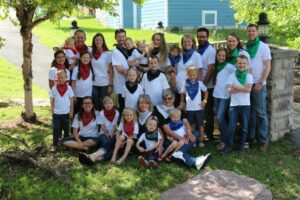
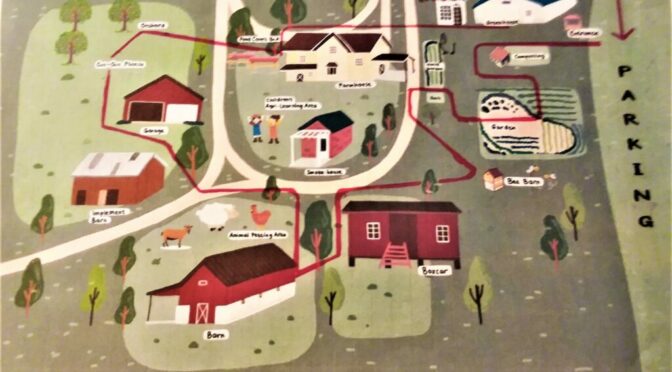
Larry and Vickie Shead are opening their farm next week for the community to view the organic homestead they have created.
All the Sheads will be helping on the day of the Organic Homestead Festival, including themselves, their adult children and their spouses, along with their 20 grandchildren.
The Organic Homestead Festival has several purposes.
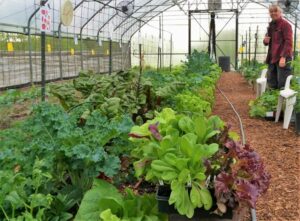
“To share our family farm’s story-touring the farm, which will be laced with the history….to show our gardens, orchards, high tunnel, animals, bees and others, to supply ideas and information from what we learned in 43 years, to stir up interest in sustainable organic lifestyle, to sell products: produce, plants, kittens and poultry, to serve lunch for hungry people, to strengthen the community with other like-minded people and to sign-up for future classes,” Vickie said.
The event is scheduled for Saturday, May 22 from 10 a.m. to 5 p.m. with single tickets-$5 or a family, $20.
A walking taco meal will be available for an additional $5.
To view a Shead YouTube on spring planting:
https://www.youtube.com/watch?v=1dk-j18Ox5Y
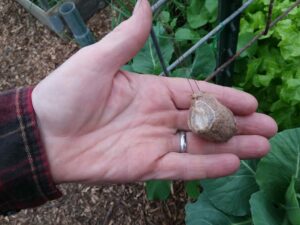
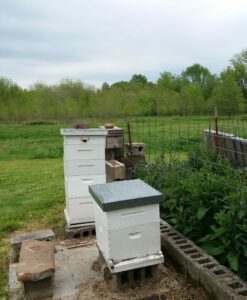
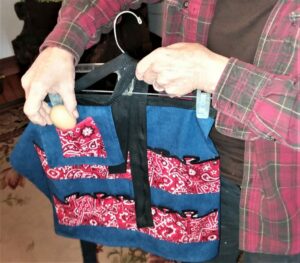
There will be a SheadStead Market Store with fresh produce picked that day, veggie powders-which add nutrients to any meal, Guatemala sun hats, egg-gathering aprons, and herbal salves.
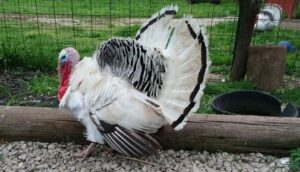
In addition, they will be selling some of their animals: peacocks, turkeys, chicks, ducklings, and kittens.

“We have always been a farm where people would come to learn and help,” she said. “Now, we have seen an increase in people asking us for information on how to grow their own organic fruits and vegetables.”
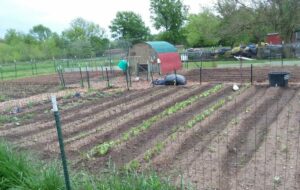
“Gardening and homestead-type living off the land are becoming very appealing to many because of the uncertainty of our future and the number of chemicals farmers are using,” Vickie said. “Many are asking if we will teach them…to plant, harvest and preserve, which includes canning, dehydrating, and freezing, as well as have one’s own meat and eggs.”
“There will be lots of fun for the whole family,” she said. “Questions and answers session on sustainable organic lifestyle..for adults.”
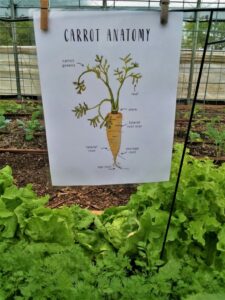
“In the children’s areas, they can…milk a cow and learn how to churn cream into butter, pet the animals in the petting yard, take pictures in photo cut-outs, hear a story about working on a farm, gather eggs…play educational games and meet Kernal Corn himself!” Vickie said.
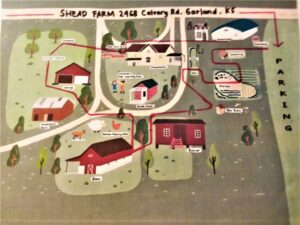
The Shead farm is located at 2468 Cavalry, Garland, south of Fort Scott.
For more information:http://sheadfarm.com or 620.224.4149.