Category Archives: Bourbon County

Emergency Food Assistance : April 29 for Western Bourbon County and May 1 for the Fort Scott Area

Uniontown Baptist Church is located on Hwy. 3  at the west edge of town. It is the site for emergency food distribution on April 29 for Uniontown, Redfield, and Bronson.

During this time of the pandemic when many have lost their jobs due to stay-at-home orders to slow the spread of the illness, the federal government has food coming to those in need.

Distribution points will be in Fort Scott for the Fort Scott area on May 1 and Uniontown , for western Bourbon County, April 29.

Frozen meats and fresh produce are part of the distribution, according to Rebecca Shinn, West Bourbon Food Program coordinator which is organized by the First Missionary Baptist Church.

” Anyone qualifies for Disaster Household Distribution (DHD) boxes however we highly encourage help to go to those families that might not otherwise qualify for TEFAP and who are affected by the COVID-19.”

The Emergency Food Assistance Program (TEFAP) is a federal program that helps supplement the diets of low-income Americans by providing them with emergency food assistance at no cost. USDA provides 100% American-grown USDA Foods and administrative funds to states to operate TEFAP, according to the TEFAP website.

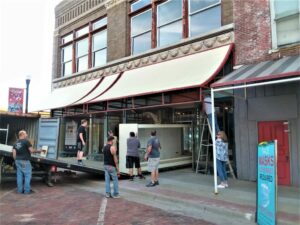
In Fort Scott, the disaster food distribution will be May 1 at the Bourbon County Senior Citizens Center, 26 N. Main.

Bourbon County Senior Citizens Center, 26 N. Main.

“It will be a drive-through,” Jackie Sellers, program coordinator said.  “From 10 a.m. to 4 p.m. people drive by on the north side of the building, Old Fort Boulevard (for the boxes of food).”

Sellers can be reached at 620-223-0750 or 620-249-1440.

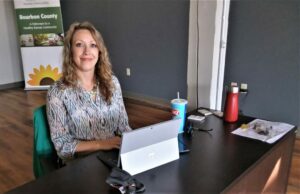
Jackie Sellers sits in her office at the Senior Citizens Center, 26 N. Main.

The Disaster Household Distribution will be on April 29, 2020, at the First Missionary Baptist Church from 4 p.m. – 6 p.m. This is for all people in the Uniontown, Redfield, Bronson area.

The church is located on Hwy. 3, on the west side of Uniontown.

“This program is to assist all that may not be working now due to COVID-19,” Shinn said. “Also for those who are high risk and can’t get to the store. At this time this program will be available April, May, and possibly June.”

Rebecca Shinn is the coordinator for the West Bourbon Food Program.

The program is offered curbside, she said.

” Honk and we will bring you a box of food. If you can’t come that evening and still want food please call me for another time for pick up,” Shinn said.  She can be reached at  (620) 223-9532.


Bourbon County Commission Minutes of April 14

April 14, 2020 Tuesday 9:00 am

The Bourbon County Commission met in open session via Facebook, the Commissioners, Shane Walker, the County Counselor and the County Clerk (via telephone) was all present for the meeting.

Lynne Oharah said that Josh Jones had volunteered to head a committee to try and get the 1% Sales Tax passed again by the voters. Jim Harris stated that in 1999-2000 a committee was formed and helped get this passed then. Nick made a motion to name Josh Jones to chair the Committee for the 1% Sales Tax for the hard surface road, Jeff seconded and all approved. Josh Jones will start this process immediately.

Nick Ruhl reported that a person had been hunting on their own land on 250th and was hit with bullets from another shooter on a nearby road, after review it was determined that the road belonged to the landowner and the landowner could put a gate and lock up to keep people off of the road; Jim Harris will contact the landowner.

Jeff Fischer asked Jim Harris to review who was responsible for the gravel road maintenance in an area in Drywood Township.

Jim Harris said they had started doing ditch work on the Lake Road. Jim said they hadn’t started work on Hackberry Road due to the water in the area.

Justin Meeks said that the March sales tax revenue was down. The income from the sales tax revenue will determine how much road work can be done. The Commissioners plan to do as much as they can afford. Jeff said in 2019 they paved 17 lane miles.

The County received hay bids for property the County owns on Native Road as well as Elm Creek Lake. Alex Bowman bid $2,800 and Mike Mason bid $1,800 for the mow able hay at Elm Creek Lake; Pat Murphy bid $161 for the mow able hay at 225th & Native Road. Nick made a motion to approve the bid from Pat Murphy for Native Road and Alex Bowman for Elm Creek Lake, Jeff seconded and all approved.

Jeff asked Jim Harris to review a device that is used to clean out culverts; Jim said he would.

Jim Harris said the County needed to get financing options from local banks as well as US Bank for the financing of the 2 new Mack Dump trucks that the County recently took possession of. He said the total purchase price for both was $291,538 less the $68,000 trade in for a total due of $223,538. Nick made a motion to get bids for financing the trucks for a five year note, Jeff seconded and all approved.

Jim Harris said they recently paid off the paver that was purchased two years ago.

Jim said the grader operators have been working; he said one grader is having mechanical issues.

Jim and the Commissioners discussed possibly closing the Landfill on some Saturdays to eliminate overtime; Jim said they could stager the employees at the Landfill to keep the Landfill open on Saturdays without causing overtime.

Jeff reported sharp rock on Fern Road near the Missouri line; Jeff asked Jim to do maintenance on the road.

Nick asked Jim how many keys were out for the Landfill gate; Jim said he didn’t think any since they had changed the lock, but said he would find out.

The Commissioners discussed the work structure due to the COVID-19 virus; Jim said he had issued two warnings to his employees and said they are keeping their employees separated. Lynne said some businesses are taking the temperatures (prior to work) of their employees due to the virus.

Appraiser Clint Anderson and Matt Quick met with the Commissioner regarding trading in their 2013 truck for one used SUV for the Appraiser’s office use. Clint felt that there was enough surplus money in the NRP fund to pay for a vehicle. They had quotes for two used Equinox’s and one Edge with a trade in difference of $6,900-$10,000. Nick suggested before trading in the truck that they consider using the truck for Road & Bridge or sell the truck to the City if they needed it, Matt suggested considering using the truck for the Courthouse custodial use. The Commissioners suggested that they get quotes for a new vehicle and shop locally if they can. The Commissioners decided to wait until after the 2019 audit is complete and review the remainder of 2020 funds to see what funds are available before deciding to purchase a vehicle.

The Commissioners rebid work to be done to the East steps and the South steps of the Courthouse; Mid Continental was the only bidder. They bid $87,505 for the base work and $2,600 for alternate work of the stone cleaning. Lynne made a motion to consider the bid after the 2019 audit is complete, Jeff seconded and all approved.

Economic Development Director Jody Hoener met with the Commissioners; she said that the Healthy Bourbon County Action Team is eligible for a $10,000 grant for the purchase of a mini dozer to be used for the county-wide trail use. She said this equipment could be carried under the County’s KCAMP insurance policy and under the County’s KWORCC work comp. insurance. She estimated the work comp insurance to cost approximately $55 for 100 volunteer hours. She said KWORCC required the volunteer hours be tracked and documented training for the equipment. Jody asked the Commissioners to approve the grant request. Lynne made a motion to apply for the grant for the mini dozer, Nick seconded and all approved and signed the application. Jody said the ABC Trails is now called the Prairie Pathways.

Lynne made a motion to approved Resolution 14-20; a salary resolution increasing the wages for the District Court Bailiff position #1, adding District Court Bailiff position #2 and adding a Personnel Director position, Jeff seconded and all approved the resolution.

Jody Hoener met with the Commissioners to discuss Bourbon County’s goal to facilitate an effective path forward and our work to build infrastructure needed to move from phase one to phase two of the COVID-19 pandemic reopening roadmap. Her presentation follows…

“March 14, 2020 Bourbon County Commission declared a state of disaster as a result of the coronavirus pandemic. Shortly after on March 26, 2020 the Southeast Kansas Multi County Health Department Officer issued an order to stay at home. Since that time there has been measurable progress at the county level, building a framework and preparing for when the Governor of Kansas tells Kansans we can reopen.
Bourbon County Commissioners realized the severity of the situation and acted swiftly in declaring an emergency existed. This resulted in opening doors to federal resources. Bourbon County Emergency Management has worked diligently to keep our frontline healthcare workers safe with the necessary personal protective equipment, PPE. Available relief has been communicated through Facebook, email, radio, webinars, and hosting teleconference meetings with state level government officials such as with David Toland our Secretary of Commerce. In three weeks, we have spoken to almost one hundred different businesses and organizations on a regular basis. At this time, we have reports of almost $4.6 million in relief to businesses awarded or applied for in our community.

Our community has responded to the crisis informed, safely, and appropriately. Our framework, the roadmap to facilitate an effective path forward to reopening, has likewise been informed by experts in their field, researched heavily to ensure safety, and appropriate needs have been identified. We do not have timeline, but we know what the triggers are to move to the next phase. Planning for each phase now should begin so the infrastructure is in place when it is time to transition. Phases are identified in the most well renowned plan called National Coronavirus Response: A Road Map to Recovery by the American Enterprise Institute.

The phase we are in right now is called “Slow the Spread.” Experts are saying to move on we must see a slowed rate of infection and our healthcare infrastructure must be scaled up to safely manage the outbreak and care for the sick. This includes using technology available to us, at its full potential, to keep our healthcare workforce, ambulance crews, and law enforcement officers safe.
The next phase is a State by State Reopening and will be determined by Governor Laura Kelly. However, we anticipate there will continue to be some physical distancing measures and limitations mandated on gathering to prevent another accelerated outbreak.

Phase three is when physical distancing restrictions can be lifted. We can reach this point when we are using technology to screen our vulnerable populations and essential workers and collect data regionally, statewide, and perhaps even nationwide. Of course, testing, once available, will be a key component. It is so important that it is worth repeating: Planning for each phase now should begin so the infrastructure is in place when it is time to transition.

The County team diligently on the needed infrastructure for when we are allowed to transition out of the current phase of slowing the spread to the next phase and beyond. For the last three weeks, we have been very intentional and strategic with our efforts with a goal to facilitate an effective path forward.

We have identified our needs in a one pager:

These include:
1. Rapid data collection of essential workers
2. Increase communication between public/private healthcare sectors
3. Improve patient communication
4. Promote a consistent message

We have articulated the required inputs to reach our goals in our Quad Chart.
These required inputs include:
1. Access to technology that can be used to tele-triage and screen our healthcare providers, the essential workforce, and the vulnerable populations. This allows for a more targeted approach to containing the COVID-19 Coronavirus.
2. Build many partnerships with experts and essential businesses such as: MRGlobal, Heart to Heart International, the healthcare sector, KDHE, public health, emergency management, nursing homes and assisted livings, law enforcement agencies, and major employers.
3. Funding through public/private relationships.
4. Equipment to keep frontline workers safe with needed PPE, a data base with software to support the self-reporting tele- screening, collection, entry and analysis of data taken during triage, testing, and recovery, and finally ensure our healthcare providers have increased testing capabilities.

There are two critical components that will be required for our community to move forward:
1. Screening and Data Collection
2. Testing and Test Kits

The Federal Government has yet to bring forth a plan. The most prominent plan widely used is the American Enterprise Institute’s Road Map to Reopening. This report calls for the need to screen and collect data on target populations. Like many chambers of commerce, cities, counties, and state governments, Bourbon County has created a roadmap and the framework to facilitate an effective path forward. “We have to have a starting point, and this is our starting point” Lynne Oharah. “This is a long-term process. Our team does an extraordinary amount of data mining and researching expert advice.”

Experts are telling us that to reopen society will require regular testing and a reliable, fast nationwide reporting network. One of the ways identified to contain the virus is to screen patients. Because the virus is so contagious even those who may have the virus need to be quarantined.

This roadmap has been our guide the last three weeks and we have made progress in our effort to facilitate an effective path forward by obtaining one of the key components. We have been working with Dr. Roger Harris, past Vice President of MRIGlobal, on an ongoing basis and through this relationship we have been able to gain access to a screening and data collection software, at no cost to the county, through Heart to Heart International and MRIGlobal. Both organizations are well regarded in their field and have relationships with the Department of Defense. They have experience in responding to pandemics like Ebola with the same type of technology. Dr. Norman himself, our Secretary of KDHE, remarked positively on the two company’s credibility and reputation.

One of the features of the platform is it provides a self-assessment and guides people where to go should they show symptoms of Coronavirus. An algorithm is used to manage key patients over time. We have had measurable conversations with Kansas Department of Health and Environment and Bourbon County Emergency Management. Randy Cason, President of Ascension Via Christi and Becky Johnson, Public Health Department Nurse have been engaged. Community Health Centers of Southeast Kansas, our primary health provider, has been a critical component in the response to the COVID-19 pandemic and will also be an essential partner moving forward. Our next steps will be to continue to reach out and engage our essential healthcare providers. The new technology should be built and available to our community in the next week.

All three commissioners voiced their full support of the plan in moving forward. “It’s an educational type of thing” stated Lynne Oharah, Bourbon County Commission Chair and COVID-19 Manager, “Educating the community on the plan. We need to move forward with this. Jody’s done a great job getting the framework in place and now we need to get all the players on board and get it out to the targeted groups.””

Jody will do a press release with the data. Jeff said once the COVID-19 is stabilized, the goal is to get people back to work. Lynne said the Emergency Preparedness director obtained P.P.E. for County and responder use. Lynne said tragically there has been one death in Bourbon County from the Corona Virus; he said the public will need to be educated to protect themselves from the virus.

Lynne made a motion to go into a 7 minute executive session for Personnel matters of individual non-elected personnel, Nick seconded and all approved, (the session included the Commissioners and Justin Meeks). No action was taken.

Lynne made a motion to go into a 30 minute executive session for Consultation with an attorney for the body or agency which would be deemed privileged in the attorney-client relationship, Nick seconded and all approved, (the session included the Commissioners and Justin Meeks). No action was taken.

Lynne made a motion to go into a 10 minute executive session for Consultation with an attorney for the body or agency which would be deemed privileged in the attorney-client relationship, Nick seconded and all approved, (the session included the Commissioners and Justin Meeks). No action was taken.

At noon, the Commissioners went to lunch and reconvened at 1:30.

Lynne made a motion to go into a 10 minute executive session for personnel matters of individual non-elected personnel, Nick seconded and all approved, (the session included the Commissioners and Bourbon County Attorney Jacqie Spradling). No action was taken.

Will Wallis met with the Commissioners regarding flood damage from April and July 2019. He is trying to complete necessary information by April 24th, for a reimbursement of $130,000 from KDEM for the damages. KDEM has requested but hasn’t received the data needed. Will said he needed to work with Jerad Heckman with Road & Bridge to identify areas (bridges, low water crossings) in the County that suffered damages due to the flooding. Will needs an estimate on the cost of repairs to bring the damaged areas/structures back to the pre-damaged state. Will suggested they review the grader operator maps to identify areas that are always a problem. Will needs to work with Road & Bridge to identify bridges, low water crossings and culverts (that were repaired or replaced) that received damage from the flooding. Will suggested getting input from the grader operators. Jeff will work with Krista with Road & Bridge to identify who worked to fix any flooding issues during the flood so that those worked hours can be charged to the disaster. Nick plans to work with Jim Harris and Jerad Heckman regarding what they need to do for Will.

Fort Scott City Commissioner Pete Allen phoned the Commissioners; Jeff said he had a discussion with Pete, he said Pete wants to promote an Interlocal agreement between the City and County to leverage the strengths, (possibly in gravel, asphalt, HR duties, economic development & municipal court). Lynne said a City Commissioner had also called him, Lynne suggested having the discussion in a different environment. Pete Allen is going to schedule a meeting with an agenda with Lynne and one other City Commissioner to discuss opportunities for integration. There will then be an open meeting scheduled to discuss it further.

Nick made a motion to go into a 10 minute executive session for personnel matters of individual non-elected personnel, Jeff seconded and all approved, (the session included the Commissioners, Justin Meeks and Shane Walker). After the session, Lynne made a motion to put out for bids for all Bourbon County property, (excluding the Law Enforcement Center) an annual bid from contractors for an hourly rate to do any maintenance or installations on heating/air conditioning, plumbing and electrical, the bids will be due May 1st, 2020, Nick seconded and all approved.

Jeff made a motion to give Lynne the authority to make any decisions regarding the HVAC controls and operations at the Law Enforcement Center, Nick seconded and all approved.

The Commissioners approved a Real Property Relief Application for Max & Mary Barbara Fanning.

The Commissioners will not have a regularly scheduled meeting on April 21st, 2020. They will meet again on April 28th, 2020.

At 2:56, Nick made a motion to adjourn, Jeff seconded and all approved.

THE BOARD OF COMMISSIONERS
OF BOURBON COUNTY, KANSAS
(ss) Lynne Oharah, Chairman
(ss) Jeff Fischer, Commissioner
(ss) Nick Ruhl, Commissioner
ATTEST:
Kendell Mason, Bourbon County Clerk
April 28, 2020, Approved Date

Bourbon County Commission Agenda April 28

Agenda

Bourbon County Commission Room

1st Floor, County Courthouse

210 S. National Avenue

Fort Scott, KS 66701

Tuesdays starting at 9:00

Date: April 28, 2020

1st District-Lynne Oharah Minutes: Approved: _______________

2nd District-Jeff Fischer Corrected: _______________

3rd District-Nick Ruhl Adjourned at: _______________

County Clerk-Kendell Mason

9:00 – 9:30 Jim Harris

9:30 – 10:00 Financing bids for dump trucks

10:00 – 10:15 Commission to open fish food bids for Elm Creek Lake

10:15 – 10:30 Commissioners to open bids for title work for tax sale

10:45 – 11:00 Rachel Pruitt, Airport Runway Expansion

11:00 – 11:45 Jeff Fischer, MRI Global

11:45 – 12:00 Executive Session – Personnel matters of individual non-elected personnel

12:00 – 1:30 Lunch

To view the COVID-19 Surveillance,Diagnostic Testing and Population Monitoring Proposal and Project Agreement, click, below:


Agenda for Commission Meeting on Tuesday, April 28, 2020 (COVID-19 Surveillance, Diagnostic Testing and Population Monitoring

Maintaining Social Connections

Barbara Stockebrand. K-State Extension Agent.


I’m not the best one to start talking about technology. Believe me, I am learning with everyone new ways to communicate and reach others at a distance through technology. Covid-19 has forced us to learn new communication strategies.

Some of our older adults may have felt some sort of isolation prior to the social distancing recommendations we have received lately. Living in rural areas can contribute to isolation. Others of us may enjoy that extra space. However, when family, friends, and neighbors pass on or move away, those feelings of isolation can be amplified for those feeling left behind.

Let’s look at some ways that we might use the time we have with this stay-at-home order to keep connected and strengthen distance relationships.

Start using or learn new technology. If we have a smartphone, a computer, or an iPad, we might already have access to some video technology, such as Skype, Zoom, or Facetime. A live video conversation is the next best thing to being there in person. If you’re like me, you may need the assistance of someone from a younger generation to talk you through the steps of doing the process, but after a time or two of doing it, you’ll get the hang of it. It can be very rewarding to connect through a video conversation.

If technology isn’t your thing, then pick up the phone and catch up the old-fashioned way. A quick text or email are great ways to stay in touch between conversations.

Engage Family and Friends. Encourage members of your social group, faith group, or volunteer group to support each other or reach out to those who are socially isolated. Just a quick check-in with them can mean a lot. Involve kids by having them create artwork that can be shared with grandparents, older neighbors, or other isolated individuals you may know. You never know how important it may be to someone to know that they were thought of that day.

If you want to step it up a notch, consider hosting a digital dinner with family or friends. Everyone joins online from their respective homes and eats together with family discussions. Some of our best discussions take place over the dinner table.

If you don’t relish the idea of watching each other eat, try playing games over video or read books to young ones. To encourage staying active, create an online exercise group where all meet at the same time by a video process. Research shows we are more accountable to our exercise program when we exercise as a group rather than individually.

Quality relationships that have developed with close family, friends, and neighbors help provide ongoing joy, excitement, support, and purpose. Maintaining meaningful relationships take a conscious effort. While we may not be able to carry on some of those relationships in person, now, more than ever, it’s important to follow through in sustaining those connections.

Whatever you do, check in on the well-being of family and neighbors who are more isolated at this time. Hopefully, they are sticking close to home as directed. A check-in call or running a quick errand for them could be what it takes to lift spirits right now.

For more information on overcoming feelings of isolation, contact the Yates Center Southwind Extension District Office at 620-625-8620.

SEK Multi-County Health Department Update April 23

SEK Multi-County Health Departments

Allen, Anderson, Bourbon, and Woodson Counties

Coronavirus (COVID-19) Update

April 23, 2020

Allen County

Current Positive Cases 0
Current Recovered Cases 0
Total Positives Since Testing 0
Deaths 0

Anderson County

Current Positive Cases 0
Current Recovered Cases 0
Total Positives Since Testing 0
Deaths 0

Bourbon County

Current Positive Cases 0
Current Recovered Cases 5
Total Positives Since Testing 6
Deaths 1

Woodson County

Current Positive Cases 1
Current Recovered Cases 4
Total Positives Since Testing 5
Deaths 0

Recovered cases are based on dates of onset of symptoms, not on day testing results are received.

Total positive counts changed in Bourbon and Woodson, because one case was living in Bourbon County, but a resident of Woodson County. This person has recovered and was listed as so last week.

Teaching Young Children During the Pandemic: A Teachers Viewpoint

Lauren Walker, a student in Mrs. Gauthier’s kindergarten class, works on an experiment at home. Submitted photos.


Uniontown’s school district began a continuous learning plan to allow students to learn from home during the nationwide closure of schools, due to the COVID 19 pandemic.

Last week, a parent’s story of how the learning plan was working was published on FortScott.Biz.

This feature is from a teacher’s view.

Rose Gauthier teaches kindergarten at West Bourbon Elementary School.

A.J. Vincent looks at her science experiment, following a lesson from WBE Kindergarten Teacher Rose Gauthier. Submitted photos.

Following is an interview by email from Gauthier.

When did the USD235 Continuous Learning Plan begin?

“We began Thursday, April 2nd with a practice run with the parents and students to work out kinks. We started our remote learning officially on Monday, April 6th. We will finish on Tuesday, May 19th.”

How much daily planning do you have for the classes?

“A lot. A teacher’s job has never been a 9:00 to 5:00 job, but even more so with this new way of teaching. It is hard to put a certain time frame on all the work the teachers, administration, and staff have put into it. From getting devices into student’s hands, the tech department working out tech issues for teachers and parents, and teachers creating different ways to teach their students with this new way of learning.”

Did you get together as a group of teachers and decide what the most important things to teach are?

“Yes. The school began with many “Zoom” meetings that included administration and teachers, with guidance from KSDE, to determine the best way to reach the kids.”

(Zoom provides users with a cloud (internet) platform for video and audio conferencing, collaboration, chat, and webinars across mobile devices, desktops, telephones, and room systems, according to the Zoom website).

“I create a meeting on Zoom and send the parents an invite.,” she said. “The students click on a link and have a password to log in.”

Rose Gauthier’s kindergarten class can view each other during lesson time. Submitted photo. Gauthier is shown on the top row, second from left.

“Our focus, as for many schools, is primarily the social and emotional spirit of the kids. This is a difficult and confusing time for them and many of the kids do not understand what is going on, especially at the primary levels. Letting them know that we are here for them, we miss and love them. Academically we are focusing on maintaining what the kids have already learned and limited new material to the essential outcomes that were agreed upon as a team”

Do you teach from home or do you go to school?

Both, the less I need from my classroom the more I teach from home. I go in once or twice a week.”

Have you seen any good come out of this difficult situation of not having the students in a classroom?

“Out of every bad situation, something good always comes out of it. Nothing will replace the social and emotional aspects of being together in the learning environment. The hugs, the high fives, being right beside them to guide them in their learning.”

“This situation has given us the appreciation of each other, the parents an opportunity to be a bigger part of the learning experience, and for all of us to step back and remember what is really important in life. And mostly, we get reminded of what a great community we have. We couldn’t do this without the support of great parents.”

What are some of the challenges?

“The biggest challenge is not seeing the kids every day. Adjusting to remote learning and tech issues are some other challenges, which gets easier as we go along. Also, reaching those kids without internet access is a challenge.”

How do you grade the kindergartners in this new plan?

“In Kindergarten we don’t give a traditional letter grade. We use checklists to provide feedback to parents about where the students are academically. During this time, we will still focus on those checklist skills while understanding that we will need to be prepared to provide the needed remediation to students at the beginning of the 2020-21 school year.”


“The district has worked together to provide a similar learning experience for all students, but obviously this looks slightly different based on the grade, content, teaching style, etc.”

Outdoor art by Kinnis Shepard, from Rose Gauthier’s kindergarten class. Submitted photos.

Gardens Can Provide Some Food Security

Krista Harding
District Extension Agent, Horticulture
Southwind Extension District
111 S. Butler
Erie, KS 66733
Office: 620-244-3826
Cell: 620-496-8786


Just like many of you, I’m having difficulty wrapping my mind around how quickly our lives have changed in a very short period of time. Seeing the panic and chaos that’s happening around us can be concerning. Now more than ever, it might be the time for folks to think about becoming more self-sufficient and grow some of their own food.

I have been in contact with a couple of our local suppliers and have seen social media posts that they are stocked with garden seed and supplies. Like many other local retailers, I know they are willing to work with you if you do not feel comfortable going inside the business. Just give them a call and arrange for outside pick-up.

If you are reading this and thinking to yourself that you have never grown anything in your life and just don’t think it’s possible, let me assure you that it is possible. Even for the most novice! You might be thinking that you don’t have space for a garden, or maybe you don’t have a tiller or other equipment. Don’t let that stop you because almost all vegetables can be grown in containers.

The containers don’t have to be anything fancy. Literally, anything that can hold soil and have drain holes drilled in the bottom can be used. Containers that are 16 to 24 inches in diameter work well. Containers less that 12 inches are probably too small – except for lettuces. The most important component of growing vegetables in a container is getting the right potting media. Potting mixes are ideal (instead of soil from your yard). The components are lightweight and hold water and oxygen much better. Make certain that you don’t forget to drill some drainage holes into the bottom of the container.

Fertilizer should be added at planting time and mixed into the soil. If you want to go the organic route, mix blood meal or bone meal into the soil before planting. If you use a synthetic fertilizer, add a slow-release type when preparing the container.

Another benefit to growing vegetables in containers – you don’t have to fight the weather quite as much. Right now, traditional garden soils are way too wet to even think about planting. But with the container system, you can keep them dry inside a garage until you are ready to plant.

Early spring is the ideal time to plant cool season vegetables such as lettuce, spinach, radish, onions, carrots and potatoes. All can be easily grown in containers, even potatoes!

Gardening is a great stress reliever. It also allows for good social distancing. If you have kids at home, gardening is the perfect activity to get them outside to enjoy some fresh air and sunshine, all while learning at the same time!

Here’s where I come in. I have lots of resource material to help you. In addition, I’m always available by phone, e-mail or social media to answer your questions. Don’t be afraid to ask! In Extension, we say there are no “dumb” questions! I am here to help you in any way that I can. The Extension mission continues. We are committed to being innovative to connect you with research-based resources and education. We appreciate your patience as we all navigate the challenges associated with this time. 

Krista Harding is a K-State Research and Extension Agricultural agent assigned to Southwind District.  She may be reached at [email protected] or 620-244-3826.

K-State Research and Extension is an equal opportunity provider and employer.

Kansas COVID 19 Update April 20

Bourbon County has six cases.

Corrected:

“The reason the number of cases went from 7 to 6 is because one of the positive cases was living in Bourbon County, but was actually a resident of Woodson County, KS. So, now Woodson County has 5, where they had 4 cases,” according to Rebecca Johnson, administrator of Southeast Kansas Multi-County Health Department.


https://www.coronavirus.kdheks.gov/DocumentCenter/View/912/4-20-20-update-numbers

The Census Is Important For Future Funding And More

“The census affects many aspects of funding, legislative apportionment, and our official population count for the next 10 years ~ it’s important to get as many people to respond as possible,” Lindsay Madison, Fort Scott Chamber of Commerce Executive Director said.   “Your help is appreciated!”
Lindsay Madison is the Fort Scott Chamber of Commerce Executive Director.

Why participate in completing the census?

According to the census website: https://www.census.gov/programs-surveys/decennial-census/2020-census/about/why.html

Here are the reasons:

Federal funds, grants and support to states, counties and communities are based on population totals and breakdowns by sex, age, race and other factors. Your community benefits the most when the census counts everyone. When you respond to the census, you help your community gets its fair share of the more than $675 billion per year in federal funds spent on schools, hospitals, roads, public works and other vital programs.

A post from the Kansas Dept. of Commerce explains some more detail of why it is important for rural areas to send back the census forms:

Taken from the Kansas Dept. of Commerce Facebook page.

The current census response rates compared to the state and national average and Bourbon County were pulled together by  Madison.

The response rates:

National- 48.6%
State- 53.3%
Bourbon County- 45%
City of Fort Scott- 46.8%

“Becki Roberts is our local ‘on the ground’ contact for the census leading the local census takers, etc.,” Madison said.

Online, phone and mailed self-responses will continue throughout the data collection process, according to information provided by Madison.

In light of the COVID-19 outbreak, the U.S. Census Bureau is adjusting 2020 Census operations in order to:

  • Protect the health and safety of the American public and Census Bureau employees.
  • Implement the guidance from Federal, State, and local authorities regarding COVID-19.
  • Ensure a complete and accurate count of all communities.

Under the adjusted 2020 Census operational plan, field activities would resume after June 1, 2020, as Area Census Offices begin returning to full staff capacity.

Extended Time To Collect Data

Due to health and safety concerns related to the coronavirus pandemic, this will be the first-ever decennial census that has been delayed, according to  Steve Hale, Sr. Partnership Specialist (Kansas) with the U.S. Census Bureau / 2020 Census, in the information provided by Madison.


For more info: 2020census.gov

 The U.S. Commerce Department officially is seeking statutory relief from Congress for 120 additional calendar days to deliver final apportionment counts, according to the info provided by Madison.
Under this plan, which must receive congressional approval, field data collection and self-response will be extended from the original July 31 date until October 31, 2020. Apportionment counts would then be delivered to the President on April 30, 2021, and the redistricting data to be delivered to the states by July 31, 2021.
Here’s a quick link to those Operational changes:
Delivery of 2020 Census Paper Questionnaires
Also of note is those households that have not yet responded online or by phone to the initial 2020 Census mailings are now receiving a paper questionnaire.
While more than half of Kansas households have already responded online, some may prefer the paper-and-mail option.
Phone Response Wait Times
Persons using the phone to respond to the Census are experiencing increased call wait times. This is primarily due to social distancing measures. There’s a link in the Infogram
explaining a call-back option and the Census Bureau making more employees available to respond to requests.
Response Map
The public is encouraged to go to the 2020 Census response rate map to see how its community is responding by county or city or census tract. The map is updated daily.

4-H Wildlife

AgentJennifer K. Terrell
District Extension Agent
4-H Youth Development
Southwind District – Erie Office
620-244-3826


Kansas wildlife is a large part of our state ranging from buffalo to birds to fish to deer and more. In this project youth will learn about wildlife behavior, habitat requirements, how wildlife species fit into nature’s scheme, how they are managed, and how they relate to humans.

To learn more about the 4-H wildlife project there is 4-H Curriculum that can be purchased. Here is a breakdown of what youth can learn at ages and stages:

Ages 7-8:

  • Characteristics of reptiles and amphibians

  • What is habitat

  • Unique features of birds

Ages 9-11:

  • Characteristics of reptiles and amphibians

  • What is habitat

  • Unique features of birds

Ages 12-14:

  • Characteristics of mammals, carnivores and omnivores

  • Significance of wetlands

  • Protective coloring of wildlife

Ages 15-18:

  • How wildlife adapt to urban environments

  • Effect of humans on wildlife habitat

  • Learn about the prairie as an ecosystem

In addition to the curriculum, youth are also encouraged to reach out to professionals within the wildlife industry to learn more. Each year, youth are able to demonstrate their hard work locally at the county fair and depending on age and placing, the Kansas State Fair.

The wildlife project is a great opportunity for youth to learn important life skills. For more information about this project, contact Jennifer K. Terrell, 4-H Youth Development for K-State Research and Extension – Southwind District at [email protected] or 620-244-3826.

Bourbon County Commission Minutes of March 16

March 16, 2020 Monday 2:30 The Bourbon County Commission met in open session with all three Commissioners, the County Counselor and the County Clerk present.

Lynne made a motion to go into a 15 minute executive session for personnel matters of individual non-elected personnel, Nick seconded and all approved, (the session included the Commissioners, Kendell Mason and the Emergency Manager Will Wallis). No action was taken.

Lynne made a motion to go into a 15 minute executive session for personnel matters of individual non-elected personnel, Nick seconded and all approved, (the session included the Commissioners, Kendell Mason and the Emergency Manager Will Wallis). No action was taken.

Justin Meeks, Bobby Reed and Bill Martin met with the Commissioners and Will Wallis regarding the Corona virus; Lynne said if they were to close the Courthouse due to the virus, the Sheriff and the Jail would still have essential service (personnel) as well as the Landfill that would have to work. Justin Meeks said he visited with the department heads and the departments could accommodate the closure. He said that District Court is expecting legislature to change the court system temporarily. Bobby Reed said the jail is limiting intakes and has discontinued allowing visitors for 30 days.

Anyone that is going to court is wearing masks and gloves. Lynne made a motion to close the Courthouse for non-essential personnel as of 8:30 am Tuesday, March 17, 2020, and that the Commissioners meet again at 9:00 am Monday March 23rd to reassess the reopening of the Courthouse, only essential personnel will be required to work, the non-essential employees, (including part time employees) will be paid without having to use sick or vacation time, Nick seconded and all approved.

The Landfill, Jail and Sheriff essential employees will be working.

Lynne made a motion that the Commissioners attend an emergency management meeting on 3/17/2020 at 2:00 pm, Nick seconded and all approved.

Nick made a motion that the Commissioners meet on 3/23/2020 at 9:00 am to further discuss the Courthouse closing, Lynne seconded and all approved.

At 3:58, Nick made a motion to adjourn, Lynne seconded and all approved.

THE BOARD OF COMMISSIONERS OF BOURBON COUNTY, KANSAS (ss) Lynne Oharah, Chairman (ss) Jeff Fischer, Commissioner (ss) Nick Ruhl, Commissioner ATTEST: Kendell Mason, Bourbon County Clerk April 14, 2020, Approved Date

 |