November 24, 2020 Tuesday 9:00 am
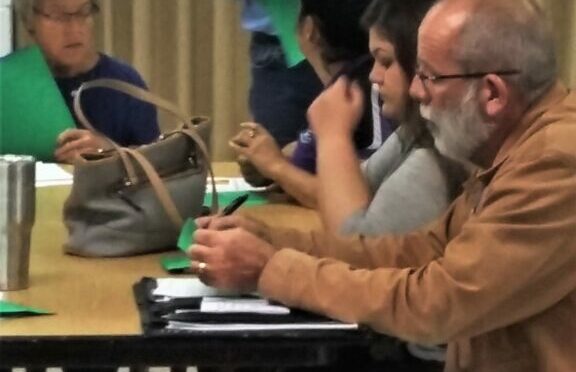
The Bourbon County Commission met in open session with Commissioner Oharah and Commissioner Fischer present, (Clifton Beth was on the phone), the County Counselor and the County Clerk were also present.
Also present were the following, (some were present for a portion of the meeting and some were present for the entire meeting), Jason Silvers with the Fort Scott Tribune, Mr. & Mrs. Clint Walker, Ben Cole, Bill Martin, Bobby Reed, Michael Hoyt and Anne Dare.
Eric Bailey (by phone) reported issues with the hydraulic pump on a dump truck; he said they are not working properly to lift the blade on the snow plow. Eric questioned if the County had pictures of the roads before the fiber company started doing work, Lynne said no; Jeff Fischer suggested revisiting the right of way policy.
Jeff Fischer and Justin Meeks both participated in a conference call regarding the Governors mask mandate; the Governor gave counties one week to opt in or opt out, or create their own version of the mandate. Jeff said Becky Johnson; the Public Health Officer was in support of the mask mandate and possibly limiting group sizes. Becky said there are currently 108 active cases in Bourbon County and said if the County supported a mask mandate then limiting group sizes may not be as important and possible revisit that at a later date to see what the mask mandate does. Jeff said if the infection rate is not controlled with the mask mandate it is likely that additional control measures will need to be put in place to eliminate the devastating impact of COVID-19. Jeff said with the increase in the infection rate and positivity rate, alarms are going off.
Lynne read the following letter which was signed by Governor Laura Kelly on 11/18/20:
EXECUTIVE ORDER NO. 20-68
Establishing a face coverings protocol
WHEREAS, securing the health, safety, and economic well-being of residents of the State of Kansas is this Administration’s top priority;
WHEREAS, Kansas is facing a crisis—the pandemic and public health emergency of COVID-19—resulting in illness, death, quarantines, school closures, and temporary closure of businesses resulting in lost wages and financial hardship to Kansas citizens;
WHEREAS, the United States Departments of Health and Human Services declared a public health emergency for COVID-19 beginning January 27, 2020, with now more than 11,136,000 cases of the illness and more than 246,000 deaths as a result of the illness across the United States;
WHEREAS, the World Health Organization declared a pandemic on March 11, 2020;
WHEREAS, a State of Disaster Emergency was proclaimed for the State of Kansas on March 12, 2020;
WHEREAS, on March 13, 2020, the President of the United States declared the ongoing COVID-19 pandemic of sufficient severity and magnitude to warrant an emergency declaration for all states, tribes, territories, and the District of Columbia pursuant to Section 50 1 (b) of the Robert T. Stafford Disaster Relief and Emergency Assistance Act, 42 U.S.C. § 5121-5207 (the “Stafford Act”);
WHEREAS, on March 13, 2020, the President of the United States pursuant to Sections 201 and 301 of the National Emergencies Act, 50 U.S.C. § 1601, et seq. and consistent with Section 1135 of the Social Security Act, as amended (42 U.S.C. § 1320b-5), declared a national emergency that the COVID-19 outbreak in the United States constitutes a national emergency beginning March 1, 2020;
WHEREAS, as of this date, in Kansas there have been 128,594 reported positive cases of COVID- 19 spread among all 105 Kansas counties, including 1,326 deaths;
WHEREAS, in the late spring and early summer 2020, Kansas experienced a steady trend of decreasing COVID-19 cases, hospitalizations, and deaths, but by mid-summer that downward trend gave way to a worrying spike in COVID-19 cases, hospitalizations, and deaths in Kansas and across the nation;
WHEREAS, as a result of that worrying spike, on July 2, 2020, I issued Executive Order 20-52 (“Requiring masks or other face coverings in public”), but in spite of the deadly and urgent public
health threat presented by the spike in COVID-19 cases, many counties exercised their temporary authority under K.S.A. 48-925(h) to “opt out” of statewide public health executive orders to opt out of Executive Order 20-52;
WHEREAS, recent weeks have again seen a worrying spike in COVID-19 cases, hospitalizations, and deaths, except that this “spike” has seen the 7-day average of cases and hospitalizations first double and then triple, stretching the healthcare system’s ability to handle the unprecedented influx of patients;
WHEREAS, if the healthcare system is overrun with COVID-19 patients, as it will be soon if current trends continue, communities will be forced to close schools and businesses, and non- COVID-19 healthcare services will be postponed due to laclc of staffing, space, and supplies in hospitals and doctor’s offices; at worst, Kansans battling COVID-19 or other serious illnesses could suffer and die from the lack of available healthcare services;
WHEREAS, wearing a face covering in public is the easiest and most effective way to protect each other, ease the burden on our overburdened healthcare system, and help keep our businesses open and our economy running;
WHEREAS, the Centers for Disease Control has determined that even “increasing universal masking by 15% could prevent the need” for restrictions on businesses and gatherings and could avoid severe economic losses;
WHEREAS, wearing a face covering in public is not only safe and easy, it is necessary to avoid more restrictive local measures that could involve closing businesses, schools, organized youth sports, and other important activities;
WHEREAS, the State of Kansas must remain flexible to account for the evolving nature and scope of the unprecedented public health emergency posed by COVID-19, while also simultaneously safely and strategically operating businesses and facilitating economic recovery and revitalization;
WHEREAS, for the aforementioned and other reasons, and in recognition and furtherance of my responsibility to provide for and ensure the health, safety, security, and welfare of the people of the State of Kansas, increasing the wearing of face coverings is necessary to promote and secure the safety and protection of the civilian population; and
WHEREAS, in these challenging times, this Administration will do whatever it can to avoid immediate dangers to the health, safety, and welfare of Kansans.
NOW, THEREFORE, pursuant to the authority vested in me as Governor of the State of Kansas, including the authority granted me by K.S.A 48-924 and K.S.A 48-925(b) and (c)(11), in order to ensure that Kansans can help keep each other safe, relieve unsustainable burdens on our healthcare system, and keep our businesses open as we restore our economy, I hereby direct and order the following:
The provisions of paragraphs 2 through 5 below do not apply in counties or municipalities that meet either of the following criteria:
counties in which Executive Order 20-52 is in effect, meaning that the county commission has not exercised its authority under S.A. 48-925(h) to “opt out” of Executive Order 20-52; or
counties or municipalities in which a local ordinance or order requires that face coverings be worn in public places and in
Effective at 12:01 m. on Wednesday, November 25, 2020, any person in Kansas shall wear a face covering when they are in the following situations:
Inside, or in line to enter, any indoor public space;
Obtaining services from the healthcare sector in settings including, but not limited to, a hospital, pharmacy, medical clinic, laboratory, physician or dental office, veterinary clinic, or blood bank;’
Waiting for or riding on public transportation or while in a taxi, private car service, or ride-sharing vehicle;
While outdoors in public spaces and unable to maintain a 6-foot distance between individuals (not including individuals who reside together) with only infrequent or incidental moments of closer
Also effective at 12:01 a.m. on Wednesday, November 25, 2020, all businesses or organizations in Kansas must require all employees, customers, visitors, members, or members of the public to wear a face covering when:
Employees are working in any space visited by customers or members of the public, regardless of whether anyone from the public is present at the time;
Employees are working in any space where food is prepared or packaged for sale or distribution to others;
Customers, members, visitors, or members of the public are in a facility managed by the business or organization; or
Employees are in any room or enclosed area where other people (except for individuals who reside together) are present and are unable to maintain a 6-foot distance except for infrequent or incidental moments of closer
The following are exempt from wearing face coverings pursuant to the provisions of this order:
‘ Unless directed otherwise by an employee or healthcare provider.
Persons age five years or under—children age two years and under in particular should not wear a face covering because of the risk of suffocation;
Persons with a medical condition, mental health condition, or disability that prevents wearing a face covering—this includes persons with a medical condition for whom wearing a face covering could obstruct breathing or who are unconscious, incapacitated, or otherwise unable to remove a face covering without assistance;
Persons who are deaf or hard of hearing, or communicating with a person who is deaf or hard of hearing, where the ability to see the mouth is essential for communication;
Persons for whom wearing a face covering would create a risk to the person related to their work, as determined by local, state, or federal regulators or workplace safety guidelines;
Persons who are obtaining a service involving the nose or face for which temporary removal of the face covering is necessary to perform the service;
Persons who are seated at a restaurant or other establishment that offers food or beverage service, while they are eating or drinking, provided they maintain a 6-foot distance between individuals (not including individuals who reside together) with only infrequent or incidental moments of closer proximity;
Athletes who are engaged in an organized sports activity that allows athletes to maintain a 6-foot distance from others with only infrequent or incidental moments of closer proximity;
Persons who are engaged in an activity that a professional or recreational association, regulatory entity, medical association, or other public-health-oriented entity has determined cannot be safely conducted while wearing a face covering;
Persons engaged in an activity or event held or managed by the Kansas Legislature;
Persons engaged in a court-related proceeding held or managed by the Kansas Judiciary; and
Persons engaged in any lawful activity during which wearing a face covering is prohibited by
Definitions:
“Face covering” means a covering of the nose and mouth that is secured to the head with ties, straps, or loops over the ears or is simply wrapped around the lower A face covering can be made of a variety of synthetic and natural fabrics, including cotton, silk, or linen. Ideally, a face covering has two or more layers. A face covering may be factory-made, sewn by hand, or can be improvised from household items such as scarfs, bandanas, I-shirts, sweatshirts, or towels.
“Public space” means any indoor or outdoor space or area that is open to the public; this does not include private residential property or private offices or workspaces that are not open to customers or public
Nothing in this order shall restrict, limit, or supersede the Secretary of Health and Environment’s authority to make isolation, quarantine, or other orders restricting movement as necessary to respond to escalating or worsening conditions in any local
Local governments retain authority to issue and enforce equally or more restrictive orders or provisions and retain any authority to issue or enforce isolation or quarantine orders or other orders as necessary to respond to escalating or worsening conditions in any local jurisdiction. Counties may also exercise authority granted by S.A. 48-925 as amended by 2020 Special Session House Bill 2016, Sec. 33.
As currently permitted pursuant to state law, the Attorney General, county attorneys, and district attorneys enforcing this order should use their discretion and consider the totality of the circumstances as they determine appropriate enforcement
In order to more accurately track and assess statewide status of COVID-19 cases, private labs conducting testing for COVID-19 shall report both positive and negative tests to the Kansas Department of Health and
The Four Tribes of Kansas (Iowa Tribe, Kickapoo Nation, Prairie Band Potawatomi Nation, and Sac & Fox Nation) retain any authority to regulate through their respective tribal councils for the health and welfare of their
This order should be read in conjunction with other executive orders responding to the COVID-19 pandemic that are still in effect and supersedes any contrary provisions of previous orders; however, the provisions of Executive Order 20-59 continue to control COVID-19 mitigation procedures, including the wearing of masks or other face coverings, in K-12 public and private school buildings and
This document shall be filed with the Secretary of State as Executive Order No. 20-68. It shall become effective as of 12:01 a.m. on November 25, 2020, and remain in force until rescinded or until the statewide State of Disaster Emergency extended by House Bill 2016 enacted during the June 2020 special session relating to COVID-19-and later extended by the State Finance Council–expires, whichever is earlier. This order may be extended or modified as circumstances dictate.
Jeff made a motion to support the Governors order by opting in the Governor’s State mandate effective at 12:01am on November 25, 2020, Clifton seconded and all approved. Anne Dare asked that the executive order and the letter from Becky Johnson supporting the executive order be placed on the Bourbon County and Health Departments Facebook pages. Justin Meeks questioned who enforces the Governors mask mandate; Michael Hoyt said it should be implied enforcement and said they should say they were going to approach people who aren’t wearing masks.
Mr. Hoyt said he would discuss advisory boards at the next Commission meeting.
The Commissioners briefly discussed a holiday meal; a holiday meal was discussed at the last meeting and it was suggested to either wait on a meal until summertime or give a gift card instead of a meal, (which is what the County has done for the employees the last few years). Bobby Reed said his employees would prefer a gift card and suggested possibly consider the Bronson Locker when getting the gift cards. Michael Hoyt suggested Chamber Bucks’ Jeff made a motion to authorize the distribution of a $25 gift card before Christmas, instead of the holiday meal, Clifton seconded, Bobby Reed suggested asking for the department heads input so that employees weren’t stuck with something random, Lynne suggested getting a list of who wants what card. All approved the motion. The gift cards will be discussed again on December 1st.
The Commissioners had planned to discuss the Omni lockbox option and to discuss Spark, but will discuss on December 1st.
The Commissioners discussed the proposed one-time longevity pay for the County employees (excluding elected officials). $51,000 has been budgeted for longevity for 2020 (to be paid prior to the end of 2020), this one-time longevity payout would have to be revisited each year when the Commissioners do the annual budget; Jeff Fischer calculated a proposed way to distribute the $51,000. He used an employee listing, with years of service and suggested 5 years of service be the starting point for employees (employees would have to have 5 years of service in by the end of 2020) to get a longevity one-time payout. He suggested paying $100/year times the years of service, an employee with less than 5 years of service get $0, 5 years would get $500, 10 years would get $1,000, etc. Bobby Reed said he was pro-employee and thanked the Commissioners for looking into longevity, but said most of his previous employees had left for pay and said if our employees get 3 weeks of vacation after 3 years of employment then the longevity pay should be calculated on less than 5 years of service, he said he had only a few employees that would benefit from the longevity pay if they start calculating it for employees that had been employed 5 years since he has a high turnover. Lynne said if they start at the end of year one they would have to have a cap on what someone received in order to fund the longevity payout, Bobby suggested starting lower than $100/year for employees that had been employed 1-5 years. Jeff Fischer plans to recalculate the longevity amount beginning with one year of service. The Commissioners plan to distribute the payout by Christmas. This will be discussed again on December 1st.
Jeff Fischer said Mark McCoy might be happy to help develop a retention training schedule, Jeff said retention is done by targeting skills needed for a job and providing education to do to the job; Bobby said the generation coming up now want to know what you are going to do for them now, Ben Cole said you can train the employees, but if it doesn’t put food on the table they don’t care. Michael Hoyt said retention begins at day one.
Lynne made a motion to go into a 10 minute executive session for personnel matters of individual non-elected personnel, Jeff seconded and all approved, (the session included the Commissioners and Clint Anderson). After the session, Jeff made a motion to backfill a vacant position in the Appraisers office, Clifton seconded and all approved.
USD 234 Superintendent Ted Hessong and teachers Jared Martin, Stephanie George and Brian Pommier met with the Commissioners to discuss COVID-19 and public health; Ted Hessong said they delayed the start of the school year and the delayed days were used to give the teachers time to prepare for opening. He said they require masks, temperature checks and social distancing. They offered the remote learning options to students (10% of the students chose the remote option). He said there are 1,827 students in the district and 360 staff. On November 16th they had 14 active cases and said the highest number of students in quarantine at one time was 164 students, the highest number of staff with COVID at one time was 6 staff (which was November 20th), he said the highest number of staff in quarantine was 38. He said most didn’t get quarantined from a contact at school, he said the high school was designated as a hotspot cluster as of November 8th. He felt the wearing of masks has helped prevent the spread of the virus at school. He said it is better academically, socially and emotionally for students to be learning in person. He said there are academic gaps when students weren’t learning in person at school. He said it is hard for the staff to balance both in class and remote learning. He said they were asking the Commissioners to use their authority to work with the health department regarding wearing masks and work with the health department to allocate resources for contact tracing. He asked the Commissioners to have a person housed at the district to assist with contact tracing. He said masks and contact tracing were needed to help control the spread. He said enrollment numbers are down. Jeff Fischer said he felt that school should be the last thing they close. Bill Martin said their hands were tied in regards to enforcing the mask mandate. Bill gave the Commissioners a memo from Attorney General Derek Schmidt dated 7/2/2020 and referenced the section “Violating the Mask Order is a Civil Wrong, Not a Crime”. He said the County Attorney would handle those complaints and suggested having the County Attorney present for a discussion over the mask mandate. Stephanie George said a huge part of the problem is that we don’t have community buy in; she said we need people to wear their masks to help keep businesses and schools open, she suggested promoting the mask mandate. Brian Pommier said a person to do the contact tracing could take the burden off of the administrator. Stephanie George thanked the Commissioners for opting into the mask mandate; she said contact tracing wasn’t budgeted for through the USD 234 Spark funds. She said teachers are teaching both in person and on Zoom at the same time, she said they are doing the best they can, but said they need help with contact tracing.
Lynne made a motion to go into a 10 minute executive session for confidential data relating to financial affairs or trade secrets of corporations, partnerships, trusts and individual proprietorships, Jeff seconded and all approved, (the session included the Commissioners and Justin Meeks). No action was taken.
Jeff made a motion to go into a 5 minute executive session for consultation with an attorney for the body or agency which would be deemed privileged in the attorney-client relationship, Clifton seconded and all approved, (the session included the Commissioners and Justin Meeks). After the session, Jeff made a motion that going forward the executive sessions are held in the old I/T office, Clifton seconded and all approved.
At 12:15, Jeff made a motion to adjourn, Clifton seconded and all approved.
THE BOARD OF COMMISSIONERS
OF BOURBON COUNTY, KANSAS
(ss) Lynne Oharah, Chairman
(ss) Jeff Fischer, Commissioner
(ss) Clifton Beth, Commissioner
ATTEST:
Kendell Mason, Bourbon County Clerk, Approved Date December 1, 2020