Bourbon County Sheriff’s Office Daily Report – October 2, 2026
Arrested
Litchfield, Leslie Lee (Age 62) — Arrested 10/1/2026 1:42 PM by Fort Scott Police Department. Charge: Warrant Bourbon County (Failure to Appear). Bond: No Bond.
Roach, Hailley-Sue Michelle (Age 23) — Arrested 10/1/2026 8:51 PM by Bourbon County Sheriff’s Office. Charges: Endangering a Child, Poss of Controlled Substance; Unknown Substance; Misdemeanor, Possess Paraphernalia; Unknown Misdemeanor. Bond: No Bond.
Smith, Jonathan Douglas (Age 27) — Arrested 10/1/2026 8:51 PM by Bourbon County Sheriff’s Office. Charges: Endangering a Child, Poss of Controlled Substance; Unknown Substance; Misdemeanor, Possess Paraphernalia; Unknown Misdemeanor. Bond: No Bond.
Evanoff, Tristen Jenifer-Lee (Age 30) — Arrested 10/1/2026 12:00 AM by Bourbon County Sheriff’s Office. Charge: Warrant – Out of County. Bond: $1,500.00 Cash. Released 10/2/2026 2:15 AM via Cash Bond.
Released
Ayers, Joshua Lorenzo — Released 10/1/2026 4:59 AM via Nothing Filed (Self).
Evanoff, Tristen Jenifer-Lee — Released 10/2/2026 2:15 AM via Cash Bond (Self).
Meir, Callie Jo — Released 10/1/2026 1:54 PM via Own Recognance (Self).
Bourbon County Sheriff’s Office Daily Report – October 1, 2026
Arrested
Harbin, Jacob Albert-Louis (Age 22) — Arrested 9/30/2026 11:40 AM by Fort Scott Police Department. Charge: Domestic Battery; Unknown Circumstance; Misdemeanor. Bond: $1,500.00 Cash/Surety.
Released
Allen, Judy Marie — Released 9/30/2026 1:13 PM via Own Recognance (Self).
Ayers, Joshua Lorenzo — Released 10/1/2026 4:59 AM via Nothing Filed (Self).
Proctor, Nicholas Edwards — Released 9/30/2026 11:32 AM via Own Recognance (Self).
FORT SCOTT — The Bourbon County Commission adopted its 2027 budget Monday night with 5% built in for an employee pay increase, after a push for much larger raises went nowhere and a motion to set raises aside until 2027 died without a second. Later in the meeting, a proposal to raise transfer-station rates for the first time in the station’s 10 years died without a second.
Chairman Gregg Motley presided, with Commissioners Joe Allen, David Beerbower, Mika Milburn-Kee and Samuel Tran, budget consultant Matt Lawn and County Clerk Ann Clarkson. The county’s recording of the meeting begins as the board returned from its first executive session at about 5:54 p.m. Coming out of that session, the commission voted to give Tran authority to ask Dr. Cohen of HR Solutions On Call, the county’s human resources contractor, to come handle personnel matters in person. It then went back into a 20-minute executive session to consult County Counselor Bob Johnson and an attorney for the county’s insurance carrier, both by phone, about pending litigation, and returned with no action.
Budget adopted at 56.678 mills
Lawn said his latest version brought the 2026 estimates closer to the budgeted amounts, which increases the carryover reserves in the general, employee benefit, and road and bridge funds. He also gave commissioners a sheet showing what raises of 5% up to 15% would cost. Milburn-Kee said the larger raises would take more than three and a half mills, and Lawn said they would deplete most of the county’s carryover reserves. “I still think your best plan to go forward is to do a real wage study and build a step system off that,” Lawn said.
Beerbower proposed a 15% raise for employees who are not directors or elected officials, which he estimated at about $500,000. He would pay for it with the roughly $200,000-plus difference between the revenue-neutral rate and the adopted rate plus cuts to each department’s commodities budget, and would put the remaining FEMA money and the Jayhawk Wind PILOT revenue into the general fund as a cash reserve. Milburn-Kee noted that commodities include fuel, which is already rising.
“The guy that comes to work every day and hasn’t seen a raise in 10 years, that’s the guy I’m talking about,” Beerbower said. “And it’s really easy to see. All you got to do is look at the payroll.”
Tran said the county still has no plan for who should be paid what. A pay study that human resources was supposed to produce this year never arrived, he said, and “if we didn’t follow up on them, that’s on us.” Beerbower said HR had promised him the study in 60 days back in March.
Motley agreed with Tran that the county needs “a program, not a no raises for three years and 15%” — one that rewards effort and performance and fits the market for each job. “Let’s do it right. Let’s just wait on big raises or anything like that until we can get this done correctly.” He said Standard & Poor’s has criticized the county for inconsistent pay changes and equipment reserves. Tran pointed to another issue on his radar: “Somewhere in this whole thing, we’ve got to come up with $22.5 million. We haven’t even talked about that.”
Allen said he has supported 5% from the beginning. “I think 5% is reasonable. It’s not excessive. And I think these employees deserve that 5%.”
Tran then moved to table all pay-raises until 2027, when he hoped the county would have a plan for step increases and employee benefits. The motion died for lack of a second.
Lawn said the budget as written keeps the 56.678-mill total and includes 5% for pay and 20% for rising insurance costs. Milburn-Kee objected that the budget has only four expenditure line items; Lawn said most operating funds are set up that way, which he called time consuming and “very problematic.” Milburn-Kee moved to adopt the budget as written, not to exceed 56.678 mills. It passed on a voice vote, with Beerbower voting no. Lawn said he would have it submitted by the end of the day Wednesday, the state’s Sept. 30 deadline.
Grant, fund transfer and other business
Emergency Manager Lou Howard asked the board to approve the Emergency Management Performance Grant application, a 50-50 federal and county cost share that can pay for salary, office supplies, technology, planning and required exercises. Commissioners authorized Motley to sign it. Howard said she will bring back the county’s Emergency Operations Plan once it is finished.
On behalf of Public Works Director Kenny Allen, the board approved moving $325,000 from the Road and Bridge Sales Tax Fund to the Road and Bridge Fund to cover payroll. Milburn-Kee asked that the record show the money was for work done on hard-surface roads.
The commission also approved $1,750 for the indigent cremation of William Watson, to be paid through accounts payable from the general fund.
Milburn-Kee invited representatives from Murphy Tractor to the table and thanked them for a detailed report on training and calibration work done for the county, which she said, citing figures Murphy gave her, helped raise the county crusher’s output from 400 tons a day to 3,600. “When we purchase this expensive equipment, the value isn’t just in the machinery,” she said. “The value is in our relationships with the vendors that are providing us those services as well.” Roland Hammond, Murphy Tractor’s regional product support manager, told commissioners that going forward, the company will communicate better before, during and after repairs. Motley suggested Hammond meet with Public Works Director Kenny Allen, the county’s main point of contact; Hammond said the two had not met.
In other action, the board:
approved having TEC reorder the county’s phone prompts at no charge, to correct the problem of too many overflow calls going to the clerk’s office;
approved sending Allen County a memorandum of understanding on the shared county appraiser, under which Bourbon County would pay its share of the appraiser’s health insurance monthly rather than yearly; Milburn-Kee said the shared insurance a big savings for the county;
gave Bourbon County Clay the board’s blessing to enter an ornament representing the county in the Kansas Association of Counties’ governor’s tree competition.
Purchasing policy goes back for input; no action on insurance
The draft purchasing policy calls for price comparisons under $2,500, three quotes from $2,500 to $9,999, three written quotes from $10,000 to $24,999, and a formal bid or request for proposals at $25,000 and up. Beerbower said those thresholds are too low, noting that a patrol car tops $55,000 and a dump truck $180,000. He suggested thresholds he said similar counties use: department authority up to $10,000, three documented quotes from $10,000 to $50,000, formal competitive quotes from $50,000 to $100,000, and a request for proposals with board approval above that, which he said lines up with a Kansas legislative move to raise county construction thresholds from $25,000 to $100,000. He also recommended using state contracts that let counties buy at the state’s bid price. Clarkson said most employees’ purchase cards have a $1,000 limit, and that at the sheriff’s office everyone carries one. Tran said department heads may need higher limits but not every cardholder should have them: “If you give them the limit, they’ll take it. I’m not saying everybody, but I’m saying somebody will sometimes.” Motley will send the versions of the policy to department heads and elected officials for their feedback.
Updating the purchasing policy of the county is intended to meet the goals of consistency and transparency, according to Milburn-Kee and Beerbower.
Milburn-Kee’s proposal to move to a flat county contribution toward employee health insurance, with a $2-an-hour premium payment for employees who have insurance elsewhere and decline county coverage, drew questions from Beerbower about workers’ compensation and KPERS. Motley said he has received “some pretty vitriolic replies” from elected officials and department heads who fear losing employees who came for the benefits if Milburn-Kee’s proposal is implemented. “We have single moms, people like that, that would lose a lot of money,” he said. Milburn-Kee said 64 employees are on employee-only coverage and 18 on employee-plus plans. No action was taken.
Beerbower said a contractor will look at the work for the courthouse move Wednesday, Sept. 30, and that an inspection is set for Tuesday.
Records-request fees
The commission adopted a resolution setting copy fees of 50 cents a page for Kansas Open Records Act (KORA) requests and assigning each county office responsibility for its own records rather than routing every request through the clerk’s office. Before the vote, commissioners Joe Allen and Beerbower discussed leaving the decision about fees for fulfilling requests to each elected officials’ offices, giving the Sheriff’s Office as an example of a county entity that sets its own fee schedule for records requests. “I think y’all need to take some time reading the statute,” Milburn-Kee said.
County Clerk Annie Clarkson reminded the commission that adding signed documents to the published agenda is a step towards the transparency needed to reduce the number of KORA requested records. She mentioned that some people don’t like to retrieve their own documents, “But, KORA request also says if they’re already available to the public, then we’re not required to fill that KORA request.”
Motley said Bob Johnson, the commission’s attorney, told him Allen County received three records requests last year, and that Bourbon County is “getting a lot of frivolous” ones. Tran agreed: “It’s KORA lawfare. They’ll file it just to do lawfare against whatever it is that they don’t like. And that’s fine. That’s their right to do that. But it is bogging down the mechanism.” Clarkson pointed out that Allen County charges more to fulfill requests than Bourbon County does.
Beerbower moved to adopt the resolution, and it passed on a voice vote, with Joe Allen voting no.
Transfer station: rates, hours and a profit-and-loss question
Beerbower answered concerns raised at earlier meetings by Kevin “Skitch” Allen, owner of Skitch’s Hauling & Excavation, who uses the transfer station. Allen had asked for the station to open for four hours on minor holidays because “the trash doesn’t stop.” Beerbower said the station has only three trained employees and already leaves one person alone on Saturdays, which he called a safety and liability problem. He said they could re-asses after the landfill is fully staffed. Kevin Allen pushed back saying that the landfill has historically been open on minor holidays until about a year ago when that service stopped. Allen also suggested opening the scales at 7 a.m. instead of 8, since the scale operator arrives at 7; Beerbower said the early staff are preparing the site for the day. Allen then suggested that some of the work done at the beginning of the day could be done at a later time.
Allen also asked how the county knows the station is breaking even before it raises rates. “How do you know you’re breaking even is my question,” he said. Beerbower said the transfer station is a service “not designed to make a profit,” that he could find no year in its 10 years of operation when it went over budget, and that its rates have not gone up since it opened while its costs have. Motley read the station’s results from the county audit: a $96,000 gain in 2025, a $3,000 loss in 2024, and gains of $68,000 in 2023 and $22,000 in 2022. He cautioned that government cash-basis accounting leaves out equipment depreciation. “That’s apples and oranges to the typical business, but it’s been within budget, and it’s operated well,” Motley said.
Allen and Beerbower also disagreed over the station’s backhoes and over Allen’s suggestion to buy a pressure washer, which Beerbower said would need a pad with environmental drainage to meet state rules. Beerbower said he would check with the Kansas Department of Health and Environment.
Beerbower then moved to raise rates effective Jan. 1, 2027: in-county construction and demolition waste from $35 to $40 a ton, in-county trash from $40 to $46, out-of-county construction and demolition from $40 to $51, and out-of-county trash from $50 to $56. He said the station handles about 12,925 tons a year, bringing in about $520,000, and that comparable facilities commonly charge $57 to $60 a ton for trash. The motion also included a 15% raise for the station’s four employees and restricted reserves of $35,000 a year for equipment and facilities, $15,000 for closure and post-closure costs and $15,000 for operating carryover. It died for lack of a second.
Backhoe bids were held until next week while Public Works confirms that the Foley quotes are still current. Future agenda items include the backhoe bids, possibly employee IT training once Stronghold sends its information, responses to the county’s request for proposals for human resources services, which Joe Allen said number three or four so far, and an update on the courthouse asbestos work and the court’s move.
Bourbon County Sheriff’s Office Daily Report – September 30, 2026
Arrested
Hall, Brandon Lee (Age 37) — Arrested 9/29/2026 2:13 AM by Fort Scott Police Department. Charges: Aggravated Endangering a Child, Reckless Situation to Child <18; Criminal Threat; Interference with LEO, Felony. Bond: $2000.00 Cash/Surety. Released 9/29/2026 5:40 PM via Surety Bond.
Meir, Callie Jo (Age 36) — Arrested 9/29/2026 2:36 AM by Fort Scott Police Department. Charges: Disorderly Conduct; Interference with LEO, Misdemeanor; Pedestrians Under Influence of Alcohol or Drugs. Bond: $1000.00 Cash/Surety.
Ayers, Joshua Lorenzo (Age 36) — Arrested 9/29/2026 4:02 AM by Bourbon County Sheriff’s Office. Charges: Possession of THC, 2 or More Convictions; Possession of Marijuana; Possession of Stimulant, 1 Prior Conviction. No Bond.
Frye, Jesse Dean (Age 44) — Arrested 9/29/2026 10:32 AM by Bourbon County Sheriff’s Office. Charge: Warrant Bourbon County (Probation Violation). No Bond.
Proctor, Nicholas Edwards (Age 40) — Arrested 9/29/2026 11:33 PM by Fort Scott Police Department. Charges: Disorderly Conduct; Pedestrians Under Influence of Alcohol or Drugs. No Bond.
Released
Hall, Brandon Lee — Released 9/29/2026 5:40 PM via Surety Bond (Able Bonding).
Hill, Marcus Juanell — Released 9/29/2026 6:03 PM via Cash Bond (Self).
Schoemig, Joshua Mark — Released 9/29/2026 11:52 AM via Surety Bond (Able Bonding).
Turnbull, Christina Lynn — Released 9/29/2026 10:24 AM via Transferred Out (Jasper County MO).
On November 3, 2026, an election for city, school and federal and state candidates will be held.
The ballot will also include the following constitutional amendment question about who is eligible to vote in Kansas. And for Uniontown’s School District citizens, a question on voting for at-large positions on the U.S.D. 235 School Board.
The following was submitted by Bourbon County Clerk Ann Clark, with information that tells who the candidates are, where you can vote, when advance voting starts and ends, when early voting begins and ends, and a special notice that some voting places have changed.
Please read the information and be prepared to let your vote count.
CONSTITUTIONAL AMENDMENT QUESTION
Explanatory statement. This amendment would clarify that only a person who is a citizen of the United States is eligible to vote in this state. “A vote for this proposition would clarify that only a person who is a citizen of the United States is eligible to vote in this state. “A vote against this proposition would make no change to the constitution of the state of Kansas, and the language concerning voter qualifications would remain the same. “Shall the following be adopted?“§ 1. Qualifications of electors.Every(a) No person shall be deemed a qualified elector unless such person:
(1) Is a citizen of the United States who;
(2) has attained the age of eighteen years; and who
(3) except as provided in subsection (b) or (c), resides in the voting area in which he or she such person seeks to vote shall be deemed a qualified elector.
(b) Laws of this state relating to voting for presidential electors and candidates for the office of president and vice-president of the United States shall comply with the laws of the United States relating thereto. A citizen of the United States, who is otherwise qualified to vote in Kansas for presidential electors and candidates for the offices of president and vice-president of the United States may vote for such officers either in person or by absentee ballot notwithstanding the fact that such person may have become a nonresident of this state if his or her such person’s removal from this state occurs during a period in accordance with federal law next preceding such election.
(c) A person who is otherwise a qualified elector may vote in the voting area of his or her such person’s former residence either in person or by absentee ballot notwithstanding the fact that such person may have become a nonresident of such voting area during a period prescribed by law next preceding the election at which he or she such person seeks to vote, if his such person’s new residence is in another voting area in the state of Kansas.”
The full list of candidates on the ballot is as follows:
UNITED STATES SENATE
Adam Hamilton, Democratic. Box 6, Stillwell, KS 66085
Roger Marshall, Republican,
David C Graham, Libertarian, Overland Park, KS
UNITED STATE HOUSE OF REPRESENTATIVES
Don Cover, Democratic, 9305 70th Road, Galesburg, KS 66740
Juan C. Luengo, Democratic,14904 S Summit St, Olathe, KS 66062
Steven Johnson, Republican,10197 S Hopkins Road, Asaria, KS 67416
Eric Lund, Libertarian, Paola, KS
COMMISSIONER OF INSURANCE
Dinah Sykes, Democratic
Daniel Hawkins, Republican, 9406 W Harvest Lane, Wichita, KS 67212
Rick Koehn, Libertarian, Cimarron, KS
KANSAS HOUSE OF REPRESENATIVES
Rick James, Republican, LaCygne, KS 66040
Robb Hodgkinson, Libertarian, Fort Scott, KS
MEMBER STATE BOARD OF EDUCATION
Heather Guernsey, Democratic, 18725 Ford Road, Chanute, KS 66720
Destry Brown, Republican, 2108 Jayhawk Rd, Fort Scott, KS 66701
SUPREME COURT JUSTICE
Eric S. Rosen,
Larkin E. Walsh
COURT OF APPEALS JUDGE
Lesley Ann Isherwood
Amy Fellows Cline
Kim R. Schroeder
Lori Ann Bolten Fleming
Jacy Hurst
DISTRICT COURT JUDGE
Amy L Harth
COUNTYCOMMISSIONER DISTRICT 1
Clint L. Walker (Democratic) 1999 105th St. Mapleton, KS 66754
Mike Hueston (Republican) 351 N Bourbon, Mapleton, KS 66754
COUNTYCOMMISSIONERDISTRICT 3
Joe Allen (Republican) 1025 260th Street, Fort Scott, KS 66701
COUNTYCOMMISSSIONER DISTRICT4
Gregg Motley, Republican 1904 Jayhawk Road, Fort Scott 66701, 66701
DRYWOOD TOWNSHIP CLERK
Laura Krom Republican, 2361 Fern Road, Fort Scott, KS 66701
FRANKLIN TOWNSHIP CLERK
No Candidate Filing
MARION TOWNSHIP CLERK
Brent M. Smit, Republican 763 95th Street, Redfield, Ks 66769
Michael Ramsey, Republican, 1270 Highway 3, Uniontown, Ks 66779
MARMATON TOWNSHIP CLERK]
No Candidate Filing
MILLCREEK TOWNSHIP CLERK
No Candidate Filing
OSAGE TOWNSHIP CLERK
No Candidate Filing
PAWNEE TOWNSHIP CLERK
No Candidate Filing
SCOTT TOWNSHIP CLERK
Donald Banwart, Republican, 982 Highway 69, Fort Scott, KS 66701
TIMBERHILL TOWNSHIP CLERK
Jennifer Epting Williams, Republican, 530 N Washington, Mapleton, KS 66754
WALNUT TOWNSHIP CLERK
No Candidate Filing
USD 235 QUESTION
CHANGE IN METHOD OF ELECTION TO ELECT AT-LARGE FOR MEMBER POSITIONS The Uniontown School District;
Unified School District No.235
Bourbon County, Kansas
Shall the following change in the Method of Election be adopted?
“Shall Unified School District No. 235, Bourbon County, Kansas change the method of election from the current three member district method under which the school district is divided into two member districts, in which three board members are elected from each member district is divided into two member districts, in which three members are elected from each member district and one board member is elected at-large, to the election at large for member positions method of electing school bord members under which:
The school district is not divided into any member districts, and all board members are elected at large.
“Shall a change in the method of election as described in the ballot title above, be approved?”
To vote in favor of the method of election change, make a cross or check mark in the square to the left of the word
Yes; to vote against it, make a cross or check mark in the square to the left of the word no.
VOTING PRECINCTS IN BOURBON COUNTY– PLEASE NOTE THAT THE POLLING PLACES HAVE CHANGED!!
It is hereby noted that the polls are open between the hours of 7:00 am to 7:00 pm at the following location:
1st,4th, 5th.and 6th Wards and Scott D1, D2 and D4 Townships at Community Christian Church, 1919 S Horton, Fort Scott
Freedom, Fulton, and Osage Townships at Fulton Community Building, 408 W. Osage, Fulton
2nd, 3rd, and 7th wards, Drywood Township, and Scott D3, and D5 Townships at Grace Baptist Church, 502 S. Margrave, Fort Scott
Franklin, Mapleton, Millcreek and Timberhill Townships and Mapleton City at Mapleton Community Building, 565 Eldora, Mapleton
East Marion, Marmaton, Pawnee, West Marion, and Walnut Townships and Bronson, Redfield, and Uniontown Cities at Uniontown City Hall, 206 Sherman, Uniontown
Voter Registration And Voting
You may register to vote at the office of the County Clerk during their regular business hours, or online
Deadline to Change Party: K.S.A. 25-3304(b) The deadline for party affiliation changes is October 14, 2026 at the end of the business day. Party affiliation changes will be accepted and processed after December 1, 2026. If you still desire to update or change your party affiliation, you may do so December 1, 2026, by filling out a new voter registration.
Closing of Registration Books: Pursuant to K.S.A. 25-2310 & K.A.R. 7-23-4 Notice is hereby given that on the 14th day of October 2026, registration books for the City/School General Election will close at the end of the business day. The books will remain closed until the day following the General Election.
Advance Voting by Mail; K.S.A. 25-1123 Any registered voter is eligible to vote by Advance Ballot, beginning Thursday, October 15, 2026. The last day to request an advance ballot by mail is Wednesday, October 28,2026
Apply for Advance Ballot: K.S.A. 25-1122 € (4). Applications for advance Ballots are available at the Bourbon County Clerk, Election Office or by calling 620-223-3800 Ext:100. A printable application for an Advance Ballot is available on the county website www.bourboncountyis.org or Kansas Secretary of State website www.kssos.org.
Returning Advance Ballots: K.S.A. 25-1132
In Person: ballots must be returned by 7:00 p.m. on Election Day to any polling location within the County or to the County Election Office, Courthouse, 210 S National Ave. Fort Scott, KS 66701.
By Mail: Ballot must be postmarked on or before Tuesday November 3, 2026 (Election Day) and received in the County Election office by Friday, November 6th, 2026.
Early Voting: Voters can vote in advance in the Commission Room at Bourbon County Courthouse beginning Monday, October 19th, 2026, through Monday, November 2, 2026, at 12:00 p.m. (Noon)
Important Note: Per K.S.A. 25-2908 All Voters must provide Valid Photo Identification (Drivers License, Military ID, Kansas College ID, Kansas ID or other qualifying ID card) to Vote. For a list of accepted identification and additional information go to www.gotvoterid.com or call 1-800. 262.vote (8683).
Public Demonstration: K.S.A. 25-4411(b) & 25-4610(b) A Public Demonstration of the Clear Ballot Election Software will be held Friday October 30th, 2026, at 9:00 a.m. in the Bourbon County Courthouse.
CANVASS: KSA 25-3101, 3104, 3107 Monday November 9th, 2026, at 10:00 a.m. in the Commission Room of the Bourbon County Courthouse.
Bourbon County Sheriff’s Office Daily Report – September 29, 2026
Arrested
Schoemig, Joshua Mark (Age 46) — Arrested 9/28/2026 8:22 AM by Fort Scott Police Department. Charge: Criminal Damage to Property; Misdemeanor. Bond: $1000.00 Cash/Surety.
Wall, Brandon DJ (Age 29) — Arrested 9/28/2026 2:59 PM by Douglas County. Charge: Other Agency Hold. Bond: $0.00.
Lewis, Melvin (Age 24) — Arrested 9/28/2026 3:15 PM by Douglas County. Charge: Other Agency Hold. Bond: $0.00.
Santmyer, Jeremy Lee (Age 53) — Arrested 9/28/2026 3:40 PM by Fort Scott Police Department. Charge: Warrant Bourbon County (Probation Violation), Case No. BB-23-CR-39; Warrant Bourbon County (Probation Violation), Case No. 19-CR-659; Warrant Bourbon County (Probation Violation), Case No. BB-22-CR-46. Bond: No Bond $0.00.
Odell, Rickey Dean (Age 58) — Arrested 9/28/2026 6:11 PM by Bourbon County Sheriff’s Office. Charge: Aggravated Assault, Aggravated Battery; Unknown Circumstance, Aggravated Kidnapping, Criminal Threat; Unknown Circumstance. Bond: No Bond $0.00.
Hall, Brandon Lee (Age 37) — Arrested 9/29/2026 2:13 AM by Fort Scott Police Department. Charge: Aggravated Endangering a Child; Reckless Situation to Child <18, Criminal Threat; Unknown Circumstance, Interference with LEO; Unknown Circumstance; Felony. Bond: No Bond $0.00.
Meir, Callie Jo (Age 36) — Arrested 9/29/2026 2:36 AM by Fort Scott Police Department. Charge: Disorderly Conduct; Unknown Circumstance, Interference with LEO; Unknown Circumstance; Misdemeanor, Pedestrians Under Influence of Alcohol or Drugs. Bond: No Bond $0.00.
Ayers, Joshua Lorenzo (Age 36) — Arrested 9/29/2026 4:02 AM by Bourbon County Sheriff’s Office. Charge: Poss of THC; 2 or More Convictions, Possession of Marijuana, Possession of Stimulant; 1 Prior Conviction. Bond: No Bond $0.00.
Released
Murray-Crawford, Benz — Released 9/28/2026 2:45 PM via Transferred Out (Douglas).
Prattis, Ronald — Released 9/28/2026 2:45 PM via Transferred Out (Douglas Co).
Smith, Earl Dean — Released 9/28/2026 5:57 PM via Surety Bond (Greenfeather).
The packet also carries the 14-page batch that commissioners already approved at the September 21 meeting, added at the table for a total of $110,758.06.
Batch Due 9/21/2026 — Grand Total: $110,758.06 (Pages 40–53)
Non-Departmental Funds: $3,316.95 total, including Employee Benefit $1,766.96 and Addiction Settlement Fund $984.28 (Path of Ease Association mobile mechanic services). (Pages 40–41)
County Attorney — $10,271.56, including contracted assistant county attorney services from Clifford Wayne Lee ($3,500), Justin Meeks ($2,500) and Matthew Bonner ($3,500) (Page 44)
County Coroner — $1,350.00 for body removal/transport (Page 45)
Human Resources — $7,093.10, including payroll and benefits consulting services (Page 51)
3. Official Meeting Minutes Approval – September 21, 2026 (Pages 3–6)
Attendance & Logistics: Commissioners Milburn, Allen, Tran and Beerbower were present with Clerk Ann Clarkson; the meeting was called to order at 5:30 PM at 210 South National Avenue. (Page 3)
Agenda Modifications: Additions were made for a budget discussion, a court-relocation item, and an accounts-payable batch of $110,758.06; approved as amended by Milburn, seconded, all approved. (Page 3)
Financial & Payables Approvals: Accounts payable were approved in two batches — $581,360.08 that went out with the agenda and $110,758.06 added at the table — motion by Milburn, all approved. (Page 3)
Public Comments: County employee Bob Reed spoke on wages; Clint Walker addressed executed-documents procedure; Kevin Allen renewed concerns about transfer-station foam-filled tires, air conditioning repairs and partial holiday hours. (Pages 3–4)
Executive Session – Appraiser: A 5-minute executive session was held on appraiser employment; Commissioner Milburn-Kee was authorized to continue onboarding the incoming non-elected appraiser. (Page 4)
Budget Discussion: County budget consultant Matt Lawn presented 2027 budget scenarios ahead of the September 30 deadline, including a Road & Bridge overspend of roughly $240,000 and discussion of a wage increase above the 5% baseline built into projections. (Page 4)
Old & New Business: Board authorized Beerbower to sign the Apex Environmental asbestos/lead inspection agreement; approved Resolution 30-26 appointing Danielle Louk County Appraiser; adopted Resolution 31-26 reallocating courthouse lower-level space; tabled the KC Crown/HITC housing project, purchasing policy, employee benefit restructuring and KORA resolution for further review. (Pages 4–6)
Adjournment: Motion to adjourn by Commissioner Allen, seconded, carried unanimously. (Page 6)
4. Restrictive Covenant – Former Landfill Property (Pages 35–39)
Recording Details: Recorded September 18, 2026 in Book 533, Pages 399–402 by Register of Deeds Lora Holdridge; the tract in Section 19, Township 25 South, Range 25 East is a closed solid-waste disposal area under KDHE Permit #206. (Page 35)
Terms: The covenant grants KDHE a permanent easement to monitor and maintain the closed landfill cap, requires KDHE approval before any future construction or excavation, and runs permanently with the land. (Pages 36–37)
Execution: Signed by Vice Chairman Joe Allen on 9/1/2026 and notarized by County Clerk Lora Ann Clarkson. (Page 38)
Scope: Approves a Planning Services Agreement with Confluence, Inc. to develop a Comprehensive Plan and Zoning Code Regulations addressing utility-scale wind/solar, battery storage, data centers and other land uses identified under the county’s Resolution 24-26 moratorium. (Pages 54–55)
Funding: Total fee of $116,500, including up to $5,000 in reimbursable expenses — $36,000 from the 2026 General Fund and $80,500 from the 2027 General Fund. (Page 56)
Adoption: Adopted September 14, 2026 and signed by Chairman Mika Milburn-Kee and Commissioner Beerbower. (Pages 56–57)
Levies a property tax rate exceeding the calculated Revenue Neutral Rate of 54.661 mills, following a September 14, 2026 public hearing at which the Board heard testimony and still found it necessary to exceed the rate. (Page 58)
Public Hearing: Staff presented a proposed mill levy of 56.678 versus the 54.661 Revenue Neutral Rate — a 2.017-mill difference representing about $294,000 in additional revenue on an assessed valuation of $138,681,091; the Board adopted the resolution to exceed RNR 5-0. (Page 60)
Public Comments: Kyle Parks spoke in support of funding the comprehensive plan and zoning initiative; Care to Share board members reported assisting cancer patients at over $12,000 per month and announced the 5th Annual Fort Fest, September 25–26 at Riverfront Park. (Page 61)
Executive Sessions: Held for appraiser-applicant interviews and for attorney-client consultation on pending legal matters. (Pages 61–62)
Old Business: SEKRPC update on pending Bronson CDBG water-system grants; adoption of the Confluence comprehensive-plan/zoning Resolution 28-26; burn ban lifted effective immediately following five to six inches of recent rainfall. (Pages 62–63)
New Business: Kevin Allen and Clayton Miller raised transfer-station concerns including a CDL driver pay-plan increase from $17 to $30/hour and a request for a profit-and-loss analysis before rate changes; a fence-viewing request was found outside the scope of K.S.A. 29-201; the KC Crown Fort Scott housing project was postponed; the HR RFP was approved for publication. (Pages 63–64)
8. Resolution 30-26 – Appointment of County Appraiser (Pages 66–67)
Appoints Danielle Louk, a Kansas Registered Mass Appraiser, as Bourbon County Appraiser effective September 21, 2026 to fill the unexpired term through June 30, 2029, repealing Resolution 20-25 and authorizing a shared-services arrangement with Allen County. (Pages 66–67)
9. Special Meeting Minutes – September 14, 2026, Appraiser Interviews (Pages 68–70)
Commissioners Allen, Beerbower and Milburn met in person with Commissioner Sam by phone (Motley absent) to conduct four rounds of executive-session interviews with appraiser candidates, concluding with a final candidate, Brooke, interviewed in person. (Pages 68–70)
10. Allen County Appraiser Memorandum of Understanding (Pages 110–113)
Shared Services: Danielle Louk will serve as County Appraiser for both Bourbon and Allen counties beginning September 21, 2026, each county administering her payroll, deductions and KPERS separately as her own W-2 employer. (Pages 110–111)
Health Insurance Cost-Share: Allen County continues to administer her health coverage; Bourbon County reimburses half the $905/month premium ($452.50/month, $5,430 annually), with a prorated September payment of $150.80. (Page 111)
Scope: Pre-renovation asbestos NESHAP inspection, lead-based paint (XRF) screening and ambient air monitoring of the courthouse elevator and third floor ahead of planned renovation work, Proposal No. 26147AL dated September 4, 2026. (Page 72)
Fee: $2,475.00 for field inspections and report generation plus an estimated $1,050.00 for 30 asbestos bulk samples at $35.00 each. (Page 74)
Execution: Agreed to by Commissioner Beerbower on September 21, 2026. (Page 75)
12. Bourbon County 2027 Adopted Budget (Pages 77–104)
Summary: Total 2027 budget authority of $19,969,633 against $8,148,472 in 2026 ad valorem tax, with the General Fund carrying $3,681,333 in authority and $1,788,956 in tax; the Revenue Neutral Rate is 54.661 mills against a proposed estimated rate of 56.678 mills. (Page 77)
Debt & Leases: $5,080,000 in outstanding G.O. bonds as of January 1, 2026 and $3,098,088 in lease-purchase principal, including a Rock Crusher, motor graders, a mini excavator and the 2016 jail pod. (Pages 79–80)
13. Emergency Management Performance Grant (EMPG) Application (Pages 105–106)
FY2026 application marking Bourbon County as a new EMPG participant; Emergency Manager Louella Howard works part-time, 15 hours per week; signed by Commission Chairman Gregg Motley for submission to KDEM by September 29, 2026. (Pages 105–106)
14. Murphy Tractor Training & Production Optimization Report (Pages 107–109)
Two-day operator and maintenance training on the county’s rock crusher and classifier; technicians replaced worn vibrating pad springs, cleaned cooling packages and corrected conveyor tracking, reporting a production increase from roughly 400 tons per day to about 3,600 tons during the optimized run; nine county employees were trained. (Pages 107–109)
Resolution: A draft resolution dated 9/21/2026 establishing a competitive-bidding requirement for county purchases over $10,000, requiring at least three competitive bids when reasonably possible. (Pages 116–117)
Detailed Draft Policy: A 25-section draft purchasing policy sets tiered thresholds — competitive price comparison under $2,500, three written quotes from $2,500–$9,999, formal bid or RFP at $25,000 and above — plus rules on sole-source purchases, emergency purchases, change orders, and a requirement that Public Works submit an annual list of anticipated major purchases. (Pages 118–125)
Proposes standardizing the county’s insurance contribution at $1,100 per month for the roughly 82 employees who use county coverage, and offering a $2.00/hour premium-pay option (about $4,160 annually) to the roughly 35 eligible employees who opt out with outside coverage, at an estimated additional annual cost of $145,600. (Pages 127–128)
17. KORA (Kansas Open Records Act) Policy Resolution (Pages 129–140)
Proposed Changes: Shifts responsibility for fulfilling records requests from the County Clerk to the official custodian in each department/office, and would supersede the county’s existing Resolution 99-19 and Resolution 10-06. (Pages 129–136)
Fee Schedule: Sets a standard $0.50-per-page paper copy fee and staff-time charges at the lowest-cost applicable wage, replacing the current $0.25-per-page fee under Resolution 10-06, which is included in the packet for reference alongside the 1999 KORA resolution it would replace. (Pages 139–140)
Bourbon County Sheriff’s Office Daily Report – September 28, 2026
Arrested
Violett, Matthew James (Age 38) — Arrested 9/25/2026 9:31 AM by Fort Scott Police Department. Charge: Warrant Bourbon County (Probation Violation). Bond: No Bond $0.00.
Pierce, Jason Ray-Douglas (Age 27) — Arrested 9/25/2026 1:10 PM by Bourbon County Sheriff’s Office. Charge: Warrant Bourbon County (Probation Violation). Bond: No Bond $0.00.
Vandament, Loretta Lynn (Age 57) — Arrested 9/25/2026 3:50 PM by Bourbon County Sheriff’s Office. Charge: Warrant Bourbon County (Failure to Appear). Bond: Cash $1,258.00.
Rodriguez, Christopher Paul (Age 40) — Arrested 9/25/2026 3:29 PM by Bourbon County Sheriff’s Office. Charge: Warrant Bourbon County (Failure to Appear). Bond: No Bond $0.00.
Shortsleeve, Nikya Joann (Age 26) — Arrested 9/25/2026 4:59 PM by Fort Scott Police Department. Charge: Criminal Damage to Property (Misdemeanor), Domestic Battery, Unknown Circumstance (Misdemeanor). Bond: Cash/Surety $500.00. Released 9/26/2026 11:10 AM via Cash Bond.
Griffith, David Taylor (Age 38) — Arrested 9/26/2026 8:09 PM by Fort Scott Police Department. Charge: Transporting an Open Container, Warrant Bourbon County (Failure to Appear). Bond: Own Recognizance $2,500.00, Cash/Surety $1,000.00 (total $3,500.00). Released 9/27/2026 3:47 PM via Surety Bond.
Norman, Carl Eugene (Age 45) — Arrested 9/26/2026 6:55 PM by Bourbon County Sheriff’s Office. Charge: Distribute Controlled Substance, Unknown Substance; Warrant – Out of County; Warrant – Out of State. Bond: No Bond $0.00, Cash $1,014.50, No Bond $0.00 (total $1,014.50).
Farris, Andrew James (Age 43) — Arrested 9/26/2026 6:55 PM by Bourbon County Sheriff’s Office. Charge: Distribute Controlled Substance, Unknown Substance; Fleeing or Attempting to Elude a LEO, Unknown Felony; Warrant – Out of County (three warrants). Bond: total $26,000.00.
Hill, Marcus Juanell (Age 42) — Arrested 9/27/2026 12:03 AM by Bourbon County Sheriff’s Office. Charge: Disorderly Conduct, Unknown Circumstance; Interference with LEO, Unknown Circumstance (Misdemeanor); Possession of Controlled Substance, Unknown Substance (Misdemeanor); Possess Paraphernalia (Misdemeanor). Bond: No Bond $0.00.
Smith, Earl Dean (Age 45) — Arrested 9/27/2026 12:05 AM by Fort Scott Police Department. Charge: Disorderly Conduct, Unknown Circumstance; Possession of Controlled Substance, Unknown Substance (Misdemeanor); Possess Paraphernalia (Misdemeanor). Bond: Cash/Surety $1,000.00.
Allen, Judy Marie (Age 47) — Arrested 9/27/2026 12:26 PM by Bourbon County Sheriff’s Office. Charge: Warrant Bourbon County (Failure to Appear). Bond: Cash/Surety $5,000.00.
Mayes, Christopher Brian (Age 38) — Arrested 9/27/2026 1:32 PM by Bourbon County Sheriff’s Office. Charge: Domestic Battery, Unknown Circumstance (Misdemeanor). Bond: Cash/Surety $5,000.00.
Released
Fischer, Stephen Lyle — Released 9/25/2026 3:33 PM via Cash Bond (Self).
Griffith, David Taylor — Released 9/27/2026 3:47 PM via Surety Bond (Larry Lamb).
Hunter, William Ray — Released 9/26/2026 12:57 AM via Nothing Filed (Self).
Levasseur, Kimberly Jean — Released 9/26/2026 4:48 PM via Surety Bond (Able).
Moore, Justin A — Released 9/25/2026 12:48 PM via Transferred Out (DGSO).
Obryan, Edward — Released 9/25/2026 3:33 PM via Time Served (Self).
Shortsleeve, Nikya Joann — Released 9/26/2026 11:10 AM via Cash Bond (Tyesha Perry).
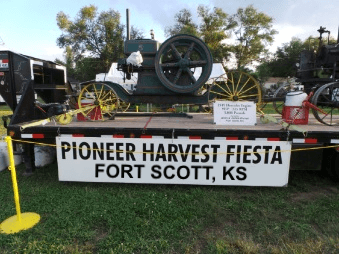
This is the 70th and final year for Pioneer Harvest Fiesta (PHF), according to a press release.
PHF is Kansas’s oldest antique farm show, according to Jim Kemmerer, a spokesman for the annual event in Bourbon County at the fairgrounds.
The event kicks off with a Parade of Antique, Classic Farm Implements and More through Fort Scott’s historic downtown on October 1 at 6 p.m. on Main Street.
All three days are alive with events that help tell the story of life in the area in earlier times.
Steam Engines, Blacksmiths, Food and Flea Market Vendors, Drag Saw Demonstrations, Tractors & Gas Engines on Display, Baker Fan Demonstrations, Quilt Show, Straw Baling, Wheat Threshing, Corn Husking/Shelling, Sorghum Making Demonstration, Rock Crushing, Saw Mill Operation, Car Show, Tractor Pull (Antique & Classic), Garden Tractor Pull, and many more learning events.
It’s one great weekend to kick off Fall in the 4-state’s region, according to its website.
Friday, October 2, through Sunday, October 4, events, vendors, demonstrations, etc. will be at the Bourbon County Fairgrounds on South Horton Street, across from Fort Scott Community College.
A 2015 photo of some of the farm implements on display.Quilts displayed during the Pioneer Harvest Fiesta 2015. The quilt show is October 2-4 at the event in 2026.
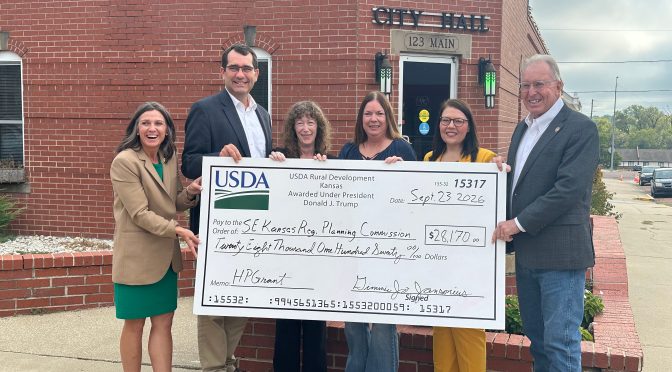
This week, U.S. Rep. Derek Schmidt welcomed Glen Smith, USDA Undersecretary for Rural Development, to Southeast Kansas for a rural housing roundtable in Fort Scott. Schmidt thanked everyone who joined the discussion and shared their perspectives, and also thanked USDA for presenting a $28,000 check to help address specific housing needs in Bronson.
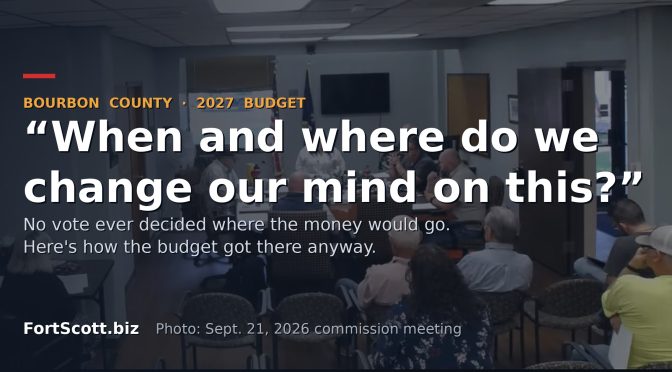
FORT SCOTT — Bourbon County commissioners spent part of their Sept. 21 meeting trying to work out when they had agreed to shift money between funds in the 2027 budget. They never voted on it, and they did not agree about what their earlier discussions had settled. Meeting video and the county’s own minutes show how the idea moved forward over four meetings without a vote.
Aug. 24: a stated goal, no vote
Commissioner Mika Milburn-Kee described what she wanted from the budget: “keep everybody exactly where they’re at, revenue neutral, but us take the assessed valuation increase of that two mil and put it in the reserves in the general fund” (video, 52:45). She put that growth at “approximately $300,000, a little bit less.” The only vote on the 2027 budget that night authorized publishing the hearing notice. The minutes, approved Sept. 9, record the idea as “the Commission’s overall objective.”
Aug. 31: a new recommendation, with Tran absent
A week later, budget consultant Matt Lawn of Baker Tilly recommended “lowering that mill levy” for Road and Bridge “by about four mills and then essentially pushing those mills back into general fund and the employee benefit fund,” using one-time FEMA reimbursement money in the road fund (video, 23:20). He said the plan was based on “some requests that I’ve got from you guys.”
Commissioner Samuel Tran was absent. The commission took no vote on the recommendation. County Treasurer Jennifer Hawkins cautioned that part of the road fund’s balance predates the FEMA reimbursements and that some is needed to match bridge grants. The minutes say the commission directed that her reconciliation of those funds “be completed before any mill reallocation is finalized.”
Sept. 14: the shift shows up in the numbers
After the revenue-neutral rate hearing, Lawn walked through how mills had been moved between funds while the total levy stayed flat: up 2.313 mills in the employee benefit fund and down 1.134 mills in Road and Bridge, among other changes. He said the Road and Bridge cut was smaller than first proposed because some of the FEMA money was “already spoken for” and some had to stay in its special project fund, and that the changes were made “based on council priorities.” The commission voted 5-0 to exceed the revenue-neutral rate but did not adopt the budget. Later that night, all five commissioners, Tran among them, voted to approve the Aug. 31 minutes describing Lawn’s recommendation.
Sept. 21: “When and where do we change our mind?”
When Lawn described moving Road and Bridge money into the employee benefit fund, Tran objected. “That’s the last thing I remember the five of us talking about,” he said of the general fund plan. “We agreed to that, all of us, unanimously” (video, 12:26). “I just want to know when and where do we change our mind on this.”
Milburn-Kee said she was “fine with general.” Lawn said he was “merely saying what Commissioner [Milburn-Kee] asked me to consider” and was open to whatever the board wanted. Tran asked who had directed the change. “Projections. Nobody directed,” Milburn-Kee said, explaining that Lawn had projected what Road and Bridge would overspend in 2026 and carried that forward (video, 13:20).
About 25 minutes later, Commissioner David Beerbower said he did not remember that discussion at the table. “Did we vote?” he asked. “No,” Tran said. “We never voted because we weren’t voting at the time. It was just a consensus like, hey, that’s a good idea” (video, 37:42). He said two commissioners had liked the idea, “so I kept it in the back of my head.”
“To be fair for Matt, we’re throwing him all over the place because we haven’t voted on a single thing,” Milburn-Kee said.
Tran then told Lawn that direction should come only from the full board. “Any marching orders that you get should come from the table,” he said. “It should always come from the table where there’s a consensus. … We rule as a body, not as a single person” (video, 38:35).
“To be fair to him again, we haven’t made any motion here,” Milburn-Kee said of Lawn. “He’s just listened to all the conversations and tried to build something.”
What’s next
The allocation also bears on raises: the draft includes a 5% wage increase across departments, and Milburn-Kee pressed Lawn on whether it rests on one-time money. Lawn agreed to bring about four versions of the budget. The budget must be adopted by Sept. 30, and the commission’s next regular meeting is Sept. 28. Full coverage of the Sept. 21 meeting is also available.
The Pioneer Harvest Fiesta Quilt and Fiber Arts Show returns this year with quilts and fiber art projects on display at the Meyers Building at the Bourbon County Fairground, October 2-4.
Area quilters and fiber artists are invited to enter items that have never been exhibited before in the show. Fiber art includes any work done with thread, yarn, fiber or fabric — weaving, rug hooking, spinning, knitting, crocheting, embroidery, needlepoint, cross stitching, tatting, needle felting, macrame and more.
In addition to the exhibits, fiber artists will be present at various times during the show working on their current projects. The public is invited to drop in, view the exhibits, talk to the artists, and bring their own needlework projects to work on.
“A quilt and fiber arts show is a wonderful place to come be inspired, encouraged, and tempted,” said Linda Rogers, this year’s show organizer. “You will see some fantastic quilts, some showcasing new techniques and contemporary colors, as well as more traditional quilts. And if you are thinking about taking up a new craft, or if you are in the middle of a needlework project and have hit a roadblock, maybe one of our quilters or artisans can make suggestions to help you.”
Quilting and fiber arts are examples of “what goes around comes around.” Generations ago, quilting and needlework were necessary skills, then became less important as mass production took over. During the craft revival of the 1970s, interest in unique handmade items resurged, and crafts like quilting and weaving were rediscovered. Now new generations have again “rediscovered” these “granny crafts.” Today traditional crafts continue in homes and studios by women and men who enjoy creative pursuits as a hobby, a source of income, or simply to fulfill a need to create art. In a hyper-connected, technology-driven world, both adults and youth are finding the simple joy and calm that comes from working with colors and textures to create something tangible with their own hands.
Show Details
Take-in (to enter items): Thursday, October 1, 11:00 a.m. to 2:00 p.m. There is no fee to exhibit items. The only award given is a “People’s Choice Award.”
Public viewing hours: Friday, October 2 and Saturday, October 3, 9 a.m. to 4 p.m.; Sunday, October 4, 11:00 a.m. to 2:00 p.m. Admittance is free.
Item pickup: Sunday, October 4, 2:30 to 3:00 p.m.
For more information, contact Linda Rogers at 620-215-4905.