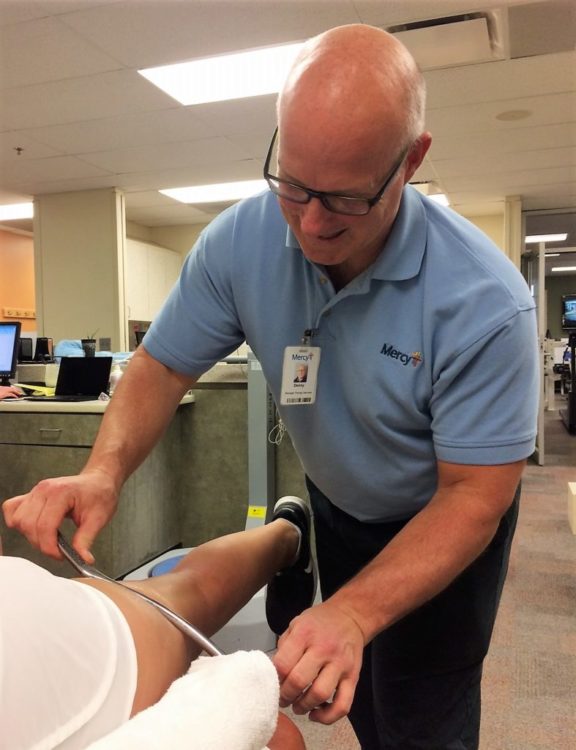
Daniel Jenkins, CPRF Wheelchair and Posture Seating Clinic Technician, adjusts the positioning of a joystick on a customized wheelchair.
The Cerebral Palsy Research Foundation (CPRF) of Kansas is a United Way of Bourbon County agency.
FortScott.Biz is providing a series featuring each agency in the coming weeks.
United Way is primarily funded through donations from local businesses when employees agree to donate an amount through payroll deductions.
Gina Shelton, president of United Way of Bourbon County said the cost of a purchased soft drink, one dollar if it was payroll deducted by many people, would help the agency meet its 2018 Campaign goal of $50,000.
The following is from an interview with Kacee Shuler, director of public relations with Cerebral Palsy Research Foundation of Kansas.
The contact person is Shuler, who can be reached at 316-688-1888 or [email protected]
What service do you provide for our community?
“We provide customized wheelchair and posture seating services, financial aid for assistive technology and medical equipment, and accessible living opportunities. All CPRF programs are designed to promote quality of life and independence for individuals with disabilities.”
When are you open? Monday through Friday, 8 a.m. to 5 p.m.
Local address?
“We do not have an office in Bourbon County. Our Wichita address is 5111 E 21st St N | Wichita, KS 67208.”
What percentage of your budget is the United Way grant?
“On average, our allocation is about 50 percent of our budget in Bourbon County.”
Submitted photo of Kenny Felt. Felt is promoting awareness of human trafficking by photographing local people who will post on their individual social media platforms on Feb. 22, Shine A Light On Slavery Day.
The End It Movement is about human trafficking.
Local photographer Kenny Felt decided to get involved in bringing awareness to the human rights issue.
“I don’t know a lot, but I know enough to be scared of it,” Felt said.
“It’s hard to get a number of victims because it’s a hidden practice,” he said. “The victims aren’t known, have no voice or ability to speak out.”
“How many times have we seen something and did nothing,” Felt said. “This is my attempt to bring awareness.”
The red x symbol was designed to spark a conversation, he said.
February 22 is “Shine A Light On Slavery Day”.
“I don’t have the ability to do much, but I can take pictures and post them on Feb. 22,” Felt said.
He set a goal to get 50 photos of local people with a red x painted on them.
“More than that have joined in so far,” Felt said.
Each participant posts on their own social media.
Adam LaRoche is a supporter of the End It Movement.
“I will post a movie gallery on my Facebook page on Feb. 22,” he said.
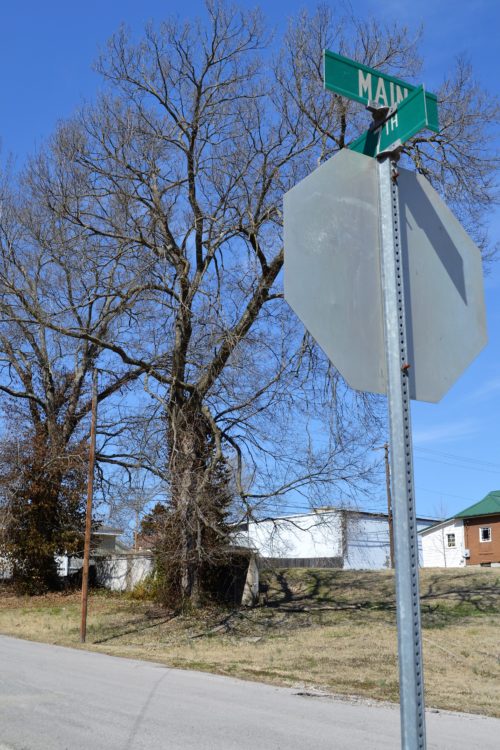
To have a free photo taken by Felt to post on social media in support of this cause, he is available to take photos for this project at his studio 13 N. North Main:
Human trafficking is the criminal activity of holding another person for the purposes of exploitation through forced labor and sex trafficking, according to a Kansas Department of Labor (KDOL) website: dol.ks.gov/HumanTrafficking.
Even here in Kansas, men, women, and children are forced to work for long hours under deplorable conditions for little or no pay without the freedom to leave, according to the KDOL website.
Notice to Victims of Human Trafficking
If you or someone you know is being forced to engage in any activity and cannot leave – whether it is commercial sex, housework, farm work or any other activity – call the toll-free National Human Trafficking Resource Center Hotline at 1‑888‑373‑7888 to access help and services, according to the website. The toll-free hotline is available 24 hours a day, seven days a week and available in many languages.
Indicators of Human Trafficking
According to the Department of Homeland Security at dhs.gov/blue-campaign here are some common indicators to help recognize human trafficking:
Does the person appear disconnected from family, friends, community organizations, or houses of worship?
Has a child stopped attending school?
Has the person had a sudden or dramatic change in behavior?
Is a juvenile engaged in commercial sex acts?
Is the person confused, or showing signs of mental or physical abuse?
Does the person have bruises in various stages of healing?
Is the person fearful, timid, or submissive?
Does the person show signs of having been denied food, water, sleep, or medical care?
Is the person often in the company of someone to whom he or she defers? Or someone who seems to be in control of the situation, e.g., where they go or who they talk to?
Does the person appear to be coached on what to say?
Is the person living in unsuitable conditions?
Does the person lack personal possessions and appear not to have a stable living situation?
Does the person have freedom of movement? Can the person freely leave where they live? Are there unreasonable security measures?
Not all indicators listed above are present in every human trafficking situation, and the presence or absence of any of the indicators is not necessarily proof of human trafficking.
Are you itching to get out of the house and do something productive in the landscape? If you have fruit trees, then now is the time to prune! A little planning ahead with fruit trees can mean big rewards later in the growing season.
Are you like many who are “afraid” to prune? Don’t be. When done correctly, pruning is an essential component of growing a healthy, productive fruit tree. Fruit trees should be pruned every year and for several reasons. The first is the development of a strong tree structure. Pruning should begin when the tree is planted and continued each year thereafter. Another reason to prune is the increased penetration of sunlight for the development of fruit buds and for the fruit to mature properly.
Trees can be pruned this early (winter) because they are dormant. This can be done in January, February and even early March. Pruning when trees are dormant makes it easier to see undesirable branches because leaves aren’t present. It is important to do any pruning before dormant sprays are applied, to avoid spraying some of the wood that will later be removed. Total spray coverage of limbs, branches, and shoots will be increased after pruning. Do not prune if temperatures are below 20°F because this can cause tissue damage.
Have your fruit trees been neglected for quite some time? If so, pruning can seem like an overwhelming task; where to start, how much wood to remove, etc. But a neglected tree can be revitalized.
The first step in revitalizing a neglected tree is to prune wood around the trunk area and near the ground. Remove all sucker growth around the trunk by cutting as close as possible to the point of origin. Next, remove all branches that hang below a 4-foot level. Prune them off at the supporting limb. Stand back and study the tree and decide the next cut to make. Retain scaffolds that are growing away from the tree center at wide angles with the trunk. Scaffolds are one of the main branches making the basic framework of a tree. They should be positioned on different sides of the tree for good distribution of the fruit crop.
The right tools are needed for proper pruning. Tools always need to be sharp so clean cuts can be made. Cuts that result in bark tears, stubs, or jagged surfaces are slow to heal and may even not completely heal. A scissor type of hand shear is used to prune small size wood, usually ¼ inch in diameter. Long handled loppers should be used to cut ¼ to ½ inch wood. These will need to be used generally by the third year of tree growth. For branches larger than ½ inch, use a fine-toothed pruning saw.
The Extension office has a publication titled, “Pruning Fruit Trees,” that explains in more detail how to prune depending on the age of the tree. It also has a section devoted to pruning different types of fruit trees. The publication has diagrams that demonstrate how and where pruning cuts should be made. As with most Extension services, this publication is free of charge.
If you would like me to evaluate your trees, give me a call and a home visit can be scheduled.
Krista Harding is a K-State Research and Extension Agricultural agent assigned to Southwind District. She may be reached at 620-244-3826 or [email protected].
K-State Research and Extension is an equal opportunity provider and employer.
Fort Scott Munitions President Robbie Forester, left, along with City of Fort Scott Community Development Director Rhonda Dunn greet Lt. Governor Tracey Mann Thursday morning in front of the business.. In the background from left is Office of the Governor’s Communication and Policy Specialist Daniel Seitz, and Kansas Director of Legislative Affairs Tim Shallenger. Behind Mann is David Soffer, special assistant to the Governor.
Lt. Governor Tracey Mann began his day in Fort Scott Thursday morning.
The newly appointed Kansas Lt. Governor went on a statewide tour, including two stops in Southeast Kansas.
Mann met with employees of Fort Scott Munitions, 523 E. Wall, for a tour of the business.
Fort Scott Munitions President Robbie Forester told FortScott.Biz the governor’s office requested the meeting with the business.
Fort Scott city officials Dave Martin, Rhonda Dunn, and Rachel Pruitt came to greet the lt. governor’s entourage.
To the employees of the business and the city officials, Mann said the focus of the newly formed team of Governor Jeff Colyer is “reform, jobs, and education.”
Communication and Policy Specialist Daniel Seitz said the tour is to visit small businesses and some community colleges to talk about Governor Colyer’s vision for Kansas’ future.
Following a short tour of the business, the entourage headed south to Columbus to view Crossland Construction Co.
Fort Scott City Manager Dave Martin, right, walks with Lt. Governor Tracey Mann into Fort Scott Munitions Thursday morning.Lt. Governor Tracey Mann listens to Ryan Kraft during a tour of Fort Scott Munitions Thursday morning. Kraft created the business.
Mann was selected Feb. 13 to be Kansas Governor Jeff Colyer’s Lt. Governor.
Tracey Mann is the managing director and principal of Newmark Grubb Zimmer, a commercial real estate company headquartered in Kansas City. Prior to this, Mann served as senior program director for the National Student Leadership Forum on Faith and Values, according to a press release.
Mann has previously served on the board of directors for the Kansas Agriculture and Rural Leadership (KARL) program and the Kansas Chamber of Commerce. He is also a board member of the City Teen Center, a non-profit educational facility serving children in Salina.
Tracey Mann is a fifth-generation Kansan from Quinter, Kansas. He regularly returns to work on the family farm.
He earned a degree in Agricultural Economics from Kansas State University in 2000, where he also served as Student Body President. In 1997, Tracey served as Jerry Moran’s first intern in Washington, DC.
Tracey, his wife, Audrey and their four children live in Salina, Kansas.
The sign atop the new John Deere Tech Program building at the intersection of Horton and 23rd Streets. The building is located on the easternmost segment of the main campus of Fort Scott Community College..
The public opening of the new John Deere Tech Program at Fort Scott Community College was held at the site Feb. 9.
A hamburger lunch was provided by the college.
Attending were prospective students, local residents, business corporations, FSCC staff and Fort Scott Chamber of Commerce members.
Attendees of the Fort Scott Community College John Deere Tech Program grand opening eat in the largest building of the tech complex. This building is the old National Guard Armory at Horton and 23rd streets.The college provided a hamburger lunch for attendees of the John Deere Tech Program official opening.
Following the lunch were speeches and a ribbon cutting sponsored by the Fort Scott Chamber of Commerce.
FSCC President Alysia Johnston speaks to the crowd at the public opening of the new John Deere Tech Program building, completed in December 2017.
Tours were given prior to the event for those interested.
FSCC President Alysia Johnston left, gives a tour of the renovated welding shop located north of the new tech program building. At right is FSCC Board of Trustees Member Dana McKenney.
A building north of the new John Deere Tech Program building was renovated for welding classes instruction. The program began in August, with Brandon McAdam, as the instructor.
The John Deere corporation supplies new and used tractors for training the students, said Dale Griffiths, tech program instructor.
Additional old tractors are supplied by dealers and individuals, he said.
Currently, there are 23 students in the program, mostly from Kansas and Missouri, Griffiths said.
“Ninety-five percent of the students will have a job waiting for them,” Griffiths said. “Technicians are the most demanded field in the ag. equipment business.”
Classes are in session from Monday through Thursday, Griffiths said.
“Most kids will travel back to work at their dealers,” he said.
In this program, students are required to work through a qualified dealership that provides paid internships throughout the program’s two years, according to information provided by FSCC.
After completing the program, students receive an associate of applied science degree and can transfer to Pittsburg State University to complete a four-year management option.
Many students choose to stay with their sponsoring dealerships to begin their career as a technician.
Federal loan and grant programs are available to students who qualify. For more information contact the financial aid office at 620-223-2700 or visit fortscott.edu.
Topeka – Governor Jeff Colyer today announced the selection of Tracey Mann to serve as Kansas Lieutenant Governor.
“I am pleased that Tracey has agreed to join our team as Lieutenant Governor”, said Colyer. “Tracey has been a leader on economic development and rural issues in Kansas for years, and I am excited to bring those skills to our team. Tracey truly knows what it means to listen, serve and lead.”
“I look forward to working with him in the weeks and months ahead to usher in a new day in Kansas politics and serve the people of this great state.”
Tracey Mann commented that he was impressed with Governor Colyer’s willingness to lead, saying “I am extremely grateful for the opportunity to serve as Lieutenant Governor for Dr. Colyer. Over the years, I’ve been impressed with his willingness to serve as a leader on the hard issues.
“Governor Colyer’s track record shows he doesn’t shy away from tackling the difficult problems. I am excited to join him in serving the people of Kansas as we focus on reform, jobs and education.”
Kansas Farm Bureau CEO, Terry Holdren, added his endorsement of Mann as the new Lt. Governor, saying “Kansas farmers and ranchers, as the backbone of the state’s economy and heritage, expect good leadership from friends in positions across government,” said Holdren, “Tracey Mann is both a good friend of Kansas agriculture and a great leader. We look forward to working with him in this new role.”
Tracey Mann is the managing director and principal of Newmark Grubb Zimmer, a full service commercial real estate company headquartered in Kansas City. Before joining Newmark Grubb Zimmer, Mann served as senior program director for the National Student Leadership Forum on Faith and Values.
Mann has previously served on the board of directors for the Kansas Agriculture and Rural Leadership (KARL) program and the Kansas Chamber of Commerce. He is also a board member of the City Teen Center, a non-profit educational facility serving children in Salina.
Tracey Mann is a fifth-generation Kansan from Quinter, Kansas. He regularly returns to work on the family farm. He earned a degree in Agricultural Economics from Kansas State University in 2000, where he also served as Student Body President. In 1997, Tracey served as Jerry Moran’s first intern in Washington, DC.
Tracey, his wife, Audrey and their four children live in Salina, Kansas.
A good local health care system may itself be part of the prescription for maintaining a healthy rural economy.
In the year 2016, the healthcare sector accounted for an estimated 13.1 percent of Bourbon County’s total employment or about 1,246 jobs. In that same year, over one in four healthcare sector workers were employed at Mercy Hospital Fort Scott.
Those are just a couple of the finding published in a recent study by researchers at K-State Research and Extension and sponsored by the Kansas Hospital Association documenting the economic impact of the healthcare sector on a county-by-county level.
The report also noted that Mercy Hospital Fort Scott has a significant “ripple effect” or secondary impact on employment and income throughout other industries in Bourbon County. This occurs when the hospital’s employees spend their income locally for household goods and service. As dollars are spent locally, they are, in turn, re-spent for other goods and services.
For example, the 2016 study showed that Mercy Hospital’s 339 co-workers had an employment multiplier of 1.64. This means that for each job at the hospital, another 0.64 jobs are created in other businesses and industries in the county’s economy. The direct impact of those 339 hospital employees resulted in an indirect impact of 217 jobs (339 x 0.64 = 217) throughout all businesses and industries in the market area. Thus, the hospital employment had a total impact on area employment of 377 jobs (339 x 1.64 = 556).
Similarly, multiplier analysis can estimate the total impact of the estimated $28,493,000 direct income for hospital employees. According to the data in the 2016 study, Mercy Hospital Fort Scott had an income multiplier of 1.23, which indicates that for every one dollar of income generated in the hospital, another $0.23 is generated in other businesses and industries in the county’s economy. Thus, the hospital had an estimated total impact on income throughout all Bourbon County businesses and industries of $35,069,000 ($28,493,000 x 1.23 = $35,069,000) (numbers rounded)).
The study’s authors calculated economic multipliers for 13 healthcare sectors from dentists, to veterinarians, to home care services and estimated that health care services, directly and indirectly, accounted for 1,737 jobs throughout the county. Furthermore, they estimate that Bourbon County’s health care sector employees accounted for more than $75 million in total county income and over $21 million in county retail sales.
“As with most rural areas, the health sector in Bourbon County plays an important role in the economy,” said Reta Baker, Mercy Hospital Fort Scott president. “I think we tend to take our local health services for granted, just a little. We don’t realize how important health care is to the county’s economic well-being.”
That is exactly the point the reports are trying to get across, according to Dr. John Leatherman, an agricultural economist at K-State’s Office of Local Government and lead author of the report. He points out that access to affordable quality local health care services is essential to attracting and retaining local businesses and retirees.
“Research has shown time and again that local health care and education are two enormously important factors for economic development,” Leatherman said, “and both can be positively or negatively influenced by local action or inaction.” He said the local health care system has sometimes been the “tie-breaker” in industry location decisions and that retirees view quality local health care as a “must have” local service.
Tom Bell, president and CEO for the Kansas Hospital Association said, “Kansas hospitals are a critical piece of the economic engine in Kansas communities and a symbol of continued community cohesion. They are important not only for the healthcare services they deliver but for maintaining the overall economic vitality and viability of the communities they serve.”
Copies of the full report have been distributed and are available free of charge at the Kansas Rural Health Works Web site at: www.krhw.net.
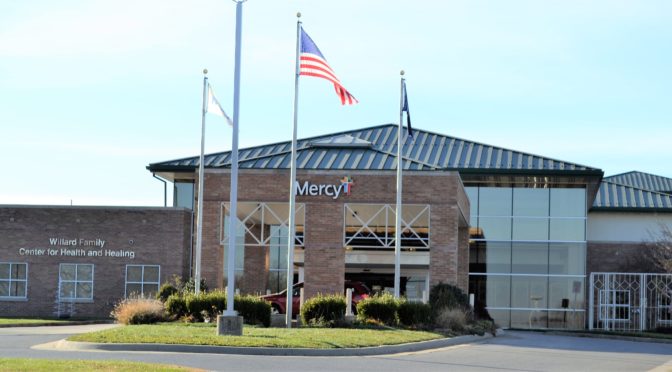
Mercy Hospital Fort Scott is an acute care hospital with 46 licensed beds, offering comprehensive medical, surgical, OB/GYN, pediatric, home care and hospice services. Inpatient care is provided with 24/7 physician coverage. In 2017, Mercy Hospital Fort Scott received The Leapfrog Group’s prestigious A rating. Mercy Clinic Fort Scott is located on hospital grounds as well as Mercy rural health clinics in Arma and Pleasanton.
Mercy, named one of the top five large U.S. health systems in 2017 by Truven, an IBM Watson Health company, serves millions annually. Mercy includes 44 acute care and specialty (heart, children’s, orthopedic and rehab) hospitals, more than 700 physician practices and outpatient facilities, 40,000 co-workers and more than 2,000 Mercy Clinic physicians in Arkansas, Kansas, Missouri, and Oklahoma. Mercy also has outreach ministries in Arkansas, Louisiana, Mississippi, and Texas.
Photo Credit: FSCC. Student Dylan Giager and Carpentry Instructor Kim Coates at the 53rd annual SkillsUSA National Leadership and Skills Conference in 2017.
February is Career and Technical Education (CTE) Month.
Carpentry, heating and air conditioning, masonry and welding classes at the Career and Technical Education Center in Pittsburg, which offers Fort Scott Community College classes have seen a rise in enrollment, according to Kris Mengarelli, CTEC Executive Director.
“I do not have a current number of high school students for this spring, but (I do) for Fall 2017 – I know enrollment is up for the Spring semester,” he said.
Mengarelli is glad to see the increase.
“There are significant opportunities in the trades workforce,” Mengarelli said. “Trade businesses are in need of skilled workers to fill the demand of a workforce that is moving toward retirement. In addition, according to Association for Career and Technical Education, students involved in CTE courses are more engaged, graduate at higher rates and go on to post-secondary education.”
The statistics for the fall semester at CTEC that Mengarelli produced:
In heating and air conditioning, there are 10 male students whose average age is 23. None are high school students. The students are from Bourbon, Crawford, Allen, and Anderson counties.
For masonry, there are 17 students, 15 males, and two females with an average age of 18, from Crawford, Cherokee, Montgomery counties and two out of state students. Eight are high school students from Pittsburg, Girard, and Southeast.
For construction trades, there are 23 students, 20 males, and three females with an average age of 18. They are from Crawford, Labette, Allen, Anderson, and Cowley counties and two out of state students. Nine are high school students from Pittsburg and Girard.
For welding, there are 61 students, 57 males, and four females with an average age of 21. They are from Crawford, Cherokee, Bourbon, Johnson, Anderson, Linn, Miami counties and out of state.
There are 32 high school students in this group, from Pittsburg, Frontenac, Northeast, St. Mary’s Colgan, Southeast, and Girard.
For more information contact:
Kris Mengarelli
CTEC Executive Director [email protected]
(620) 232-5644
Chris Sterrett
Heating, Ventilation, Air Conditioning & Refrigeration (HVAC) Instructor [email protected]
(620) 232-5644
The theme for CTE Month is Celebrate Today, Own Tomorrow! This month provides CTE programs an opportunity to demonstrate how CTE makes students college and career ready and prepares them for high-demand career fields, according to a Kansas Department of Education press release.
CTE in Kansas helps meet the needs of business and industry through the development of the foundational knowledge and skills aligned to the Kansas workforce.
Kansas has 16 Career Clusters for students to choose from, and there are 35 Career Cluster Pathways, according to the press release.
A Career Cluster is a group of occupations similar in skill set and training.
Career Cluster Pathways are focused on specific areas of study leading to a particular area of industry or business. These occupations fall within seven career fields in Kansas — agriculture; business; design, production, and repair; family and consumer sciences; health; media and technology; and public services.
Kansas schools have 2,606 pathways across these fields.
John Tidwell, left, talks with Bill Pollack following the Kansas Humanities Council Presentation Thursday at the Gordon Parks Museum at Fort Scott Community College. At right, Melody Leavitt waits to speak to Tidwell.
Kansas University Professor John Edgar Tidwell spoke to a room full of people Thursday during the Kansas Humanities Series Lunch and Learn at Fort Scott Community College’s Gordon Park Museum.
The event was in celebration of Black History Month.
Tidwell gave some history on how President Abraham Lincon, with the Emancipation Proclamation in 1863 and Dr. Martin Luther King, in the March On Washington in 1963 helped to change America.
“They led the way to freedom,” Tidwell said.
Although the Emancipation Proclamation did not end slavery in the nation, it captured the hearts and imagination of millions of Americans and fundamentally transformed the character of the war. After January 1, 1863, every advance of federal troops expanded the domain of freedom. Moreover, the Proclamation announced the acceptance of black men into the Union Army and Navy, enabling the liberated to become liberators. By the end of the war, almost 200,000 black soldiers and sailors had fought for the Union and freedom, according to https://www.archives.gov/exhibits/featured-documents/emancipation-proclamation
“There were creed and practice differences,” Tidwell said of American history.
During the March On Washington For Jobs and Freedom on August 28, 1963, Dr. King gave a powerful speech that helped the progress of the Civil Rights Movement.
The most memorable part of the speech was after Mahalia Jackson, the black Gospel singer, shouted out “Tell them about the dream!” Tidwell said.
King then set aside his written speech and spoke spontaneously to the approximately 250,000 people gathered that day.
Jackson was on the platform that day of the march, as a singer.
Here is a clip of that speech:
Black women were at the forefront of the movement, he said, but “they were marginalized and doubly oppressed by racism and sexism”.
Tidwell encouraged the audience to “try to find ways to sustain mutual respect” in the current era of American history.
“Find one thing you see right and work towards that,” he said.
“What can we learn from Lincoln’s struggle with slavery and Dr. King’s efforts to set forth a dream rooted in the American Dream?” Tidwell asked.
“History can be a great teacher. One lesson we can learn is that we are only as free as the respect we show others. In my view, the world we now live in is best described as uncertain.
“No, it is not the world of Dr. King’s separate drinking fountains, segregated classrooms, the real estate practice of red-lining, and other acts of racial discrimination.
“As made clear by the recent outcome of the presidential campaign, our world is beset with an enervating discourse rooted in divisiveness, intolerance, and discord. The moral imperatives of civility, mutual respect, and common sense have been sacrificed to political cant and ethnocentrism.
“The politics of insincerity and expediency have become poor substitutes for compassion and statesmanship.”
“I want people to understand that once they have sympathy and empathy for others, that will translate into an improved engagement with our history, our traditions and all those things that make us, us,” Tidwell said in a later interview. “I want this speech to inspire a little bit for how they can work together on a goal that will enhance everybody’s situation, not just their own”.
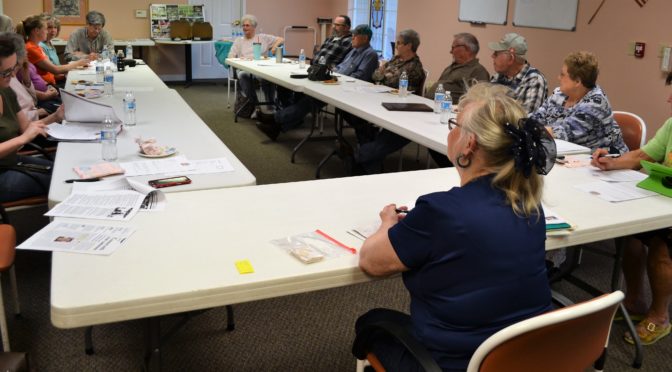
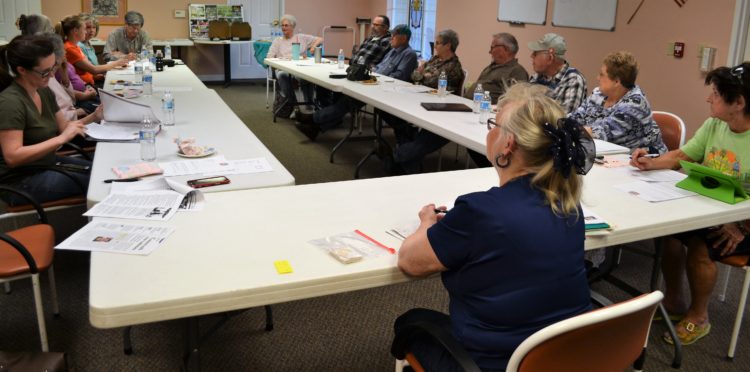
The audience eats lunch and converses before John Tidwell speaks for the Kansas Humanities Council Series presentation at Fort Scott Community College.