Similarities and differences in prior Kansas polling-place prosecutions and the current Bourbon County case.
The charges against Commissioner Milburn-Kee
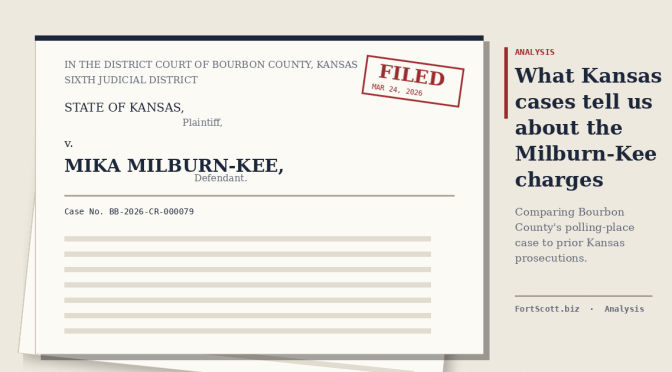
On March 24, 2026, the Kansas Attorney General’s office filed a two-count misdemeanor complaint against Bourbon County Commissioner Mika Milburn-Kee. Count One is a general charge for interfering with public business in a public building. Count Two, what is looked at in this article, charges her under K.S.A. 25-2413(c), the polling-place “three-foot rule”: a Class B misdemeanor to come within three feet of a voting booth or an election-board table unless you are there to vote or the supervising judge lets you. The law is associated with K.S.A. 25-2432, which says a public official who is convicted of an election crime loses their office (25-2413; 25-2432).
What is alleged
A prior FortScott.biz summary of the security-camera video describes the commission meeting room being used during early voting to validate voters and handle provisional ballots. On October 25, 2025, Milburn-Kee is shown sitting at the commission table near a stack of what election officials said were unverified provisional ballots, reading a newspaper, and waving and greeting a voter through the open doorway. County Clerk Susan Walker is shown twice telling her she cannot be in the polling-area rooms; on the second try, Walker offered to help move her things and said she would call the police if required. Milburn-Kee moved to an adjoining office about twelve minutes after first being told to leave.
The closest Kansas comparison: Blubaugh
In October 2024, Meghan Blubaugh — the wife of a newly elected Sedgwick County commissioner — wore a T-shirt with her husband’s campaign name on it to an early-voting site in southwest Wichita. Poll workers asked her to turn it inside out, and she refused. The county Election Commissioner then came to the site in person and asked her again, and she refused a second time. Poll workers called the Secretary of State’s office, and Blubaugh was charged under K.S.A. 25-2430 (electioneering), a Class A misdemeanor. In January 2025, the case was resolved by diversion, with about $160 in court costs and completion of a county election-worker training. Diversion is not a conviction, but does usually require one to admit fault. If she finishes the program, the case is dismissed with nothing on the record.
This seems to be about the closest match to an election-related case in Kansas. The original polling-place misdemeanor filing, a politically connected defendant, and an alleged refusal to follow an election official’s on-site instruction. The result was Blubaugh choosing to admit guilt and take a diversion rather than fight the charge.
But there are differences. Blubaugh wasn’t a sitting elected official, so forfeiture of office was never on the table; the statute charged was different, and her conduct unfolded over a shorter window than the roughly twelve minutes in Milburn-Kee’s video summary. Diversion can be offered in one case and declined in another, so the fact that it was used in the Blubaugh case doesn’t mean it would be an option in another case, even if the situation were the same.
Milburn-Kee was not charged under 25-2430 herself, even though she greeted a voter. That statute is aimed at campaign advocacy (candidates, parties, ballot questions). The public description of her interaction doesn’t mention campaign material.
The same-statute comparison: Ceballos
Joe Ceballos-Armendariz, the former mayor of Coldwater, was charged in November 2025 with six felonies for voting as a Mexican citizen and lawful permanent resident in three prior elections. His defense attorney, Jess Hoeme, initially told KCUR he was “confident he’ll beat this” by arguing Ceballos never intended to commit crime a before a jury. However, his case was resolved when he plead guilty to a lesser crime. April 20, 2026 Ceballos pled guilty to three Class B misdemeanor counts of K.S.A. 25-2413 (the same statute cited in Count Two against Milburn-Kee). In exchange, the court dismissed all six felonies Ceballos was charged with. The sentence after the plea deal involved a $2,000 fine plus costs, six months jail per count (but this was suspended), and one year of probation.
His sentence after pleading guilty to the lesser charge is probably the most current example of how 25-2413 has been applied in Kansas, but Ceballos’ case isn’t a perfect parallel for Milburn-Kee’s charges. Under Kansas law, elected officials must be legal electors, so he had to step down from Coldwater’s city council immediately instead of waiting to see if he won or lost the case. He also faced possible federal deportation tied to a conviction. Both can change what a plea is worth in ways that wouldn’t apply to a U.S. citizen serving out an elected term in an office they are legally qualified to occupy. He was also negotiating down from six felonies. With Commissioner Milburn-Kee’s case, it isn’t clear what lower charge might be offered in exchange for a plea, should she decide not to fight the charges.
Gaps in the record
Every Kansas 25-2413 and 25-2430 case that could be found ended in the defendant admitting guilt through a plea or diversion, and none of them went through trial to a verdict. So it is hard to determine, from past cases, how a judge or jury would apply the three-foot rule to facts like the current situation. The forfeiture-of-office statute is also doesn’t come up in these cases. It appears to make loss of office automatic on final conviction, but Ceballos wasn’t in office at the time of conviction, and Blubaugh wasn’t running for office. How forfeiture would work for an official who stays in office through a conviction is an open question.
One caveat: the Attorney General’s office, like most prosecutors, generally files cases it thinks it can win or settle, avoids cases it doesn’t think it doesn’t think are very strong, and publicizes wins more than losses.
On the one hand, this might indicate that the Attorney General doesn’t bring charges until their investigation gives them full confidence of a conviction. On the other hand, there might be cases that the AG drops that are harder to find in the judicial record. If they exist, they might indicate potential for Milburn-Kee to mount a successful defense.
Laws and legal filings:
- The criminal complaint in State v. Milburn-Kee, Bourbon County District Court Case No. BB-2026-CR-000079.
- K.S.A. 25-2413 — Disorderly Election Conduct
- K.S.A. 25-2432 — Forfeiture of Office or Employment Upon Conviction
Links to news stories on Kansas cases with similarities: