Open Property, Liability and Work Company Insurance Bids
KCAMP – Insurance Proposal
Will Wallas – EMPG Grant
Anne Dare – Audit
Lora Holdridge – Road Closing State of Kansas
Approval of District Court Budget for submission to State
County Counselor Comment
Susan Bancroft, Finance Director Comment
Public Comment
Elected Officials Comment
Commission Comment
Justifications for Executive Session:
KSA 75-4319(b)(1) To discuss personnel matters of individual nonelected personnel to protect their privacy
KSA 75-4319(b)(2) For consultation with an attorney for the public body or agency which would be deemed privileged in the attorney-client relationship
KSA 75-4319(b)(3) To discuss matters relating to employer-employee negotiations whether or not in consultation with the representative(s) of the body or agency
KSA 75-4319(b)(4) To discuss data relating to financial affairs or trade secrets of corporations, partnerships, trust, and individual proprietorships
KSA 75-4319(b)(6) For the preliminary discussion of the acquisition of real property
KSA 75-4319(b)(12) To discuss matters relating to security measures, if the discussion of such matters at an open meeting would jeopardize such security measures.
Governor Laura Kelly Announces Kansas’ September Tax Receipts
~ Kansas’ Total Tax Collections Grow $147.6 Million Compared to Same Time Last Year~
TOPEKA – Today, Governor Laura Kelly announced Kansas’ September total tax receipts were $876.5 million. Those collections are $162.2 million, or 22.7% more than the estimate and a growth of 20.2%, or $147.6 million, from last September.
“Our tax collection numbers continue to show promising growth,” said Governor Laura Kelly. “In the months ahead, we must maintain fiscally-responsible policies to strengthen our growing economy.”
Individual income tax collections were up $51.8 million, or 14.6%, for the month with $406.8 million collected. That is $48.2 million, or 13.4%, more than the same month of 2020. September corporate income tax receipts, which are comprised primarily of estimated tax payments, have continued to trend upward. Corporate income tax collections were $85.3 million, or 142.1%, more than the estimate with $145.3 million collected. That is a growth of $55.6 million, or 62.0%, from the same month of last year. September 2021 corporate income tax collections were also 46.8% more than September 2019 actual receipts.
“After three quarters, these higher-than-expected estimated payments are a strong indication that corporations anticipate improved profit margins in 2021,” Secretary of Revenue Mark Burghartsaid.
Retail sales tax collections were $225.2 million which is $15.2 million, or 7.2%, more than the estimate. Those collections are 15.1%, or $29.6 million, more than last September. Compensating use tax collections were $60.7 million which is $6.7 million, or 12.5%, more than the estimate. That is also $15.1 million, or 33.2%, more than September 2020.
Governor Laura Kelly Directs Flags be Flown at Half-staff to Honor National Fallen Firefighters Memorial Day
TOPEKA – In accordance with Executive Order 20-30, and in recognition of the National Fallen Firefighters Memorial Day on Sunday, October 3, 2021, Governor Laura Kelly has ordered flags throughout the State of Kansas to be flown at half-staff from sunup to sundown on October 3.
“This year, we lost three brave firefighters dedicated to protecting their communities from harm,” said Governor Laura Kelly. “On National Fallen Firefighters Memorial day, it is our responsibility to remember their lives and sacrifice and pay our respects to their families and loved ones.”
The honor is extended for all fallen firefighters – including firefighter Johnny Ivison Jr. of Easton, Kansas, who died in November 2020 responding to a house fire in Leavenworth County; Joshua Schwindt, who passed away in August 2021 after being electrocuted while responding to the scene of an accident; and Michael Baker, the Assistant Fire Chief in the 190th Air Refueling Wing in the Air National Guard, who died in September 2021 from complications caused by COVID-19.
“Johnny Ivison Jr., Joshua Schwindt, and Michael Baker paid the ultimate price in service to their communities. They will not be forgotten,” said Governor Laura Kelly.
Olys William “Bill” Lawrence, age 92, a resident of Ft. Scott, Kansas, passed away Thursday, September 30, 2021, at the Via Christi Hospital in Pittsburg, Kansas.
He was born February 11, 1929, in Picher, Oklahoma, the son of Eulys Lawrence and Annie May Simmons Lawrence.
Bill later moved to the Ft. Scott area where he was employed by the Western and later American States Insurance Company. He worked in the printing department and later in the computer department.
Following retirement from American States, Bill worked part-time for Cheney Witt Chapel for many years.
He enjoyed reading, walking and playing the piano.
He was a member of St. John’s United Methodist Church.
Survivors include his daughter, Yvonne Jones (Bill) of Fayetteville, Arkansas, his daughter-in-law, Brenda Lawrence and two grandsons, Gary Lawrence and Keith Lawrence all of Ft. Scott and several great-grandchildren and nieces and nephews.
He was preceded in death by his son, Jack Lawrence and five sisters, Blanch, May, Lena, Vonda and Veta and a special friend, Mary Jo Pellett.
Rev. Jim Brackett will conduct funeral services at 11:00 A.M. Tuesday, October 5th at the Cheney Witt Chapel.
Burial will follow in the Evergreen Cemetery.
Memorials are suggested to the St. John’s United Methodist Church and may be left in care of the Cheney Witt Chapel, 201 S. Main, Ft. Scott, KS 66701. Words of remembrance may be submitted to the online guestbook at cheneywitt.com.
KANSAS CITY, Mo., – Oct. 1, 2021 – Evergy has received customer reports today of individuals placing phone calls to customers and claiming to be Evergy representatives. The individuals are asking customers for immediate payment to avoid service disconnection. These representatives are not employees of Evergy. For past-due accounts, calls from Evergy requesting payment are never made the same day as the disconnection.
Several customers have contacted us after receiving suspicious calls. In most cases, the caller claims to be an Evergy customer service representative and asks the customer to provide credit card information or other personal information, telling the customer a check has bounced or he or she has a past-due bill. Imposters will often ask customers to use a pre-paid card for payment. Evergy will never ask a customer to purchase a pre-paid debit card to pay for service.
Customers may verify an individual is from Evergy by asking to see company identification or by calling the Customer Contact Center before giving any information such as your Evergy account number or banking information. If you can’t verify that you’re speaking with an Evergy employee, do not give them this information. Evergy Missouri and Evergy Kansas Metro customers may reach customer service toll-free at 1-888-471-5275. Evergy Kansas Central customers may call 1-800-383-1183. Customers can also review their account status online by visiting www.evergy.com.
Evergy wants its customers to know how to identify Evergy representatives. Employees will carry Evergy employee identification. For a service appointment, they may be driving an Evergy vehicle or wearing Evergy branded clothing. Evergy does not perform door-to-door sales. Evergy employees rarely need to enter a customer’s home.
Throughout the COVID-19 pandemic, scammers have increased calls, texts, emails, and in-person tactics and are contacting utility customers asking for immediate payment to avoid service disconnection. As a reminder, Evergy will never ask customers to make payments with a pre-paid debit card, gift card, any form of cryptocurrency, or third-party digital payment mobile applications. If you feel you have been a victim of a scam, please work with your local law enforcement agency to report the crime.
Governor Laura Kelly Announces New Dashboard Tracking COVID-19 Cases in Kansas School Districts
TOPEKA – Today, Governor Laura Kelly announced a new public dashboard tracking rates of COVID-19 disease and vaccinations in Kansas school districts on the Kansas Department of Health and Environment (KDHE) COVID-19 Resource Center.
“This dashboard will provide transparent, frequently updated information to help local health officials and school districts make informed, data-driven decisions to control the spread of COVID-19 among our students,” said Governor Laura Kelly. “My administration will continue working with our local partners and encouraging vaccinations among all eligible Kansans to beat this virus once and for all.”
This dashboard includes all cases of COVID-19 among school-aged children (ages 5-17 years) during the last 14 days and does not necessarily indicate where a student was exposed or that transmission occurred in the school setting.
The dashboard also tracks the cumulative COVID-19 vaccination rates among school-aged children (ages 5-17) by school district. Cases and vaccinations among school-aged children are aggregated to school district boundaries by the home address of individual cases. The data does not reflect exceptions for students who do not attend their assigned school district.
“Sharing this information in an easy-to-understand format will help parents and families understand the risks for COVID-19 in their own school district, empowering them to make the best choices to keep their kids safe in school by wearing a mask, getting tested regularly, and getting vaccinated if eligible,” said Dr. Stephanie Kuhlmann, the Safer Classrooms Workgroup co-chair.
“With so much misinformation being shared about COVID-19, this school dashboard provides a simple tool to help school districts keep track of what is happening locally and across the state,” said Dr. Jennifer Bacani-McKenney, co-chair of the Safer Classrooms Workgroup. “We will continue supporting our teachers and School Boards by providing timely, fact-based data so they can set strong policies to protect their kids, teachers, and staff.”
Data will be updated on the dashboard every Monday, Wednesday, and Friday. Data displayed represents the last 14 days.
Governor Laura Kelly Congratulates KDOT for Receiving National Recognition
~Turner Diagonal Project named Top 12 finalist in the 2021 America’s Transportation Awards competition~
TOPEKA – Today, Governor Laura Kelly congratulated the Kansas Department of Transportation (KDOT) for receiving national recognition for the Turner Diagonal project in Wyandotte County. The Turner Diagonal project was recently named a Top 12 finalist in the 2021 America’s Transportation Awards (ATA) competition.
“Congratulations to everyone at KDOT for receiving this well-deserved recognition for the Turner Diagonal project,” said Governor Laura Kelly. “Since day one, my administration has used transportation dollars for what they are meant for – improving our roads, bridges, and highways to create jobs, grow our economy, and improve quality of life for all Kansans. This recognition is proof that our efforts are working.”
The $30.3 million Turner Diagonal project in Kansas City reconfigured the interchange on I-70, allowing the release of nearly 50 acres of right-of-way and opened 300 acres of land for economic development and job creation. Using alternative delivery methods, the project was completed ahead of schedule, opening in less than a year from ground-breaking.
“From the start, the Turner Diagonal project embodied so much of our new IKE transportation program, building on the foundational elements of partnerships, options and problem solving,” said Kansas Department of Transportation Secretary Julie Lorenz. “With this project, we have delivered with public sector principles and private sector urgency.”
The Turner Diagonal project made use of public funds from the Unified Government of Wyandotte County, KDOT and a USDOT Build grant, as well as private-sector support. The Kansas Turnpike Authority donated right of way. Completing the project 20 months faster than traditional delivery months helped create 2,000 new jobs at Turner Logistics Park. Truck staging areas improved truck travel times in the area. Pedestrian paths and sidewalks provided a more sustainable, usable community asset.
The finalists – whittled down from 80 nominees from 35 state DOTs – now compete for the ATA Grand Prize and for the People’s Choice Award. Both prizes come with a $10,000 cash award, for a charity or transportation-related scholarship of the winners’ choosing.
The ATA People’s Choice award winner is selected through online voting. KDOT and Governor Kelly are encouraging Kansans to show their support by voting once a day for the Turner Diagonal project here. Voting is underway and continues until Oct. 25. Transportation industry experts will select the Grand Prize winner.
The national ATA winners will be announced at the American Association of State Highway and Transportation Officials (AASHTO) annual meeting at the end of October.
Customers without service can take advantage of special payment plan in October
Overland Park, Kan. – Oct. 1, 2021 – Colder temperatures are on the horizon, and Kansas Gas
Service urges customers with inactive service to sign-up for a special offering. During October,
customers who have exhausted standard payment arrangement opportunities can make a down
payment to restore their service.
“We understand many customers continue to navigate through the challenges of the pandemic,
and we don’t want any of them to go without their natural gas service,” said Abbey Frye, director
of Customer Service for Kansas Gas Service. “By taking advantage of this special offer to
re-establish service now, those customers can also avoid the winter rush that brings longer wait
times.”
How to sign up for the payment plan:
• CALL – Call the Kansas Gas Service Customer Contact Center at 800-794-4780.
• PAY – Pay one-fourth of the total account balance. The company will bill the remaining
balance in six monthly installments.
• SCHEDULE – Schedule service restoration. Customer Service Representatives are
available to assist Monday through Friday, 7 a.m. – 7 p.m.
Customers who are experiencing financial hardships may qualify for assistance through several
programs and community agencies. Visit the KansasGasService.com/Cares for energy assistance
resources.
About Kansas Gas Service
Kansas Gas Service provides a reliable and affordable energy choice to more than 640,000 customers in Kansas and
is the largest natural gas distributor in the state, in terms of customers.
Headquartered in Overland Park, Kansas Gas Service is a division of ONE Gas, Inc. (NYSE: OGS), a 100-percent
regulated natural gas utility that trades on the New York Stock Exchange under the symbol “OGS.” ONE Gas is
included in the S&P MidCap 400 Index and is one of the largest natural gas utilities in the United States.
For more information and the latest news about Kansas Gas Service, visit kansasgasservice.com and follow its social
channels: @KansasGas, Facebook, Nextdoor, LinkedIn and YouTube.
###
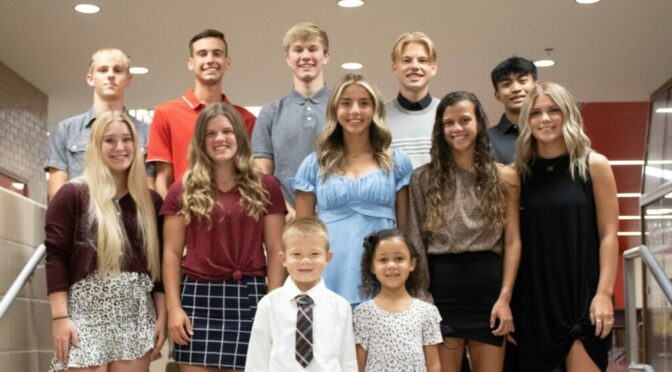
Fort Scott High School Homecoming is scheduled for next Friday, October 8. The coronation will be at 6:30 p.m. prior to the game against the Chanute Blue Comets.
Candidates are (middle row) Mckinzie Bohrer, Karlie Chipman, Emma Daly, Addisyn Fowler, Lindsay Majors, (back row) Parker Allen, Grant Feagins, Gibson Fess, Elijah Self, and Scott Tome. Little People are Bishop Glades and Blakely Graham (front row).
We all agree that honesty is a noble quality, but do we practice it when it costs us something? Literally “costs” us something?
Dave and I last week were in the San Francisco area, visiting friends from Mazatlán, Joyce and Howard, who live on a golf course when not in Mexico.
Errant golf balls are commonly found in their back yard, but Joyce shared that one day when she returned from running errands, she found her guest bedroom’s French door to an outside patio shattered by such a hit. Joyce phoned her local country club to ask for help in finding who might have teed off that morning.
The club contacted those golfers, and within two days, one called her and admitted that he had hit a ball in that direction but had no idea when it went over her fence it broke a window. He showed up at her house, apologizing and leaving her a check for the $600 he owed.
My friend told of another time two years ago when she returned from Mazatlán to find a large hole in that same wooden fence. It appeared that a cart had done the extensive damage. Again, Joyce called the club to report the damage, but this time no one came forward. The club ended up repairing the hole.
Fast forward to last Friday when Howard and Dave were repairing the mesh fence that adds a few more feet of ball protection height to that fence. Two golfers came by and parked their carts near where the guys were working.
Howard struck up a conversation with one and told the story of the unresolved issue. “I know who did that,” said the golfer, pointing to his partner standing a few yards away. Immediately, the guilty man turned his back to Howard, jumped in his cart and skedaddled away. (We could only imagine the conversation between those two golfers when they met on the next hole. Oh my!)
In 2 Corinthians 8:21, Paul the apostle reminds readers of his intentional honesty: For we are taking pains to do what is right, not only in the eyes of the Lord but also in the eyes of man. He writes further in Ephesians 4:25: Therefore, each of you must put off falsehood and speak truthfully to your neighbor, for we are all members of one body.
I picture the dishonest golfer waking the next morning, worrying he might be caught, and yes, my friend intends to call the club to ask for help in finding the blameworthy runaway.
But before we point fingers, if we are really honest, we must admit that our human nature is not to get caught when our mistakes cost us something…even if it’s not money but instead is our reputation or our position or our supposed spirituality.
Who knew this better than King Saul of the Old Testament? The prophet Samuel relayed God’s message to warrior Saul to destroy “everything” of the Amalekites, enemies of Israel and the first nation to attack the Israelites when Moses led them out of Egypt.
Instead of obeying, Saul failed to slaughter the enemy’s animals and kept the Amalekite king alive as his war trophy, returning to Israel and erecting a monument to himself.
Big mistake.
When Samuel confronted Saul, the king lied and made excuses, blaming the soldiers by saying that they kept the animals alive to make sacrifices to the Lord. He even asked Samuel to cover his sin and make him look good to his fellow Israelites.
God’s reaction was anything but understanding. Saul would no longer be king.
Someone once said, “Tell a lie once, and all your truths become questionable.” I think that God knows that, and if He would go to such drastic measures to punish Israel’s leader, I imagine that none of us should expect leniency. Honesty is, after all, the best policy.