Do you have a hard time staying focusedwhile working on the computer or studying? Do you ever feel like your brain is on idle or taking a nap? If you have ever felt like this, then you should try taking a brain break! A brain break is an exercise that gets you out of your chair while using different parts of your brain. These challenges can be altered for all ages, abilities and working environments. Brain breaks help one to refocus, increase energyand helps you have fun!
Brain breaks can be used within a classroom setting, office environment or any place that includes long periods of stationary work. These exercise bursts should last between one to four minutes in length. It is recommended that for elementary students to have a brain break after 20-30 minutes of sedentary work. A quick brain break allows physical energy to be burned allowing the brain to reawake while also utilizing regions that aren’t used when students are sitting down. For adults, a brain break can allow for a quick session of stretching to make sitting at a desk more comfortable.
Since brain breaks require you to stand or participate in light exercise, this benefits the participant by improving cognitive skills while encouraging muscle growth, increasing motor skills and strengthening cardio-vascular systems. By using both the brain and body simultaneously this allows for the brain to be reset while increasing the flow of blood & oxygen that in return boosts energy.
Having fun is anotherreason to break up your workday with a short brain break. These activities allow you to take a breather from work while being silly and testing your personal best. Some brain break activities can be completed as a group to have fun with colleagues or classmates. When participating in a fun activity it boosts your mood, encourages smiling, causes laughing while helping to decrease stress.
If you’re interested in more information,go to our Facebook page or YouTube channel named Southwind District 4-H and watch various brain break activities. Other youth development resources can be found at southwind.ksu.edu.
Fort Cinema is located at 224 W. 18th. Submitted photo.
The COVID-19 pandemic has had a significant impact on movie theaters throughout the nation.
It has also impacted Fort Cinema, located at 224 W. 18th.
“We have lost 70% of our revenue during the same time frame from a year ago,” Brent Cavin, who has worked and managed the theater since 2007, said. “Blockbuster movies continue to be pushed back by studios.”
In spite of this, the cinema owners have had community support.
“The community has been great about supporting us with purchasing of concessions and gift cards. We take it as a sign that our citizens want to make sure the theater remains in Fort Scott.”
Cavin is co-owner of Anderson and Cavin LLC, with his brother-in-law, Chris Anderson, and they have been in talks with the current theater owners, Des and Amanda Hale, about purchasing the theater, he said.
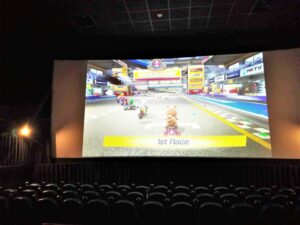
Recently they introduced video game rentals on the big screen.
“It is $100 for two hours, $50 per additional hour,” Cavin said.
Participants must bring in a console that has wireless control to use on the big screen.
“We’ve hosted multiple parties already for: MarioKart, FortNite and Super Smash Brothers,” he said. “The parties are a great way to gather with family and friends.”
MarioKart, a video game, can now be viewed on the big screen at Fort Cinema. Submitted photo.
The business has been practicing measures to ensure safety for its customers.
The theater requires employees to wear masks during customer interaction, they have put seating gaps in the viewing parties and they “deep sanitize” all heavy traffic areas in-between shows and while open, he said.
“The (gaming) initiative was created as a means to provide a safe environment to gather and have fun during a pandemic,” he said. ” We have had a few parties already that asked privately if they could connect a console to our projectors. When we realized that the content looked incredible on our screen we decided to go public with the idea. We have had a lot of success with opening our theater to private movie parties in the last few months and wanted to expand upon that premise.”
Rentals take place outside of normal business hours, Monday through Thursday. A theater can be rented anytime before 4 p.m. or after 8:30 p.m. On Friday through Sunday, they can be rented anytime before 1:30 p.m. or after 8:30 p.m.
Video game rental prices are $100 for two hours, with additional hours at $50 an hour.
Any wireless controller console can work, and WiFi is available for online gaming.
The cinema also offers theater rentals for movies: Classic movies are $100, new releases are $200.
“I would also like the public to know that we are open every day of the week with new movies again,” Cavin said.
Contact on Fort Cinema Facebook page via Messenger, or call (620) 223-3366 during the business hours of 6:00 to 9:00 nightly.
See the update from Misty Adams at the bottom of this feature.
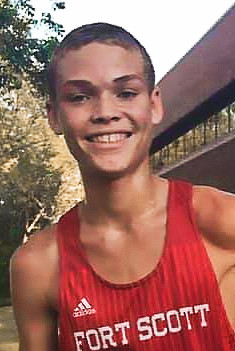
Raymond Harper, 19, was kayaking at Lake Fort Scott on Sunday, Sept. 13 and went missing. On Sept. 14 a body was taken from the lake, for an autopsy to be performed.
Memorial services are planned for Harper on Sept. 21.
Misty Adams put this on her Facebook page yesterday.
“Chuck and Connie Harper of Fort Scott suffered a family loss no parent wishes to encounter. On the evening of Sunday, September 13th their beloved son, Raymond had an accident at the Fort Scott Lake while kayaking. His family in the past 24 hours have suffered so much, but today their worst fear became reality when Raymond’s body was recovered from the lake.”
“If you know Chuck and Connie you know these two have hearts of gold and both have been foster parents to a lot of children. They love others when others don’t. They help others when needed and give support when needed. They are special people to me and to many others.”
“Connie was recently diagnosed with cancer and has been battling that fight and now has to deal with the loss of a child. So much pain and suffering for one family who have a heart of gold.”
Adams asked the public to pray for the Harper family in the days ahead.
“I am also asking that our community supports this family like I know Fort Scott people can. We need to bless this family like they have other families and children who the Harper’s have been their foster family.”
“A memorial fund account was opened at Union State Bank today to cover funeral expenses. His funeral arrangements are under the care of Konantz Cheney. I ask that you help this family with the funeral expenses they are now burdened with. Our goal is to raise $15,000 for the family in the next few days ahead.”
“Please understand the $15K is just a number that we felt like would cover any and all expenses,” Adams said in an email interview. ” We do not even know if we will raise that much money, but anything we can do to ease the parent’s worry is a blessing. We are so very thankful to those who do contribute to his memorial fund.”
“Any money left over will stay in the memorial fund,” Adams said in the interview.
“Donations can be mailed to Union State Bank
PO Box 546 Fort Scott Ks 66701 or hand-delivered to their location at 1009 S Clark St Fort Scott Ks. Those wishing can also send a donation to Konantz Cheney Funeral Home at 15 W Wall St Fort Scott Ks 66701. Please make checks payable to Raymond Harper Memorial Fund.
“Please donate no amount is too small as every dollar is a blessing to this family. Please share this post to help spread the word and God Bless you all,️ Misty Adams, Tisha Miller and Sara Vaughn Mills.”
UPDATE
“God answered some prayers,” Adams told fortscott.biz “The funeral expenses are covered for the family. The Harper family wasn’t sure how to cover such a large expense unexpectedly, but our God answered their prayers. Connie Harper contacted me immediately yesterday, and we felt like the account needed to continue in his honor. We know we no longer need the goal we set forth for his funeral expenses, but if people are willing to donate towards the scholarship fund, we will accept funds in Raymond’s honor.”
“We will be turning the account into a Fort Scott High School Scholarship fund for cross-county athletes. The funds will be used to award a cross country Senior athlete a scholarship.”
“The Harper family and those organizing this memorial fund appreciate the prayers, support, generosity, and those who have contributed already to this amazing young man we are remembering. Thank you- Misty Adams, Tisha Miller, and Sara Mills.”
A teacher at Fort Scott Middle School resigned in August and USD 234 had a fifth-grade teacher request to transfer to the middle school, creating a 5th-grade opening.
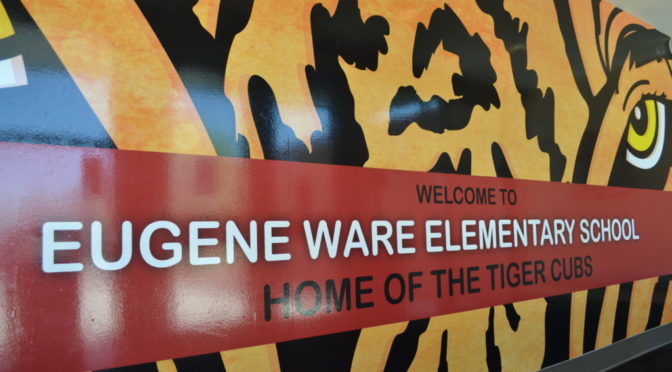
Tiffnie Spears is the new fifth-grade teacher at Eugene Ware Elementary School in Fort Scott.
Tiffnie Spears, 29, graduated from Fort Scott High School in 2009 and graduated from Wichita State University with a Bachelor’s Degree in Communications in 2013, then received her Master’s Degree in Elementary Education from Western Governors University in April of 2020.
“I was born and raised in Fort Scott and, as soon as I graduated from Wichita State, moved back home to be near my friends and family,” she said.
” I was able to do my internship hours with Mrs. Malone in the Fall of 2019 and did my student teaching with Mrs. Stepps this past Spring semester.”
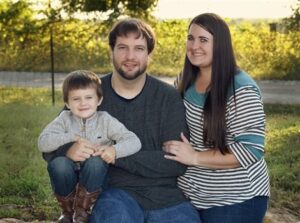
She has been married to her husband, James, since 2011 and they have a 4-year-old son named Jacoby.
“My family loves to travel and our goal is to get Jacoby to as many states as possible before he graduates high school,” she said.
How did you become an educator?
“There wasn’t much that got me as excited than seeing my son, niece, and nephews grow and learn new things so I just knew I needed to go back to school to be a teacher. I was torn between following through with being a communication major or an educator so going back to school was a pretty easy choice.”
Did someone inspire you to teach?
“It was my son who inspired me to teach. After Jacoby was born, I knew I wanted to not only help him to grow and learn every day but to have a positive impact on as many children as possible.”
What is the best part of teaching for you?
“The ‘Ah-ha!’ moments are the best and most rewarding moments for me. Being able to see the positive impact you’ve made in helping that student succeed means everything.”
What is the greatest challenge in teaching?
“Starting my first year in the classroom during COVID-19 has so many obstacles but the students are doing so great with the changes we are all being faced with.”
Section of K-3 to close for pipe replacement project
The Kansas Department of Transportation (KDOT) will close a section of K-3 in Bourbon County to replace four crossroad pipes on Monday and Tuesday, Sept. 21-22, weather permitting.
K-3 will be closed to through traffic between K-39 and U.S. 54 from 7:30 a.m. until 5:30 p.m. both days. Traffic should use alternate routes.
Persons with questions may contact KDOT Superintendent Derrick Shannon, (620) 901-6550, or Public Affairs Manager Priscilla Petersen, (620) 902-6433.
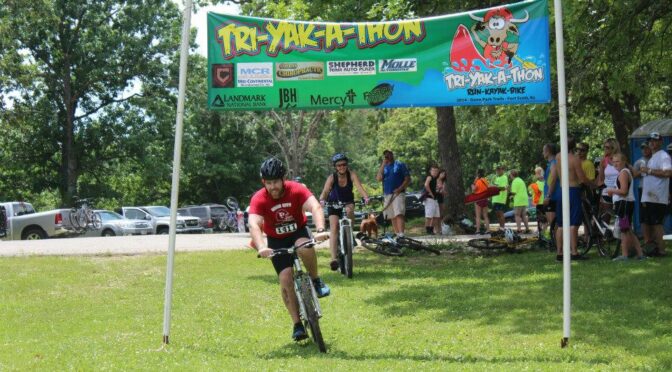
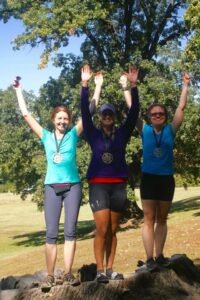
Tri-Yak-A-Thon winners in a past competition. Submitted photos.
The Gunn Park Trail volunteers are hoping to hold an annual multi-sport competition on Oct. 10 at 10 a.m. in the park.
“We may not be able to hold the Tri-Yak-A-Thon this year,” Penny Pollack-Barnes, spokeswoman for the group, said. “In these uncertain times, we decided to hold the event if we have enough interest in the event. If we have 40 registered participants by September 26 we will hold the event, assuming we don’t experience a COVID surge and the weather cooperates. So far, we have nine registered participants.”
“We will be observing social distancing recommendations at the event,” she said. “We expect participants to help us in our efforts to make sure our event does not result in the spread of the Coronavirus.”
A runner in a prior Tri-Yak-A-Thon. Submitted photos.
Triathalon competitions are multi-sport events that require all-around fitness for the solo participants, Barnes said.
“The variety in activities allows team members with different skills to participate,” she said. “We make the event ‘off-road’ to show off Fort Scott’s wonderful trail system.”
Kayakers in a prior Tri-Yak-A-Thon, navigate the Marmaton River. Submitted photos.
“The Tri-yak-A-Thon is a race where participants run on Gunn Park’s beautiful trails, kayak up and down the Marmaton River, and then tackle the trails again on a bike,” -Barnes, said. “We will donate all proceeds from the 2020 Tri-Yak-A-Thon to Fort Scott Paws & Claws.”
“The goal of the event is to have fun and raise money to support the animal shelter,” she said. “The trail run is a 5K, the kayak portion is another 5K, and the bike portion is a 10K. Participate as a relay team, or if you are tough enough, you can do the entire race as a solo participant. You must bring your own kayak, life jacket, helmet, and mountain bike. Riders must wear a helmet.”
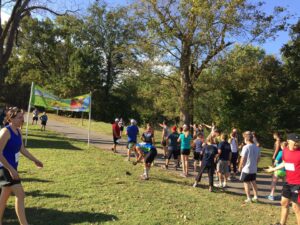
The race starts during a previous Tri-Yak-A-Thon. Submitted photos.
The cost is $35 for individual participants and $75 for each team.
Packet pickup will be from 8:00 to 9:45 AM at Shelter House #6.
Registration will only be available online this year. Participants must register before the event to avoid people congregating at the registration area. Online registration will close on September 26.
Kayaks are lined up waiting for the kayaking leg of the Tri-Yak-A-Thon in a prior competition. Submitted photos.
The race will begin at 10:00 AM.
“Whether you enter the race or just come and cheer, please join us and support our park, our trails, and our animal shelter,” Barnes said. “While much of the race occurs out of view on the trails, the participants go through our staging area multiple times. This offers many opportunities to cheer people on.”
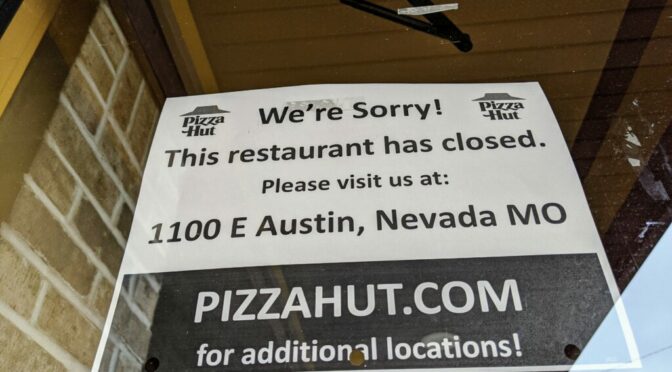
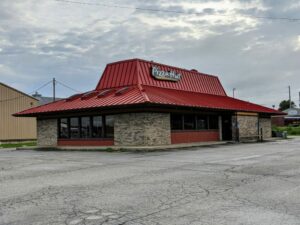
Fort Scott Pizza Hut, 1801 S. Main has closed permanently.
A call to the Fort Scott Pizza Hut revealed that the store at 1801 S. Main is permanently closed.
“On August 17, (2020) NPC (the company that operates Pizza Hut) announced that it reached an agreement with Pizza Hut that would allow NPC to close up to 300 of our Pizza Hut restaurants,” Columbia Clancy replied in response to an email to corporate headquarters. “Since that time, we have finalized our plan for next steps and after careful analysis and consideration, NPC has moved forward with closing a number of those Pizza Hut locations (including the Fort Scott, KS restaurant), effective September 8.”
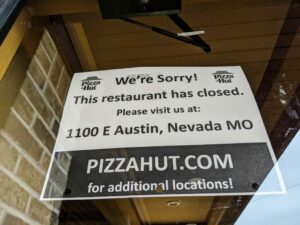
A sign in the window of the Fort Scott Pizza Hut on Sept. 11, 2020.
“As part of our restructuring process, we made the very difficult decision to close the Fort Scott Pizza Hut restaurant,” according to a NPC spokesperson. ” We did not take this decision lightly, and we are committed to providing support to impacted employees, including providing transfer to other NPC or Yum! Brand locations, wherever possible. Ultimately, these actions will best position our remaining restaurant business for success. NPC continues to operate many other Pizza Hut restaurants across the country which remain open for business, supported by our 23,000 dedicated employees who are ready to serve our customers.”
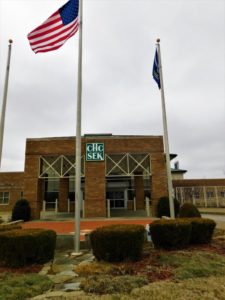
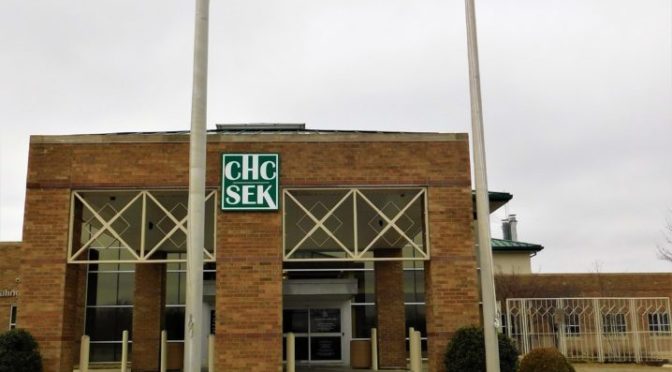
The Community Health Center of Southeast Kansas Clinic, 401 Woodland Hills, just off Hwy. 69 south of Fort Scott.
Mental health is a factor in the COVID-19 Pandemic.
With increased stress due to the virus, the economy, social injustice issues, and the upcoming United States general election, mental health issues are a concern.
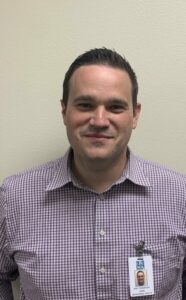
Eric Thomason, PMHNP, the Community Health Center of Southeast Kansas Behavioral Health and Addiction Treatment Services Clinic Director, answered the following questions in an email interview with fortscott.biz.
Thomason said he is seeing a spike in people needing mental health services.
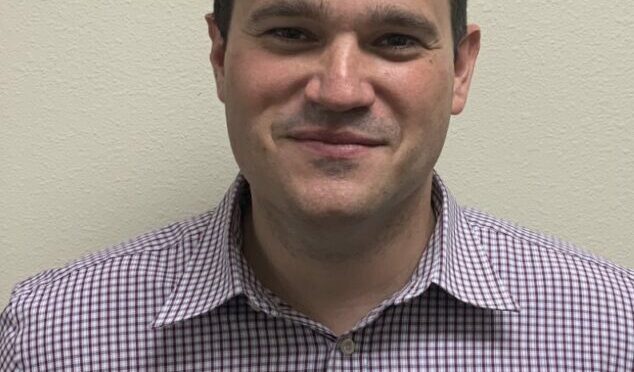
Eric Thomason. Submitted photo.
Thomason gives a recap of the pandemic, starting with how it began.
” It was this invisible thing, which we didn’t know much about, and it was killing people. This is an anxiety-provoking idea. We started to see the spread through urban areas of the United States. A lot of us collectively held our breath and thought, “How long until it is here?” Instead of carrying a belief that tomorrow can be better today, we removed the hope that tomorrow can provide.
Hope: A Weapon Against Depression
Hope is the single most important weapon in the battle of depression. One of my primary jobs is to restore hope. To restore a very simple idea, that if I get up, get dressed, and keep fighting, today can be better than yesterday.”
Economic Stress
“The economic fallout has been tremendous. I treat a lot of blue-collar hard-working folks from Fort Scott and the surrounding areas. Our community members are some of the hardest hit in the nation due to involvement in livestock operations. I have had patients who lost jobs in the foodservice industry or as a part of other health care clinics. The removal of employment does two terrible things. It reduces our income and it reduces the perception of our value and purpose. Employment gives us a sense of accomplishment. If we did nothing else today, we finished our days’ work. COVID-19 took that away from a lot of the hardworking individuals I serve”
Social Support Systems Needed
“Lastly, social support systems are profoundly important to our wellbeing. Social isolation is often a symptom and predictive factor of depression. COVID-19 increased our isolation, thus increasing our risk of depression.”
Have there been more substance abuse issues during this time?
“Unfortunately, the rate of substance abuse, accidental overdoses, and death related to drug overdose throughout the nation has increased. Some national tracking services such as the Overdose Detection Mapping Application Program estimate that drug-related overdose has increased over 40% across the country. This is in part to the removal or lack of coping strategies as well as treatment dropout rates due to social isolation and fear of COVID-19. One of the ways we worked to combat treatment dropout is to offer telephone, telemedicine, and in-person appointments despite COVID-19 spread throughout our communities. This is a testament to our incredible staff who chose to continue to serve and provide support to our communities when we were needed the most.”
What are some practices that people can do to help themselves with their mental health?
“Be honest with yourself or listen to your loved ones. If you aren’t doing well or someone you trust says you aren’t doing well, please get help.
Social distancing does not mean social isolation. Get on Skype, Zoom, Facetime, etc to have social interaction. The telephone is not enough.
Eat a balanced diet and get plenty of exercise. You can socially distance and exercise outside. CHC/SEK offers Wellness Services that includes a Chiropractor, Physical Therapist, Nutritionist, and Fitness Coordinator.
Avoid illicit drugs and alcohol.
Stay away from social media and political radicalism. We should be supporting one another during this difficult time, not tearing each other apart.
Be there for someone. Make a difference in someone’s life and you will feel better for it.”
Is a physician referral needed for mental health services?
“It is very easy to access any of our services. No physician referral is required. You can contact our Fort Scott Clinic at 620-223-8040 and ask about any program or service offered through CHC/SEK. Our goal is to answer your questions as efficiently as possible.”
Does insurance cover mental health services?
“Mental health services are covered under most insurance plans. For any specific questions, please contact our clinic and we can help determine your plan’s coverage. We work with our patients to determine if they would qualify grant-supported treatment and/or sliding scale fees. Always remember at CHC/SEK we treat all individuals regardless of their ability to pay for service.”
Closing Thoughts
“You are worth believing that tomorrow can be better than today. You are worth being a better father, mother, husband, wife, brother, sister, employee and/or boss. You are worth treatment. In a world where everything is outside of your control, you can control whether you pick up the phone and ask for help. CHC/SEK is committed to being that help.”
Last week, I wrote about “stuff.” Since we all handle things differently, we should look for commonalities if friendships are to last. Sometimes, that’s easier than it sounds.
I phoned a girlfriend. Not to chit-chat. To ask for advice. I was upset and knew that this friend would give me Godly counsel. After reading her a text/email exchange between “Sue” and me, I asked if my final response was (a) too harsh or (b) appropriate. (“Too harsh.”) Was I demonstrating Christ-likeness? (“No.”) Would she feel as frustrated as I did? (“Yes”—finally, a teensy bit of empathy from my friend.)
This all began when Sue, a cannot-take-no, multi-marketer acquaintance, invited me to be a part of a ZOOM call as well as a Facebook collaboration to learn about a new product that would cure several ailments. Was I available on Tuesday night? I shared that I am on a ZOOM Bible study every Tuesday evening. No problem for Sue. There was another ZOOM on Thursday evening. She would sign me up and send me the FB link.
This is what I wrote: “I don’t attend ZOOM meetings that sell something or promote something. I’ve done too many that want me to participate in something. I have been stung and just can’t bring myself to participate. I love that you are energized by these, but I am not. I have multiple requests to listen to these. I hope you understand.”
She did not. Why, to her, I had to be interested! Why would I not be? “You are even going to your Bible study on ZOOM” (which means?????). The rest of the text told me how great the product was and that I need to be informed, and she ended with this: “I am disappointed that you think that of me.”
I re-read the text several times. Just what did I think of her? I asked her that question and added that my best friends know that I don’t have luck with multi-level products. “So, we just agree to disagree,” I wrote.
Sue told me that I was missing out, that she is not a “fly by the seat of my pants kind of person,” and she knows results. She copied and pasted a meme listing the 3 C’s in life: “You must make the Choice to take the Chance if you want anything in life to Change,” signing off with this: “Think about it.” I was thinking about it, all right, but not in a loving-Jesus-sort-of- discipleship way.
I thanked Sue for thinking of me but shared that the product I bought last year from a close friend did not solve my ailments, in spite of several positive testimonials. “I know your intentions were to help” were my final words.
Well, according to Sue, obviously my friend did not sell me good merchandise. Had it been tested and approved? On she went, explaining criteria I should have used to research the product and ending with this: “But you basically called me a snake oil salesman and called zooms the devil! Bible study zooms sell something too! Eternal Salvation.”
Let’s just say I was not thinking about Eternal Salvation when I wrote my “I want to yank your tongue out” response, including that, because of Jesus, Eternal Salvation is Free, thank you very much. But something (Somebody?) prevented me from hitting “send.” That’s when I called my girlfriend who talked me down from my ledge of pride, self-pity and retaliation. Her suggestion was that I go ahead and vent…get it all out of my system…write away…and then hit the delete button.
I said a few prayers and took my friend’s advice (even though the tongue-yanking sounded more appealing). She was right. We all need friends that pull us towards God, those who don’t add to our anger but who remind us of what Scripture says about forgiveness instead of payback. Hopefully, should the need arise, I will offer the same kind of advice.
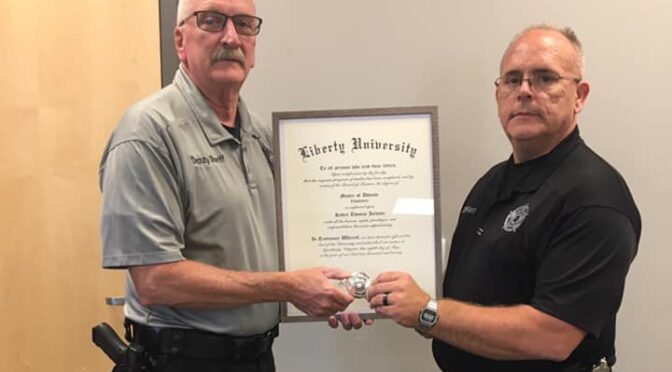
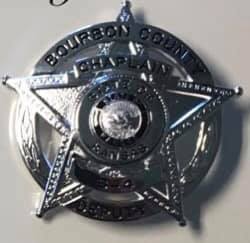
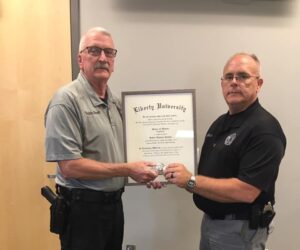
After serving as a Bourbon County Sheriff Deputy for over 33 years, Bob Jackson recently completed a master’s degree in chaplaincy.
“After completing my bachelor’s degree in Religion / Christian Counseling, I continued on to achieve my MD in Chaplaincy because I believed chaplaincy was a good fit for me,” Jackson said.
Bourbon County Deputy Chaplain Bob Jackson, left, receives a congratulatory handshake from Sheriff Bill Martin on his earning his Master’s of Divinity Degree. Courtesy photo.
“I have served this community for the past thirty-three-plus years in law enforcement and believed, for now, God wanted me to continue serving Him in law enforcement serving the sheriff department as both a deputy sheriff and the department’s chaplain,” he said.
“I believe that God has called me to serve Him in two different areas,” Jackson said. “He has called me to serve Him as the Chaplain for the Sheriff Department in which the department has never had one. And, I believe that God has placed me in Uniontown, Ks, as the School Resource Officer as well. Since the start of school, I have felt such a overwhelming desire to serve these kids and the teachers. I believe that God’s will is for me to repair the damage that has been done over the past several weeks between our communities and law enforcement.”
His duties include ministry on the job and with fellow officers.
“My duties as a chaplain will be to minister to those who are experiencing the loss of a love one, or a friend,” he said. “To be there for my fellow officers and their families, when they are experiencing difficulties dealing with the stress that comes with law enforcement. The biggest duty of all is to have compassion for all as God has for us. These are just a few examples and certainly not all of the duties that a chaplain will perform.”
Jackson received both a bachelor’s degree and a master’s degree through Liberty University online. His bachelor’s degree in May 2017 and master’s degree in May 2020.
Rinehart Christian Church will have a corn maze in October. This an areal view of the maze. Submitted photo.
Rinehart Christian Church will be offering their Corn Maze event again this year the first four Saturdays of October (3, 10, 17, & 24) from 11 AM-4 PM. This is an event for the whole family to enjoy together with activities including the maze, hayrides, a corn pit, lawn games, pumpkin painting, duck races, and fire pits. Admission to this event is completely free, with a hot dog lunch included from 11 AM- 1 PM.
We have a heart for families, and that is what drives this event. We want to provide an opportunity for families in our community to enjoy time together. We believe serving families is one of the best ways we can serve God.
To make this event as safe as possible, we have moved every event outside this year.
Rinehart Christian Church is located at 9443 S 900 Rd in Richards, MO.
Here are directions from Fort Scott: Take 69 Hwy. north to the Hammond exit. Then go east two miles on Soldier Rd. The road turns to the north; follow the blacktop (245th St.) to the stop sign (Valley Road); then go east. This becomes Hwy. D in Missouri. Continue on Hwy. D through Stotesbury to 900 Rd. Go South 0.5 miles to the church.
Community Health Center of Southeast Kansas (CHC/SEK) has been serving the citizens of Fort Scott and surrounding towns since early 2019.
Hoping to improve the overall health of Bourbon County, the organization met with treatment providers, community leaders, and the citizens of Bourbon County, according to Eric Thomason, who is the director of CHC/SEK Behavioral Health and Addiction Treatment Services.
“The message was clear, there was an increased need for behavioral health and addiction treatment services,” said Thomason.
“We are proud to announce that in October of 2020 we will begin offering in-person addiction treatment services,” Thomason said. “As a part of our current addiction treatment services we offer Medication Assisted Therapy for the treatment of substance use disorders. CHC/SEK has a designated addiction treatment nurse, Mitzi Clarkson RN, who is available for patient and provider consultation.”
Mitzi Clarkson. Submitted photo.
In October of 2019 CHC/SEK launched psychiatry services to the Fort Scott clinic, primarily utilizing telehealth services.
“In March of 2020, we increased our psychiatry availability to include face to face services,” Thomason said. ” Psychiatry is offered by Tien Nguyen, PMHNP. Tien is a graduate of the University of Missouri-Kansas City. He offers treatment for depression, anxiety, and other mental health disorders primarily utilizing medication.”
Tien Nguyen. Submitted photo.
As part of the CHC COVID-19 response, they increased access to behavioral health and addiction treatment therapy staff via telehealth and e-visit appointments.
“Due to the overwhelming utilization these alternative service platforms will remain in place,” Thomason said.
CHC/SEK works to meet the needs of the community regardless of a person’s ability to pay for service, he said.
“We will continue to strive to make ‘healthcare the way it should be,'” Thomason said.
Any person interested in enrolling in mental health or addiction care, contact 620.223.8040, or talk with your CHC health care provider about a referral.