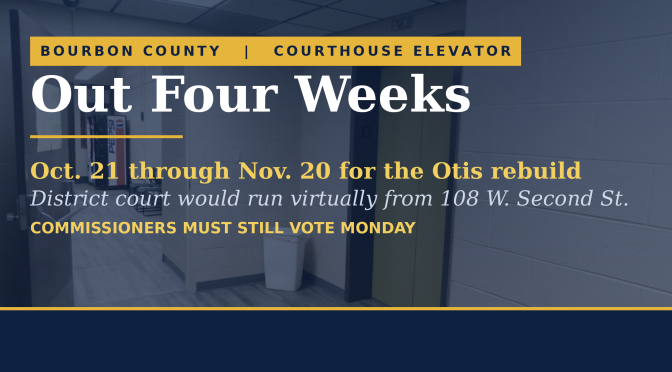
FORT SCOTT — Otis Elevator and Bourbon County settled on dates Thursday for the courthouse elevator shutdown that will push district court out of the building: the elevator goes out of service Wednesday, Oct. 21, and is scheduled to be back in service by Friday, Nov. 20.
The dates came out of a work session with Otis project manager Kyle George, who told commissioners the replacement equipment has already been bought and is sitting at a distribution center waiting to ship.
“We can deliver material today or next week if we call upon it now. It’s ready to go,” George said. “It’s procured, and it’s at our third-party company right now.” (video, 18:50)
Nothing was voted on. The session was noticed as a work session at which no formal county business would be conducted, and two decisions the court is waiting on are still outstanding.
What still has to happen Monday
Chief Judge Amy Harth needs two things from the commission at its next meeting, Monday, Aug. 24: permission for district court to operate out of the county-owned building at 108 W. Second St., and a vote closing the courthouse’s second and third floors to public access while the work runs.
“I ran into Commissioner Beerbower in the hall,” Harth said. “I would like to be able to make the request to change the location of court on a temporary basis to the Supreme Court sooner rather than springing it on them at the last minute. So the sooner you guys can get to that, that would be great.” (video, 16:20)
Asked what the commission needed to do formally, Harth said: “Just tell me that we’re okay to have court in that building. That’s really it.” (video, 16:40)
Beerbower confirmed the item is coming. “We had to make a decision on 108 West 2nd on Monday at the next meeting on the court being there, because we didn’t formally do it yet,” he said. (video, 16:07)
The floor closure would run the length of the project — from the Oct. 21 start through the conclusion of the work. Only staff and county attorney staff would be upstairs. Staff would keep their access, Harth said, because court recordings still have to be run from the courtrooms on those floors.
“From our perspective, we have asked the commission to close the second and third floors to public access,” she said. “If the commission hasn’t already, and they act on that request, that solves any disruptions for us.” (video, 15:14)
Two commissioners missing
Three of the five commissioners took part: Chairman Gregg Motley, David Beerbower and Mika Milburn-Kee. Samuel Tran and Joe Allen did not.
Tran had pressed Otis for a pre-construction meeting in the first place, he is the one who had been dealing with the company — “I’ve been working closely with Samuel up to this point,” George told the room — and he is the one who moved the meeting to 3:30 p.m. to suit the court’s schedule.
At Monday’s regular meeting, Deputy Clerk Michael Hoyt asked whether three or more commissioners would attend, which is what determines how the session has to be noticed. Tran answered for himself.
“I will be here. I can’t speak for my peers,” he said. (video, Aug. 17, 22:19)
Minutes later, explaining how the time had been set, he was more explicit still: “Originally, when I spoke to Judge Harth and I spoke to Otis, it was a later time. Her staff came back and said the judge can make it at 3:30. So I said, that’s fine. I’ll make myself available.” (video, Aug. 17, 23:19)
Allen told the commission that night why he could not come. Besides his county seat he is the Fort Scott school district’s transportation director so he has commitments when school is insession.
“I will not be there during bus routes,” he said. (video, Aug. 17, 23:51) Thursday’s meeting started at 3:30 p.m. It is a constraint he has raised before: setting work-session times in March, he said, “4:30, 5 o’clock is about the earliest I can get here on a school day.” (video, March 16, 89:26)
Motley said that night that he would not be there either — “Yeah, I won’t be there Thursday” — but he did end up attending.
Beerbower, asked the same question Monday, said “I’ll come” — and did.
Start date moved from Oct. 20 to Oct. 21
Harth opened by asking for an Oct. 20 start, the date she had floated at the Aug. 12 work session. George said that would work — material delivered Monday, elevator out of service Tuesday.
Then Harth reconsidered, because of a retirement reception for Judge Mark Ward on the afternoon of Monday, Oct. 19.
“We have a retirement reception the afternoon of the 19th. Should we push it to the 21st, or will there be anything disruptive about what’s going on on the 19th?” she asked. George said it would not be a problem. (video, 11:21)
“Let’s do it the 21st, and that way we just aren’t even having that problem,” Harth said. “We have a judge retiring… he’s local, and so I think a lot of folks are going to want to come and wish him well.” (video, 11:56)
The back end moved too. Milburn-Kee asked George to confirm the window — “October 21st through November 19th” — and then, after George said his crews might want the option of working a Friday, the group extended it a day to Friday, Nov. 20.
How the four weeks break down
George walked through the schedule. A semi arrives with roughly eight pallets of material, and from that day the elevator is out of service until the final inspection is signed off.
“Generally speaking, we account for a month of downtime,” he said. “The elevator portion of the work will be about 90% complete within two weeks.” (video, 5:59)
The third week goes to building work — fire alarm and electrical tie-in — handled by subcontractor CBI under Otis’s umbrella. The fourth week is contingency, and buys time to get a third-party inspector scheduled.
“That fourth week is just more so a contingency,” George said. “So we like to plan for four weeks.”
Otis will schedule and pay for the inspection, which he said runs two to three hours and gets booked a couple of weeks out, with the electrical and fire alarm subcontractors on site in case anything needs fixing that day.
Motley asked what could cause delays. George pointed at the building side rather than the elevator.
“A lot of it normally falls on just that building-related work — our fire alarm tie-in, sometimes there’s maybe a software upgrade to the fire panel that we otherwise wouldn’t know until we tie in those new devices,” he said. “Within the span of a month, it’s usually correctable and not causing any delay on the project.” (video, 12:42)
The crew works four 10-hour days, Monday through Thursday, 6 a.m. to 4:30 p.m., which means someone has to open the courthouse at 6 a.m. Beerbower said that would be handled: “We can make sure the building is open.” Deputy Clerk Michael Hoyt noted that Veterans Day, Nov. 11, falls inside the window; the crew will be off that day, and he raised the November election calendar as well.
Most of the work happens in the basement machine room and the shaft. George said noisier work could be kept to the early hours before business starts, and that nothing on the job requires drilling or other sustained noise.
A 1977 elevator, well past its expected life
Harth asked George why a modernization was needed at all — whether it was simply something that “pops up.”
“In the elevator industry we tell all of our customers it’s 20 to 25 years is the average life expectancy for an elevator,” he said. “We’ve gotten quite a bit more out of this elevator than that.” (video, 13:49)
The courthouse elevator was installed in 1977. Asked whether the rebuilt unit should last another 20 to 25 years, George said that was the expectation.
Commissioner Mika Milburn-Kee asked George whether the county’s maintenance contract is now with Otis. It is, he said, and “we’ll have a lot more streamlined once the project’s wrapped up.” Otis is the elevator’s original manufacturer; the county’s prior contract was with Kone, and Commissioner Samuel Tran told the commission on Aug. 3 that Kone had “dumped us on the contract,” which is why replacement parts for this summer’s breakdown had to be routed through the manufacturer.
The elevator is working now. Asked whether the last repair was just a board, George said he believed so — that and the switch serving the basement.
What the court still needs
Harth said the court is finalizing an equipment list for 108 W. Second and will email it to the commission before Monday. Her instruction to her own staff was to keep it cheap and reuse what the county already owns.
“When you see the list, you’re going to see, like, I think I said, 10 or 12 six-foot tables. If you have 10 or 12 six-foot tables, use those. Don’t go buy them,” she said. (video, 17:10) Later she summed it up: “Just when you get our list, don’t think we need fancy things. We just need the things.” (video, 21:17)
Chairs do not have to match, she said, and metal folding chairs are fine. Renting or borrowing tables and chairs from other communities at no cost, rather than buying them, came up as an option. The court has already been through its own stock — Harth said Chief Clerk Administrator Stephanie Gerken and District Court Clerk Melissa Trim had worked through the court’s devices to see what still works. Court staff attended alongside her; one asked that the list include chairs for them.
Two things on the list are not optional. The first is internet capacity: the plan calls for roughly eight Zoom rooms running at once in the perimeter offices. The second is a camera covering the open space those rooms open onto — a recommendation from the Office of Judicial Administration staffer who walked the building with court staff the previous Friday.
“It’s a blind corner back there, and we just want to be able to see,” Harth said. “Also, if someone were to need help back there, the clerks won’t be able to see them.” She said an off-the-shelf doorbell-style camera would do: “We don’t need some fancy spyware back there.” (video, 22:32)
Moving courthouse security over to 108 W. Second is also on the list.
What did not come up: asbestos
Asbestos was not mentioned at Thursday’s meeting. The question is a live one at the courthouse, and the state’s position, as the county itself has recorded it, is that asbestos becomes a regulatory matter when construction disturbs it. The meeting was about construction inside the courthouse, chaired by the commissioner the board assigned to the asbestos question three weeks ago.
Reached by phone Friday, Motley said the two are not in the same place.
“Those are not in proximity, so there wouldn’t be any concerns there,” he said.
Background
Commissioners approved the Otis modernization on Dec. 18, 2025, accepting a $199,700 proposal and funding it from the jail sales tax fund, Fund 370, on a 2-1 vote. Harth told commissioners at that meeting that the inoperable elevator was “an ADA violation for us and probably a 19-104 violation for the county.” K.S.A. 19-104 requires Kansas counties to provide a suitable courthouse and keep it in repair.
The elevator failed again this summer. Harth told commissioners on July 27 that the court had been “really down since June 16th,” that a defendant charged with aggravated kidnapping had a jury trial continued, and that because the obstacle was the court’s own inability to hold a trial, the delay would not be charged against the defendant — “if these people run out of time, these cases will have to be dismissed.”
At the Aug. 12 work session, Harth proposed running court virtually from 108 W. Second for the outage rather than building out a courtroom there, scaling back an earlier and more expensive concept. No cost estimate for the buildout has been made public.
Thursday’s meeting was the pre-construction meeting Tran pressed for at that Aug. 12 session. It was the commission’s first work session on the elevator since Gregg Motley replaced Tran as chairman on Aug. 17.