Report on Kansas Infant Mortality

Kansas Department of Health and Environment Releases

Report on Infant Mortality

Topeka — The Kansas Department of Health and Environment (KDHE) has released its annual report on infant mortality. The Kansas Infant Mortality & Stillbirth Report, 2019 examines trends and disparities in infant mortality and stillbirths. The full report can be viewed here.

Some notable findings include:

  • In 2019, there were 5.4 stillbirths at 20 weeks or more of gestation, per 1,000 live births plus stillbirths. This was unchanged from the 2018 rate. Since 2000, the overall trend for stillbirths has been increasing.
  • The infant mortality rate in Kansas decreased from 6.4 infant deaths per 1,000 live births in 2018, to 5.3 infant deaths per 1,000 live births in 2019. Since 2007, the overall trend for infant mortality has been decreasing.
  • From 2000 to 2019, infant mortality decreased among non-Hispanic White births and non-Hispanic Black births. No statistically significant trends in infant mortality were observed among Hispanic births.
  • In 2015-2019, the leading cause of infant mortality was congenital anomalies (23.9% of infant deaths), followed by Sudden Unexpected Infant Death (19.0%), short gestation and low birth weight (17.3%), and maternal complications of pregnancy (6.1%).
  • The rate of preterm-related mortality declined from 2000 to 2019. In 2015-2019, there were 190.0 preterm-related deaths per every 100,000 live births. The rate among non-Hispanic Black births (537.7 deaths per every 100,000 live births) was higher than that among non-Hispanic White births or Hispanic births.

“While the number of infant deaths reported is the lowest on record for the state, disparities in infant mortality rates among the non-Hispanic White, non-Hispanic Black and Hispanic populations continued to exist in 2019,” said Kay Haug, State Registrar and Director of the KDHE Bureau of Epidemiology and Public Health Informatics.

“Focusing on maternal health is critical to improving birth outcomes and preventing infant mortality,” said Rachel Sisson, Director of the KDHE Bureau of Family Health. “Specifically, the health, nutrition, and behaviors of a mother prior to and during pregnancy directly impacts the infant’s health at the time of birth and throughout life. Further, eliminating disparities in infant mortality starts with addressing social determinants of health for the mother by ensuring access to care, individual and family supports, education, and maternity care practices that promote breastfeeding and safe sleep.”
UMB Donates To CASA

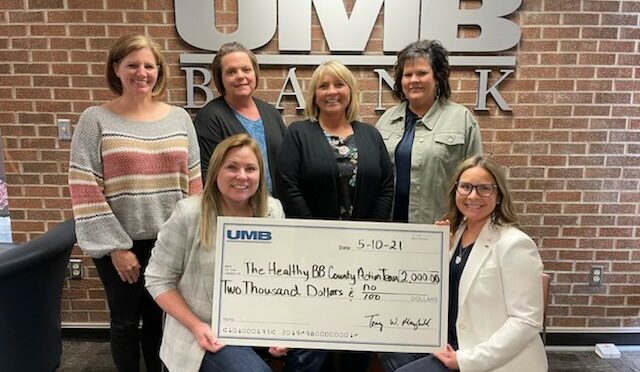
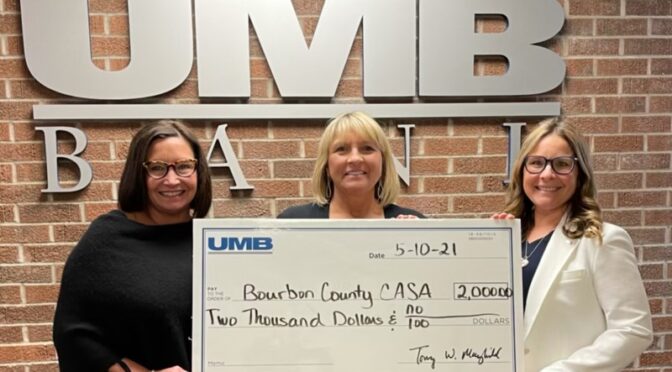
UMB Bank donates $2,000 from its community fund to support Bourbon County CASA. UMB is a proud sponsor and supporter of the local CASA program.
Bourbon County CASA, founded in May 1990, has provided advocates for over 900 local children who are victims of abuse and neglect. This would not be possible without the support of individuals and businesses such as UMB.
On Mother’s Day, we celebrated everything a mother does for her children. Mothers change their children’s diapers, fed them, teach them to walk, take them to school, protect them and so much more.
Sadly, not all children are so lucky to have a mother, or a mother figure, who can and will do these things for them.
When a child is placed in the state’s care because of evidence of abuse and neglect, a judge can appoint a CASA (Court Appointed Special Advocates) to speak up for a child’s best interest by learning everything about the child’s situation. Often the CASA volunteer is the stability a child needs during this frightful time. CASA volunteers advocate for the child’s best interests in court and in the child welfare system when no one else can.
CASA volunteers are regular people — stay-at-home moms, retirees, teachers, business people. They don’t need to be lawyers or social workers. They just need to be willing to speak up for children in need just like a mother would for her child.
“CASA volunteers become that role model because they often are the one constant in a child’s life while he or she is in the foster care system,” said Horn.
You can help break the cycle of abuse from one generation to another. You can model what a good mother looks like by becoming a CASA volunteer or supporting Bourbon County CASA.
The next training class to become a CASA volunteer for Bourbon County CASA is spring 2022. More information can be found at nationalcasagal.org or by emailing [email protected].

UMB Bank Contributes $2000 toward The Healthy Bourbon County Action Team’s “Center for Economic Growth”

The Center for Economic Growth (The Center) is giving individuals, living in a historically impoverished rural community, an opportunity for economic stability and wealth creation. Because of generous donations like these, critical services will continue to be provided to Bourbon County and City of Fort Scott residents and businesses free of charge. The Center provides expertise, business planning, financial projections, training and more with a focus on low to moderate-income, minority, woman-owned, or food-related business.
Economic stability represents an individual’s ability to access resources such as food, housing or healthcare, as well as creating a healthy business culture to help an employer attract and retain talent, reduce absenteeism and turnover, and improve productivity. “Since 2016, we have focused intently on our mission to enhance the quality of life and encourage economic growth in individuals,” Jody Hoener, President and CEO of The Healthy Bourbon County Action Team, “Through this collaboration, we are increasing access to employment and entrepreneurship in a population that has lacked upward mobility in employment opportunities and access to capital.”
The Center for Economic Growth has an array of state, regional, and local partnerships that include: The Fort Scott Area Chamber of Commerce, PSU Small Business Development Center (PSU SBDC), Southeast KANSASWORKS, Fort Scott Community College, and BAJA Investments. “I am constantly impressed with how well each entity works together,” Dacia Clark, Assistant Director, PSU SBDC says, “This collaboration benefits our clients as a one-stop-shop for services. Because of The Center, Bourbon County is ahead of the pack and significantly contributing to our regional goals.” Through the Blue Cross Blue Shield Pathways to Healthy Kansas Grant, The Center has access to even more expertise and resources right at their fingertips.
According to Smart Growth America, in today’s world business growth is driven by collaboration among many types of entities, private companies, universities, and others, that must interact frequently and work together creatively. “UMB is excited to support the creative and innovative efforts of The Center for Economic Growth. We hope that our contribution will make a difference in the lives of individuals in our community.” Crystal Maddox, UMB Senior Vice President-Commercial Lender.
The Center is located in the Historic Downtown Fort Scott in the upstairs of 17 South Main Fort Scott KS. It is a “one-stop-shop” for business, employment, food, telework, and distance learning needs. Current businesses, and those looking to start a business, have a physical location to meet with a person. Additionally, services are available for those seeking employment, developing soft skills (i.e. interviewing), or other job-seeking assistance. Businesses are encouraged and welcome to contact Southeast KANSASWORKS to see how they can connect with those looking for employment.
An overview of services The Center provides Bourbon County:
• WORKERS & FAMILIES:
o Distance Learning and Telework Space
o Unemployment & Job Seeking Assistance
o Increasing Access to Healthy Food
o Building Capacity for Local Food Assistance
• ADDRESSING CHILDCARE:
o Relief in Fulfilling Educational Requirements for Centers
o Incentives for Becoming a Legal Childcare Provider
• BUSINESS TOOLS & TECHNICAL ASSISTANCE:
o Getting Businesses Online via new Websites & Social Media
o Loans & Grants
o Special COVID Programs & Resources
Find us on social media! On Facebook, Instagram and Twitter #healthybbco
Background of The Healthy Bourbon County Action Team:
The Healthy Bourbon County Action Team is a Blue Cross Blue Shield Pathways to Healthy
Kansas Community. Its mission is to increase access to healthy food and physical activity,
promote commercial tobacco cessation, enhance quality of life and encourage economic
growth. The problems of health inequity and social injustice are complex in nature and
inextricably linked to key economic indicators. A healthy workforce is a prerequisite for
economic success in any industry and in all cities.
Contact information:
Jody Hoener, President and CEO
The Healthy Bourbon County Action Team, Inc
620-215-5725
[email protected]
Mary Hunt, Interim Operations Director
Southeast KANSASWorks
Desk: 620-232-1222
Cell: 620-670-0006
Website: www.sekworks.org
Dacia Clark, Assistant Director, PSU SBDC
[email protected]
785-445-2537
Lindsay Madison, President and CEO, The Fort Scott Area Chamber of Commerce
[email protected]
(620) 223-3566

Union State Bank a Mainstay and Family Business for 120 Years

Union State Bank, Uniontown. Courtesy photo.
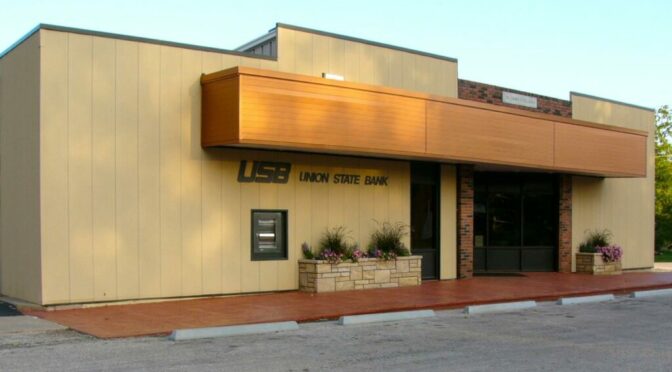
Union State Bank, Fort Scott. Courtesy photo.

The Holt family started as bankers in Uniontown on May 10, 1901, with an investment of $5,000.


“The bank’s assets are around $60 million total,” said current Union State Bank President Bryan Holt. “That is an increase of about 20% over this time last year. There’s currently nearly $5 million in Tier 1 capital.”


For five generations they have served the banking needs of their community, starting with Emmit Holt, then his son, Curtis, then his son, Kent, then his son Kenny, then his son, Bryan. All these were in succession.


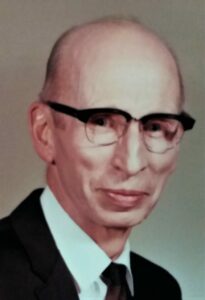
Emmit Holt, courtesy photo from Union State Bank.


Curtis Holt. Submitted photo.

Kent Holt, 89, remembers the first job at 12 years old.  He helped his parents, Curtis and Helen, where he could.


“One of my duties was the Address-o-Graph, that machine that addressed envelopes,” Kent said.


By that time in the early 1940s,  his mom and dad were the owners of the bank.


Kent Holt. Submitted photo.


Kent became president when his father died at 62 years old, he was 35 years old.


When he was the president he could do any job in the bank, he said. But through the years, the industry has become more complicated.


“The big change was computers coming to the bank,” he said. “it was slow coming in, and in stages. Then we had to hire more people.”


Kenny Holt was president and CEO of Union State Bank from 1993 until 2018 when he retired. He died in November 2019.


To view his story:

Baton Is Passed at Union State Bank


Fifth-generation president, Bryan Holt,  became president and CEO of Union State Bank on January 1, 2019.

Bryan Holt.


“I returned to the bank in 2005 after working for 10 years in the accounting and tax software industry,” Bryan said. “I had always wanted to work in the family business and was, and still am, grateful for the opportunity to do so.”


Changes that Bryan has seen in the banking industry also include technology.


“Most recently, the ability to conduct business via a mobile device has been a game-changer in terms of service,” Bryan said. “Our mobile banking app allows for users to deposit checks via their phone, which is extremely convenient. We’ve also added our debit cards to mobile wallets, which allow for payments via mobile phone. Personally, I didn’t see this as a great addition, but after I used it, I use it as often as I can.”


Through the years Kent’s wife, Marilyn, and sons, Kenny and his wife Nancy, and Randy and his wife Debbie, and daughter, Susan Eldridge,  worked at the bank, along with some of their children. Then grandsons, Bryan and Chad, and his wife Amy.


Daughter, Debbie Likely, chose to teach for her career.


“Holt family members currently working in the bank include Randy Holt, Susan Eldridge, Chad Holt, Amy Holt and myself.,” Bryan said. “Aiden Holt( Chad’s daughter) works part-time in Uniontown during the summer and Claire Holt (Bryan’s daughter) works as a part-time teller in Fort Scott.”


In 1992, the bank opened a branch in Fort Scott, just off Hwy. 69 and 12th Street.


“We have 16 full- and part-time employees between the two branches.,” Bryan said.


Kent Holt Remembers a Bigger Community


Like most small towns, the population of Uniontown has shrunk.


Uniontown Park, approximately the early 1900s. Courtesy of Union State Bank.
Union State Bank, the original building, in Uniontown, KS. Courtesy of Union State Bank.

Uniontown used to have more people, Kent Holt said.


He tried to remember all the businesses in town while he was working at the bank.


“Stroud’s Grocery Store, Griffith Elevator and Lumber, Bishard Grocery Store, there was an old folk’s home, Gates-the blacksmith,  several filling stations-Ira Steele’s was one, a barber shop-Raymond Mosier, telephone company, two doctors-Dr. Miller was one, a dentist, Arch Ramsey, we were the only bank in town,” Kent said.


Flora Klenklen was his secretary for several years, then Alice Ramsey.


Kent Holt said he just faded out, he didn’t really retire, and was a member of the bank’s board of directors until about five years ago.


See the latest about the bank on its’ Facebook page.


Aglow Lighthouse Speaker: Anna Toll Kim on May 13

Fort Scott Aglow Lighthouse welcomes guest speaker, Anna (Toll) Kim, Thursday, May 13th, 2021.
Anna (Toll) Kim was born in Kansas and raised in Fort Scott.
From a young age she loved listening to the stories of missionaries from around the world.
In high school she went on her first overseas mission trip to Ecuador, an experience that influenced her life in many ways.
After graduating from Manhattan Christian College she moved to Asia to work with urban poor.
She made friends who became like family and started a family of her own.
Most recently, she lived in the Philippines and then moved back to Fort Scott to settle down with her family for a time. She loves being outdoors, puzzles, and spending quality time with family. Also, she loves sharing about her adventures in Asia.
Guests are welcome to visit our Lighthouse monthly gathering at 6:30 p.m., Thursday, May 13th in the conference room of Fort Scott Inn, 101 State Street.

FSCC Men’s Track and Field Wins Conference Championship; Qualify 14 for National Meet


The Fort Scott Community College men’s track and field team traveled to Arkansas City for the regional meet this past weekend. With outstanding performance from many, the Hounds were able to bring home the first KJCCC East Conference Championship in school history. In only the third year of having the program back on campus, the Greyhounds took down the perennial power Cowley College by the score of 224-222. The meet came down to the 4×400 meter relay (Tre Buchanan, Marcus Freeman, Jarvis Miles, Jordan Collins) where the Hounds cruised to a time of 3:10.19, defeating second place Butler Community College by more than 7 seconds. Cowley finished the race in fourth place, giving the Hounds the conference crown.

Coach Philip Redrick on the men’s performance: “This was a complete team victory and came down to the last event. I told the team before the race that we needed to win the 4×400 if we wanted to take home the conference championship. It was an amazing performance and I couldn’t be more proud of the group. It takes everyone on the team competing at a high level to win a conference meet, and they didn’t disappoint.”

While there were many performances which contributed to the win, the Greyhounds were paced by the following conference champions:

Javris Miles – 400 meters – 47.57

Tre Buchanan – 400 hurdles – 52.63

Demarion Smith – High Jump – 1.95m

4×400 Meter Relay (Buchanan, Freeman, Miles, Collins – 3:10.19

4×800 Meter Relay (Lecorian Deboest, Lonnell Johnson, Alex Jaje, Marcus Freeman) – 7:41.41

Full results from the conference meet can be found at: https://kjccc.org/sports/track/2020-21/2021_Jayhawk_East_Final_Outdoor_Results.pdf

Next up will be the national meet which will be held in Levelland, Texas starting 5/11/2021. The men’s team has 14 student-athletes who have qualified for the meet. Go Hounds!

FSCC Women’s Track and Field Sweeps Season Conference Championships; Qualify 10 for National Meet

Back in March the Fort Scott Community College women’s track and field team brought home the first conference championship in school history when they took the indoor title. This past weekend, the Hounds again ran through the conference, winning the outdoor title and completing the conference sweep. The meet was again a close competition which came down to the wire, but the Hounds prevailed over rival Cowley College by the score of 190-180.

Coach Redrick on the women’s performance: “This is a special group of women. They knew what they were going to have to do to compete and bring home another title, and they did just that. We had a huge number of special performances over the weekend. I’m so proud of them.”

Leading the way for the Hounds were the following conference champions:

Trinity Sinegal – Long Jump – 5.59m

Damazvia Dames – Long Jump – 5.59m, Triple jump – 12.19m

Rachel Booker – Heptathalon – 3356 points

Full Results for the conference meet can be found at: https://kjccc.org/sports/track/2020-21/2021_Jayhawk_East_Final_Outdoor_Results.pdf

Next up the Hounds will travel to Levelland, Texas for the NJCAA National Meet. 10 Greyhound student-athletes have met the national qualifying standards for the meet. Go Hounds!


Sharing Our Stories


Barbara Stockebrand. K-State Extension Agent. Submitted photo.

Maybe I’m just at that point in my life, but I always find it interesting when I get a chance to hear some of the personal stories of someone who has lived a full life. They are likely remembering back in their time. They are also sharing bits and pieces of what has molded their lives to be the person they are today.

All older adults have made their mark on their families, their communities, and beyond – whether they realize it or not. Just by the fact that they have lived life, they have had many trial and error and success experiences.

Older adults bring wisdom, experience and life history to younger adults’ perspectives on their future. Purposeful sharing and connections can be incredibly valuable to both of the individuals involved. We need to make time to visit with our older adult relatives and friends and encourage them to tell their stories.

Jumpstart those memories with questions, photos and portions of stories which you may already be aware. Let them fill in the blanks and the story behind the story.

Here are some questions to stimulate the stories:

— What kinds of toys and games did you play?

— What was your schooling like? You may learn their one-room school building had been moved from one location to another in the middle of the night as a result of a neighborhood feud.

— What were you paid for your first job?

— What was your favorite vacation spot?

— What would you like to tell your 22-year-old self?

— What do you think your 22-year-old-self would want to tell you?

— What are the best and worst pieces of advice you’ve received?

— What motivated you in life?

— What were some of the turning points in your life?

— Looking back, is there something you wish you had done that you did not?

— What are you most proud of?

These are samples of questions, and most will lead to many other questions and stories. Plan on several visits. Be sure to write them down or document them in some way to share with other family members and your younger generations.

Many countries revere their older adults where older age is honored and celebrated, and respect for elders is central to the family. Our western culture often depicts aging in a negative light. We have a lot to learn.

May is Older Americans Month. It’s a great reminder for all of us to find ways to celebrate the older adults in our own lives and communities.

K-State Research and Extension is an equal opportunity provider and employer

Angels Disguised as Mothers by Carolyn Hayward Tucker

Keys to the Kingdom – Carolyn Hayward Tucker

Carolyn Tucker. Submitted photo.


Even though I’ve been a mother for 34 years, I usually don’t think of myself but rather my own mother as Mother’s Day approaches. Most everyone believes they have/had the best Mom in the world, and they should. The last time my brother and I celebrated this special day with our Mom was 2015. The definition of angel is: a spiritual being who acts as an attendant, agent, or messenger of God with greater-than-human power appearing in human figure with wings and halo; a person of exemplary conduct and virtue. Hmm, this description sounds a lot like a loving mother.

According to the dictionary, a mother is the female parent of a child. That matter-of-fact definition doesn’t butter my biscuit at all. A mother is a teacher of faith, a giver of hope, and God’s earthly example of love. In addition to the usual information, Mom’s headstone has five words engraved on it: “An Exemplary Life of Love.” In 1 Corinthians 13, we find that love is the more excellent way to live. There’s faith, hope, and love, but the greatest of these is love.

The supreme goal for all mothers is to practice love. Love is most important because it lasts forever. When children have been loved appropriately during their nurturing years at home, they will continue to carry that love until their last breath.

Mom’s words still resound in the warm and fuzzy places of my heart. Her teaching topics on everyday life were quite varied: “Be sure your sins will find you out.” “Smile at everyone — it doesn’t cost you anything.” “A soft answer turneth away wrath.” “Shoes make or break your outfit.” “Never leave the kitchen while you’re baking cookies because you need to watch them so they don’t overbake.” “Keep your word, do what you say you’ll do, and be dependable.” “You might as well laugh as cry.” “If you can’t say anything good, then don’t say anything at all.“ She also proved that God had first place in her heart by her everyday lifestyle.

Country/gospel music artist Randy Travis released the song “Angels” in 2004. Buck Moore, Troy Seals, and Harvey McNalley co-wrote the song. Here are some of the lyrics that will warm your heart and make your eyes leak: “Me and some of the boys were sitting around the other night and started talking about politics, religion, love and life; and is there or isn’t there angels here on earth. And then one guy said, ’If it’s something I can see or something I can touch, well I might believe in all that stuff.’ So I just had to say to him, ’Are you tellin’ me that you’ve never seen an angel? Never felt the presence of one standing by? No robe of white, no halo in sight, well you missed the most obvious thing! Man, are you blind? Just look in your mother’s eyes.’” (I suggest you to go online and give this song a listen.)

Mom began keeping a diary when her first grandchild was born in 1970. After she died, I found multiple diaries and eagerly read them. I was tearfully impacted by her acts of love in her daily life and I decided that I wanted to be like her. Because being like her was the same as being like Jesus.

The Key: A loving mother is as close to an angel as you can get. Happy Mother’s Day!

West Bourbon Elementary: A Music Program Following COVID-19 Protocols

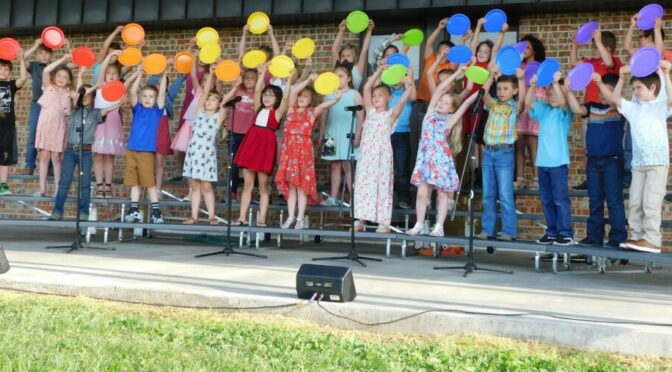
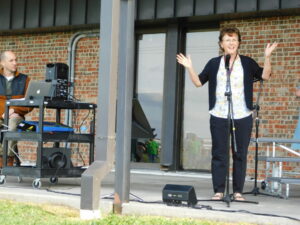
West Bourbon Elementary School Principal Vance Eden worked the soundboard, while WBE Music Teacher Rhonda Allen welcomes the audience to the spring program of kindergarten through third-grade students on May 3.

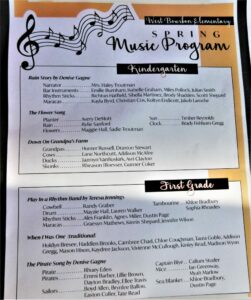
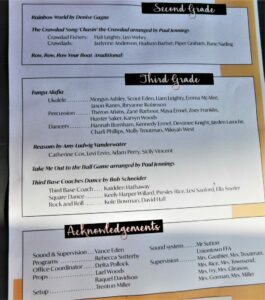
The music program for the performances.
Rhonda Allen has taught music for 39 years, with 30 of those at West Bourbon Elementary School in Uniontown.
“I teach pre-k through 6th-grade general music and junior high choir,” she said. “I also accompany the high school choir.”
Second-grade students enjoy their teachers Sheryl Fry and Brenda Gleason hamming it up during a performance.
But Monday’s kindergarten through third-grade spring music concert was not the normal spring concert at WBE.
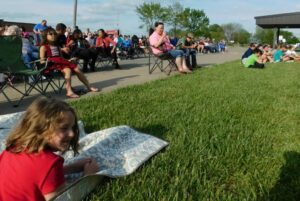
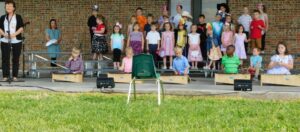
It was held outside on the front porch of the school, with parents and the community invited to bring blankets or lawn chairs to enjoy the performances, because of the COVID 19 pandemic restrictions.
The audience brought lawn chairs and blankets to watch the performances.
The idea was born out of some recommendations and some experiences, Allen said.

“There were recommendations by the National Association of Music Education, that outside is a safer place to make music,” she said.


First-grade students perform.


Last fall the district had outside performances in the local park.


“We had an event held last fall in Uniontown City Park by the 4th and 5th grades, and the junior high and high school music and art students called Art in the Park,” Allen said.  “It was very successful.”


“And we knew, an outdoor venue would not require us to limit the audience for these young performers,” she said.  “An indoor program would be limited to four audience members per participant.”


At the end of each class performance, parents came to retrieve their students. They could then leave or stay for the entire concert.


So plans were made for the annual spring concert with fingers crossed and prayers to God for good weather.
“It was a delight to be able to have a spring program this year,” Allen said. ” At the beginning of the school year, performances seemed unlikely. We were very thankful that the rain held off!”
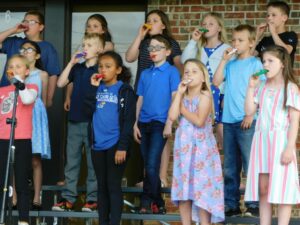
Third-grade students performed on the kazoo.


“I feel the outdoor venue was a success,” she said.  “Many seemed to enjoy the relaxed atmosphere as they watched the kids perform.”
Allen feels performing music is important.
“Performance skills are an important part of the elementary music curriculum,” she said.  “I was grateful to be able to teach those skills in this unprecedented year.”
Kindergarten students perform
Covid impact on Music Education
“A study done in the summer of 2020 revealed the amount of aerosol, how Covid is spread, created while singing or playing an instrument was significantly higher,” Allen said.  “Music education was deeply impacted by this discovery.  Social distancing, masks, and bell covers on the ends of instruments were some of the protocols followed.”
“Until late February, I traveled to each classroom, teaching from a cart,” she said.  “This changed my curriculum and the activities I normally used to teach music concepts.  It was different, but it was doable. Though it was challenging, I learned new skills and had the opportunity to discover new, and sometimes better, ways to teach music skills.”


Bourbon County Local News