|











…
[Message clipped] View entire message
 |
|
|
|
|
|
|
[Message clipped] View entire message
|
|
|
|
|
|
My friend, Carol, scanning her items in an Indiana Walmart, noticed a curious behavior from the couple buying groceries next to her.
Since the store’s attendant was texting and not paying attention to the customers, the man and woman used this as an opportunity to scam the Supercenter. The woman twisted each item so that the code faced away from the electronic reader. She pretended to swipe but made sure the machine was given no opportunity to read and record her “purchases.”
Her partner-in-crime husband had perfected the “Beep” sound made when a purchased item was logged onto the screen and mimicked it with faultless pitch and timing.
Carol stood amazed at how these thieves operated and didn’t seem bothered that we all pay higher prices because of shoplifters like them.
We could only guess what would happen if the employee at the exit asked for their receipt.
My reaction would not have been my friend’s. Either I would tell the pilfering pair that I was going to rat them out if they didn’t pay for the groceries, or I would quietly alert the texting employee to what I had witnessed
. Carol did neither, fearing the thieves would realize that she was the stool pigeon and shoot her in the parking lot. (I have some over-reactive friends.)
More alarming, my friend said she actually was pretty impressed with the talent of the couple. Say WHAT?
It’s never easy to chastise someone, but doing nothing accomplishes…well, nothing.
I appreciate the story in the Old Testament following King David’s arranged murder of his lover’s husband.
The clever prophet Nathan was sent by the Lord to chastise David. He said, “There were two men in a certain city. One was rich, and the other was poor. The rich man had a very large number of sheep and cows, but the poor man had only one little female lamb that he had bought. He raised her, and she grew up in his home with his children. She would eat his food and drink from his cup. She rested in his arms and was like a daughter. “Now, a visitor came to the rich man. The rich man thought it would be a pity to take one of his own sheep or cattle to prepare a meal for the traveler. So, he took the poor man’s lamb and prepared her for the traveler.”
David became livid, claiming that the rich man deserved to die and must pay back four times the price of the lamb. Nathan then exclaims that David is that man and life would not go well for him because of his sin.
The prophet modeled Proverbs 17:27: A man of knowledge uses words with restraint, and a man of understanding is even-tempered.
Most of the time, I work towards that goal. Sometimes, not so much. I don’t mean to be heartless, but I’ve had it with robbers who believe they are entitled to improve their lives by taking from others.
We’ve all watched phone videos of crooks walking—or riding their bikes— out of stores with their stolen goods in hand. My husband fears that this will happen when I am nearby, and he will be forced to defend me as I show neither restraint nor even-temperedness when I tackle…and scream…and grab the thieves’ wares.
And no, this does not make me over-reactive like Carol.
It doesn’t.
Sometimes we need to be brave because, let’s face it, our entire life is lived on a witness stand. God invites us to give compelling testimony to what we have seen and heard about our faith.
Wimping out is not an option. Carol needs to know that.
Maybe Walmart is a good place to start practicing.

The Bourbon County Republican meeting; THURSDAY, OCTOBER 21, 2021 at 6 p.m. in the EMPRESS EVENT CENTER, 7 N MAIN, FT SCOTT.
All Republicans and Independents cordially invited
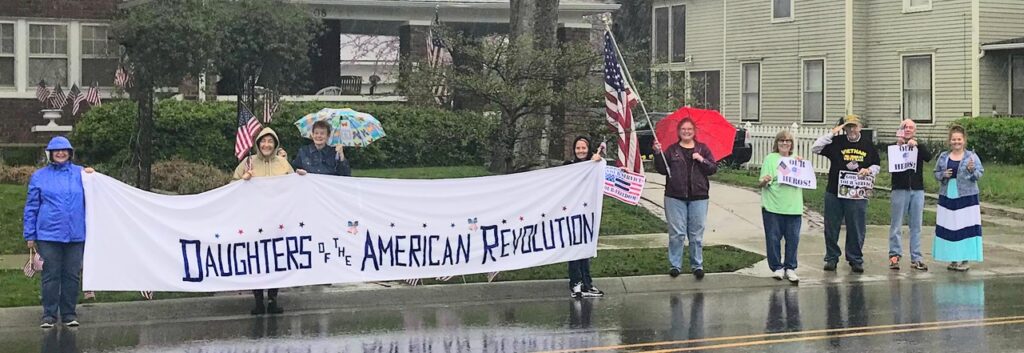
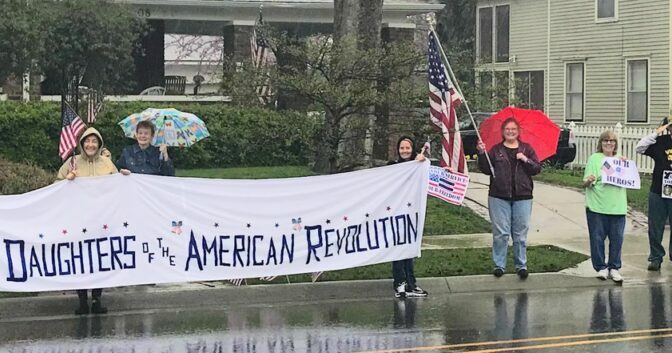
A local organization is celebrating 110 years in Fort Scott.
“The Daughter of the American Revolution organization itself is 131 years old being founded in 1890. Our chapter was founded in 1911 and thus we are 110 years old,” Martha Scott, a group member said.
The objectives of the Daughters of the American Revolution and the local Molly Foster Berry Chapter are to perpetuate the memory and spirit of the men and women who achieved American Independence; to cherish, maintain and extend the institutions of American freedom, to foster true patriotism and love of county, (and) to aid in securing for mankind all the blessings of liberty, according to information provided by Scott.
“In selecting a name for the chapter, they chose to honor the first regent, Miss Frances Hall, by selecting the wife of her Revolutionary War ancestor, Samuel Berry,” Scott said. “They chose the name of his wife, Mary Foster Berry, as the name of their chapter.”
Since its founding in 1890, the national DAR has admitted more than 950,000 members.
Currently, the Molly Foster Berry Chapter has 27 members.
Here are highlights of the group’s activities through the years provided by Scott:
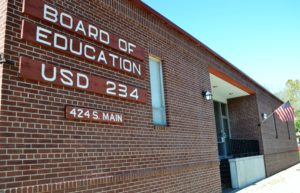
On Monday, October 11, at the USD 234 School Board meeting the USD 234 School Board adopted gaiting criteria and a Test to Stay and Learn addendum to the current Operations Guidelines for the 2021-2022 school year that will begin on October 18, 2021.
The gaiting criteria adopted would allow the district to go mask optional if the criteria adopted is met.
The gaiting criteria consists of two areas, the first being the monitoring of new COVID-19 cases in Bourbon County. The threshold of less than 30 new cases in a week in Bourbon County will be the guideline.
A COVID-19 positivity rate of less than 2% for a specific school building will be the guideline for each building.
If these two criteria are met, this would allow the school buildings to be mask optional.
Mask optional would mean the parents/guardians can decide if their child should wear a mask at school.
If the numbers go above the 30 new cases in a week and if there is a COVID-19 positivity rate above 2% for a particular building, the district or specific building would go back to masks being required.
These gaiting criteria will take effect on Monday, October 18, 2021. The district will monitor county cases on a weekly basis and the building COVID-19 positivity rate will be monitored daily.
The district will communicate on the Friday before whether a building or the district is able to be mask optional depending on the adopted criteria for the upcoming week.
The USD 234 School Board also adopted a new mitigation protocol called the Test to Stay and Learn Modified Quarantine.
This modified quarantine will include rapid antigen testing for identified school high-risk (not wearing a mask or not vaccinated or has not had COVID-19 in the last 6-months) or household close contacts where parents/guardians will give consent to have their student tested for COVID-19 daily.
If they test negative, they will be allowed to attend in-person during their quarantine period but will be required to wear a mask while at school.
The rapid antigen test is a nasal swab and will only be performed with parent/guardian consent.
If the high-risk or household contact does not opt-in to the Test to Stay and Learn Modified Quarantine, they will need to stay home during their quarantine.
USD 234 has received a grant from the Kansas Department of Health & Environment (KDHE) and will partner with Community Health Center (CHC) to implement the testing program. The logistics of this testing program are being developed and more information will be released before testing becomes available. It is going to take some time for CHC to hire the staff to implement the testing and to set up the logistics of the testing.
Masks will still be required on school transportation no matter the gaiting criteria. This is a federal mandate school districts are required to follow.
USD 234 recommends that students have a mask with them at all times in case a cluster breaks out in a building and masking needs to be implemented immediately.
Low-risk close contacts, those who are wearing a mask or are vaccinated or have had COVID-19 in the past 6-months, will not be expected to quarantine from school unless they have COVID-19 symptoms.
Click on the link below to see the updated Operations Guidelines:
Click on the link below to see the Test to Stay and Learn Modified Quarantine addendum:
USD 234 Test to Stay and Learn Modified Quarantine
Click on the link below to see an infographic about the Test to Stay and Learn Modified Quarantine:
USD 234 Test to Stay and Learn Modified Quarantine Infographic
USDA Offers Online Tool for Drought-Stricken Ranchers to
Estimate Compensation for Feed Transportation Costs
Assistance also available for water hauling expenses
WASHINGTON, Oct. 13, 2021— An online tool is now available to help ranchers document and estimate payments to cover feed transportation costs caused by drought, which are now covered by the Emergency Assistance for Livestock, Honeybees and Farm-raised Fish Program (ELAP). The U.S. Department of Agriculture (USDA) updated the program this year to include feed transportation costs as well as lowered the threshold for when assistance for water hauling expenses is available. USDA’s Farm Service Agency (FSA) will begin taking applications this fall.
“Drought has had a tremendous impact on producers, and we are thinking outside the box to help producers mitigate the effects of drought, which is a necessary first step to realizing the Secretary’s vision of ensuring agricultural producers get a fair share of the food dollar,” said FSA Administrator Zach Ducheneaux. “From climate change to COVID-19, we are continuously working to make our programs as flexible as possible and so they effectively help producers face today’s challenges.”
The new ELAP Feed Transportation Producer Tool is a Microsoft Excel workbook that enables ranchers to input information specific to their operation to determine an estimated payment. Final payments may vary depending on eligibility.
To use the tool, ranchers will need:
The tool requires Microsoft Excel, and a tutorial video is available at fsa.usda.gov/elap.
Updates to ELAP
ELAP provides financial assistance to eligible producers of livestock, honeybees and farm-raised fish for losses due to disease, certain adverse weather events or loss conditions as determined by the Secretary of Agriculture. ELAP now covers feed transportation costs where grazing and hay resources have been depleted. This includes places where:
Drought intensity is D2 for eight consecutive weeks as indicated by the U.S. Drought Monitor; or
Drought intensity is D3 or greater.
The tool calculates the estimated payment for feed transportation assistance, but it is not an application. Once FSA begins accepting applications later this fall for feed transportation assistance, ranchers should contact their FSA county office to apply. To simplify the application process, ranchers can print or email payment estimates generated by this tool for submission to FSA. The deadline to apply for ELAP, including feed transportation costs, for 2021 is Jan. 31, 2022.
ELAP already covers above normal costs for hauling water to livestock in areas where drought intensity is D3 or greater on the drought monitor. FSA is also updating ELAP to also cover water hauling in areas experiencing D2 for eight consecutive weeks, lowering the threshold for this assistance to be available. Program benefits are retroactive for 2021.
Payment Calculations
USDA will reimburse eligible ranchers 60% of feed transportation costs above what would have been incurred in a normal year. Producers qualifying as underserved (socially disadvantaged, limited resource, beginning or military veteran) will be reimbursed for 90% of the feed transportation cost above what would have been incurred in a normal year.
USDA uses a national cost formula to determine reimbursement costs that will not include the first 25 miles and distances exceeding 1,000 transportation miles. The calculation will also exclude the normal cost to transport hay or feed if the producer normally purchases some feed. For 2021, the initial cost formula of $6.60 per mile will be used (before the percentage is applied).
Eligibility
To be eligible for ELAP assistance, livestock must be intended for grazing and producers must have incurred feed transportation costs on or after Jan. 1, 2021. Although producers will self-certify losses and expenses to FSA, producers are encouraged to maintain good records and retain receipts and related documentation in the event these documents are requested for review by the local FSA County Committee.
More Drought Recovery Information
USDA has taken additional steps to assist drought-impacted producers, including:
USDA offers a comprehensive portfolio of disaster assistance programs. On farmers.gov, the Disaster Assistance Discovery Tool, Disaster Assistance-at-a-Glance fact sheet, and Farm Loan Discovery Tool can help producers and landowners determine all program or loan options available for disaster recovery assistance. For details, producers should contact their local USDA Service Center.
USDA touches the lives of all Americans each day in so many positive ways. In the Biden-Harris Administration, USDA is transforming America’s food system with a greater focus on more resilient local and regional food production, fairer markets for all producers, ensuring access to safe, healthy and nutritious food in all communities, building new markets and streams of income for farmers and producers using climate smart food and forestry practices, making historic investments in infrastructure and clean energy capabilities in rural America, and committing to equity across the Department by removing systemic barriers and building a workforce more representative of America. To learn more, visit www.usda.gov.
#
USDA is an equal opportunity provider, employer and lender.
Fourth Annual Kansas Prevention Conference Scheduled for Next Week: “Strong for the Next Generation”
TOPEKA – The Kansas Department for Aging and Disability Services (KDADS) has partnered with the Kansas Prevention Collaborative (KPC) to host the fourth annual Kansas Prevention Conference October 21-22, 2021, with a pre-conference session October 20. This year’s conference, “Strong for the Next Generation,” is a virtual event and welcomes two nationally recognized keynote speakers. Last year, the conference drew more than 175 virtual attendees who joined for educational opportunities designed to help them in their prevention work throughout the state.
The KPC Conference will provide attendees with educational opportunities to increase awareness of emerging trends in prevention, build skills and knowledge to prevent suicide, alcohol, tobacco, and other drug abuse and advocate for best practices. Participants in the conference will also learn ways to connect and network with their community and advocate for best practices in prevention.
“Each year this conference attracts people across that state who understand that the work we do around prevention is a fundamental part of the larger public health conversation we must have in our state,” KDADS Secretary Laura Howard said. “Bringing everyone together is one of the ways we can share our knowledge with coalitions and communities across the state in an effort to empower them to move forward with some of the strategies presented in the diverse breakout sessions offered.”
The conference will kick off October 21 with opening remarks by Secretary Howard followed by a keynote address by speaker Dr. Wanda Boone, founder of Together for Resilient Youth (TRY). Dr. Boone’s presentation will reveal how traumatic events and experiences impact prevention as she also takes a dive into the importance of identifying trauma as a social determinant of health and how to apply a resilience-based, equity informed, and community driven lens to prevention.
National Director of Children’s Programs at Betty Ford Center, Jerry Moe, MA, will also give a keynote presentation, “Through a Child’s Eyes,” on the second day of the conference. He will discuss how children are impacted in a family with alcoholism and drug addiction and uncover specific prevention strategies that can make a real difference in their lives.
KDADS’ Behavioral Health Services (BHS) Commission and the KPC are excited to provide this learning opportunity to communities across Kansas. To learn more about the conference, view the schedule and read more about the keynote speakers, visit kansaspreventioncollaborative.org/conference.
KPC is a group of eight partner organizations funded by KDADS working to integrate and innovate behavioral health prevention efforts. This conference is part of KPC’s strategy to ensure that Kansans get the tools they need to prevent underage drinking, substance misuse, problem gambling and suicide. Partner organizations are KDADS, Kansas Suicide Prevention HQ, Wichita State University Community Engagement Institute, DCCCA, Learning Tree Institute at Greenbush, and Life Span Institute University of Kansas.
These eight partner organizations along with these nine conference sponsors make this year’s event possible: Aire Recovery Center, Blue Cross and Blue Shield of Kansas, United Behavioral Health, Mirror, Opioid Response Network, Valeo, C.E. Mendez Foundation, Inc., Verde Environmental Technologies, Inc., Valley Hope Addiction and Recovery.
About the Kansas Prevention Collaborative: The Kansas Prevention Collaborative was created in 2015 in an effort to integrate and innovate behavioral health prevention efforts. A partnership of several different state, educational, and provider agencies, the KPC’s goal is to expand prevention efforts to be more inclusive of mental health promotion, suicide prevention, and problem gambling education and awareness, as well as to increase the availability of resources to adequately fund local-level prevention and promotion strategic plans. For interviews, media inquiries, or more information, please contact the Kansas Prevention Collaborative at [email protected].
|
|
|
|
|
|
|
|