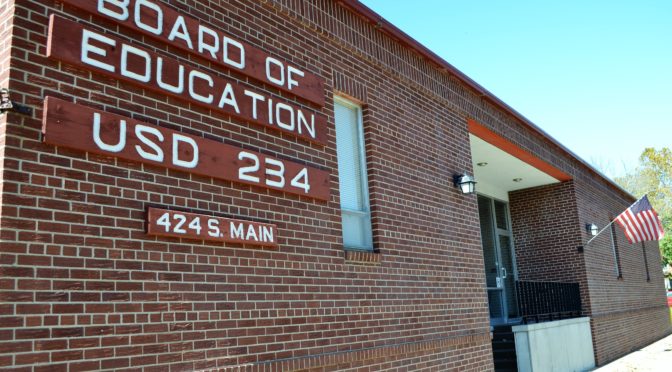
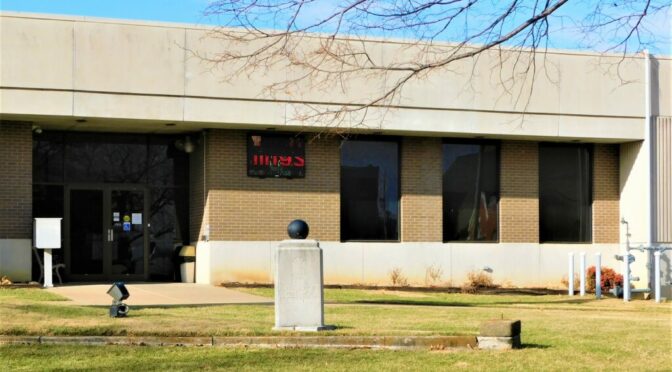
Members of the USD 234 Board of Education met at 5:30 p.m. on Monday, February 27, 2023, for a special board meeting at the board office.
President Danny Brown opened the meeting.
The board held a work session led by Superintendent Destry Brown to update the board regarding long-range facility and maintenance needs facing the district. Gina Shelton, Finance Director/Board Clerk provided financial information in regard to the various funds that can be used for capital projects. There was discussion.
The board went into an executive session for personnel matters.
The board approved the following items:
Approval of Personnel Report (following)
President Danny Brown adjourned the meeting.
PERSONNEL REPORT – APPROVED EMPLOYMENT
February 27, 2023
RESIGNATIONS/TERMINATIONS/RETIREMENTS:
Sabrina Cady – Resignation, Van Driver/Fort Scott Middle School Paraprofessional, effective March 8, 2023
Colin Downey – Resignation, Fort Scott High School Social Studies Teacher, effective at the end of the 2022-23 school year
Lienna Upchurch – Resignation, Eugene Ware Special Education Teacher, effective at the end of the 2022-23 school year
Robert West – Termination, Preschool/Eugene Ware Custodian, effective March 7, 2023
EMPLOYMENT/REASSIGNMENTS:
Megan Blythe – Fort Scott High School Art Teacher – remainder of 2022-23 school year
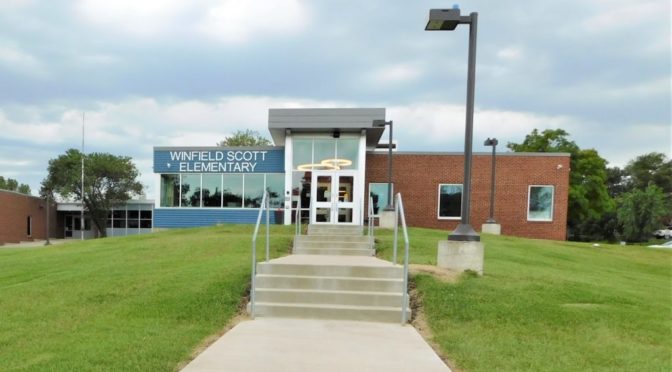
Alicia Craig – Change position to a 4-hour Van Driver and 6.50-hour Winfield Scott Paraprofessional, effective 03/06/23
Jamie Dawson – Transfer from Eugene Ware Paraprofessional to Winfield Scott Paraprofessional on 02/21/23
Alexandrea Herring – Preschool/Eugene Ware Custodian, effective February 23, 2023
TOPEKA – The Kansas Department for Aging and Disability Services today announced $66 million has been made available through the Strengthening People and Revitalizing Kansas (SPARK) Executive Committee and State Finance Council to close service gaps in the continuum of care by addressing statewide shortages of health and behavioral health services and the state’s increasing demand for a well-trained healthcare workforce.
The funds, approved by the State Finance Council in December, are available to service providers, educational institutions, local units of government, and non-profit organizations to specifically address three program areas: expansion of health care facilities; expanding the reach of current service providers; and workforce training expansion.
“The $66 million in SPARK funding allocated to KDADS can make a significant difference in expanding access to services by funding new facilities, program expansions, and workforce training,” KDADS Deputy Secretary of Hospitals and Facilities Scott Brunner said. “KDADS is excited to put these funds to use in communities across Kansas to meet the needs of people with mental illness, disabilities, and long-term care needs.”
Applicants must specify which of the following three program areas their proposal addresses:
Program 1: Expansion of health care facilities. KDADS seeks applications from service providers, local units of government, established partnerships of providers, or non-profit organizations to expand health care facilities. The facility expansion must result in more services being delivered within a defined geographic area or clearly increase service capacity through more licensed bed space, expanded treatment facilities, or additional credentialed providers. Expanded health care facilities must deliver more services in one or more of the following areas:
Behavioral health
Services for adults or children in acute psychiatric crisis
Forensic evaluation and restoration for criminal competency cases
Community based services for individuals with disabilities that would otherwise require nursing facility level of care
Program 2: Expand reach of current service providers. KDADS seeks applications from Medicaid enrolled service providers to deliver Medicaid services through innovative delivery models using technology to expand the reach of current service providers or to reach additional Medicaid eligible beneficiaries. Grantees must describe how their proposed intervention expands access to services for underserved individuals or communities.
Program 3: Workforce Training Expansion. KDADS seeks applications from providers, local units of government, educational institutions, or non-profit organizations to expand workforce training. Workforce training expansion must result in an increase in students being trained to serve in the medical field. Grantees must document the number of trainees and how they will impact the future health care workforce.
KDADS’s application process is open now, with submissions closing March 17 at 5:00 p.m. and awards announced March 29.
Applicants and any questions regarding the funding opportunity should be submitted to [email protected]. More information about this funding opportunity and the complete Request for Application can be found on the KDADS website: https://kdads.ks.gov/funding-opportunities.
Conventional wisdom accepts that Star Wars and the Super Bowl attract an audience of millions. What’s less well known is that arecent surveyindicates almost 50 million people attend one of more than 37,000 school theatre performances annuallyin the United States.
The Theatre in Our Schools (TIOS)Month in March, is an opportunity to inform them, and millions more, that the pleasure they get from seeing a show on stage is just oneof many benefits that school theatre brings to all involved—from overcoming fears of public speaking to the development of collaboration and teamwork. TIOS is timely in that its March celebration occurs the same month as Music in Our Schools and Youth ArtMonth.
TIOS provides an opportunity for all of us here inFort Scott—students, parents, school boards and elected officials—the entire community—to become familiar with the benefits of school theatre participation. Thespian troupe#7365 is planning a numberof events tocelebrate this month. On March2, they travel to Topeka to meet with legislators about the importance of supporting theatre education. March 6, troupe president Kinsley Davis presentsto theUSD 234 Boardof Education about the way theatre education is impacting our own school district. On Thursdays in March, Thespians will wear theatre–related t–shirts to school. March 24 is the annual FSHS Talent Show and Miss(ter) FSHS Pageant at7 p.m. in the FSHS Auditorium. Admission is $5 at the door. Thespians travel to the Music Hall in Kansas City to see the Broadway Touring production of Hamilton on March 28.
You can follow FSHS Thespians through the followingsocial media links: Facebook–FortScott High School Thespians, Instagram–FSHSThespians, Snapchat–FSHSThespians, Tiktok–fshsthespian, Twitter–FSHS_Thespians.Share your school theatre thoughts withus using#TheatreInOurSchools.
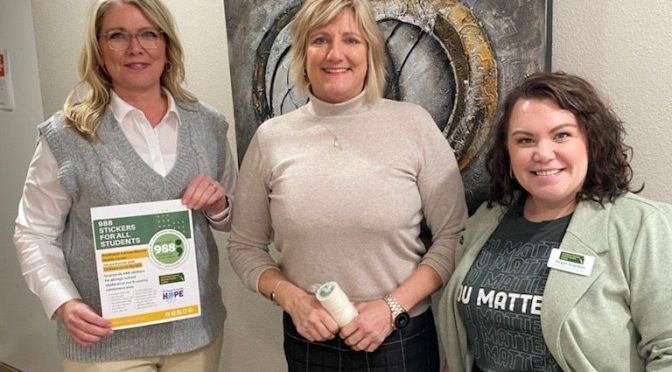
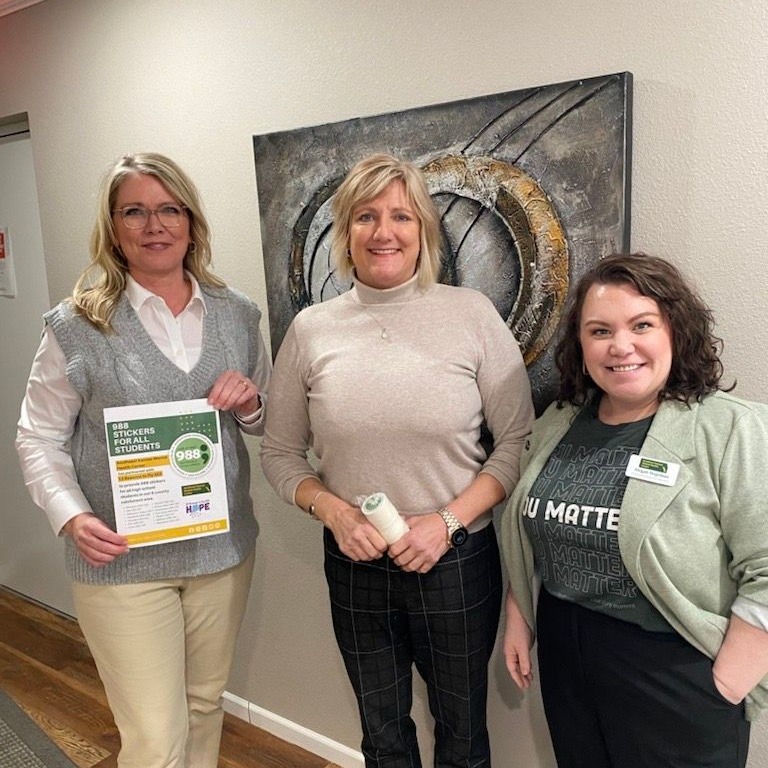
From L to R, Dawne Burchett, SEKMHC PR and Promotion and Prevention Specialist Lead; Sharla Miller, 13 Reasons to Fly SEK; and Megan Hageman, SEKMHC Promotion and Prevention Specialist. Submitted photo.
Southeast Kansas Mental Health Center is working to reach out to area students with nearly 3,200 reminders that help is available when they are experiencing a mental health challenge or crisis.
Partnering with Sharla Miller, with 13 Reasons to Fly SEK, SEKMHC created stickers themed to share information about 988, the national suicide and crisis hotline. They will be distributing nearly 3,200 of them to students in 13 high schools in their six-county catchment area.
“Even if we help just one student – that’s one life that might be saved,” commented Miller. “We need to get better at letting kids know it’s ok to not be ok. We need to encourage those conversations.”
Miller, a strong mental health advocate in the community, started the SEK chapter of 13 Reasons to Fly after her son died by suicide nearly four years ago.
Suicide is the second leading cause of death for people ages 10-24 in Kansas. Kids are reporting feelings of depression and anxiety at higher rates than ever before. Teachers are observing alarming mental health challenges experienced by their students daily. It’s undeniable that children need help.
“We hope to see lots of stickers on laptops, water bottles, and other student belongings soon!” explained Megan Hageman, SEKMHC prevention and promotion specialist. “Getting this information to the youth in the area can make a huge difference. Showing kids that they have support, no matter what, is essential!”
988 (similar to 911) is the national hotline designated to provide support for individuals who are experiencing a mental health or suicide crisis. Callers may call confidentially and speak with mental health professionals who can help them through their crises and provide referrals for additional mental health resources.
13 Reasons to Fly, a non-profit organization, works to reduce the stigma surrounding mental illness while still spreading hope to those who are struggling. The foundation advocates for continual mental health care reform so that recovery can be equitable and accessible to all people. The SEK chapter, serving Allen County and surrounding communities, incorporates education, shared stories, and perspectives of teens to dismantle the stigma of mental health.
The mission of the Southeast Kansas Mental Health Center is to provide, advocate and coordinate quality mental health care, services, and programs for people in its service area. Our vision is to improve the quality of life in southeast Kansas. We offer services and programs in the following counties: Allen, Anderson, Bourbon, Linn, Neosho, and Woodson. Our core services include outpatient psychiatry, therapy, consultation, chemical abuse counseling, case management, educational and skill-building groups, specialty training, physical healthcare coordination, and 24/7 crisis intervention services.
Governor Kelly Proclaims March Problem Gambling Awareness Month
TOPEKA – Governor Laura Kelly has signed a proclamation designating March Problem Gambling Awareness Month (PGAM) in Kansas. The Kansas Department for Aging and Disability Serves (KDADS), in collaboration with the Kansas Coalition on Problem Gambling (KCPG), recognizes March as PGAM as part of the national campaign held annually. The 2023 campaign theme is “Celebrating 20 Years” (#PGAM2023).
Problem gambling is defined as all gambling behavior patterns that compromise, disrupt or damage personal, family or vocational pursuits. Approximately 2 million U.S. adults (1% of the population) are estimated to meet criteria for severe problem gambling. Another 4-6 million (2-3%) meet the criteria for mild or moderate problem gambling. Problem gambling affects thousands of Kansans of all ages, races and ethnic backgrounds and can have a significant societal and economic cost for individuals, families, businesses, and communities.
“The good news is problem gambling is treatable and treatment is effective in minimizing harm,” KDADS Problem Gambling Program Manager Carol Spiker, LAC, KCGC, said. “It’s vital to de-stigmatize issues around problem gambling so we can reach more people to let them know there are programs and information out there to address their problem head on.”
One intervention tool, or harm reduction strategy, that has seen success in recent years in Kansas is the self-exclusion program. Self-exclusion is a voluntary process where a person bans themselves from entering specific gambling venues, or from accessing online providers. All Kansas gambling providers are required to provide the option to customers to self-exclude from accessing their venue or their products. Individuals enter into an agreement that excludes them for an agreed minimum period of time. The agreements authorize venue management to take reasonable steps to remove individuals on the self-exclusion list from state-owned casino property or the online gaming app of a state-owned casino. For some, self-exclusion is a step taken when other methods of minimizing harm have been tried without much success. For others, self-exclusion can be the first step.
Problem Gambling Awareness Month is designed to help raise awareness of the prevention, treatment and recovery services, and harm reduction strategies available to those adversely affected by gambling.
To get help for a gambling problem for you or a loved one, please call the Kansas Problem Gambling Helpline at 1-800-522-4700 (or 1-800-GAMBLER). The call is free and confidential. No-cost treatment is available to problem gamblers and concerned others through the Problem Gambling and Addictions Grant Fund. For more information about problem gambling and the resources available in Kansas, go to ksgamblinghelp.com.
Governor Kelly Announces February Total Tax Collections Exceed Estimates by Nearly $37 Million
TOPEKA – Governor Laura Kelly today announced that total tax-only collections for February were $549.8 million. That is $36.8 million, or 7.2%, more than the monthly estimate. Those collections were also $47.3 million, or 9.4%, more than in February 2022.
“Revenues have exceeded estimates for 30 out of the last 31 months – a clear sign that our efforts to make Kansas a place where businesses and families want to call home is paying off,” Governor Laura Kelly said. “These revenues will continue to grow our historic budget surplus, making it possible for our legislature to pass responsible tax cuts that help every Kansan, like my ‘Axing Your Taxes’ plan.”
Consistently strong revenues were one of the reasons S&P Global improved Kansas’ credit outlook, which the firm announced yesterday. In its report, S&P cited Governor Kelly’s recommended budgets for fiscal years 2023 and 2024 as indicators of continued fiscal responsibility that could lead to a credit rating upgrade and warned against irresponsible tax plans that could lead to a credit rating downgrade.
Individual income tax collections were $211.3 million in February. That is $6.3 million, or 3.1%, above the estimate and $27.9 million, or 15.2%, more than February 2022.
“The positive trend in tax receipts continues with all of the major tax types, individual income tax, corporate income tax, retailer’s sales tax, and compensating use tax, performing well,” Secretary of Revenue Mark Burghart said.
Corporate income tax collections were $15.3 million, which is $324,000, or 2.2%, more than the February 2023 estimate. Those collections are $8.1 million, or 34.5%, less than in February 2022. It should be noted that February 2022 corporate income tax receipts were greater than February 2023 because of the higher-than-expected collection of nonrecurring corporate audit assessments that occurred that month.
Retail sales tax collections were $203.8 million, which is $13.8 million, or 7.3%, more than the estimate. Those collections are also $8.5 million, or 4.4%, greater than February 2022. Compensating use tax collections were $64.2 million, which is $849,000, or 1.3%, less than the estimate. Those collections were $4.7 million, or 8.0%, more than in February 2022.