Fort Scott, KS – Lauren Powell has been hired as Fort Scott Community College’s new music performance director.
Powell earned a Bachelor of Music in vocal performance from Simpson College and both a Master of Music and Doctor of Musical Arts in vocal performance from Louisiana State University. Throughout her academic career, she performed numerous leading operatic roles and gained teaching experience through private instruction, collegiate teaching and studio leadership.
For the past several years, Powell has continued to expand her private studio while serving as a classical voice instructor at the School for Music Vocations at Southwestern Community College in Iowa. Her experience teaching students of various ages and musical backgrounds aligns with the college’s efforts to rebuild and grow its music program.
Powell will begin her role with an initial group of music students already committed to Fort Scott Community College, including students who signed to participate in the music program during signing events held April 28 and May 8, 2026. She will work with those students while continuing efforts to recruit and develop additional opportunities for music students at the college.
The addition of a music educator with advanced academic credentials and extensive performance experience marks an important step in the continued development of the college’s music offerings. Powell’s background in performance and instruction will support efforts to attract students, enhance campus life and expand music opportunities for both the college and the Fort Scott community.
Fort Scott Names Chad Kline New Head Men’s Basketball Coach
Fort Scott, KS – Chad Kline has been named head men’s basketball coach at Fort Scott Community College, bringing 23 years of coaching experience to the Greyhounds program.
Kline will lead the men’s basketball program as FSCC continues to build on recent success and strengthen its presence in the Kansas Jayhawk Community College Conference.
“We want to welcome Chad and his family to Fort Scott as our new men’s basketball coach,” FSCC Athletic Director Dave Wiemers said. “Coach Kline will bring strong leadership and a vision for building a competitive program. We look forward to the impact he will have as we continue the forward momentum of the men’s program.”
Joining Kline on the coaching staff is Kemani Roberson, who has been hired as the men’s basketball assistant coach. Roberson will assist with recruiting, player development and day-to-day operations of the program.
Together, Kline and Roberson will lead the next chapter of Greyhound men’s basketball, focusing on student-athlete development, competitive success and continued growth of the program.
Bourbon County Community Theatre Auditions for Willy Wonka TYA
Bourbon County Community Theatre (BCCT) is producing its first ever musical this summer, open to all ages.
Auditions for Roald Dahl’s Willy Wonka (TYA – Theatre for Young Audiences) version are 6:30-8:30 p.m. July 6 or 7 at the Fort Scott High School Auditorium.
“The delicious adventures experienced by Charlie Bucket on his visit to Willy Wonka’s mysterious chocolate factory light up the stage in this captivating adaptation of Roald Dahl’s fantastical tale. Featuring the enchanting songs from the 1971 film starring Gene Wilder, and new songs by Leslie Bricusse (Jekyll & Hyde, Doctor Dolittle) and Anthony Newley, Roald Dahl’s Willy Wonka TYA is a scrumdidilyumptious musical guaranteed to delight everyone’s sweet tooth,” according to Music Theatre International.
Those who audition should plan to stay for the entire time period on one evening of auditions. They should prepare to sing a 16-32 measure portion of a song. Auditioners should bring an accompaniment recording to sing along with.
Rehearsals are 6:30-9 p.m. Monday through Thursday at FSHS. Performances are at 7 p.m. on Aug. 7 and at 2 and 7 p.m. on Aug. 8 at FSHS.
Those who are cast in the show are asked to donate a $25 participation fee with a maximum of $50 per family. Parents who are not in the show with their children should also volunteer to supervise on a performance night.
BCCT is also looking for a Lighting Designer and Sound Designer for the production as well as Stage Crew. The show is directed by Angie Bin with musical direction by Taylor Jones and choreography by Abby Stepps.
“We are so excited to finally be able to offer our community our first ever musical production. This will be such a fun venture for all ages and we have an incredible artistic staff eager to get started,” said Bin.
BCCT is seeking sponsors to help make their first musical successful. Please see the BCCT facebook page for more information on how to become a financial sponsor or contact Bin for more information.
Roald Dahl’s Willy Wonka TYA has music and lyrics by Leslie Bricusse and Anthony Newley. It is adapted for the stage by Leslie Bricusse and Timothy Allen Mcdonald and is based on the book “Charlie And The Chocolate Factory” by Roald Dahl. It is presented through special arrangement with Music Theatre International (MTI). All authorized performance materials are also supplied by MTI, www.mtishows.com
Anyone with questions should contact Bin at 620-719-9622 or at [email protected].
Governor Kelly Announces Over $13.7M for Infrastructure Projects Across Kansas
TOPEKA – Governor Laura Kelly today announced 18 Kansas communities have secured over $13.7 million in federal and state funding for airport and energy grid resilience improvement projects.
The awards include over $10.1 million in federal Infrastructure and Investment Jobs Act (IIJA) funding and over $3.6 million in matching funds from the Kansas Infrastructure Hub and Build Kansas Fund. Combined with over $165,000 in local contributions, the total investment in Kansas for this round of infrastructure grants is more than $13.9 million.
“Kansas’ commitment to investing in critical infrastructure has helped create opportunities to secure additional funding and advance projects that benefit communities statewide,” Governor Laura Kellysaid. “These investments are about more than strengthening infrastructure; they are about improving quality of life, supporting economic opportunity, and building a stronger future for our state.”
The Kansas Infrastructure Hub connects multiple state agencies and serves as a resource center for Kansas communities to identify best practices for maximizing IIJA and other federal and state funding opportunities. The Build Kansas Fund provides state matching dollars for projects throughout Kansas that successfully apply for federal grants under IIJA.
In total, the Build Kansas Fund has provided the required non-federal match dollars for 92 federal grants across Kansas. The combined total investment by the Build Kansas Fund for all projects is over $51.28 million, which has resulted in federal grant awards of more than $161 million returning to the state of Kansas.
“These awards demonstrate the Kansas Infrastructure Hub’s commitment to supporting improvements across multiple sectors and ensuring communities of all sizes can compete successfully for federal funding opportunities,” Shawn Wesner, Executive Director of the Kansas Infrastructure Hub, said. “Through the support of the Kansas Legislature and Governor Kelly, we are bringing together federal, state and local funding to make strategic investments that will strengthen our state infrastructure and support communities for years to come.”
By helping secure investments in both airport infrastructure and energy grid resilience, the Hub continues to advance a comprehensive approach to infrastructure development that strengthens transportation networks, enhances energy reliability, and promotes long-term economic growth throughout Kansas.
“The City of Glen Elder is a rural North Central Kansas town with a population of 363. Glen Elder, like so many other small towns in Kansas, is run with a tight budget. The city was in dire need of replacing old, highly sun-faded, and hard-to-read electric meters on homes and businesses. However, the budget did not allow the city to purchase all the meters outright without the matching funds from the Build Kansas Fund. The city is extremely grateful for the Section 40101(d) Second Round Grant and the matching Build Kansas Funds which allowed Glen Elder to purchase new Itron radio-read electric meters,” Jerri Senger, Glen Elder City Clerk, said.
The Kansas projects receiving funding are:
City of Ness City – Airport Apron Expansion
Build Kansas Funding – $5,500
Federal Funding Awarded – $110,000
Applicant Contribution – $289
Total Project – $115,789
City of Ottawa – Airport Taxiway Construction
Build Kansas Funding – $29,250
Federal Funding Awarded – $585,000
Applicant Contribution – $1,540
Total Project – $615,790
City of Clay Center – Airport Hangar Project
Build Kansas Funding – $13,320
Federal Funding Awarded – $266,385
Applicant Contribution – $701
Total Project – $280,406
City of Junction City – Airfield Obstruction Removal
Build Kansas Funding – $15,200
Federal Funding Awarded – $304,000
Applicant Contribution – $800
Total Project – $320,000
City of Hays – Airport Runway Reconstruction
Build Kansas Funding – $65,302
Federal Funding Awarded – $1,306,044
Applicant Contribution – $3,437
Total Project – $1,374,783
City of Cawker City – Power Pole Maintenance & Repair
Build Kansas Funding – $37,935
Federal Funding Awarded – $82,618
Applicant Contribution – $1,997
Total Project – $122,550
Sumner County Electric Cooperative – Transmission Pole Replacement
Build Kansas Funding – $260,997
Federal Funding Awarded – $568,416
Applicant Contribution – $13,737
Total Project – $843,150
Wheatland Electric Cooperative – Pole Replacement & Undergrounding
Build Kansas Funding – $417,556
Federal Funding Awarded – $909,378
Applicant Contribution – $21,977
Total Project – $1,348,911
City of Beloit – Pole Replacement
Build Kansas Funding – $209,070
Federal Funding Awarded – $455,326
Applicant Contribution – $11,004
Total Project – $675,400
City of Glen Elder – Meter Updates
Build Kansas Funding – $10,818
Federal Funding Awarded – $23,560
Applicant Contribution – $569
Total Project – $34,947
City of Bronson – Grid Updates
Build Kansas Funding – $125,523
Federal Funding Awarded – $273,371
Applicant Contribution – $6,606
Total Project – $405,500
City of Jetmore – Pole Replacement
Build Kansas Funding – $169,268
Federal Funding Awarded – $368,643
Applicant Contribution – $8,909
Total Project – $546,820
Brown Atchison Electric Cooperative – Pole Replacement
Build Kansas Funding – $395,106
Federal Funding Awarded – $860,484
Applicant Contribution – $20,795
Total Project – $1,276,385
Bluestem Electric – Powerline Replacement
Build Kansas Funding – $383,216
Federal Funding Awarded – $834,590
Applicant Contribution – $20,169
Total Project – $1,237,975
Doniphan Electric Cooperative – Rebuild Substation
Build Kansas Funding – $541,713
Federal Funding Awarded – $1,179,775
Applicant Contribution – $28,512
Total Project – $1,750,000
Flint Hills Rural Electric Cooperative – Pole & Line Replacement
Build Kansas Funding – $459,167
Federal Funding Awarded – $1,000,000
Applicant Contribution – $24,166
Total Project – $1,483,333
City of Luray – Transformer Replacement
Build Kansas Funding – $258,067
Federal Funding Awarded – $533,933
Total Project – $792,000
City of Savonburg – Grid Replacement
Build Kansas Funding – $227,601
Federal Funding Awarded – $470,899
Total Project – $698,500
To learn more about the Hub, please visit the website here.
If you have questions about the Hub’s work, please reach out directly at: [email protected].
Meet our 2025-2026 Ambassador Emily Bittner, a ceramics teacher at Castro Valley High School in Castro Valley, California.
Each ARTEFFECT Ambassador culminates their visual arts online fellowship with a capstone project that brings the inspiring stories of the LMC Unsung Heroes into their classrooms and communities.
Here is an excerpt from Emily’s Capstone Project report:
“By learning about diverse unsung heroes, students gained a broader perspective on history and the contributions of individuals from different backgrounds. The act of translating these stories into visual form through sgraffito allowed for deeper emotional connection and creative expression.”
Congratulations to Emily and her students at Castro Valley High School in Castro Valley, California for a year full of spectacular ceramics projects inspired by LMC Unsung Heroes!
Congratulations to Emily’s student, Vlada Stinerman (Grade 12), for winning a 2026 Certificate of Excellence for her artwork A Dive Through Realityabout Unsung Hero Dr. Sylvia Earle!
Emily also had two other students whose projects were selected as Finalists in the 2026 ARTEFFECT annual competition!
2026 Finalists by Emily Bittner’s students: Cleared for Takeoff by Clarissa Sun (Grade 12) about Unsung Hero Jerrie Cobb; and Origin of the Strokeby Kalynn Huang about Unsung Hero Jackie Ormes.
ARTEFFFECT is excited to announce 46 winners in the 11th annual competition. In total, $49,750 in prizes were awarded to the 46 winners across the middle and high school divisions.
In this year’s international competition, students in grades 6-12 explored and championed the stories of LMC Unsung Heroes—role models who made a positive and profound, yet previously unrecognized, impact on the course of history. For their entries, these young artists created original works of art and wrote reflective impact statements to reframe these untold stories in an array of artistic expressions and reflections.
“The ARTEFFECT competition is a one-of-a-kind opportunity for young people to consider, interpret and create original works of art about Unsung Heroes and the invaluable lessons their heroic deeds exemplify,”says Lowell Milken, founder of ARTEFFECT and the Lowell Milken Center for Unsung Heroes. “By giving visual form to acts of heroism, students deeply engage with their subject, asking questions not only of themselves as artists but also of themselves as human beings. This process unleashes the power of art to inspire ARTEFFECT participants to celebrate the past and discover their potential to influence the future.”
Thank you to all sponsoring classroom educators, art instructors, families, and communities for supporting these talented young artists through the 2026 competition. ARTEFFECT looks forward to celebrating these achievements over the coming weeks!
Congratulations to the
2026 ARTEFFECT Competition Winners!
SPREAD THE NEWS!
Stay connected with ARTEFFECT and spread the word about the 2026 competition winners. Be sure follow us on these platforms for announcements, news, professional development, resources and more!
Presentation Explores African American Food Traditions in Kansas
Fort Scott, KS. – The Gordon Parks Museum in Fort Scott, Kansas will host “Food for the Journey: Kansas Stories,” an interactive presentation and demonstration by Theressa Rice that will take place on June 19, 2026 at 12:00 p.m. at The Danny and Willa Ellis Family Fine Arts Center at 2108 S. Horton St. Members of the community are invited to attend the free event. Contact the Gordon Parks Museum at 620-223-2700 ext. 5850 for more information. The event is part of “Kansas Folklife: Celebrating Kansas Traditions,” a series of folklife presentations developed by Humanities Kansas recognizing the nation’s milestone 250th anniversary.
This is a free Lunch and Learn event, with drinks and desserts provided.
“Everyone is welcome and encouraged to attend this presentation event to learn more about the Kansas Folklife and the journey of African Americans migration from the south” said Museum Director, Kirk Sharp.
As African Americans made their way to Kansas, what foods came with them? Theressa Rice’s presentation is rooted in stories – stories from her history, her grandparents’ farm, her family’s migration from Oklahoma and Texas, and the food that graced the table for Sunday Supper once they reached their destination. Some stories might sound familiar – hunting for rabbits, frying up chickens, boiling potatoes dug straight from the ground, and picking berries off the vine to make into a delicious pie. Audience members will connect to these timeless traditions that stretch across generations (and maybe even get a slice of homemade pie to try).
Theressa Rice is a storyteller, baker, and small business owner.
“Kansas Folklife: Celebrating Kansas Traditions” is part of “By the People: Beyond 250,” a national initiative of the Federation of State Humanities Councils and the Smithsonian Center for Folklife and Cultural Heritage.
For more information about “Food for the Journey: Kansas Stories” in Fort Scott, Kansas, contact the Gordon Parks Museum at 620-223-2700 ext.5850 or visit gordonparkscenter.org
About Humanities Kansas
Humanities Kansas is an independent nonprofit leading a movement of ideas. Since 1972, HK’s programming, grants, and partnerships have documented and shared stories to spark conversations and invite new insights. Together with statewide partners and supporters, HK encourages Kansans to draw on diverse histories, literatures, and cultures to create connections with one another and strengthen Kansas communities and our democracy. Visit humanitieskansas.org.
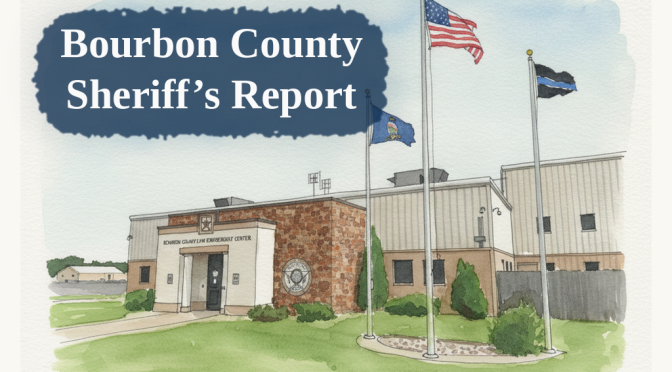
Bourbon County Sheriff Bill Martin. Submitted photo.
The following is a statement from Bourbon County Undersheriff Kevin Davidson.
“Sheriff Martin was presenting a life-saver award at Fort Scott Community College (on June 9) and suffered what is believed to be a heart attack. He was transported to a Kansas City Hospital. I spoke with him today, and he is awake and in good spirits. I appreciate the support shown to the Sheriff’s Office from our great community and we are all thankful for everything. The family is asking for prayers for a speedy recovery!”
Kevin Davidson, Bourbon County Undersheriff. Submitted photo.
“I will send an update as I get further information. I will be stepping up in his absence, along with Chief Deputy Shawn Pritchett, to accommodate his absence. There will be no changes in our office for the time being. The Sheriff’s Office is dedicated to serving our community, and that will not change. I appreciate everyone’s support and all the prayers Sheriff Martin has received.”
Ellis Fine Arts Center on the campus of Fort Scott Community College, 2401 S. Horton.
FORT SCOTT COMMUNITY COLLEGE
BOARD OF TRUSTEES SPECIAL MEETING
ELLIS FINE ARTS CENTER
JUNE 11, 2026 – 12:00 P.M.
PUBLIC AGENDA
1.0 CALL MEETING TO ORDER – CHAIR DOUG ROPP
1.1 Roll Call of Trustees by the Clerk:
Bailey, Brown, Cosens, Hoyt, McKinnis, Ropp
2.0 FLAG SALUTE & INVOCATION
3.0 LEADERSHIP REPORTS & UPDATES (INFORMATION)
3.1 Academics – Vice President of Academic Affairs – Dr. Larry Guerrero
3.2 Advancement – Dean of Advancement – Lindsay Hill
3.3 Athletics – Athletic Director – Dave Wiemers
3.4 Finance – CFO – Vice President of Finance & Operations – Gina Shelton
3.5 Student Services – Vice President of Student Affairs – Vanessa Poyner
3.6 Grant Updates – Dean of Advancement – Lindsay Hill
3.7 Presidential Update – President Dr. Jack Welch
4.0 REVIEW OF JUNE 15TH AGENDA ITEMS (INFORMATION)
5.0 PERSONNEL
5.1 Enter Executive Session – Personnel Matters (ACTION)
5.2 Exit Executive Session – Return to Open Session (ACTION)
Multiple sources say that Sheriff Martin collapsed and hit his head during a Congressional Records presentation at FSCC on Tuesday June 9th. FortScott.biz reached out to the Sheriff’s office for an official statement soon after the event, but no one was available for comment. The Sheriff’s office Facebook page was updated shortly after 3pm on Tuesday to say they were closed for the rest of the day.
Sheriff Martin suffered a medical emergency during an awards assembly on 6/9/26. As of this morning the Sheriff is in critical condition but is stable at this time. The family and the Bourbon County Sheriff’s Office appreciates the prayers and everyone who respected our privacy during this time.
FortScott.biz will update with more information when it becomes available.
The Fort Scott Area Chamber of Commerce invites members and guests to a Chamber Coffee hosted by Varia Quality Resale Clothing, 114 E. 23rd St. this Thursday, June 11th at 8am.
Coffee, juice, and refreshments will be served, and attendees may register to win a special drawing.
Varia offers affordable prices and a variety of high-quality used items, including women’s, teens’, and children’s clothing, as well as purses, shoes, jewelry, and more. Owner, Robin Kendrick, is celebrating her 5th year in business and is excited to host this event and welcome the community to join in the celebration.
Varia’s June Special will feature a $25 store credit drawing. Customers who spend a minimum of $20 when shopping in-store may register for the drawing.
For more information, contact the Chamber at (620) 223-356. Visit the Events Calendar at fortscott.com and select the Chamber Coffees category for upcoming locations.
The County Clerk and Election Officer Susan Walker and Deputy Clerk Amber Page walked FortScott.biz through the election process showing the procedures their office uses to take in, track, and reconcile every ballot cast in a Bourbon County election.
This article shows the order that an election unfolds, starting with building the ballot weeks before Election Day and ending with the canvass after Election Day.
Important Terms:
KNOWiNK Poll Pad: The electronic tablet voters sign in on at the polling place. KNOWiNK is the vendor; Poll Pad is the device.
ePolls: The Clerk’s office shorthand for the electronic pollbook export from the Poll Pads. The data feeds into ELVIS after the election.
ELVIS: Election Voter Information System. The Kansas Secretary of State’s statewide voter registration and credit system.
Clear Ballot: The scanner system voters insert marked ballots into at the polling place.
ClearDesign: Clear Ballot’s ballot-design software. Used by the Clerk’s office to build each election’s ballot manually, race by race and precinct by precinct.
UOCAVA: Uniformed and Overseas Citizens Absentee Voting Act. Federal law governing absentee ballots for military and overseas voters.
Manual pollbook: Paper backup pollbook used when Poll Pads fail. Voters sign by hand and are credited in ELVIS afterward.
Provisional ballot: A ballot cast under questioned circumstances (e.g., wrong polling place). Whether it counts is decided later, at the canvass.
Chain-of-custody sheet: Daily log signed by both Walker and Page when retrieving and validating mail-in advance ballots from the office mailbox.
Canvass / Board of Canvassers: Post-election review by the Board of Canvassers (typically the county commissioners) that decides which provisional ballots count and finalizes results.
Supervising judge: The election worker overseeing a specific polling place on Election Day. They serve once a year.
Precinct part: A sub-unit of a precinct that votes on slightly different combinations of races, created by redistricting.
1. Building the ballot
Designing a Bourbon County ballot is a weeks-long process, handled primarily by Page. She uses Clear Ballot’s design software, called ClearDesign. Every piece of information has to be typed in manually: the name of the election, the date, every race, every district, every precinct, which races appear on each precinct’s ballot, which voter groups can vote on each race, and which polling places each precinct’s ballot is available at.
Primary elections add another layer. Every contest has to be mapped to the parties that will appear in it, and every candidate has to be linked to the correct party, so they show up on the right party’s ballot.
Recent redistricting in Bourbon County added significantly to that complexity by creating more precincts and what Page called “precinct parts.” These are sub-units that vote on slightly different combinations of races. The Clerk’s office relies heavily on the district map to determine which precinct or precinct split a given voter belongs to.
Walker said that last year, after an issue discovered with the early voting ballots forced Page to rebuild an entire election configuration, work that would normally have taken several weeks, in hours to have them ready in time for voting day.
The Clerk’s office uses multiple internal and external reviewers to look at the ballot before it goes live, including people outside the office checking for spelling and other errors. Walker said the goal is to keep iterating on the process, “we keep trying to do everything better. We keep doing new processes to make it simpler.”
2. Preparing ballots for the polls
Once the ballot is finalized and printed, every ballot the Clerk’s office sends to a polling place is sealed with a numbered seal. The supervising judge at each polling place is required to keep those seals and return them. If a seal has to be broken, a new seal goes on and is logged. All seals are audited against the equipment they were applied to.
The Clerk’s office also manually counts every ballot before sending it out. On the morning of Election Day, the polling-place staff recount what was delivered and validate the count with the Clerk’s office. At the end of the day, the polling-place staff recount the unused ballots before sending everything back.
3. Voter check-in at the polling place
When a voter walks in to vote, they sign in on a Poll Pad — an electronic check-in tablet running software from a company called KNOWiNK on an iPad. The Poll Pad captures the voter’s signature and identifying information.
If the Poll Pad system goes down, there is a paper backup with the manual pollbook. Voters sign the manual pollbook, and the Clerk’s office later enters those records into the state voter system by hand. Walker described one recent example: on the first day of early voting before the November 2025 election, the Poll Pads malfunctioned, and 29 voters signed the manual pollbook. All 29 were later manually credited with voting in the state system.
If a voter shows up at the wrong polling place, they sign a separate provisional pollbook and fill out additional provisional paperwork. Whether that ballot ends up counting is decided later, at the canvass described below.
4. Mail-in and advance ballots
Some voters cast their ballots by mail rather than in person. Mail-in advance ballots are checked every single day during the advance-voting window. Walker and Page personally retrieve ballots from the mailbox together, count and validate them, log them on a chain-of-custody sheet, and both sign off. The log records how many ballots came in that day but not the voters’ names.
The office tracks who was mailed an advance ballot and who has returned it. If something is wrong — for example, a voter and their spouse have signed each other’s envelopes — the office returns the ballot for correction. Some ballots come back from the post office because of bad addresses. Those, too, are handled manually.
Kansas recently changed the law on advance-ballot returns. Previously, ballots could arrive up to three days after Election Day and still count. Under the new rule, advance ballots must be in by 7 p.m. on Election Day to count. Walker noted the new deadline is currently the subject of litigation, but the Kansas Secretary of State has directed county election officials to plan as though the 7 p.m. deadline is final.
Military voters and overseas voters are tracked separately under federal UOCAVA (Uniformed and Overseas Citizens Absentee Voting Act) rules. Walker said Bourbon County typically sees about two UOCAVA ballots a year.
5. Casting the ballot: the scanner
When a voter inserts a filled out ballot into the voting machine at the polling place, they’re using a system called Clear Ballot. At the end of the day, the Clear Ballot machine produces a report listing how many ballots passed through it.
Occasionally there are anomalies. Walker described one example: a voter who was issued a provisional ballot can sometimes tear the ballot off and run it through the regular scanner instead of returning it to the supervising judge. Those anomalies are noted at the end of the day.
6. Reconciling the count
After Election Day, the Clerk’s office reconciles every election against three independent systems:
The Poll Pad / ePolls export — the electronic check-in log that captures every voter who signed in on a Poll Pad and, after the election, gets imported into the state’s voter system.
ELVIS — short for Election Voter Information System, the Kansas Secretary of State’s statewide voter registration and credit system. ELVIS receives both the automatic Poll Pad import and any manual entries (provisional ballots, manual pollbook entries, etc.).
Clear Ballot — the scanner-side count of ballots that physically went through the machines on Election Day.
Walker said all three numbers are expected to tie out. If they don’t, the office investigates. In her experience, when the numbers don’t match, the discrepancy is almost always in advance ballots or provisionals — what she called “the most room for human error.”
As a concrete example, in last year’s election the office processed 36 provisional ballots, of which 12 didn’t count, and 13 advance ballots.
7. The canvass
After the initial reconciliation, a Board of Canvassers — typically the county commissioners themselves, though they can appoint someone else to do it on their behalf, which Walker said has happened on many occasions — meets to go through every provisional ballot and decide which ones count.
Provisional ballots are evaluated against specific statutory standards. Ahead of the canvass, Page goes through each provisional and identifies which statute applies and whether the ballot likely qualifies, in order to speed up the commissioners’ review. The commissioners make the final call. Once the canvass is complete, the results are entered into ELVIS.
Voters interested in verify their own voting history can go to the Kansas Secretary of State website and enter their name and birthdate. That lookup queries ELVIS.
Walker described cases of voters who had voted but couldn’t find a record on the state site. The cause was usually a name-entry error from years earlier — for example, an entry that placed a voter’s first name into the middle-name field, so the lookup didn’t return a match. The Clerk’s office can fix those records once notified. Walker said voters who can’t find their record on the state site should call the office. (620-223-3800 ext. 100)
Each polling place is overseen by a supervising judge — election workers who are on duty only once a year. Walker said training has historically been short for that reason. The Clerk’s office is planning longer training this year to walk supervising judges through specific responsibilities and procedures.
The Clerk’s office was recently awarded an $8,500 election-security grant from the state.
Walker said the office plans to use the grant to:
Buy five carts to securely hold ballots in transit. Currently, supervising judges — many of whom are elderly volunteers — have to move ballots to the polling places the night before Election Day. With the carts, ballots can stay sealed in the carts and be delivered for them.
Add additional security cameras. Walker mentioned that the office had previously had a camera missing from the election room; the grant will pay to address that as well.
Walker said the grant had been approved just the week before the May 22 walkthrough.
This article is based on a May 22, 2026 demonstration at the Bourbon County Courthouse. The videos of the walk through of the process are shown below.