The Bourbon County Sheriff’s Office Daily Reports May 12
Chamber Coffee at Billiard Hammer Hartman Ins. May 13
|
|

|

|
|



|
|
Obituary of John Phillip Hammons

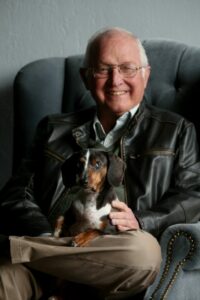
On May 4, 2021, the curtains closed on the life of John Phillip “Phil” Hammons after being on life’s stage for 77 years with his quick wit, his roaring laughter, and his irrepressible personality.
The world was graced with Phil’s presence on March 23, 1944 in Fort Scott, KS. The second son of Carol and Paul Hammons, brother to Stephen Carson. He was best described by his sainted mother Carol…”He’s never been quite right.” Following an idyllic childhood he attended the University of Kansas where he was an active, proud member of the Sigma Chi fraternity…”How’d he get in?” you might ask…we’re not sure either! Phil graduated with a major in Math in 1966 and moved to St. Louis, Missouri to work for Ford Motor Company.
In 1968 he married Susy Sheaks. Their children, Josh and Carey, were born in Missouri, which caused considerable consternation because this clashed with his deep Kansas Jayhawk roots.
The family moved to Fort Scott in 1975, where Phil joined Hammons Realty to work with his dad. The doors of Hammons Realty Company closed in 2018 after more than 50 total years in operation.
In retirement, Phil continued his real estate activities at H&H Agency and his independent appraisal business. Additionally, he was the treasurer for the Fort Scott USD 234, treasurer for the First United Methodist Church, treasurer for the Class of 1962, and treasurer for his golf group (which was his most challenging pro bono task).
A childhood bout with polio left Phil with a weak upper left arm, and rather than become the target of jokes about his disability, he became the jokester of the room, targeting anyone around him, politically correct or not. He used it to his advantage. Most any time he found himself at a disadvantage, he’d cry “But I had THE polio as a child!”
He laughed as uproariously as anyone else at his own jokes; he was his own laugh track. You may have been at the receiving end of Phil’s witty comments and comebacks. Even if some of them stung, the secret is…that meant he cared about you.
Admittedly more of a brain than an athlete, believe it or not, Phil had FOUR holes-in-one in his lifetime playing the game he loved with a group of guys he treasured. An avid KU basketball fan, in February 2020, he took great pride in taking his grandson, Nate, to his very first basketball game in Allen Fieldhouse complete with a pre-game stop at The Wheel. Another very special moment was singing a duet in church with granddaughter Avery. Although he didn’t much like hearing that she was the lead and he was her backup.
While recovering from his first round of chemo in March 2021 at Nottingham Health and Rehab in Olathe, KS, his Sigma Chi brothers serenaded him. The weather was perfect and Phil was able to sit by a large open window and even sing along until becoming verklempt.
Phil’s hometown community rallied around him during his battle with lung cancer. Phil said, “I’ve had more people at my house in the last 30 days than I had in the previous 30 years!” (Phil was more of a professional guest than host).
The town he loved really came through for him in a big way during these difficult 11 weeks since the diagnosis. He was miraculously able to stay at home with his dog, Roxy, for the last several weeks of his battle because of the selfless community support. On May 2nd, 2021, an impromptu, surprise, friendship parade was organized in a couple of hours, and approximately 100 people passed by his bedroom window with messages of love and support. He greeted each person by name and was deeply touched by their presence.
Beyond his witty and larger-than-life personality, Phil was a good man, a good father, and grandfather (Pop to his grandchildren), a good community man, a staunch member of the First United Methodist Church, a talented tenor, and well-known local real estate broker/appraiser.
Although they were divorced, he and Susy worked to maintain good relations which made it possible for many combined family celebrations over the years. Most recently, the family had several “Fridays with Pop” for favorite family meals of the past and good conversations.
He will be dearly missed by his family and friends, who when reunited with him on the other side, MAYBE by then, all of his old, tired jokes will finally seem new again. No question, he will greet them asking, “Did we go to high school together?” OR “Are you here for the cheerleaders’ convention?”
Phil leaves behind his devoted children, Joshua John Hammons (Pittsburg) and Carey Carson Hammons Parks (Overland Park), grandchildren, Avery Jane Parks and Nate Carson Parks, and last but not least, the famous Roxy the Doxy (as Phil called her), his devoted dog. She was a particular comfort in his last days (when she wasn’t standing on his chest!). Fortunately for Phil, his children were committed to him in spite of the fact that he said to a home health nurse, “Help, my kids are trying to kill me!” during her very first home health visit. If you knew Phil, this surprises no one (other than that unsuspecting home health nurse).
Greeting Phil on the other side are his father, Paul Leroy Hammons; mother, Emily Carol Carson Hammons; brother, Stephen Carson Hammons, and countless other treasured family members and friends both human and canine. The Hammons family LOVES dogs and in particular, Phil looked forward to reuniting at the Rainbow Bridge with his loving companion of 15 years (who he stole from his neighbors…that’s a story for another time) Maggie the dachshund.
In lieu of flowers, please make a donation in Phil’s memory to the organizations that brought the Hammons family its most pedigreed members:
Roxy, Phil’s dachshund: The SE Kansas Humane Society in Pittsburg, KS, – Humane Society, P.O. Box 783, Pittsburg, KS 66762 (https://www.thesekhumanesociety.com/donate).
Abe, Josh’s cocker spaniel mix:
Golden Paw Rescue out of Joplin, MO – Golden Paw Rescue, 2300 N Main St., Joplin, MO 64801, (https://www.goldenpawrescue.org/).
Willow, Carey, Avery, & Nate’s beagle mix:
Always & Furever Animal Sanctuary in Spring Hill, KS – Always & Furever, 23595 W 223rd St., Spring Hill, KS 66083 (https://www.alwaysandfurever.org/donate/).
A celebration of life service will be held at 11:00 a.m. on Friday, May 21, 2021, at The First United Methodist Church in Fort Scott under the direction of the Konantz-Cheney Funeral Home.
Due to COVID restrictions, the attendance is limited to 100 attendees maximum. The family is investigating options to stream the service online. Buck Run Community Center will be set up with chairs and a large screen for church overflow to watch the service.
When available, details to join the live stream of the service will be shared on Phil’s CaringBridge site at https://www.caringbridge.org/visit/philhammons, on Facebook, and also available from Konantz-Cheney Funeral Home, 15 W. Wall St., Fort Scott, KS, 66701.
Immediately following the church service, a procession to the cemetery will be held.
The family encourages all to join in the procession to the cemetery and at the graveside. The family requests that you please submit stories and memories to the online guestbook at www.konantz-cheney.com.
Tri-Valley 1/2 Price Plant Sale May 12
|
|



|

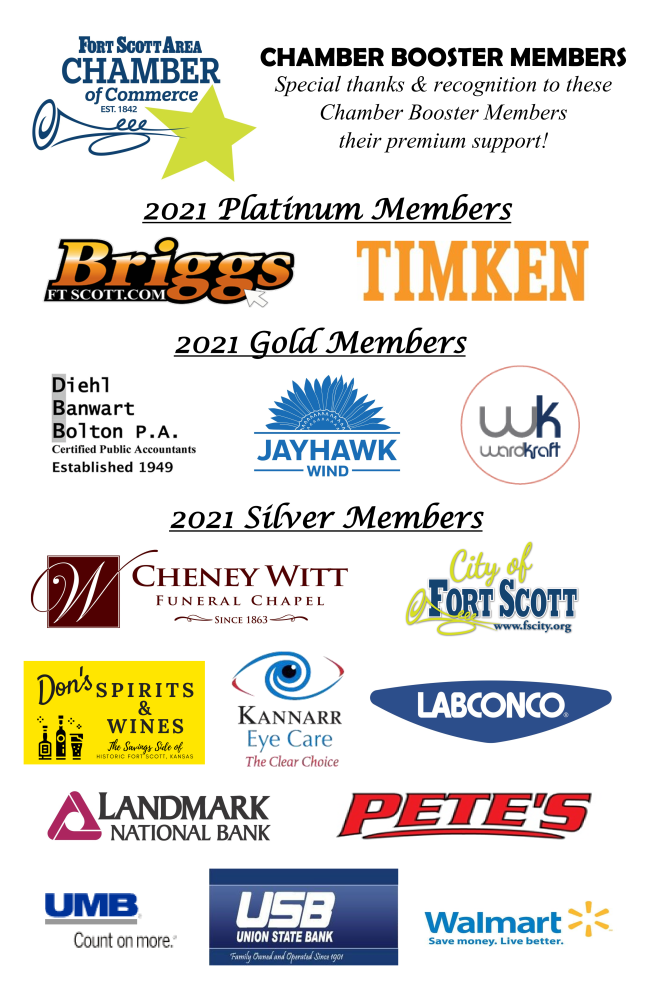
| Special Thank You to our Chamber Booster |
 |
Kansas: $5 Billion in New Capital Investment
Governor Laura Kelly Announces Kansas Economic Development Week; State Surpasses $5 Billion in New Capital Investment
TOPEKA – Today, Governor Laura Kelly announced Kansas will participate in Economic Development Week, an annual celebration hosted by the International Economic Development Council.
“Over the last two years, we’ve rebuilt the Department of Commerce and reinvested in critical services like education, transportation, broadband, and health care,” said Governor Laura Kelly. “With over $5 billion in new capital investment, our efforts are paying off in real-time. We’ll continue to reinvest in our foundation and recruitment tools to keep Kansas open for business.”
Since Governor Kelly took office, Kansas has experienced historic economic development success – recently surpassing over $5 billion in new capital investment by businesses since 2019. Of the $5 billion brought to the state, $2.5 billion was invested in 2020 alone, making 2020 the most successful economic development year in Kansas history.
“Governor Kelly has ushered in a new era of economic development in Kansas,” Lieutenant Governor and Commerce Secretary David Toland said. “Major business investments ripple through the state by bringing new visitors, residents and dollars to the state. Kansas companies expanding strengthen their communities and provide new opportunities for their neighbors. Our new way of doing business has made Kansas stronger, more secure and more prosperous – period.”
Selected investments since the beginning of the Kelly administration include:
- Schwan’s Company, Inc. – building a new 400,000-square-foot expansion at its pizza-manufacturing facility in Salina, totaling $600 million in capital investment;
- Hilmar Cheese Company – building a new production facility in Dodge City, totaling $460 million investment;
- Urban Outfitters, Inc. – building a new 880,000-square-foot omnichannel distribution center in Wyandotte County, totaling more than $400 million in capital investment;
- Amazon – two new fulfillment centers in Kansas City and Park City, totaling $210 million in capital investment;
- Merck Animal Health – new facility expansion/enhancement in DeSoto, totaling $100 million in capital investment;
- Pretzels, LLC – building a 146,000-square-foot manufacturing facility in the Lawrence Venture Park, totaling $88 million in capital investment;
- Great Plains Manufacturing (Kubota) – new manufacturing facility in Salina, totaling $43 million in capital investment.
For more information on the recent $5 billion capital investment milestone, read Governor Kelly’s recent op-ed in the Wichita Eagle here.
To read more about Kansas’ recent economic development successes and the team behind business recruitment and expansion, follow the Kansas Department of Commerce on social media, including Facebook, LinkedIn, Twitter and Instagram.
About Economic Development Week
Economic Development Week was created by IEDC in 2016 to increase awareness of local programs that create jobs, advance career development opportunities, and improve the quality of life in communities everywhere. Over the years, more than 450 campaigns have been created throughout the United States and Canada, creating millions of impressions, hundreds of news stories, blog entries, videos, events and other activities. Campaigns occurred in all 50 American states in 2018, with more than 40 communities officially proclaiming Economic Development Week.
About the Kansas Department of Commerce
As the state’s lead economic development agency, the Kansas Department of Commerce strives to empower individuals, businesses and communities to achieve prosperity in Kansas. Commerce accomplishes its mission by developing relationships with corporations, site location consultants and stakeholders in Kansas, the nation and world. Our strong partnerships allow us to help create an environment for existing Kansas businesses to grow and foster an innovative, competitive landscape for new businesses.
Bird Lands In Fort Scott, starting Friday, May 14th
The City of Fort Scott is partnering with shared electric scooter company, Bird Rides. to bring e-scooters to the city. The scooters are available through a mobile phone application and riders pay to use the scooter per minute, at no cost to the city.
City of Fort Scott Community Development and Tourism manager, Allyson Turvey, stated: “We are happy to welcome Bird to the City of Fort Scott and look forward to having the scooters available to connect visitors to our attractions. I think they will make a great addition to our community.”
The electric scooters can only be used on roads and in bike lanes and have a maximum speed of 15mph. Scooters must be parked out of the way of pedestrians. Riders are required to be 18 years-old and above to access the scooters. They are also encouraged to wear a helmet on every ride and required to obey all standard rules of the road.
“The City has been working with Bird, a LA based company for the last few months. We are excited to see the economic benefit of these scooters in our rural community.” according to Rachel Pruitt, City of Fort Scott Economic Development Director.
‘Community Mode’ allows anyone with a Bird account to report or provide feedback on vehicle-related issues such as poorly parked or damaged vehicles in their area. When a report is submitted, a member of the Bird team is assigned to correct the issue. Anyone can access Community Mode by tapping the yield sign on the bottom left of the Bird map.
If a resident has questions or concerns about the e-scooters the company can be reached directly at 1-866-205-2442 or hello@bird.co. More information about the company can be found on their website (www.bird.co) and on their blog (www.bird.co/blog).
BIG KANSAS ROAD TRIP MOVES TO SOUTHEAST KANSAS
The Big Kansas Road Trip in upper northeast Kansas ended with more than a hundred people at the Kansas Explorers Club meeting waiting anxiously for news about where the fourth annual BKRT would take place. Cheers and applause accompanied the announcement that Bourbon, Cherokee and Crawford counties in southeast Kansas would be the next area to be showcased May 5-8, 2022.
Allyson Turvey, Fort Scott Tourism Director; Rachel Pruitt, Fort Scott Economic Development Director; and Rhonda Dunn, tourism advisory board member, represented the 2022 planning team at this year’s Big Kansas Road Trip (BKRT) in Brown, Doniphan and Nemaha counties. They were introduced at the Kansas Explorers Club meeting and they welcomed the crowd to southeast Kansas.
The BKRT, a project of the Inman-based, non-profit Kansas Sampler Foundation, replaced the 27-year run of the popular Kansas Sampler Festival. The first counties to be featured in the new format in 2018 were Barber, Comanche and Kiowa counties. The next year the northwest counties of Cheyenne, Sherman and Wallace were highlighted. The 2020 event was postponed until this May due to the pandemic. Foundation director Marci Penner said, “By showcasing three counties, we give people a reason to come see a part of the state they might not know very well. We’re trying to get people addicted to exploring!”
Penner continued, “All we ask of the communities is to be good at being themselves, that’s all. It’s a time to show-and-tell a story that even locals might find interesting. The event is like a tri-county open house, an ala carte adventure. Hundreds of people will travel all over the three counties but on their own time frame to places they choose to go. Those who attend are excited to interact with the locals, to buy and eat at locally-owned businesses and to get to know something unique about each community.”
Penner and assistant director WenDee Rowe will be coming to Fort Scott, Pittsburg and Columbus on June 7 and 8 to meet with county leaders and those interested in learning more about how to participate. In addition to Turvey and Pruitt representing Bourbon County, Devin Gorman and Chris Wilson of the Crawford County Convention and Visitors Bureau will lead Crawford County, and Liz Simpson of The Columbus Project and Jake Letner, Columbus Community Development Coordinator, will lead Cherokee County. Anyone interested in being the main contact for their community should attend the June meetings.
Allyson Turvey said, “I am so excited to have the Big Kansas Road Trip making its way to Southeast Kansas next year. The locals always love the opportunity to greet new visitors, and show off everything that makes our rural communities special; BKRT is the perfect time to do just that!”
For more information about the BKRT, go to www.bigkansasroadtrip.com.
USD234 Board of Education Minutes of May 10
NEWS RELEASE
Monday, May 10, 2021
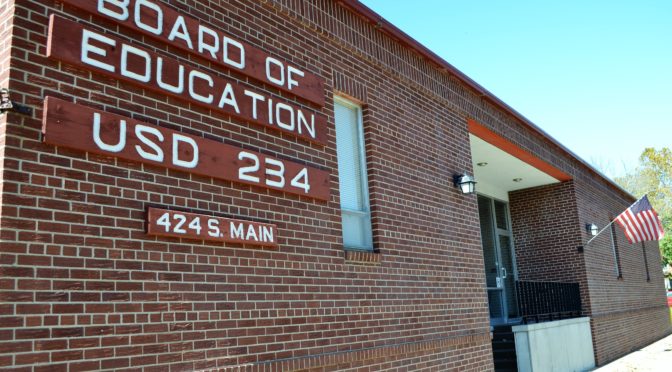
Members of the USD 234 Board of Education met at the Fort Scott Middle School Commons on Monday, May 10, 2021, for their regular monthly meeting.
President David Stewart opened the meeting. The board approved the official agenda. The board also approved the consent agenda as follows:
A. Minutes
B. Bills and Claims
C. Payroll – April 20, 2021 – $1,424,631.30
D. Financial Report
E. Activity fund accounts
F. LCP Assurances
G. May 15 – Baccalaureate – 4:00 pm; Graduation – 8:00 pm
Gifted teachers, Angie Kemmerer and Paulette Howard, presented a program on
the gifted education program.
There were no comments in the public forum section.
Reports were given by the following:
· Brenda Hill, KNEA President
· Administrators’ written reports
· Dalaina Smith, Academic Director
· Ted Hessong, Superintendent
· Gina Shelton, Business Manager/Board Clerk
Board members approved the following:
· Adjustment in adult meal fees for 2021-22
· 2021-22 Fees
· Masonry bid
· Summer Camps
· 2021 Summer pay, pending negotiations
Board members shared comments and then went into executive session to discuss personnel matters for nonelected personnel and to discuss upcoming negotiations sessions and returned to open meeting.
The board approved the following employment matters:
A. Resignation of Baylee Newman, Eugene Ware paraprofessional, effective May 13, 2021
B. Resignation of Kristin Bishop, Winfield Scott paraprofessional, effective at the end of the 2020-21 school year
C. Resignation of Vernon Hill, Winfield Scott cook, effective June 3, 2021
D. Transfer of Jennifer Tourtillott, Winfield Scott kindergarten teacher, to Winfield Scott counselor for the 2021-22 school year
E. Contract extension request from Angella Curran, high school debate and forensics teacher
F. Leave of absence request from Natalie Kitsmiller, Winfield Scott paraprofessional
G. Additional duties for Krista Gorman, high school/middle school instructional coach, as high school lead administrator for the remainder of the 2020-21 school year
H. Employment of Madeline Martin as a gifted teacher for the 2021-22 school year
I. Employment of Todd Magee as a Eugene Ware third grade teacher for the 2021-22 school year
J. Employment of Trent Johnson as a high school agriculture education teacher for the 2021-22 school year
K. Employment of Carol Glover as a Winfield Scott cook for the 2021-22 school year
L. Employment of Eileen Strakal as a Eugene Ware cook for the 2021-22 school year
M. Employment of Millicient Willard as a Winfield Scott cook for the 2021-22 school year
N. Employment of Lynn Barr as high school head girls’ tennis coach for the 2021-22 school
O. Termination of Joie Moore, high school cook, effective April 1, 2021
The board adjourned.
FS Street Advisory Board Meets May 13
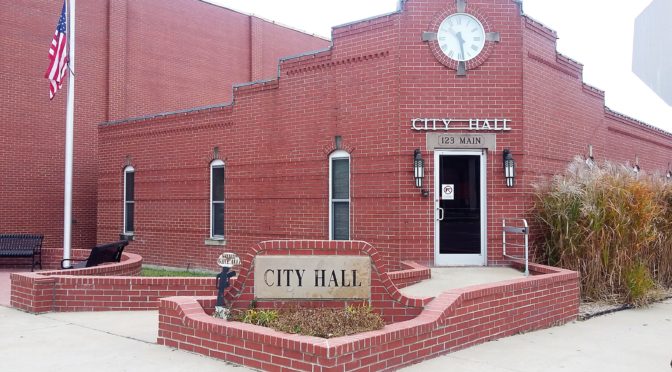
The Street Advisory Board will meet on Thursday, May 13th, 2021 at 4:00 p.m. at the City Commission Meeting Room at 123 S. Main Street. This meeting is open to the public.
This meeting will be made available via the City’s you tube channel at City of Fort Scott.
FS Design Review Board Meets May 12
The Design Review Board will meet on Wednesday, May 12th, 2021 at 4:00 p.m. in the City Hall Commission Meeting room at 123 S. Main Street, Fort Scott, Kansas. This meeting will be held to consider the signage at 18 N. Main Street.
This meeting will be made available via the City’s you tube channel at City of Fort Scott.
10 Years of Ministry: Feeding Families in His Name
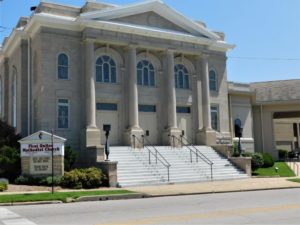
Feeding Families in His Name celebrates 10 years of ministry on May 11, 2021.
“We started the ministry because of a seen need of school children being food insecure,” Jean Tucker, coordinator of the weekly meal, said.
“Tom Braker had the idea ten years ago and gathered a group of people who started the program on May 11, 2011,” she said. “The administrative board of the First United Methodist Church voted unanimously to start the program.”
The meal is offered each Wednesday evening at 301 S. National, the Fort Scott First United Methodist Church from 5:30 to 6:30 p.m.
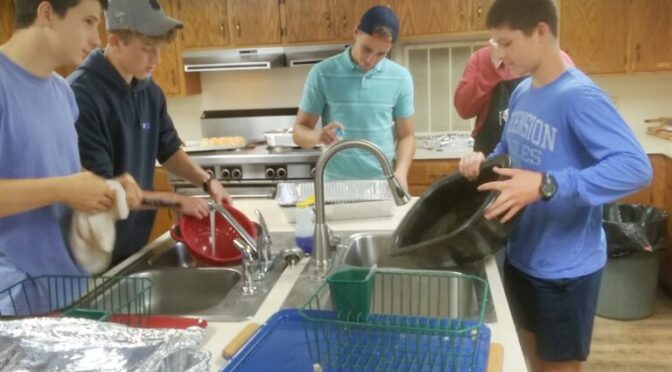
“From May 11, 2011, until March of last year we served the meal in the basement Fellowship Hall,” she said. “This allowed us to visit with the families and get to know them and their needs other than a hot-home cooked meal. Now we must visit with them as they drive through.”

“Since the beginning of COVID-19 restrictions, we have served to-go-meals only,” Tucker said.
“The ministry has extended past the serving of a meal,” she said. “Some of our dinner guests have become our valued weekly volunteers. We believe that the meal is a delivery system for God’s love!”
Currently helping weekly are Tom Braker, Steve and Susan Cole, Tom Coyan, Joey Beerbower, Linda and Leroy Cox, Betty and Pat Galan, Koyle Link, Lisa Robertson, Phyllis Colthart, and Don and Jean Tucker, plus a group of 15-20 dessert bakers who bake one or two desserts every week, Tucker said.
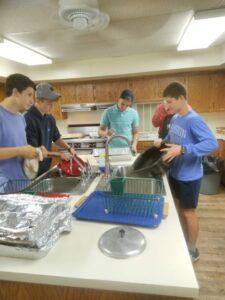
A different group helps with the entrée and serving every week.
“The first Wednesday (of each month) is St. Martin’s Schoolboys; the second Wednesday during the school year, the Community Christian Church, under the direction of Gail Sackett, alternates with the First United Methodist Church; the third Wednesday is the Nazarene Church Small Group, under the direction of Gretchen Goodyear; the fourth Wednesday is the First Presbyterian Church under the direction of Alesha Martin and Sandra Cowan, and the fifth Wednesday is Pioneer Kiwanis under the direction of Kelly Collins,” she said.
The amount of meals served has grown.
In March 2011, the ministry served 44 meals, on March 10, 2021, they served 281 people a meal, Tucker said.
“The most we have served is 422 meals on a Wednesday last November,” Tucker said.
” I just did some math and the number of meals served since we began May 11, 2011, is over 98,000 and we have averaged 1,233 meals each month for the past year,” she said.
The ministry receives funding from the Fort Scott Area Community Foundation.
For more information, contact Jean Tucker, Coordinator of FFiHN at 620-223-4617 or church office at 620-223-1950