Governor’s Council on Tax Reform Releases Second Interim Report
TOPEKA – A second interim report by the Governor’s Council on Tax Reform is issued in the wake of the last legislative session being cut short by the COVID-19 global pandemic. The report for consideration by the Kansas Legislature includes additional research of possible economic implications to the state caused by the pandemic.
Governor Laura Kelly established the bipartisan Governor’s Council on Tax Reform through Executive Order No. 19-11, which has since extended its formation.
The Council was tasked with conducting an in-depth assessment of the state’s tax structure, to explore strategies that increase both effectiveness and fairness, and receive input from stakeholders across the state.
The governor continues to recommend returning to the “three-legged stool” approach that relies on a sensible balance of income, sales, and property tax revenue.
The Council will continue to review aspects of state and local finances and how best to respond to federal tax law changes, the taxation of groceries as part of sales tax revenue, and how to best provide targeted property tax relief. The Council also is charged with determining how much room will be available in future budget projections for tax relief.
“I am pleased with the extensive work the Council has performed for the sound recommendations that will return the state to a balanced approach of sales, income and property taxes,” Governor Laura Kelly said.
Kansas Households Receiving Food Assistance Will Receive Added Benefit
Beneficiaries to see 15 percent increase starting in January
Kansas Department for Children and Families Secretary Laura Howard announced today that benefits through the food assistance program, or Supplemental Nutrition Assistance Program (SNAP), will increase temporarily.
The maximum allotments for food assistance will increase 15 percent for each household in January and will continue through June 2021. For the six-month period, the maximum allowable allotment for a family of four has been temporarily increased to $782.
“The Consolidated Appropriations Act of 2021 allows states to provide this additional assistance,” Howard said. “These added funds are imperative to ensure Kansas families have access to food in these uncertain times of the COVID-19 pandemic.”
Those that already receive food assistance don’t have to take any action to receive the increased benefit.
In January, funds will come in three issuances: The regular benefit was issued between Jan. 1 – 10 ; the 15 percent temporary increase will be available to each household as a supplement on Jan. 21; and the emergency food assistance allotment will be issued Jan. 22 – 30.
The February through June temporary maximum benefit will be issued on the regular issuance dates of the 1st through 10th of the month. In July, benefits will return to the regular benefit amount.
The temporary increase in maximum allotments are:
Household Size
January 2021 – June 2021 Maximum Benefits
1
$234
2
$430
3
$616
4
$782
5
$929
6
$1114
7
$1232
8
$1408
Each additional person
+ $176
The temporary minimum allotment for household size 1 to 2 is $19.
All food assistance benefits are based on household size, household income and allowable deductions.
Those interested in applying for food assistance can visit the DCF website at www.dcf.ks.gov or contact their local service center.
Thursday. January 14. American Legion Auxiliary Unit 25 meets at 6 PM in Memorial Hall.
Thursday. January 14. American Legion Post 25 Color Guard meets at 7:15 PM in Memorial Hall.
Saturday. January 30. American Legion Riders Chapter 25 meets at 10 AM in Memorial Hall.
I have attached the current National American Legion Membership Impact Report and the State Adjutant’s Letter. Both articles have items of interest to the Kansas American Legion family.
Anyone interested in joining the Fort Scott American Legion Family should contact Post 25 Commander Carl Jowers at 620-215-1688. Our mission is supporting Veterans and their families.
Fort Scott Community College offers adult education classes to assist students in GED preparation, basic math and reading skills, employment skills, and college preparation and transition. Individuals who have completed the adult education classes will have the opportunity to earn a GED, Basic Computer Skills certificate, and the Kansas Work Ready certificate.
Adult education classes are open to students ages 16 and older. Students who are under 18 must have a Parental Waiver for Compulsory Attendance to attend class; the form can be obtained from the last school district the student attended.
Attendance is mandatory all days of orientation. Class times are Monday through Thursday from 9 am – 12 pm, 1 – 4 pm, and 4 – 7 pm. The adult education center is located in the Student Success Center in Bailey Hall.
Based on the results of your assessment during orientation, staff members will develop an individualized plan to help you achieve your goals. In order to be eligible to take the GED examination, you must have completed all of the adult education class requirements, passed all required exams, and have a valid government issued photo identification card.
The cost for the class is $30 and includes the ACCUPLACER college entrance exam, Northstar Digital Literacy Certification, WorkKeys Employment Skills Test, TABE assessment, and one GED Ready Practice Test. GED testing fees are not included in the class fee. The GED test fees are $33 per subject (Math, Reasoning Through Language Arts, Science, Social Studies) which can be taken and paid for separately; due when you register for the test.
Upon successful completion of the examination, the student will be issued a diploma by the Kansas State Department of Education.
I am currently trying to build back my face-to-face classroom but I also offer online classes. These classes could be for students lacking a diploma OR for anyone needing to review their basic reading and/or math skills. I have had students take my class to prepare better for college entrance, to qualify for a program such as KansasWorks, or to even just learn how to use a computer and brush up on technology skills. Students CAN enroll in the ABE class if they lack basic skills, even if they have a HS diploma or GED.
I am accepting students that are ready to learn. They would just need to contact me to schedule an appointment to fill out paperwork and take the TABE pre-assessment. I will be accepting new students for 2-3 weeks. If students are not ready to start right away, our next orientation will be in March. If you know someone that is interested, please send them my way.
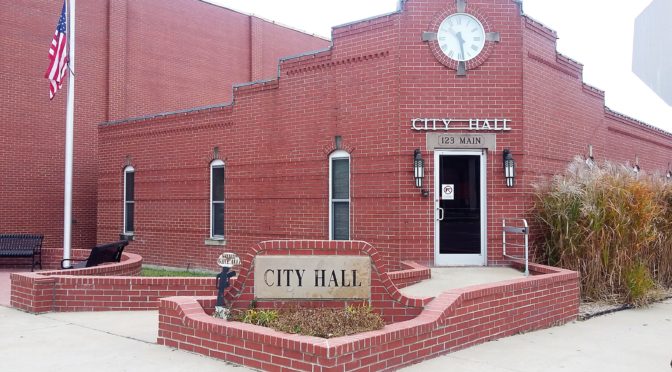
The City Commission will meet for a special meeting at 4:00 p.m. on Thursday, January 14th, 2021 at City Hall in the City Commission meeting room at 123 South Main Street, Fort Scott, Kansas. The City Commission will meet to consider financial transfers and to consider a Bourbon County contract. Also added to the special meeting is an Executive Session to discuss non-elected personnel.
This meeting will be broadcast on the City’s You tube channel. This meeting is open to the public.
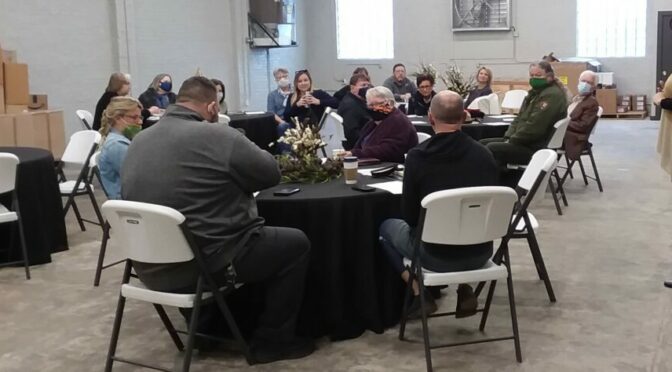
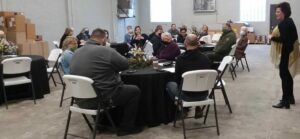
Lindsay Madison, standing on right, addresses the Fort Scott Chamber of Commerce Quarterly Meet and Greet on Jan. 12, 2021.
Business owners and others interested in downtown Fort Scott, met Jan. 12 in the future walk-in freezer space at E3 Ranch and Co. store at 13 S. National Ave.
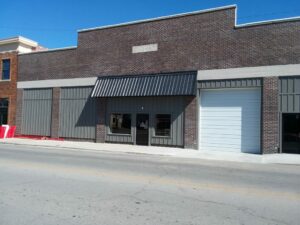
E3 Ranch and Co. 13 S. National Avenue. Oct. 2020
The Fort Scott Chamber of Commerce Quarterly Downtown Meet and Greet was hosted by E3 Ranch and Co.
E3 owner Jennifer LaRoche said the room “will be full of the walk-in freezer and meat products” soon. In addition, the storefront of the business will be redone, she said.
The other storefront business spaces at the corner of Wall Street and National Avenue “we are chipping away at construction,” she said.
There are two spaces on National Avenue and one on Wall Street available for retail space, Laroche said.
For more information contact LaRoche at the E3 Ranch store at 13 S. National or Common Ground Coffee Co. around the corner on Wall Street she said.
Business news
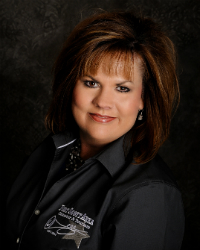
Lindsay Madison is the Fort Scott Chamber of Commerce Executive Director.
There are three new businesses this calendar quarter in the downtown area, Fort Scott Chamber of Commerce Executive Director Lindsay Madison said.
“Next week the Star Emporium is opening on Main Street,” Madison said. “Laree + Co is at Wall and National and H Bar Suites is a new vacation rental on VRBO, above the Hole in the Wall Liquor Store on Wall Street.”
Low-interest loans are available for businesses, Madison said.
E-Community Loans are available locally and can be applied for at www.networkingkansas.com, she said.
She said a Youth Entrepreneur Challenge is on for all high school students in Bourbon County. “They must put together a business plan and compete,” Madison said.
Some of those in attendance were given an opportunity to speak.
Fort Scott Interim City Manager Jeff Hancock said candidates for the city manager position have been narrowed down.
The newly reorganized city commission, with Josh Jones as mayor, will work on capital improvements, street improvements, will be sharing “business services” with the Bourbon County Commission, and working on Land Bank possibilities, Hancock said.
Fort Scott’s Economic Development Director Rachel Pruitt said the city has “come a long way” and noted that Diane Striler recently purchased the old Rennett Studio on North Main street, additionally the recently completed Union Lofts apartments on Main Street have 10 of the 25 apartments rented. There are two barbers who plan to open businesses downtown, she said.
Carl Brenner, Chief of Interpretation and Resource Management at Fort Scott National Historic Site, said the fort is doing maintenance projects on seven buildings currently. These are paid for by park user fees, he said.
Since the pandemic began in March 2020, the fort employees have been utilizing online capabilities more. In-person tours are still available and they are planning to have school student visitors at the fort in the near future.
Dacia Clark, Small Business Development Center representative, spoke about the partnership with Bourbon County Workforce and Entrepreneur Resource Center, which is located above the new Star Emporium Storefront at 17 S. Main. Her hours are Monday through Friday from 9 a.m. to 4:30 p.m. Clark can help new businesses get started and marketing plans for established ones. She can also help with Quickbooks for organizing data.
Beth Nuss spoke on behalf of the Lowell Milken Center For Unsung Heroes Park. She and a citizen committee have worked for several years on the greenspace repurposing. Recently Lowell Milken is providing funds to bring the new park to fruition, and “the goal is to have it done by the all-school reunion in (June 2021),” she said.
Madison said the downtown walking trail, a project of LEAD Bourbon County, is slated for completion by April 1, 2021. The project was funded by the Healthy Bourbon County Action Team.
Madison said a sailor remains are being returned to Fort Scott for burial at the national cemetery on May 29. William Barnett was 21 when he died at Pearl Harbor, Hawaii in World War II. She wondered if there were any living relatives who would be interested in the event. Cheney-Witt Funeral Chapel owner Jerry Witt who attended the meet and greet, said Barnett was his second cousin.
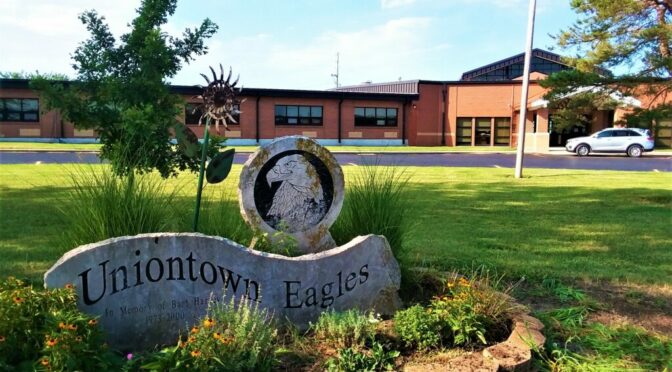
The Eagles came back from winter break with three wins against Northeast Arma. The JV girls fought hard, but lost 15-18. The JV boys won with a score of 39-28.
The Varsity girls beat the Vikings 50-34 on Tuesday. The team was 100% from the free throw line, with Danielle Howard, Karleigh Schoenberger, and Sammie Hampton each making all of their free throws. They also lead the team in points, scoring 12, 15, and 11 respectively. Howard and Schoenberger also led in rebounds, with 6 and 5. Howard also had 6 assists and 4 steals. Gwenyth Fry and Schoenberger each had 3 assists.
“It was good to get back to competing tonight,” said Coach Miller. “We were a little slow getting started, but the girls earned another league win. We hope to continue this trend as we travel to Altoona Midway on Friday for another league game.”
The Varsity boys also defeated Arma 57-30. Clay Sutterby lead the team in points, scoring 16, followed closely by Luke Perry and Cade Goodridge, who scored 11 and 10. Sutterby and Goodridge also had 6 and 7 rebounds, respectively, and Sutterby had 4 blocks. Luke and Drew Perry had 3 assists, and Drew also had 4 steals and took a charge. Freshman Byron Fry also took a charge in the last minutes of the game.
Coach Hays said about the game, “It felt great getting back on the court tonight after about a month off. Our JV got the night started off right with a win, and that carried over into the Varsity game. I thought we played with great energy and shared the ball well tonight. We were able to get the ball inside the paint and finish around the basket. Defensively, our help defense needs to improve, but overall I felt like we gave good effort on that end. We have to get ready for a scrappy Altoona team on Friday.”
A ribbon cutting was never held to celebrate their grand opening with the pandemic starting shortly after their opening, so we will celebrate their first anniversary!
Masks are strongly encouraged and masks will be available for those that need one.
Grand Opening & Ribbon Cutting
Luther’s BBQ!
The Fort Scott Area Chamber of Commerce invites members and guests to a Chamber Coffee and Ribbon Cutting ceremony this Thursday, January 14th at 8 a.m. to celebrate the one-year anniversary of Luther’s BBQ in the Downtown Historic District at 3 W. Oak St. Coffee, juice, and light refreshments will be served.
Owners Dave Lipe and Luther Saulsberry established the restaurant in December 2019 offering dine-in, carry-out, and full-service catering. The business has adapted to the pandemic through curbside ordering, pickup, and enhanced outdoor dining. The River Room Event Center, in the same building upstairs from Luther’s BBQ, is able to accommodate events up to 600 in occupancy. Although the year 2020 hasn’t been the optimum first year for opening a business, they are looking forward to 2021 for the restaurant and event center and welcome private parties and corporate events.
Contact the Fort Scott Area Chamber of Commerce
for more information at (620) 223-3566 or visit fortscott.com.
TOPEKA – Governor Laura Kelly today announced her third budget recommendation. The fiscally responsible budget protects and invests in core services – like education, infrastructure, and economic development – while keeping Kansas on a path for economic growth.
“All Kansans benefit from good schools, a strong infrastructure, and access to affordable healthcare,” Governor Laura Kelly said. “This fiscally responsible budget protects the critical resources, services, and programs Kansas communities and businesses need to recover and emerge from this pandemic stronger than ever.”
Governor Kelly’s budget protects Kansas public schools, includes funding to expand Medicaid and behavioral health services, allocates $37.5 million to modernize the state’s unemployment system, and maintains fiscal responsibility though a $600.9 million ending balance.
The Kelly budget accomplishes the following critical policy goals necessary to recover and rebuild from COVID-19 without any increases in individual or business income taxes:
Maintaining Fiscal Responsibility: The Governor’s proposed budget for FY 2022 protects critical public services while also stabilizing the state budget during a year of significant economic uncertainty. It leverages federal stimulus dollars and avoids any increases to income taxes for Kansas families and businesses. Due to the Governor’s fiscal leadership during her first term, this year’s recommendation maintains a healthy State General Fund ending balance of $600.9 million.
Continuing Record-Breaking Economic Growth: Despite the economic pressures of COVID-19, Kansas recorded more than $2.5 billion in new investment from businesses like Urban Outfitters, Amazon, and Great Plains Manufacturing. These deals, which will bring thousands of quality jobs to Kansas communities, were spurred by the Governor’s investments in rebuilding the Kansas Department of Commerce and its economic development tools. This budget protects these tools by supporting community development programs like the Kansas Main Street Program, protecting funding in the Economic Development Initiatives Fund, and allocating state dollars to hire experienced economic development staff to make Kansas an attractive place to grow a business.
Protecting Kansas K-12 Public Schools: In 2019, the Kansas Supreme Court unanimously ruled that Kansas had enacted a plan fulfilling the state’s constitutional obligation to adequately and fairly fund public schools. The Governor fully funds this plan in the FY 2022 budget, putting Kansas on track to increase school funding by $388.1 million through FY 2023. This year, despite significant state fiscal challenges brought forth by the pandemic, the Governor has continued her commitment to public education in Kansas by protecting K-12 education funding for the FY 2022 and FY 2023.
Expanding Access to Affordable Healthcare and Behavioral Health Services: The COVID-19 pandemic has further highlighted the importance of access to affordable, quality healthcare in protecting the health of Kansans and keeping the state on the path of economic growth. The Governor’s recommendation includes $19 million to expand KanCare, the state’s Medicaid program. The budget also allocates $5 million in additional funding to the Mobile Response and Stabilization Services Program and $3 million for Family Crisis Response and Support services. These programs will expand behavioral health crisis response and triage services to Kansans across the state, including for justice-involved youth and children in foster care.
Closing the “Bank of KDOT”: When Governor Kelly entered office, she promised to close the “Bank of KDOT” by the end of her first term. This budget keeps that promise, reducing transfers from the State Highway Fund to $133.7 million in FY 2021 and $66.9 million in FY 2022. In a difficult budget year, Governor Kelly’s budget recommendation to phase out the reliance on the State Highway Fund for general fund purposes will provide the resources necessary to continue critical investments in the comprehensive Eisenhower Legacy Transportation Plan approved during the 2020 Legislative Session.
Investing in the State’s Digital Infrastructure: Updating our digital infrastructure is critical to both economic growth and increasing the transparency and accessibility of Kansas’ public services. The Governor’s budget makes substantial investments to improve the state’s IT systems, including leveraging $37.5 million in federal funds to begin to modernize and improve the state’s unemployment insurance systems. It also makes a number of other critical IT investments, including $2 million for Electronic Health Records support to the Kansas Department for Aging and Disability Services, $3.1 million for replacing the state’s Juvenile and Offender Management Information Systems, and $4.1 million in funding for the Office of Informational Technology Services to make capital improvements in IT security and underlying systems.
. Protecting State Retirees by Stabilizing KPERS: The Governor’s Budget Recommendation also proposes the reamortization of the legacy unfunded actuarial liability of KPERS for 25 years. This in an inevitable,
fiscally responsible step that will both stabilize the state’s KPERS system and create $158.7 million in savings to the State General Fund. Reamortization is a frequently used tool to manage pension systems in other states and better positions Kansas to make full, timely KPERS payments now and into the future. Stabilizing the KPERS system through reamoritzation is especially critical in FY 2022 to continue the important investments in economic development, infrastructure, and healthcare that will help the state recover.