
Community Gathers to Learn About Ticks and Alpha‑Gal Syndrome at Southwind Extension Program
Fort Scott, KS — March 23, 2026 — Nearly 60 community members joined K-State Extension for the program “Beyond the Bite: Understanding Ticks and Alpha-Gal” last Monday evening at the FSCC campus. This event highlighted how K-State Extension – Southwind District is addressing emerging health issues with timely, research‑based education. An Alpha‑Gal–friendly baked potato bar was provided by Great Western Dining.
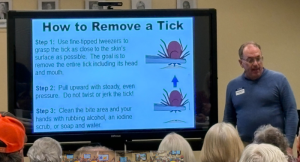
Raymond Cloyd, PhD, KSU Professor and Extension Specialist, presented on tick identification and life cycles, strategies for preventing tick bites, proper removal techniques, and recommended steps to take after spending time outdoors. Ticks are typically found just a few inches above the ground on vegetation. To remove a tick, individuals should use fine‑tipped tweezers to grasp the tick as close to the skin as possible and pull upward with steady, even pressure to remove the entire tick—including the head and mouthparts. After removal, the area should be cleaned with rubbing alcohol, an iodine scrub, or soap and water.
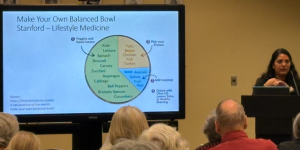
Priscilla Brenes, MPH, PhD, KSU Assistant Professor and Nutrition Specialist, discussed how Alpha‑Gal affects the body and shared nutritional strategies for managing life with Alpha‑Gal Syndrome (AGS). While there is currently no cure for AGS, individuals can reduce symptoms by carefully avoiding foods and products that may trigger reactions. Many people are surprised to learn that rotisserie chicken or turkey sausage may be seasoned or processed with beef‑derived ingredients. Some individuals with this allergy may also react to wearing leather boots, and others may need to carry an epinephrine auto‑injector.
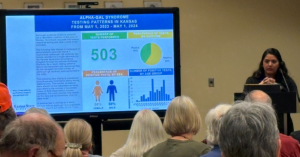
Alpha‑Gal Syndrome is an allergy to red meat and mammal‑derived products that is becoming increasingly common across Kansas, particularly in rural areas. According to the U.S. Centers for Disease Control and Prevention, AGS can develop after a bite from the Lone Star tick. When an infected tick feeds on a human, alpha‑galactose (alpha‑gal) enters the body and triggers the immune system to produce antibodies. If the body later encounters alpha‑gal—through red meat or mammal‑derived products—a potentially life‑threatening allergic reaction can occur. Fish and poultry do not contain alpha‑gal antigens, making them safe options for those affected.
Symptoms of AGS may appear after eating red meat or being exposed to mammal‑derived products (including leather) and can include hives or itchy rash, nausea or vomiting, severe stomach pain, heartburn or indigestion, diarrhea, cough, shortness of breath or difficulty breathing, a drop in blood pressure, swelling of the lips, throat, tongue, or eyelids, and dizziness or faintness.
To request handouts from the program to be emailed or for additional information about Alpha‑Gal Syndrome, please contact Sandy Haggard, Southwind Extension Nutrition, Food Safety, and Health Agent, at SJHaggard@ksu.edu or 620‑365‑2242.