CITY OF FORT SCOTT
CITY COMMISSION MEETING
Minutes of August 1, 2023 Regular Meeting
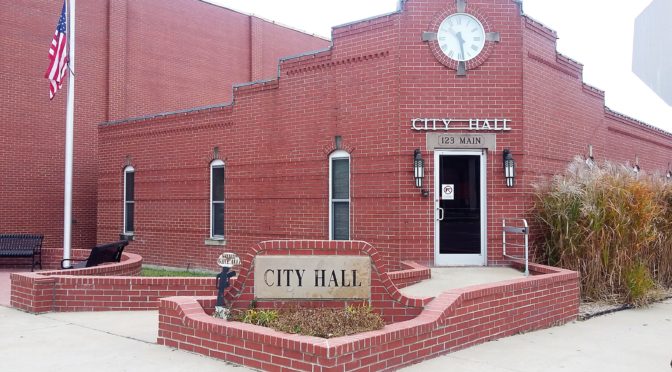
The regular meeting of the Fort Scott City Commission was held July 25, 2023 at 6:00PM in the City Commission Meeting Room at City Hall, 123 S. Main Street, Fort Scott, Kansas.
ROLL CALL:
Commissioners T. Van Hoecke, E. Woellhof, M. Guns (via telephone) were present with Mayor M. Wells. K. Harrington was absent.
PLEDGE OF ALLEGIANCE AND INVOCATION: E. Woellhof, said a prayer asking God for guidance for the City, our Government and City officials.
AUDIENCE IN ATTENDANCE: Brad Matkin/City Manager, Bob Farmer/City Attorney, Lisa Lewis/City Clerk, Ben Hart/Finance Director, (via telephone), Jason Dickman/Earles Engineering, J. Pickert/Police Chief, D. Bruner/Fire Chief, Rachel Carpenter, Michael Hoyt, Dyllon Olson, Tracy Dancer, and Mark McCoy.
APPROVAL OF THE AGENDA:
- Wells moved to approve the agenda with the addition of Consideration to approve Fort Scott joining the Mayoral Alliance Against Hunger to be added as Item E to New Business. T. VanHoecke seconded. All voted aye.
APPROVED THE AGENDA WITH THE ADDITION OF CONSIDERATION TO APPROVE FORT SCOTT JOINING THE MAYORAL ALLIANCE AGAINST HUNGER TO BE ADDED AS ITEM E TO NEW BUSINESS
CONSENT AGENDA:
- Approval of Minutes of the Regular Meeting of July 25, 2023
- Approval of Appropriation Ordinance 1341-A — $213,912.62
- Request to Pay – Bennett, Inc. via Earles Engineering & Inspection, Inc. – 2022 CDBG Sanitary Sewer Project – Project No. 23-409 (22-306) – Contractor’s Application for Payment No. 3 – $553,602.60
- Approval of Drinking Establishment City License Renewal – Pizza Republic – 17 S. Main Street – Bret Holder
- Approval of Ordinance No. 3748 – Amending Chapter 10.04 of the Fort Scott Municipal Code to Incorporate Standard Traffic Ordinances for Kansas Cities – 2023 Edition
- Approval of Ordinance No. 3749 – Adding Section 10.05 Regulating Public Offenses Within the Corporate Limits of the City of Fort Scott, Kansas; Incorporating by Reference the Uniform Public Offense Code for Kansas Cities, 39th Edition, “With Certain Omissions, Changes, and Additions; Prescribing Additional Regulations; and Providing Certain Penalties.
- VanHoecke moved to approve the Consent Agenda. M. Guns seconded. All voted aye.
APPROVED THE CONSENT AGENDA.
PUBLIC COMMENTS: None
OLD BUSINESS:
- Approval of the date of September 5, 2023, at 6:00PM for City of Fort Scott Budget Hearing – T. VanHoecke moved to approve the date of September 5, 2023, at 6:00PM for the City of Fort Scott Revenue Neutral Rate Hearing and Budget Hearing. E. Woellhof seconded. All voted aye.
APPROVED THE DATE OF SEPTEMBER 5, 2023, AT 6:00PM FOR THE CITY OF FORT SCOTT REVENUE NEUTRAL RATE HEARING AND BUDGET HEARING.
- Consideration of MOU with Bourbon County Health in All Policies Task Force and select a representative – TABLED FROM JULY 25, 2023.
- Woellhof moved to table the consideration of the MOU to the August 15, 2023, meeting and have City Attorney review the terms that T. VanHoecke questioned and revise the language. T. VanHoecke seconded. All voted aye.
APPROVED TO TABLE THE CONSIDERATION OF THE MOU TO THE AUGUST 15, 2023, MEETING AND HAVE CITY ATTORNEY REVIEW THE TERMS THAT T. VANHOECKE QUESTIONED AND REVISE THE LANGUAGE.
- Selection of date for Certified Local Government Program (CLG) Work Session in August with Katrina Ringler, Commission and Community
- Wells moved to approve the date of Friday, August 11, 2023, at 5:00PM as a Work Session to invite the community to participate in an open discussion with Katrina Ringler about Fort Scott becoming a Certified Local Government as an option to our current Design Review Board process. He requested that the City Clerk post the information packet online for those who were interested in learning more about the program.
APPROVE THE DATE OF FRIDAY, AUGUST 11, 2023, AT 5:00PM AS A WORK SESSION TO INVITE THE COMMUNITY TO PARTICIPATE IN A DISCUSSION WITH KATRINA RINGLER ABOUT FORT SCOTT BECOMING A CERTIFIED LOCAL GOVERNMENT AS AN OPTION TO OUR CURRENT DESIGN REVIEW BOARD PROCESS.
APPEARANCES:
- Rob Hansen – Son of American Legion Car & Motorcycle Show: Squad Commander R. Hansen addressed the Commission to request a temporary street closure for a fundraising event that will be held in the Landmark Bank parking lot. He is requesting to close off the street for safety because it is a family event.
- VanHoecke moved to approve the request for a temporary street closure of 3rd between Main and National on Saturday, September 16, 2023, from 8:00AM-1:00PM. E. Woellhof seconded. All voted aye.
APPROVE THE REQUEST FOR A TEMPORARY STREET CLOSURE OF 3RD BETWEEN MAIN AND NATIONAL ON SATURDAY, SEPTEMBER 16, 2023, FROM 8:00AM-1:00PM.
- Matkin stated the City would provide barricades for both ends of the street.
- Mark McCoy and Tayton Majors – Bourbon County REDI: T. Majors addressed the Commission with a Business Retention and Expansion presentation. The PowerPoint presentation is included with these minutes.
NEW BUSINESS:
- Consideration for the purchase of a fire truck: Fire Chief, Dave Bruner gave a presentation on the need for the City to consider purchasing a fire truck to replace the failing 1997 E-One Pumper from Station 2. It was usually the first truck out, however over the past (6) months the reliability of the truck is an issue and has been placed into a backup reserve mode. Bruner stated that a worn apparatus is a threat to the community and the firefighters. He said that the parts become more difficult to get with the age of the truck and repairing it does not change the age of the unit and waiting for a disaster is not safe or productive. He asked the Commission for permission to begin looking for grants and bids on inventory. PowerPoint presentation included with these minutes.
- VanHoecke moved to approve that the FSFD could begin looking for grants and potential inventory for the purchase of a fire truck to replace the 1997 E-One Pumper from Station 2. E. Woellhof seconded. All voted aye.
APPROVED THAT THE FSFD COULD BEGIN LOOKING FOR GRANTS AND POTENTIAL INVENTORY FOR THE PURCHASE OF A FIRE TRUCK TO REPLACE THE 1997 E-ONE PUMPER FROM STATION 2.
- Amendment 1 to the Brick Street Policy: M. Wells requested that the Commission approve an amendment to the current Brick Street Policy as follows:
Amendment 1
- Concerning the treatment of manhole covers; it is here by adopted according to the recommendation of the street advisory board to allow up to 12 inches in a square pattern around manholes for bricks to be laid up against. This will protect the manhole covers and allow the bricks a solid surface to rest against.
- Concerning the intersections of brick streets and asphalt streets. It is here by adopted, according to the recommendation of the street advisory board that wherever a brick street abuts against a non-brick street the intersection where the brick streets abut against; May upon the advisement of the Public Works, Director, or the street department Director be done as a concrete intersection. Concrete at intersections where the brick street would abut against shall be done in a minimum of 8 inches of concrete reinforced by a minimum 3/8 rebar on an 8 in.² pattern or according to KDOT specifications.
Be it also adopted that wherever a case shall arise where the brick street is running through the middle of two adjoining asphalt streets, there may at the advisement of the public works Director, or the street department Director, allow for the use of an apron of up to 20 feet that would abut against the brick street that passes through, allowing the brick street, a continuous path, splitting the two concrete aprons, adjoining the asphalt streets. All concrete aprons shall be done at a minimum of 8 inches, with a minimum of 3/8 rebar being placed on 8-inch squares, or according to KDOT specifications.
This will again allow a solid surface for the bricks to abut against.
- Any, and all bricks that may become available because of any concrete apron or intersection, shall be palletized, cleaned, and stored according to the Brick Street policy to later be used on the
repair and maintenance of other brick streets. At no time shall bricks be allowed to be used as full, or underlayment.
- VanHoecke moved to approve Amendment 1 to the Brick Street Policy. E. Woellhof seconded. All voted aye.
APPROVED AMENDMENT 1 TO THE BRICK STREET POLICY.
- Consideration of bids for Evergy Infantry Substation Sanitary Sewer Relocation Project No. 23-005B: J. Dickman stated that (5) bids were received for the project on July 21, 2023. The lowest bidder was Bennett, Inc. of Lamar, MO with the bid of $232,477.50, substantially complete within 90 days, fully complete in 120 days. J. Dickman stated that he recommends the bid be awarded to Bennett, Inc.
- VanHoecke moved to approve that the bid for the Evergy Infantry Substation Sanitary Sewer Relocation Project No. 23-005B be awarded to Bennett, Inc. of Lamar, MO at $232,477.50. M. Guns seconded. All voted aye.
APPROVED THAT THE BID FOR THE EVERGY INFANTRY SUBSTATION SANITARY SEWER RELOCATION PROJECT NO. 23-005B BE AWARDED TO BENNETT, INC. OF LAMAR, MO. AT $232,477.50.
- Wells clarified with J. Dickman that this project is paid for by Evergy and not the City.
- Consideration to set deadlines for City Commission meeting agenda practice and procedure: M. Wells requested that the Commission consider approving a deadline for the good of the Commission to receive the information earlier to have time to make more informed decisions at meetings. This would require an earlier deadline. T. VanHoecke stated that he believed there was a policy already in place.
- Woellhof moved to table the consideration until the August 15, 2023, meeting to confirm if there was an existing policy in place. M. Wells seconded. All voted aye.
APPROVED TO TABLE THE CONSIDERATION UNTIL THE AUGUST 15, 2023, MEETING TO CONFIRM IF THERE WAS AN EXISTING POLICY IN PLACE.
REPORTS AND COMMENTS:
City Manager: B. Matkin – no comments
City Engineer: J. Dickman/Earles Engineering & Inspection
- CDBG Sanitary Sewer Project continues. Currently the crew is working behind City Hall to line manholes.
- 15th and National – 17th and Eddy – trying to get contractor out to clean up and finish. Utilities are moved. Contractor states they are currently booked on other projects.
- M. Wells confirmed with J. Dickman that the South Industrial Park Waterline Extension has a purpose in the future and ties into the loop to increase water pressure to the businesses in the area. Also, the City needs to move forward and complete the access road. J. Dickman stated that he needs to know the measurements to add the additional cost of asphalt to the bid.
City Attorney: B. Farmer
No comment.
COMMISSIONERS’ COMMENTS:
- Harrington: Not in attendance
- Guns:
- Thank you to all volunteers for the Splash Pad
- USD 234 will provide free breakfast and lunch to all students in the district for the school year
- August 4th and 5th is Sales Tax Holiday, many local businesses are participating
- Many activities this week including the Champions Forever event at Memorial Hall
- August 10th is the Contractors’ Meeting at City Hall
- August 12th is the Poverty Paradigm at the Middle School brought by CORE Community Bourbon County. She is planning to attend. Tickets are still available.
- Woellhof: No comments other than a correction that the Champions Forever is being held at the High School, not Memorial Hall.
- VanHoecke:
- Hats off to City Crews for the storm clean up again.
- Brush dump is still open
- Congratulations and thank you to all those who worked to get the Splash Pad completed for Fort Scott
- Wells:
- Thank you for the Splash Pad and very thankful for all who worked to get it to its completion, have seen many out there enjoying it
- Thankful for the rain
ADJOURNMENT:
- VanHoecke moved to adjourn the meeting at 7:44PM. E. Woellhof seconded. All voted aye.
APPROVED TO ADJOURN THE MEETING AT 7:44PM.
Respectfully submitted for approval,
Lisa A. Lewis, City Clerk