All posts by Loretta George

New Fort Scott Business: Spyder, Inc.

Nedra Barr from the Spyder Inc. website

Nedra Barr started her insurance career at age 16 in Fort Scott, and this week announces that she is bringing her new business home.


“I started my insurance career in Fort Scott while in high school,” Barr said.  “After a great career in the insurance industry, I started developing software that served this market.  I’ve designed various software products serving this industry.  It’s very exciting to develop the Spyder (her new company) product.  It will help producers and home offices modernize, digitize, standardize and simplify their business.”


She is the Cheif Executive Officer of Spyder, Inc., and Sharon Ross, Charlotte, SC,  is the Chief Operating Officer, with Bob Peacock, Denver, CO  the Chief Technology Officer of the business.

Sharon Ross from the Spyder, Inc. website.


Bob Peacock, from the Spyder, Inc. website.


“All three of us are software executives in the insuretech/fintech industry,” Barr said.  “I am an award-winning software executive.  I have won a Top 50 Tech Visionary award in 2019, a Top 50 Tech Leaders award in 2021, and last week named one of the most impactful women in technology,” she said.


See the feature of her award here: https://www.analyticsinsight.net/The-10-Most-Impactful-Women-in-Technology-2021-Volume-5/#page=1


“Once our offices are ready, I will be spending lots of time in Fort Scott as well Sharon and Bob,” Barr said.


The office is located at  102 W 2ndSt, Fort Scott,  with hours of 8 a.m.-5 p.m. Contact  Barr at 620-531-0368.


“The first two Spyder products will be released in June,” she said.  “The first two products will be cybersecurity device certifications and a document storage solution that is purpose-built for the insurance industry.  Additional products will be coming in the fall timeframe as well.”


Barr has led teams and guided technology firms for many companies, including SunGard Insurance Systems, Insurance Technologies, Experian, and Docupace Technologies. Most recently, Nedra was Chief Revenue Officer for Skience,


See the business website:  www.spyderloop.com


The Spyder logo, taken from the website.


” We are excited to get our software company going strong to contribute to the economic growth and employment of Fort Scott,” Barr said. ” We believe we will be hiring employees in the fall timeframe.  We will work closely with the Healthy Bourbon County initiative and the Chamber of Commerce to contribute to the well-being and beautification of Fort Scott.”

New Venture For the Shead Family: Organic Homestead Festival

The Shead family, minus three grandchildren who hadn’t been born yet. Submitted photo.

Larry and Vickie Shead are opening their farm next week for the community to view the organic homestead they have created.

All the Sheads will be helping on the day of the Organic Homestead Festival, including themselves, their adult children and their spouses, along with their 20 grandchildren.

The Organic Homestead Festival has several purposes.

“To share our family farm’s story-touring the farm, which will be laced with the history….to show our gardens, orchards, high tunnel, animals, bees and others, to supply ideas and information from what we learned in 43 years, to stir up interest in sustainable organic lifestyle, to sell products: produce, plants, kittens and poultry, to serve lunch for hungry people, to strengthen the community with other like-minded people and to sign-up for future classes,” Vickie said.

The event is scheduled for Saturday, May 22 from 10 a.m. to 5 p.m. with single tickets-$5 or a family, $20.

A walking taco meal will be available for an additional $5.

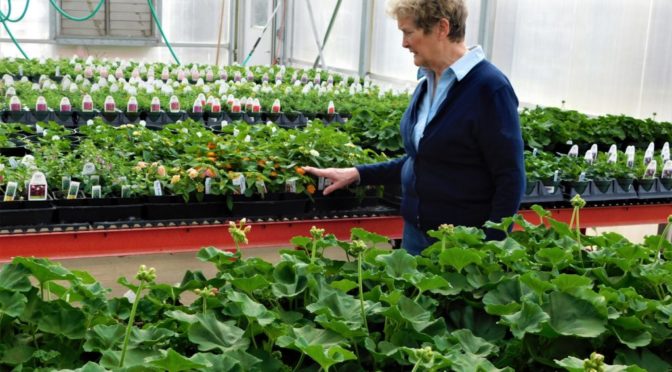
Vickie Shead inside the high tunnel greenhouse on their farm.

To view a Shead YouTube on spring planting:

https://www.youtube.com/watch?v=1dk-j18Ox5Y

Education is an important part of the Shead farm. Pictured is a graphic depicting all parts of a carrot, with the plant featured below the graphic.
Part of organic farming is natural pesticides. Pictured is a praying mantis nest.
This old turkey was roaming free on the farm on May 7.
Beehives on the Shead farm.

There will be a SheadStead Market Store with fresh produce picked that day, veggie powders-which add nutrients to any meal, Guatemala sun hats, egg-gathering aprons, and herbal salves.

Vickie Shead demonstrates the egg apron’s usefulness. The aprons will be for sale on the day of the festival.

In addition, they will be selling some of their animals: peacocks, turkeys, chicks, ducklings, and kittens.

Poultry will be for sale at the Organic Homestead Festival.

“We have always been a farm where people would come to learn and help,” she said. “Now, we have seen an increase in people asking us for information on how to grow their own organic fruits and vegetables.”

Rows of vegetables on the Shead farm on May 7.

“Gardening and homestead-type living off the land are becoming very appealing to many because of the uncertainty of our future and the number of chemicals farmers are using,” Vickie said. “Many are asking if we will teach them…to plant, harvest and preserve, which includes canning, dehydrating, and freezing, as well as have one’s own meat and eggs.”

“There will be lots of fun for the whole family,” she said. “Questions and answers session on sustainable organic lifestyle..for adults.”

“In the children’s areas, they can…milk a cow and learn how to churn cream into butter, pet the animals in the petting yard, take pictures in photo cut-outs, hear a story about working on a farm, gather eggs…play educational games and meet Kernal Corn himself!” Vickie said.

A graphic of the Shead Farm.

The Shead farm is located at 2468 Cavalry, Garland, south of Fort Scott.

For more information:http://sheadfarm.com or 620.224.4149.

Center for Economic Growth: Focus on Health and Economic Stability

Dacia Clark and Jody Hoener.

The group that set up an office on the second floor, above the Star Emporium Downtown General Store, 17 S. Main,  has changed the name, but not services.


“The partners that made up the Bourbon County Workforce and Entrepreneur Resource Center (BWERC) have decided to name ourselves The Center for Economic Growth,” Jody Hoener, director of the center, said. “We have the same space, model, operations, and services that were provided before.” The one exception is the Bourbon County Commission is not a part of the partnership, she said.


“Our mission is to increase access to physical activity and healthy food, promote tobacco cessation, enhance the quality of life and encourage economic growth,” she said.  “We wanted our program and name to tie directly to our mission.”


“The Healthy Bourbon County Action Team Board and our partners re-branded our collaborative efforts,” Hoener said.  “Our work to build healthy communities and address the social determinants continues, with health and economic stability as the focus of the center.”


“Specifically, we are working with community members and our partners on economic stability,” she said.


“Priority is given to those businesses owned by low-income, minority, female, or veteran,” she said. “Pittsburg State University Small Business Development Center uses the U.S. Small Business Administration small business definition…typically 500 employees or less with less than $5m in profit in a two-year period.”


Jody Hoener at her desk at the Center For Economic Growth, 17 S. Main, second floor.


“Poverty and low income are drivers of poor health,” Hoener said. ” Bourbon County is a rural community… with higher rates of poverty.  Our community has seen low investment and low upward mobility in employment.  We are working to create economic opportunities to generate wealth and income for Bourbon County residents.”


The partner organizations are the Fort Scott Chamber of Commerce,  Fort Scott Community College, Kansas Works, Pittsburg State University’s Small Business Development Center, and  BAJA Investments.


Hoener’s work as the Bourbon County Economic Director ended in March


Continue reading Center for Economic Growth: Focus on Health and Economic Stability

10 Years of Ministry: Feeding Families in His Name

First United Methodist Church at Third Street and National Avenue,

Feeding Families in His Name celebrates 10 years of ministry on May 11, 2021.


“We started the ministry because of a seen need of school children being food insecure,” Jean Tucker, coordinator of the weekly meal, said.


“Tom Braker had the idea ten years ago and gathered a group of people who started the program on May 11, 2011,” she said. “The administrative board of the First United Methodist Church voted unanimously to start the program.”


The meal is offered each Wednesday evening at 301 S. National, the Fort Scott First United Methodist Church from 5:30 to 6:30 p.m.


“From May 11, 2011, until March of last year we served the meal in the basement Fellowship Hall,” she said. “This allowed us to visit with the families and get to know them and their needs other than a hot-home cooked meal. Now we must visit with them as they drive through.”


Feeding Families in His Name offers a meal to Fort Scottians each Wednesday evening.


“Since the beginning of COVID-19 restrictions, we have served to-go-meals only,” Tucker said.


“The ministry has extended past the serving of a meal,” she said.  “Some of our dinner guests have become our valued weekly volunteers. We believe that the meal is a delivery system for God’s love!”


Currently helping weekly are Tom Braker, Steve and Susan Cole, Tom Coyan, Joey Beerbower, Linda and Leroy Cox, Betty and Pat Galan, Koyle Link, Lisa Robertson, Phyllis Colthart, and Don and Jean Tucker, plus a group of 15-20 dessert bakers who bake one or two desserts every week, Tucker said.


St. Martin’s Academy students clean up after preparing and serving the meals for Feeding Families in His Name on May 5 . From left to right:  Oliver Stover, Jack Costanzo, Deneys Lategan, and Aidean Harris.  In the background is volunteer Tom Coyan,  who is responsible for FFiHN food inventory and kitchen. Submitted photo by Steve Cole.


A different group helps with the entrée and serving every week.

“The first Wednesday (of each month) is St. Martin’s Schoolboys; the second Wednesday during the school year, the Community Christian Church, under the direction of Gail Sackett, alternates with the First United Methodist Church; the third Wednesday is the Nazarene Church Small Group, under the direction of Gretchen Goodyear; the fourth Wednesday is the First Presbyterian Church under the direction of Alesha Martin and Sandra Cowan, and the fifth Wednesday is Pioneer Kiwanis under the direction of Kelly Collins,” she said.


The amount of meals served has grown.

In  March 2011, the ministry served 44 meals, on  March 10, 2021, they served 281 people a meal, Tucker said.


“The most we have served is 422 meals on a Wednesday last November,” Tucker said.


” I just did some math and the number of meals served since we began May 11, 2011, is over 98,000 and we have averaged 1,233 meals each month for the past year,” she said.


The ministry receives funding from the Fort Scott Area Community Foundation.


For more information, contact Jean Tucker, Coordinator of FFiHN at 620-223-4617 or church office at 620-223-1950


Union State Bank a Mainstay and Family Business for 120 Years

Union State Bank, Uniontown. Courtesy photo.
Union State Bank, Fort Scott. Courtesy photo.

The Holt family started as bankers in Uniontown on May 10, 1901, with an investment of $5,000.


“The bank’s assets are around $60 million total,” said current Union State Bank President Bryan Holt. “That is an increase of about 20% over this time last year. There’s currently nearly $5 million in Tier 1 capital.”


For five generations they have served the banking needs of their community, starting with Emmit Holt, then his son, Curtis, then his son, Kent, then his son Kenny, then his son, Bryan. All these were in succession.


Emmit Holt, courtesy photo from Union State Bank.


Curtis Holt. Submitted photo.

Kent Holt, 89, remembers the first job at 12 years old.  He helped his parents, Curtis and Helen, where he could.


“One of my duties was the Address-o-Graph, that machine that addressed envelopes,” Kent said.


By that time in the early 1940s,  his mom and dad were the owners of the bank.


Kent Holt. Submitted photo.


Kent became president when his father died at 62 years old, he was 35 years old.


When he was the president he could do any job in the bank, he said. But through the years, the industry has become more complicated.


“The big change was computers coming to the bank,” he said. “it was slow coming in, and in stages. Then we had to hire more people.”


Kenny Holt was president and CEO of Union State Bank from 1993 until 2018 when he retired. He died in November 2019.


To view his story:

Baton Is Passed at Union State Bank


Fifth-generation president, Bryan Holt,  became president and CEO of Union State Bank on January 1, 2019.

Bryan Holt.


“I returned to the bank in 2005 after working for 10 years in the accounting and tax software industry,” Bryan said. “I had always wanted to work in the family business and was, and still am, grateful for the opportunity to do so.”


Changes that Bryan has seen in the banking industry also include technology.


“Most recently, the ability to conduct business via a mobile device has been a game-changer in terms of service,” Bryan said. “Our mobile banking app allows for users to deposit checks via their phone, which is extremely convenient. We’ve also added our debit cards to mobile wallets, which allow for payments via mobile phone. Personally, I didn’t see this as a great addition, but after I used it, I use it as often as I can.”


Through the years Kent’s wife, Marilyn, and sons, Kenny and his wife Nancy, and Randy and his wife Debbie, and daughter, Susan Eldridge,  worked at the bank, along with some of their children. Then grandsons, Bryan and Chad, and his wife Amy.


Daughter, Debbie Likely, chose to teach for her career.


“Holt family members currently working in the bank include Randy Holt, Susan Eldridge, Chad Holt, Amy Holt and myself.,” Bryan said. “Aiden Holt( Chad’s daughter) works part-time in Uniontown during the summer and Claire Holt (Bryan’s daughter) works as a part-time teller in Fort Scott.”


In 1992, the bank opened a branch in Fort Scott, just off Hwy. 69 and 12th Street.


“We have 16 full- and part-time employees between the two branches.,” Bryan said.


Kent Holt Remembers a Bigger Community


Like most small towns, the population of Uniontown has shrunk.


Uniontown Park, approximately the early 1900s. Courtesy of Union State Bank.
Union State Bank, the original building, in Uniontown, KS. Courtesy of Union State Bank.

Uniontown used to have more people, Kent Holt said.


He tried to remember all the businesses in town while he was working at the bank.


“Stroud’s Grocery Store, Griffith Elevator and Lumber, Bishard Grocery Store, there was an old folk’s home, Gates-the blacksmith,  several filling stations-Ira Steele’s was one, a barber shop-Raymond Mosier, telephone company, two doctors-Dr. Miller was one, a dentist, Arch Ramsey, we were the only bank in town,” Kent said.


Flora Klenklen was his secretary for several years, then Alice Ramsey.


Kent Holt said he just faded out, he didn’t really retire, and was a member of the bank’s board of directors until about five years ago.


See the latest about the bank on its’ Facebook page.


West Bourbon Elementary: A Music Program Following COVID-19 Protocols

West Bourbon Elementary School Principal Vance Eden worked the soundboard, while WBE Music Teacher Rhonda Allen welcomes the audience to the spring program of kindergarten through third-grade students on May 3.

The music program for the performances.
Rhonda Allen has taught music for 39 years, with 30 of those at West Bourbon Elementary School in Uniontown.
“I teach pre-k through 6th-grade general music and junior high choir,” she said. “I also accompany the high school choir.”
Second-grade students enjoy their teachers Sheryl Fry and Brenda Gleason hamming it up during a performance.
But Monday’s kindergarten through third-grade spring music concert was not the normal spring concert at WBE.
It was held outside on the front porch of the school, with parents and the community invited to bring blankets or lawn chairs to enjoy the performances, because of the COVID 19 pandemic restrictions.
The audience brought lawn chairs and blankets to watch the performances.
The idea was born out of some recommendations and some experiences, Allen said.

“There were recommendations by the National Association of Music Education, that outside is a safer place to make music,” she said.


First-grade students perform.


Last fall the district had outside performances in the local park.


“We had an event held last fall in Uniontown City Park by the 4th and 5th grades, and the junior high and high school music and art students called Art in the Park,” Allen said.  “It was very successful.”


“And we knew, an outdoor venue would not require us to limit the audience for these young performers,” she said.  “An indoor program would be limited to four audience members per participant.”


At the end of each class performance, parents came to retrieve their students. They could then leave or stay for the entire concert.


So plans were made for the annual spring concert with fingers crossed and prayers to God for good weather.
“It was a delight to be able to have a spring program this year,” Allen said. ” At the beginning of the school year, performances seemed unlikely. We were very thankful that the rain held off!”
Third-grade students performed on the kazoo.


“I feel the outdoor venue was a success,” she said.  “Many seemed to enjoy the relaxed atmosphere as they watched the kids perform.”
Allen feels performing music is important.
“Performance skills are an important part of the elementary music curriculum,” she said.  “I was grateful to be able to teach those skills in this unprecedented year.”
Kindergarten students perform
Covid impact on Music Education
“A study done in the summer of 2020 revealed the amount of aerosol, how Covid is spread, created while singing or playing an instrument was significantly higher,” Allen said.  “Music education was deeply impacted by this discovery.  Social distancing, masks, and bell covers on the ends of instruments were some of the protocols followed.”
“Until late February, I traveled to each classroom, teaching from a cart,” she said.  “This changed my curriculum and the activities I normally used to teach music concepts.  It was different, but it was doable. Though it was challenging, I learned new skills and had the opportunity to discover new, and sometimes better, ways to teach music skills.”


Infrastructure! by Gregg Motley

Greg Motley. President of the Bourbon County Economic Development Council. Submitted photo.

Gregg Motley is the chairman of the Bourbon County Economic Development Council.

As mentioned in previous columns, there is not much we can do about some megatrends; but, we can do the basic blocking and tackling to make our town more attractive and livable. We can’t lose sight of long-term investments in exchange for short-term gains. What is infrastructure? Congress has struggled with this definition lately. Here are my thoughts:

Roads and Sewers

Somehow, we quit maintaining these two critical features. I was involved in an exchange program, designed to send teams to a “sister city” and evaluate them on numerous criteria. Our partner was Independence, Kansas, and a small group of us took off for a stealth tour of the town. A few days later, a group from there toured Fort Scott. Their report on us? Overwhelmingly positive, except one category: roads. And, if they could have seen underground to examine our sewer system, that grade might have been worse. It cost five times more to repair/replace than to maintain. Yes, the catch up, and beginning proper maintenance might be painful in the short-term, but the price tag will be substantially more later.

Internet Access

In whatever form it comes, Internet access is becoming almost important as paved roads. It is critical to our businesses and schools, as well as desirable for every citizen in Bourbon County. We have to expand and improve this infrastructure, in whatever form it comes, to the far reaches of the county.

Downtowns

Studies show that outsiders judge the vitality of communities by their downtowns and central business districts. We have to pay attention to this aspect of every community in Bourbon County, and see what we can do to put our best foot forward.

Schools

What do working-age parents evaluate first in considering a move to a community? This is a no-brainer; continue to invest our collective time, talent, and treasure in the public and private schools in our county.

Recreation

Years ago, corporate site selectors paid little attention to recreational amenities when deciding where to locate; now it is critical. Younger people want something to do; some place healthy to “hang out”. Older people want amenities too, a place to connect around a recreational activity.

Faith Community/Charity

Is this infrastructure? Yes! How we create community, and how we respond to the most vulnerable among us is a quality of life issue that must be addressed. Most American’s are concerned about the poor, and want to live in communities that respond to these critical needs. We can’t ignore this factor when considering how to grow our communities and create quality of life for all. I am so glad for the success of the Fort Scott Area Community Foundation, our strong church community, and other charities that focus on meeting basic human needs.

Next week: Eleven common attributes of non-energy sector small towns that are bucking the trends, and continuing to grow.

Uniontown Medical Clinic Open For Patients

Lori Reith, left, medical assistant, and Stephanie Hallacy, nurse practitioner, stand in front of the newly opened Girard Medical Center of Uniontown Clinic.

Uniontown’s new medical clinic is open for patients as of May 4.


The staff has been in the building for a month, working on the accreditation process which was completed.


The clinic staff received accreditation this week.


“There was a soft opening for four weeks,” Medical Assitant Lori Reith said. “We have seen 20 patients.”


The official title of the facility is the Girard Medical Center of Uniontown Clinic.


The building is located south of the USD 235 football field, at 401 Fifth Street. The phone number is 620-756-4111.


Clinic hours are 8 a.m to 5 p.m. Monday, Wednesday, and Thursday. The clinic is closed each day between noon and 1 p.m.


On the front door of the clinic is a list of the summer holiday schedule.


Reith is in the clinic on Tuesdays doing bookkeeping, she said. “I can schedule appointments, answer questions and fill out new patient forms.”


Stephanie Hallacy is the nurse practitioner and Reith is the medical assistant of the clinic. Candi Adams is the director of clinic operations, with Dr. Adam Paoni the medical director.


Hallacy is a family practice nurse practitioner, who will be offering primary care to the community in western Bourbon County.


Hallacy has worked for Girard Medical Center since 2013 as a nurse practitioner in their clinics as well as its walk-in clinic, she said in a prior interview.


From 2006-2014 she was a flight nurse for EagleMed.


Prior to that, she worked as a registered nurse in an intensive care unit in Oklahoma from 1994 – 2006.

Nurse Practitioner Stephanie Hallacy works on charting at her desk in the Uniontown Clinic.
Hallacy received her 1994 associate degree in nursing from Grayson County College in Denison, TX,  her bachelor of science in nursing from the University of Oklahoma, and her master of science in nursing from Pittsburg State University in 2012.

To see a prior story on Hallacy, click below.

Stephanie Hallacy: New Nurse Practioner At Uniontown Clinic


Medical Assitant Lori Reith works at the front desk at the Uniontown Clinic.


Reith’s education was as an emergency medical technician but was cross-trained in the lab and as a medical assistant. She was a phlebotomist for 15 years and recently worked for the Community Health Center of Southeast Kansas in Iola.

Reith is married to Uniontown Junior High/Senior High Principal Mike Reith.


Medical Assistant Lori Reith stands in the laboratory of Uniontown Clinic.


A sign on the door of the clinic states a mask must be worn.


“It is a walk-in clinic, but also primary care,” Reith said.

Other services:

rapid testing for strep, flu, COVID-19

urinalysis, urinalysis for pregnancy,

hemoglobin tests,

tetanus shots,

blood draw,

monitor of blood pressure,

steroid shots,

stitches and

referral of patients.


“We are also able to do sports physicals free for the month of May, Reith said.  “We can do pre-school physicals. We offer immunizations, but those need to be scheduled.”


A patient exam room at the Uniontown Clinic.


Jessie by Patty LaRoche

Patty LaRoche

On my recent trip to Florida, I hurriedly rounded the aisle in Target, my daughter-in-law and grandbaby waiting for me in the car. An agitated, middle-aged man was talking on his cell phone. “I’m so sick of Christians,” he said. “In all my years in the business world, no one has stabbed me in the back more and been more crooked than they have.” I continued pushing my shopping cart away from the man who wasn’t through giving us a tongue-lashing. I wanted to linger, to tell him that I was sorry and to say that we all aren’t like that. Then again, maybe too many of us are. I certainly have my moments. Fewer, the older I get, but there still are times I don’t represent Jesus Christ very well. Jesus spoke of his “followers” who failed to embody the fruits of the spirit as listed in Galatians 5:22-23: love, joy, peace, forbearance, kindness, goodness, faithfulness, gentleness and self-control. These people pretend well and are referred in Scripture as “lukewarm” Christians. Francis Chan spends a chapter in his best-seller Crazy Love describing behaviors of people in this category. Following is a short list of his descriptions. These people:

give money to charity and the church…as long as it doesn’t impinge on their standard of living care more about what others think of them than what God thinks of them don’t want to be saved from their sin but only from the penalty of their sin fail to share their faith for fear of being rejected gauge their morality by how they compare to the secular world have a hard time loving anyone other than those who love them back or don’t disappoint them

Here in Mexico, I have befriended Jessie, a sweet, young woman who is studying to be a missionary. A few weeks ago, she called me and said that her team of missionaries was at the beach near our condominium, and she wanted to talk. When I picked her up a few minutes later, she was wearing her swimsuit with a cover-up and shorts. I could tell immediately she was struggling with something. I was not prepared for what she had to share.

“I gave all my clothes away last night,” she began.

All? And how would you define ‘all’ your clothes?” I asked. Apparently, all meant all, except for what she had on. At base camp the previous night, the discussion had been about our idols and what we love more than God. Two girls shaved their heads because they found that their hair determined much of their self-worth. Jess prayed about it and realized that she loved her clothes far too much, so she gave them away. “Well, honey, you can’t go to your classes this week in the outfit you’re wearing now,” I reminded her. She knew that, and within a few hours, I drove her back to her base, finding my closet now barer than when Jess arrived. Somehow, not surprisingly, her sacrifice had become mine as well. I had to laugh. The first commandment states that we are to have no god before God, yet lukewarm Christians do just that. Anything we don’t want to do without has the potential to be the one thing we probably should do without, if we want to grow in our faith. If the “Christians” with which the man in Target worked had put God before the idol of their business transactions, his conversation about them might have been radically different. We all must understand that we have the potential to be the person(s) about whom he was talking.

Star Emporium Closes in Downtown Fort Scott

Bill Michaud. Submitted photo.

Star Emporium Downtown General Store owner Bill Michaud announced the closing of the store after four months on a May 5 post on its Facebook page.

The store is located at 17 S. Main and featured grocery store items and a deli.


The Star Emporium’ was formerly the Kress Store in Downtown Fort Scott. Submitted photo.


Starting today all items in the store will be 20 percent off, then Friday and Saturday-40 % off, then Monday-60 % off.


“It’s an awful feeling for something that I had such high hopes to make a difference in the elevation of the retail climate downtown to be shut down so quickly,” Michaud told fortscott.biz.   “The perishable inventory and low sales level pushed us to this.”


Michaud is working on a new chapter of the storefront in downtown Fort Scott, though.


“We certainly hope that Fort Scott comes out and helps us liquidate our inventory this Friday and Saturday,” Michaud said.  “We will be closed on Mother’s Day and most of what’s left will be offered for sale at 60% off on Monday.”
  “We are very hopeful that all perishable and frozen items are purchased so that we can shut down the refrigeration equipment,” he said. “IF our sale is successful, Monday will be our last day open.”
 “We will open the deli and sell sandwiches on Monday to utilize as much deli meat and cheese as possible but the salad bar will not be open.”


“We will keep our regular hours during the sale – 10 a.m. – 7 p.m.,” he said.
What is on the horizon for you at this storefront?
“Since its inception, this project has been about aiding the growth of our downtown, addressing the limited food access in this part of the community, and giving local producers a place to sell products,” Michaud said.  ” We’ve done all those things, but we have unfortunately learned that our business model was not financially sustainable.”
  “Because this project was funded in large part by the SPARK grant (A COVID-19 relief grant) funding that we received, we have always viewed this as investment in the community, so we have an obligation to figure out a different business model that is sustainable and still helps us with the objectives set forth by that grant program.”
Food Producers Co-Op
“The new model we are working to put together will be more of a producer’s co-op type format,” he said.   “We are looking for people who produce products of all types in our region that are looking for a marketplace.”
  “We will begin hosting producer meetings soon and form a co-op model together to create that marketplace at the store,” Michaud said.  ” There are still more questions than answers on how this will come together but we will navigate the questions together with the producers to create a model that the group feels will be sustainable and beneficial for all involved.”
“We’re getting more community involvement in hopes that we can attract more broad-based support and offer more products that people will go out of their way to buy than was offered in the previous grocery store model.”
Licensed Commercial Kitchen
“Our current deli will become available as a licensed commercial kitchen in which space may be reserved for co-op members, as well as others, to rent in order to produce products that are able to be sold to retailers.”
 “Currently there is no licensed commercial kitchen available for use in our community for small quantity producers or that can be used as a food-based business incubator,” Michaud said.  “This opportunity will allow someone to start small and develop a base business prior to expanding into a larger space such as a restaurant, bakery, or other food production facility.”
 “With great resources in our community such as the Center for Economic Growth on the second floor of the (Star Emporium) store and the Chamber of Commerce E-Community loan program,  we hope to continue to pursue the economic impact goal that was one of the purposes of the SPARK program.”

New Bourbon County Eco Devo Director: Rob Harrington

Robert Harrington. Submitted photo.

On Monday, May 10, Rob Harrington will begin as the newly created position of Bourbon County Economic Director.


Harrington, 40,  has 13 years of experience in economic development and civil investment.


Currently living in Houston, MO, Harrington is the economic director there. He has a wife and four children.


The Harrington family. Submitted photo.From left: Ostin, his wife Kathryn, Rob, Braley, Hunter, and Avery.


“His office will be in the Landmark building,” Gregg Motley, chairman of Bourbon County Economic Development Council, said.  “That may be temporary, but we would like him to take ownership of a final domicile.”


Harrington has a bachelor’s of science degree from the University of Phoenix in business and has been a retail company business manager and in politics, he said.


He has a master’s degree in economic development practicum and certification from the Advanced Economic Development Leadership Program sponsored by the University of Clemson, Texas Christian U., Southern Mississippi U., and New Mexico U.


He is currently finishing a master’s degree in public administration from Park University,  based in Parkville, Mo.


“I am facilitating a rural economic development class in the Kansas City portion, for the Advanced Economic Development Leadership Program.”


For Harrington, the best part of his job is “Knowing if I do my job right, the person with no job, can get a job and provide for their family.”


Challenges  of Economic Development


The number of members in a family has decreased, which for this generation means fewer workers,  Harrington said.


People his parent’s age are retiring, and there are not as many people in the working-age group, he said.


“Also in rural areas, is ‘brain drain’ in the 1990s and early 2000s,”  Harrington said. This is where young people left their rural areas to find higher-level wages.


That is changing because of quality of life issues like cost of living and crime, and many in urban areas are seeking smaller towns, he said.


“And in my opinion, the COVID-19 Pandemic has changed the way people look at being in densely populated areas,” he said.


Work ethic also comes into play.


There is a work ethic problem when you can stay at home and receive money, he said.


“There will still be some who would live off the system,” he said.


Harrington has been president of the University of Missouri Extension Board and treasurer for the Houston Community Foundation, along with several other groups in his community, he said.


“My kids are active in our school, where we live,” he said.


In his spare time, he likes to hunt and fish and is a Kansas City Chiefs and St. Louis Cardinals fan.


Harrington will have a forty-hour workweek, Motley said


“We are not disclosing salary, as we are a private entity,” Motley said.  “Funding is from a budget from the county (Bourbon County Commission).


Opening Soon: Fort Scott Barbershop, 118 E. Wall

From front to back are Jaylisha Montanez, Giancarlo Montanez, and Jose Montanez, the three new barbers in Fort Scott. Mayra Montez stands beside her husband, Jose. In the barber seat is Jose Montanez Jr.
A view of the inside of Fort Scott Barbershop, 118 E. Wall.

The Montanez family will soon open their new barbershop at 118 E. Wall.


They are waiting on a few items to complete the shop and plan on opening in the next few weeks.


Jose Montanez is father to the other barbers: his daughter, Jaylisha Montanez, and son, Giancarlo Montanez. Jose’s wife, Mayra does bookkeeping for the business “and everything else,” Jose said.


For 20 years the family has had a barbershop in Overland Park, operating six shops altogether, Mayra said.


“Jose won an award for best barbershop in the midwest and the Trailblazer Award of Kansas City,” she said. “Jose started training other barbers. We specialize in straight razors. It gives a clean, direct shave to the face, that started getting people’s attention.”


Razor cuts are what the Montanez family is known for in Overland Park.
Jose Montanez demonstrates a razor cut on his son Giancarlo.

“It is an old fashion barbershop with hot towels and hot lather for our VIP treatment,” Mayra said. “But also all the trending hairstyles.”


The cost for a haircut is $20 and $30 for the VIP Treatment, which includes a beard cut with a hot towel and hot lather, Jose said.


There are posters of 180 men’s hairstyles on the wall of the barbershop, Jose said. “But we can also do custom hairstyles.”


“If you bring your kid in for a first haircut, they get a certificate with a piece of the hair and their name, date, and the signature of the barber,” Mayra said.


Their hours will be Tuesday through Saturday from 7:30 a.m. to 6 p.m.


Their first day of business, instead of a traditional ribbon-cutting ceremony, will be a day of free haircuts for City of Fort Scott personnel: which includes police officers, firemen, city office, EMTs.


“Following the honoring of Fort Scott employees, the shop will be open to the public,” Mayra said.


“We are making vouchers, so if the city employees can’t come on that day, they can still come and get the VIP treatment,” she said.


“Being Puerto Rican…we know how to work with all hair,” Mayra said. “That has helped us be so diversified in the city. Anybody can come  and get a great haircut experience.”


Fort Scott City Manager Jeremy Frazier was in the shop on May 3 to welcome the new business.


Fort Scott City Manager Jeremy Frazier, right, welcomed Joses Montanez, to Fort Scott on May 3 outside the new barbershop.


When people are looking for a new town to reside in, they look for the basics: housing, transportation, schools, health care… but also personal care, such as barbers, Frazier said. “I feel like this shop will help add diversity and offer people with different kinds of hair a place for a haircut.”


The Montanez family purchased the storefront at 118 E. Wall from Dean and Marlene Gettler.

Former building owners Dean and Marlene Gettler stop in the Fort Scott Barbershop on May 3 to view the building remodel.


The Gettler’s would often have coffee and people-watch from the storefront, they were told by their realtor, Barbara Albright.


Realtor Barb Albright, left talks with Mayra Montanez on May 3 at the new barbershop.


So the Montanez’s have installed a coffee station in the shop, with free coffee, and a table to sit and have the coffee.


“We started a coffee station, with Puerto Rico, Brazilian and American coffee, so the Gettlers can come for coffee, along with patrons,  and can have a free cup of coffee,” Mayra said.


Jose and Mayra have purchased a home on Judson, Jaylisha a home on Main Street and Giancarlo is looking to purchase a home in Fort Scott, as well.


To view the previous story on this barbershop:

Downtown Barber Shop Coming Spring 2021