|
| Stay Connected with Kansas Office of the Governor: |
    |
|
| Stay Connected with Kansas Office of the Governor: |
| |
Rebecca Sutterby and our digital media kids have put together their second magazine of the school year. As people of the press, I thought you might enjoy their efforts.
https://indd.adobe.com/view/57b6a6a4-a4af-4020-a90e-273cfca470ab
Submitted by Vance Eden, superintendent of USD235, Uniontown
When we opened our rural country store, we committed to giving it a full three years then see if it’s sustaining on its own or choking out our pork rind business that we worked so hard to build. Thanks to our community’s support, we now have clear data showing what works. The results are simple: 76% of our revenue happens Thursday through Sunday. Smart business means recognizing trends, knowing the numbers, and being responsible.
Those four days are when our customers show up in force. To continue operating a healthy, sustainable rural store, we must focus on those days. Staying open just to be open the other three days would drain the business and jeopardize having a rural micro grocery store at all. We already knew the pork rind side of the business was sustainable and working since 2017. Tossing in a micro grocery store was all new and uncertain. Moving forward, Perry’s will operate Thursday through Sunday, this will begin Monday, January 19, 2026.
This decision doesn’t mean we are slowing down, it means we are scaling up.
Those three weekdays will now be dedicated to:
Today, we already supply two bakeries with bulk butter, flour, sugar, and packaging, and several non chain convenience stores. Thus saving them the trip to Sam’s or meeting high minimums with suppliers on their own. We recognize the power of working together for sustainability when you’re not one of the big guys.
We will still offer everything our customers love:
This shift ensures Perry’s continues to be what it was always meant to be: a sustainable rural store, a growing Kansas-made food brand, and a community partner for years to come. While others have struggled or even closed in communities two and three times our size, we intend to press forward and pivot with honesty and transparency about why we do what we do. A family member told us we don’t owe anyone a story or explanation — and while that may be true, we believe transparency and realness are exactly why our model is working.
We are deeply grateful to everyone who shops local, buys our products, and believes in what we’re building in a rural area. This is how rural businesses survive — by being honest with the numbers, bold with the vision, and committed to serving their community in the smartest way possible.
Sincerely,
The Perry’s
8th and Eddy Intersection will be closed for the next two-three weeks while City Crews work on the stormwater system in this area. Intersection will then be concreted. 8th Street will be closed from Crawford to Holbrook and from St. Mary’s road to 9th Street except for residents. Thank you,
Brad Matkin
City Manager
City of Fort Scott
Fort Scott, Kansas 66701
620-223-0550 ext. 210
FROM THE BLEACHERS-743
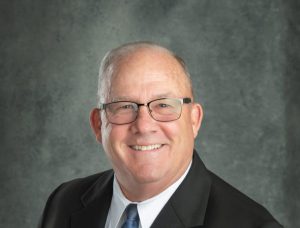
BY DR. JACK WELCH
Why most goals fade and the ones that don’t
This time of year, goal setting is as common as cold weather and gym memberships. New calendars, new planners, new promises. We tell ourselves this will be the year things change. We’ll get in shape. We’ll eat better. We’ll save more. We’ll be better.
Then, somewhere around mid-February, most of those goals quietly fade away. Why? Goals don’t fail due to lack of intention. They fail because they were never backed by habit, discipline, or passion. Wanting something is easy. Sustaining something is hard. Hard things require a change in lifestyle, not just a change in language.
Let’s be honest, most of us are out of shape not because we don’t know what to do, but because we’ve grown comfortable with how we live. Change only happens when discomfort outweighs comfort. There has to be a desperate shift in attitude before there’s a lasting shift in behavior. Until then, goals remain good ideas written on paper.
Scripture speaks directly to this struggle. “The heart of man plans his way, but the Lord establishes his steps” (Proverbs 16:9). Proverbs 16:1–9 reminds us that wise planning begins with surrender. Planning isn’t the problem. Pride is. When goals are built solely around our will, they tend to collapse under pressure. When they’re rooted in God’s purpose, they gain staying power.
Athletics gives us countless examples of this truth. One of the most well-known is Michael Jordan. As a sophomore, he was cut from his high school varsity basketball team. That moment could have defined him, or defeated him. Instead, it fueled him. Jordan didn’t just want to be better. He committed to daily discipline. Early mornings. Extra reps. Relentless effort. That determination, repeated day after day, turned disappointment into greatness. His goal wasn’t a wish, it became a way of life.
Great achievements, on the field or in life, don’t happen by accident. They happen because someone decided the goal mattered enough to suffer for it. They were willing to sacrifice time.
So, as you set goals this year, ask yourself: Is this just something I want, or something I’m willing to commit to? Have I invited God into it, or am I asking Him to bless something I’ve already decided?
Thought for the Week, “A goal without discipline is a wish. A goal surrendered to God becomes a calling.” R.B. Shoemaker, former iconic Baptist Minister
Dr. Jack Welch serves as President of Fort Scott Community College. With a career spanning professional sports, public education, and rural community development, he brings a servant-leader mindset and a passion for building trust-driven cultures that empower people to thrive in the classroom, on the field, and in life. He is also the author of Foundations of Coaching: The Total Coaching Manual.
|
PITTSBURG, Kan. – The Community Health Center of Southeast Kansas (CHC/SEK) has received three American Heart Association achievement awards for its commitment to reducing the risk of heart disease and stroke by improving high cholesterol, Type 2 diabetes, and blood pressure management. The awards recognize a commitment to following the latest evidence-based care guidelines.
CHC/SEK received three achievement awards:
“We are proud to be recognized by the American Heart Association for our focus on Type 2 diabetes, cholesterol, and high blood pressure management and care,” said Brenda Stokes, CHC/SEK Vice President of Nursing and Quality Improvement. “We care for more than 15,000 patients with hypertension and almost 7,000 with diabetes. These recognitions underscore the incredible work of our staff and their commitment to providing quality healthcare to everyone.”
According to the Centers for Disease Control and Prevention, nearly half of U.S. adults have high blood pressure, over 14% have diabetes, and more than 11% have high cholesterol. Research shows that these conditions occur at higher rates in rural communities and are significantly more likely to go uncontrolled.
“Unmanaged, these conditions can lead to serious health problems such as heart disease and stroke,” said Stokes. “At CHC/SEK, we focus on early detection, prevention, and helping patients take charge of their health. Often, small changes like taking the right medications or making simple lifestyle adjustments can make a big impact.”
Patients can receive comprehensive care for high blood pressure, diabetes, and high cholesterol at any CHC/SEK clinic. To find the nearest clinic, visit chcsek.org/our-communities.
###
About Community Health Center of Southeast Kansas
The Community Health Center of Southeast Kansas (CHC/SEK) serves as a healthcare hub for communities in Kansas and Oklahoma. CHC/SEK delivers quality, integrated care to nearly 90,000 patients each year with a goal of improving health, sustaining rural communities, and providing purpose-driven work to 950 staff members. Beyond healthcare, CHC/SEK finds innovative ways to improve lives by focusing on education, housing, and transportation. Regardless of income or insurance status, CHC/SEK ensures everyone receives the care they need. For more information, visit chcsek.org.
MORRIS, ERIC MICHEAL, 46
Arrested: 1/9/2026 10:05 AM
Agency: BCSO
Charges:
– Battery Of Leo; Rude Contact
– Interference With Leo; Obstruct/Resist Misd ($5,000 cash/surety)
– Possession Of Certain Hallucinogenic Drugs (CASH/SURETY)
– Use/Poss Drug Paraphernalia/Human Body (CASH/SURETY)
Bond Total: $5,000
BELCHER-COWLISHAW, GABRIELLE KAY, 20
Arrested: 1/9/2026 2:12 PM
Agency: Fort Scott PD
Charges:
– Warrant: Bourbon County ( Failure To Appear) * ($2,500 cash/surety)
– Warrant: Bourbon County ( Failure To Appear) * ($2,500 cash/surety)
Bond Total: $5,000
PIPER-IHOLTS, CAMERON LITTLEBEAR, 24
Arrested: 1/12/2026 12:15 AM
Agency: BCSO
Charges:
– Agg Assault (NO BOND)
– Contribute To Child Misconduct; Encourage Felony (NO BOND)
– Criminal Trespass; Unknown Circumstance (NO BOND)
Bond: $0
HERMRECK, LEVI MATTHEW, 41
Booked: 01/08/2026
Released: 1/9/2026 at 8:22 PM
Type: Surety bond
Released to: Able Bonding
KITCHINGHAM, AUSTIN COLE, 32
Booked: 01/08/2026
Released: 1/9/2026 at 7:25 PM
Type: Surety bond
Released to: Able Bonding
KOBER, SHAIDEN PATRICK, 19
Booked: 01/08/2026
Released: 1/9/2026 at 7:00 PM
Type: Surety bond
Released to: Able Bonding
Source: Arrest Summary PDF | Inmate Released List PDF
The Fort Scott High School Thespian Troupe #7365 brought home a number of honors from the 2026 Kansas Thespian Festival (KTF).
Students attended the festival with nearly 2,000 other students from across the state on Jan. 8-10 at the Century II Performing Arts and Convention Center in Wichita.
Sixteen students performed in the Thespy individual events competition with a record number of FSHS students receiving Superior ratings and qualifying to compete at the International Thespian Festival at Indiana University on June 21-26. Superior achievers include senior Levi Fairchild in both Duet Acting and Musical Solo, senior Junie Fisher – Musical Solo, senior Lily Brown – Short Film, senior Grace Walker – Stage Management, junior Ava Johnson – Solo Acting, junior Clark Uttinger – Duet Acting, and sophomore Gianna Gorman – Musical Solo.
“Kansas Thespian Festival has always been so fun and is always a great reminder of why I love theater,” Fisher said. “This year’s festival was truly a great way to close out my senior year!”
The troupe received the Gold Honor Troupe Award, the highest level of achievement for Thespian troupes in Kansas, based on performances, community, outreach, advocacy, and service from the past school year.
The Advanced Drama class performed the one-act play “When Bad Things Happen to Good Actors” by Ian McWethy and Jason Pizzarello. The troupe also presented a Lobby Display featuring photos and events from the past school year.
FSHS State Thespian Festival Board Members, senior Chris Newman and Juniors Ava Johnson and Allie Wards helped organize the festival as leaders.
“KTF taught me, challenged me, and reminded me why theatre matters so much to me. It’s not just something I love to do, it’s something that’s continuously changing my life,” said Wards.
FSHS Theatre Director Angie Bin taught a workshop entitled “From Burnout to Balance: Wellness for Theatre Teachers” and Bin as well as Assistant Theatre Directors Mesa Jones and Abby Starkey judged Thespy events performing at the festival. Bin, a member of the Kansas State Festival Board, also led the Competitive Improv Event and the Honor Troupe competition.
Students participated in a variety of workshops and classes throughout the festival learning about acting, technical theatre, dance, playwriting, and other theatre-related topics. Workshops were taught by theatre professionals from all over the country. Thespians also viewed mainstage and one-act productions from schools throughout the state. Students competed in events including Competitive Improv, Speed Charades, and Creative Costuming. Attendees also had the opportunity to meet with college theatre programs from across the country.
Brown said, “At KTF, I learned to embrace failure, and to use failure to my advantage, whether it be humorous or serious, I can use my failures as a way to bring life to my performances. In fact, failure is no longer a word I use to describe mishaps in my performances anymore, now I call them moments of opportunity.”
Sophomore Theodore Bowman added, “Going to KTF is more than an experience, it’s a bonding adventure full of new friends, incredible workshops, lots of laughs, and mind-blowing performances. KTF isn’t a theatre-filled field trip, it’s a weekend where emotions are inevitable, friends are everywhere, laughing is plenty, and memories are made.”
FSHS Theatre’s next event is auditions for Clue High School Edition on Jan. 12 and 13 with performances on March 5-7, 2026.
Photos and information about Troupe #7365 can be found at the Fort Scott High School Thespians Facebook page.
# # #
Contact: Angie Bin, angela.bin@usd234.org, 620-719-9622.
International Thespian Festival qualifiers from left to right: Top – Clark Uttinger, Levi Fairchild, Lily Brown. Bottom – Ava Johnson, Junie Fisher, Gianna Gorman, Grace Walker.
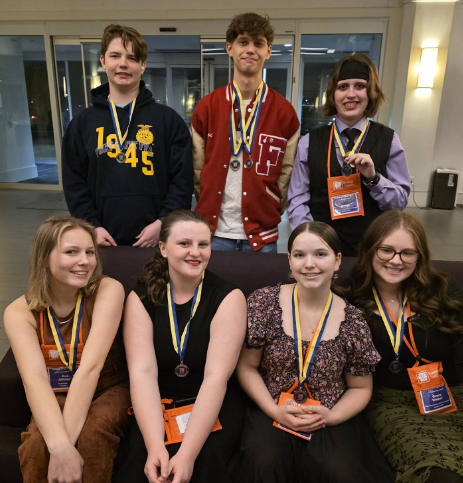
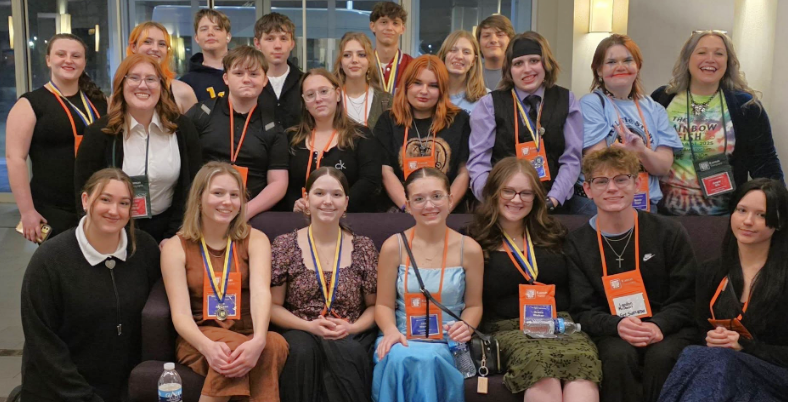
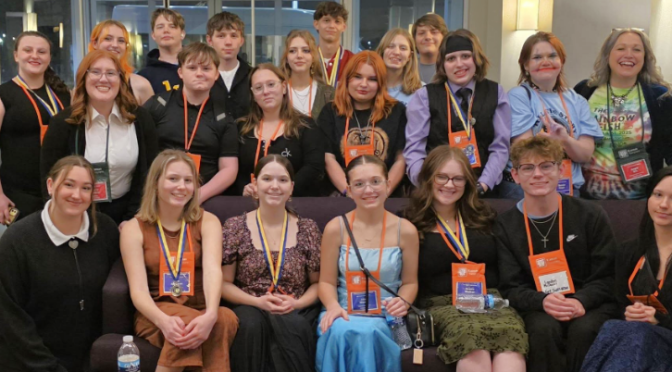
Fort Scott High School Thespians attending the Kansas Thespian Festival from left to right: Top – Junie Fisher, Chris Newman, Clark Uttinger, Tray Maloun, Aimee Hardwick, Levi Fairchild, Tyffani Bolden, Michael Stevenson II. Middle – Abby Starkey, Theodore Bowman, Emma Marshall, Isis Patton, Lily Brown, Bonnie Esgar, Angie Bin. Bottom – Mesa Jones, Ava Johnson, Gianna Gorman, Allie Wards, Grace Walker, Landon McDaniel, Trinity Leihsing.
FSHS students compete in the Creative Costuming event: (from left to right) Isis Patton, Ava Johnson, Grace Walker.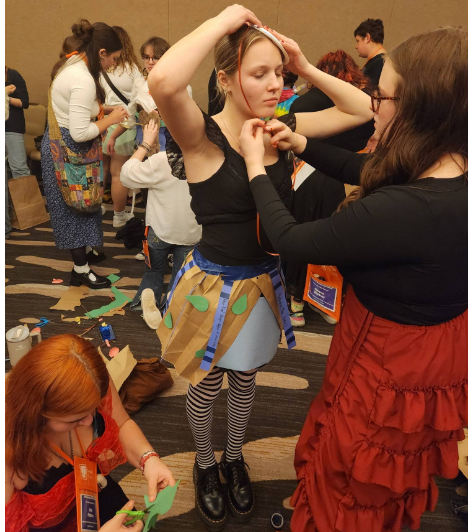
Chris Newman and Ava Johnson in the one-act play “When Bad Things Happen To Good Actors.”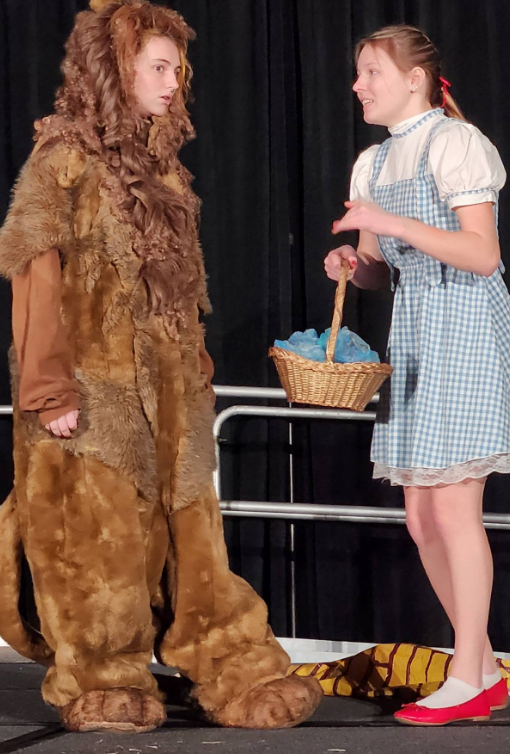
|
||||||||||||||||||||||||||||||||||||||||||||||||||||||||||||||||||||||||||||||||||||||||||||
|
||||||||||||||||||||||||||||||||||||||||||||||||||||||||||||||||||||||||||||||||||||||||||||
|
||||||||||||||||||||||||||||||||||||||||||||||||||||||||||||||||||||||||||||||||||||||||||||

Keys to the Kingdom
By Carolyn Tucker
Stay in Sync
Have you ever watched a movie where the sound was not in sync with the actor’s lips? That drives me nuts! Or have you ever ridden at night with someone who didn’t use their headlights on high beam? That drives me bonkers and scares me all at the same time. One of the important rules I learned in driver’s ed was to not overdrive your headlights. If you’re driving faster than the distance your headlights allow you to see clearly, you’re overdriving your headlights; so you might not have enough time to react to that unexpected deer crossing the highway. If your speed and headlights are not in sync with each other, you may find yourself calling 911 and your friendly insurance agent.
When Christ followers run into a patch of spiritual fog, we need to slow down and get in sync with God. We don’t want to overdrive our life and speed past God as He waves a yellow flag at us. He knows the perfect lane of life that we’re supposed to travel upon. Whether we’re two steps ahead, or two steps behind, our goal should be to match God’s speed. When we’re in sync with Him, the peace of God quiets our minds and rests our hearts. We can put our hand in His and feel safe like a little child. God knows the way out of the fog and we can wholeheartedly trust Him to work on our behalf. “The Lord my God holds my right hand; He is the Lord, Who says to me, Fear not; I will help you!” (Isaiah 41:13).
In this new year, it’s good to be excited about new beginnings. However, believers need to be careful that we don’t go off half-cocked! We need to avoid the mistake of not praying about a new venture simply because of our enthusiasm. It’s vital to pause and ask God what He thinks about it. “I am one of God’s sheep and His sheep hear His voice” (John 10:27). He’s faithful to give us either a green light or a red light.
Christ followers shouldn’t give in to the temptation of arrogantly thinking we’re smart enough to run our lives by ourselves. Life will see to it that we don’t have what it takes to drive solo. “Pride lands me flat on my face, but humility prepares me for honor” (Proverbs 29:23 MSG).
When we’re presented with a new opportunity or need to make an important decision, many times a friend will say, “Sleep on it and see how you feel in the morning.” This is excellent advice because when we’re asleep, our minds are peaceful, clear, and at rest from thinking. Right before you fall asleep, you can ask God to give you the answer you need. “When I am deficient in wisdom, I ask of the giving God [Who gives] to everyone liberally and ungrudgingly, without reproaching or faultfinding, and it will be given to me” (James 1:5 AMP). It’s possible that when you awaken in the night, God will reveal the answer to you because your mind is at rest and ready to hear.
As believers read God’s Word, listen for His voice and obey, we are better able to stay in sync with Him. He is faithful to keep His promises and we can trust in His plan and purpose for our lives. Even when we’re in the dark, our heavenly Father knows every bend and hill on our journey.
The Key: Stay in sync with God and you’ll never overdrive your life.








 A Winter Road Trip Favorite in Kansas
 Plan your visit today:
 Phone: 620-223-1312
 Email:
 The Discovery Award Keeps Growing
 Do you know an educator or student who would love this opportunity?