|
|
|
|
TOPEKA – Lieutenant Governor and Secretary of Commerce David Toland, alongside leaders from across the state, today unveiled Love, Kansas, a dynamic talent attraction campaign aimed at boosting Kansas’ population by inviting past residents to choose the Sunflower State as their future home. This national marketing initiative will highlight Kansas as an exceptional place to live, work and raise a family, with a special emphasis on “boomerangs” – individuals with previous ties to the state.
The campaign was launched at the Flint Hills Discovery Center in Manhattan, where Lieutenant Governor Toland shared his personal journey back to Kansas that was inspired by a heartfelt phone call from a family friend about a job opportunity in his hometown of Iola.
“It’s simple: We need more humans in Kansas to keep up with the phenomenal economic growth our state is experiencing,” Lieutenant Governor and Secretary of Commerce David Toland said. “The best way to do that is to first approach Kansans who left the state for economic opportunities elsewhere and invite them to build a life in a place they know and have connections to, whether in their hometown or elsewhere in the state. And with the Love, Kansas campaign, we aren’t just extending an invitation to those who once called Kansas home to come back – we’re also inviting families from around the country to build their lives in the Sunflower State.”
Love, Kansas will focus on the state’s abundant job opportunities, high quality of life, excellent education system and affordable communities. The campaign will be driven at the local level but will strategically target key markets across the U.S., with a strong focus on digital and social media platforms. Influencer and journalist engagement, as well as targeted in-person events both within and outside of Kansas, will play a crucial role in reaching potential boomerangs.
During the launch event, it was announced that the first 50 communities to partner with Love, Kansas will be eligible for a $5,000 grant to assist in their efforts in attracting new residents to their community. Nineteen pilot communities and seven universities already have joined the initiative and are planning events that are aligned with the campaign’s theme. A primary goal is for communities across the state to do direct outreach to past residents they have a personal connection with, inviting them to return home.
“The collaboration already on display between so many partners underscores the enthusiasm for this campaign,” Tourism Director Bridgette Jobe said. “There are so many amazing things happening in Kansas right now; Love, Kansas gives us the chance to let people throughout the country know about them.”
The Love, Kansas campaign is being spearheaded by the Kansas Department of Commerce.
For more information about the campaign, view this video (here) or visit the Love, Kansas website here.
About Kansas Tourism:
The mission of Kansas Tourism is to inspire travel to and throughout Kansas to maximize the positive impacts that tourism has on our state and local communities. Kansas Tourism works hand in hand with other Commerce community programs to elevate and promote Kansas as a tourist destination. Kansas Tourism oversees all tourism marketing and PR for the state, produces travel publications and advertising, manages state Travel Information Centers, manages both the Kansas By-ways program and the Kansas Agritourism program, approves tourist signage applications, produces the KANSAS! Magazine, and provides financial and educational support to the tourism industry in Kansas through grants, education, and support.
About the Kansas Department of Commerce:
As the state’s lead economic development agency, the Kansas Department of Commerce strives to empower individuals, businesses and communities to achieve prosperity in Kansas. Commerce accomplishes its mission by developing relationships with corporations, site location consultants and stakeholders in Kansas, the nation and world. Our strong partnerships allow us to help create an environment for existing Kansas businesses to grow and foster an innovative, competitive landscape for new businesses. Through Commerce’s project successes, Kansas was awarded Area Development Magazine’s prestigious Gold Shovel award in 2021, 2022, 2023 and 2024, and was awarded the 2021 and 2022 Governor’s Cup by Site Selection Magazine.
###
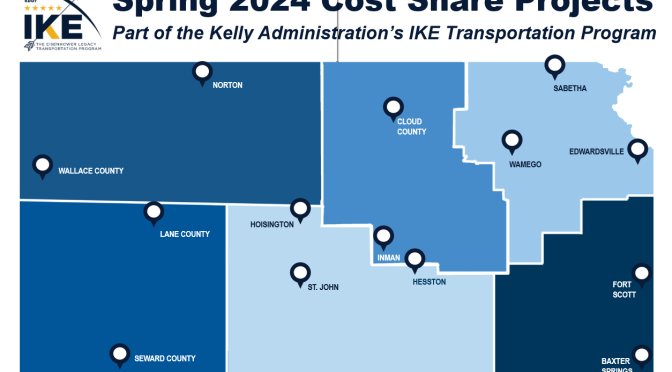
EDWARDSVILLE – Governor Laura Kelly and Transportation Secretary Calvin Reed today announced that $8.6 million will be awarded to 14 transportation construction projects through the Kansas Department of Transportation’s Cost Share Program for spring 2024.
“These new Cost Share projects will repair and modernize transportation infrastructure in communities across Kansas,” Governor Laura Kelly said. “Collaboration on these selected projects address short-term challenges to bring long-term solutions to the places Kansans call home.”
Governor Kelly lauded the 104th Street sidewalk expansion in the City of Edwardsville as a prime example of how a Cost Share project can benefit a community. Enhancements to the city’s pedestrian facilities will fill the largest gap in pedestrian access between K-32 and the elementary school and encourage safe non-motorized access to school and recreational activities.
With today’s announcement, more than $260 million has been invested to support the 179 projects selected in the Cost Share Program since it began in the fall of 2019. Combining more than $146 million in state funding with more than $115 million in matching local funds has been a substantial boost to Kansas communities.
“Kansans understand the value of partnerships,” Kansas Transportation Secretary Calvin Reed said. “The Cost Share Program provides the opportunity for partnership between KDOT and communities to solve local transportation issues through shared investment. Addressing these infrastructure projects enables solutions that will help these communities and residents keep moving forward for generations.”
Both rural and urban areas can submit transportation projects that improve safety, support job retention and growth, relieve congestion, and improve access and mobility. The program is part of the Kelly administration’s 10-year, bipartisan Eisenhower Legacy Transportation Program, or IKE.
Click here to view a map of the 14 Cost Share Program projects announced today. These projects are also listed below:
More information about KDOT’s Cost Share Program is on KDOT’s website at https://www.ksdot.org/
June 21, 2024
Special Session resulted in two bills becoming law, Senate Bill (SB) 1, tax relief for all Kansans, and House Bill (HB) 2001, an expansion of the Sales Tax And Revenue (STAR) Bonds program.
No State Income Tax On Social Security is a major win in SB 1 that will help over 76,000 Kansans. The average savings will be around $1,300 a year according to Legislative Research. I have been leading this effort for a few years. It is now law.
Lower Income Taxes for all Kansas taxpayers is a win; by decreasing the 5.7 bracket to 5.58, the 5.25 to 5.2, and 3.1 to 0; increasing the current $2,250 personal exemptions to $9,160 for a single filer, $18,320 for married, and $2,320 for each dependent; and increasing standard deductions 3% – single filer from $3,500 to $3,605 and married from $8,000 to $8,240. A Kansas family, married filing jointly with two dependents, taking a standard deduction will not pay income tax on the first $31,200 of earnings – which happens to be the current federal poverty level.
Property tax relief comes from increasing the current $44,700 exemption to $75,000 when calculating the K-12 20 mill. It was reported to be about $70 savings for a homeowner. It is much smaller than many of us wanted. Also lost were future tax cuts based on inflation, so as inflation increases the property tax exemption $75,000 for homeowners, all standard deductions and personal exemptions would have also increased – thus lowering your taxes. The grocery sales tax going to 0% earlier than next year was lost. Because the Governor and a handful of legislators refused to support tax bills that overwhelmingly passed during session, you will continue to pay 2% state sales tax on groceries until Jan 1, 2025. They blocked those items from becoming law with over $4 billion of taxpayer money sitting in the state coffers. SB 1 was as good as we could get this year for major tax cuts. SB 1 also abolishes the Local Ad Valorem Tax Reduction Fund (LAVTR) and the County & City Revenue Sharing Fund. No money has been transferred to these funds for over 20 years.
The STAR Bonds program is basically a loan via bonds used to build a project, except STAR Bonds, i.e. loans, are paid off with sales tax and other revenue (taxes) collected in a designated STAR Bond district. The owner of the property doesn’t pay for the facility being built, the STAR Bonds and taxes pay for most, if not all of it. HB 2001, expanding STAR Bonds, sailed through the special session. It didn’t have the votes during regular session, but over 30 lobbyists were hired to push it during a “special session”. HB 2001 allows STAR Bonds to be issued and to pay for 70% of a Chiefs, Royals, and/or practice stadiums to be built. It also allows for STAR Bonds to pay for businesses like restaurants, hotels and others, with sales taxes and other revenue (taxes). Previous STAR Bond projects were funded at 50%, not 70%, and had a 20 year payback, not the 30 year payback in HB 2001. Another change is that 100% of taxes collected on alcohol sales can be used to pay off the bonds. Can you believe the law requires revenues filed with Kansas Department of Revenue in connection to STAR bonds for sports stadiums “shall be kept confidential” and if disclosed subject to legal penalties? And then the law puts a handful of legislative leaders in control of extensions and one person in charge of the program. Local tax money, property taxes and such, could also be used to develop these stadiums. Just look at Wyandotte County property taxes to see what exempting the NASCAR racetrack and other properties do for local homeowners in the area. They have some of the highest mill levies, which means higher taxes. Another question, how will they secure the property to build? Eminent domain was used to force homeowners, landowners, businesses, and even a church to sell their property to build a racetrack. There are always reasons to vote yes or no on a bill, but the negatives outweighed the excitement of one of the most generous giveaways to a professional sports team ever, so I voted No.
It is an honor and a privilege to serve as your 12th District State Senator.
Caryn
|
|
|
|
~~ Gov. Kelly Also Signs Legislation Approving Economic Development Tool to Attract Professional Sports Teams to the State ~~
TOPEKA – Governor Laura Kelly announced today that she has signed Senate Bill 1, bipartisan legislation that will provide tax cuts for all Kansans without threatening the state’s long-term fiscal health. The bill reduces property and income taxes, immediately eliminates the state tax on Social Security income, and increases the standard deduction and Child and Dependent Care Tax Credit.
“I am proud to be delivering on my commitment to responsible, meaningful tax relief for all Kansans,” Governor Laura Kelly said. “I appreciate the Legislature’s quick work to pass this tax relief package. Senate Bill 1 provides significant tax relief while preserving our ability to continue fully funding our public schools, roads and bridges, and State Water Plan.”
The governor also signed House Bill 2001, enabling the use of the Sales Tax and Revenue (STAR) Bonds, an economic development tool, to expand Kansas’ portfolio of professional sports teams. STAR Bonds allow the issuance of bonds to finance the development of major commercial, entertainment, and tourism projects. The bonds are paid off through the sales tax revenue generated by the development.
“We know that modernizing our economic development tools provides the opportunity to increase private investment into the state,” Governor Kelly said. “By modifying the STAR Bonds program, one of our strongest economic development mechanisms, lawmakers crafted a viable option for attracting professional sports teams to Kansas.”
Click here to learn more about STAR Bonds.
MANHATTAN, Kansas — Twenty-five students from five schools in Kansas have been awarded the Kansas Department of Agriculture’s Kansas Agriculture Skills and Competencies Certificate. High schools with students earning certificates include Buhler, Centre, Ellsworth, Fort Scott and Republic County.
Students have completed requirements in the areas of classroom instruction, supervised agricultural experience (SAE) and FFA. They have demonstrated excellence in agricultural knowledge, career readiness, and leadership development. Students must also maintain a cumulative GPA of 2.5 or higher in all school courses to earn the certification.
“Students receiving these certificates are among the most well-rounded agricultural education students in the state. This recognition isn’t based on one single activity or achievement but on meeting the criteria for several components showing diversity in agricultural knowledge and success in and out of the classroom,” said John Clark, the agriculture education teacher at Buhler High School.
KDA is committed to establishing a dynamic and well-equipped workforce that meets the diverse needs of the agriculture industry today. “As agriculture continues to advance, there is a continued need for skilled young people to operate high-tech machinery on our dairies, ranches, and farms, and technical specialists to provide research in agronomy, technology and animal science fields,” said Russell Plaschka, KDA marketing director. “Kansas agriculture is growing, and the industry requires a well-equipped workforce to help support that growth in our great state. We are proud of these young adults.”
These certificates have been endorsed by several industry organizations and employers.
Applications for the Kansas Agriculture Skills and Competencies Certificates are accepted each spring. To find more information, visit agriculture.ks.gov/ageducation
Complete list of students:
Buhler High School
Jaelyn Anderson
Peyton Coldren
Marlie Cooper
Brynlee Frank
Krysten Hamby
Amos Harder
Megan Krueger
Mikayla Milburn
Danielle Rogers
Madison Shain
Makenna Siemens
Emmie Stallman
Centre High School
Jenna Bittle
Leah Brunner
Karsen Kroupa
Jenaya Plett
Emilee Remmers
Isabel Rziha
Allie Stuchlik
Payton Svitak
Ellsworth High School
Rebekah Vague
Fort Scott High School
Reegan McDaniel
Republic County High School
Macey Homeier
Camryn Reynolds
Gracia Siemsen
###
TOPEKA — Governor Laura Kelly announced today that Kansas has garnered Area Development magazine’s coveted Gold Shovel Award for the fourth year in a row. The latest accolade—without precedent in state history—reflects the economic development success the state has experienced under the Kelly administration.
“Earning a fourth Gold Shovel underscores the work my administration is doing to attract business investment and increase job opportunities to continue making Kansas the best place to live, work, and raise a family,” Governor Laura Kelly said. “The influx of jobs in every corner of the state is providing the possibilities for young Kansans to start or expand their careers right here at home.”
Since the start of 2019, Kansas has created 1,180 new economic development projects worth more than $19 billion in private sector investment and created and retained more than 67,000 jobs statewide.
Kansas was recognized for its achievement in attracting high-value investment projects that will create a significant number of new jobs throughout the state. In 2023, there were 255 projects totaling almost $3.1 billion in private sector investment and nearly 12,000 jobs created or retained. The single largest project was Building Materials Manufacturing Corporation’s $350 million facility in Newton.
“After years of decline — and Kansans fleeing to other states in search of economic opportunity — the Kelly-Toland Administration has Kansas back on a path of growth,” Lieutenant Governor and Secretary of Commerce David Toland said. “Kansans in every region of our state deserved greater opportunities, and we needed a strategic plan to breathe life back into our communities. This fourth consecutive Gold Shovel is proof that our plan, the Kansas Framework for Growth, is working. Kansas has jumped from the middle of the pack to the top of the heap, establishing a new normal as a nationally recognized economic powerhouse. We will continue to work tirelessly to ensure an even brighter future.”
The Framework for Growth, developed in partnership with communities, businesses, education institutions, and economic development stakeholders, focuses on five target sectors:
These target sectors emphasize Commerce’s focused, purposeful approach to economic development. Ninety percent of the business successes announced during the Kelly-Toland administration came from one of the target sectors.
Area Development Magazine is a publication for economic development executives involved with corporate site selection and relocation. Five states were awarded the prestigious Gold Shovel in their respective population categories, with Kansas leading the list of the states with fewer than 3 million residents.
The top 10 projects from 2023:
|
Company |
Location |
Investment |
Jobs |
|
Building Materials Manufacturing |
Newton |
$350 million |
137 |
|
Walmart |
Olathe |
$257 million |
667 |
|
High Plains Ponderosa Dairy |
Plains |
$168 million |
95 |
|
Kiewit Corp. |
Lenexa |
$120 million |
723 |
|
Camso Manufacturing |
Junction City |
$113 million |
181 |
|
H&T Kansas |
De Soto |
$110 million |
180 |
|
Koch Fertilizer |
Dodge City |
$93 million |
– |
|
Marvin Lumber and Cedar Co. |
Kansas City |
$76 million |
585 |
|
Oppidan |
Olathe |
$70 million |
6 |
|
Southwest Plains Dairy |
Syracuse |
$54 million |
45 |
###
|
| Stay Connected with Kansas Office of the Governor: |
    |
MANHATTAN, Kansas — Several legislators along with leadership from key Kansas agriculture organizations joined the Kansas Department of Agriculture on June 6 as Governor Laura Kelly signed House Bill 2607, a bill amending and updating the Kansas Pesticide Law.
The KDA pesticide and fertilizer program administers and enforces the laws applicable to pesticide use in Kansas, including the licensure, training, and certification of pesticide businesses, dealers, and applicators. HB 2607 made critical updates to the state’s pesticide law which will enable KDA to continue working with Kansas producers to ensure we have a safe, effective system to provide oversight of pesticide use in the state, emphasizing training and education.
“Legislators, state agencies, and industry stakeholders worked diligently together to achieve this all-encompassing piece of legislation addressing pesticide use and application for future years,” said Representative Lisa Moser, vice chair of the House Committee on Agriculture and Natural Resources.
The bill’s development incorporated input from stakeholders in the Kansas agriculture industry, legislators, and pesticide applicators. The bill makes necessary revisions to expand education, reduce barriers, and meet the standards required by the EPA to enable the program to continue its role in administering and enforcing the Kansas Pesticide Law.
“I appreciate how we were able to collaborate with KDA and others in the Kansas agriculture industry to make amendments in the House to address stakeholder concerns and make this bill work for Kansas,” said Representative Sydney Carlin, ranking minority leader of the House Committee on Agriculture and Natural Resources.
Following the signing of HB 2607, the KDA pesticide and fertilizer team will develop regulations to provide more guidance to the regulated community about how the statute will be applied to those who are licensed as pesticide businesses and applicators. In addition, KDA will work with K-State Research and Extension to develop training and testing materials as outlined in the bill.
For more information about the Kansas Pesticide Law, visit KDA’s website at www.agriculture.ks.gov/
###
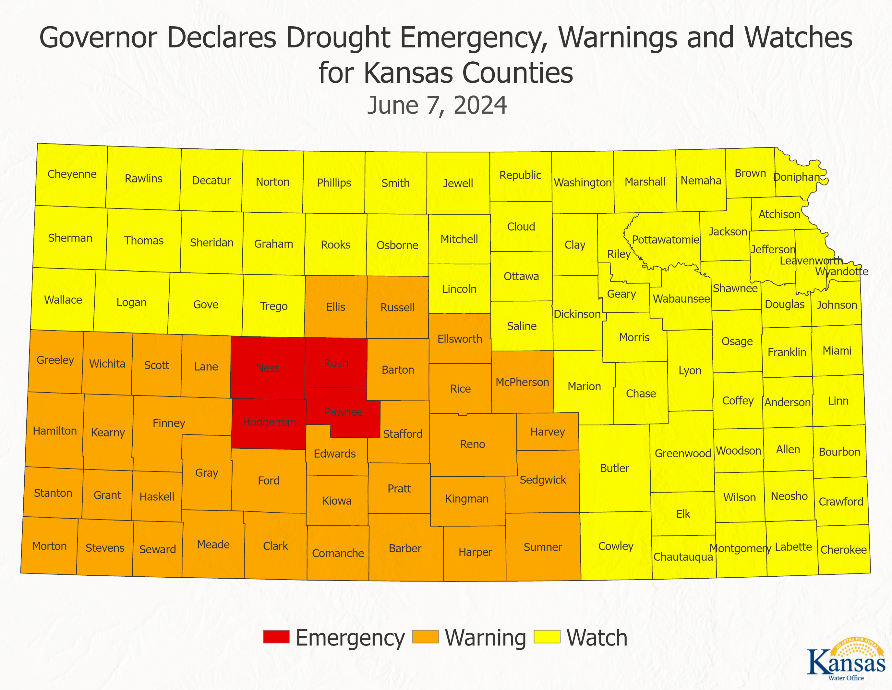
Governor Kelly Updates Declaration of Drought Emergency, Warnings, and Watches for Kansas Counties
TOPEKA — Governor Laura Kelly has approved updated drought declarations for Kansas counties through proclamation.
“While drought conditions have improved in some areas of the state, many counties continue to be negatively impacted by the decline in water supply or strains on water resources,” said Governor Laura Kelly. “I strongly encourage all Kansans to continue to conserve water over the summer months.”
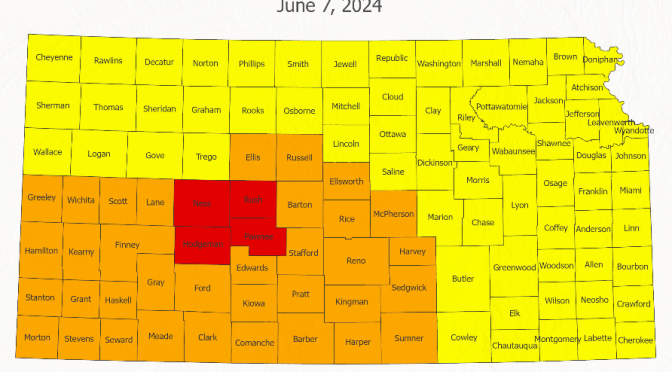
The drought declaration placed four counties into emergency status, 35 into warning status, and 66 into watch status. This action was recommended by Connie Owen, Director of the Kansas Water Office and Chair of the Governor’s Drought Response Team. While Eastern Kansas has seen significant relief from drought since March, central and western Kansas has declined rapidly into Severe and, in a few counties, Extreme Drought.
“The counties in a watch status are experiencing conditions that indicate the probability of a water shortage is rising. It is important to monitor these conditions and be mindful of water usage in these counties,” said Owen. “Summer has arrived, and with it, higher temperatures and a decrease in precipitation. The Governor’s Drought Response Team will continue to monitor the drought conditions across Kansas and make recommendations to Governor Kelly as conditions change.”
Through an interagency agreement between the Kansas Water Office, the Kansas Department of Wildlife and Parks, and the Kansas Division of Emergency Management, counties in the emergency stage are eligible for emergency water use from certain state fishing lakes and some federal reservoirs.
Individuals and communities must contact the Kansas Water Office for a water supply request before any withdrawals from lakes. These requests will, in turn, be referred to the appropriate office to obtain necessary permits to withdraw the requested water.
This proclamation shall remain in effect for those counties identified until rescinded by a proclamation ending the declaration or revising the drought stage status of the affected counties.
Effective immediately, the proclamation:
The Governor’s Drought Response Team will continue to watch the situation closely and work to minimize the negative drought-induced effects on Kansans.
For more detailed information about current conditions, visit the Climate and Drought webpage on the Kansas Water Office website at kwo.ks.gov.
County Drought Stage Declarations:
Drought Emergency: Hodgeman, Ness, Pawnee, Rush.
Drought Warning: Barber, Barton, Clark,
Comanche, Edwards, Ellis, Ellsworth, Finney, Ford, Grant, Gray, Greeley, Hamilton, Harper, Harvey, Haskell, Kearny, Kingman, Kiowa, Lane, McPherson, Meade, Morton, Pratt, Reno, Rice, Russell, Scott, Sedgwick, Seward, Stafford, Stanton, Stevens, Sumner, Wichita.
Drought Watch: Allen, Anderson, Atchison, Bourbon, Brown, Butler, Chase, Chautauqua, Cherokee, Cheyenne, Clay, Cloud, Coffey, Cowley, Crawford, Decatur, Dickinson, Doniphan, Douglas, Elk, Franklin, Geary, Gove, Graham, Greenwood, Jackson, Jefferson, Jewell, Johnson, Labette, Leavenworth, Lincoln, Linn, Logan, Lyon, Marion, Marshall, Miami, Mitchell, Montgomery, Morris, Nemaha, Neosho, Norton, Osage, Osborne, Ottawa, Phillips, Pottawatomie, Rawlins, Republic, Riley, Rooks, Saline, Shawnee, Sheridan, Sherman, Smith, Thomas, Trego, Wabaunsee, Wallace, Washington, Wilson, Woodson, Wyandotte.
# # #
As the state’s water office, the Kansas Water Office conducts water planning, policy coordination and water marketing as well as facilitates public input throughout the state.
The agency prepares the KANSAS WATER PLAN, a plan for water resources conservation, management and development.
ABILENE — Governor Laura Kelly today joined veterans of World War II, the Eisenhower Foundation, and local, state, and federal leaders at the Eisenhower Presidential Library and Museum to observe the 80th anniversary of D-Day.
“As we commemorate the 80 years since D-Day, we pay tribute to the men and women who bravely fought in World War II,” Governor Laura Kelly said. “General Eisenhower’s leadership and expertise were invaluable in carrying out this successful operation, which laid the foundation for the peace he championed throughout his lifetime. May we never forget the sacrifices and stories of those who served.”
The D-Day operation brought together land, air, and sea armed forces on the beaches of Normandy in World War II. Under the leadership of Kansan and then-General Dwight D. Eisenhower, the operation resulted in France’s liberation and the Allied forces’ subsequent victory.
“Today, we honor those who served and those who gave their all to end the last World War,” said Meredith Sleichter, Executive Director of the Eisenhower Foundation. “As one of the first organizations formed to honor World War II veterans, the Eisenhower Foundation is honored to hold this event alongside the global commemoration of D-Day. We do this to ensure we do not forget the sacrifices made to ensure the freedoms we still hold dear today.”
The Eisenhower Foundation was formed in 1945 to honor President Eisenhower through programs and events that celebrate his legacy. The D-Day remembrance ceremony included a wreath-laying and certificates of honor for 21 World War II veterans.