The Kansas Department of Transportation will begin a pavement patching project the week of Monday, Aug. 24, on K-7 north and west of Fort Scott in Bourbon County.
The nearly 14-mile project area starts at U.S. 54 and continues north to the K-31 junction.
A pilot car will guide motorists through the work zone as the project progresses. Motorists can expect delays of up to 15 minutes.
The K-7 project is expected to be completed by October, conditions permitting.
Emery Sapp and Sons Inc. and Subsidiaries, of Columbia, Missouri, is the contractor for the $272,731 project.
KDOT urges motorists to stay alert, follow posted signs and refrain from hand-held mobile device use in all active work zones. For current road conditions, visit kandrive.gov or call 511. For updates on construction projects in southeast Kansas, visit ksdot.gov/projects/southeast-kansas-projects.
TOPEKA – Governor Laura Kelly and The Kansas Department of Transportation (KDOT) announced that $37.2 million in federal funds has been awarded to 33 projects selected for inclusion in KDOT’s Transportation Alternatives (TA) program. The TA Program provides federal funding to promote and enable use of active transportation and for certain scenic and historic improvements, such as:
Safe Routes to School – construction and non-construction
Historic transportation facility preservation and rehabilitation
Scenic and environmental improvements
“Improving alternate modes of travel provides better mobility and connectivity opportunities that keep people moving across the state,” Governor Laura Kelly said. “As the state’s largest program that funds community projects focused on active transportation, the Transportation Alternatives program provides crucial support in every corner of Kansas.”
KDOT evaluated the 40 applications from this cycle and made selections based on the program criteria and input provided by internal and external partners. Criteria consisted of including proven safety countermeasures, demonstrating readiness and need, population size, and geographic distribution. KDOT also assessed data available as part of the state’s Vulnerable Road User Safety Assessment Tool.
“The TA program prioritizes safety and accessibility for people who walk, bike, or roll to work, school, appointments, and other activities,” said Jenny Kramer, KDOT State Active Transportation Manager. “With the focus on safety, it is exciting that the Highway Safety Improvement Program is also investing $6 million towards this round. More funding allows for more projects, which enhances safety in more communities.”
The next call for projects is expected to open in spring 2028.
TOPEKA – Lieutenant Governor and Secretary of Commerce David Toland today announced a new round of funding totaling $250,000 available through the Strategic Economic Expansion and Development (SEED) grant program. Now in its fifth round, the SEED initiative continues to support economic development and quality-of-life improvements in Kansas’ smallest communities.
“Over the last eight years, we’ve worked strategically to bring economic opportunities to all of our Kansas communities — including the rural and smaller parts of our state,” Lieutenant Governor and Secretary of Commerce David Toland said. “SEED funding creates transformational change in communities that might not otherwise have the means to complete necessary economic development projects on their own.”
Administered by the Kansas Department of Commerce, SEED grants are available to communities in 78 eligible counties, with populations of 5,000 or fewer. Grants of up to $25,000 will be awarded in the following categories:
Childcare and Senior Programming – Projects that support or enhance services, such as building improvements, educational materials, supplies and equipment
Community Vibrancy – Projects that re-energize and beautify rural communities through public art, signage and placemaking initiatives
Food Retail – Projects that increase access to food through new, expanded or renovated retail spaces
Libraries – Projects that expand access to information and community resources through reading materials, technology upgrades, furnishings and facility improvements
Eligible applicants include local government, economic development organizations, chambers of commerce and other community-based organizations in towns that have not received a SEED grant in the past year. A 10% local match is required, and all funded projects must be completed within 12 months of receiving grant funds. Grants will be distributed in two installments: half at the time of award and the remainder once the project has reached at least 50% completion.
Awarded grants are having a real impact on real Kansas communities. In 2025, a $25,000 SEED grant paired with $43,450 in local matching funds is helping the City of Larned build a greenhouse at the Larned Community Garden for students, volunteers and seniors to utilize. A “Senior Saturdays” program will have seniors planting vegetables and flowers during the winter, then returning in the spring to take them home. The city also is creating programming with cooking classes and a county-wide equipment share co-op that will give seniors more opportunities for socialization.
“We’re excited about the impact that the equipment share program and the greenhouse will have on our community,” City of Larned City Manager Bradley Eilts said. “Together, they create opportunities that simply wouldn’t be possible in a small rural community. Through programs like Senior Saturdays, we’ll be able to provide meaningful hands-on experiences, social connections and access to resources that enrich the lives of our older adults.”
Funding for the SEED program is made possible through the Technology Enabled Fiduciary Financial Institutions (TEFFI) Development and Expansion Fund, established through bipartisan legislation in 2021 to promote economic development statewide in rural communities.
SEED grant applications will open Monday, August 17, and close at 5 p.m. Monday, October 19. Awardees will be announced in December.
A webinar to learn more about this opportunity will take place at 2 p.m. Tuesday, August 18. Those interested in participating can register here. The webinar also will be recorded and available on demand following the meeting.
For information about program guidelines, the list of eligible counties, or to view previous awardees, visit the SEED Grant webpage.
TOPEKA – Kansas Tourism has announced that applications for the Attraction Development Grants program will open August 17. The program is designed to provide funding support for the development of new tourism attractions or the enhancement of existing attractions that encourage travel to and throughout Kansas. A total of $1 million will be granted during this round. The deadline for applications is October 16, 2026.
“Investing in tourism means investing in the future of our communities,” Lieutenant Governor and Secretary of Commerce David Toland said. “Through this grant program, communities can transform promising ideas into attractions that draw more visitors, support job growth, and generate new economic activity – all while improving quality of life and establishing Kansas as a top travel destination.”
The $1 million available funding will go to support projects that develop or enhance destination-based tourism assets and experiences. Applications will be evaluated based on their potential to increase visitation, generate economic impact, improve the visitor experience and enhance the quality of life in Kansas communities.
“Every Kansas community has its own story to tell, and memorable attractions are one of the best ways to tell those stories,” Kansas Tourism Director Bridgette Jobe said. “These grants help create experiences that inspire travelers to explore Kansas, stay longer and discover all the unique places across the Sunflower State.”
The mission of Kansas Tourism is to inspire travel to and throughout Kansas to maximize the positive impacts that tourism has on our state and local communities. Kansas Tourism works hand in hand with other Commerce community programs to elevate and promote Kansas as a tourist destination. Kansas Tourism oversees all tourism marketing and PR for the state, produces travel publications and advertising, manages state Travel Information Centers, manages both the Kansas By-ways program and the Kansas Agritourism program, approves tourist signage applications, produces the KANSAS! Magazine, and provides financial and educational support to the tourism industry in Kansas through grants, education and support.
About the Kansas Department of Commerce:
As the state’s lead economic development agency, the Kansas Department of Commerce strives to empower individuals, businesses and communities to achieve prosperity in Kansas. Commerce accomplishes its mission by developing relationships with corporations, site location consultants and stakeholders in Kansas, the nation and world. Our strong partnerships allow us to help create an environment for existing Kansas businesses to grow and foster an innovative, competitive landscape for new businesses.
A Fox television station in the Kansas City area reported recently they had received tips that some people in Kansas are not getting money loaded onto their Electronic Benefit Transfer (EBT) cards.
EBT is the electronic debit card system used to access the official Food Assistance Program in Kansas, which is the state’s name for the federal United States SNAP (Supplemental Nutrition Assistance Program), according to the KDCF website.
Fortscott.biz went to the local Department of Children and Families in Fort Scott to find out more.
The spokesperson at DCF, Fort Scott, said she was unable to give information and sent a request to the Kansas Department of Children and Families media relations spokesperson.
In a nutshell, the answer is yes, there have been delays for some people because of requirements by federal and state laws that need longer processing times for case updates, along with increased workload and staffing shortages.
Erin La Row, MBA, who is the Deputy Director of Media Relations, responded with the following in an email:
“My colleagues in Fort Scott said after seeing the FOX 4 story, you were looking for information about delays clients may be facing with receiving their SNAP Food Assistance,” she said in the email.
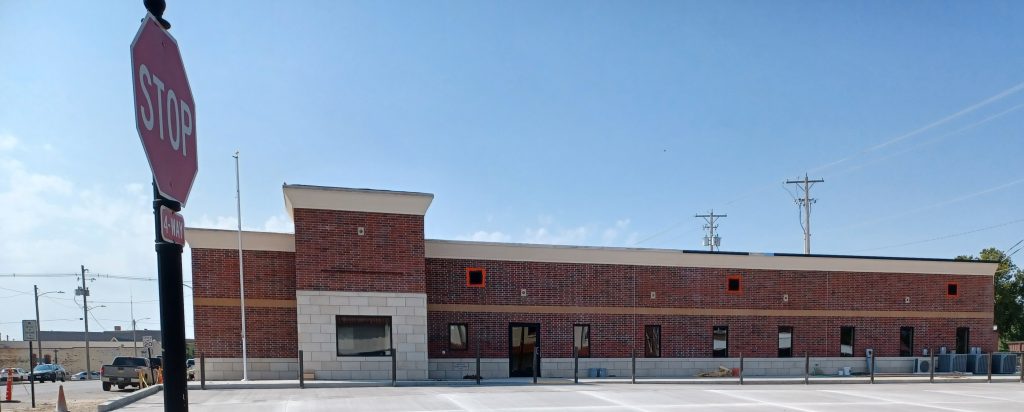
The Department of Children and Families building, National Avenue and Wall Street, August 2024
“Some clients are experiencing delays in receiving their benefits due to longer processing times for required case updates, including recertifications, change reports, and interim reports. We understand how important these benefits are to the individuals and families who rely on them, and we recognize the hardship and uncertainty that delays can create.”
She listed several factors contributing to longer processing times.
“Increased seasonal workload and staffing shortages, and the time required to obtain and review required verifications —such as shelter and utility expenses— to ensure benefit accuracy and reduce error rates. Some of these factors are related to new requirements put in place by the U.S. Congress and Kansas Legislature.
“DCF is committed to reducing processing times. The agency has implemented overtime opportunities and continues to prioritize recruitment and training to strengthen the eligibility workforce, reduce wait times, and improve service for Kansans.”
Result of 2025 Laws
The U.S. Congress in 2025 enacted the One Big Beautiful Bill Act, with the effect trickling down now to the local level.
To learn more about this legislative act, click below.
The One Big Beautiful Bill Act of 2025 reduces federal funding for the Supplemental Nutrition Assistance Program (SNAP) by $187 billion through 2034 and establishes stricter eligibility standards nationwide, according to a Public Broadcasting Service story:
With highway construction continuing and the beginning of the school year fast approaching, the Kansas Department of Transportation and the Kansas State Department of Education are reminding drivers of a new law aimed at reducing distracted driving in construction and school zones.
Senate Bill 366 prohibits handheld mobile device use in active construction and school zones across the state. Governor Laura Kelly signed the bill this spring, which then became law on July 1. Devices are still allowed to be used in hands-free mode.
Law enforcement officers are issuing warning citations until June 30, 2027. Beginning July 1, 2027, violations may result in traffic citations with a $60 fine plus court costs.
“Removing the distraction of handheld devices in construction and school zones is an effort to improve safety in locations where vehicles and pedestrians or construction workers can be in close contact with one another,” said Gary Herman, KDOT Behavioral Safety Section Manager. “The safety of people in these zones must be a top priority.”
An active construction zone means workers are present, and signs are posted at the beginning and end of the work zone to alert drivers. Active school zones are defined as areas where reduced speed limits are in effect. Devices are still allowed to be used in hands-free mode.
“People are walking and working in these areas just a few feet from passing vehicles,” said Keith Dreiling, KSDE State Director of the School Transportation Safety Unit. “We urge drivers to use extra caution and remain aware of their surroundings when traveling through school and construction zones.”
TOPEKA – The Kansas Department of Commerce, in collaboration with the Export-Import Bank of the United States (EXIM) Regional Export Program, announced the upcoming EXIM Roadshow. This first of its kind learning opportunity is designed to help small- to medium-sized businesses in Kansas grow through exporting.
“So many Kansas businesses are excelling and having an extraordinary impact on their communities and the entire state,” Lieutenant Governor and Secretary of Commerce David Toland said. “This roadshow will help companies learn how to take advantage of the power of exporting – allowing them to further build on their success, reach new markets and bring lasting economic benefits throughout the state.”
The EXIM Roadshow will focus on three areas:
Financing options for businesses and customers to assist with expansion projects
Accessing local, state and national resources for international trade and business growth
Strengthening resources for the small business ecosystem through evolving partnerships
The EXIM Roadshow will feature speakers from the Kansas Department of Commerce, EXIM Bank, U.S. Small Business Administration (SBA), U.S. Commercial Service, and local speakers with industry-focused topics. This is an opportunity for Kansas manufacturers and service providers to explore resources and be more strategic about growth in the international market.
To reach as many Kansas businesses as possible, the EXIM Roadshow will take place at the following locations:
Overland Park, Johnson Community College – Monday, August 24, 1–4 p.m.
Wichita, Wichita State University – Tuesday, August 25, 1–4 p.m.
Salina, Salina Area Chamber – Wednesday, August 26, 9 a.m. to noon
Dodge City, Santa Fe Depot – Thursday, August 27, 11 a.m. to 2 p.m.
“There are hundreds of great Kansas businesses that are capable of expanding but might lack the appropriate resources or knowledge to take the next steps,” Office of Small Business Director Laurie Pieper said. “These events give us the opportunity to bring together an array of professionals with priceless knowledge — and give our businesses the confidence to step into a future of exporting.”
These sessions are open to the public. Anyone interested in expanding markets or gaining access to resources for export readiness and business growth are encouraged to attend. To register, visit grow.exim.gov/kansas-exim-roadshow.
Representation from the Kansas Department of Commerce will include staff from the Office of Small Business, Office of Innovation, In-State Business Development team and the International Division.
The Kansas Department of Commerce is a partner in the EXIM Regional Export Promotion Program — and was named the 2025 EXIM REPP Partner of the Year. To learn more about EXIM and REPP, visit exim.gov/community/repp.
As the state’s lead economic development agency, the Kansas Department of Commerce strives to empower individuals, businesses and communities to achieve prosperity in Kansas. Commerce accomplishes its mission by developing relationships with corporations, site location consultants and stakeholders in Kansas, the nation and world. Our strong partnerships allow us to help create an environment for existing Kansas businesses to grow and foster an innovative, competitive landscape for new businesses. Through Commerce’s project successes, Kansas was awarded Area Development Magazine’s prestigious Gold Shovel award in 2021, 2022, 2023 and 2024, and was awarded the 2021 and 2022 Governor’s Cup by Site Selection Magazine.
PRATT – The Kansas Department of Wildlife and Parks (KDWP) will celebrate the grand opening of Lehigh Portland State Park on Wednesday, Aug. 12, officially opening the newest Kansas state park.
The grand opening celebration will include remarks from KDWP leadership, local officials and project partners, followed by a ribbon-cutting ceremony. The public is invited to tour the new visitor center during an open house from 2 to 3 p.m. at 1578 Montana Rd., Iola. Visitors will have the opportunity to meet park staff and learn more about the park.
Lehigh Portland State Park is built on the site of a former limestone quarry that provided stone for the Lehigh Portland Cement Company, which helped build roads and cities across Kansas in the early 1900s. Today, the former quarry has been transformed into a destination that blends the area’s industrial heritage with outdoor recreation, offering towering limestone cliffs, clear waters, wooded trails and scenic overlooks unlike anywhere else in Kansas. The park features approximately 15 miles of trails for hiking, trail running and mountain biking, along with new camping opportunities and amenities for both day-use and overnight visitors.
“Lehigh Portland State Park offers visitors the opportunity to experience a landscape unlike any found at other Kansas state parks,” said Kansas State Parks Director Conner O’Flannagan. “Whether visitors come for the day or spend the weekend camping, we look forward to welcoming them to Kansas’ newest state park.”
Reservations for the park’s 27 campsites open Aug. 13. Campsites can be reserved at campitks.gov or through the CampIt KS mobile app.
All visitors entering the park are required to have a Kansas State Park vehicle permit. Daily permits are available for purchase at the park office for $5, or $3.25 for seniors and individuals with disabilities. Annual permits, which provide unlimited entry to all Kansas state parks during the calendar year, are available for $25.
“The opening of Lehigh Portland State Park reflects KDWP’s commitment to expanding outdoor recreation opportunities while preserving Kansas’ unique natural and cultural resources,” said KDWP Secretary Christopher Kennedy. “The park’s distinctive setting adds character to an already exceptional outdoor experience. We’re excited to welcome visitors to experience this unique destination for years to come.”
The Kansas Department of Wildlife and Parks (KDWP) is dedicated to the conservation and enhancement of Kansas’s natural resources for the benefit of both current and future generations. KDWP manages 29 state parks, 177 lakes and wildlife areas, more than 300 public waterbodies, and 5 nature centers. Other services include management of threatened, endangered, and at-risk species, law enforcement, and wildlife habitat programs. For more information about KDWP, visit ksoutdoors.gov.
K-7 will be closed to through traffic from the K-39 junction south one mile to Cavalry Road in Bourbon County for excavation work starting the week of Aug. 10, according to the Kansas Department of Transportation.
The work is a continuation of the K-7 improvement project that is rehabilitating pavement, adding 6-foot shoulders, extending box culverts and conducting other work on the corridor from near U.S. 69 to near Farlington south of K-39.
K-7 remains closed to through traffic from K-39 northeast to near U.S. 69. Work on this section of K-7 is expected to be completed in September, conditions permitting.
After that, work will fully transition to K-7 between K-39 and 700th Avenue north of Farlington. This work also includes pavement, shoulder and box culvert extensions. In addition, the culvert for Second Cow Creek drainage will be replaced.
The next phase will improve K-7 from Farlington to K-47 in Girard and is scheduled to be let for bids in September.
The official detour around the construction zone remains. A signed detour follows K-3, K-47, K-7, U.S. 69 and U.S. 54.
KDOT awarded the primary K-7 construction contracts totaling $20.4 million to APAC-Kansas Inc., Shears Division, of Hutchinson.
KDOT urges motorists to stay alert, follow posted signs and refrain from hand-held mobile device use in all active work zones. For current road conditions, visit kandrive.gov or call 511. For updates on construction projects in southeast Kansas, visit ksdot.gov/projects/southeast-kansas-projects.
The Kansas Department of Transportation requests comments on the draft Federal Fiscal Year (FFY) 2027-2030 Statewide Transportation Improvement Program (STIP) document.
The STIP is a project specific publication that lists all KDOT administered projects, regardless of funding source, and includes projects for counties and cities as well as projects on the State Highway System. The draft STIP document is available for review online at https://www.ksdot.gov/about/publications-and-reports/state-transportation-improvement-program-stip. Select the draft FFY 2027-2030 STIP link at the top of the page.
The approval of the STIP requires a public comment period of 30 days, which concludes on Sept. 4. To make comments on the draft STIP, contact KDOT’s Division of Program and Project Management at 785-296-2252.
This information is available in alternative accessible formats. To obtain an alternative format, contact the KDOT Division of Communications, 785-296-3585 (Voice/Hearing Impaired-711).
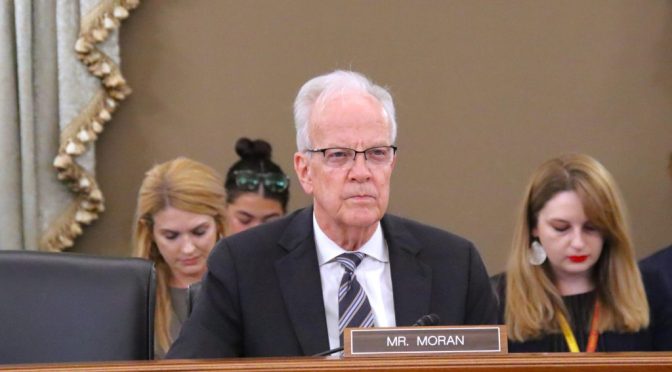
On Friday, Sen. Jerry Moran joined Greg Akagi on WIBW Ag Radio and Chip Flory on AgriTalk to discuss the latest developments on the Farm Bill with the markup scheduled for this Thursday in the Senate Agriculture Committee and the importance of advancing priorities critical to Kansas agriculture. When he meets with Kansas farmers and ranchers, he hears firsthand about the challenges they are facing, including high input costs, ongoing drought conditions and uncertainty in the agriculture economy. Passing this legislation will provide certainty for rural America and Kansas farmers and ranchers.
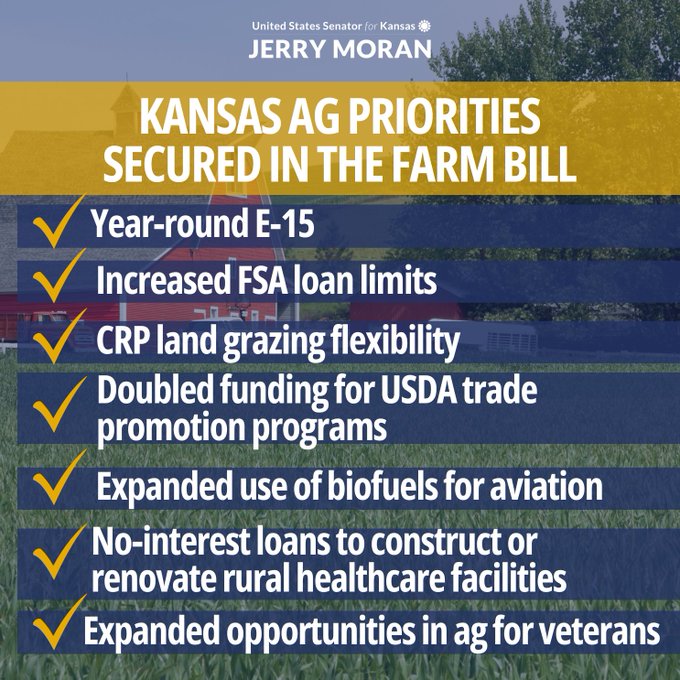
As a member of the Senate Agriculture Committee, Sen. Moran has worked to make certain the Farm Bill includes priorities that strengthen Kansas agriculture, and he is working to include his legislation to permanently transfer the administration of the Food for Peace program from the Department of State to the U.S. Department of Agriculture. This legislation also includes a number of provisions that will benefit producers and rural communities in Kansas, such as:
Year-round E15 sales, which expands markets for Kansas farmers and ethanol producers, supports American energy independence and provides consumers with more affordable options at the pump
The CRP Improvement and Flexibility Act, increasing flexibility for livestock grazing on conservation lands
The Rural Hospital Revitalization Act, which would provide no interest loans for constructing or renovating rural healthcare facilities
The Farm to Fly Act, allowing sustainable aviation fuel to qualify for USDA energy programs
The Colonel Gary LaGrange AgVets Act, which would expand career opportunities in agriculture for veterans
Language to increase FSA loan limits to better reflect lending conditions in farm country
Doubled funding for USDA trade promotion programs, better allowing producers to market their products globally
Introducing Legislation to Strengthen Rural Kansas Hospitals & Providers
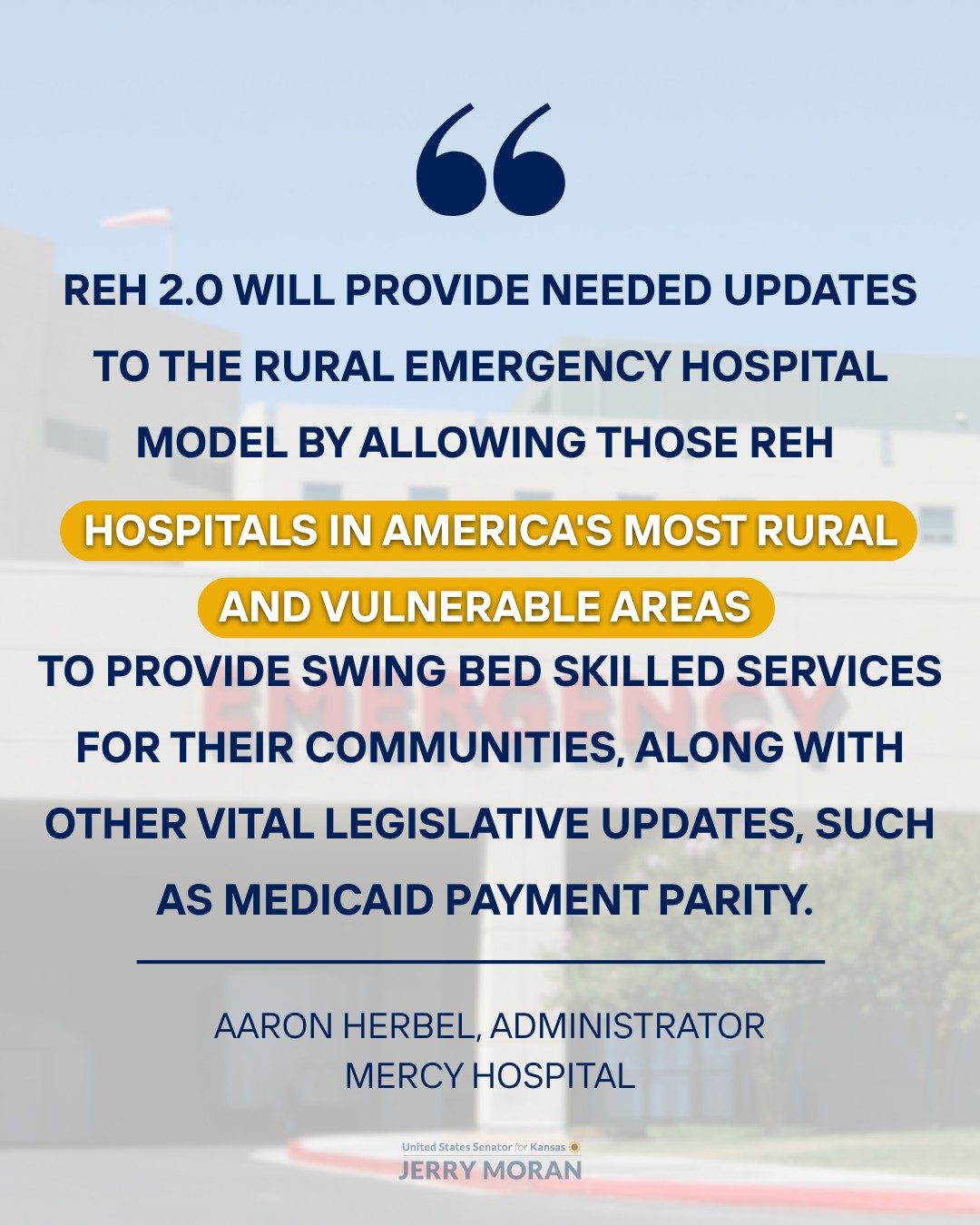
This week, Sen. Moran introduced bipartisan legislation with Sen. Tina Smith (D-Minn.) to expand access to federal resources for rural hospitals through the Rural Emergency Hospital (REH) Medicare designation. The legislation, the Rural Emergency Hospital Designation Improvement Act (REH 2.0), would allow more Critical Access Hospitals (CAH) and rural hospitals at risk of closure to sustain health care services in rural communities, and it would make technical improvements to strengthen the designation.
Sen. Moran worked to help establish the REH designation through the Consolidated Appropriations Act of 2021, providing eligible rural hospitals with a pathway to convert and continue serving their communities with limited services rather than closing their doors. He has visited every hospital in Kansas numerous times, and during these visits, providers shared their recommendations for strengthening the designation so it can better support the struggling health care facilities it was originally intended to serve.
The legislation introduced this week is the direct result of what Sen. Moran has heard from rural hospitals and providers in Kansas, and it makes needed improvements to the program to help make certain patients can continue to access critical health care services in their communities for years to come.
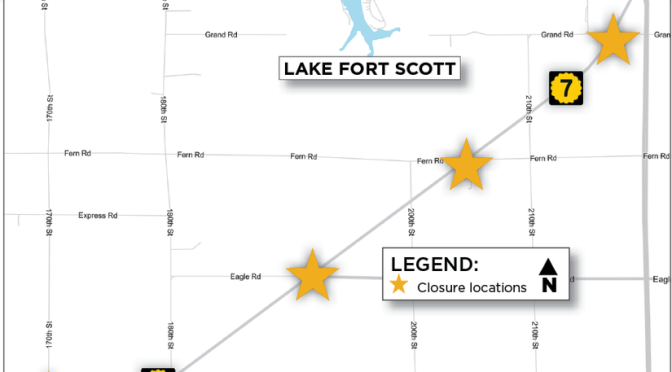
Work on current K-7 improvements between K-39 and U.S. 69 in Bourbon County will require some daytime closures of roads crossing the highway, according to the Kansas Department of Transportation.
K-7 remains closed to through traffic because of the project, but these closures will involve the streets and roads that cross K-7. These daytime closures allow the contractor to work on the road base and start pouring asphalt. Please find an alternate route during daytime hours.
Some closures – 160th Street, 180th Street, 200th Street and 210th Street – have already started and will wrap up after daytime work hours today, Tuesday, Aug. 4.
On Wednesday through Friday, Aug. 5 to 7, 170th Street, Eagle Road, Fern Road and Grand Road will be closed during daytime hours for the same work.
These intersections will reopen to traffic overnight and during times that work is not occurring. No two adjacent side roads will be closed simultaneously.
APAC-Kansas Inc., Shears Division, of Hutchinson, is the primary contractor.
KDOT urges motorists to stay alert, follow posted signs and refrain from hand-held mobile device use in all active work zones. For current road conditions, visit kandrive.gov or call 511. For updates on construction projects in southeast Kansas, visit ksdot.gov/projects/southeast-kansas-projects.