It is the recommendation of the Bourbon County Health Officer, that if you were served at Common Ground Coffee Company (12 E. Wall, Fort Scott, KS) on the dates of June 16th (between 3:00-9:30pm) and June 17th (between 6:30am-2:30pm), to please quarantineyourself in your home and monitor for symptoms of COVID-19, through July 1st.
Symptoms are:
Fever or chills
Cough
Shortness of breath or difficulty breathing
Fatigue
Muscle or body aches
Headache
New loss of taste or smell
Sore throat
Congestion or runny nose
Nausea or vomiting
Diarrhea
Symptoms may appear 2-14 days after exposureto the virus. This list does not include all possible symptoms.
For more information you may call the SEK Multi-County Health Department: Bourbon: (620)223-4464 Monday-Thursday 7:00am-5:30pm OR the COVID-19 Hotline: (866)534-3463.You may also visit the COVID-19 Resource Center at: https://www.coronavirus.kdheks.gov/OR Southeast Kansas Multi-County Health Departments on Facebook or our website: www.sekmchd.com for local updates.
A Bourbon County, KS positive COVID-19 test was confirmed this afternoon. The testing was confirmed through a reference laboratory that was used. This case is a contact of a positive case that was confirmed yesterday. The Bourbon County Public Health Department is diligently working to complete the investigation at this time.
The Bourbon County Public Health Department urges the public to continue to take appropriate actions. Individuals should continue to practice social distancing, clean/disinfect any high touched surfaces, wash their hands with soap and water routinely, use hand sanitizer if soap and water is not available and avoid touching your face (especially eyes, nose & mouth).
Please remember if you have the symptoms to:
Call before going to a Clinic, Hospital, ER, or Health Department
Close contact means: 6 foot or less for 10 minutes or more, with a positive case.
STAY HOME IF SICK!
If you are experiencing life threatening symptoms, PLEASE CALL 911.
For more information you may call the SEK Multi-County Health Department: Bourbon: (620)223-4464 Monday-Thursday 7:00am-5:30pm OR the COVID-19 Hotline: (866)534-3463.You may also visit the COVID-19 Resource Center at: https://www.coronavirus.kdheks.gov/OR Southeast Kansas Multi-County Health Departments on Facebook or our website: www.sekmchd.com for local updates.
COVID-19 Case at Osawatomie State Hospital; Kansas Neurological Institute Reports 12 Cases
TOPEKA – Kansas Department for Aging and Disability Services (KDADS) Secretary Laura Howard announced today that one staff member at Osawatomie State Hospital (OSH) has tested positive for COVID-19. This is the first positive case at OSH in either residents or staff. Howard also announced the Kansas Neurological Institute (KNI) has 12 new positives cases in five staff members and seven residents.
To protect the identity of staff and residents at each hospital, no further information will be released.
Friday, June 19, an employee at OSH reported a positive test result to the hospital’s infection control nurse. In coordination with the Miami County Health Department, all 11 residents on the unit who were in close contact with the positive employee will be tested as a priority. A testing strategy that reaches beyond those working or living on the unit is currently being discussed and several steps have been taken to further maximize safety precautions already in place to minimize risk of further exposure:
Any employee with direct, close contact with the positive employee has been contacted and begun a 14-day quarantine as instructed by the Miami County Health Department.
Any patients directly exposed to the positive employee are strongly encouraged to isolate in their room and wear a facemask anytime they leave their room. Patients on the unit where the employee worked will remain on the unit and are being closely monitored for any change in status. COVID-19 testing will be implemented at the appropriate time according to time of exposure.
At this time, there will be no admissions to the affected unit. All staff working on the affected unit are required to wear full personal protective equipment (PPE) at all times, to include nurses, other professionals, security and housekeeping.
Separate entrances and exits have been established on the affected unit to minimize exposure to staff and patients on other units.
The frequently touched surfaces in the affected unit are now being disinfected three times per shift.
“This is an extremely stressful time for patients, their loved ones and our staff members,” OSH Superintendent Kristin Feeback said. “We recognize that communication with patients, families and staff is critically important, especially after a confirmed COVID-19 case. I appreciate our staff being so responsive and adaptive to the instructions given by local health officials to make sure we do all we can to prevent the spread of the virus as effectively as possible.”
Thursday, June 18, KNI reported one staff member and one resident in the same home on campus tested positive for COVID-19 and at least one more staff member was symptomatic. Officials at KNI worked in collaboration with the Kansas Department for Health and Environment (KDHE) and the Shawnee County Health Department to administer more than 80 tests to all staff working in the affected home as well as all residents in the building where that home is located. At the time of this release, those tests have resulted in positive cases in five staff members and seven residents in three living units covering two campus buildings. Three of the 12 positive cases at KNI are symptomatic, but zero currently require hospitalization.
KDHE and KNI and local health department officials are expanding testing on campus in the coming days to include all staff in potentially affected areas with a goal of an additional 200 staff tested by end of day today. Residents in all three affected living units have already been tested. KNI continues to follow similar PPE practices to those implemented at OSH.
“We are thankful to the health officials at the state and local level for their quick and effective communication and response,” KNI Superintendent Brent Widick said. “Our residents are like family and we work very hard to keep them safe, so this kind of news takes a real emotional toll on our staff.”
KNI reported its first two cases of staff members on April 17 this year. Both of those cases have been cleared.
For current information on COVID-19 in Kansas, and to sign up for updates, go to the KDHE COVID-19 Resource Center at kdhe.ks.gov/coronavirus.
Jody Hoener, Bourbon County Economic Development Director. Submitted photo.
Bourbon County Economic Director Jody Hoener is working on securing leases in the former Mercy Hospital building on Fort Scott’s south end, in hopes of providing the county with a medical mall.
A medical mall is a facility offering comprehensive ambulatory medical services such as primary and secondary care, diagnostic procedures, outpatient surgery, and rehabilitation, except the overnight beds, according to merriam-webster.com.
“Bourbon County demographics show proportionately more elderly, more children living in poverty, lower incomes, and more chronic health conditions,” Hoener said. ” In addition, our community recently felt the impact of fewer health services (with the closing of Mercy Hospital in 2018). Rural health systems can overcome these challenges by creating linkages and efficiencies.”
“Access to robust and diverse health services is much more than a quality of life issue,” she said. “A vigorous and thriving health care system is essential not only for public health and welfare, but to enhance economic opportunity as well.”
Health organizations that currently have a part in Bourbon County health care have shown interest.
“We are currently working on leases with Community Health Centers of Southeast Kansas and Ascension Via Christi,” she said. “These leases will be ten-year long-term contracts,” she said. “Fort Scott Community College Nursing program will also be leasing space through an inter-local agreement.”
Other entities have “paused” conversations.
“Although we have been in talks with additional healthcare providers to occupy space, the COVID-19 pandemic has paused much of these conversations.,” Hoener said. “Recruitment activities will be a high priority with a goal of one additional anchor tenant in the next 3-5 years.”
The combined operation of many entities under one roof provides financial benefits to each involved, Hoener believes.
“The healthcare mall addresses many challenges local providers face in an innovative approach, creating synergy within the four walls, that will help each organization’s bottom line,” she said. ” In general, there are fewer healthcare providers in rural areas, and they operate on very thin profit margins. When compared to urban communities, our local health providers face unique challenges.”
Bourbon County’s vision for the community:
“Our vision is a healthy, safe, and thriving Bourbon County.,” she said. “A strong health care system is a critical piece of any community’s vitality and sustainability.”
The healthcare industry impacts the local economy.
“The healthcare industry is rapidly changing and has the potential to greatly impact access to these services in the future, ” Hoener said.
“Through the healthcare mall, we are becoming proactive in maintaining high-quality local health care services. In addition to health outcomes, healthcare services have shown to have an impact on:
Attracting and maintaining business and industry growth
Attracting and retaining retirees
Creating higher-paying jobs in a growing sector
Contributing to public finances, supporting essential public services”
” Americans are spending more dollars on healthcare,” Hoener said. “In 1970 healthcare costs accounted for 7.0 percent of the GDP. In 2017, Americans spent $3.5 trillion on healthcare, or 18.0 percent of the GDP. The projected GDP is 19.4 percent by 2027 (Kansas Health Association, 2019). Capturing a share of this economic growth will only help our community.”
“When residents spend health care dollars elsewhere, rather than purchasing the service locally, it can have a negative economic impact and result in loss of dollars within our local community,” she said. “Out of town trips to obtain healthcare services naturally offer opportunities to spend dollars outside of town that may have been spent locally.”
“Nationwide, employment in healthcare services increased 92 percent from 1990 to 2015. For Bourbon County, in 2017, health services ranked number 3 in terms of employment,” she said. ” Also, in 2017, the health care sector’s impact on retail sales was $19,308,000, county sales tax impact of $270,000, and a total impact of $65,378,000. (Kansas Health Association, 2017).”
“Industry and business leaders look for good health and education services when making location decisions,” Hoener said. “They also want to ensure the local labor force will meet their needs.”
” Attracting and maintaining retirees is also important as this is a special group of residents whose spending can provide a significant source of income for the local economy.”
The west end of the former Mercy Hospital is vacant. The county government is working to create a medical mall in the vacant section.
BCBS Health Insurance Plan through the Chamber if you have at least one part-time employee in addition to yourself.
The Chamber is looking to offer a HEALTH INSURANCE PLAN
to our members!
Businesses/organizations of all sizes
will be eligible from sole proprietors
to large companies.
You must have at least yourself and one other employee,
who is not a spouse, and can be a dependent child,
to be eligible for this plan. Part-time employees working less than 30 hours or more per week are not eligible for the plan, however the owner would still be eligible.
Take this Survey!
As a first step in this process, we would like to gather insight on the level of interest from our members. Please take the survey linked below.
The Fort Scott Area Chamber of Commerce is excited to offer another benefit to our members. We are here to help extend your value by attracting and maintaining employees by offering cost-effective, high-quality health solutions to your team.
If completed surveys indicate enough interest for this initiative to move forward, your company will be able to offer a health insurance plan to your employees and their families. With the ever-changing health landscape, buying coverage for themselves and their families has become a challenge, primarily due to changing health care legislation and affordability issues. By offering a group health insurance plan, purchasing through a pool can help overcome some of these challenges, while also providing more benefit rich plans.
Owner/operators are eligible to join an Association Health Plan provided that they have an employee in addition to themselves. This employee does not have to participate or even be eligible to participate in the group health plan, meaning they could be a part-time employee.
Census Info. Needed for Survey
When you complete the survey link above, you will need to enter the basic census information shown below.
You only need to enter the census info. on yourself & any other interested full-time employees you may have so BCBS can put together a proposal with rates and a benefit package for us.
If you only have a part-time employee in addition to yourself, you will still be eligible for the insurance, you just will not need to provide their census information on the survey.
IF you are already on a BCBS plan, but interested in this Association Health Plan as a comparison, we encourage you to go ahead and take the survey. In this case you will not need to provide employee census info., you will just provide your current BCBS group number and they can access the information needed.
The requested census fields are below. If the employee would like a rate for their spouse and/or dependents, you will need the same information on them. I have drafted a form you may use to collect this information from your employees in case this makes it easier for you. This form is just a resource for you, you may collect the information however you would like.
First Name
Last Name
Date of Birth
Gender
Zip Code
Does the member have Medicare primary?
We would like all responses back by no later than June 11th. Responses will still be accepted after that date,
but we have set that as a stop date to gauge the interest of
members in this opportunity.
If you have any questions or need more information, contact:
Lindsay Madison, Fort Scott Area Chamber of Commerce
Krista Postai, president and Cheif Executive Officer of Community Health Center of Southeast Kansas. Submitted photo.
The worldwide COVID 19 Pandemic has affected society in the last three months for all segments, especially health care.
“COVID certainly dominated our activities and thinking, for two solid months,and we’re just now getting back to thinking ahead,” CHS/SEK President and CEO Krista Postai said.
“We did commit to remaining in the (former Mercy) hospital once the county assumes responsibility,” she said. “We are planning some minor remodeling including enlarging the pharmacy and moving all of our diagnostics (including mammography) into the clinic space freeing up the former diagnostic space for Ascension/Via Christi.”
“We are starting to see more people in the clinic now as the state is ‘opening up’,” Postai said. “At one point about one-third of our visits were through televideo or on the telephone but we definitely find that folks in Ft. Scott prefer face-to-face visits. We’re not quite back to normal activity level but getting there.”
“In addition to testing for COVID, we are now offering the antibody testing with a doctor’s order,” Postai said. “This is used to see if you had the virus and have since developed antibodies that could help protect you for getting it again. Although the science is still out on that, as some people seem to be susceptible to having it a second time. So far everyone we have tested thus far have been negative.”
“We have added staff including mental health,” she said.
CHC/SEK welcomed Tien Nguyen, a board-certified psychiatric mental health nurse practitioner to it’s Behavioral Health Services team, according to a press release.
Psychiatric NPs assess and diagnose patients, provide psychotherapy and prescribe medication.
Tien Nguyen. Submitted photo.
In addition, six nurse practitioners were added to the team.
“CHC/SEK welcomed its first class of nurse practitioner residents, thanks to a partnership between the Irene Ransom Bradley School of Nursing at Pittsburg State University and the health center. The new residency program is the first such program in Southeast Kansas,” according to the CHC/SEK Facebook page.
“With guidance from their professional preceptors, six nurse practitioners — Lorraine Lorentz, Kelly McGuire, Kelly Mishmash, Brice Saunders, Maranda Scott, and Mayra Watson — will care for patients in Coffeyville, Fort Scott, Pittsburg, and Miami, Oklahoma clinics.”
Community Health Center of Southeast Kansas is pleased to welcome Tien Nguyen, a board-certified psychiatric mental health nurse practitioner to our Behavioral Health Services team.
Psychiatric NPs assess and diagnose patients, provide psychotherapy and prescribe medication.
They assist patients with mental health issues, including anxiety, depression, bipolar disorder, substance abuse, or dementia; other patients may struggle with grief, anger, adjustment issues, or other conditions.
Tien is serving patients in Iola, Fort Scott, and Pleasanton clinics. For our patient’s convenience, he is offering a combination of in-person, telehealth, or e-visits.
He is a graduate of the University of Missouri-Kansas City.
Tien has previous nursing experience, including inpatient psychiatry, and works with substance use disorders.
If you or a loved one feel they may benefit from psychiatric consultation, appointments can be made by calling 620-231-9873, or by calling your home clinic.
Community Health Center of Southeast Kansas (CHC/SEK) is a non-profit Federally Qualified Health Center dedicated to providing affordable, high quality medical, dental, behavioral health, and pharmacy services to everyone, regardless of income or insurance status. For more information, visit www.chcsek.org
ABourbon County, KS positive COVID-19 test was confirmed this afternoon, making Bourbon County’s total number of positive cases 8. The testing was confirmed through a reference laboratory that was used. The resident is in isolation and their family is in quarantine. This case is most likely travel related. The investigation is complete and any potential contacts have been notified. There is low risk of exposure for Bourbon County residents from this case.
The Bourbon County Public Health Department urges the public to continue to take appropriate actions. Individuals should continue to practice social distancing, clean/disinfect any high touched surfaces, wash their hands with soap and water routinely, use hand sanitizer if soap and water is not available and avoid touching your face (especially eyes, nose & mouth).
Please remember if you have the symptoms to:
Call before going to a Clinic, Hospital, ER, or Health Department
Close contact means: 6 foot or less for 10 minutes or more, with a positive case.
If you are experiencing life threatening symptoms, PLEASE CALL 911.
For more information you may call the SEK Multi-County Health Department: Bourbon: (620)223-4464 Monday-Thursday 7:00am-5:30pm OR the COVID-19 Hotline: (866)534-3463.You may also visit the
COVID-19 Resource Center at: https://www.coronavirus.kdheks.gov/OR Southeast Kansas Multi-County Health Departments on Facebook for local updates.
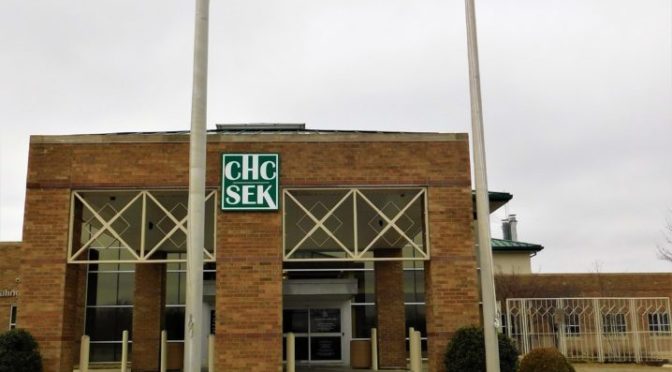
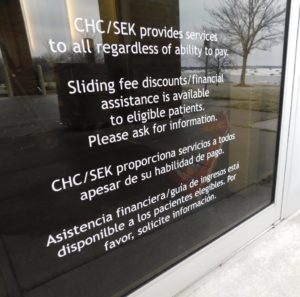
Sliding fee discounts and financial assistance is available to eligible patients, as stated on the front door of the CHC/SEK Clinic in Fort Scott.
Community Health Center of Southeast Kansas now offers COVID-19 antibody testing through QUEST Laboratories, according to Robert Poole, Communication and Marketing Director, in a press release.
Antibody testing is useful for research and specific virus investigations or epidemiologic studies. CHC/SEK shares testing results with its state and federal partners, according to the press release.
Put simply, the body makes antibodies to fend off germs and other harmful substances. And this process is part of the body’s immune response, according to dictionary.com.
The antibody test requires a physician’s order and looks for antibodies in persons who may have had, and have recovered from COVID-19, according to the press release.
Individuals wanting this antibody testing should discuss their concerns and what their results might mean with their doctor.
Laboratory orders can be accepted from physicians outside of the organization for this test, for example, a college student might have a primary care physician in another city.
COVID-19 antibody tests require a blood draw.
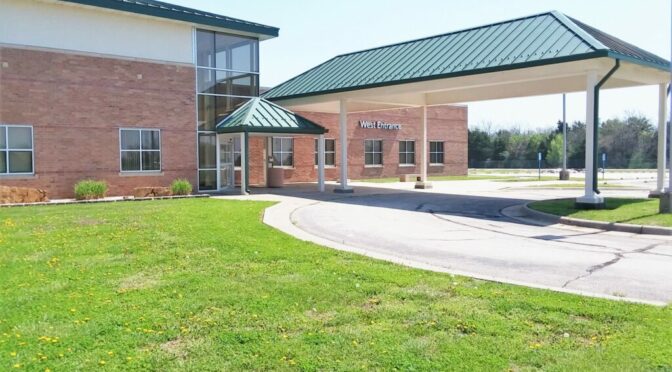
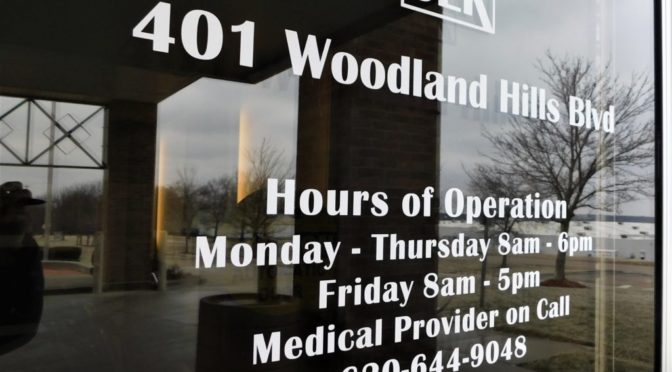
Testing is available at either the CHC/SEK Walk in-In Care, 1624 S. National, or the medical clinic at 401 Woodland Hills Blvd.
A positive result does not guarantee immunity from the virus. Whether you test positive or negative, you should still take preventative measures to protect yourself and others from the virus.
The cost of the COVID-19 antibody testing is being covered by the federal government, however, patients may incur an office visit fee depending on their insurance and income status.
Other points from the press release:
The science of COVID-19 testing is evolving, and test accuracy is not perfect. However, testing for antibodies can help identify people who have likely been exposed to the COVID-19 and have mounted an immune response to the virus.
The timing of the test is important. It typically takes 1 to 3 weeks after someone becomes infected with COVID-19 for their body to make antibodies; some people may take longer to develop antibodies.
It is unknown if people with antibodies have immunity and are protected from becoming sick with COVID-19 again. It is also not known how long those antibodies will last.
Antibody tests are not used to diagnose someone as being currently sick with COVID-19. To see if you have a current infection, you need a viral test that checks respiratory samples, such as a swab from inside your nose.
Whether you test positive or negative for COVID-19, you should still take preventative measures to protect yourself and others from the virus.