Kansas’ Total Tax Receipts Up $604.6 Million Over Last May
TOPEKA – The month of May marked one year since Governor Laura Kelly signed Executive Order 20-31 to safely reopen businesses across the state. Since that time, the Kansas economy has rebounding significantly – with May 2021 tax collections totaling $604.6 million, or 134.7% more than May 2020. For the month of May, the state collected $1.1 billion in total taxes; an increase of $509.4 million, or 93.7%, more than the estimate.
“Our May tax receipt numbers are good news and show that our efforts to strengthen Kansas’ economy are paying off,” said Governor Laura Kelly. “We will continue moving forward by prioritizing pro-growth policies that will support Kansas businesses and Kansas families.”
Individual income tax collections were $708.7 million. That is 154.9%, or $430.7 million, above the estimate and $492.8 million, or 228.2%, more than last May. Corporate income tax collections were $29.8 million. That is $33.2 million, or 976.8%, more than last May. Those collections are $24.8 million, or 495.6%, more than the estimate.
“Overall, the economy performed much better during the pandemic than any state had forecasted and the tax receipt trend in Kansas is comparable to that experienced in other states,” Revenue Secretary Mark Burghartsaid. “Taxpayers who had meaningful positions in the stock market did extremely well during the pandemic. A significant portion of the individual income tax receipts are due to capital gains transactions.”
Retail sales tax collections were up $53.9 million, or 31.0%, over last May with $227.8 million collected. Collections were $32.8 million, or 16.8%, more than the estimate. Compensating use tax collections were $54.4 million which was $14.4 million, or 36.0%, more than estimated. That is a $16.7 million, or 44.5%, gain compared to the same month of the previous fiscal year.Ka
TOPEKA – Governor Laura Kelly today announced that Kansans will have the opportunity to enter a free raffle drawing for various prizes from the Kansas Speedway next weekend – including the chance to drive two laps around the track – at a Race to End COVID-19 event.
Participants can enter the Race to End COVID-19 by getting a free COVID-19 saliva test and/or vaccine administered by the University of Kansas Health System and the Kansas Department of Health and Environment.
“It is critical to our state’s continued pandemic recovery efforts that every Kansan gets vaccinated,” Governor Kelly said. “The Race to End COVID-19 is a great incentive to curb declines in vaccine demand and encourage Kansans to get tested for and vaccinated against COVID-19. I appreciate the Kansas Speedway for their partnership in making this event possible, and I encourage all unvaccinated Kansans to attend.”
The Race to End COVID-19 will be held at Kansas Speedway, 400 Speedway Blvd., Kansas City, Kansas (enter via France Family Drive, near the Sporting KC stadium across from Nebraska Furniture Mart):
Friday, June 4 from 5 to 8 p.m.
Saturday, June 5 from 11 a.m. to 4 p.m.
The Kansas Speedway is hosting the event in partnership with Wyandotte County Unified Government, University of Kansas Health System, Kansas Department of Health and Environment, and Kansas Division of Emergency Management.
All vaccine recipients will be asked to review educational material about COVID-19 vaccines and sign a consent form. After receiving the vaccine, participants will wait 15 minutes for observation for any rare allergic reactions. Those receiving the Pfizer vaccine will need to make separate arrangements for their second dose.
RAFFLE DRAWING:
Individuals that are tested and/or vaccinated will be entered into a free raffle drawing. Prizes include a set of two tickets to the Oct. 24, 2021 NASCAR Cup Series Race; a set of four tickets to the Oct. 24, 2021 NASCAR Cup Series Race; and gift cards for the NASCAR Racing Experience Ride Along.
VICTORY LAP DETAILS:
Track lap participants must have a valid driver’s license, car registration in their name, and proof of vehicle insurance. Track lap participants 16 to 17 years old with a valid driver’s license must have a parent or legal guardian in the vehicle to sign a minor release form. All track lap participants are required to remain in their personal vehicle at all times. Drivers and their riders will take two laps behind a track pace vehicle at highway speed. No motorcycles, tractor-trailers, recreational vehicles, etc., may be used for track rides.
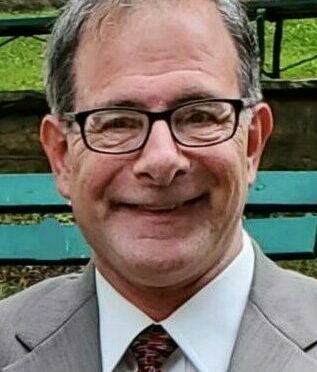
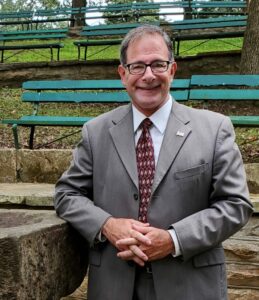
W. Jackson Tough, 52, is the new Fort Scott Tourism Manager.
“I have some commitments related to my position as the El Dorado Springs, Missouri Chamber of Commerce CEO/Executive Director so I will be full-time as of Monday, June 21,” Tough said. “However, I do plan to attend some functions and meetings to immerse myself into the new position before the start date.”
“I’ve spent quite a bit of time around Fort Scott the past two and a half years since my wife, Michele Love Tough is a life-long resident,” he said. “We reside just south of town, adjacent to the family farm near her parents, Bob and Joyce Love.”
“I’ve spent many years in marketing and promotion, from broadcast media in Springfield to promoting businesses and communities in a rural area.,” Tough said.” I’m a native of El Dorado Springs, Missouri which is just about thirty-six miles east of Fort Scott.”
Tough has been the CEO / Executive Director at El Dorado Springs, MO Chamber of Commerce – from September 2012 to June 2021.
“As the El Dorado Springs Chamber of Commerce Executive Director, I was deeply involved in our community on many levels,” he said.” I participated on many boards and committees; Discover More on Route 54 which promotes the US Highway 54 corridor from Jefferson City to Nevada, the Opera House Theater board which is about maintaining the historic theater and promotion of the arts (especially for our youth), the El Dorado Springs R-2 Schools Capital Improvements Committee, the Spring City Revitalization Group as well as all of the committees through the chamber organization.
“I really look forward to taking an active role in Fort Scott as well!”
“I developed professional networks, created marketing plans for our organization and community, and united business and community leaders,” Tough said. “Along with our members and staff, I developed and coordinated community events including National Day of Prayer, Clean-Up El Do Campaign, Annual Excellence in El Dorado Springs Awards Gala and coordinated monthly chamber luncheons for 50-60 attendees.”
“I also developed and implemented tourism activities, attractions, and events including Patriot Parkway – forty-eight US flags (on 48 utility poles) along a one mile stretch of US Highway 54 in El Dorado Springs, Spring City-Wide Sale, Labor Day Weekend 100 Mile Sale from Camdenton to Nevada, Spring City Spooktacular is a Halloween event that draws hundreds to the community, Christmas Parade, Lighting Celebration, and our annual Holiday Expo among others.”
“I Initiated and coordinated community betterment projects, published a weekly e-newsletter, and I’m the primary administrator for our social media and press releases,” he said.
Before that, he was the marketing and events director for Spring City Revitalization Group (El Dorado Springs, MO) from October 2006 to August 2012.
In this job he developed and coordinated marketing and events for downtown revitalization including grants, an annual chili cook-off, summer concert series, and more, he said.
From 1999 to 2005 Tough was the station and sales manager for Clear Channel Communications (Springfield, MO).
In this position, he designed marketing strategies and promotional events with staff on behalf of clients to increase their business revenue and market share, as well as managed daily sales operations for US97 and ESPN 1400. He was also an on-air personality and voiceover production.
Tough attended El Dorado Springs, MO R-2 Schools, and Missouri State University.
Tough has a new bride, Michele Love Tough, two daughters in college, both studying in the medical field, two “bonus” daughters, one in El Dorado Springs and one in Frederick, Maryland and three grandsons.
“I see a lot of opportunities here and I believe Fort Scott has so much to offer visitors! ” Tough said. “I know quite a bit about the community but I also believe I bring “fresh eyes” to the community and to our tourism.”
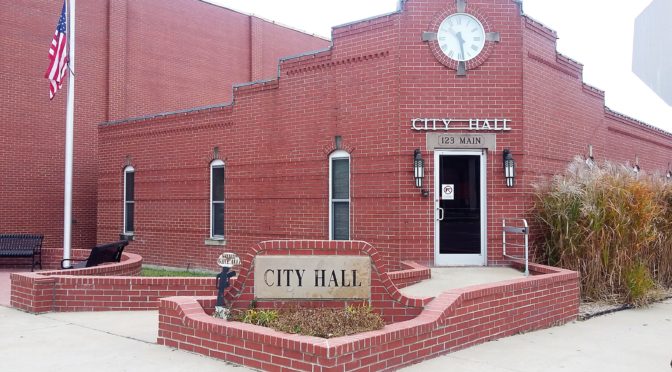
The Airport Advisory Board that was scheduled for Wednesday, June 2nd, 2021 at 12:00 p.m. at the City Commission meeting room at City Hall, 123 S. Main Street, Fort Scott, Kansas has been cancelled. It will be rescheduled for June 23rd, 2021.
WASHINGTON, June 1, 2021 – Today, Agriculture Secretary Tom Vilsack kicked off National Homeownership Month, as part of a nationwide celebration to highlight U.S. Department of Agriculture (USDA) efforts to provide access to affordable housing for rural Americans.
“Safe, energy-efficient, affordable housing is essential to the vitality of communities in rural America,” said Secretary Vilsack. “The American Rescue Plan is providing critical relief to rural homeowners and helping to keep more Americans in their homes. USDA is committed to using our resources to help support healthy, resilient and more equitable communities through homeownership.”
Since 1949, USDA has helped 4.7 million families and individuals buy homes in rural areas. USDA Rural Development supports rural homeownership through the following programs:
The Single Family Housing Direct Home Loan Program provides loans directly to families and individuals so they can buy or build homes in rural America. In its lifetime, this program has helped 2.2 million families and individuals purchase a home.
Through its Single Family Housing Guaranteed Loan Program, USDA has partnered with more than 4,000 private lending institutions, backing their loans to help nearly 2 million families and individuals buy homes in rural areas since the program was created in 1991.
The Home Repair Loan and Grant Program provides loans and grants to help families and individuals repair and modernize homes, making them safer, healthier places to live. Since it started in 1950, the programhas helped nearly 434,000 families improve the quality of their homes.
The Mutual Self-Help Housing Grant Program provides grants to qualified organizations to help them carry out local self-help housing construction projects. Through this program, USDA has worked with nearly 230 organizations to provide a unique opportunity for families and individuals to lower the overall purchase price of a new home by investing “sweat equity” into its construction.
Under the Biden-Harris Administration, Rural Development provides loans and grants to help expand economic opportunities, create jobs and improve the quality of life for millions of Americans in rural areas. This assistance supports infrastructure improvements; business development; housing; community facilities such as schools, public safety and health care; and high-speed internet access in rural, Tribal and high-poverty areas. For more information, visit www.rd.usda.gov. If you’d like to subscribe to USDA Rural Development updates, visit our GovDelivery subscriber page.
USDA touches the lives of all Americans each day in so many positive ways. In the Biden-Harris Administration, USDA is transforming America’s food system with a greater focus on more resilient local and regional food production, fairer markets for all producers, ensuring access to safe, healthy and nutritious food in all communities, building new markets and streams of income for farmers and producers using climate smart food and forestry practices, making historic investments in infrastructure and clean energy capabilities in rural America, and committing to equity across the Department by removing systemic barriers and building a workforce more representative of America. To learn more, visit www.usda.gov.
###
USDA is an equal opportunity provider, employer, and lender.
The Airport Advisory Board will meet on Wednesday, June 2nd, 2021 at 12:00 p.m. at the City Commission meeting room at City Hall, 123 S. Main Street, Fort Scott, Kansas. This meeting is open to the public.
This meeting will be made available via the City’s youtube channel at City of Fort Scott.
TOPEKA — The Kansas Department for Aging and Disability Services (KDADS) announces a grant funding opportunity for communities through a request for application (RFA) process for the Kansas Prevention Collaborative-Community Initiative (KPCCI) to reduce and prevent substance abuse in identified communities and enrich prevention efforts across the state through the implementation and sustainability of effective, culturally competent prevention strategies.
Grantees will use these funds to create a comprehensive, community-based strategic plan to address the problems of underage drinking, youth marijuana use, or ATOD (Alcohol, Tobacco and Other Drugs), shared risk and protective factors, and produce sustainable systems change in their communities. Communities will utilize the Strategic Prevention Framework (SPF) model designed by the Substance Abuse and Mental Health Services Administration (SAMHSA) to assess their local needs, build capacity and create an implementation plan.
“Community-driven grants are an important piece of our statewide prevention system,” said KDADS Secretary Laura Howard. “KDADS’ Behavioral Health Services Commission works directly with community partners who apply for and receive these funds to provide essential training and support. We encourage communities to apply for this grant opportunity and become part of the statewide team working to prevent substance use in Kansas.”
The KPCCI grant is funded by SAMHSA “to prevent and reduce substance abuse in identified communities and enrich prevention efforts across the state through the implementation and sustainability of effective, culturally competent prevention strategies. Through the advancement of technological supports, learning processes, technical assistance, direct consultation and other resources, grantees will be supported through each of the five steps of the Strategic Prevention Framework (SPF).”
The RFA is directed at newly established coalitions in existence for the past six months ready to incorporate the SPF’s sustainable guidance and evidence-based strategies:
The planning phase: determining what works to address prevention needs and how to do it well based on data;
The implementation phase: delivering evidence-based intervention as intended, supported by KDADS and its partners in the Kansas Prevention Collaborative (KPC).
Communities ready to start the process or who have already started the planning stage and are ready to progress to the implementation phase are eligible to apply for funding. KDADS strongly encourages those eligible to apply.
“The KDADS prevention team continues to support positive community outcomes with this grant. For many years the communities involved in this meaningful work have played a pivotal role in the state’s prevention efforts,” said KDADS Children’s Services Director Gary Henault. “Our grantees and community partners committed to serving others continue to have a positive impact on the communities they serve.”
About the Kansas Prevention Collaborative:
The Kansas Prevention Collaborative was created in 2015 to integrate and innovate behavioral health prevention efforts. A partnership of several different state, educational and provider agencies, the KPC’s goal is to expand prevention efforts to be more inclusive of mental health promotion, suicide prevention and problem gambling education and awareness, as well as to increase the availability of resources to adequately fund local-level prevention and promotion strategic plans. For more information, see https://www.kdads.ks.gov/commissions/behavioral-health/kpc.
KSA 75-4319(b)(1) To discuss personnel matters of individual nonelected personnel to protect their privacy
KSA 75-4319(b)(2) For consultation with an attorney for the public body or agency which would be deemed privileged in the attorney-client relationship
KSA 75-4319(b)(3) To discuss matters relating to employer-employee negotiations whether or not in consultation with the representative(s) of the body or agency
KSA 75-4319(b)(4) To discuss data relating to financial affairs or trade secrets of corporations, partnerships, trust, and individual proprietorships
KSA 75-4319(b)(6) For the preliminary discussion of the acquisition of real property
KSA 75-4319(b)(12) To discuss matters relating to security measures, if the discussion of such matters at an open me
Governor Laura Kelly Announces $42 Million Investment to Support 30 Transportation Projects Statewide
TOPEKA – Governor Laura Kelly and Transportation Secretary Julie Lorenz today announced that more than $42 million will support 30 transportation construction projects across Kansas through an expanded list of recipients of the Kansas Department of Transportation’s Cost Share Program for Spring 2021.
Cost Share is a component of the Kelly administration’s 10-year, bipartisan Eisenhower Legacy Transportation Program, or IKE. Cost Share is designed to help both rural and urban areas advance transportation projects to improve safety, support job retention and growth, relieve congestion and improve access and mobility.
“Infrastructure projects like the ones funded through Cost Share are a perfect example of how government can make smart investments that not only make our economy more dynamic and competitive, but also make Kansas a better place to live, work, and play,” Governor Kelly said. “Through this $42 million investment, 30 communities from every corner of our state will have safer roads, increased access to outdoor recreation, and the opportunity to modernize important historical landmarks.”
KDOT took advantage of 2020 federal coronavirus relief funds by doubling the available Cost Share funding for this round. Selection criteria was adjusted to take into account hardships caused by the pandemic and points were added to communities that endured above-average economic loss.
KDOT is investing $21 million in this cycle of Cost Share with recipients contributing a 50/50 match of $21 million.
Secretary Lorenz said demand for Cost Share transportation dollars remains strong, especially after the “long, tough year we’ve been through.” She said 117 communities requested more than $103 million in funding for this, the fourth round of the Cost Share program.
“Despite that tough year, I couldn’t be more impressed with the record level of local contribution – proving we are stronger when we work together,” Secretary Lorenz said. “Thanks to the KDOT team and our local partners, we are moving quickly to expedite the delivery of projects.”
Today’s announcement was made via video (VIEW HERE) highlighting the wide range of investments made possible under the IKE program.
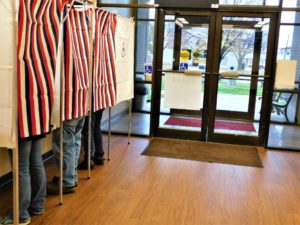
Voters at Bourbon County Clerk’s Office in a prior election…
Next Tuesday, June 1, is the last day for candidates to file for the upcoming Bourbon County elections. The deadline is noon.
“We have the paperwork for anyone wanting to file,” Kendell Mason, Bourbon County Clerk said.
As of May 25, the following have filed to run:
For the Fort Scott City Commission – Matthew Wells and Michael Hoyt.
For the Bronson City Council – Clearsia Botts.
For Uniontown Mayor – Bill Marlow.
For Redfield Mayor – Wilma K. Graham.
For Redfield City Council – Kirby Martin and Michael Beerbower.
For Mapleton Mayor – Ronald B. Burton Jr.
For Mapleton City Council – Mike Blevins and Homer Wisdom.
For USD 234 Position #4 – David Stewart
For USD 235 Position #6 – Tyler J. Martin
For FSCC Board of Trustees- John Bartelsmeyer and Bill Meyer.
The following is information for the 2021 Bourbon County Election and the positions up for election supplied by the county clerk.
All the filing deadlines, for each entity, is noon June 1st, 2021.
The filing location is the Bourbon County Clerk office, 210 S. National, Fort Scott.
The General Election will be on November 2, 2021.
In the city of Fort Scott, there are three city commission members, two of which are for four-year terms and one for two years. The filing fee is $20 or petition signed by not less than 25 qualified electors of Fort Scott and state filing fee of $50.
If more than 9 qualified candidates file there will be a Primary on August 3, 2021.
Up for election in Bronson is the mayor position and two council members, all four-year terms. There is a filing fee of $20 or a petition signed by no less than 10 qualified electors of Bronson for Bronson.
If more than 3 qualified candidates file for Mayor or more than 6 qualified candidates file for Council, then there will be a Primary on August 3, 2021.
Those positions up for election in Fulton are the mayor and five council members, all four-year terms.
The filing fee of $20 or a petition signed by no less than 5 qualified electors of Fulton.
If more than 3 qualified candidates file for mayor or more than 15 qualified candidates file for council then there will be a Primary on August 3, 2021.
For Uniontown and Redfield the positions of mayor and two council members are up for election, all four-year terms. There is a filing fee of $20 or a petition signed by no less than 20 (10%) of qualified electors of Uniontown for Uniontown.
A petition signed by no less than 10 qualified electors of Redfield for Redfield.
If more than 3 qualified candidates file for mayor or more than 6 qualified candidates file for council, then there will be a Primary on August 3, 2021.
For Mapleton, the mayor and two council members are up for election, all four-year terms.
There is a filing fee of $20 or a petition signed by no less than 2 qualified electors of Mapleton for Mapleton.
If more than 3 qualified candidates file for Mayor or more than 6 qualified candidates file for council, then there will be a Primary on
For the Southwind Extension District, there are 2 positions, both for four-year terms. There is a filing fee of $20.
For the Fort Scott School District, there are three positions, all for four-year terms.
The filing fee is $20 or a petition signed by no less than 50 qualified signatures of registered voters in the position for the USD #234 District.
If more than 3 qualified candidates file for any one position, then there will be a Primary on August 3, 2021.
For the Uniontown School District, there are three positions, all four-year terms.
There is a filing fee of $20 or a petition signed by no less than 50 qualified signatures of registered voters in the position for the USD #235 District.
If more than 3 qualified candidates file for any one position, then there will be a Primary on August 3, 2021.
For Fort Scott Community College there are three positions, all four-year terms. The filing fee is $20.
If more than 9 qualified candidates file there will be a Primary on August 3, 2021.
Any person wishing to file for any office must be a qualified elector of the corresponding city or school district.
If filing by petition, the petition must be turned in within 180 days after the first signature was collected, but no later than noon on June 1st, 2021.
Governor Laura Kelly Directs Flags be Flown at Half-staff for Memorial Day
TOPEKA – In accordance with Executive Order #20-30, Governor Laura Kelly has directed that flags be lowered to half-staff throughout the state effective from sunup until noon on Monday, May 31, 2021, in recognition of Memorial Day.
“On Memorial Day, let us all come together to honor and remember the women and men in the U.S. Armed Forces who lost their lives protecting our freedom and our way of life,” Governor Kelly said. “Today and every day, we owe them our gratitude.”