Click below:
https://www.coronavirus.kdheks.gov/DocumentCenter/View/1125/Historical—May-6?bidId=
SEK Multi-County Health Departments
Allen, Anderson, Bourbon, and Woodson Counties
Coronavirus (COVID-19) Update
May 6, 2020
Allen County
| Current Positive Cases | 0 |
| Current Recovered Cases | 0 |
| Total Positives Since Testing | 0 |
| Deaths | 0 |
Anderson County
| Current Positive Cases | 0 |
| Current Recovered Cases | 0 |
| Total Positives Since Testing | 0 |
| Deaths | 0 |
Bourbon County
| Current Positive Cases | 0 |
| Current Recovered Cases | 5 |
| Total Positives Since Testing | 6 |
| Deaths | 1 |
Woodson County
| Current Positive Cases | 1 |
| Current Recovered Cases | 5 |
| Total Positives Since Testing | 6 |
| Deaths | 0 |
Recovered cases are based on dates of onset of symptoms, not on day testing results are received.
Click below:
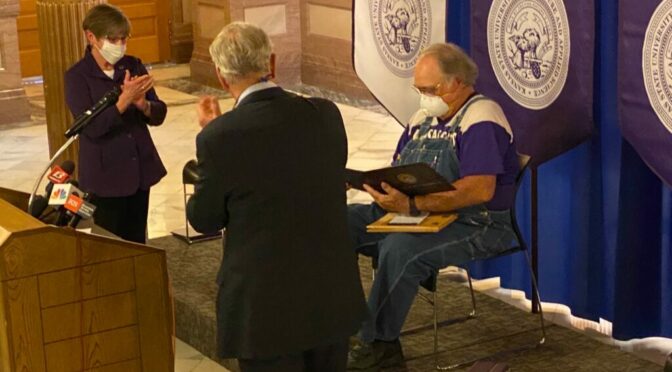
Governor Kelly, K-State President Myers confer degree upon Kansas farmer who sent N95 mask to New York
Ruhnke shows the best in humanity, encapsulates what it means to be Kansan
Editor’s note: Please take time to view the video from the presentation. I think you will find it inspiring.
A video of the presentation can be found here.
Governor Laura Kelly today joined Kansas State University President Richard Myers to confer a bachelor’s degree upon Dennis Ruhnke, of Troy, Kansas.
Ruhnke recently garnered national attention when he sent a letter to New York Governor Andrew Cuomo, in which he enclosed an N-95 mask to give to a nurse or doctor in New York.
Ruhnke wrote to Governor Cuomo: “I am a retired farmer hunkered down in Northeast Kansas with my wife who has but one lung and occasional problems with her remaining lung. She also has diabetes. We are in our 70s now and frankly, I am afraid for her.
“Enclosed find a solitary N-95 mask left over from my farming days. It has never been used. If you could, would you please give this mask to a nurse or doctor in your city. I have kept four masks for my immediate family. Please keep on doing what you do so well, which is to lead.”
“Dennis’ donation, at the height of our country’s protective gear shortage, showed us the best in humanity when we needed it the most,” Governor Kelly said. “I would like to thank Dennis for the example he’s set on how to serve – and how to be thoughtful and generous in an extraordinary way.”
In 1971, Ruhnke was studying agriculture at Kansas State University when his father passed away. At that time, he was two credits away from earning his degree, but chose to leave school to take care of his mother and the family farm.
“After speaking with President Myers, we both agreed that Dennis perfectly encapsulates K-State’s democratic mandate to be of service to people,” Governor Kelly said. “Which is why I am very honored that I was able to help present Dennis with his well-deserved bachelor’s degree in agriculture.”
“Along with his fantastic demonstration of kindness and generosity, Mr. Ruhnke’s academic work at K-State in his chosen field of agriculture qualifies him to receive his degree,” President Richard Myers said. “Kansas State University is proud to officially recognize Mr. Ruhnke as an alumus and valued member of the Wildcat family.”
. A video of the presentation can be found here.
WASHINGTON, April 21, 2020 – Producers signed a record 1.77 million contracts for the U.S. Department of Agriculture’s Agriculture Risk Coverage (ARC) and Price Loss Coverage (PLC) programs for the 2019 crop year, which is more than 107 percent of the total contracts signed compared with a 5-year average. USDA also reminds producers that June 30 is the deadline to enroll in ARC and PLC for the 2020 crop year.
“Producers for several years have experienced low commodity prices, a volatile trade environment and catastrophic natural disasters,” said Richard Fordyce, Administrator of USDA’s Farm Service Agency (FSA). “Farmers looking to mitigate these risks recognize that ARC and PLC provide the financial protections they need to weather substantial drops in crop prices or revenues.”
Producers interested in enrolling for 2020 should contact their FSA county office. Producers must enroll by June 30 and make their one-time update to PLC payment yields by September 30.
FSA attributes the significant participation in the 2019 crop year ARC and PLC programs to increased producer interest in the programs under the 2018 Farm Bill and to an increase in eligible farms because of the selling and buying of farms and new opportunities for beginning farmers and military veterans with farms having 10 or fewer base acres. Enrollment for 2019 ended March 16.
USDA Service Centers, including FSA county offices, are open for business by phone only, and field work will continue with appropriate social distancing. While program delivery staff will continue to come into the office, they will be working with producers by phone and using online tools whenever possible. All Service Center visitors wishing to conduct business with the FSA, Natural Resources Conservation Service or any other Service Center agency are required to call their Service Center to schedule a phone appointment. More information can be found at farmers.gov/coronavirus.
For more information on ARC and PLC, download the program fact sheet or the 2014-2018 farm bills comparison fact sheet. Online ARC and PLC election decision tools are available at www.fsa.usda.gov/arc-plc. To locate the nearest USDA Service Center, visit farmers.gov/service-center-locator.
#
USDA is an equal opportunity provider, employer, and lender.
KCC extends emergency order suspending utility disconnects until May 31
This morning, the Kansas Corporation Commission approved extending its emergency order suspending utility disconnects for nonpayment until May 31. The action, taken during a Commission business meeting, will offer continued relief to those experiencing hardship from the COVID-19 virus. The directive covers all electrical, natural gas, water and telecommunications utilities under the KCC’s jurisdiction.
The Commission’s original suspension order was issued on March 16 to expire on April 15. On April 14, Commissioners extended the order to May 15. Today’s order runs concurrently with Executive Order 20-28 issued last week by Governor Laura Kelly. The Governor’s order prohibits utilities, not under the jurisdiction of the KCC, from disconnecting customers until May 31.
“Even as the state begins the phased reopening process, Kansans continue to deal with the financial challenges brought about by COVID-19. Maintaining utility services is critical to ensure public health and safety as the state works toward recovery,” said Commission Chair Susan Duffy.
The Commission may elect to extend the suspension order in a subsequent order if conditions warrant.
Today’s order can be viewed at: http://estar.kcc.ks.gov/estar/ViewFile.aspx?Id=b6d84c9c-e3f3-487a-bbd2-95eec6d895fe
KDADS Implements New Steps to Safely Maintain State’s Psychiatric Hospital Services
TOPEKA – Kansas Department for Aging and Disability Services (KDADS) Secretary Laura Howard announced proactive steps to keep the state’s two psychiatric hospitals operating while keeping patients and staff safe during this pandemic. The principle behind these steps is to manage the state’s critical mental health infrastructure while creating capacity to quarantine any new patients in a single room for symptoms monitoring for up to 14 days after admission. Additionally, the hospitals have planned for isolation of any symptomatic or COVID-19 positive patients.
To implement this plan at Larned State Hospital (LSH), KDADS will work with the courts and providers to temporarily adjust hospital occupancy and actively manage a waiting list in response to COVID-19 as part of the hospital’s Pandemic Response Plan. Voluntary patients to Larned’s psychiatric services program will be diverted to community hospital resources under a diversion plan. Involuntary admissions will be accepted. Should the reduced occupancy require it, a waiting list will be established and those admissions will be on a first-come, first-served basis.
“Because this plan involves a reduction in the number of state hospital beds available at Larned, resulting in a possible delay in the ability to admit people, we are making a formal notification to the court of our plan to establish a managed moratorium,” Secretary Laura Howard said. “To help alleviate the effects of this reduction, we are tapping into the strong partnerships we’ve established with community partners like community mental health centers, private hospitals and law enforcement to identify community-based resources for voluntary admissions and beds.”
Pursuant to KSA 59-2968, the Secretary of KDADS is authorized to declare a moratorium on admissions to a state psychiatric hospital and must make a formal notification to the Chief Justice.
Osawatomie State Hospital (OSH) is also taking steps to safely manage patients through a shift to single patient rooms, the creation of a triage unit and the creation of isolation units to quarantine admissions and safely isolate COVID-19 positive or suspected positive patients. This results in a small census reduction that may have a slight impact on the hospital’s current waiting list.
The goal is to keep the state’s behavioral health hospitals open to receive patients referred for treatment in a way that protects staff and other patients from exposure to COVID-19. The principle is to manage the state’s critical mental health infrastructure while creating capacity to quarantine a new patient or offender in a single room where they can be monitored for symptoms for up to 14 days after admission to determine his/her risk of COVID-19 infection. For forensic cases ordered to the State Security Hospital at LSH, during the pandemic, very limited evaluations are being conducted to minimize opportunity for exposure to possible COVID-19, especially from jail settings. KDADS has used mobile competency with success over the last several months and will request that courts consider allowing mobile competency evaluations and treatment orders as a viable alternative to inpatient evaluation when the pandemic subsides.
The proposed shift to single rooms and active quarantine of new patients in the intake and treatment units reduces each hospitals’ capacity to admit referred patients at the same pace, resulting in longer waiting times for admissions but will improve their ability to manage the inflow of patients that could potentially be infected with COVID-19 and assess impact on other patients and staff. The impact of the capacity changes at LSH reduce available psychiatric services beds from 90 to 72 for patients and at OSH from 60 to 58.
The ability to create quarantine rooms at Larned and Osawatomie involves arranging what are now most often double-occupancy rooms into single rooms in units that receive new patients or adding bed space on campus to house incoming patients during the 14-day quarantine period.
“Both hospitals are actively screening admissions for COVID-19 symptoms,” Deputy Secretary of Hospitals and Facilities Scott Brunner said. “Implementing this temporary census management protocol allows us to effectively isolate new admissions to improve the ability of the medical staff to monitor and manage health conditions while reducing the chance of exposure of hospital staff and other patients.”
LSH began actively screening staff, including taking temperatures, on March 27, 2020. At OSH, these safety measures for staff were implemented March 24th.
Throughout the period that a moratorium is in effect, a district court or Community Mental Health Center (CMHC) may request that an individual be placed on a waiting list for involuntary admission. When the census drops below the new occupancy level, an admission will be arranged with a court or CMHC according to the chronological order in which individuals were entered on the waiting list maintained by the respective hospital. If there is no waiting list, the hospitals may admit the next individual who meets admission criteria
COVID-19 has also reduced the options for patients ready for discharge. Many of the programs, shelters and nursing facilities that prior to the COVID-19 outbreak would have accepted state hospital patients on discharge are closed to new admissions. KDADS is working with partners to create discharge paths to ensure the adult mental health system can function across the continuum of care.
KDADS plans to engage help from HealthSource Integrated Solutions (HIS) to identify regional diversion beds for patients that could be referred to LSH. HIS currently does this for OSH. The Larned staff will continue to move patients through treatment and moving them back into community services.
Agenda
Bourbon County Commission Room
1st Floor, County Courthouse
210 S. National Avenue
Fort Scott, KS 66701
Tuesdays starting at 9:00
Date: May 5, 2020
1st District-Lynne Oharah Minutes: Approved: _______________
2nd District-Jeff Fischer Corrected: _______________
3rd District-Nick Ruhl Adjourned at: _______________
County Clerk-Kendell Mason
MEETING WILL BE HELD AT THE FRONT STEPS OF THE COURTHOUSE WITH SOCIAL DISTANCING IN PLACE
9:00 – 9:45 Jim Harris
9:45 – 10:00 City State Bank Financing Documents
10:00 – 10:15 Jacqie Spradling – Office Personnel
10:15 – 10:30 Clint Anderson – Field Work and Office Personnel
12:00 – 1:30 Lunch
1:30 – 1:35 Mary Pemberton – Pilot Agreement
1:35 – 1:40 Nancy Johnson – Surveillance
This news release from K-State Research and Extension is available online at www.ksre.k-state.edu/news/stories/2020/05/pandemic-guidelines-for-reopening-businesses.html
K-State expert outlines key tips during webinar for Kansas small business owners
MANHATTAN, Kan. – Many of the guidelines that helped Americans get through the COVID-19 pandemic over the past two months will serve as a good guide as businesses throughout the country slowly begin to re-open their doors.
In fact, Londa Nwadike, a food safety specialist with K-State Research and Extension whose academic background is in public health, says avoiding close contact with others and washing your hands regularly will become even more important as Americans begin moving about more regularly.
“Ensure that you are following all guidance, especially as it is being provided by your local public health department,” said Nwadike, who holds a dual extension appointment with Kansas State University and the University of Missouri.
On April 30, Kansas Gov. Laura Kelly announced a phased re-opening of the state’s economy, which continued to emphasize the importance of the six-foot social distancing guideline, and washing hands with soap and water. Kelly’s plan also encourages wearing face masks in public settings and staying home if you feel sick.
Nwadike spoke May 1 during a First Friday webinar hosted by K-State Research and Extension and targeted for Kansas business owners. Among the advice she shared:
“Business owners should actively encourage sick employees to stay home,” Nwadike said, adding that other steps businesses can take include providing protective equipment (face coverings and gloves, for example), providing tissues and trash cans, installing plexi-glass shields for cashiers, and other modifications specific to the business – such as additional space between restaurant tables.
Additional steps that businesses can take, some of which have already been seen in stores that were able to stay open in March and April, include:
Nwadike said those practices are important since coronaviruses such as the new strain that causes COVID-19 are generally spread person-to-person through respiratory droplets. It is also thought that it may be possible to get COVID-19 by touching a surface or object with the virus on it, and then touching one’s mouth, nose or eyes – though, she adds, “this is not thought to be the main way the virus spreads.”
“Encourage your customers to shop with their eyes, not their hands,” Nwadike said. “The more we can keep people from touching shelves and products, the less likely we will pick up a virus.”
Nwadike cited a guide being distributed in the Kansas City area that provides good advice for businesses of all sizes. While the information is geared toward the greater Kansas City area, it is a good resource for all business, Nwadike said.
Nwadike and colleague Karen Blakeslee also have published a website, Food Safety and COVID-19, providing numerous resources outlining safe practices related to COVID-19.
-30-
FOR PRINT PUBLICATIONS: Links used in this story
Ad Astra: A Plan to Reopen Kansas, https://governor.kansas.gov/wp-content/uploads/2020/04/Reopen-Kansas-Framework.pdf
#SafeReturnKC, https://bit.ly/SafeReturnKC
Food Safety and COVID-19 (K-State Research and Extension), www.ksre.k-state.edu/foodsafety/topics/covid19.html
K‑State Research and Extension is a short name for the Kansas State University Agricultural Experiment Station and Cooperative Extension Service, a program designed to generate and distribute useful knowledge for the well‑being of Kansans. Supported by county, state, federal and private funds, the program has county extension offices, experiment fields, area extension offices and regional research centers statewide. Its headquarters is on the K‑State campus in Manhattan. For more information, visit www.ksre.ksu.edu
This news release from K-State Research and Extension is available online at www.ksre.k-state.edu/news/stories/2020/05/pandemic-guidelines-for-reopening-businesses.html