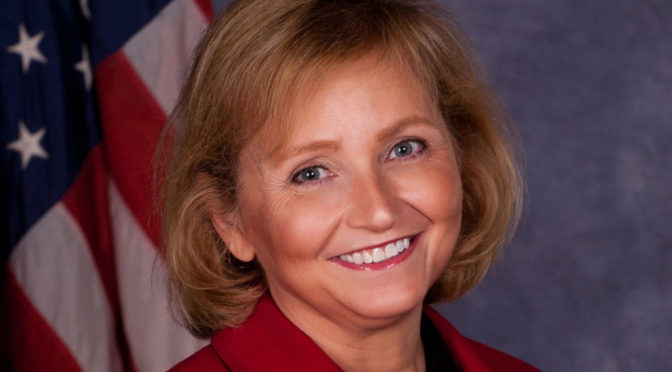
Lindsay Madison is the Fort Scott Chamber of Commerce Executive Director.
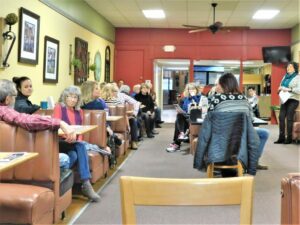
The Fort Scott Area Chamber of Commerce has been working to encourage entrepreneurship and matching skills to local employers’ needs in 2019, according to information provided during the Jan. 9 Chamber coffee.
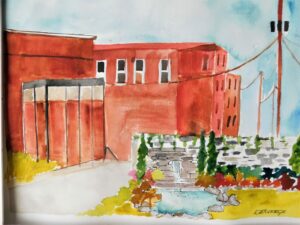
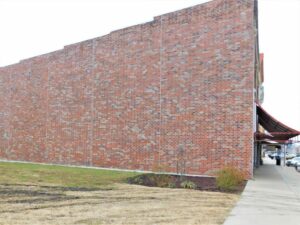
Chamber of Commerce and Visitors Center, 321 E. Wall
Two new programs were added to the community this year: Bourbon County E-Community and Work Ready Community. The focus of the two is enhancing local economic development through entrepreneurship and workforce development.
Loans for Businesses Through Entrepreneur Community
Bourbon County E-Community provides access to funds, which are locally administered through the Chamber. These loans included start-up businesses as well as existing business purchases or expenses. The funds are accessed through NetWork Kansas, whose mission statement is to promote an entrepreneurial environment throughout the state that connects entrepreneurs and small business owners with expertise, education, and economic resources.
Those who have received these loans in Fort Scott from July 1 to Dec. 31:
Smallville Crossfit, an E-Community Loan of $40,000.
Luther’s BBQ, an E-Community Loan of $45,000.
Smallville Crossfit, a start-up loan of $25,000.
Lulther’s BBQ, a start-up loan of $30,000.
Margo’s LLC (a salon and spa), an E-Community Load of $39,000.
Other events in support of E-Community: a luncheon to educate on the loan program, an entrepreneur appreciation luncheon, a semi-monthly local newspaper ad promoting the loans, and planning for a Youth Entrepreneurship Challenge, in partnership with Fort Scott High School (judging for the challenge will be March 11, 2020.)
Work Ready Community
Work Ready Community is a nation-wide program to aid matching people to a job that needs their skills and preparing people to have the skills that employers need.
Work Ready Communities is working at the grassroots level to make the country more competitive and closing the skills gap that threatens to paralyze the U.S. economy, according to its website. They do this by providing a community-based framework.
Bourbon County became a Work Ready Community in Sept. 2019.
A group of 10 people from Bourbon County, USD 234, USD235, Fort Scott Community College, the City of Uniontown and local employers attended a Work Ready Community Workshop in August 2019.
Kansas initiated an initiative for high school juniors to take the Work Keys test and earn certification. The certification is to improve hiring and employee retention, help provide employees who have the skills needed and help students attain success in landing a career.
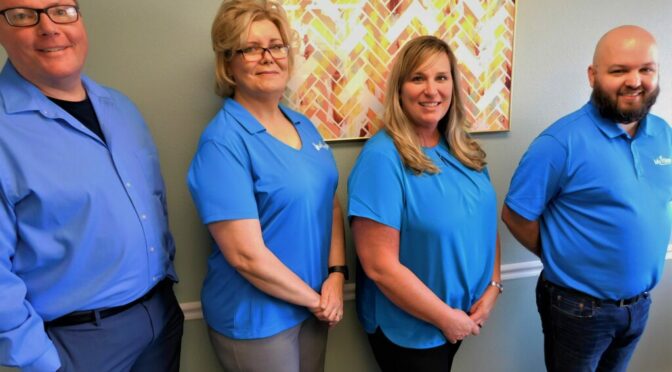
To view the Chamber leadership this year,click below:
Ground cover materials and repair of some of the children’s playground equipment were part of the workday in December.
Some local citizens have decided not to complain about issues, but instead to work on solutions.
Citizens For Park Improvements is the name of a group of local citizens who had been working in Gunn Park to improve the children’s areas.
Saw the need, took action
“The weekend before I started the group, we were at the park for a church function,” Seth Needham said. ” My youngest wanted to swing, but he couldn’t because the swings were broke. Even if the swings weren’t broke, the surface was muddy, and the whole area was unsafe. The swings that weren’t broke were 28 inches off the ground, which isn’t safe for a toddler. So, I decided to take action.”
” I have 2 sons, and I want the park to be a fun place for them.”
New ground cover under the teeter-totter makes it safer for children. The materials were provided by members of the Citizens For Park Improvements.
“It is something that had been on my mind for quite some time,” Needham said. ” I love our parks. I love taking my sons to our parks. But our parks need a lot of work. As I parent who frequents the parks, I see a lot of the issues. And I wasn’t seeing those issues being addressed. Things like a teeter-totter that was 40 inches off the ground, which was dangerous for my sons. Or slides that my two-year-old couldn’t go down because they had huge drop-offs at the bottom. Swing sets that were in disrepair. Ground covering that is non-existent. I realized I had two choices; gripe and complain on Facebook, or take action. I chose the second.”
“We have good parks,” he said. “But we have the basis for GREAT parks. And that’s what I want. I want to see Gunn Park be a wonderful safe place for families. I believe our parks department is doing a great job, but it sounds like they are overwhelmed sometimes just trying to keep up with the day-to-day operations. I figured if I could organize a group of people to help with some of the small stuff, the park department might have more time to focus on the larger issues.”
Started November 2019: More Projects In Spring
Needham started the project on November 6.
“I figured a few people might join and help, but I never expected it to take off like this. We have had one meeting, are already drawing up plans for our first six projects. We had our first workday, and got several projects done.”
Upcoming projects planned for this spring include updating bathrooms, repairing playground equipment, new ground cover for playgrounds, “and also some bigger projects which will really add to Gunn Park,” Needham said. “We have people looking into funding options, have set-up a material registry with Big-Sugar Lumber, and have experts looking into things such as drainage. And there is so much more that is going on.”
Currently, there is a project to clear off the Bell Town Park Trail on the north end of town, being organized by Denise Findley Needham.
New ground cover materials were placed under the swing sets at Gunn Park by the citizen’s group.
“Right now there are around 500 people in the group, and it’s growing daily,” he said. “We have a good group of people with fresh ideas, and the will to make it happen. One of my goals from the beginning was to make the group accessible to anyone. I want anyone who wants to help to have the opportunity, regardless of age, income, physical health, or time. I’m trying hard to organize the group where someone who has to work weekends can still contribute if they want to. Or the person who has $10 leftover after pay-day, but still wants to help. There will be a place for them. Or maybe someone who is older or disabled and can’t get out there and do physical labor…. We can use them too.”
Leadership
” We have never really decided on leadership,” he said. “I guess right now, I’m it. There have been several individuals who have really stepped up… and I couldn’t have done it without them. So if that qualifies as a leader, I would have to say Craig Campbell, Deb McCoy, Josh Jones, Beth Nuss, Lindsay Madison, Susan Bancroft, and Chad Brown so far. As projects come up, I am sure we’ll see more people step up to the plate when they see a need for something they are great at. “
Social media is helping the organization
“I organized it through Facebook to make it easier for people. Let’s face it, people are busy. It’s hard to attend traditional meetings. But by organizing it online, people can contribute on THEIR schedule. Ideas can be exchanged easily. We can set-up events so that people can see what we need, when we are working, and how they can help.”
“If anyone wants to be involved, they just need to join our Facebook group,” Needham said. “In the group, we post ideas and solutions we are working on, workdays, and how people can help.”
Bourbon County Sheriff Bill Martin. Submitted photo.
Bourbon County Sheriff Bill Martin is unhappy with the raises of administrative county employees, he said. He would have preferred giving input into raises in his office, including the one given him by the Bourbon County Commissioners.
A raise for elected officials became effective Dec. 15, 2019, according, to Bourbon County Commission minutes. This raised the clerk and treasurer’s salary to $47,248 annually, the register of deeds to 44,821 and the sheriff’s salary to $60,000.
Martin said in his budget request he had asked for a three-percent raise for all his employees.
“I did not request that large amount” for the sheriff’s position, he said.
There were no across-the-board raises given by the commission.
Martin said he was not aware of any raises until he received an email from Bourbon County Clerk Kendall Mason on Dec. 18, 2019.
“At no other time was any raise amount ever discussed with me by the commission, not for myself or any member of my staff,” Martin said. ” I attended several commission meetings where I questioned the commission on budget figures for 2020 and, as usual, I was not ever given any answers. At no time after I submitted my 2020 budget did anyone on the commission engage myself or my jail administration in salary discussions.”
In 2015 Martin had paid for a wage comparison survey and presented it to that Bourbon County Commission because he wanted to bring the salaries of the county employees as a whole up to standard amounts.
He felt it fell on “deaf ears” at the time, he said. It was a different set of commissioners.
For the 2020 Sheriff’s Office budget he had requested a three percent raise for his employees.
Instead, Martin’s salary was raised from $45,000 to $60,000.
He contends that discussions with him and his staff would have been beneficial to the decision making process.
“I am never provided with verbal information or written information as to where the money is put, cut or moved to in the budgets,” Martin said. “My door is always open for any discussion.”
Martin has two salaried employees.
“One of the two fell below the new income guideline set by the Federal Wage Law and the US Department of Labor,” Martin said. “A captain at the correctional center fell under this ‘salaried employee category’ and therefore is required by law to have a salary increase. If this wage increase is not performed, this employee would be eligible for overtime. I can assure you that increasing this wage is far less harmful than allowing this employee to request overtime hours for all the overtime he works. I am still unaware if this salary increase has been added to the correctional center budget. The commission was made aware of this federal law… several months ago.”
Martin said the responsibility of the sheriff’s office falls to him.
“I am the face and the buck stops with me, so to speak, but they are the men and women with their lives on the line every, single day and every single night. Christmas, Easter, Monday through Sunday. They sign up to make a difference in their community where they live. It’s nice to be thanked and appreciated and compensated to prove yourself worthy.”
“Top-Heavy”
The county has two many administrative positions, Martin said.
“Our county is now so top-heavy with administration that the people in the offices and on the road and doing the jobs are unable to receive any fair raises and are far from a competitive wage for the jobs they are doing,” Martin said. “Our county has a road and bridge supervisor that makes over $60,880 a year plus benefits. This county has a part-time, county counselor who makes $64,000 a year for 25 hours a week and has a private practice on the side; this is in addition to the county attorney who makes $50,000 a year. This county now pays (not attacking the person) an economic development director… $70,000 a year plus benefits. As of January 1, we have a sheriff making $60,000., a county clerk, making $47,248 a treasurer making that same amount and a register of deeds making $44,821…We have three county commissioners who make $21,416 (each) per year plus benefits, which is another $64,248 plus benefits in a year.”
” I have been requesting additional deputies every year since I have taken office and every year, I am told that there is no money to spend, budgets are close, overspending and overtime are out of control,” Martin said. “Yet, we have almost $200,000 in salaries for administrative staff, who hold jobs that should be performed by our road and bridge director and crews, the elected county clerk, our elected county attorney, and our elected county commission. $200,000 would pay for other staff raises, staff who are on the ground working.”
“It would pay for a much-needed school resource officer for Uniontown Schools plus a courthouse security officer, which is mandated by the state,” he said. “I cannot get anyone to understand that when you pay a deputy a $35,000 a year salary, you are better off to hire two more deputies on the force and reducing the $60,000 in overtime pay. I am contending that if they would not have raised my pay $15,000, they could have very easily allowed me to hire one new deputy and they would have been ahead money. Where did all this money come from and how do we put these jobs back in the hands of the people who were elected to do them and eliminate all the huge salaries that we are paying right now.”
The sheriff’s office operates around the clock much like an ambulance service or hospital does, he said. And some of his employees are struggling financially.
“People do a great job for great pay,” Martin said. “People do a decent job for decent pay and proud people show up to work to draw a wage rather than go on welfare. Some of my employees can claim state insurance benefits for their families and that is shameful to think that we cannot provide a wage above the poverty level… I also have other employees who work two and three jobs and I cannot control what my employees do outside their duty time… during my time as a deputy, I worked three jobs to provide for my family and pay my bills.”
Christina G. Hagood, age 93, a resident of Ft. Scott, Kansas, passed away Thursday, January 16, 2020, at the Via Christi Hospital in Pittsburg, Kansas.
She was born May 1, 1926, in Wichita, Kansas, the daughter of John Joseph Peters and Philomena Bachman Peters.
Christina married John Byron “Jack” Hagood on February 22, 1945. Christina had worked for several years as a receptionist for the Basham & McKenna Clinic and for Ft. Scott Family Physicians. She later provided childcare for area families.
She was a member of the Mary Queen of Angels Catholic Church. Christina was a devoted wife, mother and grandmother. She enjoyed cooking, gardening and tending her houseplants. In earlier years, she had been a member of the ONO Club.
Survivors include her three children, Margaret “Peggy” Lewis, of Ft. Scott, John Hagood and his wife, Barbara, of Medicine Lodge, Kansas and Mike Hagood, also of Ft. Scott. There are four grandchildren, John Cauthon (Beth), of Ft. Scott; Christina Hagood, of Overland Park, Kansas; Mary Anne Lunsford (Daniel), of Bonanza, Arkansas and Joseph Hagood, of Wichtia, Kansas; two great-grandchildren, Ashlyn and Lucas Lunsford as well as numerous nieces and nephews.
Her husband, Jack, preceded her in death on April 17, 1967. She was also preceded in death by her son-in-law, Tim Lewis; four brothers, John, Francis, Elmer and Chuck Peters and two sisters, Sister Mary Timothy Peters and Sister Mary Matilda Peters who were both Sisters of St. Joseph.
Father Yancey Burgess will conduct Mass of Christian Burial at 10:00 A.M. Tuesday, January 21st at the Mary Queen of Angels Catholic Church.
Burial will follow in the U. S. National Cemetery.
The rosary will be recited at 6:00 P.M. Monday evening at the Cheney Witt Chapel.
Visitation will follow from 6:30 to 7:30 P.M. at the chapel.
Memorials are suggested to the Mary Queen of Angels Catholic Church and may be left in care of the Cheney Witt Chapel, 201 S. Main, P.O. Box 347, Ft. Scott, KS 66701. Words of remembrance may be submitted to the online guestbook at cheneywitt.com.
The sign in the front window of the new Mag-Lab office, tells the phone number to call for more information: 620-232-1900.
Mag-Lab, an independent medical laboratory, headquartered in Pittsburg, KS will be opening a Fort Scott satellite office on Feb. 3, 2020.
The office will be located in the building just north of Subway Restaurant at 1711 S. National, Suite C2.
Hours are 7 a.m. to noon, Monday through Friday.
For more information contact: 620-232-1900.
The Offices, a set of professional office spaces being developed by Legweak LLC.
With specimens taken that morning , the results will be delivered to the doctor that afternoon.
“Complicated testing we send off to a reference lab,” Phlebotomist Sharon Newell said.
“If it’s a body fluid, we can test it,” Newell said.
“We can have anybody out in a few minutes,” she said. “There is not a lot of paperwork hassle. You have to have a doctor’s script if going through insurance.”
Gary and Jeannie Petersen are the owners of the lab.
Sharon Newell, the phlebotomist, stands in the doorway of the new Mag-Lab office in Fort Scott.
When one enters the lobby of the set of offices, there is a doorbell on the wall for contacting each of the personnel in the offices.
Currently, Mag-Lab is the only renter, but two more are on the horizon.
Brian Holt, medical technologist and Sharon Newell, phlebotomist stand in the lobby of The Offices, where the new Mag-Lab is located. The doorbell for notifying that clients are in the lobby is located behind Sewell.
Dr. Elias Tawil is the medical director of the lab.
Bryan and Barbara Ritter stand in front of the renovated area of the Broiler Room Brewhaus on Jan. 9.
Barbara Ritter, owner of Boiler Room Brewhaus at 2 S. National, has been extra busy since the new year began.
Her sister, Peggy, is a co-owner with Barbara and her husband, Bryan is the brewer.
Bryan and Barbara were doing the final touches of a recent reno last week.
Fort Scott’s first microbrewery is located on the busy corner of Wall Street and National Ave. The Ritter’s feature beer tastings, by the glass and take out.
Since having the business rebranded in the fall, they realized they needed to take some time to do some new things in the microbrewery.
They have expanded their tap selection.
“We are going to have six of our brews on at a time,” Barbara said. “We have been canning our beer since fall.”
They have been doing some decorative changes as well.
“Basically, we did a lot of painting,” Barbara said. “Walls, doors, vanities, tables…in nostalgic colors.”
Nostalgic colors were added to fit with the mid-century design of the building.The restroom vanity was painted.
Since the building was built in 1960, “we have added some elements from that time period,” to the decor, she said.
The Ritters are looking for vintage photos of the Downtowner Hotel, which now houses the microbrewery.
“If anyone has any vintage photos of the Downtowner or people, that they would be willing to share…to purchase or display,” Ritter said, please contact them at 913.636.4892 or 620-644-5032.
“This building was completed in February 1960,” she said.
A vintage photo of the Downtowner in the 1970s. Paul Milks found the photo and one of the Goodlander Hotel in the Bourbon County Genealogical Society library.The Boiler Room Brewhaus, 2 South National Avenue, Jan. 9, 2020.The Goodlander Hotel was the original building on the site. It was demolished for the construction of the Downtowner Hotel, Ritter said.
The Ritter’s moved their business to the new site at the corner of National Avenue and Wall Street on June 1, 2018.
The old logo is gone and has been replaced with nostalgic ones:
Barbara Ritter displays some of the new logos on the glasses, etc.
Taco night is each Thursday at the Boiler Room Brewhaus, catered by Crooner’s Lounge.Snacks and drinks are served each time the microbrewery is open.
Though the microbrewery doesn’t serve meals, they have menus from restaurants where people can order food and have it delivered or can bring it into the Brewhaus, she said.
“There is also a $5 taco bar catered by Crooner’s Lounge on Thursdays, $5 and you can eat all the tacos you want,” Barabara said.
They will also be offering some new appetizers.
Each Friday is karaoke from 7-9 p.m., and Sundays there are team trivia games from 5-7 p.m.
“We are looking to add a music bingo game, possibly on Saturday evenings,” she said. “We will try it once to see how it goes.”
“We are hoping to have musicians coming once a month,” she said. “There are three in the works so far for the next couple of months.”
Heather Fink did the lettering on the doors of the Boiler Room Brewhaus.
Currently, they have four part-time employees and two full-time.
“We are looking for one more part-time, one day a week,” she said. “Possibly an older employee with a good work ethic, who is looking for something to do.”
“We’ve had a really good year,” Barbara said. “Almost one-half of customers are new to Fort Scott. Fifty-one percent are local people.. We have a variety of people of all ages.”
“People say this is a cool little town,” she said. “This town has a lot to offer.”
Fort Scott Community College has been a part of the community for over 100 years and it is looking to help future generations find their career path.
“Even though we are in an era of declining enrollment in Kansas colleges and universities; I am very positive about the future of FSCC due to the fact we have great faculty and staff that make student learning and student success their mission,” FSCC President Alysia Johnston said. “We are also extremely fortunate to have an incredibly supportive community and Board of Trustees, which is greatly appreciated.”
On January 13, the spring semester at the college began.
A recent 2019 Annual Report Centennial Edition gave glimpses of events throughout the years and named current offerings as well.
Thirty-seven fields of study are available to students: agriculture, art, biological science, business, certified medication aide, certified nurse aid, chemistry, computer science, construction trades, cosmetology, criminal justice, education, emergency medical technician, engineering, English, environmental water technology, farm and ranch management, Harley-Davidson Motorcycle Technology, heating-ventilation-air conditioning, history, home health aide, John Deere Technology, mathematics, manicuring, masonry, music, nursing, phlebotomy, physical education, physical science, physics, political science, psychology, sociology, speech, theater, and welding.
FSCC’s John Deere Progam has been recognized as a College of Tomorrow awardee by John Deere, Inc. The honor was earned because of program excellence, instructor development, internships, and facilities, according to the annual report.
The college marked 15 years in partnership with Harley-Davidson Motor Company. FSCC offers technician training in a hands-on Harley Davidson approved environment, equipping students with both knowledge and soft skills.
FSCC’s Nursing Program was ranked 2nd in Kansas because of its overall affordability and exemplary NCLEX pass rates after evaluating 36 nursing programs in the state.
In the college’s annual report, much has been accomplished in just the last year.
In 2019 FSCC initiated its eSports program, joining in a nation-wide growing collegiate sport: competitive video gaming. The FSCC eSports team helps students improve their gaming performance, social and leadership skills, according to the annual report.
Also, last year the college added onto the Burris Building, which gives FSCC agriculture program room for future growth.
Burris Hall on the campus of FSCC was expanded and the old section updated in 2019.
FSCC welcomed the new director of the Gordon Parks Museum,Kirk Sharp, after being a part of the Gordon Parks committee for over a decade. Kirk will work to advance the legacy and memory of visionary artist Gordon Parks.
Gordon Parks Museum Executive Director Kirk Sharp, center, looks over donated photos of the film “The Learning Tree” with onlookers during the Gordon Parks Celebration in Oct. 2019.
Sports Added
Women’s golf and track and field programs were added to the college in 2019.
New Board of Trustees Members
Two new board of trustees were elected in Nov. 2019: Dave Elliott and Kirk Hart. A third trustee Bill Meyer was selected to fill the vacancy of his wife, Liz, who died at the end of 2019.
2020
“The expectation for 2020 is to continue to meet the needs of our students, community, faculty, and staff, as well as all of our stakeholders,” FSCC President Alysia Johnston said.
FSCC retiree Carolyn Sinn, from left, and FSCC Centennial speaker Gina Shelton, help FSCC Class of 1941 graduate Esther Sewell cut the Centennial Celebration cake while President Alysia Johnston, along with centennial speakers Mark Muller, Marcel Normand and Jim Barrows watch in the background, in September 2019.
Some of the events in 2020 include:
Bailey Hall
The fundraising for the renovation of Bailey Hall at the college continues.
“We have a plan for Bailey Hall renovation with a price tag of around one million dollars,” Johnston said. “However, until we have more money we will not begin the project and we have no timeline for now. We hope to use the money donated by Mr. and Mrs. Bailey as seed money to receive more dollars.”
“All gifts would be greatly appreciated and people can contact our Chief Development Officer, Jeff Tadtman, 620 223-2700 ext. 5830 [email protected]”
Men’s Golf
The college will start a men’s golf program in August 2020.
Accreditation
“Accreditation is critical to the college as it allows us not only to ensure we are Title IV eligible (federal student financial aid), but we maintain high quality and transferable courses and programs,” Johnston said. “Accreditation is a peer-review, self-regulatory process by which non-governmental associations recognize educational institutions or programs that have been found to meet or exceed standards and criteria for educational quality. ”
“Accreditation also assists in the further improvement of the institutions or programs as related to resources invested, processes followed, and results achieved.”
” We will have our first Assurance Argument due this June under the Higher Learning Commissions (HLC) Open Pathway accreditation, and we have a committee that has been working on documentation and narrative for the Assurance Argument for at least a year.”
“We were fortunate to be placed in the Open Pathway accreditation model when we received our 10-year accreditation from HLC in 2016. The Open Pathway is a less prescriptive model for accreditation and allows us to determine our own path of continuous improvement.”
Nursing Program Evaluation
“The Nursing Program is scheduled for a comprehensive evaluation from the Accreditation Commission for Education in Nursing (ACEN),” Johnston said. “ACEN is recognized by the United States Department of Education (USDE) as a specialized accrediting agency for nursing education programs located in the United States and its territories.”
Photo from L to R: Logan Geiger, Maddie Ard, Clay Brillhart, Braden Griffiths and Coach Scott Sutton.
The Uniontown FFA Meat Evaluation team recently brought home 4th place honors at the National Western Roundup Meat Evaluation contest held in Fort Collins, Colorado. Uniontown earned the opportunity to represent the state of Kansas in the contest with their state runner-up finish this past May.
The contest consisted of placing classes, beef grading, retail identification, questions, meat formulation problems and a written exam. After completing all of the above on Saturday, January 11th on the campus of Colorado State University, the team ranked 3rd in Beef Grading, 4th in Placings, 6th in Retail Identification and 4th overall.
Clay Brillhart led the team individually with a 7th place finish overall. He also ranked 8th in the placing category and 8th in the retail identification division. Maddie Ard finished 17th overall, Braden Griffiths was 5th in Beef Grading and ranked 21st overall, and Logan Geiger ranked 24th in Retail Identification. The team is coached by Uniontown FFA Advisor Scott Sutton.
Lynne Oharah, District One Bourbon County Commissioner. Submitted photo
Bourbon County Commissioners are trying to close the gap in wages for its’ elected officials, according to chairman Lynne Oharah.
Recently the commission raised four elected officials earnings with a combined total of $46,000.
At the Dec. 17, 2019 county commission meeting Ohara made a motion to approve a salary resolution for elected officials effective Dec. 15, 2019, according to commission minutes. This raised the clerk and treasurer’s salary to $47,248 annually, the register of deeds to 44,821 and the sheriff’s salary to $60,000. Commissioner Jeff Fisher seconded and all commissioners approved.
Ohara then made a motion approving a wage resolution for Bourbon County employees changing the following: the salary for the correctional center captain, the emergency preparedness director and the deputy county appraiser were raised to $35,568 annually to comply with the U.S. Dept. Of Labor standards for salaried employees. A Maintenance 5 position was added at a rate of $17.47 per hour. Commissioner Nick Ruhl seconded and all were in favor of those changes. The economic development director’s salary was changed to $70,000 a year on the same resolution.
Jeff Fischer, District 2 Bourbon County Commissioner.
Ohara made a motion to approve changing her salary to $70,000. He said that if Bourbon County gets an administrative fee from Phase 2 of the Healthy Bourbon County Grant then part of the $70,000 salary would be subsidized from the grant, Fisher seconded this motion, Ruhl voted against this motion, and the motion passed.
Nick Ruhl, District 3 Bourbon County Commissioner.
The following is an interview with Bourbon County Commissioner Lynn Oharah.
He started with a history of the raises.
“In 2015, Sheriff Martin contracted an agency to do a wage study to compare Bourbon County wages with other comparable counties because he thought there was a large wage disparity between Bourbon County employees and other like counties,” Commissioner Oharah said. “The county commissioners also accessed Kansas county wage information from the ks.gov website. The results indicated that Bourbon County wages were significantly behind our peers. The commissioners resolved to address these wage disparities and devised a plan to increase FTE (Full Time equivalent) positions first and address the next positions that had the most wage disparity, which happened to be the elected officials. Along with this effort we wanted to incentivize employees to continue working for the county and we did this by approving a $100 per year of service longevity pay increase.”
Where did the money come from to give the raises?
“We gave four elected officials raises when combined totaled $46,000.00. This money came from most of the departments managing their budgets and workforce which created a carryover from the 2015 and forward budget years. These wage increases did not increase the mill levy and this carryover gave us the resources to create a competitive wage with our peers although Bourbon County wages are still on the low side.”
What is the justification for the doubling of the earnings of the Bourbon County Economic Development Director?
“This position was initially created to see how the position could help the county,” Oharah said. “It was created with a minimum of 20 hours of work per week at $35,000 annual salary and we would look at the performance and scope to see if we needed to increase the hours and wages.”
“Our economic developer has been a great asset and for the first six months spent a lot of time helping get the Bourbon County Ambulance Service up and running along with the other duties.”
“Since then all Bourbon County businesses and government entities have been contacted and surveyed to address their needs and identify what’s important to them. Also, new businesses have been guided through the process of starting a business, grants have been written, the County NRP program has been implemented and coordinated under economic development. Meetings and plans regarding healthcare are ongoing with economic development highly involved. This is just naming a few projects that are ongoing and the time spent well exceeds what was required.”
“Based on the need, the commission voted to increase the economic development salary and scope. The salary was based on what was being paid to other economic development directors in our surrounding market and the Bourbon County Economic Development budget is still lower than most of our competitive counties.”
“Bourbon County needs to grow and prosper and we cannot get there by doing the same thing that we have been doing for the last 100 years,” Oharah said.
The commission meets on Tuesdays at 9 a.m. at the courthouse.
To contact Ohara: 620-223-3800, ext 110; Fisher at ext. 112 and Ruhl at ext. 111.
Dr. Katrina Burke, courtesy of Ascension Via Christi.
Dr. Katrina Burke’s first day at the new AscensionVia Christi Medical Clinic in downtown Fort Scott is Monday, Jan. 13.
She will be accepting new obstetrics and pediatric patients.
Burke will also see previous patients but is accepting no new adult patients, according to her receptionist Kristal Farmer.
Dr. Burke said that the Community Health Center of Southeast Kansas (CHC/SEK), her previous employer, did not send out letters, telling of the change to her patients when she left on Dec. 31. She had given CHC a 90 days notice of her intent to leave CHC/SEK.
Hours for the clinic, located at 109 S. Main (north of the Liberty Theater) are 8 a.m to 4:30 p.m. Monday-Wednesday and Friday.
Thursday afternoon she is out of the office, but is in the office in the morning, according to her receptionist.
To contact the office call 620-223-7008.
109 S.Main is the new location of Ascension Via Christi’s Medical Clinic in downtown Fort Scott. A new sign will be up soon.Ascension Via Christi employee Niki Bishir mans the desk of the new medical clinic on Jan. 9. She was temporary, while the employees were in an orientation meeting, she said.Dr. Katrina Burke has already added her personal touches to the new clinic: a hallway lined with a photo of her family and framed degrees she has earned during her career as a medical doctor.
New clinic employees are Farmer, Registered Nurse Rachel Judy, and Medical Assistant Chelsea Harrison.
For more information about the clinic, visit
viachristi.org/ftscott-clinic.
The Public Health Department, located on 6th Street, between Lowman and Horton Streets, Fort Scott.
“Parenting the Love and Logic Way”, a free parenting class, will be conducted by Jan and Dave Elliott, with class pre-registration beginning next week.
Jan and Dave Elliott. Submitted photo.
The Elliotts are independent facilitators of the curriculum.
Classes are presented in six sessions beginning Jan. 23 at 6:00 P.M. at the Health Department. Other sessions will be Jan. 30, February 6, February 13, February 20, and February 27.
There is no charge for participation in the sessions but space can be limited.
The new site for the health department is located at 524 S. Lowman St., 6th and Lowman Streets in Fort Scott.
Please pre-register at the health department by calling 620-223-4464. The deadline for sign up is Jan. 16th. The target audience is individuals that have children or take care of children.
The curriculum was developed by Jim Fay, Ph.D., and Foster W. Cline, M.D. of the Love and Logic Institute Inc. in Golden, Colorado.
“The goal of the program is to provide parents the opportunity to gain practical and proven tools for raising respectful, responsible, and happy children,” Alice Maffet, RN, said. “The program will teach responsibility and character, how to lower your stress level, have immediate and positive effects and up the odds that you will enjoy lifelong positive relationships with your children and grandchildren.”
Meaghan Russell meets with a student for lunch on Jan. 7 in the conference room at West Bourbon Elementary School, Uniontown. Russell is a school counselor and facilitator of the district’s mentoring program, TeamMates, that will be starting soon.
USD 235 staff have been working on the details of a mentoring program for the district’s students since August 2019.
On January 15, the school district will implement the program with training for mentors.
Mentors and mentees will meet during the student’s lunch period to eat and talk. There is a conference room available should the mentors/mentees want a little quieter space to talk.
Permission slips will be sent home with students for parents to agree to their child having a mentor.
“Once the forms come back signed, we will begin to match mentors with mentees, and the program will officially be up and running,” Meaghan Russell, one of the TeamMates USD 235 facilitators, said.
“We work with Michael McCambridge out of Greenbush (Education Service Center),” she said.
“We also have an advisory committee consisting of… Mike Reith (JH/HS principal), Vance Eden (elementary principal), Bret Howard (superintendent), Jeanne Camac (JH/, HS counselor), Marty DeWitt (Uniontown Baptist Church pastor), Chad Holt (banker), Sally Johnson (city clerk), Jeff Feagins (HS business teacher and pastor of Marmaton Church),” Russell said.
“The TeamMates Coordinators are out of Nebraska, and they will be here on January 15th to conduct the training,” she said.
The following is an interview with Russell:
What is the purpose of the program?
“The purpose of the program is to build interpersonal skills in our students by having them talk with an adult from the community at lunch once a week. This should not only help to build their communication skills, but also their confidence in talking with adults and having to get to know someone new.”
If one becomes a mentor, what are the expectations?
“Mentors must be 18 years of age, willing to provide three references, able to pass a background check, and willing to attend a one-time, two-hour training. After that, it just comes down to making the commitment to come and eat lunch with a student once a week. We are very much in need of mentors, so if you are someone that has a flexible lunchtime, and you could sit with a student for twenty to thirty minutes once a week, we would love to have you participate! Our students can easily keep you entertained as they are full of stories!”
Who is paying for the program?
“This year, the school has paid the initial fees to get this program started. That money covers the cost of the background checks, training, and all communication and support provided by the TeamMates coordinators and Greenbush.”
Initially, Third Through Fifth Grade
“The TeamMates program recommends third through twelfth grade have mentors and trying to get as many students matched as possible. This program is not intended for a certain demographic of students. Initially, the plan is to begin with third through fifth-grade students, but then add grades as the program grows and expands. Mentors will be matched with the same gender of students, and the matching will be based on interests and hobbies as much as possible. One of the aspects that makes this program special is that all communication between the student and the mentor is to be done through the school.”
Why start a mentoring program?
“When students leave our district, we want them to be as prepared as possible for what lies ahead for them. We may not know what they are going to face, but we do know that relationship will be a part of it. Any skills that they learn from talking with adults will definitely be beneficial to them in the long run. Also, from a social/emotional perspective, we want to ensure that all students have connections to people. Life has ups and downs, and it is nice to have a slightly larger circle of people to help listen to you in good times and in bad. The benefit of going through the TeamMates organization to start this program is that they have already completed the research to successfully implement this in different schools, and they are a great support system to help launch this here at USD 235.”
TeamMates Mentoring Program began in 1991 with the vision of the University of Nebraska Head Football Coach Tom Osborne and his wife Nancy. Osborne felt that the athletes in his program could make an impact on the middle school students, and twenty-two football players began meeting with middle school students in the Lincoln Public Schools. Of the 22 original mentees, 21 went on to graduate from high school while one left school early to pursue a successful Motocross career. Eighteen of the original mentees also obtained some form of post-secondary education.
The program has changed quite a bit since then. Now thousands of boys and girls across the Midwest are served, and mentors come from all walks of life. One thing, however, remains the same-mentors just have to be there. It’s that simple.