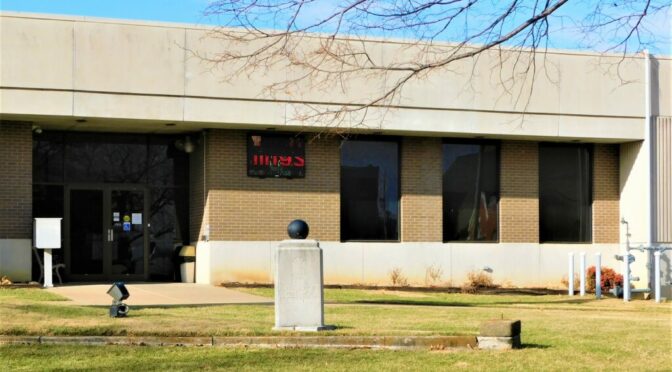
The north wing, east side of the Bourbon County Courthouse.
Before discussing a proposed noise ordinance, the clerk’s office addressed the commission concerning the new payroll company the county is changing over to.
Payroll
County Clerk Susan Walker read a statement to the commission about the payroll and benefits problems they are currently having with the new payroll system the county.
“It was not an operation improvement. It was a political move,” she said the commission’s decision to hire Pay Entry to do the county’s payroll.
“It undermines the efficiency,” she said. It has not saved time for her office but has added to the hours needed.
Walker also stated that recent comments in commission meetings implied a failure of her office. Implying that any payment has been processed without prior approval is false.
Jennifer Hawkins, Deputy Clerk, addressed the commission regarding the affects of what the new payroll system is doing.
She is working directly with Pay Entry and cited several issues she found in her meeting with them Thursday morning.
“My main concern is employees can change the cost center and their job title,” even by accident, she said, which would change their pay rates and what account their pay comes out of. Pay Entry said they cannot lock employees out of that part of the program without locking everyone else out too, including supervisors.
“The system seems rather clunky compared to what we have now. In my opinion, it’s taking two steps back compared to what we now use,” said Jennifer.
Commissioners Samuel Tran and Mika Milburn both wanted to include the vendor’s representative in a meeting about the issues.
Commissioner David Beerbower suggested putting the changeover to having Pay Entry manage the county’s payroll (which was to take place on Sunday) on hold until they can have a meeting with the payroll vendor at the regular commission meeting on Monday.
This shouldn’t be happening during the election time, Beerbower pointed out, as the clerk has election responsibilities taking her time.
Beerbower told Milburn to reach out to Emerson to ask for a delay in starting up to allow for time to work out the issues.
Walker said she was asked to start up at the end of the quarter, and she suggested waiting to start up until the start of the new year.
Tran said the commission needs to discuss it among the three of them. He also said that when there’s a problem, those involved are either a help or a hindrance.
He said the county officials and employees need to work as a team.
He also said they are trying to make things better.
Walker said that nothing was broken in the system that the county had been using.
Milburn will pass on the clerk’s office issues to Pay Entry, and the changeover will be delayed until the problems can be worked out.
Noise Ordinance Resolution
Tran said he spoke to the county’s attorneys, and the county doesn’t have standing for an injunction or a cease and desist order, so the noise ordinance is the next step they can take. It will give them standing.
Beerbower shared a noise resolution example with the commission that a citizen had given him for review. He said it is similar to noise resolutions in Atchison and Douglas Counties.
Some highlights from the resolution he read include:
Defining “plainly audible” as sound an unaided human ear 75 feet from the source can hear. Tran also requested the addition of reverberation to the ordinance.
The ordinance differentiated between residential, agricultural and commercial/industrial areas. It also distinguished between noise volume allowed during the day and night.
Daytime (7 AM-10 PM) decibel limits in the ordinance are 60 dB in residential, 65 in agricultural, and 70 in commercial and industrial areas.
Actions on the list of violations include: operating outdoor power equipment between 10 PM and 7 AM, operating muffler-less vehicles, operating amplified music or a speaker at a volume heard beyond the property boundary.
Normal agriculture operations, special events, and construction during the day are exempted from the resolution.
Enforcement would be by the sheriff’s department. Violations may result in a citation and misdemeanor charge with fines of $500 and up to 30 days in jail. Each day of the violation qualifies as a separate offense. The county can seek an injunction to stop continuous offenders.
Beerbower expressed concern about adding decibel levels to the resolution because of the issue of who measures the sound.
He said the language of the ordinance, which calls noise that causes damage to another’s health and impedes their ability to enjoy their life a violation, is adequate.
Public Comments
Zach Cross expressed concern that the commissioners consider grandfathering in existing businesses. He owns a kennel business in the south end of the county and is concerned about his ability to continue to operate if a new neighbor doesn’t want the noise of the kennel so close to their property.
Mary Ridge expressed concern about noise from gunfire and fireworks.
Michael Hoyt compared the ordinance to a speed limit change, which is enforced the minute it’s published.
Beerbower asked Tran and Milburn if they had any changes to suggest.
Beerbower asked to bring it back to the regular meeting on Monday. He said he would get legal’s opinion before then.
The north wing, east side of the Bourbon County Courthouse.
At the beginning of the meeting, the commission spent a good deal of discussion on whether or not to approve the minutes for the previous 10 meetings.
Commissioner Mika Milburn had begun going through the edits on some of the minutes, but was unable to complete all of them.
Commissioner Samuel Tran also didn’t agree with the way the minutes recorded what he said.
County Clerk Susan Walker said that it takes one of her office personnel an entire day to transcribe a regular meeting if they don’t use a transcription service.
Commissioner David Beerbower said that the commission needs training on governance and the use of minutes. He also said they need to be careful not to get caught up on small issues in the minutes.
They are an official, permanent, legal record, Beerbower said. Details that should be included are motions and resolutions, voting outcomes, a summary of discussions, but not full transcripts, and action items.
He said the commission is ten sets of meeting minutes behind, and it’s time to move on.
Tran asked if the minutes could be brought up in a court of law.
Milburn said she plans to stay current with the ongoing minutes and catch up the rest over the next few weeks.
Beerbower and Tran spent time going over Milburn’s edits.
Beerbower moved to approve the minutes for Sept. 15, 16, and Oct. 7 with corrections. Motion carried.
Casey Brown – SEK-Cap Public Transportation
Scott Christianson, transportation director for SEK-Cap Public Transportation, also spoke to the commission.
BBGO’s transportation serves Bourbon County on Mondays, Wednesdays and Fridays by providing transportation to those who request it in the county. They will no longer be able to continue after Dec. 1 of 2025 due to lack of funds.
SEK-Cap is looking for support from the county for a grant they are writing in the form of a 30% match totaling $19,000, for the federal and state grants. CCAP made up the difference between what the county and City of Fort Scott gave toward the 2024 budget, but they are no longer able to do that.
They are asking the whole community for what they want and what can be feasibly supported. Going fewer than 3 days per week will be a hardship for many of the residents who rely on the rides for medical care.
Milburn said the commission has heard from several ride share organizations in the county. She also asked about what changes they could make to the program. She suggested alternative forms of fundraising, including mailers.
Tran said that the bulk of the rides are for the City of Fort Scott residents. The city has budgeted $5,000 for BBGO for next year.
They need everything solidified in planning and writing before the end of November. The state and federal funding is secured.
No action was taken.
Public Works: Equipment Repair
The loader is down at the quarry, said Dustin Hall from Public Works. Murphy Tractor says a new motor with a one-year warranty will be $82,000. The loader is 11 years old with just under 10,000 hours on it. It hasn’t lasted as long as they expected. Without it, they don’t have a way to make gravel.
It’s still cheaper for the county to produce its own rock than to buy it.
Public Works has the funds in its budget, splitting the cost between Road and Bridge, and sales tax. Barring any further major issues, they are doing well for their budget carryover.
Hall also said that some equipment at the asphalt plant is damaged. They are unsure how to fix it, awaiting word from ADM, the manufacturer, about whether or not they can repair it, or will need to replace it. They cannot make asphalt until it’s repaired.
They can buy asphalt at $70 per ton to complete the portion of Yale Road that is ready to be asphalted.
Tran said they need to develop a good preventative maintenance plan for the Public Works department.
Milburn applauded the public works department for the standard operating procedures (SOP) they developed.
V. Pursuant to KSA 75-4319 (b)(1) to discuss personnel matters of individual nonelected personnel to protect their privacy.
Action from session: allow the chair to speak with HR regarding the matter was approved.
Consent Agenda Approval of 10.17.25 Accounts Payable that was sent for review to the Commission on 10.17.25 (not mailed until approved on 10.20.25) – Accounts Payable $377,595.70 Approval of 10.17.25 Payroll that was sent for review to the Commission on 10.15.25 and allowed for payment per K.S.A. 12-105b (b)(1) $300,350.36
Consent agenda was approved. Beerbower and Tran voted for and Milburn against.
Milburn wanted another way to handle the consent agenda. Beerbower added it to the Nov. 3 agenda for discussion.
Public Comments for Items Not on The Agenda
Clint Walker: He wants the county to get an emergency preparedness director and encouraged the commission to apply for a grant to fund that position. He also mentioned a broadband grant for $30 million in the state of Kansas that the commission should apply for.
“We need these grants cause in the long run it saves us money,” he said.
Derrick Reigns: Thanked them for the moratorium. He also asked for a cease and desist. He said the noise was painful to his ears and causes headaches.
He said several people visited the site today, despite none of them coming to the commission meeting.
Tran said their legal representation is talking to the county’s legal representation, which is why they didn’t attend the meeting.
Beerbower asked Reigns if he had sought legal counsel. He then said the county would talk to legal before they take any further action.
Reigns said that if the county would pass a cease and desist, that would cause the mine operators to do something to improve the noise situation.
Jen Franklin: Expressed concern that the installation owners wouldn’t come unless a cease and desist forced their hand.
John Spade: his property borders the property where the mine is. “It boggles my mind how somebody can come in” and nobody knows until it happens. He said the commission was there to protect them, and they looked forward to having that protection.
The whole contingent expressed gratitude to the commission for hearing them out.
Old Business
108 W 2nd
Milburn said two contractors have looked at the building to see what’s needed to get the Sixth Judicial into the space. She’s awaiting their feedback.
EMS
Tran had a constituent express concern about the city’s contract with EMS. Terry, EMS director, said they have a contract with the city, and she decided on an all-call over the weekend when they had one truck gone to Joplin and another on an orthopedic call that may have required a trip north, leaving no ambulances in the county. The all-call was to be sure there was someone available to answer any further calls should the fire department be out on a fire call and unable to help. She said they rarely use the all-call option.
Noise Resolution
The commission should establish parameters for any noise resolution that the county needs to pass along to the planning commission, said Beerbower. He suggested they all research and start formulating a plan.
“We need to be moving forward with the noise resolutions. How do we want to do it? That’s the question,” he said. The resolution should address volume and duration.
“I’m not targeting any specific industry or group,” said Beerbower.
Noise resolution was added to the Nov. 10 agenda.
Greg Motley suggested checking with the Kansas Association of Counties for examples of what other counties have done.
Technology Discussion
Beerbower asked, at Sheriff Bill Martin’s request, to hold off on the work on the switches for the Sheriff’s Department until the sheriff can attend a meeting to discuss it.
Milburn said the sheriff should reach out to the project manager at Stronghold to discuss what he needs, rather than discuss it with the commission.
Meeting Resolution
Beerbower said that some changes were suggested the last time this resolution on how the commission will conduct its meetings was brought up. It replaces resolutions, 1025 and 1125.
He read the proposed resolution aloud.
After a great deal of discussion, the resolution passed, Milburn voting against.
New Business SOP – Public Works
Tran read the standard operating procedures for sign installation in Bourbon County recently created by the Public Works Department head. He also read the one for culvert installation.
Milburn asked that the culvert SOP include having the commission approve it before installation.
Commission Comments
Beerbower: Both the Declaration of Independence and Constitution outline the rights of life, liberty and the pursuit of happiness. Everyone has the right to purchase property and use it as they see fit. However, the Supreme Court has ruled that you cannot put your neighbor at risk. “Clearly, the incident involving the generators does put our residents at risk.”
He said he is not against economic development, solar, wind, or crypto mining, but he is against neighbors putting their neighbors at risk. It is the job of the commission to protect the residents of the county.
The north wing, east side of the Bourbon County Courthouse.
Old Business, Continued
Tri-Valley Agreement for 2025
Commissioner Mika Milburn said she didn’t want to sign an agreement with Tri-Valley, since the county doesn’t have agreements with other similar entities that they support.
The county budget for supporting Tri-Valley is already budgeted and approved for the 2025 calendar year, and some payments have already been made.
County Clerk Susan Walker said that if there are delinquent taxes, it would make it so that the county can’t pay the full amount.
The commission chose to take no action on the item.
Enterprise Lease Agreement
Sheriff Bill Martin came to follow up with the commission regarding the agreement with Enterprise to lease vehicles for his fleet. The Master Equity Lease Agreement needs to be signed to begin the process.
“Something needs to be done…I need vehicles, but that choice is up to you,” said Martin.
Deputy Murphy spoke about the original request for 11 new vehicles. He said that after attending some commission meetings, they realized that was a big ask, so Enterprise came to them with some other options: one for 8 new vehicles and one for 7.
At least six of the fleet’s vehicles are so old that they cost more to repair and maintain than they would to replace. This creates the need for bigger initial start-up funding.
At issue is the safety of citizens and officers, as well as the department’s ability to meet its obligations and go out on calls.
Milburn expressed the fear that the county will be locked into a lease program that doesn’t work for them.
Murphy said it’s a lease-to-own program, giving the department equity every time they sell the old ones through Enterprise and replace them.
Greg Motley said the main issue is the loss of flexibility in finances for the county. The lease costs more than purchasing outright, assuming that the prices are the same, but the county would pay for the use of the money.
Commissioner David Beerbower said that there’s danger to the fleet and the sheriff’s department’s ability to do its job when the can gets kicked down the road because of “lean years.” Historically, that’s what has been happening in Bourbon County, and it needs to stop.
“And virtually every year’s a lean year in Bourbon County,” said Motley.
Motley recommended a toe-dip with the relationship with Enterprise.
Commissioner Samuel Tran said he is good with starting the relationship with Enterprise. “The issue is not whether or not they need to buy the car or lease the car. The issue here for me is how do you keep cost creep from gaining,” he said. Costs are going to go up, regardless of how the county gets the vehicles.
Milburn said it would take 2 mills of ad valorem tax to cover the cost, according to her math.
Murphy expressed regret that past commissions made the decisions that have placed the current commission in the position to have to fix the current fleet issues.
County Counselor Bob Johnson asked, “If they don’t approve this, how many vehicles do you have to buy?”
Murphy said they have six that need immediate replacement.
Beerbower moved to sign the Master Equity Lease Agreement. Tran seconded. Motion carried with Milburn voting against.
Law Enforcement Resolution – Inmate Housing Fund
The resolution proposed previously by the sheriff’s department was to split the income from housing out-of-county inmates with the county, 60/40.
Tran said he wanted in a sub-account within the general fund and earmark it for a contingency.
Beerbower asked that they use it for an equipment reserve fund.
Milburn asked commission to consider a resolution stating that the fund stays with the sheriff’s department to be used for big ticket items, but not on regular expenses “until we see that’s it’s stable,” over the next three years. She then wants to use the portion of the fund that is deemed sustainable to offset the taxpayers burden.
Beerbower approved of the 60/40 split, keeping the funds in a special fund to offset unexpected expenses. “This is money above and beyond anything that we get in: taxes or any other fund that we get, and it gives us a little wiggle room” that the county doesn’t have right now, he said.
Tran agreed with Beerbower, but expressed concern about micromanaging the Sheriff.
Martin expressed his intention to be transparent with the commission regarding how he spends his department’s 60% of the Inmate Housing funds.
After much further discussion, Beerbower called for a motion. He then made the motion to adopt the 60/40 split. No second.
Milburn motioned to adopt the resolution written by Johnson without the split. No second.
Tran said he doesn’t like micromanaging people, but he likes order. He motioned to adopt the resolution written by Walker, also without the 60/40 split, and citing the statutes that govern the use of the funds. Milburn seconded. Motion carried, Beerbower voting against.
Tran followed the vote by saying he is willing to change the resolution if the one they just passed doesn’t work.
KDEM (FEMA required documentation)
o Subrecipient Audit Requirements
o Title VI Civil Rights Form
o Title VI Civil Rights Policy Plan
o Notice of Nondiscrimination
o Title VI Complaint Form
Milburn wanted to ask the county HR department to handle complaints, after which time, Beerbower will come in to sign the documents, which will then allow the FEMA funds to be released to the county. Commission approved
New Business Fence Viewing Application David Bailey & Payton Farr
Set for Nov. 8, assuming it works with the schedule of the parties involved.
Department Updates
County Clerk – Election Schedule
Early voting starts October 20. Walker asked for permission from the commission to do the setup necessary in the courthouse and commission room, as well as for the setup of the polling places.
Voting at the courthouse runs from 8:30-4:30, Oct. 20-24 & 27-31; 8AM-Noon, Oct. 25 and Nov. 1, and 8:30-Noon, Nov. 3. On Election Day, voters will vote at their polling places.
Commission Comments
Milburn addressed concerns expressed by citizens regarding a recent special executive session held by the commission. While distrust of government is often well-earned, that is not the case with the county commission. She said they are as transparent as they are legally permitted to be.
“Bourbon County is currently involved in several lawsuits,” she said, and full disclosure could put the county at legal financial risk.
Patty LaRoche. 2023. Author: A Little Faith Lift…Finding Joy Beyond Rejection www.alittlefaithlift.com AWSA (Advanced Writers & Speakers Assoc.)
I had done it this time, “it” meaning I, once again, failed to act classy and professional, even though I was trying—really trying—to. The faculty and administration for all three of Girard’s schools were to come together in the cafeteria where lunch was provided for the first day of indoctrination. Students had not yet shown up for classes.
I admit, I was nervous about coming out of retirement to teach again. Proving I was capable of handling the new technology (i.e., that I was not a complete moron) was stressful. Greeting me as I entered the cafeteria was the buffet of hotdogs and hamburgers, salads and condiments. Most of the faculty were already seated, even though we were not starting for five minutes. Plenty of time to grab my lunch and find a seat.
After placing a hot dog, bun and a bag of chips on my paper plate, I walked towards the condiment line…which is where I looked over the crowd and noticed that no person had food in front of them. They were seated at large, circular tables, that were void of food. And there I was, taking care of first-things-first (eating).
Apparently, we were to eat after the meeting, not during the meeting.
As stealthily as possible, I reversed course, slowly walking backwards, and placed my chips back in the basket. But what should I do with my wiener? This was a problem. Without even thinking, I grabbed the tongs and removed the hotdog from its bun, returned it to the steaming tray, and did the same with its bun. The paper plate, napkin and fork came next, and as calm as I could fake it, I meandered over to the nearest table with an empty seat and introduced myself.
I was trying to be as cool as a used hotdog. Nonchalant. The relaxed, peaceful kind of nonchalant. Not the apathetic, indifferent, uncaring and smug nonchalant…actually, not that much different than we Christians can act. The first group can be faked. The second group doesn’t need to be. They have been lulled into a spiritual slumber and, sadly, contribute to the “I don’t care” attitude that permeates many Christian circles, telling themselves that attending Sunday service, sometimes praying before meals and answering “yes” when asked if they love Jesus is enough.
Modern churches strive to solve the problem. They now serve donuts, host coffee bars, use state-of-the-art, multi-media technology and rock out with live bands. None of that is bad…until it replaces the message of a Risen Savior who sacrificed his life for us. Who calls us to glorify him at work, school, home and in our community. Who asks that nothing comes before him.
We must ask ourselves if we go to church to be entertained or to worship, to draw closer to God or to check off our holy, weekly duty. Are we there to find depth in our spiritual walk or to catch up on our overlooked texts during the sermon? Do we desire to be an example to those watching us, or do we scurry out of church, making sure we don’t miss our beloved Chiefs or get to the local restaurant before the crowd? Do we take the time to greet those in the pews around us, or are we waiting for them to greet us first? Have we learned to feign peace and calmness when our lives are anything but? Like I did in that cafeteria?
Maybe it’s time we all take a backward spiritual step, ask ourselves how much we are pretending to be something we aren’t… and then do something about it.
The north wing, east side of the Bourbon County Courthouse.
At the beginning of the Bourbon County Commission meeting the approval of the minutes from eight previous meetings was put on hold when Commissioner Mika Milburn said she had several revisions to make to the minutes before approval and asked to bring them back at the next meeting. She also asked that greater attention be paid to the minutes before they are sent to commission.
County Clerk Susan Walker addressed Commissioner Samuel Tran’s questions about redundancy he saw in the minutes, saying she had run the minutes through a program called Copilot, which summarized each speaker’s words, allowing for attribution.
From the audience, Michael Hoyt addressed the commission regarding the motion to wait to approve the minutes until after Milburn edits them. He said thought they aren’t supposed to be verbatim, the minutes should not be untruthful
“What I said is not what was written down,” he said of the minutes’ record of his remarks at the Sept. 15 meeting.
Consent Agenda Approval of 10.10.25 Accounts Payable $161,009.81
Milburn asked if they could change the current format of approval for payroll. Payroll goes out before commission meetings.
Attorney Bob Johnson said the commission is required to approve all expenditures at some point.
Approval of tax corrections
Milburn asked for an explanation of the tax corrections, and said she wants to see them.
Walker said that the corrections are for those who have appeals or changes in property. They contain personal identifiable information and cannot leave the courthouse. Corrections are started with the appraiser’s office, moved to the clerk’s office, are approved by the commission, then sent to the treasurer’s office.
Johnson said that most tax corrections are handled by the county’s appraiser.
Trailer Reconsideration
Dustin Hall & Kenny Allen from public works came to the commission because they found they can buy a new trailer for $8,000 more than the used one they were given approval for last week. It’s the exact same trailer model as they have now. The new trailer has a 2-year 100% warranty. It will cost $93,000 with $2,500 shipping cost. Last week the commission approved the purchase of a used trailer at $85,000.
Milburn confirmed with Hall that it is within the landfill’s budget.
The commission approved the purchase.
Tran asked them to pass on to their department that folks in Uniontown are pleased with the work that Public Works has done on their roads.
Bitcoin Mining Discussion
Commissioner David Beerbower mentioned the moratorium sample he handed out last week. Johnson said it would only apply to new activity, stopping the growth for now. Going backward is much more difficult.
“The idea of a moratorium is generally to allow your zoning or planning commission to come up with rules and regulations to monitor what your issues are,” he said.
Beerbower asked about the effect of a noise resolution. Johnson said nuisance law would be the type of action necessary.
Jill Franklin, who lives a half-mile from the installation, thanked the commission for trying to do anything to help.
“Just saying they’re not going to get any louder” is not going to help, she said. She also said the noise is untenable.
Beerbower moved to go forward with the moratorium, published in resolution form.
Tran said that using a generator to extract natural gas is not new in Bourbon County, though using it to generate electricity to mine bitcoin is. He then asked if regulating this would be opening the county up to litigation.
Beerbower pointed out that the 12-month moratorium is only directed at cryptocurrency mining, not the production of natural gas.
David Ranes, from the audience, asked if any of the commission members agreed with “what they’re doing” regarding the noise issues. He said they shouldn’t be afraid of litigation.
Johnson said that the commission’s job is to follow the law. The current bitcoin mining operation was put in place before there was any legal requirement. He also said there are private remedies in nuisance law.
“I want you to follow the law, but I don’t want you to be afraid of the law,” said Ranes.
John Franklin, from the audience, said, “I think it would be really easy to argue that this is doing someone some harm.”
“The guy’s being aurally attacked non-stop, 24/7,” he said, encouraging the commission to look at solving the issue creatively.
The moratorium passed unanimously to be published and signed at the next meeting.
Tran asked for permission to address the audience. He recommended that they come next week. The bitcoin mine operator will be at the meeting next week. Tran encouraged civil participation in the discussion, saying he wants to give “due process” to everyone involved.
Hoyt asked if the county has the authority to ask them what they are doing on the property. Tran said the building looks like a two-story industrial building. He said the owner set it there because it’s the hub of a field of gas lines.
Hoyt asked if they are tax evading. Beerbower said he asked the appraiser to visit, but hasn’t heard back on that yet.
Tech Discussion
Milburn said she spoke with the lead at Stronghold about the project they are working on for the county. They have identified the sheriff’s office as having a major problem. They have a quote for hardware to update the sheriff’s office, which is out of compliance and three years past due for switch upgrades. There is a technology reserve that could fund the $11,333 hardware purchase.
They tabled the issue until next week so they can look at the packet.
Beerbower said the EMS director said their system went down over the holiday, and it was hard to get any help. Tran said Stronghold should have access to the courthouse for situations like that and not have to wait for a county employee to come let them in. Beerbower agreed, and Milburn, as courthouse liaison, will handle it.
Insurance Update
Milburn met with the insurance company on Oct. 13 about their rates. They provided a transcript of the meeting.
The biggest talking point of the meeting is that the county has a loss ratio of 117%, which makes their rates unaffordable on the current plans, so they will work on some new plans to present to the commission in a couple of weeks.
Tran asked what Milburn’s gut feeling on it is.
“I think they’re going to build us additional plans to make sure that everybody has something that’s affordable,” she answered.
The county’s loss ratio was 95% during the commission’s budget meetings.
They put it on the calendar for Oct. 27.
190th Street Benefit District
Johnson is still awaiting contact from the owners in the district. All the owners must agree, and they have to create an agreement with the county for repayment.
If someone defaults on that agreement, the amount is added to their tax, creating a lien on the property.
Eagle Road
Beerbower said he has heard from several residents on that road who do not want the speed limit raised, as was discussed in a previous meeting.
He moved to leave the speed limit at the current posted speed and take no further action. Motion carried.
95th & Unique
The commission decided to table it indefinitely.
Planning Commission
Jason Yount will take Brent Smith’s spot on the commission, per the county commission’s vote. Now the planning commission is full, and Johnson will reach out to the commission members to set up a meeting.
Elevator
Milburn said that the courthouse building maintenance department is working on getting quotes on repairs. To be discussed again Nov. 3.
Meetings Resolution
Beerbower read a resolution to adopt Robert’s Rules of Order to conduct commission meetings except where they conflict with the law or other procedures outlined in the resolution. The resolution also included procedures for building the meeting agenda and conducting the public comments portion of the meeting.
Sheriff Bill Martin expressed concern with the resolution section saying that his department will remove anyone who disrupts the meeting. He strongly suggested that the commissioners consider attending a training meeting to be held at the end of the month that will instruct them in how to deal with disruptive citizens in meetings.
The commission will continue discussion at the Oct. 20 meeting with the goal of passing a resolution at the Oct. 27 meeting.
Building Health, Inc. CareVan – General Public Transportation Letter of Support
Becky Gray, Executive Director of Non-profit, Building Health, Inc., spoke about her organization’s CareVan program. The program offers general transportation in Bourbon, Crawford, and Cherokee Counties, as well as non-emergency medical rides.
“The riders’ experience is, I think, world-class, particularly for southeast Kansas,” she said. Their drivers are trained through the Kansas Rural Transit Association program from KU.
All of their vans are ADA accessible. They provided 2300 rides in Bourbon County last year, 1,600 of them were general transportation, the remainder was to get them to non-emergency medical appointments. They transport throughout the region, including to Kansas City, Joplin, and Tulsa. Primary pick up places are Fort Scott, Redfield, Bronson, Arcadia, and other small communities.
CareVan shares the road with CCAP. By tracking the requested rides they are unable to provide, but have referred to CCAP, Gray said about 22 rides per month go unserved. She said this shows the need for additional transportation services in Bourbon County.
“We’re trying to fill that,” she said. However, KDOT requires local match money to help support the general public transportation program. Her organization bills individual insurance plans for the non-emergency medical transportation they provide to meet that requirement.
She is asking for a letter of support to help their organization’s grant application to KDOT
Commissioner Mika Milburn said the commission would like to sign it next week, when Commissioner Samuel Tran is back.
Dereck Ranes with Noise Complaint
Ranes came back to the commission to ask for a moratorium and a noise resolution regarding the bitcoin mining natural gas generators near his property, which he spoke with the commission about last week. He referred to the moratorium the commission placed on solar panels.
“We’ve lived there 6 years, and the last two years is nothing but stress,” he said. “The noise is overbearing,”
He was told by the owner of the company that operates the generators that he would do something to mitigate the noise if he got the generators working 24 hours, 7 days a week, but he has done nothing.
Ranes also expressed concern about rumors that the lessor is trying to purchase the land for expansion. He has also heard they are going to drill two new wells, and that there are people working in there at all hours.
“I wouldn’t be here if I couldn’t hear it in my house,” said Raines.
Ranes said that the stress of having the constant noise is taking a toll on him and his family.
Neighbor Kimberly Sparks lives 3/4 of a mile away and can hear the humming and feel the vibration constantly. “It’s very upsetting,” she said.
“I’m concerned that it’s going to get bad,” she said of unregulated development in the area. She suggested a noise ordinance or a moratorium.
“We’re going to do something. It’s just we gotta be sure we’re doing the right thing,” said Commissioner David Beerbower.
Milburn said she had contacted the administration of Jefferson County to get their information on how they handled this issue.
Ranes said he appreciated the commission’s attention.
Milburn said it’s staying on the county commission’s agenda.
Jill Franklin, neighbor of Raines, lives a mile away and can still hear it. She referred to ChatGPT finding of a 2020 noise ordinance in Bourbon County for wind turbines, saying they cannot be louder than 45dB measured at the nearest nonparticipant dwelling. It was not a countywide thing, but a project-specific ruling.
Sheriff Bill Martin
Martin said his department is doing everything it possibly can regarding the Evolution Technology natural gas generator noise.
Martin said that Jefferson County had their resolution in place before any similar facilities moved in to their county.
He said the commission can make a resolution or moratorium; however, by state statute, he doesn’t enforce it. The county would have to hire personnel to follow up and enforce any moratorium or resolution.
His department will continue its investigation per KSA216204. He will send the report to the county attorney, who will make the final determination about whether a crime is being committed or charges will be filed.
He said if Ranes and his neighbors want to follow up with the Kansas secretary of health and environment, they have their own investigators and do not use the sheriff’s department.
“I understand where the family and residents in that area are coming from, but I can only do what the statute allows me to do,” said Martin.
He expressed concern that a resolution wouldn’t solve the issue because you can’t punish someone after the fact, but it will become a civil issue.
Virginia Macha runs a small group that has been “rather busy” especially when it comes to the Kansas Corporation Commission.
She mentioned problems with using abandoned wells that have been capped by federal grant funding. These wells near Ranes’ property were on the plug list, and for them to repurpose it is odd, she said. She is concerned for public safety. The KCC should have addressed this and gotten something done about directly sourcing power to a data center so the Department of Revenue can collect its taxes.
Heather Etheridge asked how close the data centers are to water and what will happen if one of them catches on fire.
“We really need to keep an eye on this. This is something huge,” said Etheridge.
Beerbower handed out a rough draft of the moratorium they will talk about next week.
Martin asked that those who had turned in affidavits stay available to the deputy who will be talking to them to create the report to be given to the county attorney.
Public Works — Kenny Allen and Dustin Hall
Hall said his department needs to purchase a walking floor trailer for the landfill at $85,000. They haul trash to Allen County every day. When they started they were doing $300,000, in trash hauling with two trailers, now they are doing about $700,000. One of the current trailers has a leak in the hydraulic line and must be taken out of service to be fixed. Purchasing a third trailer will allow them to have three in rotation. The plan was to purchase next year after the building is paid off.
Milburn asked how they would fund the purchase. Hall said the landfill has the money to buy it.
They brought the issue to the commission because it is a purchase over $25,000. Commission approved.
Public Comments for Items Not on The Agenda
Heather Etheridge, president of West Plains and Centerville Cemeteries, spoke to the commission about the need for better record-keeping for the cemeteries and more volunteers. As people are getting older and dying off, nobody wants to take care of the cemeteries. It’s a voluntary position.
She showed them the maps and how they keep track of who owns which plots. Most of the cemetery records are in the hands of very elderly folks and no one younger is stepping up to help.
“All this information’s going to be lost,” she said. “It should be a huge concern.” People have invested money and need to know who owns which plots and what’s available to purchase.
They had to pass a resolution stating that if someone claimed a family member owns a particular plot, they need to show deeds, or if the deed is lost, explain what happened.
“We have got to do something,” she said. There are approximately 100 cemeteries in Bourbon County, but no centralized records anywhere.
Etheridge gave the example of Allen County, which has one person in charge of all of their cemeteries.
“We need someone,” she said. “I would do it, but I don’t want to do it for free.”
Beerbower said that 13 cemeteries in the county get tax levies. He said the county can’t intervene unless a cemetery comes to them for help. “The biggest hurdle is to get everybody together,” he said.
Etheridge agreed and said the issue is that cemetery administrators are volunteers.
Milburn suggested Etheridge take a look at the national cemetery record system, which may help with the creation of a way to track plot ownership and who is buried where.
Old Business Road Closure 140th Street
Milburn and Beerbower voted to take no action on the application for road closure for 140th St.
Gov. Deals
“Nobody bought anything,” said Beerbower of the old hospital equipment that was left to the county. He spoke with KDHE about what to do with the X-Ray machine and is awaiting a response.
Milburn moved to trash the rest of the items. Beerbower said he would determine what is junkable and what is scrap. They also discussed allowing the people of Bourbon County to pick it over.
They decided to bring it back up in two weeks.
New Business Credit Cards – Milburn
Milburn said the county has a lot of credit cards. She asked if they wanted to start a discussion on a different way to handle it.
County Clerk Susan Walker said that many of the cards are assigned to department heads. She said Public Works, Sheriff, and EMS use them the most. Much of the time they are used for travel.
The county requires itemized statements for each purchase. Milburn wants to collect every single receipt. Walker said some departments are more vigilant than others. She mentioned a policy and procedure that revokes credit cards for those who fail to turn in receipts. Milburn said they could move to a reimbursement system, but that would lead to the county paying sales tax when they shouldn’t have to as a government entity.
Walker offered to provide a Standard Operating Procedure example from when she was at the City of Fort Scott for the commission to look at.
They tabled the issue until Oct. 27.
Voting Delegate KCAMP KAC Conference
Susan Walker is attending this year and has offered to serve as the Bourbon County Delegate.
KDEM (FEMA required documentation)
Needed for the county to receive FEMA funding. Milburn wanted to wait until Tran is back. Beerbower agreed.
Build agenda for following meeting
The commission set a special meeting for Oct. 14 at 4 p.m. just prior to their rescheduled meeting at 5:30 that evening. The meeting is on a Tuesday because Oct. 13 is a holiday.
Commission Comments
Milburn: Thanked citizens and commission members. The budget levies less money than last year. “I think that’s a great accomplishment.”
The north wing, east side of the Bourbon County Courthouse.
Approval August Financials
Commissioner Samuel Tran asked for a detailed explanation of parts of the quarterly financial statement. County Clerk Susan Walker answered several of his questions.
Executive Session pursuant to KSA 75-4319 (b)(2) for consultation with an attorney for the public body of agency, which would be deemed privileged in the attorney-client relationship
County Counselor Bob Johnson stepped in to update the commission on pending litigation in place of the insurance attorney, Forest Road. The commission returned to session, no action.
Old Business
Budget Discussion
“We approved a budget last Friday,” said Commissioner David Beerbower.
Tran asked Ben Hart for an audit report on the budget. Hart said that it looked good and nothing stood out to him as problematic.
County Clerk Susan Walker asked to speak. She said she went back through and refigured the wages and the employee benefit fund. She has concerns about having sufficient funds for employee health insurance. Open enrollment is upcoming in October.
Walker asked for a $100,137 increase in the employee benefit fund, which will take the mill to almost revenue neutral at 57.45.
“We’ve actually done something that no other commission has done in…seven years,” said Tran about the county’s 2026 budget. He expressed concern about the “budget creep” that last-minute changes represent.
“We’re trying to reset the paradigm,” by only taxing for what the county needs and making a plan for the future said Tran. “We can what-if this to death.”
Beerbower said he sees them handling the employee insurance decision in the way they did the county’s budget, with detailed analysis to stay within the spending limits set by the budget.
Tran and Commissioner Mika Milburn both wanted to keep the budget as is. Beerbower agreed and no action was taken.
Roads Discussion Lynne Oharah – 95th & Unique
Oharah has found the mylar maps from 1987-89 that were used to inform the county maps until 2011.
He reiterated his request for all documentation for closing the 1056 feet of Unique Road on his property using statute 68.
“All I’m asking for is that that road be declared still open,” said Oharah. He also said they want minimal maintenance on the road.
County attorney Bob Johnson said he watched the video of meetings held during Covid masking (possibly 2020 or 2021) where a Mr. Meeks made a long explanation of the situation and the need to find the 1986 resolution from when they had the public hearings about the roads.
Johnson plans to talk to Mr. Meeks to see what the follow-up was.
Oharah said the county has maintained the road in perpetuity, including the installation of a culvert this year.
Tran took issue with the culvert. He also pointed out that Oharah was a commissioner at the time of the meeting referred to by Johnson, and he did nothing to help his neighbors who came and spoke at that meeting. Tran then pointed out that Oharah stands to gain financially from the sale of the property.
“We’re trying to do something that’s legal,” said Tran. He said they cannot speed things up, and that the current commission has to repair damage from the past commissions and ensure these same types of things don’t happen in the future.
He said he has empathy for Oharah’s plight, but he will not rush his decision.
Beerbower ended the discussion at that point.
North National,
There are new speed limit signs on North National. Citizens are requesting that the four-way stop where 218th meets N. National be made a two-way stop, with traffic open from east to west, but still stopping north and south at that intersection.
Tran asked if changing the stop signs would cause traffic problems. Sheriff Bill Martin said as long as the vegetation is cleared and visibility is good, there shouldn’t be a problem.
Beerbower made a motion to remove the stop signs going east and west on North National at the 218th street intersection. The commission approved.
Eagle Road
Eagle Road, going to Garland, east of 69, was repaved in the last 2 years after 4 or 5 years as gravel. The speed limit was lowered while it was gravel, and folks are requesting that it be raised back up to 55 now that it’s paved.
Tran recommended talking to an engineer from KDOT to determine what the speed limit should be. No official action was taken.
190th Street Benefit District
County Counselor Bob Johnson said benefit districts are typically done through an HOA, but it is still feasible for the county to set one up without that. The agreement would include an increase in ad valorem taxes for those in the district to cover the cost of the road maintenance. He offered to visit with the owners and send proposal documents to the commissioners.
Beerbower asked if the Public Works Department could give an assessment, and the county would proceed from there.
Kenny Allen from public works said the road needs a good deal of work done before it can be paved.
CIC Access
Milburn said they are working to get view-only access for the commissioners and the sheriff.
Walker said that her office enters all the bills, as it is her responsibility by statute, and no other departments should be entering bills.
Tran said they need a standard operating procedure from either the clerk’s office or the sheriff’s office on how things are entered into the system.
Johnson will review the statute and advise next week.
Courthouse Elevator
Milburn said the current elevator company will not give a certificate of compliance because the elevator doesn’t meet requirements. They are looking for bids on repairing the elevator.
Tran offered to help by reviewing the contract for repair if needed.
108 W 2nd
Milburn had no updates for that. The county paid $162,700 in 2013 for the building. The plan was to build a parking lot out of the lot behind it as well. They are waiting to decide what to do with the building until it is emptied by moving the sixth judicial and driver’s license department.
Crawkan
Tran asked about adding a “termination with convenience” clause for the county to the contract, and Johnson said he’d look into it.
Planning CommissionTerms – Beerbower
Beerbower announced that Planning Commission members with one-year terms are Pete Owenby and Jeremy Milburn; two-year term members are Brent Smith and Bo Casper; three-year term members are Kyle Parks, Brian Ashworth II, and Seth Tucker.
Bob Johnson said he would work to get the first planning commission meeting up and going.
Resolution 1125 Review
Beerbower wants to “scratch the whole thing and start over.”
He handed out notes on changes, and they will bring it up again at the Oct. 6 meeting.
New Business Credit App for Enterprise – Bill Martin and Ben Hart
Sheriff Martin took a moment to recognize Sergeant Scott Hillman of Hays, Kansas, who was killed in the line of duty over the weekend.
Martin said he is awaiting information from the clerk’s office to fill out the Master Equity Lease Agreement with Enterprise. He is also awaiting word back from legal counsel regarding agreement.
He plans to come back to the commission with the completed documents at the next meeting.
Resolution – Law Enforcement
Johnson, Hart, and Martin addressed the commission regarding a resolution that would fix the unidentified fund discussed in a previous meeting.
Milburn expressed displeasure with the resolution, and a discussion about the use of funding from the housing of out-of-county prisoners followed.
Beerbower and representatives of the sheriff’s department were in favor of using those funds to help with the purchase of bigger-ticket items the department needs, such as replacing vehicles and upgrading radios.
Tran said those funds fluctuate a great deal and cannot be used to build the sheriff department’s budget. He also pointed out that Sheriff Bill Martin is the CEO of his department and is fully responsible for his department’s budget.
Tran asked Martin what he expects in the future regarding payment for housing at the county jail. Martin said he hopes it will stay the same. They only fill the jail to 85% capacity with out-of-county inmates to make sure they always have the necessary space.
Martin went on to say he would not spend from the fund without bringing it before the commissioners first.
“We’re just trying to capture the revenue that’s already there in a resolution form, not create a different fund,” said Hart.
“You guys have been doing this” since 2019, said Johnson.
Beerbower said they would bring it back in two weeks.
Motion to move normal meeting from the 13th of October to the 14th. Passed.
Department Updates Public Works – Kenny Allen and Dustin Hall
Tran thanked the department for patching North Union in Mapleton.
KDOT Grant – Bridge 19.2-Q.0. The grant is for 2027. The plan is to set aside some of the expected FEMA money to help with the county’s 10% of the $82,000 cost to rebuild the bridge.
Tran asked how their meeting went with Enterprise. Hall said the meeting went well, but they want to test it out before committing. If it works out, they would work to replace a third of their fleet each year until they were fully enrolled in the program.
“For us, I think it would work out in the long run,” said Hall. The two trucks they are replacing are mowing trucks. The department has two broken-down trucks now, which they will trade in.
Milburn said she would love to have them figure it up both ways, leasing, and continuing to purchase vehicles on their own.
Hall said it is a lot easier for Enterprise to sell used vehicles than it is for Public Works as a department.
They discussed leasing equipment like graders and dump trucks as well.
Transfer of Thomas Quarry
The commission approved the signing of reclamation paperwork for the quarry, transferring it to the new company that took over from the county.
Commission Comments
Milburn: “I want to acknowledge that the recent changes, while not easy, were both necessary and effective,” she said of the budget process. She believes the changes made will position the county for a better future.
Tran: “I’m happy that we got the budget through.” He learned a lot, and the vast majority of the county officials and department heads are willing to tighten their belts and do what’s needed. He’s cautiously optimistic about 2026. He anticipates the work on the insurance to be a challenge, but that the commission will rise to the occasion.
Beerbower thanked the commission for their work on the budget and looked forward to the strategic planning and insurance work coming up.
Approval of 09.19.25 Accounts Payable Totaling $250,084.75
Approval August Financials
Executive Session (Statutory consultation with an attorney)
V. Public Comments for Items Not on The AgendaVI. Old Business
Budget Discussion
Roads Discussion
Lynne Oharah – 95th & Unique
North Crawford Street
Eagle Road
190th Street Benefit District
CIC Access – Milburn
Elevator – Milburn
108 W 2nd – Milburn
Crawkan – Milburn
Planning Commission announce terms – Beerbower
Resolution Review – Beerbower
Commission Meetings & Commissioner Conduct VII. New Business
Credit App for Enterprise – Bill Martin
Resolution – Law Enforcement
Motion to move normal meeting from the 13th of October to the 14th
VIII. Build Agenda for following meetingIX. Commission CommentsX. Adjournment
Detailed Summary of Information Packet
Executive Sessions and Future Agenda Items
Executive Sessions (PDF Page 2): The form for a motion to enter Executive Session lists statutory reasons, including discussion of personnel matters, attorney consultation (which would be privileged), employer/employee negotiations, financial affairs/trade secrets, preliminary real estate acquisition, and security measures.
Future Agenda Items (PDF Page 2):
October 6, 2025: Vehicle Lease Program, Economic Development, Juvenile Detention Contract, Sanitation Work Session, Benefits Committee Letters, Elm Creek Quarry, Phone System.
The north wing, east side of the Bourbon County Courthouse.
Lynne Oharah’s concern about the county declaring Unique Road open was the first item of business the commission handled after opening its meeting with regular county business.
Oharah wants the portion of Unique Road that adjoins his land to be declared open by the commission. He says that the procedures for closing a road, per KSA68102 or 102a are “very specific on how roads are closed,” and that the road portion he is concerned about has not been officially closed by the county.
He wanted to address an issue he said should be uniform throughout the county. He mentioned three roads (Quail and two sections of Unity) that the county stopped maintaining during his tenure as commissioner. He says they were arbitrarily closed and had their signage removed.
“You can’t do that. That’s not in the KSAs,” he said.
He referred to a certified survey from 1973, which he provided to the county commissioners, saying that the pins on the survey denote there is a 40 foot right of way between the two fences, which is the county road Unique.
“I don’t care what GIS shows. The pins don’t lie,” said Oharah.
He wants the county to direct the clerk to update its records, as the county is responsible for providing an accurate map of the county to the state. He said the title company would not accept the survey without the county also declaring the road to be open.
He says there is a discrepancy between the 2011 map and the 2012 map, which is what the public works director at that time “ran with.”
Beerbower said that because Oharah’s neighbor had his lawyer contact the county’s counselor, they couldn’t discuss the matter in an open meeting.
“Part of that land is mine, so I am requesting — I am not represented by legal counsel — I’m requesting that my portion of this road be opened,” said Oharah.
“Time is of the essence. Because I’m down to the wire,” said Oharah, referring to his efforts to sell some of his land.
He said that the commission didn’t need legal counsel to make a decision.
“We’re going to seek advice before we proceed any further,” said Beerbower, referring to the fact that they were dealing with the actions of past commissioners.
Oharah asked the commission to consider holding a special meeting if something were to happen that would jeopardize the sale of his land.
Tri-Valley – Bill Fiscus
Fiscus thanked the county for its support of Tri-Valley over the years. At the last meeting they spoke of a missed payment for Tri-Valley from 2024 for $13,750. The current agreement is for $55,000. They have also requested $55,000 in 2026.
He asked if they would receive that missed payment and how will it affect the 2025 and 2026 allocations.
County Clerk Susan Walker said the carryover from the missed payment was taken out of the budget in the last county commissioner meeting. She said a normal levy for Tri-County is 0.3 and the county is now levying 0.26.
The commission opted to discuss it during budget discussions later in the meeting.
Derek Raines
Raines spoke of the problems his family is having with EvoTech, a bitcoin company, which put in natural gas generators 172 yards from his house about 18 months ago. They run the generators continuously, 24/7. Inside the house, it’s 59-61 decibels, 54 dB in the back porch, and 73-74 on the front deck. He said the hum is constant in the house and they cannot open the windows.
The Raines had lived in their home for five years before EvoTech moved in and started running their generators.
Raines said he contacted the undersheriff who guided him to McCloud, in Jefferson County, KS. He then spoke to Doug Walbridge, who offered his assistance to the Bourbon County Commission to get this issue regulated.
“It’s just overbearing. We moved to the country from town for the peace and quiet,” he said. It’s bringing their property value down.
He said his parents can hear it 2 miles away.
He offered to get a petition signed or whatever else might help.
“It’s messing up our little piece of heaven,” he said.
He said he spoke to his state representative today as well, and plans to speak to KDHE also.
He mentioned that he pays more taxes to the county than EvoTech.
Tran asked what would need to happen to make it work for the neighborhood. Raines said it needs to be made so they can’t hear it.
Beerbower said the commission was looking into all the options and would keep working on the problem.
Sheriff Bill Martin & Ben Hart
Enterprise Fleet Management – Kenneth Olsen
Olsen represents Enterprise Fleet Management, which is working on an allocation for Chevy Tahoe police vehicles to replace vehicles in the sheriff’s current fleet.
Commissioner Mika Milburn asked how it would affect the 2026 budget. Olsen said they have a five-year plan to replace all the sheriff’s department vehicles for an average of $163,000 per year.
The funding for the new vehicles would come from the jail sales tax. Walker handed out a budget spreadsheet showing how the sheriff’s department budget would work.
Beerbower was in favor of adopting the leasing plan from Enterprise.
Tran expressed concern about the issue of balancing budget creep with the need to provide the sheriff’s department with reliable equipment.
Olsen said his company wants to create a partnership with the county. The county isn’t locked into the five-year plan Enterprise has proposed, but a flexible relationship bringing good data to the county to help them make wise decisions about vehicles going forward.
“This is a hard pill to swallow, but this is a pill we are going to have to swallow,” said Tran. He also asked that Ben and County Counselor Bob Johnson look over any contract before the county signs it to be sure there’s no fine print that will cause the county problems going forward.
Olsen also asked about getting a contract to work with the Public Works department, as his team prefers to have two departments involved. He said their vehicles’ average age is 2008.
Public Comments for Items Not on The Agenda
Susan Walker, County Clerk, corrected a statement she made at the previous meeting that commissioners must make $5,000. That’s not by statute, but a necessity to qualify for KPRS.
She also wanted to respond to comments Milburn made that Walker felt were directed at her. She was getting $6,500 to administer the county’s payroll, but that job is being transferred to an outside company, PayEntry.
Walker also said that the clerk’s office never handled HR issues, just activities and job descriptions. Bourbon County was lacking an HR department to handle disciplinary issues. She welcomes having someone from outside the county handle those issues. In the past, those issues were handled by the commission and the county counselor as the de facto administrators. “That was not something that was handled in the clerk’s office,” she stated.
“To say that I was the one directing the budget and the budget decisions is a misstatement,” she said, referring to Milburn’s commissioner comments in the last regular meeting.
The county had been paying her $3,500 to enter the budget numbers given her by department heads into the county’s budget document. The auditor offered to do it for $6,500.
Walker also expressed concern about PayEntry. There are several factors she was hesitant about in the process, and wasn’t consulted or allowed to ask questions during the meeting when it was discussed.
The kickoff meeting to transfer payroll to PayEntry was last week. One county employee took a whole day taking screen shots to give them data that could not be pulled from the system. PayEntry will charge $40 per pay period for those employees that are asking for paper checks. The county can require them to take pay cards or direct deposits instead.
PayEntry will only support child support garnishments, but there are other garnishments that the county will have process.
There are several exceptions to the rules that must be set up including grants that are used to make some parts of payroll.
Oct. 3rd is not a reasonable timeframe to be able to start up.
“What I have essentially come down to is: What we are doing, is we are paying a company to cut payroll checks and file federal and state taxes for us and that’s probably the easiest process for us to do,” she concluded. Her office will still have to do the benefit reconciliations, which is the most challenging part of the county’s payroll process. If she had been involved in this process from the beginning, the county might not be in this situation.
Milburn replied by saying that her comments were “a complication of a lot of things that needed addressed.”
The north wing, east side of the Bourbon County Courthouse.
The Bourbon County commission meeting opened to a full house for the budget hearing. The hearing began at 5:35p.m. with public comments.
JD Handly began the public comment section by acknowledging that the county is not in good financial condition. He asked that the commissioners consider their positions as public service and be willing to forego their salaries completely, noting they are not immune to the financial problems that the county currently has.
Joe Smith also spoke. He was a member of the budget advisory committee. He said the budget they presented to the commission was feasible and seemed good to them at the time. He then said that the commission had added things to the budget that caused it to exceed what the committee recommended.
“There seems to be an attitude by the commission that excessive overspending is correct,” he said. Citing the commission’s decision to remove the IT personnel and replace them with a service based in Missouri, which cost the county “nearly a mill” in tax dollars, he said the commission had created an unacceptable state for the people of Bourbon County. He also said they had added a financial advisor who is cutting the county clerk out of her job as the financial advisor to the commission.
“You have overspent by about $345,000,” according to his understanding of the budget. That did not include the money spent on Stronghold (IT Department).
Diane Brillhart spoke on behalf of the Bourbon County Fair Association, asking them not to cut the fair’s budget by half. She said that the county’s allocation is appreciated and needed and has been unchanged for the last 10 years. She emphasized the fair’s service to the youth of Bourbon County and the statute that requires the county to pay for judges and premium amounts, which “well-exceed $10,000.” The utilities alone run $17,000 per year, and insurance is $6,000. They work hard and try to host lots of events for the area. She asked them to reconsider the fair’s allocation.
Lynne OHarah, said it was hard to make a budget, as he remembered from his time as commissioner. He disagreed with the idea of commissioners working without pay, saying it would lead to the need for a county manager to cover what they would no longer have time to do if strictly volunteers.
He then spoke on behalf of seniors and those in lower income brackets, saying they want to stay in Bourbon County, but their income stays the same as the taxes go up. He asked the commission not to raise their taxes.
Clint Walker agreed with chairman Beerbower that the county needs a maintenance program for all their vehicles and they “have missed the boat” in that regard thus far. He said it would save the county a great deal of money to do that.
Anne Dare offered appreciation to the commission for serving. She then asked for confirmation of her understanding of the current mill levy situation. Currently it is 59.9. To stay revenue neutral, they would have to reduce it to 57.55. She confirmed that liability insurance and health care benefits costs for the county have increased.
She asked if the 59.936 mill rate covers the increased insurance costs? A commissioner answered that it does not, and will cause the reserves to be even more depleted. Dare said it doesn’t seem to be possible to go revenue neutral in light of that increase.
She asked that they be very deliberate in how they carry out the numbers and remember the people that live in Bourbon County and want to stay here and how it affects them.
Susan Walker, County Clerk, made the comment that the commissioners are required by statute to be paid a minimum of $5,000. She also, confirmed that the insurance increases are accounted for in the current 2026 budget document.
She wasn’t as involved in the budget process as in the past and has real concerns about cash reserves. “Because if revenues don’t meet their targets then you don’t meet those cash reserves,” she said.
The commissioners closed the hearing at 5:52.
Mapleton City Council – Redfield Road
Ron Burton, mayor of Mapleton, spoke to the commission about the road, saying it is becoming impassible and that the county has historically maintained it. The city cannot afford to fix it. He is concerned about the safety of the road and may have to close it or give it back to the county.
Mike Houston, city council member for Mapleton, also asked for the county’s help. Historically, it has been considered a county road linking the south and north ends of the county. He pointed out that the county maintains the portion of Yale Road that is in Mapleton city limits. He also mentioned that the road needs maintenance as a mail and school bus route.
Houston said that if the city must fix it, it will no longer be a truck route as a city street. This will remove it as an option for county trucks coming through to maintain Yale Road, as well as for all other truck traffic.
“It would pretty well shut off the north end of the county if we make it a city street,” said Houston.
Beerbower asked how long it had been since the county had worked on it. Houston said it has been years, aside from salting it during an ice storm.
Melissa Bazone, representing Timber Hills Lake Ranch and Mapleton Cafe, which just reopened, said, “The road really is becoming impassible.”
“It would be a huge loss to us to not have that,” she said, referring to the loss of business if the road is not repaired.
Houston asked if the county would just make it drivable, not necessarily re-asphalt it at this time.
Jennifer Williams, Mapleton City Clerk, said that several county trucks have come through and bottomed out.
“It’s just cost-effective” to fix those holes, she said.
Mr. Handly said the road is classified as a rural secondary road, giving it priority over other county roads. “That road needs immediate attention, like this week,” he said.
Sheriff Bill Martin also chimed in and said it needs work to be safe.
Commissioner Samuel Tran concurred after driving it himself recently. He also mentioned the recently approved interconnecting link for Uniontown, which connects Maple Road to Hwy 3 through Uniontown.
He said the KDOT map classifies State Road 125, going from Highway 54 to Highway 31, as a major collector.
It will cost the county about $32,000 in materials and $2,200 in labor to fix it.
“I think we should fix it, and I think we should memorialize this so that this does not come up again,” said Tran. He said it is hard to find information on what has been done historically.
“I feel very strongly that we need to put this back in our fold,” he said. But he doesn’t think they have the manpower to take care of it this year. However, they can patch it now to reduce the safety issue and add it to the asphalting plan for next year.
Beerbower agreed that the county should take care of it going forward.
Tran made a motion to accept responsibility for the 2226 feet of the road in Mapleton, that the county will maintain it going forward, and that public works make a plan to add it to their asphalt plan in the future.
They also decided to create a resolution to make it a matter of record.
Former commissioner Brandon Whisenhunt spoke up, saying maybe they should create a list of all the heavy traffic roads throughout the county that run from highway to highway and do the same with them. The commission agreed with his suggestion.
Lynne OHara said there was a major lawsuit about who owns the roads in the county, which affects what roads the county is permitted to maintain. Tran said he understood that inter-connectors must be done by the county. Beerbower said they would refer it to counsel and get it in line with the law
Misty Adams – Fulton City Council
Adams, mayor of Fulton City, spoke to the commission about recent repairs Public Works had done to Old 69 Highway (206th St) from the flood damage. She said they didn’t resurface it fully as they have in the past, and she was told it was because of budget constraints. She asked the commission to remedy the situation.
She also said that the county’s culvert across from the RR crossing on 215th needs to be cleaned out for proper water drainage. The RR mowing tractor got stuck in the water there. They also have a major mosquito problem because of all the water.
She also said the ditches on 215 are overgrown causing visibility issues for drivers.
Tran will follow up with public works regarding mowing and the culvert clearing.
Road Concern –Lynne O’Harah
O’Harah spoke with the commission about the road, which was called 352. It runs from 95th St. passed 75th St. Terrace. The land it crosses has been in their family since the late 1800s. It has been abandoned but not legally closed. There are procedures that must be followed to close a road and there’s no record of those procedures ever taking place, per his research.
From 1936 to 2012 a short portion of that road still showed as an open road. He wants it recognized as open by the county for 1056 feet so he can sell a portion of the land and have access to it.
Laura Holdridge, Register of Deeds, said this has been brought up several times. The 1989 map shows it as a driveway.
O’Harah is opposed to getting a permanent easement because it has never been legally closed.
Tran said he drove out and researched the subject and spoke to the family. The county recently graded 1056 feet of the road, there’s a culvert there for property access that O’Harah paid the county to have installed, and a recently installed a 911 sign.
“You don’t put culverts on private property,” said O’Harah.
Milburn said GIS said it doesn’t appear to be a road. The last map it existed on pre-dates GIS. The county still maintains the road, which is listed as a road on the 2011 map.
Beerbower said he would like to visit with counsel about the legal situation.
O’Harah said the situation has been drug out for 4 years, and he’s in danger of losing his contract to sell the property.
Beerbower made a motion to add to the agenda an executive session with county counsel to discuss the matter. Motion carried.
The executive session failed because they couldn’t reach the county counselor on the phone to discuss the matter. It has been added to a later county commissioner meeting.
They then closed the subject.
Department Updates
Sheriff – Bill Martin TUSA – Radios
The Sheriff’s department has decided to hire TUSA to do a study to determine what kind of radio system Bourbon County first responders should change to. They are required to change to an encrypted system. This will also apply to Fort Scott Police, EMS, Rural Fire, Fort Scott Fire, and all other first responders in the county.
Martin showed a video taken during the Jan. 2024 ice storm that shut the county down for a few days. He encouraged viewers to use their phone’s stopwatch functions and played the video of a Bourbon County officer who slipped and fell, hitting his head. He was unable to grab his radio because of his injury and lay on the ground for nearly one and a half minutes before his partner realized he was down and came to help him.
Martin asked the commission to consider what would happen if an officer were down for that long due to being shot when approaching a car in rural Bourbon County. He then went on to say that the new generation of radios is able to tell when a radio is horizontal and in less than a minute, will open the channel and turn on his mic so dispatch can check on him and he can get help.
Martin asked how the commission would like him to pay for the first phase of the study with TUSA to start the process of upgrading the radio system. Phase one will cost $32,600. He said their price is most reasonable for the product they will receive. Others they checked with don’t offer services that are as complete. The contract was reviewed by the sheriff’s office attorney and okayed.
Representatives of the various first responder departments in Bourbon County agreed that TUSA is the best choice for doing the study.
The second phase, at a cost of $47,000, is the vendor sifting and selecting phase, conducted by TUSA.
Milburn wants to take it out of the jail sales tax fund.
Susan Walker, county clerk, said they need to look at the long-term and their increasing debt service.
“If I were to make any recommendation, it would be out of the sales tax fund,” she said. She projects there will be $2 million in that fund, which she says is a conservative estimate.
Tran asked how much of the cost would be covered by other entities that will be involved. Martin said he was expecting the city to chip in, but he needs to do the upgrade whether they contribute or not.
Tran said that in this instance, he wants to support his sheriff. He also suggested the county might have to pay for the service over time, rather than up front.
Tran asked for suggestions from the sheriff’s finance advisor. The advisor said there are a number of ways to make it work and that having debt service over time is probably the best way.
Beerbower moved to take $80,540 from the jail sales tax to fund the contract with TUSA to upgrade the radios system for Bourbon County First Responders.
Tran said he had no issues with the project, but he had reservations about funding it completely. “I would feel much more comfortable about funding phase 1,” he said.
Beerbower said the phases are connected. The motion died.
Tran made a motion to fund the sheriff’s department completely for phase one from the jail sales tax. Beerbower seconded, and motion carried.
Crawkan – Phone & Internet
Martin said the former county IT department has historically taken care of the phones, but now the Sheriff’s department needs direction from the commission on how to fund it.
Martin also said the server that services their phones needs to be replaced, as it isn’t allowing them to make calls consistently. Crawkan wants $10,000 to update the entire phone system.
Sheriff asked where to pull the funding from. He suggested using the jail sales tax to fund it.
Beerbower made the motion to allow the sheriff $10,884 from the jail sales tax to upgrade his phone system. Motion carried.
Vehicles
The Sheriff revisited the plan of leasing his department’s vehicles from Enterprise. Eleven vehicles for $132,000 is the current plan. It will not start until January 2026, however, the portal to order cars is available for a limited time frame.
The department has 15 cars, and they are planning to lease 11 and get rid of 11, keeping the fleet number the same.
The current budget does not allow for any new vehicles.
Martin said his department operates under statutes, and the county is required by statute to provide vehicles for the sheriff’s department.
Tran asked how much it will be in the future.
Susan Walker said she will have more information on the debt service cost at the next meeting.
Public Comments for Items Not on The Agenda
Michael Hoyt
Hoyt asked what the justification was for the $8,000 paid to a law firm at the beginning of the meeting when the commission approved the payment of budget items. Beerbower said it was paid to progress a civil case between the county and a plaintiff. Hoyt said that the amount was not mentioned in the motion, which makes the payment illegal.
“We’ll take that up with our counsel,” said Beerbower.
Old Business Budget Discussion & Approval of Final Budget
Milburn suggested tabling this item until the Sept. 22 meeting. Tran asked to meet in a special meeting and keep cutting the budget and not push it off another week.
They decided to hold a special meeting Tues. Sept. 16 at 5 p.m.
Liaison Procedures & Assignments
Beerbower read a statement apologizing to the public and to his fellow commissioners. He also said the authority of the commission is collective, and they are stronger when they are together than when they fight.
Mid-Year Valuation with Appraiser
Commissioner Milburn read a portion of a letter from the county appraiser explaining the valuation situation in Bourbon County.
Every year the state of Kansas does an evaluation of each county to see if it is in statistical compliance and following the guidelines the state laid out. The evaluation is based on property sales. Ideally, the valuation should be within 10% of the value the property sells for. Last year, Bourbon County appraised values were at 72.8% of the amount the properties sold for. Halfway through 2025 they were at 81.74%. They are still appraising for less than the market value.
“90 to 100 (percent) is where we want to be,” said the appraiser’s statement.
Courthouse Elevator
The county needs to either fix the elevator or apply for a variance per the Department of Labor, or risk a fine from the Fire Marshall.
Tran advised modernizing the whole elevator system. “Replace the whole thing,” he said.
Milburn moved that they give the clerk the authority to apply for the variance to continue current operations and report back to the commission if there’s a variance fee.
Network Real Estate, LLC – Approval of Letter
For AT&T, a letter stating that the county currently has no codes or zoning.
It was approved.
The sheriff said that some counties have agreements with tower builders allowing the county to add its first responder equipment to a portion of the tower.
Claim for Windshield Damage
A county truck threw a rock and broke a citizen’s windshield. The cost of the damage is $381.57. Rather than submit it to the county’s insurance with its $500 deductible, the commission voted to pay the repair costs.
County Clerk CIC Payroll Conversion & PayEntry Contract
Walker pointed out some potential problems with the PayEntry contract, which requires the clerk to be the primary contact and take care of all the housekeeping items. There is also an $85 per hour charge, per payroll, depending on how many hours it takes them to process the payroll, per the provider addendum, and a $2 per print for W2s.
Milburn said she would talk to the company representative.
Road Records will now be handled by the clerk, since Laura Holdridge will no longer be doing them.
The commission also moved to take back the culvert approval from the consent agenda and set it aside to be brought back Sept. 22.
Commission Comments
Tran announced they have successfully hired a Director of Public Works, Kenneth Allen, who will start Sept. 22.
Milburn read a statement saying that outsourcing IT services has saved the county money and allowed it to keep up with industry standards. Also, the outsourcing of payroll services did not add new costs to the budget. The commission’s decision to engage an HR firm to help them deal with HR matters was necessary to create consistency. She also asked if the budget should be overseen by a single individual or by a governing body of three.
The north wing, east side of the Bourbon County Courthouse.
Commissioner David Beerbower started the September 8 meeting with a discussion of meeting limits. He addressed the issues of establishing a protocol for setting a time limit on their meetings and work sessions because “marathon meetings” work against the democratic process when they cause the desire to get done to become everyone’s goal. He proposed stopping the meetings 2 hours in and then reviewing where they are on the agenda, moving remaining urgent items forward, and tabling the remainder. He also said that anyone who has traveled a distance to address the board should be moved to the top of the agenda following the approval of consent agenda items.
County Clerk Susan Walker addressed concerns with the agenda and getting it finalized and accomplished in a timely manner.
Tran said that it was important for commissioners to have all the information needed for making decisions ready at each meeting, rather than treating the meeting at the work sessions.
“If we’re going to put something on the agenda, we should have the supporting documentation with it,” agreed Beerbower.
Beerbower moved to adopt the procedure outlined initially as well as setting the preliminary agenda for the next meeting at the end of each regular meeting. The motion carried.
Consent Agenda
Approval of 09.05.25 Accounts Payable Totaling $308,641.44
Approval of 09.05.25 Payroll Totaling $326,473.16
Salary Resolution, 3125
The County Clerk, Susan Walker, said the resolution reduced the county clerk’s pay by $10,000 and the register of deeds by $5,000.
Milburn said it was being done in according with the vote from 8/11.
Walker noticed the addition of a finance person for $25,000, which job she was doing for about $3,500, and a new administrative assistant position for $35,000. The $35,000 they were spending was to keep Jennifer in house to assist the clerks office as well as to learn some of the treasurer’s duties, which was a one-time thing.
Walker also said that she didn’t receive the information in the resolution ahead of time.
“My job duty as clerk is to be secretary to the board,” per state statute, she said. She is to record their proceedings and shall keep the receipts and expenditures of the county, entering them by fund. Despite the job of payroll being transferred to another entity, she is still responsible for recording payroll and benefits.
She asked the commission to reconsider the outsourcing of payroll even though they are currently in the process of making that change over.
She also compared Bourbon County pay to that of similar counties. Bourbon used to be the lowest, but she has received additional pay for preparing the budget, which most counties don’t do, but hire an outside firm. Average pay for a county clerk is $72,000, so she doesn’t feel that Bourbon County is out of line with other counties. She acknowledged that it was a big jump in pay this year, but said that there had been no consideration for several years prior to that.
Beerbower amended his motion to pay the consent agenda and discuss the resolution separately.
Milburn said that historically, when a resolution is approved at a previous meeting, as resolution 3125 was, it is moved to the consent agenda at a following meeting, once the resolution itself has been prepared.
Beerbower assented and the board approved the new salary resolution unanimously, along with the remainder of the consent agenda. The resolution will go into effect Jan. 1, 2026.
Lora Holdridge, Register of Deeds-Budget Question
Holdridge said her department’s been cut more than $25,000 and is down to one full-time and one part-time person.
“A part-time person does not care about what is very important for my office to be correct,” because they don’t get the benefits that full-time employees get, she claimed.
Holdridge said that the title companies are catching several mistakes from previous part-time employees.
“I can’t run my office on the amount that you’ve cut me,” she said.
Commissioner Mika Milburn said that they were taking her back to the 2023 budget situation.
Holdridge said she could make up the difference in salary from her department’s budget and asked the county to cover her benefits from the general fund.
The commission decided to move the discussion into an executive session at their next meeting so the employees wouldn’t be identified.
95th Street South of Unique
In July of 2021, the county public works director said that the county would maintain a portion of the drive to help the other landowner get to his field. Title insurance can’t be issued based on the minutes of a meeting, but needs a resolution that the commission will do the maintenance, or will not.
County Attorney Bob Johnson asked for the reason the commission needs to make a resolution. Milburn explained that one property owner wants to sell the back half of their lot and wants to make sure it’s not landlocked. Holdridge left in the middle of discussion as Milburn and Beerbower talked it over.
The commission agreed that it was not in the best interests of the county to make the resolution.
Executive Session: Pursuant to KSA 75-4319 (b)(1) to discuss personnel matters of individual non-elected personnel to protect their privacy. Tran requests the meeting with the three commissioners and counsel for 25 minutes.
The commission returned to session with action. Tran made motion to engage Dr. Cohen on the issue for administrative action and the motion carried.
Public Comments for Items Not on The Agenda
An audience member gave a shout out to the mower at the corner of 135th and Poplar Road. He did an outstanding job and it was greatly appreciated.
Old Business Mapleton Road
Union Street runs north and south, connecting HWY 31 to 125th in Mapleton.
Public comments from Mike Houston at an earlier meeting asked the county to maintain Union Street, which the county has historically done. He said that the town no longer has the grant they had used to fund the maintenance of the road, so he asked if the county could take it back over.
Commissioner Samuel Tran went to see the road and spoke with Public Works personnel.
“It needs help,” said Tran. He said when he asked, records show it hasn’t been maintained by the county in recent history.
Tran’s information said it would cost the county $36,729 to pave Union Street in Mapleton from Hwy 31 to 125th.
He compared it to the paving of Maple Road from where it enters Union Town to where it hits Hwy 3 because it’s an interconnecting road, like Union Street.
Tran advocated for the county to do the patching of the road. He also warned that requests like this should be taken on a case-by-case basis, but he also said that it is important to leave the county better than they found it.
Beerbower said that this road is not on the current asphalt plan, but could be reviewed next year when the commission reaches 5 members.
Milburn asked how the small municipalities patch their roads. “They don’t” was the short answer.
Audience member, Mr. Walker, said it’s a highly traveled road and also a school bus route.
A representative from EMS also spoke up and said they use it to service the EMS needs of the county too.
Tran asked for permission to tell public works to do it if they have the time and resources to get it done this year, and also talk to the city of Mapleton about possibly paying for the materials.
The issue was tabled until next week
Software program
Beerbower received an email from Diligent offering digital services for government use, including streaming and agenda building. The cost, starting at $8,500, is prohibitive for the county at this time.
Tran said they should hold off due to current projects with Stronghold. “We have a lot on our plate and we still have a budget to get done,” said Tran.
Susan Walker said that the Adobe agenda she sends out allows you to jump to attachments. The SharePoint platform the county uses offers agenda building already. She also cautioned that putting all of their agenda and minutes on the website causes the website to run out of space, leading to frequent archiving.
Beerbower said he would reach out to Diligent and tell them the county cannot use their services at this time.
Hospital Equipment Update
Beerbower said there are three unsold lots from the govdeals auction program. The commission decided to list them a third and final time and dispose of the items if they don’t sell in the next auction cycle.
Security Cameras
Beerbower asked if the county has a security camera policy in place. He wants to make sure that the policy doesn’t violate employees’ privacy. He will talk with Dr. Cohen, the county’s HR department, and bring it back in two weeks.
Craw-Kan
The commission decided to have counsel look at their contract with Craw-Kan so they can add an exit clause for the county.
Elm Creek Quarry
Tran, commission liaison to the public works department asked if the commissioners would approve the opening up of a quarry at Elm Creek Lake, which was directed by the board of commissioners two boards ago. The original plan was to have been executed in May of 2025.
Beerbower said he was a part of that commission and approved the initial proposal after assurances were made to citizens in the area regarding noise and dust control. He then stated that he has been opposed to the county owning its own quarry since he campaigned for office. He has doubts about the viability of the quarry and its benefit to the county. He asked for a comprehensive cost and environmental analysis to determine if it would benefit the county.
Tran said it would remove the competition with the private sector, providing 45+ years of rock. He also said that the county has all state-required documentation and engineer approval.
Beerbower expressed concerned about the impact on the usability of the lake.
“I’m going to keep opposing county-owned rock quarries until somebody can show me numbers from a third party that isn’t biased towards one way or the other,” he reiterated.
Tran said the possibility of losing the two quarries they currently lease (one of them may be played out soon) means the county should at least consider the Elm Creek Lake option.
Beerbower said he understands wanting to have the county own the quarry so they can’t be burned by leasing them. He asked if any counties in their area own their own quarries.
Mr. Smith, former licensed professional engineer in the audience, asked who the approving engineer was. He said it should not have been approved without an economic discussion for the county and an environmental discussion for the state.
He also announced he would be running for county commissioner in the upcoming election as a write-in candidate.
Mr. Walker, who lives next to a rock quarry, thinks people overblow the traffic and noise caused by quarries. He said they are a sign of improvement for the county. He also said the roads have improved tremendously under the previous public works director, and expressed concern that the county is going backwards without access to enough rock.
Tran said he wants to table the issue indefinitely and get more information.
Freeman Agreement
Beerbower made a motion to approve the second amendment to the Emergency Department Funding Agreement, amending the agreements from Dec. 5, 2024 and May 12, 2025. Quarterly itemized accounting will be provided to the county by Freeman and some of the information will not be able to be released to the public as the hospital is now operating, and that information will be about private individuals.
It was approved.
Act/Web Page Access
Milburn said the county web page has a single administrator and needs another. She said the county also needs another account holder for CrawKan and Verizon, as well as another administrator for the county’s Facebook page.
She asked if Beerbower was willing, then moved to make him a full admin of those accounts. Motion carried.
New Business
Freeman/EMS
Milburn explained that when Mercy had a hospital in Fort Scott, it also managed the EMS department. Freeman is willing to talk with Bourbon County about doing so as well.
Tran asked what the end goal of moving EMS over to Freeman is. Milburn said if the financial burden on the county can be lifted and the services provided to the citizens maintained, it would be good for Bourbon County to transfer the burden to Freeman.
Tran asked what would happen if Freeman went “belly up.” Milburn said the county would take it back on. Tran asked if it would be painful to do so.
“Nothing’s painless…everything here is painful,” said Milburn.
Milburn said she’s asking to continue to have conversations with Freeman and wants to know if the commission will listen. Tran said he would listen.
Beerbower said he is not in favor of it. One reason is that the hospital just opened and it’s premature to ask them. EMS isn’t a burden, nor a tax-levy-funded department, and their income will go up due to an increase in transfers from Freeman. He wants to wait another year to see how things are going. He doesn’t want to have to start all over again with the county running EMS.
“I think we’re rushing it,” said Beerbower. He advocated for waiting until they had five-commission board.
“You’ve already crossed the line,” he said, when Milburn asked if wanted her to stop gathering information to bring to the board. He said that as the liaison to Freeman, a management method recommended by county HR director, Dr. Cohen, he should have been asked to work on the issue.
“So you want me to ask for permission to find ways to save this county money?” asked Milburn.
“I want you to not step on somebody else’s toes doing it,” replied Beerbower.
Tran stepped in and asked everybody to step back and take a deep breath. He claimed to understand each of the other commissioner’s position. He said they need to remember to work as a team.
He agreed that it is premature to hand over EMS to Freeman.
He also said that the reason Freeman is willing to talk is because Milburn is a sitting commissioner, but that they have taken on more monetarily than is currently known.
Greg Motley said he had spoken to Freeman about this issue, but they really don’t have any interest in taking on EMS right now. “They are sinking big money into this project,” he said of the hospital, and they have fewer personnel than Mercy had. The correct timing of this discussion should be after they get their cash flow up and running.
Anne Dare spoke up and said the commission should stick with the liaison positions and stop confusing the county. The commission should also watch how they treat each other. “I would really like for you to get back to those responsibilities,” she said.
Terry, EMS director asked: “Where has EMS cost the county money outside of what you subsidize?” She said she saved the county $165,000 in grants in the last year. The county is required by state statute to subsidize anybody, whether the county or Freeman. Last year it cost $212,000. When Mercy was in charge of EMS, the county subsidized them by almost $350,000.
Milburn said she couldn’t see why people were so offended by the topic. She claimed that she brought it up multiple times in past meetings, and the purpose of the conversations is just to explore options.
Tran said that change scares people and brings out their defensiveness.
“The bottom line is this: that you had a liaison process that you overstepped and you’re going to try to justify it saying that you brought it before this board before,” said Beerbower as Milburn interrupted, saying she wouldn’t accept his comment.
“As far as I’m concerned, we’re done,” said Beerbower.
No further action was taken.
190th Street – Milburn
Milburn said a taxpayer reached out to her, asking that the county consider creating a benefit district to maintain the private road he lives on. He and the other three homeowners would pay the county for the maintenance. County Counsel will advise, Sept. 29
Planning Commission Selection Process
Beerbower asked if the other commissioners were ready to make their selections. Per the resolution, each commissioner was to have two members and the commission as a whole would vote on the seventh member.
Milburn was not ready, as she had to check the districts of the people she wanted to appoint.
The item was tabled until the next meeting, Sept. 15.
Commission Comments
Milburn thanked her fellow commissioners and the citizens of Bourbon County for putting in the work to make necessary changes to improve the county.
The north wing, east side of the Bourbon County Courthouse.
County Commissioner Samuel Tran asked Chris Martin from Linn County to speak about the new radio system choices the county has and what’s associated with changing over to a new system. Martin has been with Linn County since 2009, starting as a sheriff’s deputy, he became IT director in 2015 and has managed the sheriff’s office radios since 2013 and the whole county’s radios since 2015.
He said that Linn is smaller than Bourbon County but has similar terrain to deal with when choosing a radio system. He pointed out that there is a big difference between frequencies and technologies and all digital modes have issues. Bourbon County is currently on a DMR system with two channels on one frequency.
Sheriff Bill Martin said that the current plan is to hire TUSA Consulting Services to do a study and make recommendations for a radio system to a collection of first responder leaders in Bourbon County. TUSA will then collect bids for equipment and services that meet their recommendations for Bourbon County.
One reason for the change over to a new system, in addition to fixing the issues with the current system is that the county must begin working towards encryption per new FBI regulations.
Stronghold Discussion
Stronghold Technologies representatives came to the meeting to discuss the scope of work from their recent assessment of the county’s technology.
Among other issues, they addressed the county’s firewall, the need for new VLANS, cleaning up the user accounts, and organizing the wire and fiber within the county.
The report says that the county’s firewall is a very good one but needs to be reconfigured for best use. The county’s internet system also needs segmentation and dedicated lanes for information transfer. Stronghold would like to install new VLANS, but not new servers at this time, as well as create a plan for replacing hardware as it becomes outdated.
Organizing the wire and fiber by tracing and labeling will reduce the time taken to troubleshoot when issues arise. The goal is to create documentation and a complete map of the Bourbon County network, laying the foundation for their infrastructure.
Another goal in their scope of work is to eliminate the congestion in communicating with the Sheriff’s department.
They also proposed checking the current phone system for correct configuration.