Category Archives: Government

Walther Celebrates 25 Years as Fort Scott Public Library Director

Fort Scott Public Library Board Member Lissa Gorman, presented a framed certificate and 25 year pin to Director Lisa Walther.


Fort Scott Public Library Director Lisa Walther, celebrated her 25th work anniversary on July 8.

“The board and I recognized her for her service during this past Tuesday’s board meeting on July 13,” Valetta Cannon, the youth librarian and assistant director, said.

The library is open from 9:30 a.m. to 5:30 p.m., Monday – Friday and 9:30 a.m. to 1:30 p.m. on Saturdays.

“We ask people to follow CDC guidelines regarding masks, and we provide hand sanitizer and disposable masks for anyone who wants to use them,” Cannon said. “We ask people to limit their time browsing upstairs to a half-hour per day and their time on the computers or wifi downstairs to one hour per day. Beyond that, we have no restrictions.”

Algae Advisory For Kansas Lakes

Public Health Advisories for Kansas Lake Due to Blue-Green Algae

TOPEKA – The Kansas Department of Health and Environment (KDHE) and the Kansas Department of Wildlife and Parks (KDWP) has issued several public health advisories for Kansas lakes due to blue-green algae.

Active Advisories

Warning

Herington Reservoir (New City Lake), Dickinson County

Gathering Pond at Milford, Geary County

Milford Lake Zone C, Geary County

Harvey County East Lake, Harvey County (upgraded 7/15)

Altamont City Lake “Idle Hour” Main Lake, Labette County (upgraded 7/15)

Big Hill Lake, Labette County

Marion Reservoir, Marion County

Webster Reservoir, Rooks County

Jerry Ivey Pond, Saline County

Big Eleven Lake, Wyandotte County


Watch

Brown State Fishing Lake, Brown County (downgraded 7/15)

Mission Lake Horton, Brown County

Herington City Lake (Old Lake), Dickinson County

Geary State Fishing Lake, Geary County (new)

Milford Lake Zones A and B, Geary County

Horsethief Reservoir, Hodgeman County

South Lake, Johnson County

Altamont City Lake “Idle Hour” North Lake, Labette County (new)

Linn Valley Lake, Linn County

Marion County Lake, Marion County

Melvern Outlet Pond, Osage County

Overbook City Lake, Osage County

Agra City Lake, Phillips County

Atwood Township Lake, Rawlins County

River Pond below Tuttle Reservoir, Riley County (new)


Advisories Lifted 7/15/21

Atchison County State Fishing Lake, Atchison County


When a warning is issued, KDHE recommends the following precautions be taken:

  • Lake water is not safe to drink for pets or livestock.
  • Lake water, regardless of blue-green algae status, should never be consumed by humans.
  • Water contact should be avoided.
  • Fish may be eaten if they are rinsed with clean water and only the fillet portion is consumed, while all other parts are discarded.
  • Do not allow pets to eat dried algae.
  • If lake water contacts skin, wash with clean water as soon as possible.
  • Avoid areas of visible algae accumulation.


A watch means that blue-green algae have been detected and a harmful algal bloom is present or likely to develop. People are encouraged to avoid areas of algae accumulation and keep pets and livestock away from the water.


During the watch status, KDHE recommends the following precautions be taken:

  • Signage will be posted at all public access locations.
  • Water may be unsafe for humans/animals.
  • Avoid areas of algae accumulation and do not let people/pets eat dried algae or drink contaminated water.
  • Swimming, wading, skiing and jet skiing are discouraged near visible blooms.
  • Boating and fishing are safe. However, inhalation of the spray may affect some individuals. Avoid

direct contact with water, and wash with clean water after any contact.

  • Clean fish well with potable water and eat fillet portion only.


KDHE investigates publicly-accessible bodies of water for blue-green algae when the agency receives reports of potential algae blooms in Kansas lakes. Based on credible field observation and sampling results, KDHE reports on potentially harmful conditions.

Signs of a possible bloom include if there is scum, a paint-like surface or the water is bright green, avoid contact and keep pets away. These are indications that a harmful bloom may be present. Pet owners should be aware that animals that swim in or drink water affected by a harmful algal bloom or eat dried algae along the shore may become seriously ill or die.

For information on blue-green algae and reporting potential harmful algal blooms, please visit www.kdheks.gov/algae-illness/index.htm.


KDHE amends COVID travel quarantine list


KDHE amends travel quarantine list

TOPEKA – The Kansas Department of Health and Environment (KDHE) has amended its travel quarantine list to include the countries of the British Virgin Islands, Cyprus, Fiji, Jersey, The United Kingdom and Tunisia. The countries of Brazil, Costa Rica, French Guiana, Maldives, Oman, Saint Kitts and Nevis, Suriname and Uruguay have been removed. These changes are effective today, July 15.

A comprehensive list of those individuals needing to quarantine includes visitors and Kansans who have:

  • Traveled on or after July 15 to British Virgin Islands, Cyprus, Fiji, Jersey, The United Kingdom or Tunisia.
  • Traveled on or after July 1 to Namibia.
  • Traveled on or after June 17 to Kuwait or Mongolia.
  • Traveled on or after June 3 to
  • Traveled on or after May 6 to Seychelles.
  • Traveled on or after April 22 to Argentina.
  • Traveled between July 1 and July 15 to Brazil, Oman or Saint Kitts and Nevis.
  • Traveled between June 3 and July 15 to Suriname.
  • Traveled between May 20 and July 15 to Costa Rica or French Guiana.
  • Traveled between May 6 and July 15 to Maldives.
  • Traveled between April 8 and July 15 to Uruguay.
  • Attendance at any out-of-state mass gatherings of 500 or more where individuals do not socially distance (6 feet) and wear a mask.
  • Been on a cruise ship or river cruise on or after March 15, 2020.


The travel quarantine period is seven days with a negative test result or 10 days without testing, with release from quarantine on Day 8 and Day 11, respectively. Further information on quarantine periods can be found on KDHE’s website.

For those traveling internationally, the Centers for Disease Control and Prevention (CDC) is requiring testing within three days of flights into the U.S. For further information on this and other requirements, visit their website.

For those who are fully vaccinated (meaning it has been greater than two weeks since they completed their vaccinations) they are not required to quarantine regarding travel if they meet all of the following criteria:

  • Are fully vaccinated (i.e., ≥2 weeks following receipt of the second dose in a 2- dose series, or ≥2 weeks following receipt of one dose of a single-dose vaccine).
  • Have remained asymptomatic since the travel.

Persons who do not meet the above criteria should continue to follow current quarantine guidance for travel.

Additionally, people with previous COVID-19 disease are not required to quarantine following travel if they meet all of the following criteria:

  • Have evidence of a previous infection supported by a positive PCR or antigen test
  • Are within 6 months following infection. If an investigation was done documenting the date that symptoms resolved, or the date isolation measures were discontinued for asymptomatic patients, then the 6-month period can start from that end date. If those dates are not available, then the period will start from the date of the positive laboratory test. A serology or antibody test may not be substituted for a laboratory report of a viral diagnostic test.
  • Have remained asymptomatic since the travel

Persons who do not meet all three of the above criteria should continue to follow current quarantine guidance for travel.

The travel quarantine list is determined using a formula to evaluate new cases over a two-week period, then adjusted for population size to provide a case rate per 100,000 population. This provides a number that can then be compared to the rate in Kansas. Locations with significantly higher rates — approximately 3x higher — are added to the list.

For more information on COVID-19, please visit the KDHE website at www.kdhe.ks.gov/coronavirus.


KDA Seeks Nominations for Kansas Ag Heroes 

MANHATTAN, Kansas — At last summer’s Ag Growth Summit, the Kansas Department of Agriculture kicked off a new recognition program to honor outstanding Kansans: Kansas Ag Heroes. Nominations are now open for the second year of the program, and KDA anticipates new stories of outstanding service from across the Kansas agriculture community.

Kansas Ag Heroes was established as a way to recognize those in the agriculture industry who went above and beyond to serve others and better their community when it was needed most. KDA encourages Kansans to nominate any individual, family, or business in Kansas agriculture which you feel provided a notable contribution to the agriculture industry or their community as a whole this year. Nominations will be accepted through August 13. The nomination instructions can be found at www.agriculture.ks.gov/AgHeroes.

KDA leadership will review each nomination and will recognize a select number of agriculture heroes during the Kansas Governor’s Summit on Agricultural Growth in Manhattan on August 26.

For questions about the Kansas Agricultural Heroes Program nomination process, please contact Brittney Grother at 785-564-6797 or Brittney.Grother@ks.gov.

###

KDA Seeks Nominations for 2021 Kansas Ag Heroes.pdf


2019 Kansas Health Risk Behaviors Report Published 

State Officials Release Annual Survey Results


TOPEKA – The Kansas Department of Health and Environment (KDHE) has released the results from the 2019 Behavioral Risk Factor Surveillance Survey (BRFSS).

“The overall goal of the BRFSS is to provide Kansas-specific data that are used for monitoring the leading contributors to morbidity and premature death, tracking health status and assessing trends, measuring public knowledge, attitudes and opinions, public health program planning and evaluation as well as policy development,” said Dr. Lee Norman, KDHE Secretary.

Results of the 2019 survey show the rate of obesity in Kansas is over 35 percent, and higher among those with diabetes or living with a disability. Over 27 percent of Kansans did not take part in any leisure-time physical activity. Also, more than 16 percent of Kansans smoke cigarettes, with much higher rates of smoking among those with an annual household income of $15,000 or less. Obesity and smoking are significant contributors to chronic diseases like cancer and heart disease. Behavioral changes to reduce obesity and smoking can reduce the burden of such chronic diseases.

Additional highlights from the 2019 BRFSS data include:

  • 6% have health care coverage
  • 2% with a personal doctor
  • 9% were ever diagnosed with depression.
  • 6% consumed fruit at least once per day.
  • 1% consumed vegetables at least once per day.
  • 8% were diagnosed with diabetes
  • 6% were diagnosed with some form of arthritis, rheumatoid arthritis, gout, lupus or fibromyalgia.
  • 5% were diagnosed with hypertension.
  • 9% were tested and diagnosed with high cholesterol.

“BRFSS gives us an in-depth look into many health behaviors,” Julie Sergeant, PhD, Bureau of Health Promotion, Director of the Kansas BRFSS program, said. “Having data to use helps us shape the efforts of many state health programs and to partner with Kansans to improve their health.”

The Behavioral Risk Factor Surveillance System (BRFSS), which is coordinated and partially funded by the Centers for Disease Control and Prevention, is the largest continuously conducted telephone survey in the world. It is conducted in every state, the District of Columbia, and several United States territories. Conducted in 2019-2020, the Kansas Department of Health and Environment (KDHE) completed its 29th BRFSS Survey to guide the state’s health activities. The survey is conducted year-round.

Answers to commonly asked questions can be found on our website www.kdheks.gov/bhp/HealthRiskStudies/ksbrf/index.htm  or call toll free at 1-866-445-1429. The complete 2019 Health Risk Behaviors of Kansans Report is available for download at www.kdheks.gov/brfss/PDF/2019_Kansas_BRFSS_Report.pdf.

Bourbon County Commission Minutes of July 6

July 6, 2021                                         Tuesday 9:00 am


The Bourbon County Commission met in open session with Commissioner Oharah and Commissioner Harris present, Commissioner Beth arrived at 9:20, the County Counselor and the County Clerk were also present.


Also present were the following: (some were present for a portion of the meeting and some were present for the entire meeting), Jason Silvers with the Fort Scott Tribune, Susan Bancroft, Michael Hoyt, Anne Dare, Mr. & Mrs. Clint Walker, Harley & Beverly Fuhrman, Lora Holdridge and Economic Development Director Rob Harrington.


Lynne made a motion to approve the previous meetings Commission minutes, Jim seconded and the motion passed.


The Commissioners received a request for a permanent road opening at 45th & Unique; Lora said this used to be an open road, but was closed, Jim said it was closed in 1849.  Lora said one road in that area is not officially closed, but is being used as a private driveway.  Jim said he was concerned that if they opened this road, they would receive more requests in the future to open roads.  Lynne said they couldn’t deny access to an individual’s property.  Lynne made a motion to support opening 1,293’ starting at 45th & Unique going East, Jim seconded and the motion passed.  Lynne made a motion to sign the application for the permanent road opening of 1,293’ starting at 45th & Unique Road going East, Jim seconded the motion and the motion passed and they signed the application.  Lynne made a motion to adopt Resolution 18-21 to open 1,293’ starting at 45th & Unique going East, Jim seconded and the motion passed and they signed the resolution.


Lynne asked Eric to review an area of Unique going West off 95th; Lynne said it had never been closed.


Eric Bailey said heavy rain had caused washouts around the County and they are hauling gravel.  He said they had a sinkhole at 75th North of 54 Highway and a sinkhole on Xavier ¾ mile East of 215th, both sinkholes have been fixed.


Eric said they will be doing a blast at the Beth Quarry on July 13th.  They will then be crushing at the Beth Quarry.


They are asphalting on the Jefferson Highway now.  Eric said that asphalt oil had gone up $40/ton.


Eric said they will be putting berms around the soybeans this week.


Eric said the KDOT off system bridge report is due at the end of July; he said he is working with Schwab Eaton on this.


Jim said that at some time they need to clean up the metal bridge on 250th.


Windmill update; Eric said they are also dealing with the heavy rains.


Lynne asked Eric to check out 120th & Unity going South to make sure it is a closed road and said if not there is a metal bridge there that is dangerous.


County Counselor Comment: Justin Meeks said he had received a petition to revoke a 1 cent sales tax on the City-wide sales tax; he said he would meet with Kendell Thursday of this week and will get a response back to the individual that sent the petition.


Mercy Hospital facility: Justin said the County is now the owner of the Bourbon County healthcare facility (formerly Mercy Hospital), Clifton said 3 employees there will keep the building up to the Joint Commission Standards.  The Commissioners will be over the 3 employees, but there is a supervisor amongst the 3 employees.  Susan Bancroft said one of the employees had been working under contract, but is retiring, so they would need to replace this employee.  Lynne said the contracts in place now have to be honored.


Clifton made a motion to amend the agenda to have an executive session, Jim seconded and the motion passed.


Clifton made a motion to go into a 15 minute executive session for KSA 75-4319(b) (1) to discuss personnel matters of individual non-elected personnel to protect their privacy the session is related to job function, the Commissioners will meet in another location and reconvene in the Commission room at 9:49, Jim seconded and all approved, (the session included the Commissioners, Susan Bancroft, Shane Walker and Justin Meeks).  Clifton made a motion to resume the normal session, with action, Jim seconded and all approved.


Clifton made a motion that the County take on two of the existing employees at the Bourbon County Health System as County employees, Jim seconded and all approved.


Clifton made a motion to make Shane Walker – the County I/T director the director of the Bourbon County Health System facility, and that all contacts go to him regarding maintenance and I/T there, Jim seconded and all approved.


Clifton made a motion to give Susan Bancroft the ability to post for a maintenance technician at the Bourbon County Health System facility, Jim seconded and all approved.


Susan Bancroft will work with Kendell to add the Bourbon County Health System facility employees to the County Salary Schedule.


Clifton made a motion to approve allowing Lynne Oharah to sign the feasibility study (for the healthcare facility), Jim seconded and all approved.


Justin Meeks said they would probably publish for the tax sale next week.


Clifton made a motion to go into a 20-minute executive session for KSA 75-4319(b) (6) for the preliminary discussion of the acquisition of real property for that reason, the Commissioners will meet in another location and reconvene in the Commission room at 10:19, Jim seconded and all approved, (the session included the Commissioners, Susan Bancroft, Rob Harrington, Shane Walker and Justin Meeks).  Clifton made a motion to resume the regular session, Jim seconded and all approved.


Lynne made a motion to give Clifton permission to call someone at Pittsburg State regarding a contract with Bourbon County, Jim seconded and approved.


Lynne made a motion to allow Rob Harrington and Susan Bancroft to look into an issue with a MOU and come back to the Commission next Tuesday about this, Jim seconded the motion, Justin said the MOU deals with real property that is not owned by the County and will possibly have revisions to it, all approved the motion.


Susan Bancroft reminded the Commissioners of the budget work session next Tuesday, July 13th.


Public Comment: none


Commissioner Comment: Jim said he had received a phone call from Jeremy Frazier at the City of Fort Scott, requesting that he be part of the HR interview process; Justin Meeks said as a private citizen he didn’t need a motion to allow this.  Justin said they are still looking into a shared service on this, but aren’t sure.


At 10:23, Clifton made a motion to adjourn, Jim seconded and all approved.


THE BOARD OF COMMISSIONERS

OF BOURBON COUNTY, KANSAS

(ss) Lynne Oharah, Chairman

(ss) Jim Harris, Commissioner

(ss) Clifton Beth, Commissioner

ATTEST:

Kendell Mason, Bourbon County Clerk

July 13, 2021, Approved Date



USDA Pandemic Assistance For Livestock Producers

USDA to Provide Pandemic Assistance to Livestock Producers for Animal Losses

Farm Service Agency Will Begin Taking Applications for Indemnity Program July 20

WASHINGTON, July 13, 2021— Livestock and poultry producers who suffered losses during the pandemic due to insufficient access to processing can apply for assistance for those losses and the cost of depopulation and disposal of the animals. The U.S. Department of Agriculture (USDA) Secretary Vilsack announced the Pandemic Livestock Indemnity Program (PLIP) in [recorded] remarks at the National Pork Industry Conference in Wisconsin Dells, WI.  The announcement is part of USDA’s Pandemic Assistance for Producers initiative. Livestock and poultry producers can apply for assistance through USDA’s Farm Service Agency (FSA) July 20 through Sept. 17, 2021.

The Consolidated Appropriations Act, 2021, authorized payments to producers for losses of livestock or poultry depopulated from March 1, 2020 through December 26, 2020, due to insufficient processing access as a result of the pandemic. PLIP payments will be based on 80% of the fair market value of the livestock and poultry and for the cost of depopulation and disposal of the animal. Eligible livestock and poultry include swine, chickens and turkeys, but pork producers are expected to be the primary recipients of the assistance.

“Throughout the pandemic, we learned very quickly the importance and vulnerability of the supply chain to our food supply,” said Agriculture Secretary Vilsack. “Many livestock producers had to make the unfortunate decision to depopulate their livestock inventory when there simply was no other option. This targeted assistance will help livestock and poultry producers that were among the hardest hit by the pandemic alleviate some financial burden from these losses.”

Additional Assistance Planned

The previous administration proposed pandemic assistance using flat rates across the industry, which does not take into account the different levels of harm felt by different producers. Pork industry supported analysis projected that disruptions in processing capacity in the pork supply chain create a situation with small hog producers and especially those that sell on the spot market or negotiate prices, bear a disproportionate share of losses. USDA has examined the difference between the negotiated prices for hogs and the 5-year average and documented a significant drop during April through September of 2020 due to the pandemic. USDA has set aside up to $50 million in pandemic assistance funds to provide additional assistance for small hog producers that use the spot market or negotiate prices. Details on the additional targeted assistance are expected to be available this summer.

PLIP Program Details

Eligible livestock must have been depopulated from March 1, 2020 through December 26, 2020, due to insufficient processing access as a result of the pandemic. Livestock must have been physically located in the U.S. or a territory of the U.S. at the time of depopulation.

Eligible livestock owners include persons or legal entities who, as of the day the eligible livestock was depopulated, had legal ownership of the livestock. Packers, live poultry dealers and contract growers are not eligible for PLIP.

PLIP payments compensate participants for 80% of both the loss of the eligible livestock or poultry and for the cost of depopulation and disposal based on a single payment rate per head.  PLIP payments will be calculated by multiplying the number of head of eligible livestock or poultry by the payment rate per head, and then subtracting the amount of any payments the eligible livestock or poultry owner has received for disposal of the livestock or poultry under the Natural Resources Conservation Service (NRCS) Environmental Quality Incentives Program (EQIP) or a state program. The payments will also be reduced by any Coronavirus Food Assistance Program (CFAP 1 and 2) payments paid on the same inventory of swine that were depopulated.

There is no per person or legal entity payment limitation on PLIP payments. To be eligible for payments, a person or legal entity must have an average adjusted gross income (AGI) of less than $900,000 for tax years 2016, 2017 and 2018.

Applying for Assistance

Eligible livestock and poultry producers can apply for PLIP starting July 20, 2021, by completing the FSA-620, Pandemic Livestock Indemnity Program application, and submitting it to any FSA county office. Additional documentation may be required. Visit farmers.gov/plip for a copy of the Notice of Funding Availability and more information on how to apply.

Applications can be submitted to the FSA office at any USDA Service Center nationwide by mail, fax, hand delivery or via electronic means. To find your local FSA office, visit farmers.gov/service-locator. Livestock and poultry producers can also call 877-508-8364 to speak directly with a USDA employee ready to offer assistance.

As USDA looks to long-term solutions to build back a better food system, the Department is committed to delivering financial assistance to farmers, ranchers, and agricultural producers and businesses who have been impacted by COVID-19 market disruptions. Since USDA rolled out the Pandemic Assistance initiative in March, the Department has announced over $7 billion in assistance to producers and agriculture entities.  For more details, please visit www.farmers.gov/pandemic-assistance

USDA touches the lives of all Americans each day in so many positive ways. In the Biden-Harris Administration, USDA is transforming America’s food system with a greater focus on more resilient local and regional food production, fairer markets for all producers, ensuring access to healthy and nutritious food in all communities, building new markets and streams of income for farmers and producers using climate smart food and forestry practices, making historic investments in infrastructure and clean energy capabilities in rural America, and committing to equity across the Department by removing systemic barriers and building a workforce more representative of America. To learn more, visit www.usda.gov.

#

USDA is an equal opportunity provider, employer, and lender.

USDA Grassland Signups

USDA Announces Dates for Conservation Reserve Program Grasslands Signups

MANHATTAN, Kansas, July 13, 2021 –– Agricultural producers and landowners in Kansas can apply for the Conservation Reserve Program (CRP) Grasslands signup from today until August 20. This year, the U.S. Department of Agriculture (USDA) updated signup options to provide greater incentives for producers and increased the program’s conservation and climate benefits, including setting a minimum rental rate and identifying two national priority zones.

The CRP Grassland signup is competitive, and USDA’s Farm Service Agency (FSA) will provide for annual rental payments for land devoted to conservation purposes.

“USDA is excited to roll out our new and improved CRP Grasslands signup,” said Charles Pettijohn, Acting State Executive Director for FSA in Kansas. “USDA is providing a bigger return on investment in terms of protecting natural resource benefits. The Grasslands signup is just one of the many tools available through CRP to help protect our nation’s working lands.”

Grasslands Signup

CRP Grasslands helps Kansas landowners and operators protect grassland, including rangeland, and pastureland and certain other lands, while maintaining the areas as working grazing lands. Protecting grasslands contributes positively to the economy of many regions, provides biodiversity of plant and animal populations, and provides important carbon sequestration benefits.

FSA has updated the Grasslands Signup to establish a minimum rental rate of $15 per acre, which will benefit 1,300 counties.

To focus on important wildlife corridors, FSA also identified National Grassland Priority Zones, providing extra incentives to producers for enrolling grasslands in important migratory corridors and environmentally sensitive areas – the Greater Yellowstone Elk Migration Corridor and the Severe Wind Erosion – Dust Bowl Zone. Counties within these two zones get extra ranking points as well as $5 added to their rental rate. The CRP Grasslands Ranking Factors fact sheet has additional information.

How to Sign Up

To enroll in the CRP Grasslands signup, producers and landowners should contact USDA by the August 20 deadline. Service Center staff continue to work with agricultural producers via phone, email, and other digital tools. Because of the pandemic, some USDA Service Centers are open to limited visitors. Contact your Service Center to set up an in-person or phone appointment. Additionally, more information related to USDA’s response and relief for producers can be found at farmers.gov/coronavirus.

More Information on CRP

Signed into law in 1985, CRP is one of the largest voluntary private-lands conservation programs in the United States. It was originally intended to primarily control soil erosion and potentially stabilize commodity prices by taking marginal lands out of production. The program has evolved over the years, providing many conservation and economic benefits. The program marked its 35-year anniversary this past December.

Under the Biden-Harris Administration, USDA is engaged in a whole-of-government effort to combat the climate crisis and conserve and protect our nation’s lands, biodiversity, and natural resources, including our soil, air and water. Through conservation practices, USDA aims to enhance economic growth and create new streams of income for farmers, ranchers, producers and private foresters. Successfully meeting these challenges will require USDA and our agencies to pursue a coordinated approach alongside USDA stakeholders, including state, local, and tribal governments.

USDA touches the lives of all Americans each day in so many positive ways. In the Biden-Harris Administration, USDA is transforming America’s food system with a greater focus on more resilient local and regional food production, fairer markets for all producers, ensuring access to healthy and nutritious food in all communities, building new markets and streams of income for farmers and producers using climate smart food and forestry practices, making historic investments in infrastructure and clean energy capabilities in rural America, and committing to equity across the Department by removing systemic barriers and building a workforce more representative of America. To learn more, visit www.usda.gov.


#

USDA is an equal opportunity provider, employer and lender.

Kansas Cybersecurity Force Created

Governor Laura Kelly Creates Bipartisan Cybersecurity Task Force to Protect Kansas’ Digital Infrastructure

TOPEKA – Governor Laura Kelly today created the Governor’s Cybersecurity Task Force to protect Kansas’ digital infrastructure from increasingly sophisticated cyber-attacks.

The bipartisan task force is charged with developing a comprehensive plan to address potential cybercrime, and protect essential services that Kansans and businesses depend on.

“As cyber-attacks become more sophisticated, it’s critical that we prevent disruptions in essential public services, and protect Kansans’ privacy, economic activity, and public safety,” Governor Kelly said. “Through this bipartisan, collaborative effort, with partners from both the private and public sectors, we will develop a plan to protect our digital infrastructure and improve cybersecurity statewide.”

The Task Force’s specific duties are as follows:

  • Facilitate cross-industry and cross-government collaboration to share best practices and mitigate cybersecurity risks related to critical infrastructure and protected systems;
  • Identify opportunities to improve the overall cyber security posture across all levels of government within Kansas;
  • Identify partnerships and avenues to maximize and leverage existing cybersecurity resources within the state;
  • Develop a framework for coordinated information sharing, response, simulation, testing, and mutual assistance between the government and private sectors;
  • Develop a coordinated and collaborative State of Kansas Cyber Response Plan;
  • Recommend appropriate and cost-effective safeguards to reduce, eliminate, or recover from identified threats to data;
  • Recommend resources and possible methods to accomplish the recommendations identified above.

The group must submit an initial report to the Governor within the next 90 days, detailing recommendations and proposals for the Task Force’s work. A comprehensive report and recommendations are due to the Governor by December 5, 2021.

The members of the Cybersecurity Task Force are:

  • State Chief Information Technology Officer or designee (ex-officio): Secretary Dr. DeAngela Burns-Wallace
  • State Chief Information Security Officer or designee (ex-officio): Jeff Maxon, Topeka
  • The Adjutant General of the Kansas National Guard or designee (ex-officio): Col. David Hewlett, Wichita
  • The Attorney General or designee (ex-officio): Jay Emler, Lindsborg
  • The Secretary of State or designee (ex-officio): Kevin Comstock, Topeka
  • Representative from the Kansas Department of Emergency Management: Jonathan York, Topeka
  • Director of Kansas Criminal Justice Information System (ex-officio): David Marshall, Topeka
  • Director of the Kansas Intelligence Fusion Center (ex-officio): William (Bill) Glynn, Topeka
  • Representative from a municipal governments: Mike Mayta, Wichita
  • Representative from the Regents institution: John Godfrey, Shawnee
  • Representative from critical infrastructure: Charles King, Overland Park
  • Representative from critical infrastructure: John Berghuis, Salina
  • Representative from the joint committee on Information Technology: Representative Kyle Hoffman, Coldwater
  • Representative from the joint committee on Information Technology: Senator Jeff Pittman, Leavenworth
  • Representative of county governments: Doug Peters, (Garden City, Finney County)

View E.O. #21-25 here.

###

USD234 Press Release

NEWS RELEASE


Monday, July 12, 2021


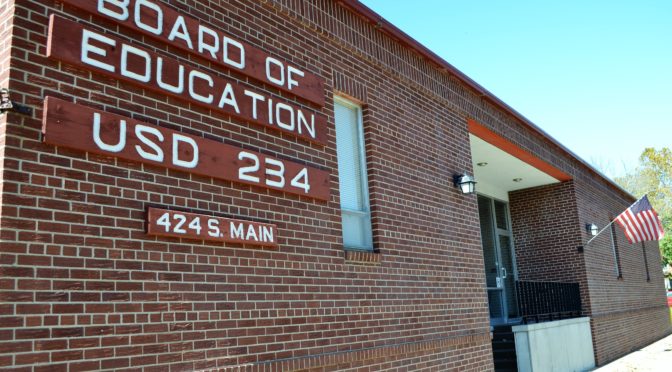
Members of the USD 234 Board of Education met at the Fort Scott Middle School Commons on Monday, July 12, 2021, for their regular monthly meeting.

President David Stewart opened the meeting.  The board approved the official agenda.  The old board adjourned Sine Die with the reorganization of the new board.  The board elected James Wood as board president and Kellye Barrows as board vice-president.

The board went into an executive session to discuss personnel items for non-elected personnel.  The board returned to the open meeting.

The board approved the consent agenda as follows:


A.    Minutes

B.    Bills and Claims

C.    Payroll – June 18, 2021 – $2,044,997.49

D.    Financial Report

E.    Activity fund accounts

F.     Designation of banks for deposit of school funds

G.    Designation of newspaper for official school publications – The Fort Scott Tribune

H.    Officers for the 2021-22 school year

I.      Recreation Commission Board Member Terms

J.      Resolution for Waiver of Generally Accepted Accounting Principles

K.    Resolution for Rescinding Policy Statements found in Board Minutes

L.    Resolution to set dates and times for board meetings

M.   Resolution to Establish Home Rule by Board of Education

N.    Resolution for Destruction of Records

O.    Organizational Chart

P.     Set fees for copying of records

Q.    Current state mileage reimbursement rate – $.56

R.    High school fundraisers and extended trips

S.     2021-22 high school Site Council members; dates and times of meetings


Ted Hessong, the Superintendent, reported on the School Board Retreat, ESY, and Summer School, the football field turf evaluation, athletic trainer update, Kansas Can Success tour, and the theme for the 2021-22 school year, FOCUS ON LEARNING.  Gina Shelton, Business Manager/Board Clerk, presented a report.

The board approved the following:


·       Mitigation protocols for students in buildings for summer school

·       2021-22 Negotiated Agreement

·       Revenue Neutral Tax Rate

·       EduCLIMBER renewal

·       Handbook changes


Superintendent Hessong gave a school board self-evaluation report.  In addition, he reviewed Board Policy KGD – Possession of Firearms.  The board tabled any action on this policy.

The board set July 30 at noon for a budget presentation.  In addition, the board set August 25 at 5:30 p.m. for RNR and a budget hearing at 6:00 p.m.

The board selected the following:


·       Hearing officer for suspensions and expulsions – Gary Billionis

·       BEDCO Representative – David Stewart

·       Chamber of Commerce Ex-Officio Board Member – Ted Hessong


Board members shared comments and then went into executive session to discuss personnel matters for nonelected personnel and returned to open meeting.

The board approved the following employment matters:


A.    Resignation of Stephanie Witt, Eugene Ware Principal, effective at the end of the 2020-21 school year

B.    Resignation of Codee Weddle, Winfield Scott paraprofessional, effective at the end of the 2020-21 school year

C.    Resignation of Tammy McDaniel, middle school paraprofessional, effective at the end of the 2020-21 school year

D.    Resignation of Judy Welch, bus driver, effective at the end of the 2020-21 school year

E.    Employment of Justin Robinson as Fort Scott Middle School/Fort Scott High School band instructor and for band presentations at middle school and high school for the 2021-22 school year

F.     Employment of Matthew Wells as a 4-hour bus driver for the 2021-22 school year

G.    Employment of Wanita Tate as a 5.5-hour preschool bus driver for the 2021-22 school year

H.    Employment of Winfield Scott supplemental employees for the 2021-22 school year

I.      Employment of high school supplemental employees for the 2021-22 school year

J.      Employment of Whitley Chesney for middle school music presentations for the 2021-22 school year

K.    Recommendation for Andrea Scott, FSPC Principal, to be district Special Education Coordinator for the 2021-22 school year

L.    Employment of Carlee McCullough as a preschool teacher for the 2021-22 school year

M.   Employment of Josh Hudiburg as a high school assistant football coach and Jacob DeLaTorre as high school assistant freshman boys’ basketball coach for the 2021-22 school year

N.    Transfer of Yasmina Query, Eugene Ware fourth grade teacher, to Eugene Ware Principal for the 2021-22 school year

O.    Resignation of Curt Toll, high school assistant track coach, effective at the end of the 2020-21 school year

P.     Combining three custodian positions (5.5 hours for 12 mo.; 3.5 hours for 10 mo.; 8 hours for 10 mo.) into two custodian positions (8 hours for 10 mo.; 8 hours for 12 mo.)


The board approved a Resolution for Bank Account Signers  In addition, the board approved a 1.5% increase in salary for administrators and classified employees for the 2021-22 school year.

The board adjourned.