
Advertising on FortScott.biz lets you solve the mystery of how to stay relevant as a small business in a rural local market. Reach out to advertising@fortscott.biz to find out creative ways your business can gain more customers.
All posts by Mark Shead

Opinion: County Allowed To Run Road Graders Under The Commissioners New Law?
In the Bourbon County minutes from December 19th, 2017, the county voted to buy 2 Caterpillar 120M2 road graders. Presumably, those are still being used. According to the spec sheet, these tractors are 8 meters long and produce 106 dB when measured in accordance with ISO 6395:2008. That ISO standard says that noise levels for equipment that is 8 meters long should be measured from 16 meters away.

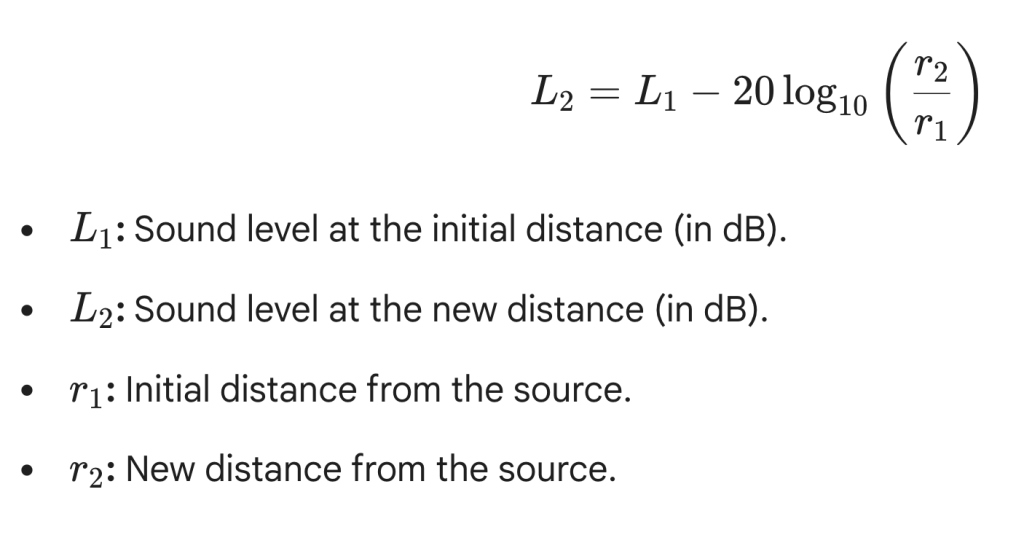
If a sound is 106 dB at 16 meters (~52 feet), it will be right around 102.9 dB at 75 feet.
Feel free to double-check my math. Here is the sound attenuation formula I used.
According to Bourbon County Ordinance 50-25, which Tran and Beerbower voted for, but Milburn voted against, the following is illegal:
Any noise greater than 55 dB outdoors (7 a.m. to 10 p.m.) near sensitive areas (residences)….These measurements recorded within 75 feet from the source shall be prima facie evidence of a violation of this section.
The ordinance goes on to say that any person violating this ordinance is subject to a fine of not more than $500, with a new offense (and presumably another fine) for each day the violation is repeated.
Best I can tell, our elected officials have passed an ordinance that makes it illegal to operate a road grader during the day on roads where there is a house. Does the county buy new road graders that are smaller and quieter? Do the roads need to be graded by hand or mules now? Are all the roads in the county going to be paved so road graders are no longer needed? Who pays the fine? Is it the operator or the county commissioners?
Fortunately, the stakes are low for this particular ordinance. If the county ever tries to fine someone (or fine themselves) for breaking this ordinance and it ends up in court, I’m sure a judge would have a good chuckle, asking the two commissioners what they were thinking when someone they tried to fine $500 points out all the county operations that fall under the wide umbrella of 50-25.
It is silly and kind of funny. To be fair, everyone makes mistakes. Many mistakes are what we call honest mistakes. Other mistakes are considered negligence. The difference is whether the decision-maker acted with prudence or recklessness. Neither of the two commissioners who voted for it thought to ask, “How loud is the equipment the county operates compared to what we are trying to outlaw?” Neither of the two commissioners who voted for it thought to ask, “How loud is my air conditioner?” Neither of the two commissioners who voted for it thought to follow their lawyers’ advice when he suggested the proposal be given to the planning committee for consideration of the potential impact.
What do you think? Is 50-25 an honest mistake, or is it a sign of recklessness?
Note: FortScott.biz publishes opinion pieces with a variety of perspectives. If you would like to share your opinion, please send a letter to news@fortscott.biz.

Ad: GriefShare Seminar & Support Group
GriefShare is a non-denominational 13-week seminar
support group.
Professionally developed videos and a workbook give you
practical suggestions from counselors, pastors and experts
in grief recovery, along with group participation.

We all grieve differently.
There are no rules nor measurements such as time.
For more than 25 years GriefShare has helped over
1 million people heal from the pain of grief.
All materials are FREE, Snacks provided.
Contact Us Today
Mondays 5:00pm—7:00pm
January 5, 2026 through March 30, 2026
Mary Queen of Angels, Room 203
705 S Holbrook
Fort Scott, KS 66701
GriefShare.com/Find a Group or
Text/Call Laura at 740 317-6379
Ad: GriefShare Seminar & Support Group
GriefShare is a non-denominational 13-week seminar
support group.
Professionally developed videos and a workbook give you
practical suggestions from counselors, pastors and experts
in grief recovery, along with group participation.
We all grieve differently.
There are no rules nor measurements such as time.
For more than 25 years GriefShare has helped over
1 million people heal from the pain of grief.
All materials are FREE, Snacks provided.
Contact Us Today
Mondays 5:00pm—7:00pm
January 5, 2026 through March 30, 2026
Mary Queen of Angels, Room 203
705 S Holbrook
Fort Scott, KS 66701
GriefShare.com/Find a Group or
Text/Call Laura at 740 317-6379

Opinion: The Government Is Here To Protect You From “Heating Toss” (Hot Potato?)
When the noise resolution was presented on Monday, the commissioners’ lawyer said it should be given to the planning committee. After hearing this recommendation, Beerbower moved to vote on it in the current meeting. He and Tran passed it over Milburn’s objections.
If you read through what they voted for, you’ll notice something interesting in this section: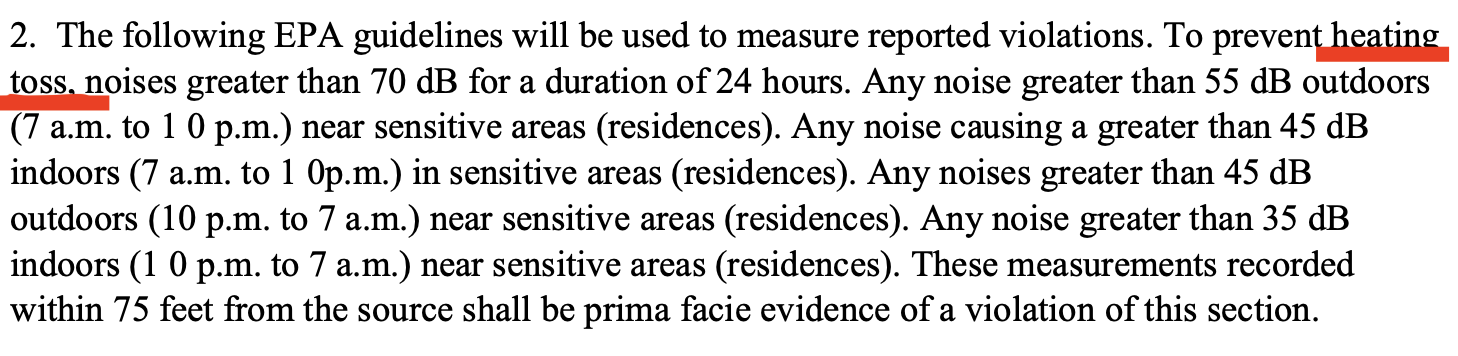
Now you might see the term “heating toss” and assume it is a misspelling that just went unnoticed. Perhaps the commissioners who voted for it treated the whole adage of “read things carefully before you vote for them” just like the “listen to your lawyer.” Stuff like that might be nice to say, but don’t let it get in the way of creating new regulations for the taxpayers. What good is a commission meeting if the citizens have the same legal rights after the meeting as they had before?
So while you might think they didn’t actually take the time to read it, why assume the worst? I’d like to suggest that we assume the best!
Let’s assume Beerbower and Tran DID indeed read it carefully, thought through exactly the repercussions of what the document says, carefully examined any side effects, and believe it does exactly what they want to see enacted for the betterment of Bourbon County. If we make those assumptions, maybe “heating toss” is the name of a game, a time-honored tradition that has been played in Bourbon County all the way back to the time when dragoons camped at Fort Scott, and bison roamed the plains.

The game is often called “hot potato.” With careful reflection, Tran and Beerbower have determined that they want to prevent people from playing “Heating Toss” (aka “hot potato”) in Bourbon County. You may think it is a harmless game, but they know better and have made a law to fine people who introduce this hated game (well, hated by two of the commissioners anyway) into the county. It is for the betterment of the county as a whole! You may think that you’d rather live in a county where commissioners do not waste their time making laws against various children’s games, but you’d be wrong. Wrong, wrong, wrong. Your government knows better. You may just be too dumb to understand.
That’s the optimistic view that assumes they carefully read what they voted on. Or maybe, just maybe, they just didn’t take the time to read what they were voting for.
Had they read it, you’d think they might have questioned whether it was a good idea to fine people $500 for “any noise” that is greater than 45 dB at 75 feet between the hours of 10 pm and 7 am. That is a level of sound that includes things like older air conditioning units, a dog barking, a donkey braying, or starting a semi.
But surely they wouldn’t vote for something they didn’t fully understand or hadn’t read. Right?
Ad: GriefShare Seminar & Support Group
GriefShare is a non-denominational 13-week seminar
support group.
Professionally developed videos and a workbook give you
practical suggestions from counselors, pastors and experts
in grief recovery, along with group participation.
We all grieve differently.
There are no rules nor measurements such as time.
For more than 25 years GriefShare has helped over
1 million people heal from the pain of grief.
All materials are FREE, Snacks provided.
Contact Us Today
Mondays 5:00pm—7:00pm
January 5, 2026 through March 30, 2026
Mary Queen of Angels, Room 203
705 S Holbrook
Fort Scott, KS 66701
GriefShare.com/Find a Group or
Text/Call Laura at 740 317-6379
Request for Proposals for Sale of Property for County
Ad: GriefShare Seminar & Support Group
GriefShare is a non-denominational 13-week seminar
support group.
Professionally developed videos and a workbook give you
practical suggestions from counselors, pastors and experts
in grief recovery, along with group participation.
We all grieve differently.
There are no rules nor measurements such as time.
For more than 25 years GriefShare has helped over
1 million people heal from the pain of grief.
All materials are FREE, Snacks provided.
Contact Us Today
Mondays 5:00pm—7:00pm
January 5, 2026 through March 30, 2026
Mary Queen of Angels, Room 203
705 S Holbrook
Fort Scott, KS 66701
GriefShare.com/Find a Group or
Text/Call Laura at 740 317-6379
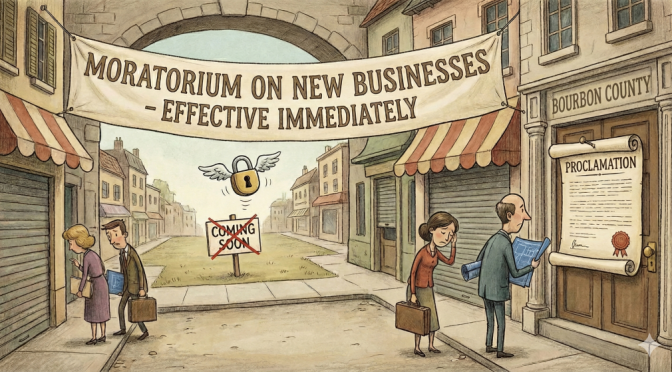
Opinion: Proposed Moratorium On All New County Businesses
In October, I wrote a piece about how the commissioners had passed a resolution to ban running a particular computer program. Ostensibly, they were trying to make it illegal to run loud generators, but instead of writing an ordinance about generators or sound, they issued an ordinance that would include three silent computers that can fit in the palm of your hand without saying a single thing about what they claimed they were trying to address.
Despite having full access to paid legal counsel, despite technologically savvy citizens who are happy to provide advice for free, despite knowing that the issue with a loud generator is, well, the loud generator, the commissioners managed to pass an ordinance that was completely divorced from the actual sound problem. It was written to ban what a tech- and business-savvy middle schooler might run in their bedroom, while being useless when it comes to preventing another identical generator-run installation that uses a different algorithm.
If the commissioners, in an effort to prevent loud, noisy generators, accidentally ended up banning things so trivial, we should be very concerned that when they spend your taxpayer money in lobbing their nuclear bomb of zoning at solar and wind installations, it might not only miss what they say is the mark, but do significant collateral damage. That was my concern back in October. What happened since that silly moratorium made me realize that I severely underestimated just how bad that blast radius could be.
There is a planning committee created by the commissioners to make recommendations on zoning. As usual, this committee contains people who were not elected. They also didn’t go through the normal process of having citizens submit letters of interest. Instead, the members were hand-selected by the commissioners. This isn’t necessarily a bad way to select people and it has a distinct advantage for anyone trying to figure out where the commissioners are trying to take the county. This hand selection means that when the committee passes a resolution, it is being made by the people the commissioners felt most represented their goals for the future.
So with that background, residents should be paying very close attention when the planning committee votes on a resolution. We got a very insightful glimpse on page 7 of the agenda packet for the commissioners meeting on 11/17. There was a resolution, passed unanimously by the planning committee, that said:
The Planning Committee, passes unanimously. recommends that the Bourbon County Board of Commissioners enact a moratorium, effective immediately, requiring that any new business—specifically, commercial or industrial—that is not agricultural in nature and located in unincorporated areas of the county, be required to obtain a special use permit prior to commencing operations. This moratorium should reference the existing Bourbon County zoning (taxation) map as the basis for determining current land use designations.
The purpose of this moratorium is to protect the county and its residents while the Planning Committee continues the process of developing more detailed and comprehensive zoning regulations.
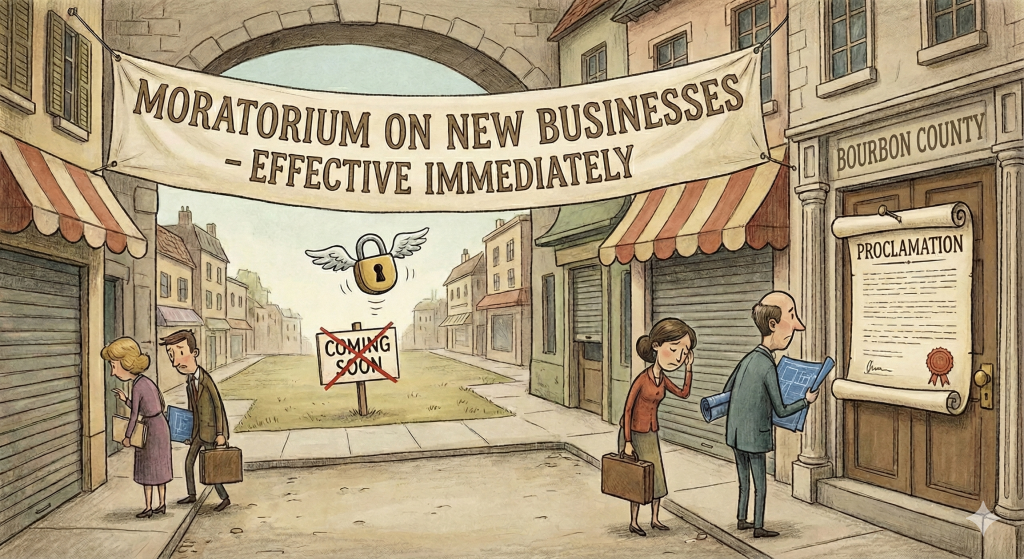
There were some legal issues with the recommendation, so the commissioners didn’t end up discussing it, but even if they couldn’t put a moratorium on all businesses worded in this way, it doesn’t diminish the desired goal. We can clearly see what the committee (and the commissioners who appointed them) see as a desired future. The planning committee, that hand-selected group the commissioners thought were the best people in the county to accomplish their zoning goals, unanimously resolved to recommend a moratorium on all new non-agricultural businesses in the county. It didn’t pass by a small margin; it wasn’t just discussed. They unanimously passed a resolution to make this recommendation, and that is a very big deal.
Some might say it was just the political back and forth and doesn’t really mean anything, that some of the people voting for it didn’t think it would pass, etc. But consider the actual implications: If you want to start a commercial lawn mowing business and you are outside the city limits, they want you to have to get special permission from the commissioners. If you want to start a business doing small manufacturing of high-end telescopes, the resolution recommends that your business should be illegal until the commissioners give it their blessing. If you want to start exercising your skills as a mechanic, start a printing company, create an LLC to make furniture, or anything else in the rural county areas, every single person on this committee voted that you should be required to come hat in hand to the commissioners and answer all their questions about your business and beg them to make an exception to the moratorium to allow you to pursue your business idea.
This desired change by the planning committee is a fundamental shift. We currently live in a county where the default position is that you are allowed to start any legal business and move forward with it. You might have a good idea and do well. You might have a bad idea and go bankrupt. Either way, you are free to pursue your capitalistic endeavors without being subject to the whims, biases, and the sometimes general confusion of the commissioners.
For an average member of the community, voting for a resolution to recommend such an action would have come with a huge reputational risk. Would you really want to be on the record as having voted to move from a default of saying yes to business to a default of saying, “you have to get permission from the commissioners first”? Somehow, not a single person on the committee, who I might remind you, were hand-selected by the commissioners, looked at the resolution and said, “I’m not sure I want my name on something that does this to our local economy.” Instead, every single one voted for it.
As I’ve said before, the issue with zoning is not whether there is a hypothetical way to implement it that would do no or only minimal harm. The question is how likely we are to get a future where the damage from zoning isn’t egregiously worse than whatever the commissioners think they are trying to attack by this massive expansion of their powers. This unanimous resolution from the planning committee gives us a peek into the future we are headed toward, a future that further increases the probability that the “cure” of zoning will turn out to be worse than the “disease.”
Mark Shead
Note: FortScott.biz publishes opinion pieces with a variety of perspectives. If you would like to share a perspective or opinion, please send a letter to news@fortscott.biz.
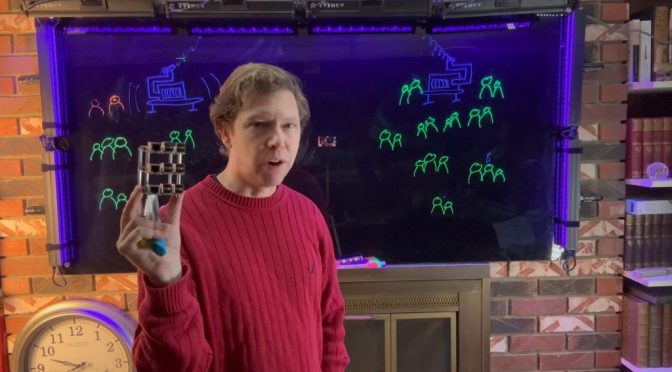
Opinion: Two approaches to dealing with loud generators
Mark explains two approaches to dealing with loud generators. This video shows the protections we have in place today and contrasts them with the proposals for the future.

Opinion: Bitcoin, Noise, & Zoning’s Future
In a recent county commission meeting, a moratorium on commercial bitcoin mining was passed. The moratorium makes it illegal for an entity to run a cryptocurrency mining algorithm if it meets the following criteria:
- Contains 3 or more interconnected computers.
- Is operated for commercial purposes.
If it isn’t immediately apparent the breadth of what the commissioners have voted to ban, here is a photograph of three computers that can be interconnected, can be used to mine cryptocurrency, and are owned by a commercial entity.

Why would the commissioners write a moratorium that would ban a particular algorithm from running on these three computers that can fit in the palm of your hand? It all goes back to a complaint by Cassie and Dereck Ranes, who reside in the county. (It isn’t clear exactly when they moved in, but tax records show they made their first tax payment on a modular home in January of 2025.) In 2024, a company called Evolution Technology, LLC leased a gas well across the road from them and at some point after January of 2024 put a large generator on it to run a bitcoin mining operation.
The Ranes say the sound of the generator is unbearable, even to the point of making it difficult to sleep. While the Ranes have standing to seek resolution in civil court under existing Kansas nuisance laws, they have not chosen to exercise that option. The county does not currently have standing to do anything on their behalf. The Ranes and other neighbors asked for this moratorium to prevent any new bitcoin mining operations from being started. A moratorium does nothing to deal with existing businesses operating in the county and would only stop new installations from operating.
Imagine that you have a problem with cars driving by the front of your house at high speeds. You go to the commissioners to complain and mention that there is a red car that drives by really fast. The commissioners could tell you to talk to law enforcement about laws that were being broken. They could change the speed limit to 45 mph to help slow people down. They might even have the county put a speed bump in front of your house. Those would all be things related to the speed issue.
But what if instead they passed a moratorium on registering cars that match the particular shade of red that you mentioned? What would that do?
- It would deprive everyone in the county of the freedom to buy a car of a particular color.
- It would introduce a huge burden of compliance with silly rules that would need to be enforced by someone.
- It would require the commissioners to spend time and attention doing things that individual citizens can better handle for themselves and away from things that only commissioners can do (deal with benefits, understand the budgeting process, make sure the payroll service they selected can handle the county needs, etc.).
Would it address the actual problem in any way? No. Absolutely not.
Is the car example just silliness, or is it a good proxy for what the county is doing with this moratorium?
When the commissioners wrote the moratorium, the problem at hand was noise, but they inexplicably wrote and passed a resolution that doesn’t contain a single parameter, guideline, or requirement related to noise. Instead, they banned an algorithm with parameters that encompass hardware that a middle schooler might run in their bedroom. (Though the middle schooler might be able to claim they are not operating commercially when law enforcement shows up at their door.)
Would the moratorium keep a company from putting another loud generator on another gas well they have leased? Absolutely not. The moratorium is completely orthogonal to the use of generators, production of sound, or pretty much anything else that is causing an issue. They could put in another installation, exactly like they have now, and run a different algorithm on it. For example, their setup would be perfect for training large language models.
I suppose the commissioners could try to pass another moratorium this time to ban a different algorithm. If they used a similar definition, they could ban people with a job working on AI training models who happen to have more than three computers in their home. The commissioners can play whack-a-mole with various algorithms without ever actually addressing the underlying problem. What if the commissioners finally decide to ban any GPU installation capable of more than 20,000 tera hashes per second? That would take care of the noise problem, right? Well, no. The generator can still be used to charge electric vehicles, pump water for irrigation, and all the other things that electricity can be used for.
While the moratorium is a bit silly with problems a crypto-savvy high-school student could have pointed out, it seems unlikely it could legally be applied to everything it technically applies to. However, I believe it points to a much bigger problem with the direction the commissioners are trying to go with zoning. As I’ve mentioned before, under the best conditions, maybe zoning would have some positive aspect for the county. There is some theoretical possible future where zoning does more good things than it does bad. But this moratorium illustrates that there are many more possible futures where zoning creates a huge mess.
How do we know what type of future zoning would have in Bourbon County? This moratorium is a good way to predict what would be a probable future. With full access to legal counsel and citizens who are willing to look over technical details, the commissioners managed to pass a moratorium that is completely divorced from the actual problem they were trying to address and is so broad that it covers things people run under their desks and even things that would fit in the palm of your hand.
In an effort to pass a moratorium quickly, no one stopped to consider what was actually in the documents they were signing. Imagine that same type of decision-making process being applied in the future with an expanded set of powers under zoning. This particular example is relatively benign, but it should serve as a warning about where the commission is trying to take the county with zoning.
Mark Shead
Note: FortScott.biz publishes opinion pieces with a variety of perspectives. If you would like to share a perspective or opinion, please send a letter to news@fortscott.biz.

Opinion: How Big of Government Do You Want?
I was recently in another state visiting a county, not all that different from Bourbon, and looked at their taxes. Property taxes were double what I pay in Bourbon County for a house with a similar appraised value. As high as taxes seem locally, there are places that have grown the size of their government to where they are much higher.
When confronted with the fact that other people are paying twice as much in property taxes, you probably had one of two reactions. If you like bigger government, you might think, “Wow, think how much more our county could spend if we could double property taxes!” If you like smaller government, you probably think, “Wow, how do we keep our county from becoming like that?”
A few months before George Washington took office, Jefferson wrote, “The natural progress of things is for liberty to yield, and government to gain ground.” Whether you fall into the “bigger government is better” camp, or you are aligned with “smaller is better,” Jefferson’s quote gives you a blueprint. If you want a bigger, more powerful government, you simply have to let government take its natural course and undermine efforts by anyone who wants to prioritize liberty that would constrain government growth and spending.
On the other hand, if you want a small government, you have a much harder job. Why is it so much harder? You have to be willing to give up having control of some things that you consider good, in exchange for keeping government small.
For example, if Bob built his house right next to his neighbor’s property line and the neighbor decides his life goal is crossing roosters, guineas, and emus to try to set a world record for the world’s loudest bird, Bob might be inclined to support some type of county-wide noise ordinance.

If Jane really wants a county-run indoor skydiving facility, she might be inclined to support a new sales tax so she can get other people to pay for it. If John feels that the ~$20,000 spent on his little Johnny in the public school is half as much as he’d like to see spent, he might support dramatic increases in property taxes to drive it up to $40,000—especially if John doesn’t own much property and thinks the burden will fall more on his neighbors.
While those may seem like silly examples (though I have heard people supporting the school spending one), they illustrate the fact that everyone has things they would like to see the government demand of or take from their neighbor.
This is the natural progression that Jefferson describes. Citizens that think controlling or taking money from their neighbor is more important than keeping government small will end up with a very large government and a large tax bill. Citizens that feel that their neighbor’s liberty is more important than their own personal convenience have a shot at keeping government small and their tax bill constrained.
This is one of the reasons I am opposed to Bourbon County exceeding the revenue-neutral rate. Spending has grown by 11.2% over the last two years. If we start by asking “What do we want to pay for?” the budget will always go up. If we start by saying, “Here is how much we have to spend,” then careful prioritization will make sure we retain the most important functions while constraining the growth of government.
This is also one of the reasons I’m opposed to the commissioners’ current efforts to implement zoning in Bourbon County. While I can see some ways that zoning might be beneficial, even some things that would benefit me personally, making the county government even bigger in our current situation comes with a cost, both in dollars and loss of freedom, that far outweighs any benefit.
Mark Shead
Note: FortScott.biz publishes opinion pieces with a variety of perspectives. If you would like to share your opinion, please send a letter to news@fortscott.biz.