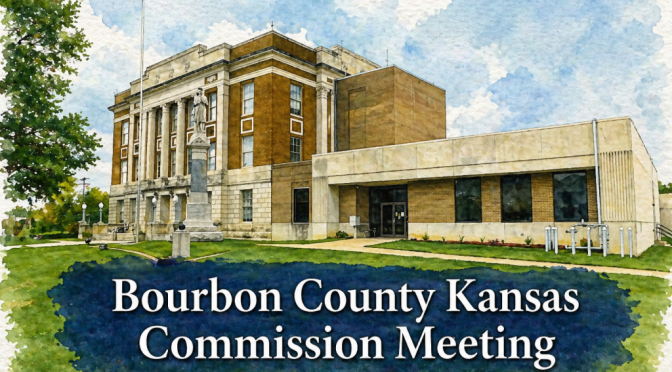

The Bourbon County Commission met Monday, June 29, 2026, with a Public Works budget work session scheduled to follow. With out-of-town guests waiting and the work session ahead, the board trimmed its agenda at the top — tabling several items, including the Jarred Gilmore Phillips audit engagement, an American flag purchase, a resolution-adoption procedure, Resolution 25-26 on canceling warrant checks, and Heartland business-license billing — and added an economic-development update, a Chamber of Commerce item, and an executive session for non-elected personnel.
Comprehensive plan: firm in place, funding unresolved
Planning Commission representative Brian Ashworth presented the “best and final” offer from Confluence, the firm the board selected on June 15 to write the county’s comprehensive plan and zoning code. Confluence lowered its price from $152,000 to $116,500 by combining the end of the planning phase with the start of zoning, trimming public-engagement sessions, and removing outside legal-review fees (items that can be added back later by change order).
The commission did not sign the agreement, opting first to settle how to pay for it. Chairman Samuel Tran favored signing immediately, noting the contract can be terminated at any time with the county paying only for work already done: “I say, let me sign it just so we can get the wheel moving, because in the end we can cancel if we haven’t done anything, right?” Commissioner Gregg Motley pushed back: “I would prefer to know how we’re going to pay for it first.”
The commission voted to add a resolution for payment after the public comments portion of the meeting.
With the county’s financial advisers from Baker Tilly at the table, commissioners weighed several funding sources for the project, which is not in the current budget:
- Inmate-reimbursement fees — Commissioner Mika Milburn-Kee believed about $150,000 was available, but Baker Tilly’s Ben Hart corrected the figure to roughly $50,000 and advised against using it, because the fund reimburses the sheriff’s inmate-housing costs (about $320,000 a year) and helps keep that office under budget.
- FEMA funds — Commissioner David Beerbower said about $600,000 is available but should go to Public Works.
- Solar-agreement money — Beerbower asked outside counsel to report on possible funds tied to the Tennyson Creek and Hinton Creek solar agreements.
- Year-end budget savings — Hart suggested pooling unspent money from across departments (unfilled positions, unbought commodities) as a one-time source.
Commissioner Joe Allen said, “I don’t want to touch the sheriff’s funds. I really think that FEMA money should go back to Public Works also.” He expressed the need to be creative in finding the funding.
Motley agreed with Allen and Beerbower about not touching the sheriff’s money or the FEMA money. He also mentioned that situations like this are why it’s important for the county to carry cash reserves.
Tran asked the advisers to “please, find us the money somewhere.” He expressed concern that the money be found and encumbered so that it cannot be spent elsewhere. Hart agreed that has been the county’s history. He also applauded a funding resolution as a step that puts everyone on the same page.
Baker Tilly is expected to bring year-to-date figures and a forecast back to the board at its next meeting, and Beerbower expects an update on the solar money from outside counsel.
Accounts payable, financials and minutes
The commission approved both accounts-payable batches — $83,374.82 (June 18) and $453,809.91 (June 26) — but pulled a single postage line of about $3,011 pending an explanation and invoice, after Milburn-Kee questioned why a “postage overage” charge was being billed to the courthouse general fund rather than a department budget. The board also approved the May 2026 financials and the minutes for the June 15, May 11 (revised) and April 13 (revised) meetings.
Public comments
Al Neese updated the board on a local museum group’s plans for the downtown depot and its interest in the Moody building, announcing the group had been gifted a “Katie Caboose” from Houston that morning, with the pad poured and track work expected soon.
Don Tucker, along with Jennifer Simhiser, live-in manager at Redemption House, asked the county to use Opioid Settlement Fund money to replace the Redemption House roof, which has a hole causing water damage; three companies recommended full replacement. The lowest bid they got for a new roof is $24,000. The roof has been patched, but it is 30 years old and cannot withstand more patching.
Commissioners were unsure how much opioid money remained after an earlier transportation expense and questioned whether the bid covered needed roof decking. A motion by Beerbower to fund the roof did not carry, but Tran said they would add it to the next week’s agenda, when they have “the hard numbers” to work with to determine how much money is available in the opioid fund to help with the need.
Juvenile detention
Commissioner Allen reported on a Southeast Kansas juvenile-detention meeting, where the recommendation was to stay one more year with the facility in Girard and recruit other counties to share costs, while Sheriff Bill Martin favors switching to a pay-as-you-go arrangement with Johnson County. With a contract deadline of July 1, commissioners were split between staying with Girard, and moving to a pay-as-you-go arrangement with Johnson County.
Motley agreed with Allen’s recommendation. Beerbower agreed with the sheriff’s recommendation. Milburn-Kee asked that Allen “get out there and talk to other counties and do some recruiting” to get them to join in membership with the Girard facility, bringing the costs down for Bourbon County.
Beerbower said that by following the suggestions of waiting a year, the commission is continuing the pattern of kicking the can down the road and not dealing with the issue. “We’re paying for something that we’re not getting the value of our money for,” he said.
A representative from the sheriff’s office said they need to terminate the contract to save money: “Based on what I know from the sheriff being there, we do not want that contract.”
Tran expressed his opinion of NGOs (Non-Governmental Organizations), saying they often raise prices and reduce what they deliver over time. He said that if the county doesn’t terminate the agreement with the juvenile facility at Girard, it will be obligated to them for 2027, as well as the rest of 2026. He suggested banking the money that may be needed to send juveniles to Johnson County, rather than, “to pay for a buffet that you’re not eating from…to me it’s a no-brainer that we should go ahead and pull out of that and use our money the way we want to use it and not be stuck to something that really doesn’t fit our needs.”
Tran moved to notify Southeast Kansas that the county would not continue, Beerbower seconded. Milburn-Kee suggested it was a gamble to forfeit the county’s position at the Girard facility.
Tran called for a vote. The motion did not carry. Beerbower and Tran voted for it, but Allen, Milburn-Kee, and Motley voted against, so the county’s membership at Girard will continue at least until summer of 2027.
Other action
- Chamber of Commerce — the commission approved renewing its Chamber of Commerce membership for another year.
- Jayhawk bridge — the board signed a previously approved engineering contract for the Jayhawk Road bridge (which requires a geological study before fall construction), recommending PEC for the work.
- Executive sessions — the commission held two closed sessions on the performance of non-elected personnel under K.S.A. 75-4319(b)(1) and reported no action out of either.
Looking ahead
Future agenda items include the Redemption House roof, an update from outside counsel on solar money, a discussion of commissioner job descriptions, and the budget. A Public Works budget work session followed the meeting; among the items discussed was a requested $75,068 increase to the landfill budget tied to staffing, fuel and disposal costs. Baker Tilly recommended the board adopt the authority to exceed the revenue-neutral tax rate at an upcoming meeting (a cap, not a commitment), with a second-quarter forecast expected later in July. Current figures for revenue neutral would lower the mill.
Agenda: Agenda summary for the June 29, 2026 meeting (full agenda packet PDF).