
District 4 Commissioner Gregg Motley says the county is pursuing enforcement of a safeguard in the 2022 donation, not seizing a building for Freeman.
Bourbon County has engaged an attorney to determine whether it can unwind its 2022 donation of the former Mercy Hospital building, a step Commissioner Gregg Motley says is about one thing: whether or not the county will still have a hospital in the future.
“The status quo threatens the long-term health care of Bourbon County,” Motley said. “What we need to do is do everything we can to ensure that we have health care in Bourbon County long term.”
Motley, a retired banker seated in January, spoke with FortScott.biz on June 11 after a portion of a memo he wrote for an executive session was posted to a Facebook group. He rejected the spreading claim that the county is taking Kansas Renewal Institute’s (KRI) building to benefit Freeman Health System: the county “does not want to own that building,” and Freeman “is not behind” it.
A safeguard the county built into the donation
The “clawback” is not a legal loophole; it is the remedy the county wrote into the donation itself. Effective Nov. 17, 2022, the agreement gave the former Mercy property and $2 million to Legacy Healthcare Foundation, a California nonprofit. The $2 million could be used only for building maintenance, “development of an Acute Care Hospital and ancillary services,” and reduced rent for community-benefit tenants — the county’s way of tying the gift to keeping health care on the site.
The agreement also set out what happens if the recipient breaks the deal: its “sole and exclusive remedy” is that the property returns to the county, along with a sliding-scale refund — $1 million if the deal is unwound in the first year of operation, $750,000 in years two through four, $500,000 by the fifth. After five years, the county has no remedy at all.
That five-year window — which Motley says closes in November 2027 — is the source of his urgency. The clause exists so that if the recipient fails to deliver, Bourbon County gets the building back instead of watching it slide toward foreclosure or wind up owned by a mortgage company. The claim rests on both Legacy and KRI being in default under the donation agreement and the lease, Motley said.
“The Mercy situation all over again”
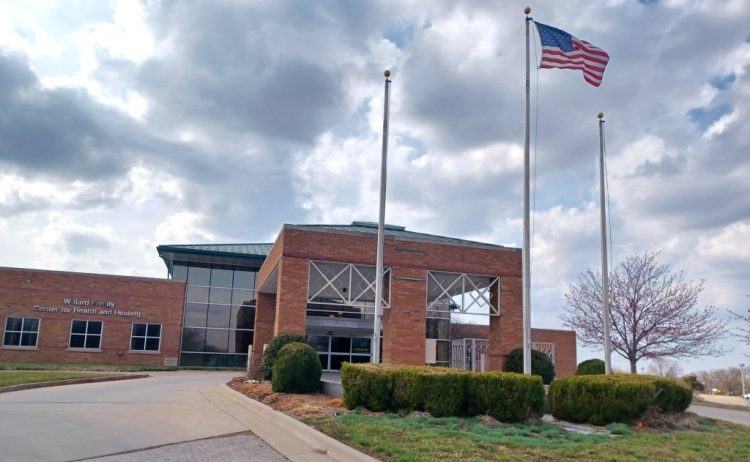
No full hospital has operated there since Mercy Hospital Fort Scott closed in December 2018. Legacy sold the building to KRI, a mental-health treatment center for children and adults, which took ownership in December 2024 and renovated it. Joplin-based Freeman opened a 10-bed hospital and emergency department there in 2025.
Much of his information, Motley said, came from a February briefing where KRI told the Fort Scott city manager, chamber president and others they could share what they heard. By that account and his own research, he said, KRI is losing six figures a month; it paid $8.5 million for the building, and the state has cut its daily reimbursement 34%, issued only a provisional license and so far denied its property-tax exemption request.
“It’s really the Mercy situation all over again,” Motley said. “We just bleed them to death and they leave.” If nothing changes, he said, the county is “likely to lose Freeman in four years,” when a five-year healthcare sales tax and the KRI–Freeman lease expire.
The lease had Freeman staffing 10 inpatient beds on KRI’s side for about $120,000 a month, but the state has refused to license the beds and KRI is in default, Motley said. “That is a big hole in the Freeman budget.”
Those missing payments compound other setbacks, Motley said: a subcontractor delayed Freeman’s opening to September, a collapsed lab deal left a seven-figure hole, and it could not bill Medicare or Medicaid until late February — months “virtually without patient revenue.” Persistent roof leaks and HVAC failures, he said, violate both the lease and the donation agreement.
Questions about the sale
Motley also questioned the financing. KRI says it paid $8.5 million, but Legacy’s IRS Form 990s report $7.5 million — “a million dollars unaccounted for,” he said. Legacy sold a $2.5 million KRI mortgage to Pasadena Lending at 13% interest, well above market. “Risk and rate are conjoined,” Motley said. “A high rate means high risk.”
If KRI fails, the building could revert to Legacy or Pasadena Lending through foreclosure, he said — leaving the county “right back where we started.”
Not just the county
The concern did not start with the commission, Motley said: state and elected officials sought his assessment, and hired Kansas City’s Polsinelli law firm at the state’s own expense. Polsinelli, the state and Freeman all agree the agreement was violated in several provisions, he said, and officials are “dubious” KRI will ever be fully licensed.
A more viable operator
Motley’s premise is that KRI cannot sustain the operation on its own, a conclusion he draws from KRI’s own disclosures of mounting losses, its provisional state license, and the state’s refusal to license its 10 beds. If KRI cannot continue, he said, the question is who keeps the same kind of children’s behavioral-health care going on the site.
His answer is Freeman, whose Ozark Center runs behavioral health across the state line in Missouri. Freeman believes it can do what KRI could not — win full licensing and get the 10 beds approved. They could continue the operation, likely hiring many of KRI’s staff, he said. That would put Freeman in KRI’s place as operator; KRI reported 110 employees in 2024, and its five investors, from California, Colorado and the Midwest, pay what Motley said KRI itself describes as “California wages in southeast Kansas,” above local rates.
Those above-market wages, Motley suggested, also help explain some of the opposition to enforcing the terms of the donation agreement. He acknowledged a tension between residents focused on the county’s long-term health care and some who benefit from KRI’s higher pay and would like to see the operation continue as long as possible. “This is why … I’m not their best friend right now,” he said.
“I have a lot of friends and people I dearly love who work at KRI, and I don’t want to see them harmed,” Motley said. “But my number one priority is that we have health care in Bourbon County for the next 50 years.”
What the county is considering
The commission voted 3-2 to explore legal action — Motley, Joe Allen and David Beerbower in favor, Mika Milburn-Kee and Samuel Tran opposed, Motley said. An initial $10,000, overseen by Motley and county counselor Bob Johnson, funds a review of the claim’s viability and title work on the property.
Delay is costly, he said: the reversion window closes in November 2027, the refund the county could recover shrinks each year, and Freeman’s losses deepen. If the case looks winnable, the first step would be a new donation agreement with Freeman to keep both the hospital and the children’s services running. Other possible fixes could also help without any clawback: Freeman misses new rural-health reimbursement enhancements because it was not open in 2020, and the state could restore KRI’s rate or license the beds, he said.
Conflicts and the closed session
Motley said he resigned from Freeman’s board in December, before taking office, as required by Freeman’s conflict-of-interest policy. “I’ve never taken a nickel from Freeman,” he said. “The board positions were unpaid. I have a Freeman t-shirt, but I paid for it.” He is simply applying “45 years of financial experience in accounting,” he said.
The matter began in executive session to protect KRI, not to hide it, he said. “My hope originally was that we could get to this point in executive session, without disclosures, and protect KRI and everyone else involved until we knew,” he said. “But that didn’t work out.”
He said he does not know who leaked the memo, noting only that someone outside the commission had information about what happened in the closed session.
Motley urged residents with questions to contact him directly, at 620-215-7125, rather than rely on social media. The next step is the attorney’s opinion on whether the county can realistically reclaim the building “to try to make sure it gets in the hands of someone that’s on better financial footing” — and keep a hospital here for decades to come.
Reporting note: This article is based on a June 11, 2026 interview with Commissioner Gregg Motley. Building history and donation terms come from prior FortScott.biz reporting and county records. Characterizations of the finances, licensing, lease and legal views are Motley’s account; KRI, Legacy Healthcare Foundation and Freeman Health System were not interviewed and may differ.