
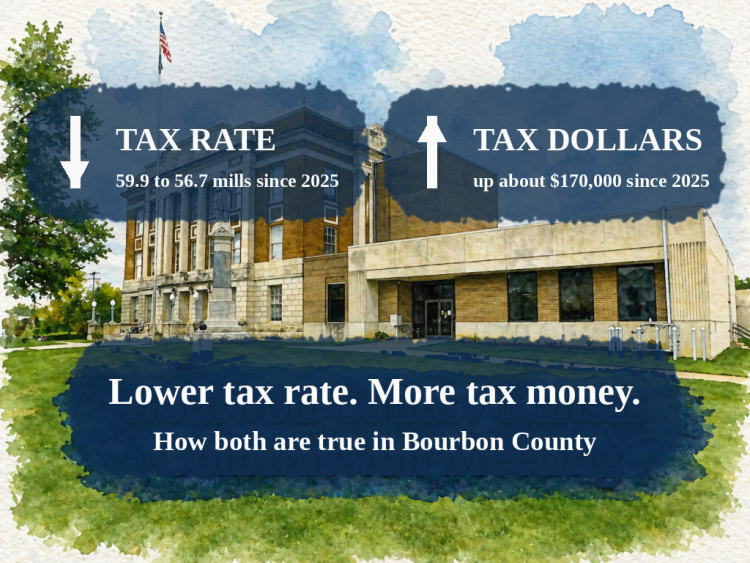
The Bourbon County Commission voted 5-0 Monday night to keep the county’s property tax rate exactly where it is: 56.678 mills. Before it could do that, state law made it hold a public hearing and vote, on the record, to exceed what the law calls the revenue-neutral rate, the rate that would bring in the same dollars as last year.
Why would keeping a rate flat need a hearing about exceeding a rate? Because property values in the county went up, and a flat rate on higher values means the county will be raising the amount of taxes collected.
Start with the mill
Property tax is figured in mills. One mill is $1 of tax for every $1,000 of assessed value.
Kansas does not tax a home on what it would sell for. It taxes a home on 11.5% of that figure, which is called the assessed value. A $100,000 house has $11,500 of assessed value. To get the tax, multiply the assessed value by the mill rate and divide by 1,000. At the county’s rate of 56.678 mills, that is $11,500 times 56.678, divided by 1,000, or $651.80 a year going to the county.

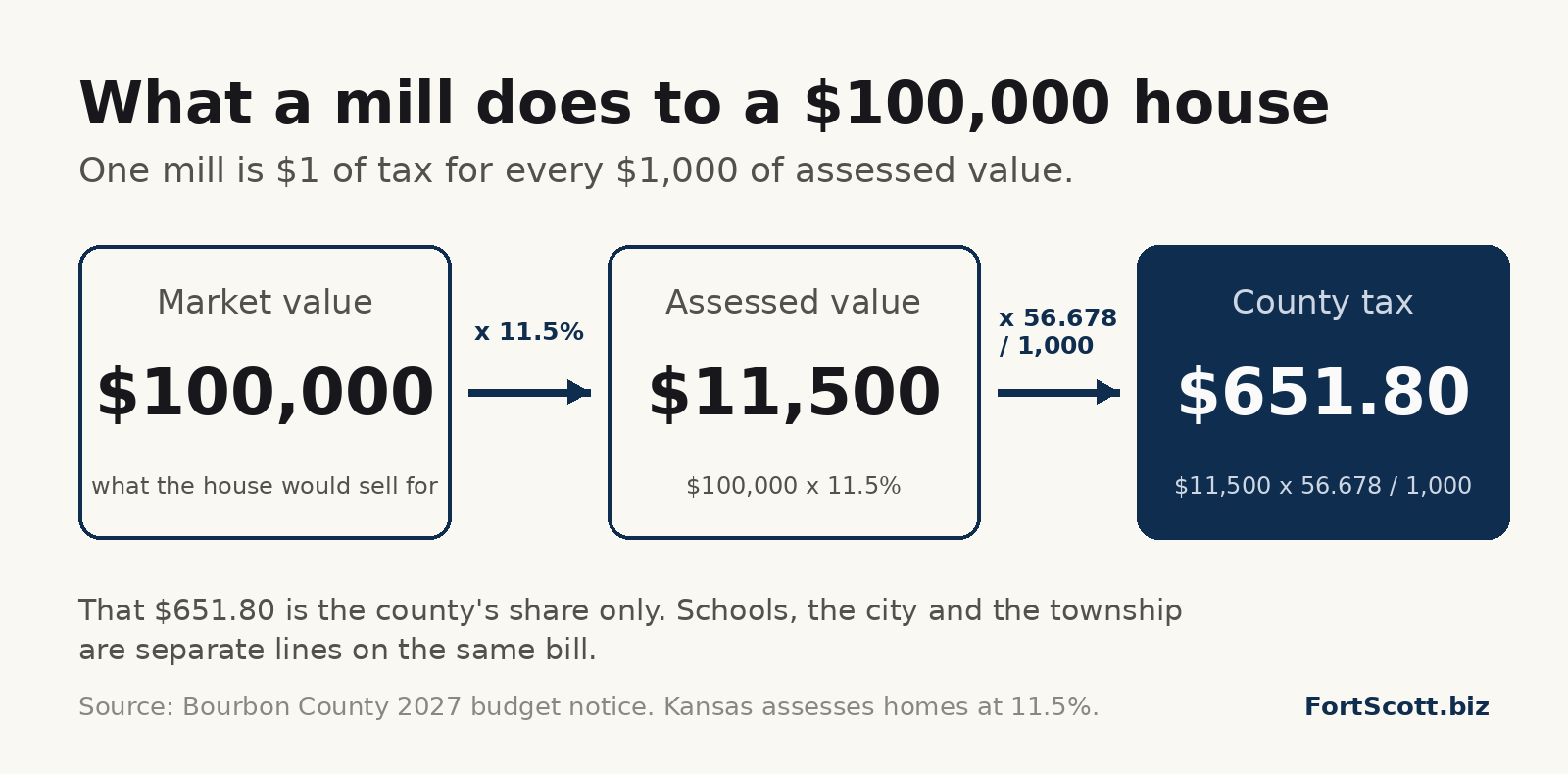
That $651.80 is only the county’s line. The school district, the city and the township each set their own mill levy, and they are separate lines on the same bill.
The revenue-neutral rate is a calculation, not a decision
Every year the county clerk takes the property tax dollars the county collected last year and asks one question: with this year’s property values, what rate would bring in exactly the same dollars? That rate is the revenue-neutral rate. It is based on simple mathematics, and it moves every year because property values move.
For 2027 it came out to 54.661 mills. Last year the county’s property tax levy, the total it charged, was $7,858,151. For the 2027 levy, the county’s total assessed value (the sum total of the assessed value of all the property in the county) is $143,767,695. Multiply that by 54.661 and divide by 1,000 and you get $7,858,486, last year’s money within a few hundred dollars. The small gap is only rounding.
“Flat” does not mean taxes don’t go up
The commission adopted 56.678 mills, the same rate the county is levying this year. Budget consultant Matt Lawn of Baker Tilly called it “a flat mill levy”.
But the same rate on higher valuations raises taxes. Put 56.678 mills on the same $143,767,695 and you get $8,148,465, within a couple of hundred dollars of the $8,148,297 the 2027 budget asks for in property tax. The revenue-neutral rate is 54.661 mills. The commission kept 56.678. That 2.017-mill gap is worth about $290,000 more in county tax.

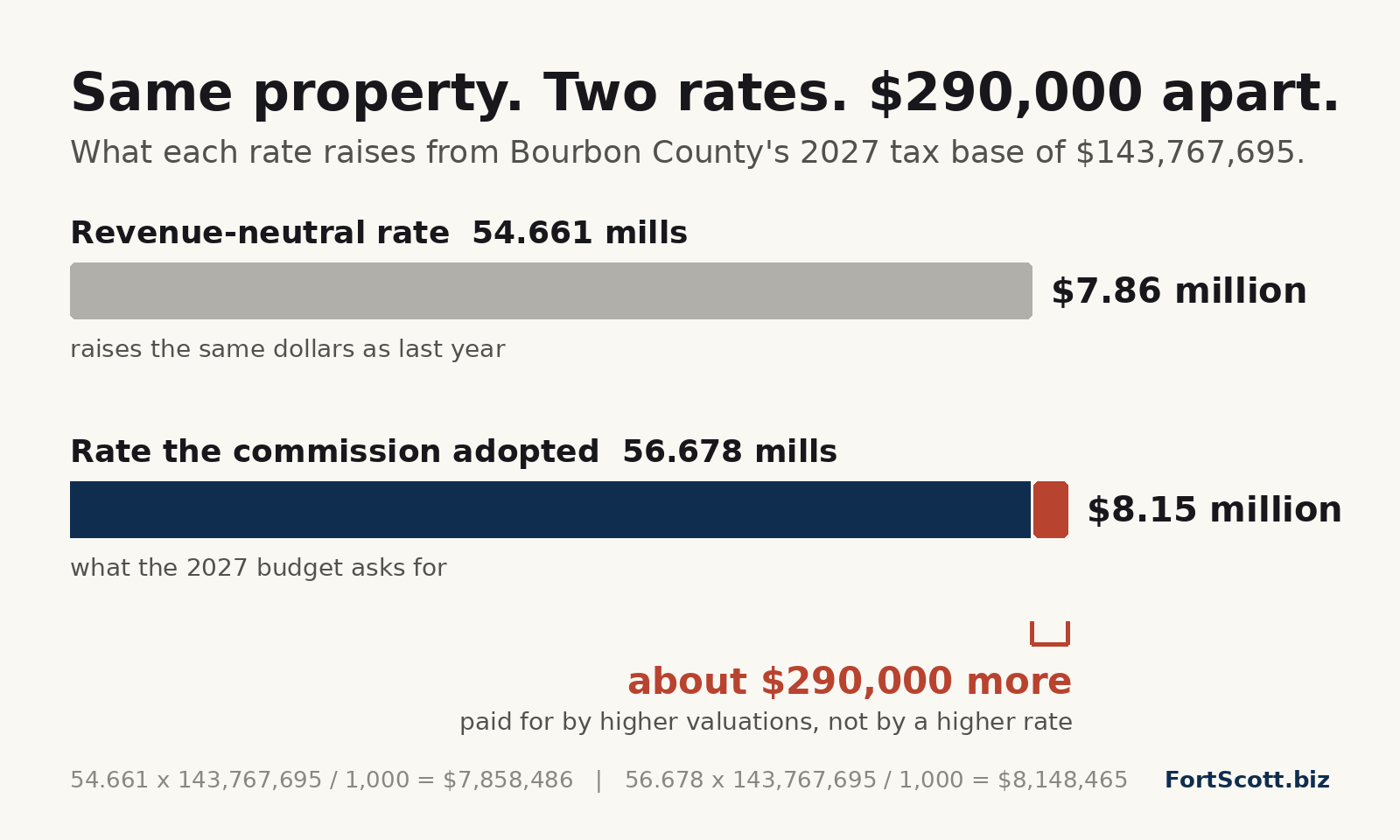
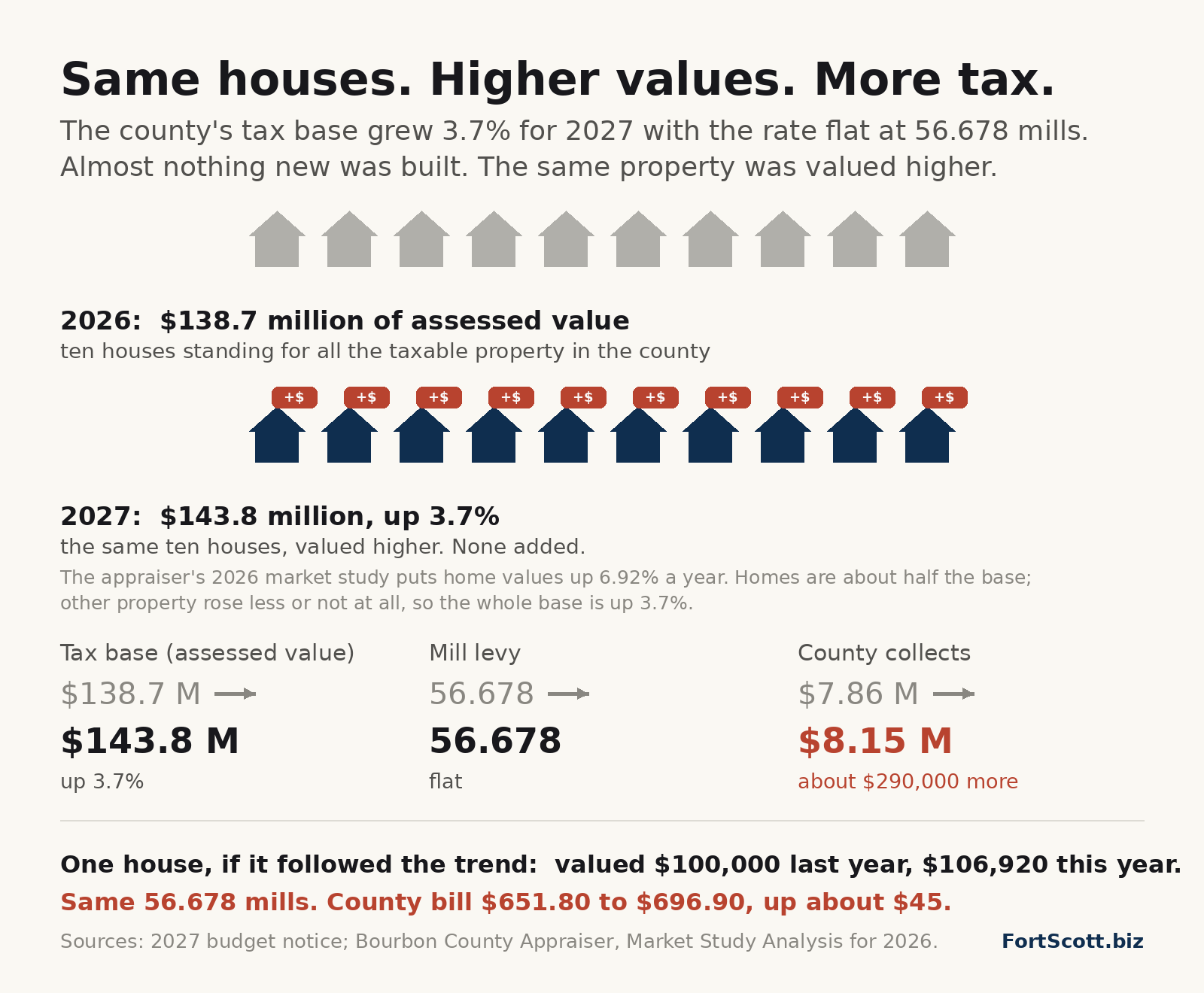
Where did the extra come from? The tax base grew. One mill is $1 per $1,000 of assessed value, so last year one mill in Bourbon County raised about $138,700. This year since valuations have gone up, it raises about $143,800. Higher values on property that was already there, with only a little new construction, added about $5.1 million of assessed value to the county’s tax base (the total assessed value of everything in the county). At the flat rate, that growth raises about $290,000 a year, roughly the gap between the two rates.
Your bill can go down while the county takes in more
Back in 2025 the county’s rate was 59.900 mills, and the county share on that $100,000 house was $688.85. At the 2027 rate of 56.678 mills the county will charge $651.80. The hypothetical $100,000 home that didn’t increase in value would have seen its county tax bill fall about $37 from 2025 to 2027.
At the same time, the county will collect about $290,000 more in 2027 than it would at the revenue-neutral rate. Both things are true, because the county is now taxing a higher total valuation of property. If that were because more homes and businesses had been built, more people would be sharing the load. In Bourbon County that is mostly not what happened. The county’s population has been flat to slightly down since 2020. The county appraiser’s market study for 2026 found home values rising 6.92% a year and commercial property 4.97% a year. Homes are nearly half the county’s tax base and businesses about a fifth, so those two trends together add about $5.8 million of assessed value, more than the whole $5.1 million increase, before counting anything newly built. The growth is mostly the same houses and businesses valued higher, not more of them. When that is what is happening, a flat rate means most county tax bills go up, because most valuations did.

While the rate is down 3.2 mills since 2025, property tax dollars the county levies are up about $170,000, from $7,977,466 to $8,148,297.

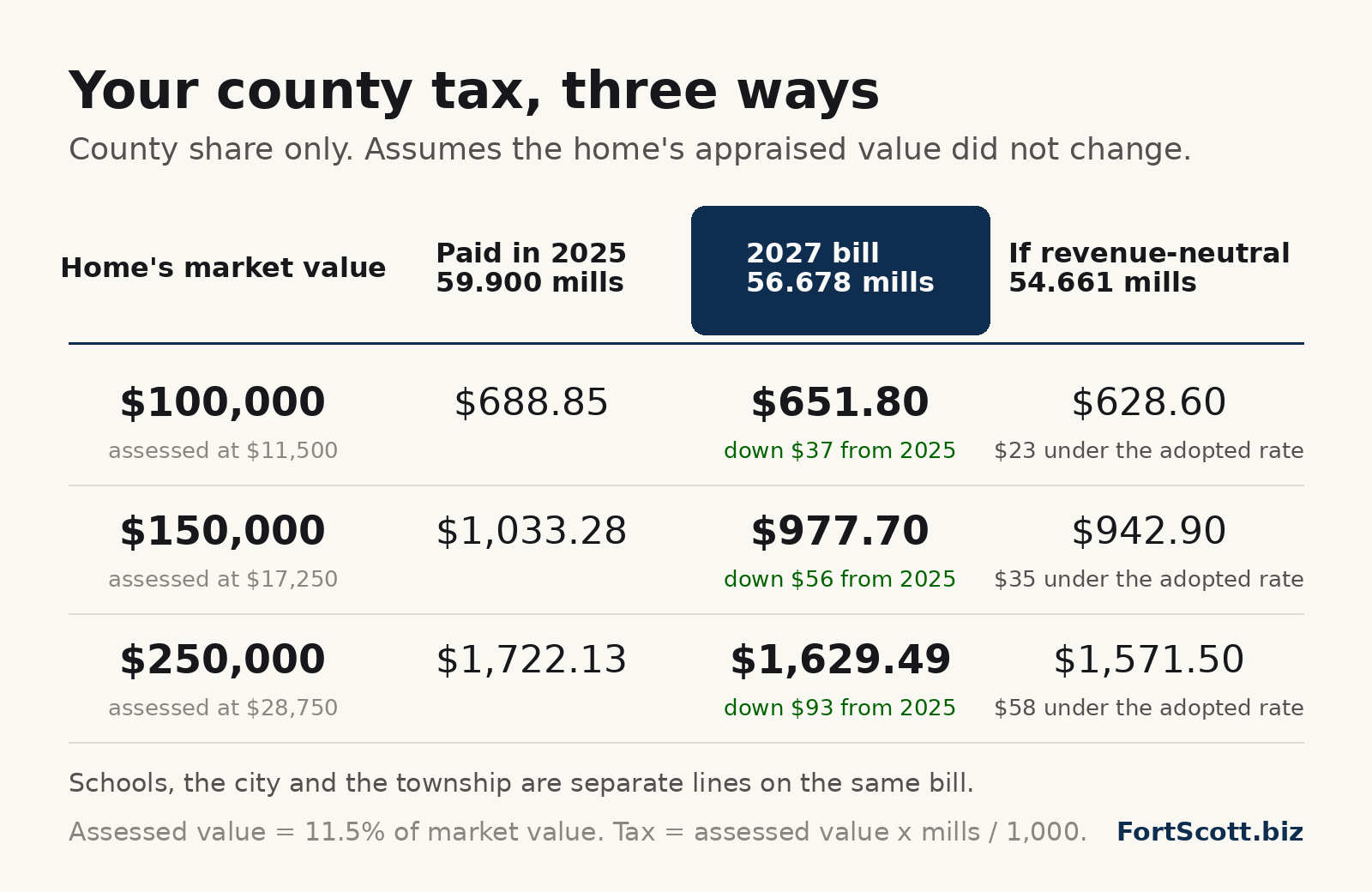
To be clear, your bill only falls if your own valuation did not go up. If your house followed the appraiser’s residential trend, a $100,000 house last year is valued at about $106,920 this year. Its assessed value is $12,296, and at the same 56.678 mills its county share goes from $651.80 to $696.90, up about $45 with no change in the rate. That is also $8 more than the $688.85 it paid in 2025, even though the rate is lower. Whether your own bill went up or down depends on the valuation notice you got this spring, not on the rate alone.
Why the law makes them hold a hearing
Since 2021, Kansas law (K.S.A. 79-2988) has required any city, county or school district to hold a public hearing and take a recorded roll-call vote if they intend to increase the total amount they are taking in taxes. It doesn’t matter whether the rate goes up or down. The hearing is triggered whenever the rate is above the revenue-neutral rate, the rate that would collect the same dollars as the year before. That applies even when the rate itself has not changed, which is Bourbon County’s situation this year.
The reason is the arithmetic above. Before that law, a county could adopt the same rate year after year while rising valuations raised the dollars it collected, with no separate vote on the increase. The rate was voted on. The extra money was not. The hearing and roll call require that extra money to be approved in public, with each commissioner’s vote recorded.
What happened Monday night
Commission Chairman Gregg Motley opened the hearing a few minutes into the Sept. 14 meeting, Lawn laid out the two rates, and Motley asked for public comment.
The only person to question the numbers was Deputy County Clerk Michael Hoyt, who asked why the published notice showed the county’s 2026 assessed valuation as zero. Lawn said “there was an error in the spreadsheet” and that he was correcting it. The figure was given in the room as $138,681,091.
Motley asked twice more for comment. “Going once, going twice,” he said. There was none.
He read the resolution, and the clerk called the roll. Joe Allen, David Beerbower, Mika Milburn-Kee, Motley and Samuel Tran all voted yes. The 2027 budget itself, about $20.1 million in total spending, was not adopted that night. Our story on the full meeting has the budget details, and the Sept. 11 work session on wages and transfer-station rates covers the spending behind those mills.