
Late in the spring of 2014, a Bourbon County man was working outdoors on his property. He picked up several tick bites and found one tick on his shoulder swollen with blood.
Within a few days he felt sick to his stomach and weak, with diarrhea. A fever came the next day. On the third day he saw his primary care doctor, who prescribed doxycycline, the standard antibiotic for a suspected tick-borne illness.
The next morning his wife found him barely conscious. An ambulance took him to a local hospital, where doctors started intravenous fluids and intravenous doxycycline and kept testing him. Rocky Mountain spotted fever, Lyme disease, ehrlichiosis: they were all negative. He kept getting worse, and on the eighth day they moved him again, this time to the University of Kansas Medical Center in Kansas City (Mitchell et al., Case Reports in Infectious Diseases, 2026), for what the 2015 report calls further evaluation and management. Two days after that he was in intensive care.
Nobody ignored his symptoms. As he failed to improve, his doctors escalated at every step: from a clinic to a local hospital to a tertiary care center in five days. They ruled out the treatable causes before transferring him.
Every test for the tick-borne illnesses anyone knew about came back negative. Two days before he died, doctors sent a sample of his blood to a Centers for Disease Control and Prevention lab in Fort Collins, Colorado.
Eleven days after his first symptom, he died of septic shock. His blood pressure had fallen past what three separate drugs could hold up, and his organs were shutting down (Kosoy et al., Emerging Infectious Diseases, 2015). Scientists at that CDC lab went on to find a virus never before seen in a sick person in this country.
They named it for the county the man came from. Bourbon virus.
Why the antibiotic did not work
Here is the part worth remembering. Doxycycline is an antibiotic, and antibiotics kill bacteria. They do nothing at all to a virus.
Kansas has numerous bacterial tick diseases, including Rocky Mountain spotted fever, ehrlichiosis, and tularemia. Doxycycline is the standard first-line treatment for a suspected bacterial tick illness. Bourbon virus is not bacterial, and that one difference explains most of what makes this disease dangerous.
When the CDC announced the discovery in February 2015, it said this was the first virus of its kind ever shown to make a person sick in the United States.
It comes from the lone star tick
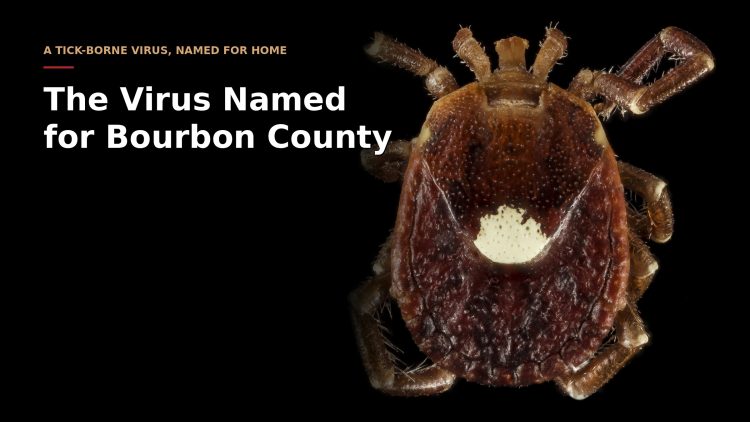
Bourbon virus is believed to spread through the bite of an infected tick, and every known case has followed one. The only species ever confirmed to carry it is the lone star tick, identifiable by the small white dot on the female’s back. A 2023 review of the research notes that in the five cases known at that point, the species of the tick that bit each patient was never identified.
This is not a rare or exotic tick. In a 2024 advisory, the Kansas Department of Health and Environment called the lone star tick the most common tick in Kansas, living across at least the eastern two-thirds of the state and biting people aggressively.
Scientists have also found the virus in ticks collected in the wild. A CDC team tested more than 39,000 ticks collected in northwestern Missouri in 2013 and found live Bourbon virus in three batches, all of them lone star ticks (Savage et al., 2017).
The second death, also in Bourbon County
In the spring of 2024, a 63-year-old man with well-controlled diabetes was preparing hunting ground in the woods of Bourbon County. He pulled two small ticks off himself that day and found a third on his lower back two days later. None of them were swollen with blood.
A week later he nearly fainted while standing, and went to an urgent care clinic with a headache, sore muscles, no appetite, and swollen legs. His blood pressure was 67 over 54.
He reached intensive care already in multi-organ failure. Within four hours he was on maximum doses of four separate drugs to hold his blood pressure up. His kidneys gave out and he went on continuous dialysis, then onto a machine that takes over the work of the heart and lungs. They gave him doxycycline early, in case this was bacterial. It was not. CDC testing came back positive for Bourbon virus.
Late in his stay he developed a fungal pneumonia, which his doctors linked to the steroids used to fight the shock. He died on his 21st day in the hospital. The report lists that infection alongside the virus as what killed him.
His case was written up by KU Medical Center doctors and published in January 2026 (Mitchell et al., Case Reports in Infectious Diseases). The same report notes that the 2014 patient died at that hospital too. In a June 2024 advisory, state health officials wrote: “This year alone, KDHE has investigated several tickborne disease cases with severe health outcomes, including hospitalizations due to Rocky Mountain Spotted Fever and Tularemia, and a fatal case of Bourbon virus.”
A search of the FortScott.Biz archive found no local news coverage of this death at the time.
Two men have died of this virus after picking up ticks in Bourbon County. Their deaths were ten years apart, both at the University of Kansas Medical Center in Kansas City.
The virus is in ticks here
After his diagnosis, the state health department surveyed the man’s land.
They collected 1,253 ticks, and every single one was a lone star tick. Tested in batches, one batch came back positive for Bourbon virus, and eleven came back positive for Heartland virus, an unrelated tick-borne virus spread by the same tick, which causes a similar illness and also has no cure.
That is a finding from 2024, not a footnote from 2014. The virus remains uncommon, though. Earlier CDC surveys near Bourbon County estimated roughly 0.25 to 0.32 infections per 1,000 adult ticks, and a 2016 survey found none at all.

How rare is it, really
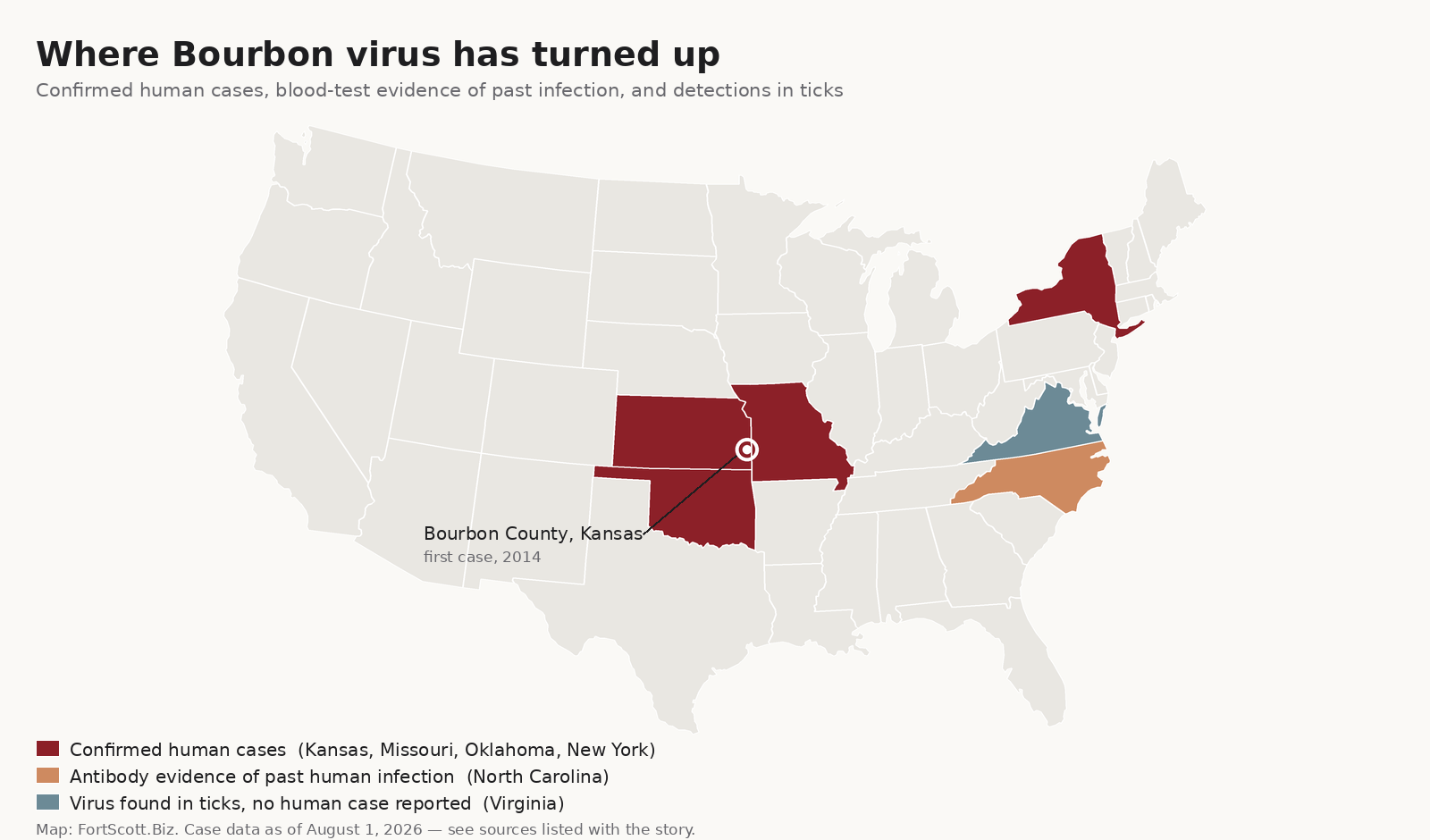
Six human cases have been reported in the medical literature since 2014, in four states: Kansas, Oklahoma, Missouri, and New York. That count comes from the January 2026 case report. The CDC’s own page, updated in June 2026, gives no running total at all.
One of the Missouri cases was a state park official whose death was linked to Bourbon virus in a March 2018 report by The Missourian, a Franklin County newspaper. That case is documented in news coverage rather than in the medical journals, and the 2023 scientific review of the virus cites the newspaper account rather than a case report.
The researchers who study it say the real number is higher. There is no commercial test for Bourbon virus, so a doctor who suspects it has to send samples through the state and then to the CDC. The Stony Brook team notes that many clinicians are unfamiliar with the virus, which raises the chance of a missed diagnosis.
When researchers went looking in stored blood samples in North Carolina, they found four people out of 518 carrying antibodies showing they had been infected at some point (Zychowski et al., 2024). That state has never had a confirmed case.
That does not mean those people got seriously ill, and some infections are probably mild. It does mean the virus reaches more people than the case count shows.
Long Island doctors reported the same kind of finding this summer. They rechecked blood from 107 patients who had a fever after a tick bite between 2019 and 2024, and two carried Bourbon virus antibodies (Bateman et al., American Journal of Tropical Medicine and Hygiene, 2026). One of them was New York’s first confirmed case, identified in April, a patient who had been hospitalized and assumed to have Lyme disease (Stony Brook Medicine, July 2026). Fox Weather reported that the patient recovered.
What to do about it
There is no vaccine and no drug that treats Bourbon virus. Hospitals can give fluids and treat the pain and fever, but they cannot kill the virus.
Since there is no treatment, not getting bitten is the only defense. The advice is the same as for every other tick illness. Treat clothes and boots with permethrin. Use a repellent with DEET, picaridin, oil of lemon eucalyptus, or IR3535. Tuck your pants into your socks. Shower soon after you come in. Then do a real tick check: waistband, armpits, around the ears, belly button, behind the knees, and in your hair. Check the dog too. Pull an attached tick straight out with fine-tipped tweezers, gripping close to the skin.
If you are being treated for a tick bite and not improving, tell your healthcare provider. That failure to improve is the specific clue Kansas health officials tell doctors to watch for.
Kansas health officials tell doctors to consider testing for Bourbon and Heartland viruses when a patient has a fever, a possible tick bite in the last three weeks, certain abnormal blood counts, and an illness that is not responding to doxycycline. Both Bourbon County men were given it. So was the New York patient, who was first thought to have Lyme disease.
The state also says to watch for symptoms for 30 days after a tick bite, and to tell your doctor about the bite. Kansas doctors who want testing help can call the state Epi Hotline at 877-427-7317, option 5.
Sources
- Kosoy OI, et al. “Novel Thogotovirus Associated with Febrile Illness and Death, United States, 2014.” Emerging Infectious Diseases, 2015;21(5):760–764.
- CDC. “CDC and Partners Investigate Newly Discovered Virus.” February 20, 2015.
- Savage HM, et al. “Bourbon Virus in Field-Collected Ticks, Missouri, USA.” Emerging Infectious Diseases, 2017;23(12):2017–2022.
- Roe MK, et al. “Comprehensive Review of Emergence and Virology of Tickborne Bourbon Virus in the United States.” Emerging Infectious Diseases, 2023;29(1):1–7.
- Kansas Department of Health and Environment. “Increased Activity of Vector-Borne Diseases Identified in Kansas.” June 24, 2024.
- Zychowski DL, et al. “Evidence of Human Bourbon Virus Infections, North Carolina, USA.” Emerging Infectious Diseases, 2024;30(11):2396–2399.
- Mitchell A, et al. “Lethal Case of Bourbon Virus Leading to Shock and ECMO Utilization.” Case Reports in Infectious Diseases, 2026;2026:4652171.
- Bateman VA, et al. “Evidence of Heartland and Bourbon Viruses Transmitted by Ticks in Suffolk County, New York.” American Journal of Tropical Medicine and Hygiene, 2026;115(1):140–144.
- Stony Brook Medicine. “The Lone Star Tick Is Bringing Another Infection Concern.” July 21, 2026.
- Fox Weather. “First case of rare, potentially fatal tickborne virus confirmed in New York state.” July 31, 2026.
- CDC. “About Bourbon Virus.” Updated June 17, 2026.
- KDHE. “Heartland and Bourbon Virus Disease: Information for the General Public.” April 2026.
- KDHE. “Heartland and Bourbon Virus Disease: Information for Local Health Departments and Healthcare Providers.” April 2026.
Top photo: Sam Droege, USGS Bee Inventory and Monitoring Lab (public domain). Map by FortScott.Biz.