
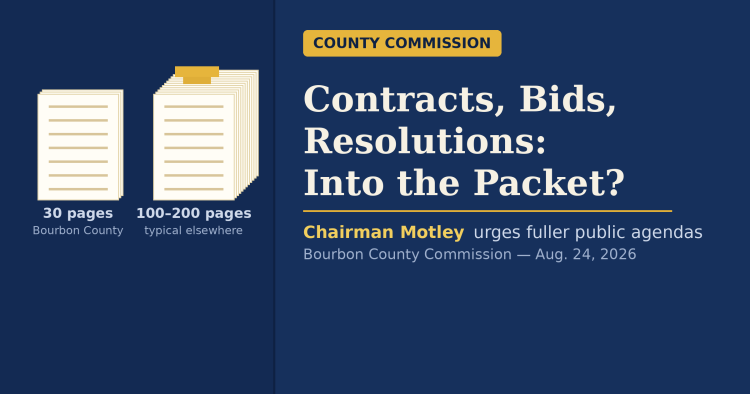
Bourbon County’s agenda packet should carry the documents the commission votes on, Chairman Gregg Motley told fellow commissioners at the end of Monday’s meeting — contracts, bids and resolutions included, so both commissioners and the public can read them before decisions are made.
“Our agenda was, with accounts payable, about 30 pages,” Motley said, describing his review of other local governments’ agendas. “In most cities and counties, their agenda is about 100 to 200 pages, because all these kinds of documents that we have laying around are on the agenda so that the public can see it, along with commissioners, in advance of meetings.” (video, 71:45)
He pointed to the five road-work bids Public Works had handed across the table earlier that evening as the kind of document that “could have been on the agenda and in the packet so that we could see those in advance.”
Motley also connected the thin packet to the county’s open-records workload. Stronghold, the county’s IT contractor, services numerous cities and counties, he said, and “we have more KORA requests than all other cities and counties in their jurisdiction combined. And some of that is that documents like this, people have to KORA instead of just seeing it in the agenda.”
His ask: “I’m going to suggest that we send documents to the clerk so that they can be included on the agenda packet… contracts, resolutions, bids, anything that we can get in the agenda packet. I think it’s going to be helpful to us and the public.” No motion was made; the suggestion drew no objection.
Commissioner David Beerbower answered that the requirement, at least in part, already exists: “The resolution we did on meetings said… you shouldn’t put anything on the agenda that … you’re not prepared to provide the supporting documents” — unless, he added, an item is “pure discussion” with no documents to attach. (video, 73:23)
A rule with a year of history
Beerbower is right that the books already say something. The commission has been circling this exact problem since last fall.
September 8, 2025. Then-chairman Beerbower first proposed meeting-procedure reforms, including that “all items on the agenda … supporting documents should be provided to the clerk prior to the deadline date.” (video, Sept. 8, 7:20)
October 14, 2025. Beerbower brought a drafted “Rules of Procedure” resolution requiring agenda requests “to include supporting documents” be submitted to the county clerk before a deadline. Commissioner Samuel Tran’s question then still hangs over the discussion: “How hard are you going to adhere to this? Because quite frankly, that has not been adhered to since I’ve been” on the board. (video, Oct. 14, 1:50:55) The same night, the board debated what counts as a supporting document, and the clerk noted an agenda-request form exists but “the only one that really ever uses it is the sheriff.”
October 20, 2025. The board adopted the resolution 2–1 (Beerbower and Tran yes, Mika Milburn-Kee no), amending the deadline on the floor to noon Friday before a regular meeting. (video, Oct. 20, 2:57:40) The text, as drafted, is on page 145 of that meeting’s own agenda packet: any county department, elected official or commissioner may submit agenda items, and “such requests, to include supporting documents, must be submitted to the County Clerk’s office” by the deadline, with the chair able to add emergency items. That packet, at 156 pages, drew Tran’s praise the same night: “For 90% of your package, it was spot on… I just want to give you props.” (video, 2:49:16)
Since then. The rule has proven easier to adopt than to live by. In December, Tran went looking for documentation on a benefits item — “if you’re going to bring something to the table, you’ve got to have some supporting documentation” — and Beerbower conceded compliance had been “kind of iffy.” (video, Dec. 15, 4:52) In February, Motley himself named the failure mode — “what’s problematic is when a resolution hits the table that we never read” (video, Feb. 19, 2:28:54) and Commissioner Joe Allen noted the City of Fort Scott had just adopted a stricter version: a resolution nobody has seen in advance is tabled to the next meeting except in emergencies. (video, 2:29:17) Tran shared his view Monday’s proposal: nothing in the county’s rule requires the documents be available to the public. Though it wasn’t clear if he was suggesting a different packet could be sent to the commissioners separate from the public published agenda. (video, 2:30:56)
The dynamic predates the resolution. In May 2025, when a landfill restructuring proposal arrived with no numbers attached, then-commissioner Brandon Whisenhunt declined to second it — according to the minutes, saying that had he known the topic was coming he “would have brought his numbers in,” and asking not to be surprised “like this with discussions.” The motion died. (video, May 5, 2025, 1:47:33)
The existing resolution talks about what reaches the commissioners: documents go to the clerk so the board is prepared while including those documents in the public agenda is generally how that is given to the commissioners and the public, Tran seemed to suggest the information could be provided ahead of time for the commissioners in way that wasn’t public. Motley’s suggestion was to follow the existing resolution and also include all the information in what the public sees, making the published packet posted with the agenda so people have access without requiring a KORA request to view it.