
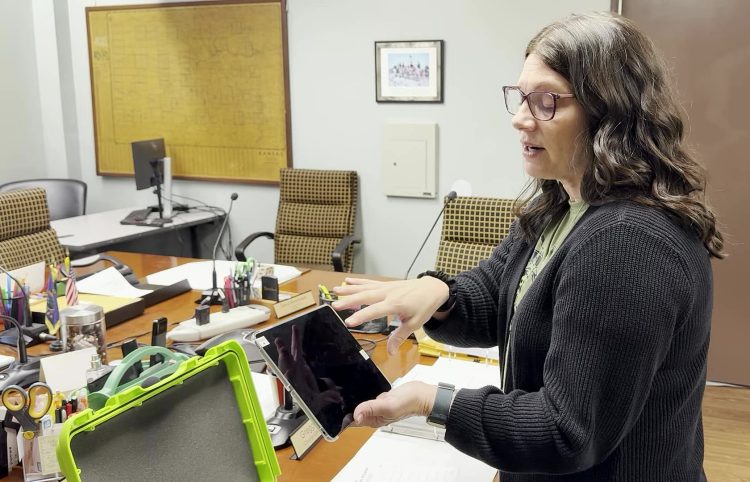
The County Clerk and Election Officer Susan Walker and Deputy Clerk Amber Page walked FortScott.biz through the election process showing the procedures their office uses to take in, track, and reconcile every ballot cast in a Bourbon County election.
This article shows the order that an election unfolds, starting with building the ballot weeks before Election Day and ending with the canvass after Election Day.
Important Terms:
KNOWiNK Poll Pad: The electronic tablet voters sign in on at the polling place. KNOWiNK is the vendor; Poll Pad is the device.
ePolls: The Clerk’s office shorthand for the electronic pollbook export from the Poll Pads. The data feeds into ELVIS after the election.
ELVIS: Election Voter Information System. The Kansas Secretary of State’s statewide voter registration and credit system.
Clear Ballot: The scanner system voters insert marked ballots into at the polling place.
ClearDesign: Clear Ballot’s ballot-design software. Used by the Clerk’s office to build each election’s ballot manually, race by race and precinct by precinct.
UOCAVA: Uniformed and Overseas Citizens Absentee Voting Act. Federal law governing absentee ballots for military and overseas voters.
Manual pollbook: Paper backup pollbook used when Poll Pads fail. Voters sign by hand and are credited in ELVIS afterward.
Provisional ballot: A ballot cast under questioned circumstances (e.g., wrong polling place). Whether it counts is decided later, at the canvass.
Chain-of-custody sheet: Daily log signed by both Walker and Page when retrieving and validating mail-in advance ballots from the office mailbox.
Canvass / Board of Canvassers: Post-election review by the Board of Canvassers (typically the county commissioners) that decides which provisional ballots count and finalizes results.
Supervising judge: The election worker overseeing a specific polling place on Election Day. They serve once a year.
Precinct part: A sub-unit of a precinct that votes on slightly different combinations of races, created by redistricting.
1. Building the ballot
Designing a Bourbon County ballot is a weeks-long process, handled primarily by Page. She uses Clear Ballot’s design software, called ClearDesign. Every piece of information has to be typed in manually: the name of the election, the date, every race, every district, every precinct, which races appear on each precinct’s ballot, which voter groups can vote on each race, and which polling places each precinct’s ballot is available at.
Primary elections add another layer. Every contest has to be mapped to the parties that will appear in it, and every candidate has to be linked to the correct party, so they show up on the right party’s ballot.
Recent redistricting in Bourbon County added significantly to that complexity by creating more precincts and what Page called “precinct parts.” These are sub-units that vote on slightly different combinations of races. The Clerk’s office relies heavily on the district map to determine which precinct or precinct split a given voter belongs to.
Walker said that last year, after an issue discovered with the early voting ballots forced Page to rebuild an entire election configuration, work that would normally have taken several weeks, in hours to have them ready in time for voting day.
The Clerk’s office uses multiple internal and external reviewers to look at the ballot before it goes live, including people outside the office checking for spelling and other errors. Walker said the goal is to keep iterating on the process, “we keep trying to do everything better. We keep doing new processes to make it simpler.”
2. Preparing ballots for the polls
Once the ballot is finalized and printed, every ballot the Clerk’s office sends to a polling place is sealed with a numbered seal. The supervising judge at each polling place is required to keep those seals and return them. If a seal has to be broken, a new seal goes on and is logged. All seals are audited against the equipment they were applied to.
The Clerk’s office also manually counts every ballot before sending it out. On the morning of Election Day, the polling-place staff recount what was delivered and validate the count with the Clerk’s office. At the end of the day, the polling-place staff recount the unused ballots before sending everything back.
3. Voter check-in at the polling place
When a voter walks in to vote, they sign in on a Poll Pad — an electronic check-in tablet running software from a company called KNOWiNK on an iPad. The Poll Pad captures the voter’s signature and identifying information.
If the Poll Pad system goes down, there is a paper backup with the manual pollbook. Voters sign the manual pollbook, and the Clerk’s office later enters those records into the state voter system by hand. Walker described one recent example: on the first day of early voting before the November 2025 election, the Poll Pads malfunctioned, and 29 voters signed the manual pollbook. All 29 were later manually credited with voting in the state system.
If a voter shows up at the wrong polling place, they sign a separate provisional pollbook and fill out additional provisional paperwork. Whether that ballot ends up counting is decided later, at the canvass described below.
4. Mail-in and advance ballots
Some voters cast their ballots by mail rather than in person. Mail-in advance ballots are checked every single day during the advance-voting window. Walker and Page personally retrieve ballots from the mailbox together, count and validate them, log them on a chain-of-custody sheet, and both sign off. The log records how many ballots came in that day but not the voters’ names.
The office tracks who was mailed an advance ballot and who has returned it. If something is wrong — for example, a voter and their spouse have signed each other’s envelopes — the office returns the ballot for correction. Some ballots come back from the post office because of bad addresses. Those, too, are handled manually.
Kansas recently changed the law on advance-ballot returns. Previously, ballots could arrive up to three days after Election Day and still count. Under the new rule, advance ballots must be in by 7 p.m. on Election Day to count. Walker noted the new deadline is currently the subject of litigation, but the Kansas Secretary of State has directed county election officials to plan as though the 7 p.m. deadline is final.
Military voters and overseas voters are tracked separately under federal UOCAVA (Uniformed and Overseas Citizens Absentee Voting Act) rules. Walker said Bourbon County typically sees about two UOCAVA ballots a year.
5. Casting the ballot: the scanner
When a voter inserts a filled out ballot into the voting machine at the polling place, they’re using a system called Clear Ballot. At the end of the day, the Clear Ballot machine produces a report listing how many ballots passed through it.
Occasionally there are anomalies. Walker described one example: a voter who was issued a provisional ballot can sometimes tear the ballot off and run it through the regular scanner instead of returning it to the supervising judge. Those anomalies are noted at the end of the day.
6. Reconciling the count
After Election Day, the Clerk’s office reconciles every election against three independent systems:
- The Poll Pad / ePolls export — the electronic check-in log that captures every voter who signed in on a Poll Pad and, after the election, gets imported into the state’s voter system.
- ELVIS — short for Election Voter Information System, the Kansas Secretary of State’s statewide voter registration and credit system. ELVIS receives both the automatic Poll Pad import and any manual entries (provisional ballots, manual pollbook entries, etc.).
- Clear Ballot — the scanner-side count of ballots that physically went through the machines on Election Day.
Walker said all three numbers are expected to tie out. If they don’t, the office investigates. In her experience, when the numbers don’t match, the discrepancy is almost always in advance ballots or provisionals — what she called “the most room for human error.”
As a concrete example, in last year’s election the office processed 36 provisional ballots, of which 12 didn’t count, and 13 advance ballots.
7. The canvass
After the initial reconciliation, a Board of Canvassers — typically the county commissioners themselves, though they can appoint someone else to do it on their behalf, which Walker said has happened on many occasions — meets to go through every provisional ballot and decide which ones count.
Provisional ballots are evaluated against specific statutory standards. Ahead of the canvass, Page goes through each provisional and identifies which statute applies and whether the ballot likely qualifies, in order to speed up the commissioners’ review. The commissioners make the final call. Once the canvass is complete, the results are entered into ELVIS.
Voters interested in verify their own voting history can go to the Kansas Secretary of State website and enter their name and birthdate. That lookup queries ELVIS.
Walker described cases of voters who had voted but couldn’t find a record on the state site. The cause was usually a name-entry error from years earlier — for example, an entry that placed a voter’s first name into the middle-name field, so the lookup didn’t return a match. The Clerk’s office can fix those records once notified. Walker said voters who can’t find their record on the state site should call the office. (620-223-3800 ext. 100)
Each polling place is overseen by a supervising judge — election workers who are on duty only once a year. Walker said training has historically been short for that reason. The Clerk’s office is planning longer training this year to walk supervising judges through specific responsibilities and procedures.
The Clerk’s office was recently awarded an $8,500 election-security grant from the state.
Walker said the office plans to use the grant to:
- Buy five carts to securely hold ballots in transit. Currently, supervising judges — many of whom are elderly volunteers — have to move ballots to the polling places the night before Election Day. With the carts, ballots can stay sealed in the carts and be delivered for them.
- Add additional security cameras. Walker mentioned that the office had previously had a camera missing from the election room; the grant will pay to address that as well.
Walker said the grant had been approved just the week before the May 22 walkthrough.
This article is based on a May 22, 2026 demonstration at the Bourbon County Courthouse. The videos of the walk through of the process are shown below.

—–
